
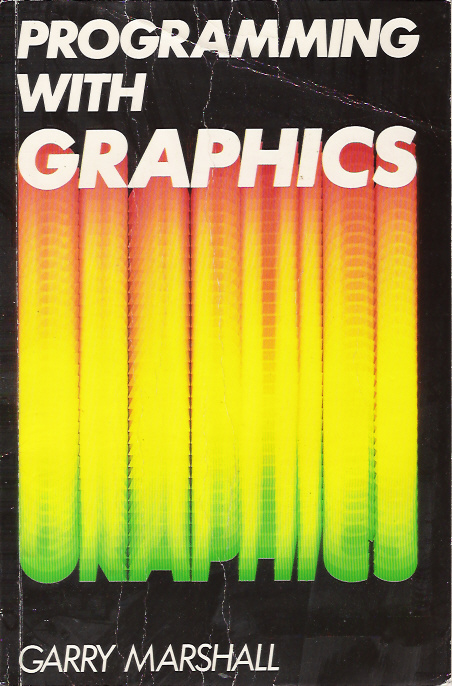
Programming with Graphics
Book: Paperback · English
Granada Publishing · 1983 · Pound sterling 5.95 · 120 pages · ISBN 0-246-12021-5
MIA Missing in action. This is known to have existed, and no copy has ever been found. If you own one, the archives would like to hear from you.
Discussion
Nobody has started a thread about this yet.
Files and rights
No permission is on record either way. Screens and pictures are copied here on a take-down basis: if you hold the rights and want something removed, say so and it goes.
Credits
- Garry Marshallcredited
Sign in to credit somebody, or say what these people did.
In the magazines 3
ZX Computing #16Dec 1984 · p.150
Patrick Cain
"For my money the graphics capability of a microcomputer is usually its most attractive feature" - Garry Marshall. I would put my money with Mr Marshall as far as the most attractive feature of a microcomputer goes. Most people - I would guess - are attracted to home computing by the graphics potential. It would follow that a book dedicated to graphics programming is likely to be of interest to many, perhaps too many for the text is not specific to any one machine: strange, given that "there is almost total lack of standardisation in the way that graphics facilities are provided by microcomputers". Is then the "great advantage over most books on this subject of being machine independent" an advantage more to Mr. Marshall than the reader? A strange contradiction; but stop being an old cynic, Cain, get inside further and see what the book's about. Chapters 1 and 2 introduce and explain how the three graphic display types - block, pixel and line graphics - are produced and what their requirements on the computer system are. Three chapters are dedicated to each type of display give a general, but easily understood, account of resolution, movement, shapes, magnification and reduction, lines, curves, squares and 3D graphics. A sixth chapter deals further with the subject of 3D, turtle graphics and speaks on the requirements for a graphics package. I found the read through the 100 or so pages informative and enjoyable and a lot of light was shed on things I had never before really questioned. The text was clearly written and should offer little problem to the reader. Each chapter was concluded by a summary. The author has been aware of the mathematical nature of the subject and has made allowances so that seldom is a familiarity with maths beyond school level necessary. Unfortunately, in spite of an appendix that lists the graphics facilities present on most popular home micros, I still feel that potential readers might best be served by a book aimed at their own machine. "Programming With Graphics" is published by Granada, written by Garry Marshall and costs £5.95.
Sinclair User #14May 1983 · p.89
John Gilbert
TALKING IN LANGUAGES THE COMPUTER UNDERSTANDS John Gilbert reviews the latest books on machine code. Many Sinclair owners are turning their attention to machine code and trying to program either in direct Z-80 low-level code or in assembly language. Publishers have also entered that area of the market and several good books have been produced. Melbourne House has two new books which cover machine code and related subjects more than adequately. The first is by Dr Ian Logan, author of several books and pamphlets on the ZX-81 ROM. Understanding Your Spectrum covers both Basic and machine code programming. Its aims are to show how the Spectrum works, to teach Z-80 machine code, and to give the reader an understanding of the ROM operating system in the machine. Logan does all those things in a very expert manner which even the beginner should understand. The other book from Melbourne House is Spectrum Machine Language For The Absolute Beginner. It is even easier to understand than Logan's. It starts from a very simple base and takes the reader through most of the Z-80 instruction set as implemented on the Spectrum. The theory is supported by practical examples which can be entered and run by anyone. The book is completed by taking the reader from conception to the completion of an arcade game, Frogger, written all in machine code. Both books are excellent in content but a little over-priced. Understanding Your Spectrum costs £7.95 and Spectrum Machine Language For The Absolute Beginner £6.95. If you are thinking of programming in machine code, the books will teach you almost everything you want to know. A good alternative is introducing Spectrum Machine Code by Ian Sinclair. It provides an easy introduction to machine code but does not offer so much in terms of content as the Melbourne House issues. Sinclair begins by introducing the reader to ROM and RAM. He shows how both those systems are used to give the user an easy way of programming. He then provides a long discussion of Z-80 programming. The book is sprinkled adequately with examples and many of the machine code routines explained are put into Basic listings in the form of DATA, to allow the user to enter them quickly. Introducing Spectrum Machine Code, from Granada Publishing, costs £7.95. The range of books not aimed at a particular computer is growing. Several will prove useful to Sinclair owners. Some Useful Basic Subroutines again is written by Ian Sinclair. He uses MicroSoft-type Basic and some of the routines will need re-writing to work on Sinclair machines. The book would be of great value to ZX-81 users, as it includes Basic routines for flashing, scrolling and centering titles, underlining titles and sorting data. From Newnes Microcomputer Books, it is good value at £4.95. Get More From Your Personal Computer is another title from Newnes. The author is Ian Hickman. It deals with the development of the computer, explains Basic programming and then the principles behind number systems, logic diagrams and, finally, machine code. It works well as a general guide to the principles of computing and the way in which humans and computers interact. It costs £5.95. Another general book of interest to Sinclair users is Programming With Graphics by Garry Marshall. It takes the reader through the various types of graphics on computer systems - block, pixel and high resolution. There are also chapters dealing with the production of graphic displays, three-dimensional representation and animation. For those wishing to produce arcade games or who want to demonstrate physics experiments on the screen, the book is ideal. If you want to know how those images on TRON were created, but at a much simpler level, you will get some idea from the book. It is available from Granada and costs £5.95. The Youngs Computer Register for the ZX-80 and ZX-81 has just been republished. It now contains an extra supplement with invaluable information on the Sinclair market. The guide lists the names and addresses of most software and hardware companies and also provides information on products. As with the previous issue, the register is split into sections for easy reference. Together with the supplement, it can be obtained from Youngs Computer Publications for £3.95. The supplement is also available separately for £2. The quality of books both in content and packaging is improving as the market expands. Computer books are now finding their way from the technical to the general sections of bookshops. That is a good move, as it will make more people aware of the computer market. Melbourne House (Publishers) Ltd, [redacted]. Granada Publishing, [redacted]. Newnes Microcomputer Books, [redacted]. Youngs Computer Register, [redacted].
Personal Computer News #3Apr 1983 · p.33
Ralph Bancroft
'Programming with Graphics' by Garry Marshall, published by Granada at £5.95 (papertback, 120 pages) If you enjoy programming the chances are that at some stage you will want to try your hand at graphics. Garry Marshall's book would be a useful starting point. Avoiding complex mathematics, he steers the reader through the pitfalls and advantages of the different forms of graphics available on micros. The book, unlike many on this subject, is machine independent. This may cause confusion at first as the Basic syntax used could be different from that on your machine. However, the approach has its merits as it enables a full description to be given of block, pixel and line graphics in a clear and concise way. Anyone thinking of buying a micro will find the appendix particularly helpful as it describes the features of the leading machines and their graphics capabilities. The book really comes into its own with its discussion on how to draw lines, curves and shapes. The text is illustrated with examples and strengthened by the inclusion of Basic sub-routines, which will make graphics programming easier. Some micro users will find the treatment of advanced subjects like three-dimensional graphics and animation somewhat cursory. They should not be too surprised as the book has no pretensions to being anything other than an introductory text.
Reviews from people here
Sign in to write about this, or make an account. It takes a minute and lets you correct the catalogue too.
No description recorded.
Sign in to correct or add to this.
Hold the rights to this and want it taken down?