
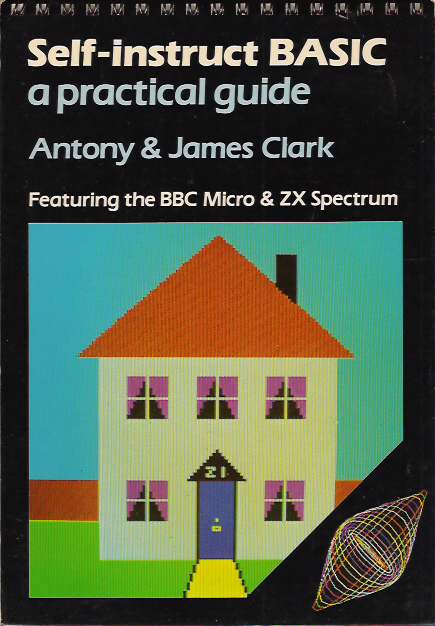
Self-Instruct BASIC: A Practical Guide
Book: Spiral bound · English
Pitman Publishing Ltd · 1983 · Pound sterling 4.50 · 118 pages · ISBN 0-273-02020-X
MIA Missing in action. This is known to have existed, and no copy has ever been found. If you own one, the archives would like to hear from you.
Discussion
Nobody has started a thread about this yet.
Files and rights
No permission is on record either way. Screens and pictures are copied here on a take-down basis: if you hold the rights and want something removed, say so and it goes.
Credits
- Antony Clarkcredited
- James Clarkcredited
Sign in to credit somebody, or say what these people did.
In the magazines 3
ZX Computing #12Apr 1984 · p.141
Patrick Cain
PATRICK CAIN ONCE MORE PUTS ON HIS THINKING CAP, STOKES THE LOG FIRE AND SETTLES DOWN WITH THREE NEW BOOKS. SELF INSTRUCT BASIC - A PRACTICAL GUIDE Antony and James Clark It's said that first impressions go a long way: my first impression of this book certainly didn't take it any further than the floor. As I opened the cover I thought 'Self Destruct Basic' might have been more appropriate! For some reason the publishers, Pitman, have bound this volume in a fashion similar to a secretary's shorthand pad. Opening it for a second time, with a bit more care, I began to form second impressions of the novel binding and the contents. Once mastered, the cover proved to be a great success. This book, by father and son authors Antony and James Clark, is intended to be a step by step guide to beginners on both the ZX Spectrum and the BBC Micro Computer, and as a teaching aid the cover folds into a readily accessible support for the inner texts. Having many times in the past all but lost concentration trying to type a listing into the computer while being continually frustrated by losing my place on the page, I found this simple and effective solution most convenient. But let's not judge a book by the cover alone, what of the text that is so adequately supported? The book is aimed at beginners and assumes little more than that the reader has successfully set up the computer and glanced over the manual. I should dispute, however, that it is suitable for users as young as nine years, if for no other reason than that they at such an age are likely to lose interest very quickly in such a factual treatment of the problem. Readers who can sustain interest are intended, on completion, to be familiar with a full range of programming instructions and to be aware of their usefulness. The topics covered are strings, string arrays, input and assignment statements randomize, FOR.... NEXT loops, screen formatting and all commands necessary for their implementation. Also included are examples and hints on program writing and programming style. New users will find that there is no shortage of books with similar material, so other than the novel binding, what have Messrs. Clark included to make their book worthy of any note? The strength of 'Self Instruct Basic' is not the content, which is no more than might be expected in an elementary book, but the method of presentation. From what I can remember of the hours I have spent close to sleep at the back of a lecture hall as a student teacher, the technique has much merit. In each section there is an introduction to the topic, an example of its use and a short discussion to highlight and reinforce the principle. Further, there are suggestions for putting the newly discovered technique to use and questions to ensure that the theory has been properly learned. In the main though, this is a book to be used when sitting in front of the computer. Any computer user worth his 'chips' knows that hands on experience is the only way to develop skill - this book is intended to be used as a companion and guide while gaining that experience. It is a well structured course in basic programming and should be followed, as suggested, in the order laid out. To gain all the book has to offer the reader should be prepared to be a good student following that course and investigating the projects suggested. All that it has to offer is a good grounding in BASIC for both Spectrum and BBC users but that is no small task. On first impressions 'Self Instruct Basic' may seem flimsy; but as a guide to new users it has my 'backing'. 'Self Instruct Basic a Practical Guide' is written by Antony and James Clark, published by Pitman and costs £4.95. ISBN 0 273 02020X.
Personal Computer News #45Jan 1984 · p.389
Geof Wheelwight
Since much of the material written about the BBC Micro is relevant to the Electron, BBC books not yet converted for the Electron can still be useful to Electron users. Self-instruct Basic: a practical guide, is a Pitman book from the father and son writing team of Anthony and James Clark; it contains programs for the BBC Micro and the Sinclair Spectrum - and a number of the BBC programs and explanations would apply just as well to the Electron as the BBC. The book comes in a 'flip-over' ring binder so it can be easily stood up while you're working, it is published by Pitman at £4.50.
Personal Computer News #37Nov 1983 · p.69
Igor Thomas
'Self-Instruct Basic (A Practical Guide)' by Antony and James Clark, published by Pitman Publishing Ltd at £4.50 (paperback, 125 pages). There are many ways to learn computer programming, and there are many more ways to teach it. In the face of this slightly foreboding situation, Messrs Clark and Clark (senior and junior) have produced an interesting approach. Very similar to other schools titles from the same publishers, 'Self-Instruct Basic' is written expressly for you to 'try it and see what happens' rather than just blindly copy the examples. This includes making deliberate mistakes as part of the education of your grey matter. Use of this style relies on actually having your computer in front of you, and learning more from the computer than from the text itself. The first half of the book quickly covers the most often-used words in the Basic vocabulary, and includes references to both the Spectrum and BBC microcomputers. In the latter part of the book comes the ideas and Exercises section. This is where you can get lost for six months, trying out all the experiments, and generally building a Charles Atlas brain. Over 200 ideas for programs are given, including word processing, statistical analysis, graphics, and games. With only a few exceptions, these programs are offered as learning exercises, not as full programs. However, each idea is referenced to the preceding chapters, so you should be able to answer all your own questions. Since the book is here to help you learn about Basic, very little time is spent on lesser things like using cassettes and disks, structured programming, and how microcomputers work. Self-instruction may not be a guaranteed way to learn, but this book makes a thorough job of it, and £4.50 is a small price to pay if it works.
Reviews from people here
Sign in to write about this, or make an account. It takes a minute and lets you correct the catalogue too.
No description recorded.
Sign in to correct or add to this.
Hold the rights to this and want it taken down?