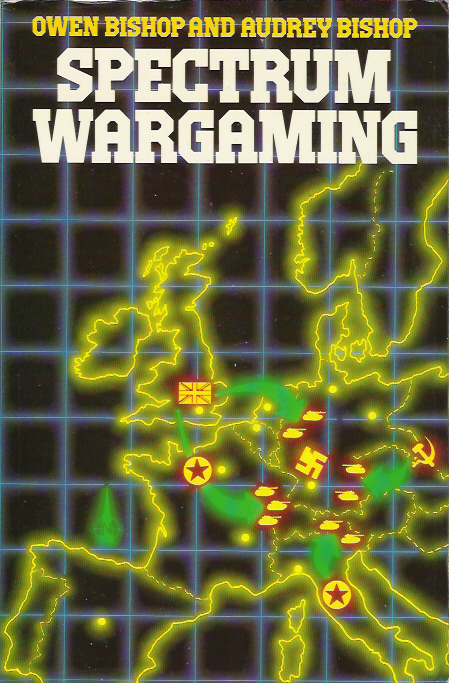
Spectrum Wargaming
Book: Paperback · English
Collins Educational Ltd · 1985 · Pound sterling 9.95 · 256 pages · ISBN 0-00-383147-7
Discussion
Nobody has started a thread about this yet.
Documents
- SpectrumWargaming.pdfComplete book English
Files and rights
No permission is on record either way. Screens and pictures are copied here on a take-down basis: if you hold the rights and want something removed, say so and it goes.
Credits
- Owen Bishopcredited
- Audrey Bishopcredited
Sign in to credit somebody, or say what these people did.
In the magazines 2
ZX Computing #22Dec 1985 · p.74
David Harwood
HARWOOD'S HYPOTHESIS This month we have only four books appearing on this page. This could be due to the fact that publishers aren't letting us reviewers get our hands on the books and then beating them into pulp, or more likely it is because the computer book market is starting to falter. Will it eventually collapse? The problem lies at the hands of two parties. The publishing industry and the computer owner. The former because they knew too early what a good thing was and rushed out and produced books to do this and that on all types of computer, completely flooding the market, which then slackens as everyone who wants one. has got one. Another reason for the fall in the market is that all readers who wanted a book with lists of arcade games have by now got them. Then to produce a book on the Spectrum with lists of games after games is just pointless. Who would buy a new book when there have been thousands on the market for ages already? That is why generally the books this month are starting to move away from the idea that people just want to program their machine to play space invaders. SPECTRUM WARGAMING Collins £9.95 The first book of the four is called Spectrum Wargaming, by Owen and Audrey Bishop and is published by Collins. Wargames concentrate on tactics and the disposal and control of forces. Wargaming can be played either on a board, as in the usual board games, or more often a table, with models representing houses, soldiers, guns etc. You can achieve a high level of realism and accuracy in setting up the wargaming table, and this I am told, is half the fun of wargaming to its dedicated followers. With a computer, it is possible, if you are not interested that much in converting the dining room into a battle field, to play the complete war game on the TV screen, although this method does lack the realism that most wargamers enjoy. The book explains the principles of wargaming, from the setting of the scene, to the complex rules system. The book initially introduces wargaming, and then delves into the 'computer wargame', with a number of wargames listings. It is possible, using the book to get the wargames up and running without any prior knowledge of computing. Four wargames are included in the book, so without any delay, apart from the laborious keying in, you can turn your Spectrum immediately into a war machine. If you want a little bit more than just to play a war game, then this book is definitely for you. The authors have written routines that allow wargames to be tailor made, depending on the data that is entered for the game. Basically, the wargame program is very short, and is used as the controller of all the computer data. This data is the bulk of the game. The wargame is moulded together by using various utilities, ie TABLEMAKER, ARMYMAKER and MAPMAKER. These utilities set up all the necessary wargaming data. The TABLEMAKER utility is used to set up the CRT's (not Cathode Ray Tubes but Combat Resolution tables), which are basically the standard rules of the game, eg number of turns per side, weapon usage, etc. ARMYMAKER is used to detail information about each side and MAPMAKER to describe the terrain in all areas of the battlefield. All these details amount to a vast amount of data, and because of this, the information is directly compressed into the bytes of the RAM instead of using BASIC variables. Variables take up on average 6 bytes, where we need use only one or less, by directly accessing the RAM. DATASTORER is used to compress all the data entered from the various utilities into the RAM, so it is easily accessed by a wargaming controller module. The remainder of the book consists of the wargames. The first game is used only for example and does not make use of the ARMYMAKER utility, but only the TABLEMAKER. This is to give the reader a feel for wargaming, before jumping into it straight away. After doing this, the reader may enter the fully computerised version of the same battle, including maps of the terrain and German and French armies fighting against each other. The other games included are a Napoleonic Campaign, a medieval battle and a conflict in outer space. The authors have taken great lengths so that this book is adaptable to all aspects of wargaming, as well as using the full potential Of the computer. Wargaming can be played bet ween two Spectrums on an Interface connection, and details on how to achieve this are included. The book is an excellent opener for anyone who wants to get into wargaming or even for the experienced 'manual' wargamer. The book is well written and takes the reader carefully through each section, so that by the end of the book, he or she will be writing their own war games, or at least adapting the ones in the book. A very intelligent book, well thought out and enough to keep anyone occupied over the winter months. Any wargame has the capability to be programmed, and this book provides you with the information you need. At £9.95 you may feel it is a bit expensive, but for the information inside, I would rather have this book than two games tapes any day.
Your Spectrum #19Oct 1985 · p.13
Ian Beardsmore
By Owen Bishop and Audrey Bishop Collins £9.95 Calling all Spectrum warmongers. Now's your chance to plan and execute all those triumphant campaigns and strategies without suffering the tedium of third-rate wargames software. Owen and Audrey Bishop have come up with a book that offers enough wargaming and programming ammunition to help you on your way to winning the battle. In true wargaming style, this book of tactics has two 'sides' - or rather, two approaches to the problem. Firstly, there's the direct method - just type in the complete games you're offered and off you go. And though they're certainly pretty good using them means that you'll miss out on an excellent lesson in software design. The second path is purely for programmers and it's immensely flexible. A good wargamer will make great demands on the average wargames program and if you're going to meet those demands you'll just have to start programming yourself, simple as that. Although this is specifically a wargames book you can adapt the tables for other simulations. You can play games from 1066 right into the future with single men or battalions. Here you'll find explanations for almost everything from morale to hidden movement. In fact, the only major omission I could turn up was Zones of Control - the area around a unit - and even this problem is partially solved by the routine Proximity that'll detect nearby units. You'll find five games and five utilities listed. Each game has two parts - game mechanics and game data. The great flexibility comes from the way you can create or adapt large amounts of data using the utilities. You're given, for example, a Tablemaker, an Armymaker and a Mapmaker all of which speak for themselves. A fourth utility called Datastorer assembles all the files you've created and places them in a single file for use by the game mechanics. These mechanics are little more than a collection of subroutines, with each game adding new elements, when the Napoleonic campaign is reached, there are twenty two sub-routines, data, and just nine other lines. At every stage documentation is excellent, explaining computing to wargamers and wargaming to programmers. In effect, the book supplies a set of building blocks which can be used off the shelf or customised. In one sense the book has little to do with wargames or even the Spectrum for that matter! Instead we are introduced to a set of program modules, all of which are inter-compatible. and easily accessible. In this case good programming design happens to have been applied to wargaming on the Spectrum, and very successfully at that. Computer users may well find that wargaming seems accessible in this form as all the tedium of table writing has gone - and wargamers will probably learn more about program structure than they ever knew before. For programmers and wargamers alike, this book offers sound tactics, and you'll find that your investment in terms of both time and money will transform you into a victorious wargamer. Battle on chaps!
Reviews from people here
Sign in to write about this, or make an account. It takes a minute and lets you correct the catalogue too.
No description recorded.
Sign in to correct or add to this.
Hold the rights to this and want it taken down?