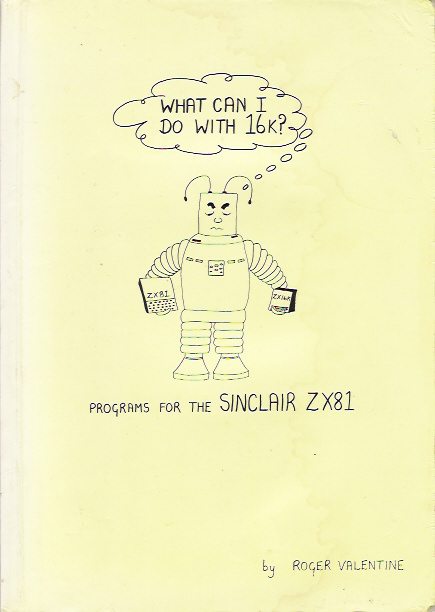
What Can I Do with 16K?
Book: Paperback · English
V&H Computer Services · 1982 · Pound sterling 4.95 · ISBN 0-471-88730-7
MIA Missing in action. This is known to have existed, and no copy has ever been found. If you own one, the archives would like to hear from you.
Discussion
Nobody has started a thread about this yet.
Files and rights
No permission is on record either way. Screens and pictures are copied here on a take-down basis: if you hold the rights and want something removed, say so and it goes.
Credits
- Roger Valentinecredited
Sign in to credit somebody, or say what these people did.
In the magazines 1
ZX Computing #4Dec 1982 · p.56
SPECTRUM RULES THE WAVES Every publisher in the UK seems to have discovered the Spectrum, so there is sure to be a bumper crop of reading matter for Spectrum owners in the coming months. Our review panel have been looking at a selection of the Spectrum books and finds that the standard is uniformly high (both in terms of content and presentation), with each book representing value for money in its own way. This is the Follow-up to 'What can I do with 1K?' by the same author. Whereas that book's task was to tell you how you can achieve something worthwhile with only 1K of RAM, this book has the job of instructing us in how to get the most from the 16K we now have access to. The entire book is in dot matrix print-out - probably with a CP80 or CP100, because there are no descenders. Nonetheless the text was clear and readable. The book shares much in common with the first half of Stewart and Jone's book, for it too aims to teach better programming techniques. The book starts off with a program that may not be for everyone (a tarot card simulation), but is certainly an excellent program to learn the many techniques of structuring and memory conservation which Roger Valentine suggests. The rather more 'hands-on' approach of this book from it's beginning seems rather better than that of Stewart and Jones. That said I do not imagine the authors would be claiming to be teaching the same things. Other programs in this book make rather less explicit attempts to teach the reader any given fact about 'better programming', but rather give details as to how the program goes about its job. This is a pity, and perhaps Valentine might have given a tittle more discussion. CONFUSING The lack of discussion certainly becomes apparent in the Battleships program, for the reader is asked to key in some machine code with no introduction as to what machine code is. Examples like this may make this book rather confusing for those readers with relatively little experience. In summary, this book certainly shows you in a practical sense what you can do with 16K, but it may not be the best guide to how you can use 16K to best advantage. Nonetheless, many of the programs are excellent, and there are many useful hints for those who have programmed beyond Roger Valentine's What can I do with 1K? and books like it.
Reviews from people here
Sign in to write about this, or make an account. It takes a minute and lets you correct the catalogue too.
No description recorded.
Sign in to correct or add to this.
Hold the rights to this and want it taken down?