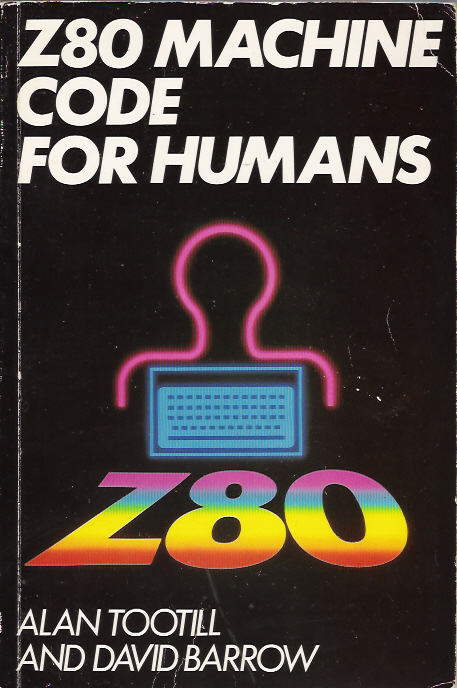
Z80 Machine Code for Humans
Book: Paperback · English
Granada Publishing · 1983 · Pound sterling 7.95 · 152 pages · ISBN 0-246-12031-2
MIA Missing in action. This is known to have existed, and no copy has ever been found. If you own one, the archives would like to hear from you.
Discussion
Nobody has started a thread about this yet.
Files and rights
No permission is on record either way. Screens and pictures are copied here on a take-down basis: if you hold the rights and want something removed, say so and it goes.
Credits
- Alan Tootillcredited
- David Barrowcredited
Sign in to credit somebody, or say what these people did.
In the magazines 2
Sinclair User #20Nov 1983 · p.131
John Gilbert
THERE ARE MOVES TOWARDS TECHNICAL END OF MARKET John Gilbert reviews a new development in publishing but discovers there is still a great deal of room for improvement. We forecast two months ago that books about computers would become more technical towards the end of the year. That has happened but a large gap is still left in that part of the market. Ian Sinclair's new book, Inside Your Computer, is an example. It provides a general introduction to what a computer is made of and how it functions but offers little new information, the author was accurate to describe it as being aimed at beginners, because it could not be recommended to anyone who has had a computer for more than six months and has read any computer magazines. Although it is a simplistic introduction there is little wrong with what it preaches. Sinclair has taken a diverse set of subjects and put some structure into them. The result is a clear definition of both the hardware and software of a machine. The author refers to specific machines several times but that is not often sufficient. The ZX-81 and Spectrum are dragged into the explanations twice but some of Sinclair's descriptions are difficult to understand because one cannot visualise the machine he is explaining. The book compensates for that deficiency to some degree, however, with photographs and diagrams. For a technical book for the beginner there are too few illustrations, although those which are included provide some degree of expansion and enlightenment on the text. On the whole the book is disappointing, because from the taster on the back and the picture on the front the reader could be led to expect more. It can be recommended to the complete beginner who has just bought a computer or to someone who has no computer but wishes to know how one works. The book is published by Granada Publishing and costs £4.95. First Steps With Your Spectrum, by Carolyn Hughes, is another book for beginners dealing only with software. It is published by Armada, a company which specialises in children's products and a first attempt at breaking into the computer field has worked. The book contains a satisfactory combination of text and illustrations. Unlike many other publications which bunch straight into an explanation of a computer language and how to use it, the author takes time to explain what a computer can do and why it would be useful. Written in a style anyone should understand the book would be equally useful to an adult who knows nothing about computers but wants to learn. The author has included several programs designed specially with beginners in mind. Some of them, such as the fruit machine, are predictable but others, such as Elephant, where you have to build an elephant, and Morse Mole, where you have to find a bleeping rodent, are brilliantly simple and perfect for beginners. Well worth recommending, it can be obtained from Armada Original Publishing and costs £1.25. Spectrum Adventures, by Tony Bridge and Roy Carnell, is a sight for sore eyes and it also fills a very important gap in the computer book market. It fulfills two functions. First it provides a guide to playing adventure games. It gives a general history of adventure gaming and provides details of some of the major adventure games available on the Spectrum, including The Hobbit and the adventures A, B, C and D from Artic Computing. That part of the book provides some good tips for the old and new adventurer alike, without revealing too much. The second function is to show how an adventure game is written. The example, The Eye of the Star Warrior, was written by Carnell, who also wrote the Black Crystal and, like its counterpart, it is a graphics adventure. The book provides a wealth of information for anyone interested in dungeons and dragons. Its authors have made the book interesting and exciting and have provided a complete text book for that aspect of software. It can be obtained from Sunshine Publications for £5.95. Just as esoteric but much more complicated is Z-80 Machine Code for Humans by Alan Tootill and David Barrow. The title is unfortunate as the book seems to be a regurgitation of others which follow the same lines. It provides concrete examples of what can be done when you and not the Basic operating system control the microprocessor. The unfortunate aspect is that it is difficult to tell whether it is a machine code trainer or if it is a book for programmers who know how to use the language but do not know what to do with it. There are several machine code routines in the book, including printing a string of text on the screen all the way up to drawing high-resolution lines. The book is not machine-specific but most of the routines should work on the Spectrum and some of them on the ZX-81. Any reader, however, should make some allowance for the fact that Sinclair machines use a Z-80A processor and not the Z-80. In most cases there is little difference but you should be careful to check. Granda Publishing, [redacted]. Armada By Fontana Books, [redacted]. Puffin Books, Penguin Books Ltd, [redacted]. Sunshine Publishing, [redacted].
Personal Computer News #34Nov 1983 · p.69
Wendy Pearson
Z80 Machine Code for Human: by Alan Toothill and David Barrow, published by Granada, price £.95 (paperback, 152 pages). This book prepares you for the worst by stressing, at the outset, the importance of exercising one's mind with hard mental effort. But true to its title, it succeeds in taking the nightmares out of machine code, progressing through explanations and exercises in orderly fashion. The authors explain how to control the speed of machine code and emphasise the usefulness of compilers. Interpreters and assemblers when writing your own applications, complete with advice and ideas. Even the chapter on arithmetic and conversion is clearly explained and encouraging in outlook. Particularly interesting, too, is a chapter labelled 'Relocatable Code', and there is much detail on graphics, giving the routines that form a graphics system. Pixel graphics are dealt with separately. Collected at the back of the book are various recommended ways of doing repetitive tasks which often trouble the machine code novice. Explanations of binary and hexadecimal number systems follows, as well as an enlightening comparison between Basic and machine code. And at the end of it all you feel spurred to action. Definitely an encouraging book.
Reviews from people here
Sign in to write about this, or make an account. It takes a minute and lets you correct the catalogue too.
No description recorded.
Sign in to correct or add to this.
Hold the rights to this and want it taken down?