
The ZX Spectrum: Your Personal Computer
Book: Paperback · English
Prentice-Hall International · 1983 · Pound sterling 5.95 · 224 pages · ISBN 0-13-985028-7
MIA Missing in action. This is known to have existed, and no copy has ever been found. If you own one, the archives would like to hear from you.
Also known as De ZX Spectrum - Uw Personal Computer (Dutch), Sinclair ZX Spectrum (German), ZX Spectrum Guida All'Impiego (Italian), ZX Spectrum: Votre Ordinateur Personnel (French)
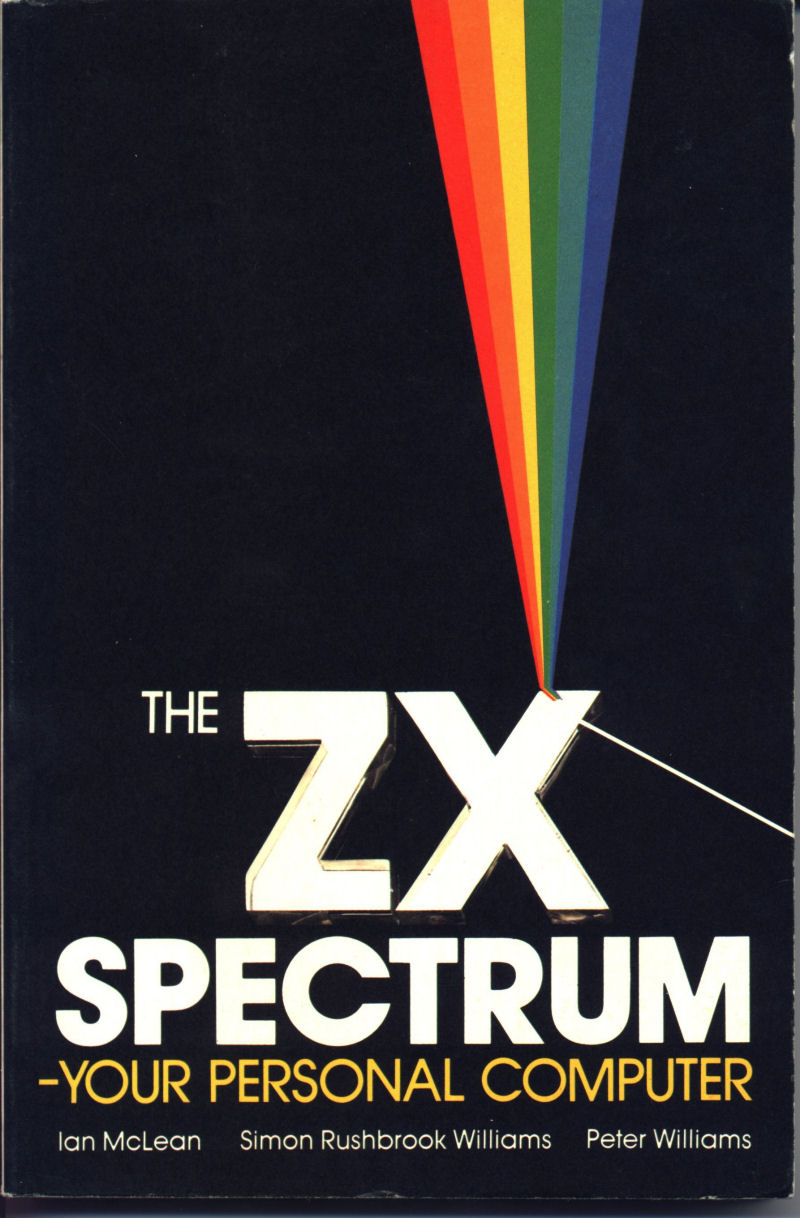
(CarlHanserVerlag).jpg)
(DeltaPress).jpg)
(Intereditions).jpg)
Discussion
Nobody has started a thread about this yet.
Releases
- 1983Prentice-Hall InternationalPound sterling 5.95
- 1983Delta Press Sold as De ZX Spectrum - Uw Personal Computer
- 1984Carl Hanser Verlag Sold as Sinclair ZX Spectrum
- 1984Intereditions Sold as ZX Spectrum: Votre Ordinateur PersonnelFrench franc 115.00
- 1985Tecniche Nuove Sold as ZX Spectrum Guida All'Impiego
Files and rights
No permission is on record either way. Screens and pictures are copied here on a take-down basis: if you hold the rights and want something removed, say so and it goes.
Credits
- Ian McLeancredited
- Simon Rushbrook Williamscredited
- Peter Williamscredited
Sign in to credit somebody, or say what these people did.
In the magazines 10
ZX Computing #9Oct 1983 · p.38
Patrick Cain
'The ZX Spectrum - Your Personal Computer' is a departure from the 'norm' of computer books, and one which fills an area so often ignored, that of the newcomer to computing. The authors Ian McLean, Simon Rushbrook Williams and Peter Williams, all members of the Micro Electronics Educational Development Centre, Paisley College, Scotland, have identified the difficulties that often beset the first time user. Personal computing is not the preserve of 'a special elite of geniuses' as many other books appear to assume and if you've all but gone blue in the face PEEKing and POKEing and getting nowhere then this may be the book you need. From pages one to 216, the text is lighthearted and entertaining. In eleven chapters it covers what the computer can do, how to use the keyboard, loading and saving programs through to files and data handling, and if you're unsure how the pieces which comprise a full unit are assembled or how to wire the plug it covers that too. Any learning process is always easier if it's enjoyable and while the scope of the book is not far reaching it is neither elementary - rather it assumes no previous knowledge and moves from this most elementary stage to clearly cover all that is necessary to write well written programs in a most enjoyable fashion. Before the software came the hardware and before any worthwhile software is written it is essential to have a good working knowledge of the bits and pieces. Chapters one to three look at how to get the apparatus up and working properly; saving to and loading from tape, verifying at each stage that what you wanted to do has been done; exploring the keyboard and what each button does - each step is discussed in a clear but uncomplicated way and accompanied by diagrams. At no point are you likely to get the feeling that tells you the next move is the one which will ruin your new investment. With new-found confidence, tackle chapter five, and see what the Sinclair ROM (by this time you'll know exactly what that is) has provided to enhance the programs you'll soon be writing. The graphic attributes BORDER, PAPER, iNK, etc, are all put through their paces. The PRINT statement is introduced and tested. But where the going gets heavy, schematic diagrams and flow charts accompany the text to illustrate what is being discussed. Again, as in the previous chapters, each point is detailed with examples to test the theory. Computer programs are a series of logical steps, but the trouble is that people tend not to be too logical. Chapter six, 'Making Decisions', deals with the language of the Spectrum. The BASIC commands are introduced (again the approach is a 'suck it and see' style) the sense of each command, or sets of commands, being borne out by the examples which are given. Building from what has gone before, the scope of each command is investigated, reinforcing and confirming the earlier theory, cross-referencing the manual and explaining clearly what the manual often assumes. Here, as throughout, the various sections open with a listing and definition of each of the language elements to be discussed and concludes with a summary of what has been covered. In chapter seven, 'Words and Numbers', a study of data manipulation statements, LEN, VAL, STR$, ABS, etc, discusses the finer points of Spectrum BASIC. Commands which might otherwise have gone unused through a lack of understanding, but ones that are none the less inherent in any accomplished program, are clarified with reasons for their use and helpful examples. With equal commitment to ease of understanding and clarity, the remaining chapters examine the sound and graphics capabilities on the Spectrum. Worthy of special note is chapter ten, 'Files and Data Handling'. This is perhaps a difficult area to grasp for anyone not familiar with the sizable amounts of data, but again the treatment is such that the complexities of the problem are greatly diminished. Throughout, the standard of 'The ZX Spectrum - Your Personal Computer' is high. A good foundation is an essential part of any advanced programming endeavour. On completion of this book it is likely that you wilt move with ease to higher level books; certainly your command of BASIC should enable you to write good quality programs encompassing all of the features of Spectrum BASIC. 'The ZX Spectrum - Your Personal Computer' is written by Ian McLean, Simon Rushbrook Williams and Peter Williams, and published by Prentice/Hall International and is excellent value at £5.95. ISBN 0 13 985028 7.
Sinclair User #16Jul 1983 · p.81
John Gilbert
GUIDES FOR BEGINNERS John Gilbert reviews the latest titles on the bookshelf. Publishers are beginning to realise that there are few general introductory books to computers on the market. Several new titles have been released in the last few months and they have steered clear of introductions to specific machines. The Pre-computer book by F A Wilson is published by Bernard Babani. The book has an odd title but that is the only strange thing about it. Wilson provides an introduction for the complete beginner. The concept of the computer is examined, together with such diverse subjects as number bases, hardware and simple programming. As a result it covers a great deal in very few pages. The book will satisfy your curiosity if you want to know what a byte is or where to find the ROM of a machine, but if you are looking for very detailed information, this general guide is not for you and does not pretend to be. The Pre-computer Book costs £1.95 and is one of the least expensive books which have been reviewed to date. Another book for the complete beginner is Programming for Real Beginners from Shiva Publishing. The author is Philip Crookall. It is a general introduction to computers and does not stay on the theme of programming. It may be useful to someone who is beginning a course in computer studies and would suit anyone doing CSE or O level. It is available for £2.95. For people who want to go a few stages further, Century Books thinks that it has provided the definitive text on Sinclair machines with its Century Computer Programming Course. What it has done is to publish a massive tome of text which is not indexed in any way. The book contains some interesting information on both machines but there is no way to find the information quickly. A proper index would, most probably, occupy another 10 pages. While the expansion into the general sector of the market has been taking place, more Spectrum books have appeared. The state of play seems to be that anyone will do anything for a Spectrum. The Century Computer Programming Course is written by Peter Morse, Ian Adamson, Ben Anrep and Brian Hancock. It costs £9.95 and is well worth the money. The recent release of the Complete Spectrum ROM Disassembly, by Dr Ian Logan and Dr Frank O'Hara, must be a great relief to many machine code programmers who want to get to grips with the Z-80A processor inside the machine. The book is published by Melbourne House and gives a detailed breakdown of all the routines in the ROM, including information on I/O routines, arithmetic and floating point calculations and the re-start routines at the beginning of the ROM. The Complete Spectrum ROM Disassembly costs £9.95. It is slightly overpriced, although the information is worth having. A book on machine code, Spectrum Machine Code, has been published by Shiva. The authors are Ian Stewart and Robin Jones and their handling of the subject is excellent, so far as it goes. The book is very thin, although it provides a great deal of information. The chapters on the display and attribute files of the Spectrum are very interesting and will be of immense value to anyone who wants to use machine code graphics within programs. Spectrum Machine Code is part of the Shiva Friendly Micro series and costs £5.25. Advanced Graphics with the Sinclair ZX Spectrum by I O Angell and B J Jones is published by Macmillan Press. The authors are obviously academics, as the book seems to be aimed at those with a great technical understanding of the Spectrum and also a knowledge of Cartesian Co-ordinate geometry. It is written rather like a treatise, with many references to other books in the main text. It is well-presented and provides plenty of technical information. The authors show how to develop arcade-quality graphics and also go into the realms of three-dimensional animation. The problem is that many Spectrum users would lose their way in the book, not because of any failing on their part but because of the authors' narrative style. Advanced Graphics with the Sinclair ZX Spectrum costs £9.95. The ZX Spectrum - Your Personal Computer is published by Prentice/Hall International and written by Ian McLean, Simon Rushbrook Williams and Peter Williams. The first third of it is taken-up by drawings of the Spectrum keyboard with marks showing the relevant key positions. Some readers may regard that as an insult to their intelligence, as all of those key functions are marked clearly on the Spectrum. There are, however, several redeeming features. The text is clearly set out and the examples are excellent. The chapter on loading and saving programs is useful but merely repeats the one in the Spectrum manual. It is a useful adjunct to the Spectrum manual and costs £5.95. Melbourne House (Publishers) Ltd, [redacted]. Bernard Babani (Publishing) Ltd, [redacted]. Shiva Publishing Ltd, [redacted]. Macmillan Press, [redacted]. Prentice/Hall International, [redacted].
Personal Computer News #13Jun 1983 · p.17
John Lettice
'The ZX Spectrum - Your Personal Computer', by Ian McLean, Simon Rushbrook Williams and Peter Williams, published by Prentice/Hall International at £5.95 (paperback 221 pages). Some books can turn you off straight away. You know the sort I mean - all the books that tell you how to make your first million in 30 minutes through the application of a positive mental attitude. They set out to build up your morale, then send you out into a series of problems to be tackled. This book, unfortunately, is a little like this at the start. It sets the scene by telling you that your brain is potentially one million times as powerful as the largest of computers, and takes it from there. There's certainly a market for microcomputing books that start at the beginning, but the problem with this one is that the beginning turns out to be a lot further back than you'd ever have dreamed. This really is the problem throughout the book: it'll certainly tell the absolute novice how to use the Spectrum, but it takes an inordinate amount of space to do it. Up to a certain point, you'll certainly become a polished programmer, but for the money, and in the space available, you should be able to learn more. It's a pity because the further you get into the book, the more useful it gets. If you can bear the elementary introductions to the music section, for example ('You will probably have heard of the musical scale: doh, re, me....') you'll learn quite a lot about music and the Spectrum. You won't learn that you'll need a fairly complex add-on set-up to get anything more useful than half a dozen kinds of beep out of it, but you've got to bear in mind that books of this sort are essentially partisan. Certainly, it's a good machine, and it could have been a good book too. But the parts that are useful to anyone but the absolute beginner are overshadowed by the rest. If the authors had aimed their sights a little higher. I feel they could have performed a greater service to the micro industry than they have done.
Advert7
- ZX Computing #11Feb 1984 · p.75
- Sinclair User #22Jan 1984 · p.21
- Sinclair Programs #15Jan 1984 · p.14
- Sinclair User #15Jun 1983 · p.16
- Your Computer #6Jun 1983 · p.154
- Home Computing Weekly #12May 1983 · p.13
- Popular Computing Weekly #21May 1983 · p.40
Reviews from people here
Sign in to write about this, or make an account. It takes a minute and lets you correct the catalogue too.
No description recorded.
Sign in to correct or add to this.
Hold the rights to this and want it taken down?