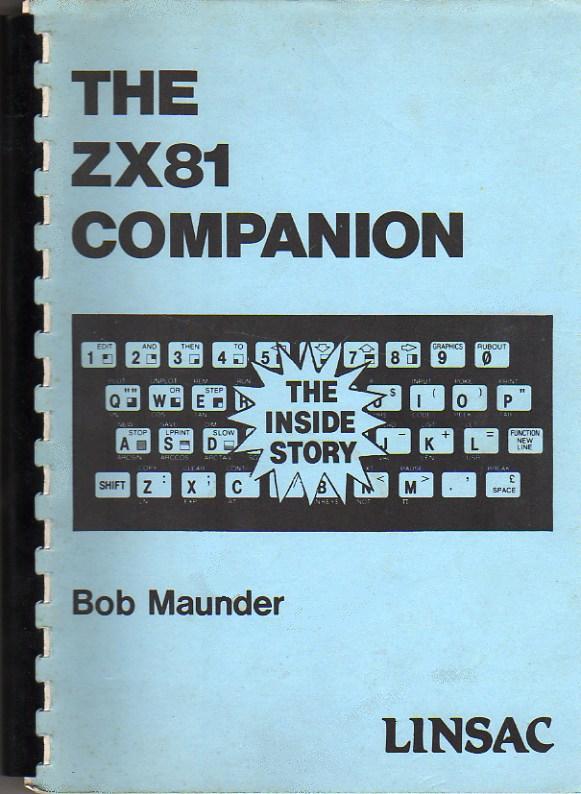
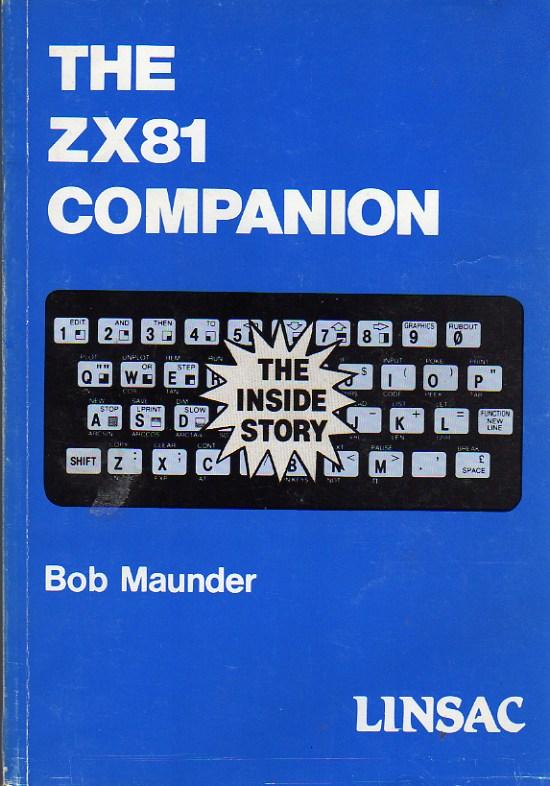
The ZX81 Companion
Book: Paperback · English
Linsac · 1981 · Pound sterling 7.95 · 131 pages · ISBN 0-907211-01-1
Discussion
Nobody has started a thread about this yet.
Documents
- TheZX81Companion.pdfComplete book English
- The_ZX81_Companion%28Bob_MAUNDER%29%28acme%29.pdfComplete book English
Files and rights
No permission is on record either way. Screens and pictures are copied here on a take-down basis: if you hold the rights and want something removed, say so and it goes.
Credits
- Bob Maundercredited
Sign in to credit somebody, or say what these people did.
Scores
In the magazines
- ZX Computing #21982 · Overall4/5
In the magazines 3
ZX Computing #2Aug 1982 · p.714/54/5
Overall 4/5
Alistair Lindsay 4/5
OUT OF THE MOUTHS OF 10-YEAR OLDS 49 EXPLOSIVE GAMES FOR THE ZX81 Written by Tim Hartnell, published by Interface. £5.25. GETTING ACQUAINTED WITH YOUR ZX81 Written by Tim Hartnell, published by Interface. £5.95 NOT ONLY 30 PROGRAMS FOR THE SINCLAIR ZX81 Written by various authors and published by Melbourne House. £6.95 THE ZX81 COMPANION By Bob Maunder, published by Linsac. £7.95 THE ZX81 POCKET BOOK Written by Trevor Toms and published by Phipps Associates. £4.94 UNDERSTANDING YOUR ZX81 ROM Written by Dr. Logan, published by Melbourne House. £8.95 Ten-year-old A. D. Lindsay of Frodsham sent us in his review of a number of ZX books, and we include the review here, word for word as we received it. A couple of days ago a few packages dropped through my letterbox. They did (surprise, surprise) all contain books. It is amazing what books can do. They re-awaken interest in the black shelled object, which just happens to be called ZX81. There are lots of ZX81s lying neglected in their boxes because, frankly, there is nothing else to be done with them. You do, however, have to be careful with books; some of the programs do not work. All of the ones that I tried worked first time - or were quite easy to modify. The first book which came under my scrutiny was called 49 Explosive Games for a ZX81. This book does not (as you will have gathered from the title) pretend to teach you programming; it just has page after page of great programs. Some are real oldies, like 'NIM' but some are completely new, like an adventure called 'Smugglers Bold' which fits in to 8K RAM '81. The programs are chosen, I am told (it says on the back) to illustrate a certain programming skill. There is, however, a conversion table of PEEKs and POKEs from the old ZX80 ROM to the new 8K ROM. This is very useful when converting 27 ZX80 programs to run on the 81. Many of the programs need extra memory so I would advise people with only 1K RAM to leave this book alone. The next one I examined was called Not Only 30 Programs for the Sinclair ZX81. This book is a collection of programs which show just how much can be crammed into Sinclair's tiny RAM chips. Most of the programs are games. The first one is a very basic pattern generator, though a 1K Draughts is available later in the book. The programmer, however, has to report to machine code for this game to fit into Clive's magic chips. They are written by a few different programmers but are all set out in the same way. First there is a description of what happens when the program is run. After this, the structure or how the program is built - is explained. Then there are notes on running it and finally, the actual program. The ZX81 Pocket Book is much better than its ZX80 counterpart. Trevor Toms has learnt from his mistakes and the book now has more space-saving hints and games. One very useful routine which he discovered was PAUSE 4E4. This means that the computer pauses until a key is pressed. Getting Acquainted with your ZX81 is written by Tim Hartnell. This is probably the best ZX81 book around because it combines games with tips. It contains over 80 programs. Many of these are very short, but there are a few good games. If "PRINT PEEK 16396 + 256 * PEEK 16397 - 16509" is used as a direct command, it will print how many bytes of memory have been used in your program. This can be very useful if you have only 1K RAM to play with. There are a few graphics routines which show just what can be obtained with a six-line program. These are listed under titles such as Games and Data Files. For someone with only 1K it is a good investment. The book shows just how much can be squeezed into the 81's mini memory. If one has 16K, one would be critical of some of the games, though one could modify to make them even better. Understanding Your ZX81 ROM aims to teach you how to program short machine code routines into your computer. It contains 26 basic programs and quite a few chapters. Chapter Six examines the 8K monitor in quite some detail. This is written by Dr. Logan and it is really for people with no previous machine code knowledge. Those who have will be very disappointed not to find a complete listing of the ROM in one place. The ZX81 Companion is written for people with the 16K RAM pack. Without it, this book is of no use. It is not a "games" book but rather a learning book. Some of the chapters are about saving and loading machine code and the ZX81 as an educational tool. Chapter Four deserves a special mention because it is very good - "Examining and using the Monitor" is its title and it contains an almost complete monitor listing. (I shall give each book a star rating, out of five).
C&VG (Computer & Video Games) #7May 1982 · p.87
HARD CORE - A GAMES PLAYERS GUIDE TO THE ZX81 In the spring of 1980, home computing was lifted out of the realms of the expensive hobbyist market and offered to a receptive public. The Sinclair ZX80 was the reason and it was superceded the following year by the ZX81 model. Love or hate these machines, they were instrumental in putting computers at the fingertips of the public at a price they could afford - and utilising such house-hold items as a TV set and a cassette recorder. Among the 81's limitations were a difficult to operate, touch-sensitive keyboard, crude graphics and it was launched with only 1K of memory and no printer facilities... it still sold 50,000 in the first three mouths and Sinclair ownership has now risen to 150,000 in the U.K. and 260,000 worldwide. The printing and memory deficiencies were made up towards the latter end of last year and many other firms realised the potential for producing Sinclair peripherals and software. These names and addresses, are laid out below - if an address is missing it will be included elsewhere. The ZX81 in kit form costs £49.95 and £69.95 assembled. It is built by Sinclair Research of [redacted]. ONE TOUCH WORDS The Sinclair is based around a Z80 microprocessor, and for your money you will initially receive a startlingly small, light, box with a "Qwerty" keyboard on it, a power pack, leads for a television and cassette recorder and one of the best written Basic manuals for beginners to get to grips with. The Sinclair Basic is very close to the Microsoft variety but does without such well-used command words as READ and DATA. It also has the time-saving notion of one-touch key words which come up on the screen when you need them. An example is to touch the "P" on the keyboard after a program line number, then PRINT will appear on the screen, already spaced for you. Beginners will find this confusing initially but with usage it becomes automatic. MEMORY APLENTY Memory capacity tor the ZX81 is expanding and prices are coming down. Memotech now offers a 64K RAM pack for £79. Details can be obtained from the company at [redacted]. A variety of 16K RAM packs are available. JRS Software produces one at £35, DK'tronics sells a ready built pack for £42.95, and a kit for £32.95. It also produces a 2K pack at £15.95 and a 4K pack for £22.95. Other firms which offer memory expansion packs include Byg Byte of [redacted], 16K for £42.95. And Audio Computers of [redacted] does a 16K for £33; 32K for £45; 64K for £73 and 128K for £123. Sinclair Research's 16K RAM pack costs £49.95. The ZX81's membrane keyboard has proved a problem for some users. There are now several typewriter-style keyboards available. Fuller Micro Systems produce a keyboard which comes ready-built and costs £39.95. The ZX81 fits neatly inside the case, as does the power supply and memory boards with no leads hanging about outside. Details from Fuller Micro Systems, [redacted]. DK'tronics also produces a keyboard, at £27.95. Redditch Electronics produces a keyboard in kit form for £20.50. A keyboard connector is optional and costs a further £1.95. D K Computer Keyboards produces a keyboard, at £28.95. Voice recognition and music are possible on the ZX81. William Stuart Systems produces a speech recognition system for the ZX81 called Big Ears. It allows speech input through a microphone provided with the system, and costs £49. It also produces a music synthesiser which can be used to put out sound effects and music. Through its input and output lines the ZX81 can monitor a home security system and control a robot arm. Details can be obtained from William Stuart Systems Ltd., [redacted]. The 50-character-per-second printer developed by Sinclair for the ZX81 allows the user to have hard copy of program listings or of program output. It costs £49.95. It is useful to have a holder for the ZX81 and its peripherals, to contain all those loose wires. Various units are available including the ZX81 Workstation, a specially-moulded tray from Peter Furlong Products, [redacted]. If you prefer a wooden workstation, try ZX Business Systems' £15 console. The address is [redacted]. ARE YOU GAME? There is no shortage of software for the ZX81 from independent suppliers. Many firms have set up producing both business and games for the machine but the standard of some of these is very poor. Sinclair Research itself sells four tapes of programs which users have submitted to the firm. Included in the range is a tape containing six games, Orbit, Sniper, Meteors, Life, Wolf Pack and Golf. There is a junior education tape, and a business and household management tape. You can buy the tapes mail order from Cambridge based Sinclair for £3.95 each. Many of the firms are sown, one-man outfits which operate on a mail order basis. Prices for software range from £3 to £10 and the more you pay the better the quality tends to be. The main firms involved in software production are: Bug Byte, [redacted]. This firm has about a dozen games on its books including versions of most of the popular arcade games like asteroids, space invaders as well as an adventure game. It also supplies a multi-purpose filing program, a machine code program, and a disassembler/debugging program. Artic Computing, [redacted] has a trio of adventure games for the ZX81 with 16K. Premier Publications, [redacted], is a games supplier offering a wide range of generally good quality. The prices start at just under £4. Quicksilva, [redacted] currently has three well presented games on the market. They are all versions of popular arcade games, Space Invaders, defender and asteroids and all cost £5.50. Silversoft, [redacted] produces games for the ZX81 with a starting price of £4.95. Macronics, [redacted]. This firm has nine games on sale which start at £3.95 going up to £6.95. Games included are space invaders, breakout and a music pack. DK'tronics, [redacted], offers centipede, a version of the recent arcade game, and a 3D labyrinth game. Prices start at £3.95. Micro-Gen, [redacted], is a small firm supplying a couple of games for the ZX81, including a chess program, for £6.50. Humorous games come from Automata, [redacted]. Advertised as suitable for adults only, the series of three starts at £3. J. K. Greye Software, [redacted] produce a range of games with a lot of variety. Lowest price is £3.95. Psion Computers. 20 Clifton Court, [redacted], sells sci-fi fantasy games based on the adventure concept. Again the price is low at £3.85. Other suppliers are: Axis, [redacted]. J. O'Connor, [redacted]; Bridge Software, [redacted]; Giltrole, [redacted]; Michael Orwin, [redacted]; Second Foundation, [redacted]; Control Technology, [redacted]; Timedata, [redacted]; JRS Software, [redacted]; Video Software, [redacted] and Richard Shepherd Software, [redacted]. A USER'S STORY What's the user's view of the ZX81? Well! To set up the computer it is much like any other, fairly easy if you read the manual. It is when you come to type in a program that the trouble starts. The membrane keyboard is difficult to get along with, especially if you are used to a regular keyboard. Most people I have talked to heartily dislike it as well. I found the keyword system slow and awkward to use at first. If you are new to computing don't bother to use the manual that comes with the unit. I found it easier to grasp the basic principles using a book like the ZX81 Basic Book. A lot has been said about loading problems, but I have not encountered very many. For the record, I use a Ferguson 3T15 portable cassette player. All sorts of hard and software is becoming available for the ZX81 and it must be said that some of it is of dubious quality. Buy software carefully, read the reviews published in this and other magazines. This year will see a multitude of peripherals for the ZX81. Sinclair's own printer has just become available and various bits and pieces are coming on the market monthly. Joysticks, memory packs, sound boards and desk units. I would recommend that you join a group of local users if there is a club in your area. The interchange of ideas is invaluable. Another source of advice, programs and reviews is the National ZX81 Users Club. For details send an S.A.E. to [redacted]. The ZX81 represents good value for money. Sinclair's product support does leave a lot to be desired especially if you mail order. Order lead times are quite long. WEALTH OF BOOKS A wealth of books are now on sale to help you glean every piece of information about your Sinclair machine. Many of them cover the same subjects, like programming your ZX81, machine language and the use of subroutines, but treat the topic in varying ways. We have included a selection with comments. The Explorer's Guide To The ZX81 by Mike Lord of software house, Timedata. It covers programming aids, lists some games, applications, machine language and goes over the hardware side and expansion. It costs £4.95 from Timedata, [redacted]. It claims to carry on where the Sinclair manual leaves off. And for £4.75, Timedata sells the ZX81 Magic Book. Getting Acquainted With Your ZX81 by Tim Hartnell. It contains 80 programs for the unexpanded 1K ZX81 and is available in three editions. Numbers two and three cost £3.95 and £4.95 respectively from the ZX81 user club's magazine interface by mail order. The address is [redacted]. And 49 Explosive Games For The ZX81 by Hartnell costs £5.25 and contains listings to program into your Sinclair. Stretching Your ZX81 To Its Limits by Trevor Sharpies and Hartnell is available from Computer Publications, [redacted]. It costs £6.95. Mastering Machine Code On Your ZX80 is by Tony Baker and it costs £5.95. So is the Gateway Guide To The ZX81 and ZX80 by Mark Charlton for £5.95. 34 Amazing Games For The 1K 7X81 by Alistair Gourlay is priced at £3.95. All are obtainable from Interface. The ZX81 Basic Book by Robin Norman is from Newnes Microcomputer Books and the price is £4.95. He has also written a similar book for the older machine called Learning Basic With Your Sinclair ZX80, costing £4.95. Peek, Poke, Byte And RAM is about Basic programming and includes information on graphics, setting up the hardware, logic, looping and branching, character manipulation, subroutines and debugging. It is by Ian Stewart and Robin Jones and costs £4.95 from Shira Publishing of [redacted]. Byteing Deeper Into Your ZX81 by Mark Harrison gives programming tips and 37 programs to try out your newly acquired skills. Sigma Technical Press is the publisher at [redacted]. The price £4.95. The ZX81 Pocket Book deals with machine code, decimal justification, and playing adventure games as well as giving hints and tips to get the most out of your computer. Phipps Associates at [redacted] publishes this book by Trevor Toms and sells it for £5.95. Books from Kuma Computers of [redacted] are: Understanding Your ZX81 ROM by Dr Ian Logan, costing £8.95. The ZX81 Companion for £5.95. The Sinclair ZX81 Programming For Real Applications by Randle Hurley at £6.95. Hints and Tips for the ZX81 by Andrew Hewson priced at £4.25. Machine Language Made Simple for £8.95 and Not Only 30 Programs For The ZX81 at £6.95 but also 50 Rip-Roaring Games for the ZX81/81 for £4.95. Finally Making The Most Of Your ZX80 by Tim Harwell is obtainable through Interface and the following shops: Timedata, [redacted]; Foyles Bookshop, [redacted]; Syntax Software, [redacted]; The Software House, [redacted]; Mine Of Information, [redacted]; Sinclair Research, [redacted]. GRAPHICS JAM The ZX81's graphics capability is very limited. In fact there are 20 graphics characters, and an inverse space, to play with. Although it has flicker free graphics the ZX81 is not viable for programming complex graphics displays in Basic. It is possible, but it takes up an awful lot of memory and makes animated graphics displays move sluggishly and jerkily. Machine code is the other possibility, but not a good alternative for Basic for the beginner. There are several add-ons for the ZX81 that allow use of programmable and hi-resolution graphics. Quicksilva produce a programmable character generator at £26.00. It allows the user to program lower case letters, scientific notation, and space invader-type meanies to name just a few. The character generator comes with a demonstration cassette of fast machine code routines. Quicksilva also produce a hi-resolution graphics board, at £85. This enables the user to produce very detailed screen displays, such as maps and almost perfect sine waves, with a high degree of accuracy. Details of both these products can be obtained from Quicksilva, [redacted]. DK'tronics produces a graphic ROM board at £29.95. This can be attached to the ZX81 by three solder connections. It allows the use of lowercase characters and also a variety of games orientated graphics characters. Anyone who has tried playing a dexterity game on the ZX81 keyboard, will realise the value of joysticks. These are available from Micro Gen, Dept. VG, [redacted], at £9.60 each. Light pens are useful when using menu driven programs. They make the selection of items on the screen easier, without having to use the keyboard to input replies. RD Laboratories produces the "Doodler" at £32.50. Details from RD Laboratories, [redacted]. For users who have difficulty with loading, the Abacus Controller should provide a remedy. At £12 the controller switches from SAVE to LOAD by turning just one switch. Details from Abacus Electronics, [redacted]. Finally a colour programmable character generator will soon be available from Fountain Computers of [redacted]. As we went to press it was still under development and a price had yet to be fixed. But for around £90 it will let you program any character or pixel in colour.
Sinclair User #1Apr 1982 · p.48
Ron Coates
STARTING TO GET ACQUAINTED WITH THE SINCLAIR BOOK WORLD Since the dawning of the ZX-80, hundreds of thousands of words have been written about it and its successor. Each month we will examine some of those words to see if they are of value to users. By Ron Coates. Once you have your ZX-81, have set it up and worked your way through the manual provided, the obvious question arises - Where do I go from here? For the Sinclair book, good of its kind, is still only a manufacturer's manual - a guide to the capabilities of the product. It will tell how to do things but is not concerned particularly with why the techniques it describes are useful, nor the best way of attacking a practical program, whether for household accounts or a game. Do not worry. Publishers are falling over each other to produce books which will aim, with varying degrees of success, to provide the answer for which the new ZX-81 owner is looking. In the UK, there are at least 15 manuals generally - available for owners of all levels of experience and fields of interest, with new titles appearing almost weekly. That is at least comforting but it raises another problem, that of which to choose. The answer can really be provided by deciding the purpose for which you bought the machine in the first place. The machine is just a tool. It is how you use it that counts - for enjoyment, for work or for education. The authors and publishers have had somewhat the same problems of trying to decide what information the ZX-81 user might want and how best to impart it. The approaches generally can be divided into two - that the whole thing should be fun and that the reader should be taught or shown the techniques he needs to know for what he wants to do. Both frequently then leave you to get on with it. Both are fair enough. The programming techniques learned in computer games are just as applicable to writing a household accounts program as those designed specifically to do so. We aim to provide a rough guide to the books available, so that you can choose the approach to suit you. All the books assume that the reader has read the manual. Some may say that is not the case but all have to rely at one point or another on various pieces of information and the explanations in it. That probably is unavoidable, for if any manual or book tried to explain all its terms and usages in comprehensive detail, it would be long, boring, tedious and, worst of all, very expensive. The game approach to teaching computer programming has a long history. Many big computer companies and universities discovered that one of the best ways of teaching programming was for the students to design their own games and run them on a machine. It was regarded by the teachers and students as a painless way of learning how to make the machine work and do what was required of it. When you think that the alternative was to read a number of manuals and then write programs to work out the VAT on any quantity of widgets, you can see way it became popular; it also worked. That is the approach followed by one of the pioneer ZX-80 writers. Tim Hartnell, who has a number of titles to his credit of scaled degrees of difficulty. Getting acquainted with your ZX-81 starts at the lowest level. It aims to have the reader start using the machine as soon as it can be hooked to the television. The explanatory text is held to a bare minimum, as are the other books. There is a page-and-a-half of introduction and Hartnell then expects you to key-in the first game to see how it works and enjoy it. Then he explains what has happened. Through the book games of greater complexity are listed, most to demonstrate a programming technique or facility of the machine - tricks with the screen, specialised functions in mathematics and so on. His other book, Making the most of your ZX-80 and Stretching your ZX-81 or ZX-80 are continuations of increasing complexity and I found that stretching referred more to me than it really did to the computer. The good point is that Hartnell makes the effort to make learning a pleasure and pushes the reader quickly to a point of confidence in programming ability and the ZX81. The techniques and uses of the machine are indicated very well by the example programs. The disadvantages are that the books are all revisions of books for the ZX-80 and Hartnell has had neither the time nor resources to make it clear which listings of programs are for which machine. His explanations are terse, occasionally to the verge of incomprehensibility, but he never says anything without reason and you can generally grasp the point with a little thought. That may sound damning but on the whole the books are to be recommended because of the successful effort Hartnell has put into judging the level of information he presents in each. A book which tries to cover much the same ground is The ZX81 Pocket Book by Trevor Toms. The author has made an effort to extend his explanation - for instance each line of programming code is explained if it is novel - and to do more than provide a series of listings to type into the machine. It is not really for the absolute beginner but embraces most of the techniques dealt with by Hartnell's three books. Readers will probably find his explanations easier to follow. because of his step-by-step notation. For the person who wishes to take the ZX-81 really seriously, The ZX-81 Companion is one of the better books. It is different in concept from the others reviewed. The author is an academic and his style, while not heavy-handed, shows it. Programs and examples are presented clearly but he is obviously addressing himself to the ZX-81 owner who wants to move as quickly as possible from the manual to using the machine for teaching, business or household accounting. Next month we will look at more serious books and the delightful Peek, Poke, Byte and Ram.
Reviews from people here
Sign in to write about this, or make an account. It takes a minute and lets you correct the catalogue too.
No description recorded.
Sign in to correct or add to this.
Hold the rights to this and want it taken down?