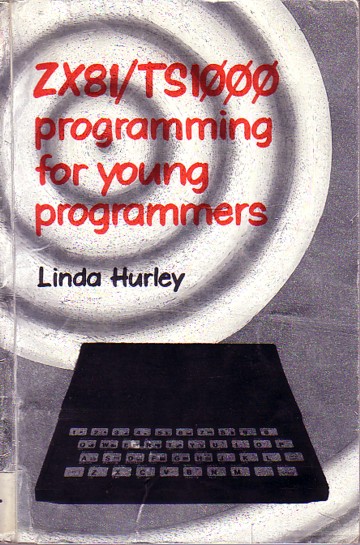
ZX81/TS1000 Programming for Young Programmers
Book: Paperback · English
McGraw-Hill Book Company UK Ltd · 1983 · Pound sterling 4.95 · 88 pages · ISBN 0-07-031449-7
Also known as Programas para Jovens Programadores: TK82-83-85 CP200 (Portuguese)
Discussion
Nobody has started a thread about this yet.
Remarks
Tape £5.95
Releases
- 1983McGraw-Hill Book Company UK LtdPound sterling 4.95
- 1984McGraw-Hill [BR] Sold as Programas para Jovens Programadores: TK82-83-85 CP200
Documents
- programas_para_jovens_programadores-tk_82_83_85_cp200.pdfComplete book Portuguese
Files and rights
No permission is on record either way. Screens and pictures are copied here on a take-down basis: if you hold the rights and want something removed, say so and it goes.
Credits
- Linda Hurleycredited
Sign in to credit somebody, or say what these people did.
In the magazines 7
Personal Computer News #58Apr 1984 · p.16
Kenn Garroch
SUFFERING FROM KEYBOARD FINGER? TAKE A BREAK WITH A BOOK. 'ZX81/TS1000 Programming for Young Programmers' by Linda Hurley, published by McGraw Hill at £4.95, cassette £5.13 (paperback, 88 pages) This book and cassette appear to be aimed at younger people programming for the first time. How young these prospective readers are is debatable since, at first sight, the style is rather jolly and there are pictures of the keys that appear to have been sketched rather than drawn. After describing how to use the keyboard, the book gets down to programming. The first of the examples is simple, and so is the second and the third. The first major program is about 11 lines and converts words into anagrams, giving examples of string handling, printing and so on. Following this there are additional lines to add to the program to make it more flashy. The book continues in the same style covering graphics, moving graphics, numbers, subroutines and includes games that use these ideas. The cassette contains 11 programs, some developed in the book, plus a few others. Some of them need the RAM pack expansion (notably the ZX81). They vary in loading time, from 16 seconds to five minutes, and hence in length, but most are short and are documented in a small booklet included with the tape. These notes describe the tricks that have to be used to get the best from the machine. The cassette is a nice idea but appears to be sold separately. It might have been better if book and cassette came together as a single package for, say, £6 to £7.
Sinclair Programs #17Mar 1984 · p.9
June Mortimer
SOFT FOCUS New this month. Softfocus will be a regular feature, providing short reviews of the newest software for the Sinclair Computers. This month the focus is on the way ahead for software. Late last year, programs produced for the Spectrum Christmas market pointed the way for software in 1984. Ant Attack by Quicksilva and Android 2 by Vortex both included stunning animated graphics routines, setting a new standard for other programmers. Artic Computing has now produced Bear Bovver for the 48K Spectrum, a shining example of animated graphics, which are used in an arcade-style game. Satan's Pendulum by Minatron Computing (48K) also includes animated sequences and, for keen programmers, gives a guide to how they were produced in the accompanying booklet. While such excellent original software is being produced, software houses which cling to versions of Space Invaders and Pac-man are looking more and more outdated. The Romik Galactic Trooper and 3D Monster Chase are competent and bug-free games but do not have sufficient new ideas to make them attractive in 1984. Realistic screen displays are becoming more and more common. Wheelie, from Microsphere for the 48K Spectrum, sends the player hurtling past obstacles and through caverns in search of the ghost rider. In the program, crash sequences are very graphic and tend towards the tasteless, while in Deathchase from Micromega - 16K Spectrum - the view from a motorcycle is shown in realistic detail but the death of another rider is not depicted at all. Problems as to how players should be made to suffer for the misdeeds of their on-screen persona, whether they should watch deaths in graphic detail or miss them completely, are resolved in the new Automata game for the 48K Spectrum, Pi-Eyed. The hero, the Pi-man, wanders from pub to pub, drinking beer and avoiding obstacles. Wandering into other buildings for safety results in the telling of very bad jokes, a fate far worse for the player than any graphics representation could be. With programs such as the Legend Valhalla (48K) and Melbourne House Hobbit (48K) on sale, other adventures fade into insignificance. The Island, produced by Virgin Games for the 48K Spectrum, is an enjoyable adventure, with added sound effects and short games contained in it. Demon Lord by Javlin Software is an enormous adventure, made up of four 48K adventures on two separate cassettes. Pictures are given, in painstaking detail, of each location, but the vocabulary is small, making it extremely difficult and very frustrating to play. Computer magazines receive a constant stream of letters enquiring about software other than games for computers. Mansfield Park and Nineteenth Century England, both by Sussex Software for the 48K Spectrum, act as secondary-school-level revision aids. Their subjects are those suggested by the titles and each subject is divided into different areas, for which questions and detailed answers are given on which the user can be tested. New ZX-81 games, so plentiful a year ago, are becoming rarer and rarer. Contrast Software has produced Fort Apache, a 16K strategy game, in which the player takes the part of a general with 300 men to command, laying siege to an Apache fort. It is a game involving thought and forward planning rather than fast reactions. Cyborg Wars, by Stratagem Cybernetics, is a more complex 16K strategy game involving up to four players in an imaginary galactic conflict between four nations of androids. The game relies more strongly on the instruction booklet than could be expected from a computer program but it is a carefully-thought-out and exciting game. Three games for the ZX-81 are included on the cassette accompanying the book ZX-81/TS-1000 Programming for Young Programmers, published by McGraw Hill. Bomb Run, written in machine code for the 1K ZX-81, is a version of the popular City Lander type of program in which the player must bomb buildings from an aircraft to avoid running into them. Mazer, also for the 1K ZX-81, is a simple maze game in which the aim is to avoid the ghost for as long as possible. More complicated is Golems, on the same cassette, for the 16K ZX-81, a strategy and fantasy adventure in which the aim is to outwit the Lord of the Black Tower. More detailed reviews of all these games, together with their respective Gilbert Factors, can be found in Sinclair User.
Sinclair User #23Feb 1984 · p.49
AN EXCELLENT INTRODUCTION Three games are included on the cassette which supplements a book, ZX-81/TS 1000 Programming for Young Programmers, published by McGraw Hill. Two of the games, Bomb Run and Mazer, are written in machine code for 1K machines and manage to provide plenty of action and entertainment. In Bomb Run, you are in an aircraft which loses altitude on each run and you must bomb various buildings out of your way before you crash into them. You have only a limited number of missiles, so it is important to use them sparingly and accurately. Mazer is a simple maze game in which the object is to avoid the ghost and stay on the move as long as possible. Each time you move, you score a point. Novices will enjoy the ease of scoring and the practical layout of the keyboard; any key in the top row moves you up, any key in the bottom row moves you down, and the left- and right-hand sides of the keyboard will move left and right respectively. Both games allow you to start again easily if you crash or are eaten by ghosts. Golems for the 16K Spectrum is a more complicated Strategy and fantasy adventure game in which your object is to outwit the Lord of the Black Tower. The cassettes also include programs which are listed in the book, including Hangman, Sketcher and Owl Swoop, with additional graphics and other improvements. Together the book and cassette form an excellent introduction to Basic programming on the ZX-81. They are available from McGraw Hill Book Co, [redacted]. The cassette costs £5.95.
ZX Computing #10Dec 1983 · p.65
THE ZX81 SOFT SELECTION In which Nick Pearce scrutinises the latest software packages for the ZX81. ZX81/TS 1000 PROGRAMS FOR YOUNG PROGRAMMERS Linda Hurly and Stuart Nicholls Programming for Young Programmers is a very well produced book containing some 40 programs for the complete beginner. It is complemented by a cassette containing some additional games and extended listings for six of the programs in the book. Taking the book first. This really is for the novice and assumes absolutely no knowledge of computing or the BASIC language. The only part of the Sinclair manual which needs to be read are the setting-up instructions. The book will be particularly useful as a means of familiarising the young user with the ZX81 keyboard. Programs are in the main short (they all fit easily into 1K) and are clearly set out with colours used effectively to highlight the Shift Graphics keys. Special 'keyboard maps' are used to assist in locating keys the first time they are encountered. The programs are all very good. Some of them are only a few lines long and the user is able to run some effective and absorbing programs immediately with the minimum of keying-in. just right for the young beginner! The book follows a logical sequence starting with programs which manipulate and display words, through drawing with the computer and picture displays, and on to movement and games. There is even a 'help' section at the end to aid fault finding of the user's own initial programming attempts. The book contains a host of good ideas for the budding programmer although there is little in the way of explanation of how the programs work. The cassette takes things a little further and leads on to the Sinclair manual and more advanced studies. The author has struck the right balance with this book which is likely to prove a favourite and a valuable teaching aid. The cassette contains a good range of programs. 'Bomber' and 'Mazer' are both 1K games written entirely in machine code. 'Bomber' is particularly good - you have to obliterate the city before you crash into any of its buildings - and compares well with 16K versions on the market. 'Mazer' is a maze game in which you are chased by five ghosts; you score each time your character moves and the object is to avoid being captured for as long as possible. 'Golums' is a board/adventure type game which performs well although the action is rather slow. It is written almost entirely in BASIC and is readily LISTed with the intention of introducing the user to the rudiments of computer gaming. REM statements are liberally dispersed throughout the listing to guide the user through the program. An eight page booklet provided with the cassette contains an explanation of some aspects of the 'Golums' listing. The remaining six programs extend some of the listings given in the book and each requires a little more than 1K. The booklet draws attention to some of the lessons which can be learnt from the listings and indicates ways in which they might be extended and enhanced. The book and cassette together provide a very useful learning package and are highly commended. They will undoubtedly be a source of ideas and inspiration for many young ZX81 (and TS 10001 owners. The book and cassette are published by McGraw-Hill Book Co (UK) Ltd, [redacted].
Personal Computer News #37Nov 1983 · p.69
Sandra Grandison
'ZX81/TS1000 Programming for Young Programmers' by Linda Hurley, published by McGraw-Hill at £4.95 (paperback, 88 pages). You'd have thought that all the possible titles to have been written for the ZX81 were already on the market. Apparently not. There's nothing original in this book, but what it does give is a clear and concise understanding on how to use your micro. Written for the ZX81 user and TS1000 owner in the US, this book gives a step by step introduction to using Basic on your computer. After a brief introduction, the book unravels some of the mishmash meanings of the keys on the keyboard and gets the user to familiarise himself with them. The chapters that follow each begin with a short easy program that does something straightaway. As you work your way through the chapter the programs get longer, and to polish it off, suggestions for changing programs and adding your own ideas are given.
News/Note2
- ZX Computing #15Oct 1984 · p.17
- ZX Computing #11Feb 1984 · p.88
Reviews from people here
Sign in to write about this, or make an account. It takes a minute and lets you correct the catalogue too.
Everything ZXDB can hold about this is here.
Sign in to correct or add to this.
Hold the rights to this and want it taken down?