
Fantasia Diamond
Adventure Game: Text/Illustrated · ZX-Spectrum 48K · 1 players · English
Hewson Consultants Ltd · 1984 · Pound sterling 7.95
.jpg)
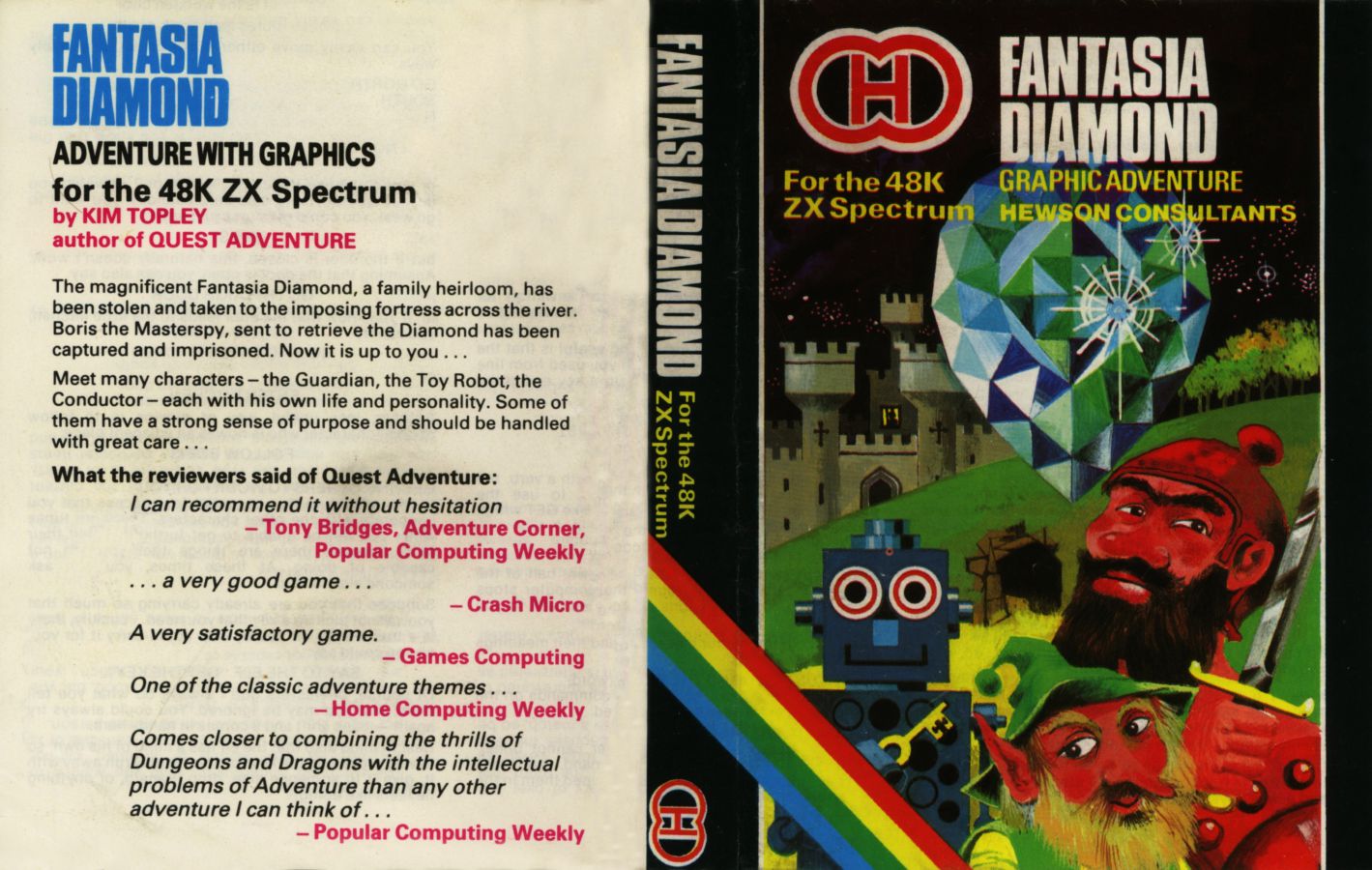
_Front.jpg)
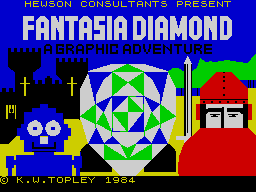
_Media.jpg)
Discussion
Nobody has started a thread about this yet.
Remarks
Fantasia Diamond won Le prix du Meilleur Scenario for the best game scenario in the prestigious Grand Prix Internationale du Logiciel d'Adventure Because of this, it was to be released in French as well as Dutch and German.
Releases
- 1984Hewson Consultants LtdPound sterling 7.95
- UnknownV.T.R. Software
Play
- fantasiadiamond.zipRZX playback file
- FantasiaDiamond.tzx.zipTape image English20 KB
- FantasiaDiamond.tap.zipTape image English22 KB
- FantasiaDiamond(VTR).tzx.zipTape image French20 KB
Documents
- FantasiaDiamond_Dutch.pdfInstructions Dutch33 KB
- FantasiaDiamond(EN).txtInstructions English15 KB
- FantasiaDiamond(EN).pdfInstructions English112 KB
- FantasiaDiamond(VTRSoftware)(FR).pdfInstructions French223 KB
Files and rights
Distribution permission is on record, granted to another archive rather than to this one. Screens and pictures are copied here; everything else links to the archive that holds it.
- AllowedHewson Consultants Ltd → WorldOfSpectrum
Credits
- Kim W. Topleycredited
Sign in to credit somebody, or say what these people did.
Awards
- Crash SmashCrash5 · 1984
Scores
In the magazines
- Sinclair User #271984 · Gilbert Factor7/10
- Crash #51984 · Overall Value10/10
Elsewhere on the web
- WorldOfSpectrum 10 votes7.90
In the magazines 71
Personal Computer News #76Sep 1984 · p.18
Bob Chappell
ADVENTURES CAPITAL Bob Chappell surveys the scene to evaluate the influence of new crop of innovative adventures. Melbourne House's The Hobbit and Legend's Valhalla were both important watersheds in the development of the adventure, but how much has the adventure moved on since their launch? Like them or not, these two games set new standards in two fields, most obviously in graphics, but also in popularising semi-intelligent characters (in addition to the one usually found sitting at the keyboard). So, post Hobbit and Valhalla, you might have expected the floodgates to open for a new breed of adventures. A look at a representative sample of some of the latest releases should give us an indication of the state of this particular art. FANTASIA DIAMOND Spectrum £8.95 Hewson Consultants, [redacted] This one is Hewson's follow-up to Quest. The plot is hardly original, being littered with stolen treasure, elves, castles and the like, but there's no doubt that Fantasia Diamond is one of the most sophisticated of the current wave. It shows clear signs of the influence the Hobbit has had on the genre. The command analyser is powerful, allowing the player to enter compound commands such as 'OPEN THE DOOR AND GO EAST', 'GET THE FOOD AND THE WINE' or 'LOOK THROUGH THE WOODEN DOOR'. You can also communicate with the various characters in the adventure with the syntax 'SAY TO THE GNOME "GET THE ROD"'. The characters themselves lead separate lives, and will go about their business as you go about yours. Many of the locations also include simple graphics, and if you know the Hobbit, they will seem fairly familiar. Hewson has obviously taken the lessons of the Hobbit to heart by combining a powerful command parser, character communication, independent characters, graphics and a large scale mission. The end result is a fantasy adventure that is both sophisticated and stimulating, and offers a great challenge. WAXWORKS Commodore 64 and others £9.95 Channel 8, [redacted] Fresh from the fertile mind of Brian Howarth comes yet another in the popular Mysterious Adventure series. Originally these adventures were text only, but they've been updated, in keeping with the trend towards graphically depicted locations. One excellent feature of this particular series - apart from the fact that it is available for a wide range of micros - is that you can switch the graphics on or off at any time during the adventure. Waxworks follows a theme beloved of devotees of spook stories. You've been visiting a waxworks museum and you've fallen asleep - in this respect it's a bit like visiting the House of Lords - and you wake up to find you've been locked in for the night. The adventure breaks no new ground in terms of technical development - apart from the graphics it's a traditional verb/ noun command driven game - but, nevertheless, like its predecessors it's a thoroughly enjoyable and entertaining adventure. GENESIS II Spectrum £6.95 Mikro-Gen, [redacted] Since the days of Noah, 'ark' has generally been what passes for intelligent conversation among ravens. But no more: MikroGen's Genesis II is the biblical tale of survival on board a galactic Noah's ark. It has a good analyser, instant response and graphics, and a vocabulary of some 300 words. There are over 100 locations to explore, and 60 objects to play around with - more than enough to satisfy the most inquisitive and acquisitive of explorers. What next, one asks? Exodus II, where the children of Israel pass through a black hole into the promised galaxy? The sky quite clearly isn't the limit ... THE INFERNO Spectrum £6.50 RIchard Shepherd, [redacted] Moving right along, we fall like Lucifer into - with apologies to Richard Shepherd Software - the pits. This latest from the Shepherd stable also exhibits signs of progress. It has a command analyser which allows the entry of compound commands, communication and interaction with the characters, and has graphics which can be switched on or off. The plot is unusual, being modeled around a plan of Dante's vision of Hell, with the adventurer having to pass through nine circles of Hell to reach the centre and escape. The theme is unusual, and overall it's an attractively presented adventure. SPOOF Spectrum £6.95 Runesoft, [redacted] Program generators are just starting to have an effect on the market, and Gilsoft's Quill is certainly the most popular of them. Since its appearance the Quill has been used to produce a goodly number of commercial adventures for the Spectrum. With its release on the Commodore 64, we can expect to see a similar outpouring of adventures for that machine. Spoof is a Quill-generated adventure, but what makes it worth special attention is its humour. There are already of a number of humorous adventures to be had, the most notable being Supersoft's Streets of London (Commodore 64), Salamander's similar Cricklewood incident (Dragon) and Infocom's superb Planetfall (various micros). But Spoof stands out from these because it is a parody of the standard adventure. In it you will come across such exotic locations as the Obligatory Mountains, the Secret Mysterious Hidden Cavern (clearly signposted) and the Necessary Forest. You will also encounter a three-headed vulture who wants a bit more than the usual food to let you pass. If you happen to have on you a bottle of wart remover, the dress of a princess, a magic rope and the ring from a pig's nose, you're in business. AFRICA GARDENS Spectrum Gilsoft, [redacted] This is one of Gilsoft's own Quill-produced adventures, marketed under the title of The Gold Collection. It's a particularly good example of the series, and is set in a mysterious hotel. It's reasonably detailed and its atmospheric text descriptions ensure the player's imagination is caught. MINDBENDER Africa Gardens, Mindbender Spectrum £5.95 Gilsoft, [redacted] The Gold Collection's contribution to mind-bending is named, aptly enough, Mindbender. It's crammed with testing puzzles and action, and starts as it means to go on by forcing you to stretch your imagination if you want to progress beyond the first couple of locations. A good sense of humour in the text helps keep you from biting the carpet when you're stuck - great stuff. WHAT'S NEXT? Certainly adventures have improved in the long term, but as yet it doesn't seem that there have been any material developments since the Hobbit and Valhalla. The standard of these two is, however, being matched regularly. And as if Movisoft (the graphics system used by Valhalla) wasn't enough, Legend is currently working on Movisoft 2 for the follow-up, to be called The Great Space Race, and due for release later in the year. The next great leap forward? We'll see...
Your Spectrum #5Jul 1984 · p.535/106/107/10
Ian Simmonds 5/10
Jon Warner 6/10
Simon Cox 7/10
Sticks at the ready, the Chiltern Computer Club buckled down to some concentrated critique as they sifted through the latest bundle of software to give us their unbiased evaluations. Any club wishing to offer their reviewing services should contact Ron Smith, Spectrum Soft, [redacted]. This month, the reviewers in the YS jury hot-seat are all members of Chiltern Computer Club, Eaton Bray, near Dunstable. They are (in alphabetical order) Simon Cox, Ian Simmonds and Jon Warner. To be honest it wasn't an easy job for them, with many of the latest offerings falling short of an acceptable level - in fact, sheer crud in some cases. Read on to find out what (and what not) to buy. The Chiltern Computer Club was formed around two years ago, and usually it manages to attract about 35 members - ages ranging from 13 years to near senility. Membership is currently £4 per year, for which potential members can expect practical help with their computer problems, and guest speakers and lecturers from time to time. Club contacts can be made via Steve Betts, [redacted]. Finally thanks go to Steve for the ultra-fast speed at which he pulled the test together. FANTASIA DIAMOND Hewson Consultants £7.95 An adventure in which you have to retrieve the magnificent Fantasia Diamond, a family heirloom, from the imposing fortress across the river. Now it's up to you.
Personal Computer Games #7Jun 1984 · p.1066/106/107/106/10
Complexity 6/10
Atmosphere 6/10
Interest 7/10
Value 6/10
Steve Cooke
ADVENTURES IN COLOUR What price graphics? Don't kid yourself. One way or the another you'll have to pay for them. First, graphics can take up a lot of memory. Fans of text-only games argue that the space is better used for a larger vocabulary or better location descriptions. What's more, they point out, the pictures take a long time to draw and conflict with the image in the players imagination. Do the text-only supporters have a point? Or should they stick to reading books and playing Scrabble? Recent adventures, it seems, have overcome most of their objections. As far as memory is concerned, you might like to know that Bug-Byte's very successful Twin Kingdom Valley has over 175 locations, each with its own picture, but, incredibly, the graphics take up only 8K. 'It's a very crafty coding system,' says Trevor Hall, programmer of TKV, obviously unwilling to give away any secrets. What's more, the graphics draw in under 10 seconds and some even boast the occasional animated sprite. Other software companies, however, seem to be going in quite a different direction. Interceptor Software recently brought out Heroes of Karn for the Commodore 64, a game with only 65 locations that takes up all the available memory, a large part of which is dedicated to graphics. One look at them will tell you why. The detail of the display is fabulous and some of the locations have excellent music as well. The graphics are very slow to draw, but - although the Text-Only Supporters Club will no doubt disagree - I think they're worth waiting for and add substantially to the atmosphere of the game. Heroes of Karn was reviewed in the March issue of PCG, so all I'll say here is that it's a great adventure and well worth adding to your collection. Meanwhile most of the more recent adventures on the market are offering graphics, while some of the older, text-only games are being re-released with graphics added. Into this last category falls Adventure International, distributor of the Scott Adams adventures. These games have been around for quite a while now, but they've come a long way since Scott first hammered them out on his 16K Tandy. Four of the titles, already available in text-only form on the BBC, are about to be released with graphics for the Spectrum and Commodore 64. If you haven't tried the Scott Adams series then they're well worth sampling. Pirate Adventure is one of the simplest, but try Adventureland if you enjoy a challenge. Scott's commitment to graphic adventures is most clearly shown by his latest offerings, based on heroes from the Marvel Comics. The Incredible Hulk has just come out for the Atari, Spectrum, BBC and Commodore 64. Catching a quick glimpse of some pre-release versions a few weeks ago, I can assure you that the graphics are excellently done, and the games have some amusing and original touches. Design was carried out in collaboration with Marvel artists so authenticity is guaranteed. I'll be looking at these games in more detail in the next issue. BBC owners have been known to turn a little green at the sight of graphic adventures. That's because they're usually running on someone else's machine. Sadly the BBC doesn't quite have the space inside for all those pretty pictures, as anyone who's tried playing The Hobbit on the Acorn machine will know to their cost. Good news, then, for BBC owners. Micrograf have just released two games for the Beeb that make unusual use of graphics. Flint's Gold and Vampire Castle are predominantly text-only, but each program has occasional graphic interludes. It's a bit like reading a book with an illustration in each chapter. Because of excellent use of sound effects, varied responses, and a great sense of humour, Micrografs games score very high on atmosphere. As you walk along the sea-front in Flint's Gold you hear the waves breaking on the shore and even the sound of gulls calling out overhead. Vampire Castle brings you face to face with Count Dracula, Igor, and a number of tricky puzzles. Neither of these games is a full-blown graphic adventure by any means, but the occasional 'illustration' and the sound effects add a lot of fun. Beeb owners who insist on graphics at all cost might be tempted by The Stolen Lamp from Lothlorien. The display is colourful and draws very fast, but the game itself is repetitive and lacking in challenge. If you fancy flying round deserts and blowing up pickpockets in a search for Aladdin's Lamp then you might be able to put up with the extremely limited vocabulary and sparse locations. My own inclination would be to avoid it except in cases of dire software starvation. Adventure in a very different style for Beeb owners is offered by Pettigrew's Diary from Shards Software. This is billed as a three-part adventure, and the First 'chapter' certainly isn't short on graphics. Unfortunately it's very short on text, and there are only two locations. Yes, you guessed, it's really an arcade game. The idea behind Pettigrew's Diary is to get through the first part collecting various objects and the password to the next 'chapter'. Unfortunately the action is so agonisingly slow that it was all could do to keep playing. I spent no less than five hours struggling with the game, in which you guide a little man round a burning farmhouse looking for various objects and avoiding the ever-spreading flames. Once you've completed the first chapter you move on to the second, which is a more traditional text-adventure with standard two-word inputs. The third 'chapter' involves you undertaking eight separate challenges in order to solve the secret of Pettigrew's Diary. Whether the later stages of Pettigrew's Diary are worth all the effort at the beginning is a mystery to me since I never got beyond the first stage. For this reason I haven't included a rating of the game, but if any reader wants to write in and give us all the low-down on what happens then please do. If you fancy arcade/adventure combinations and you have a Commodore 64 then you should try Sorcerer's Apprentice from Phoenix Software. Here you must first battle it out against mad mops and brushes in order to discover a password that will enable you to play the adventure that follows. The adventure, however, is text-only. You wander about the Wizard's Castle experimenting with spells and, if you're not careful, find yourself turned into a toad or poisoned by biscuits. Once you get tired of this, Sorcerer's Apprentice doesn't have a lot more to offer. The only really good thing about the game is the error-checking, which is just as well as the vocabulary is very small. Graphics adventures for the Oric are few and far between. To make up for this, some of them seem to make extravagant claims for themselves which they then fail to live up to. Island of Death from Ocean has you wandering round a desert island using single letter commands. Each time you encounter an obstacle the program launches into a graphic interlude that takes the form of a simple arcade-type challenge. The graphics are very basic and none of the challenges really tests the player. Despite some humourous moments this game is definitely not the 'ultimate Arcade/Adventure' it claims to he. Hell's Temple from Kenema is a straightforward 3D maze game with D&D elements. You can listen outside doors, battle with monsters, and collect treasure. Like Island of Death it uses single-letter inputs and claims to be 'one of the most advanced Adventure programs for the Oric 1'. It isn't. Don't be discouraged, Oric owners. As soon as the confusion caused by the Oric/Atmos transition has died down I'll be looking at adventures for your machines in more detail. Finally, a quick look at a couple of -new releases for the Spectrum. Hewson Consultants' Fantasia Diamond is a graphic adventure with many similarities to The Hobbit, though it isn't so complex. The display will be familiar to Hobbit fans, with the picture in the top half of the screen and input/responses in the bottom half. The graphics aren't quite as good as the Melbourne House program and they're rather slow on the draw. The best thing about this game is the other characters in the story, each of whom will help or hinder you in a particular way as you search for the stolen Fantasia Diamond. You can speak to them (using the 'say to' format) and even get them to do things for you, provided they're willing to. The error-checking is good, and the vocabulary comprehensive. You'll have to persevere with some of the puzzles - even when you know the answer the program is very fussy about how you phrase it. Virgin's Atlas Assignment is for the most part text-only, but includes three arcade sequences. If that isn't enough for you (and I warn you that it won't be) then you'll be pleased to know that the adventure itself isn't at all bad. Some of the puzzles are very tricky to solve, and my only objection to the game was that it encouraged a rather homicidal approach to other people. Shoot them on sight, in other words. That said, Atlas Assignment has some novel ideas and looks like being one of Virgin's better games. Game: Hell's Temple Machine: Oric 48K Price: £12.00 Complexity: 3/10 Atmosphere: 3/10 Interest: 2/10 Value: 3/10 Game: Island Of Death Machine: Oric 48K Price: £6.90 Complexity: 2/10 Atmosphere: 4/10 Interest: 1/10 Value: 2/10 Game: Heroes Of Karn Machine: Commodore 64 Price: £7.00 Complexity: 7/10 Atmosphere: 8/10 Interest: 6/10 Value: 7/10 Game: Stolen Lamp Machine: VVC Price: £6.95 Complexity: 4/10 Atmosphere: 4/10 Interest: 3/10 Value: 3/10 Game: Sorcerer's Apprentice Machine: Commodore 64 Price: £9.99 Complexity: 4/10 Atmosphere: 5/10 Interest: 4/10 Value: 4/10 Game: Twin Kingdom Valley Machine: Commodore 64, Electron, BBC Price: £9.50 Complexity: 8/10 Atmosphere: 8/10 Interest: 6/10 Value: 7/10 Game: Flint's Gold Machine: BBC Price: £6.95 Cass, £9.95 Disk Complexity: 6/10 Atmosphere: 8/10 Interest: 4/10 Value: 7/10 Game: Vampire Castle Machine: BBC Price: ££6.95 Cass, £6.95 Disk Complexity: 6/10 Atmosphere: 8/10 Interest: 4/10 Value: 7/10 Game: Atlas Assignment Machine: Spectrum 48K Price: £5.95 Complexity: 7/10 Atmosphere: 7/10 Interest: 5/10 Value: 6/10 Game: Fantasia Diamond Machine: Spectrum 48K Price: £7.95 Complexity: 6/10 Atmosphere: 6/10 Interest: 7/10 Value: 6/10
Sinclair User #27Jun 1984 · p.67/10
Gilbert Factor 7/10
Memory: 48K Price: £7.95 Most adventure players would agree that the more complex the program the better, and that, despite the aggravation and the desperate searching of Roget's Thesaurus, the solving of even the simplest tasks - simple that is to the uninvolved observer - can provide enormous satisfaction. If you are a player who values such brain-numbing programs and do not mind plenty of hard work, Fantasia Diamond from Hewson is ideal. The huge diamond of the title was a family heirloom until it was purloined and taken to a vast fortress beyond the river. Boris the master spy has already failed to win it back and the task falls to you to recover it - and Boris as well, a straightforward plot with no easy solution. The setting is a nebulous world where ghastly pixies rub shoulders with toy robots, where you journey from modern houses to magical underground cavern systems. You must eat and drink to survive and take care to use the relationships you develop with other characters to the full. For, like The Hobbit, the others have lives of their own and will help only if they decide to do so. Complex language analysis is used and sentences can be entered in almost standard English. All the usual adventure conventions such as score, inventory and so on are available to the player. Speech has some effect on other characters and there is a useful repeat facility with which you can enter the same command time and time again in the hope that people's attitudes will change.
Crash #5Jun 1984 · p.74Crash Smash7/109/109/108/1010/1010/1010/10
Difficulty 7/10
Atmosphere 9/10
Vocabulary 9/10
Logic 8/10
Debugging 10/10
Overall Value 10/10
Derek Brewster 10/10
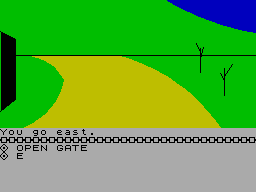
DEREK BREWSTER'S ADVENTURE TRAIL This month programmer and adventurer Derek Brewster launches properly into his quest for the perfect adventure. It's going to be a long trail, but in its course there will be many gems to uncover and doubtless many less than useful objects too. Although this issue of Crash has a few adventure games which are included although not reviewed by Derek, we will be incorporating most reviewed adventures in future within the Adventure Trail. Letters which have been pouring in from frustrated, bewildered and stuck adventurers are being sorted out even now, and hopefully Derek will be able to cope with some of them in time For the next month's issue. Derek has also devised his own rating system for reviewed adventure games, which he feels is more suitable - it is explained below. Adventure hints and help requests should be addressed to: Adventure Trail, Crash Magazine, [redacted]. This month: Fantasia Diamond - a new offering from Hewson Consultants: Here Comes The Sun (Alligata); Temple Of Vran - the second in the Incentive Ket Trilogy; Incredible Adventure from CRL: a murder inquiry called Mystery Manor from Bamby; and The Lost Gnomes from Eric Bean Adventures. THE SEARCH FOR REALISM PUSH, PULL, EXAMINE HIT, GET, MOVE... STATUE - it often ends up with you entering expletives. If your input is designed simply to match the words in the computer's memory, is this what adventuring is all about? What you need, surely, is a sense of reality in the otherwise fabulous world of the adventure. When engrossed in a good adventure you are aware of the computer as an aid only. It is a good sign when the program responds to as much of the input as possible. It is infuriating when attacking and leaving a character for dead he returns fit and active enough to give you considerable problems only a few frames later. Never mind, he's carrying some food this time and it'll be worth it but on examining the dead body you discover no food. Where has it gone? The way in which a landscape is mapped out is a moot point. Many well-known adventures have vast regions where it is impossible to chart your progress (or retreat). Although this may add atmosphere in a misty swamp or the (unfortunately) ubiquitous maze. In the long run it makes you acutely aware of the data in the computer - as would a seemingly random selection ruin the storyline behind a set of holiday snaps. A realistic combat scenario is important to any adventure - assuming the adventure is sophisticated enough to support one. A small defenceless creature should be easily dealt with without much loss of face whereas a warrior may well force upon you an early exit from the game. Something that becomes clear after much adventuring is the absurdly linear and singular pre-eminence of the route you must take. An example is when you have some food, say gooseberries, that you are incapable of eating since they can only be eaten by their rightful consumant. Strange gooseberries! EXAMINE, SEARCH and LOOK are becoming popular in adventuring since they allow you to take a more active role. I can only encourage such developments since the more active the part you play the more likely you are to become enveloped within the adventure. Isn't this what the whole thing's about? Two adventures stand out above all others this month - Temple of Vran, which features a good combat scenario, and Fantasia Diamond, a superb graphic adventure with a very intelligent and friendly vocabulary. ADVENTURE TRAIL REVIEW RATINGS The kind of headings used for ratings in the rest of Crash are not entirely suitable for adventures. You may feel that the headings listed below require some additions - we would be interested to hear your views. DIFFICULTY: The likely level of difficulty experienced by an average adventurer. ATMOSPHERE: This rating reflects the quality of location descriptions and graphics, and how credibly the characters you meet behave. VOCABULARY: Here we are looking for completeness of vocabulary and the friendliness of its response. A program should contain in its vocabulary all objects which are described in its locations, and all obvious words associated with these objects. If a tree appears in a location then the vocabulary should contain the word 'tree' as well as the associated word 'climb', otherwise the rating will suffer. LOGIC: This rating reflects the logic of the problems encountered in an adventure and whether or not you are likely to be killed without warning or chance of escape. Chopping down a tree to cross the forest river is very logical throwing a rope into a boat which is described in no location description is certainly not logical. DEBUGGING: This indicates the level of crashproofing and debugging of the program. A program should not be crashed simply by making an incorrect entry or by pressing an unfortunate combination of keys (including BREAK!). This rating will also suffer from bugs within the program and spelling errors. OVERALL VALUE: A general rating based on price and the other ratings BUT NOT AN AVERAGE OF THE OTHER RATING FIGURES as is the case in all other Crash reviews. FANTASIA DIAMOND Producer: Hewson Consultants Memory Required: 48K Retail Price: £7.95 Author: K. W. Topley Fantasia Diamond, a family heirloom and the largest diamond known to man, has been stolen and removed to a fortress across the river. Boris the master spy, who made his way to the fortress to recapture the diamond, has been imprisoned by the faithful guardian who patrols the rooms and corridors for intruders. On your journey you are likely to meet elves, pixies, gnomes and the decidedly unfriendly woodcutter. Your mission is to enter the fortress, recover the diamond and rescue Boris. But once you find the diamond the game is not over - you must still get back home, and this can be the most difficult part. On loading you notice a very attractive loading screen, followed by some pleasing graphical representations of the first few frames of the adventure. The screen that confronts you is very reminiscent of that used in The Hobbit. The screen is divided into two areas. The upper area shows the action taking place and the pictures of some of the scenes from the adventure. The lower area is used for your input and error messages. This screen presentation is adequate but it can be difficult to keep your place on the upper scrolling portion as it receives fresh information. Using different colours for the objects, characters, etc. would help but it may have been better to clear the screen as you enter new locations. When you start the adventure you are weak but you can build up your strength by eating and drinking. You should feed regularly otherwise you may become critically weak. Your strength determines how many objects you can carry and if you become too weak you won't be able to pick up the lightest of objects - including food. The characters that inhabit the adventure lead independent lives with friends more or less sticking by you. During play you become aware of the real time element to the game. Every character takes action every 15 seconds whether or not you yourself do anything. However, if you feel like a breather all action stops when you start to type and doesn't proceed until you ENTER. To make movement in the four main directions easier use has been made of the cursor keys, which is very useful for a quick early foray when the early part of the adventure can be mapped out; NE, SW, etc, can also be entered in the usual way. The vocabulary used in the adventure is a very strong point - it is both large and user-friendly. Intelligent responses are the order of the day - not just the ubiquitous - 'You Can't'. Leaving behind the Verb/Noun restrictions of many adventures, the game allows much more complex inter-actions and requires the adventurer to be specific, eg UNLOCK DOOR WITH KEY. Quite complex sentences can be used with each command starting with a verb, eg OPEN THE DOOR AND GO EAST. The vocabulary is varied enough to allow three keys which must be matched to three doors. Similarly with the three books. Another useful feature is that the computer can remember the last verb you used so you can GET KEY (ENTER) - WINE (ENTER), which saves time. The game uses a powerful LOOK command, eg LOOK AT THE CHEST is distinguishable from LOOK INTO THE CHEST and you can even look across into different scenes with LOOK THROUGH THE WOODEN DOOR or LOOK INTO THE SMALL CAVE. This gives you a chance of avoiding unfriendly characters and so marks an excellent and very useful advance which other aspiring authors would do well to note. Further examples of the breadth of dialect are seen with FOLLOW ROBOT and SAY TO ELF GET KEY. If you needed to be persistent with this last request CAPS SHIFT and 9 will repeat the commands on the last line you entered - a nice touch and a sign of a highly polished piece of software. The abbreviations are very helpful - often the first or first two letters are adequate. Fantasia Diamond is a long adventure with many interesting and logical problems to solve. Highly recommended.
C&VG (Computer & Video Games) #31May 1984 · p.125
Keith Campbell
Quest Adventure fans will be delighted to learn that Hewson have launched Kim Topley's second game - Fantasia Diamond. Hewson told me that this game is as good as anything on the market so I thought I'd better take a look just to see whether it was true or not. The family heirloom from which the game takes it name has been stolen and taken to the fortress across the river. It's your job to get it back and also to rescue Boris the Masterspy imprisoned on a previous bid to regain the diamond. The game features a split screen graphics and text system. The pretty pictures are certainly - but as good as the Hobbit? I'm sorry, Hewson, not by half. I liked Fantasia Diamond - it struck just the right level of difficulty for me. It is tough - but not so tough that I got the impression I would never solve it in a month of Sundays which was very encouraging. A well thought out and well executed adventure - in the shops now at £7.95.
Games Compendium carries this game and has 13 references of its own.
Advert33
- C&VG (Computer & Video Games) #48Oct 1985 · p.84
- C&VG (Computer & Video Games) #47Sep 1985 · p.37
- Crash #13Feb 1985 · p.107
- Your Spectrum #11Feb 1985 · p.74
- Personal Computer Games #13Dec 1984 · p.162
- Crash #11Dec 1984 · p.9
- Your Spectrum #10Dec 1984 · p.67
- C&VG (Computer & Video Games) #38Dec 1984 · p.194
- Your Computer #12Dec 1984 · p.94
- Sinclair User #33Dec 1984 · p.108
- C&VG (Computer & Video Games) #37Nov 1984 · p.175
- Personal Computer Games #12Nov 1984 · p.94
- Crash #10Nov 1984 · p.5
- Your Spectrum #9Nov 1984 · p.2
- Your Computer #11Nov 1984 · p.188
- Sinclair User #32Nov 1984 · p.68
- Your Spectrum #8Oct 1984 · p.29
- Sinclair User #31Oct 1984 · p.11
- Your Computer #10Oct 1984 · p.134
- Crash #9Oct 1984 · p.16
- C&VG (Computer & Video Games) #36Oct 1984 · p.72
- Personal Computer Games #10Sep 1984 · p.40
- Popular Computing Weekly #36Sep 1984 · p.30
- Sinclair User #30Sep 1984 · p.12
- Popular Computing Weekly #35Aug 1984 · p.41
Tips23
- C&VG (Computer & Video Games) #66Apr 1987 · p.63
- Crash #28May 1986 · p.97
- ZX Computing #24Apr 1986 · p.98
- Sinclair User #48Mar 1986 · p.67
- Popular Computing Weekly #7Feb 1986 · p.28
- C&VG (Computer & Video Games) #52Feb 1986 · p.71
- Crash #23Dec 1985 · p.130
- C&VG (Computer & Video Games) #50Dec 1985 · p.24
- Home Computing Weekly #132Oct 1985 · p.31
- C&VG (Computer & Video Games) #48Oct 1985 · p.87
- Popular Computing Weekly #42Oct 1985 · p.17
- C&VG (Computer & Video Games) #47Sep 1985 · p.107
- Popular Computing Weekly #30Jul 1985 · p.35
- Home Computing Weekly #122Jul 1985 · p.29
- Crash #17Jun 1985 · p.105
- Crash #16May 1985 · p.123
- Crash #14Mar 1985 · p.107
- C&VG (Computer & Video Games) #41Mar 1985 · p.30
- Crash #12Jan 1985 · p.134
- Crash #11Dec 1984 · p.126
- Crash #10Nov 1984 · p.117
- Crash #9Oct 1984 · p.89
- Crash #8Sep 1984 · p.75
News/Note6
- Crash #12Jan 1985 · p.172
- Home Computing Weekly #85Oct 1984 · p.4
- ZX Computing #14Aug 1984 · p.36
- Crash #6Jul 1984 · p.34
- Crash #5Jun 1984 · p.44
- Popular Computing Weekly #13Mar 1984 · p.7
Review2
- TV GamerJan 1985 · p.50
- Computer ChoiceJun 1984 · p.27
Feature1
- Personal Computer Games #7Jun 1984 · p.106
Related
- Compilations
- Games Compendium
- Ports
- (Amstrad CPC), (BBC Micro), (Enterprise 64/128)
- Same entry at
- Spectrum ComputingZXInfo
Reviews from people here
Sign in to write about this, or make an account. It takes a minute and lets you correct the catalogue too.
Everything ZXDB can hold about this is here.
Sign in to correct or add to this.
Hold the rights to this and want it taken down?