
Faust's Folly
Adventure Game: Dungeon Crawl · ZX-Spectrum 16K · 1 players · English
Abbex Electronics Ltd · 1983 · Pound sterling 5.95
Discussion
Nobody has started a thread about this yet.
Play
- FaustsFolly.tzx.zipTape image English7 KB
- FaustsFolly.tap.zipTape image English7 KB
Files and rights
No permission is on record either way. Screens and pictures are copied here on a take-down basis: if you hold the rights and want something removed, say so and it goes.
Credits
- P. Cantercredited
Sign in to credit somebody, or say what these people did.
Scores
Elsewhere on the web
- WorldOfSpectrum 2 votes5.50
In the magazines 12
Micro Adventurer #9Jul 1984 · p.23
GW
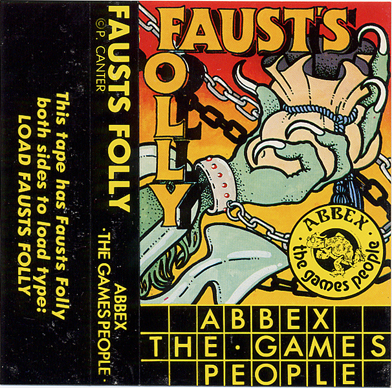
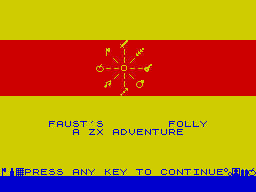
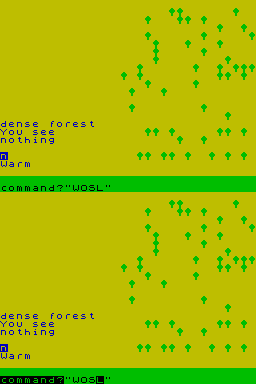
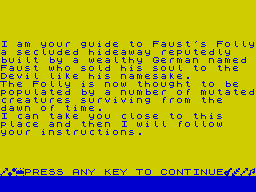
FAUST HEADS FOR A FALL MICRO: Spectrum 48K PRICE: £3.50 FORMAT: Cassette SUPPLIER: Abbex Electronics, [redacted] If you buy an adventure which is tailored to fit a 16K Spectrum, you cannot really expect a very good game to be squeezed into the available memory, even using advanced techniques of machine code and text compression. When the programmer avoids such sophistication altogether and attempts to write the adventure in 7K of Basic, then the result is likely to be very poor indeed. Such is the case with Faust's Folly, which cannot be recommended even to adventure-starved 16K Spectrum owners, despite its attractively low price. The cassette packaging is simple and unattractive and features incorrect instructions for loading the game always a bad sign. To save precious memory, and extra printing on the sleeve, the game is preceded by an introduction, which sketches a scenario: you have to find and explore Faust's Folly. This is a secluded hideaway populated by a number of mutants from the dawn of time and full of lots of treasures which, unusually for an adventure, you can just carry, all at the same time. Your mission is to collect all the treasures and escape with your life. The adventure accepts the usual verb-noun two word input, although its vocabulary is highly impoverished and there are some graphics.
Crash #4May 1984 · p.74
Producer: Abbex, 16K £5.95 Faust's Folly is buried somewhere in this congenial game with fast response times and some graphic additions. Once you have sorted out the vocab and found the entrance to the underground complex, it's a matter of the correct implements being picked up. The computer tells you that it isn't very intelligent (whatever Sinclair may tell you) and it may not know which way is which without a compass to help. In almost any location you can go in eight directions, so don't get lost. Very good for 16K.
Crash #2Mar 1984 · p.66
Producer: Abbex, 16K £5.95 Faust's Folly is buried somewhere in this congenial game with fast response times and some graphic additions. Once you have sorted out the vocab and found the entrance to the underground complex, it's a matter of the correct implements being picked up. The computer tells you that it isn't very intelligent (whatever Sinclair may tell you) and it may not know which way is which without a compass to help. In almost any location you can go in eight directions, so don't get lost. Very good for 16K.
Crash #1Feb 1984 · p.62
Producer: Abbex, 16K £5.95 Faust's Folly is buried somewhere in this congenial game with fast response times and some graphic additions. Once you have sorted out the vocab and found the entrance to the underground complex, it's a matter of the correct implements being picked up. The computer tells you that it isn't very intelligent (whatever Sinclair may tell you) and it may not know which way is which without a compass to help. In almost any location you can go in eight directions, so don't get lost. Very good for 16K.
C&VG (Computer & Video Games) #17Mar 1983 · p.410/108/108/10
Getting Started 10/10
Value 8/10
Playability 8/10
Keith Campbell
Faust was a German who sold his soul to the devil, and hid many treasures. The player is led near to the treasures and must then find them. The creatures encountered in the quest are mutants from long ago. That is the setting of this game, which although mainly text, is accompanied by mini-pictures of the objects as they are mentioned. The screen during play has varied colours. which combined with some simple sound effects make for a quite pleasing Adventure from Abbex of London for the 16K Spectrum at £4.95.
CHILDHOOD FANTASY Adventure is what all small boys - and most bigger ones - long for. Remember all those childhood books that took you into a world at excitement and fantasy? Didn't you, like me, wish you were one of the Famous Five? Adventure gaming will take you one step nearer to your dreams. In the comfort at your own home. Originally written tor large mainframe computers, these games have now been brought to the masses via the micro. Adventures are being published in ever increasing numbers for every popular machine. An Adventure game makes you the would-be here. You move about from one location to another, examine things, pick up and manipulate objects, and solve puzzles. But all the time danger lurks and hidden enemies may strike at anytime. Your goal may be anything from collecting priceless treasures to saving the world from disaster. You become part of the story, the computer working to calculate what your actions will achieve within the plot devised by the author. Don't expect fancy graphics in an Adventure - although there are graphic Adventures. Expect words. Your imagination will provide the pictures - just like it does when you read a good book. And like a good book, you will find it just as difficult to put down. When buying an Adventure first discover if the scenario and degree of complexity suit your tastes. Games reviews will help here. Find out if the speed of the game is right for you as there is a great deal of variation. From my experience a minimum of 16K of memory is required for a decent adventure and from there on up the bigger the better. A "save game" feature is useful as it enables you to return to a game where you left it at a later stage without having to leave the machine running all night. If your computer has sound and colour these will enhance game. But for the purist a good plot is enough. Keith Campbell
GAMES GLOSSARY If you can tell a Pacman from a Defender and a Galaxian from a Space Invader you probably know your way around computer games. But if some of the game terms we have used in this supplement, or in the issue itself, are new to you, then this page should supply the answers. In it we take some of the best known types of computer game and describe how they are played and what features these games normally incorporate. So, if we claim that Penetrator is a "Scramble-type game" and that leaves you just as much in the dark about what to expect, then below there is a full description of Scramble to put you in the picture. ASTEROIDS The Asteroids came into the arcades courtesy of Atari. It features a small dart-shaped craft controlled by the player which can rotate left or right and thrust or fire in the direction it is facing. There is one further control, the panic button (hyperspace) which lets you travel to another part of the screen chosen by the computer. The enemy is mainly made up of large asteroids which sweep across the screen in large deadly groups of rock. When blown up these break into smaller fragments worth extra points. There is extra danger supplied by two UFOs. The first larger creature you'll meet fairly early on. It tends to spray shots in all directions and often crashes into an asteroid. The smaller variety is far more deadly in its own shooting and also more difficult to hit. Each cleared screen means you start again with extra asteroids. DEFENDER You can't expect to keep a finger on every control button in Defender or you'd end up in knots. The action, which takes place above an alien landscape, involves some seven control buttons and takes patience to gain proper mastery of your lone craft. That patience can be rewarded though, as Defender is challenging from the word "Go". The Defender craft can go: up, down, thrust forward, reverse direction, fire, smart bomb and hyperspace. Ten humanoids wander on the landscape and these may fall prey to raiding alien creatures known as Landers. Landers pick up the humanoids and take them to the top of the screen. If they succeed in getting there the Landers turn into fearsome mutants hellbent on your destruction. In all there are six alien opponents. On top of Landers and Mutants, these are: Pods are quite harmless but contain the small and persistent Swarmers; Bombers seed space with white bombs and Baiters only appear if you take too long clearing a screen of the rest of the aliens. If all 10 humanoids are captured, the planet explodes and all remaining alien life attacks your craft at once. Defender games usually feature a small radar screen which shows what is going on at all parts of the planet surface. FROGGER Frogger has spawned a whole host of computer games with a similar theme. This game features a frog hero who must jump across a road and make his way across a river torrent to five frog-holes in the bank. The busy road usually features live streams of traffic travelling in both directions at varying speeds, between which the player must hop his frog without wrapping it around any fenders. Once across the road, the river can be crossed by leaping onto floating logs and onto the back of swimming turtles, until our frog can enter a vacant spot in the far bank. Turtles have a habit of diving though so don't let a frog dally too long on one. Being carried off the edge of the screen (by log or turtle) also results in a note in the funeral column of Amphibians' Weekly. When all five frog-holes have been filled, the game becomes more difficult with extra traffic being added to the road, snakes traversing the bank between road and river and alligators appearing instead of logs in the river. A timer running down on each frog also adds to the difficulties. The arcade original also featured a small lady frog who could be "picked up" on the logs and offered a lift home for a bonus. Other bonuses can be scored by entering a frog-hole in which a tasty fly meal has come to rest. DONKEY KONG Donkey Kong is the strange name for a climbing and jumping game which features a starlet-grabbing monster gorilla. Often referred to as Crazy Kong or Crazy Climber in the computer circles, it has only just found its way onto the home screen. The game features a gorilla holding a girl captive at the top of the screen and an intrepid hero (Mario the carpenter), who starts at the bottom of the screen. Between the two is a connecting network of platforms and ladders up which Mario must run to achieve his rescue. Kong hurls barrels down the screen and Mario makes use of his "jump" button to leap over them. He can also grab a hammer and smash the barrels as they approach him. Once at the top of the screen a new complex is built with Mario, again starting from the bottom with a view to rescue. This time the screen features a series of conveyor belts and deadly fires which travel around on the ladders and belts. GALAXIANS The Galaxians were the sons of Space Invaders. Instead of proceeding down the screen at a leisurely pace, they wavered at the top of the screen before swooping down in batches of two or three (or more often on a solo mission) firing bombs. The player has the usual left, right and fire controls on his laser base and must take care not to get trapped in a corner. He scores double points for a galaxian hit in mid-swoop and there are bonus points for taking out the red fleet commanders, who usually descend flanked by their generals, dispersing bombs at such a rate that the first instinct is to flee for cover. That is the essence of Galaxians but with each destroyed platoon, new waves appear at screen top and their attacks become more frequent, more accurate and, all too often, more deadly! PACMAN The ghostly world of Pacman is made up of a dot-filled maze, a hungry dot-eater and four pursuing spectres. Pacman variations can be found under a whole range of titles from Vic-men to Gobbleman, Snapper to Super Glooper and many others. Most dot-eating games are related to it. The main character is the dot-eater, which travels around the maze, eating every dot he touches. His objective is to clear the screen of dots. He is hampered in this by the four chasing ghosts whose touch is lethal. The Pacman's main defence against the ghosts, who usually number four, are energiser dots. These pulse in the four corners of the maze and, upon being eaten, reverse the roles for a short while. This means that Pacman can turn the tables on the ghosts and eat them for bonus points. He is allowed only a few seconds of dominance before the usual hunter and hunted rules come back into operation. It is also usual for fruits to appear on the screen occasionally and these too can be consumed by Pacman for bonus points. When Pacman has cleared the screen, it refills with dots and the game restarts except that this time the ghosts are a little livelier and a new fruit, worth extra points, appears at this level. SCRAMBLE Scramble should have a big one-way sign on its cabinet. The screen rolls from right to left, taking the player's craft along it into ever-increasing danger. Scramble variations often contain the word "Mission" or "Attack" but there are some weird and wonderful titles about. The player controls a craft heading right across the screen over hilly terrain His craft can never turn around and opt out of its mission but he does have some control over his destiny. His controls are up and down, fast and slow and he can both bomb and fire at his enemies. The Scrambler is not usually equipped with enough fuel to complete his task, but it is normal to obtain more fuel by bombing fuel tanks on the ground and so (mysteriously) replenish his own stocks. The enemies come in all shapes and sizes. Most common are missiles which fire up from the ground as your craft passes overhead and alien invader creatures which frequently inhabit caves and fly at the player's craft. The original Scramble game sent the player through a series of different terrains with new challenges in each section. And most computer Scrambles attempt to duplicate this with a number of different stages. Scramble requires a cool head which can find the right control in a crisis, but it makes an ideal computer game as success naturally leads to new and more difficult stages. INVADERS Space Invaders started the whole computer game craze back in 1977 and most gamers know the format backwards. Still, just a brief resume... The invaders come in waves above the ground and move in rows across the screen one step at a time, firing missiles earthwards. When one row of the aliens reach an edge of the screen, the whole platoon jump down a line and return back the way they came. When they achieve their slow progression to the bottom of the screen, the game ends. The player controls a laser base which moves left to right and fires directly up from its position. His aim is to blow up the entire fleet before it reaches the bottom of the screen. Flying saucers move across the top of the screen in both directions and can be hit for a mystery bonus score. In the arcade original, top saucer scores of 300 were achieved by firing 22 shots before shooting at the first saucer, then firing 14 shots in between each subsequent saucer. Some computer versions have copied this technique.
Advert5
- Sinclair User #15Jun 1983 · p.47
- Your Computer #6Jun 1983 · p.211
- Sinclair Programs #8Jun 1983 · p.60
- Personal Computer News #8May 1983 · p.42
- Personal Computer News #9May 1983 · p.90
Tips1
- Popular Computing Weekly #31Aug 1983 · p.37
News/Note1
- C&VG (Computer & Video Games) #17Mar 1983 · p.17
Related
- Same entry at
- Spectrum ComputingZXInfo
Reviews from people here
Sign in to write about this, or make an account. It takes a minute and lets you correct the catalogue too.
No description, tag recorded.
Sign in to correct or add to this.
Hold the rights to this and want it taken down?