
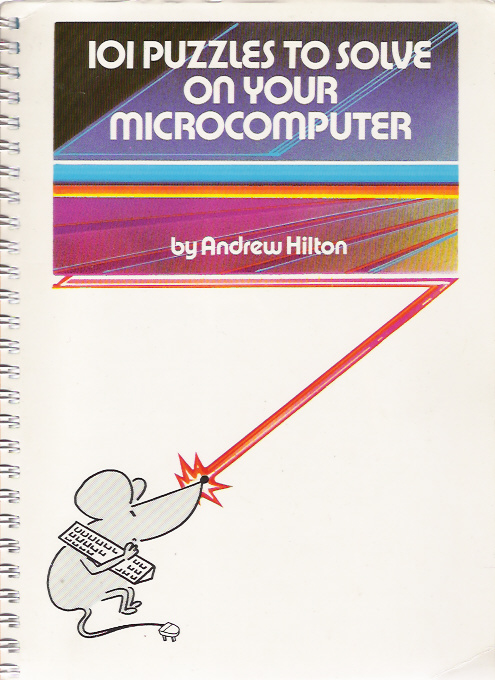
101 Puzzles to Solve on Your Microcomputer
Book: Spiral bound · English
Harrap · 1984 · Pound sterling 4.95 · 127 pages · ISBN 0-245-54214-0
MIA Missing in action. This is known to have existed, and no copy has ever been found. If you own one, the archives would like to hear from you.
Discussion
Nobody has started a thread about this yet.
Files and rights
No permission is on record either way. Screens and pictures are copied here on a take-down basis: if you hold the rights and want something removed, say so and it goes.
Credits
- Andrew Hiltoncredited
Sign in to credit somebody, or say what these people did.
In the magazines 1
Personal Computer News #66Jun 1984 · p.50
Piers Letcher
PCN'S REGULAR LOOK AT THE NEW BOOKS - WHICH ARE WORTH YOUR MONEY? '101 puzzles to solve on your microcomputer' by Andrew Hilton, published by Harrap Books at £4.95 (paperback, 127 pages) People love puzzles, but there's often much tedious legwork involved in them. In this book, some of the time-consuming chores may be taken from the puzzler's shoulders since it explains how to get your computer to do the repetitious parts. Each problem requires substantial thought, and so, although there is little text, it could take many hours (probably weeks) to solve all the puzzles. What would have improved the book, and turned it into a programmer's tool, would have been to provide solutions, not just answers. These could have been programs, with comments explaining how the problems had been approached, or hints on the methods of solution. As it is, if you don't figure out what to do, or how the answer is reached, then you're given almost no hints in most cases. The author's reason for not providing programs is thin, citing the graphics and POKE differences of machines. In fact, there are few programs there that require more than the simplest Basic routines. The publisher's other reason, to save paper, is also questionable since the cartoons (which are fun but take up a lot of space) could have been left plenty of other room for programs. However, solving the problems is conducive to logical thinking and structured programming; sometimes frustrating and often fun. The puzzles are frequently in the school punishment vein, such as 'sweep the playground with a toothbrush', but the micro can be used to do the tedious bit (sweeping) while you do the entertaining bit (watching). So although stimulating, this could have been better. Another major problem is that the author hasn't taken into account that most micros slip into exponential notation when numbers get bigger than 32,767. Many of the puzzles require you to look at ten or 12 digit numbers, which get written as, for example, 3.676377E+9.
Reviews from people here
Sign in to write about this, or make an account. It takes a minute and lets you correct the catalogue too.
No description recorded.
Sign in to correct or add to this.
Hold the rights to this and want it taken down?