
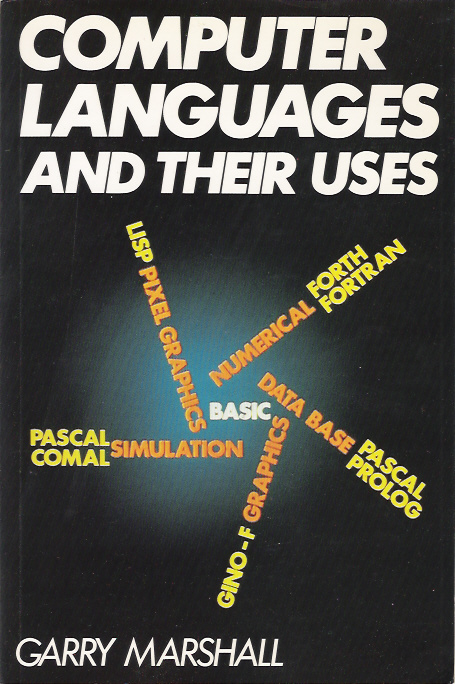
Computer Languages and Their Uses
Book: Paperback · English
Granada Publishing · 1983 · Pound sterling 5.95 · 108 pages · ISBN 0-246-12022-3
MIA Missing in action. This is known to have existed, and no copy has ever been found. If you own one, the archives would like to hear from you.
Discussion
Nobody has started a thread about this yet.
Files and rights
No permission is on record either way. Screens and pictures are copied here on a take-down basis: if you hold the rights and want something removed, say so and it goes.
Credits
- Garry Marshallcredited
Sign in to credit somebody, or say what these people did.
In the magazines 2
Personal Computer Games #1Sep 1983 · p.47
Cyndy Miles
TURN OVER A NEW LEAF A guide to some books to help you through the micro maze. COMPUTER LANGUAGES AND THEIR USES By Gary Marshall Published By Granada as a 108-page paperback at £5.95 No one can say that this book alienates the newcomers. With the opening line 'A computer language is a language for communication with a computer', it takes a stand among the not-too-advanced users. Garry Marshall takes you through Basic and out the other side to Prolog, Gino-F, Cornal and Lisp. There's a discussion of language development before a comparison of Basic with the other languages. There is also an explanation of how those languages can be used with databases, 3-D graphics, and simulation. The instructions are made clear with program listings and diagrams, and techniques are explained and reviewed. The book is written in so light and easy a way that even new users will get a broad understanding of what they can do with their micros.
Personal Computer News #5Apr 1983 · p.24
Cyndy Miles
'Computer Languages And Their Uses' by Garry Marshall, published by Granada at £5.95 (paperback, 108) No-one can say this book alienates the newcomers. With the opening line 'A computer language is a language for communication with a computer' it quite clearly takes a stand among the not-too-advanced users. But its premis is worthy, taking you through Basic and out the other side to Prolog, Gino-F, Comal and Lisp. There's discussion of language development before a comparison of Basic with the other languages and explanation of how they can be used with data-bases. 3-D graphics, simulation and Pixel graphics. Program listing and diagrams add clarity to the instructions and techniques are explained and reviewed. The author makes no pretence that he's out to break the Basic barrier. And he does so in a light and easy way that will give even new users - perhaps especially the newcomers - a broad understanding of what they can do with their microcomputers. If you want to go beyond Basic, this might be the place to start.
Reviews from people here
Sign in to write about this, or make an account. It takes a minute and lets you correct the catalogue too.
No description recorded.
Sign in to correct or add to this.
Hold the rights to this and want it taken down?