
The Hobbit
Adventure Game: Text/Illustrated · ZX-Spectrum 48K · 1 players · English
Melbourne House · 1982 · Pound sterling 14.95
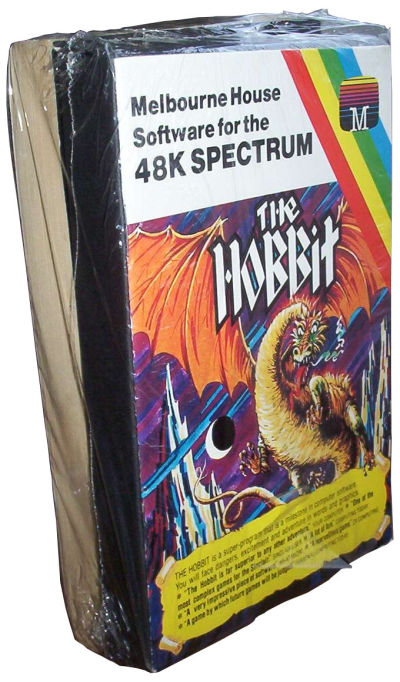


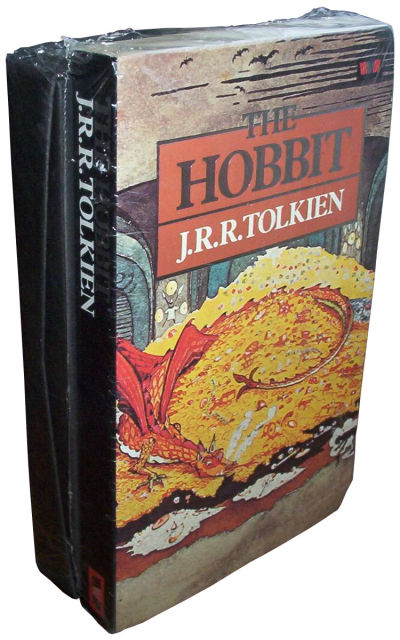
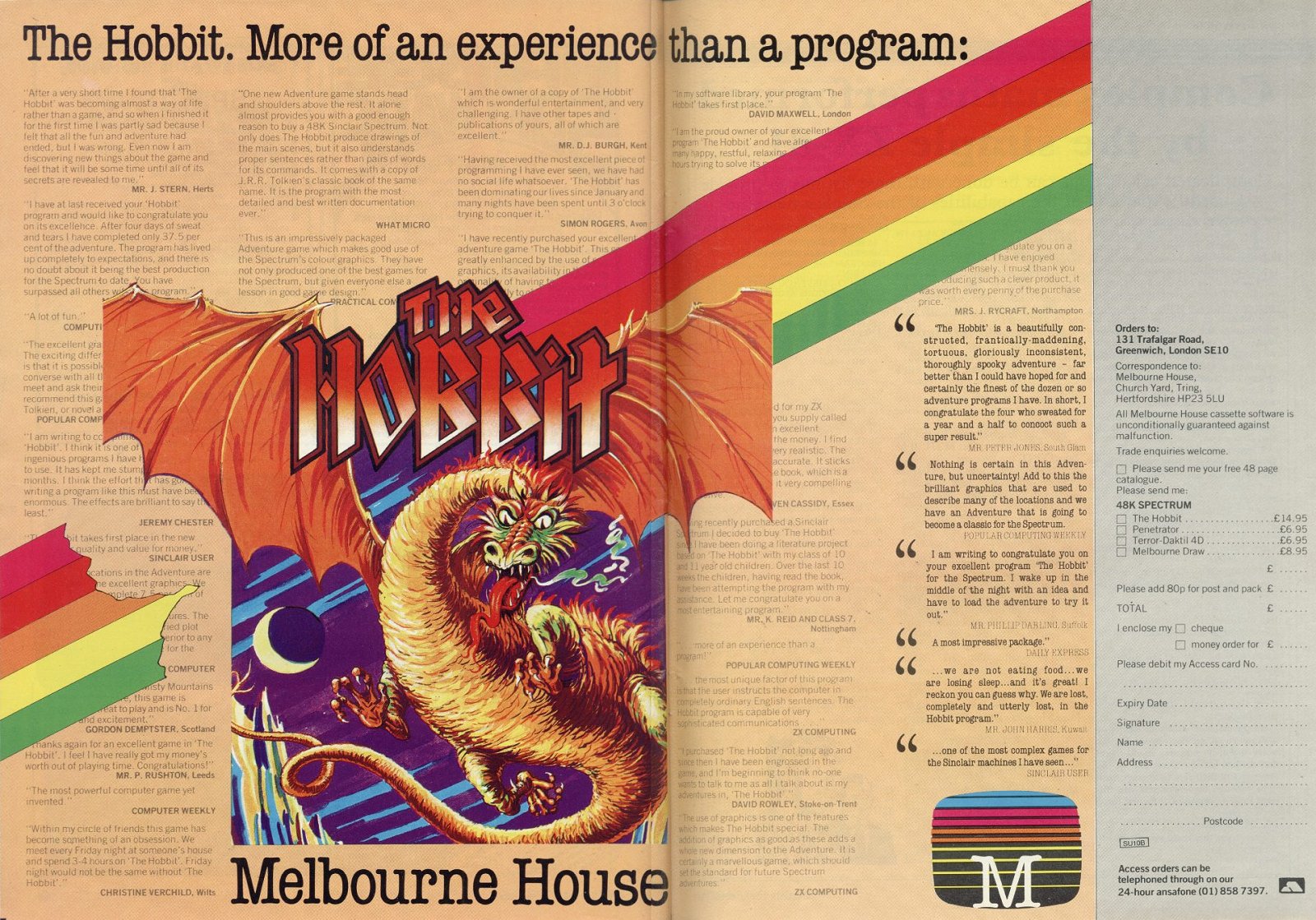

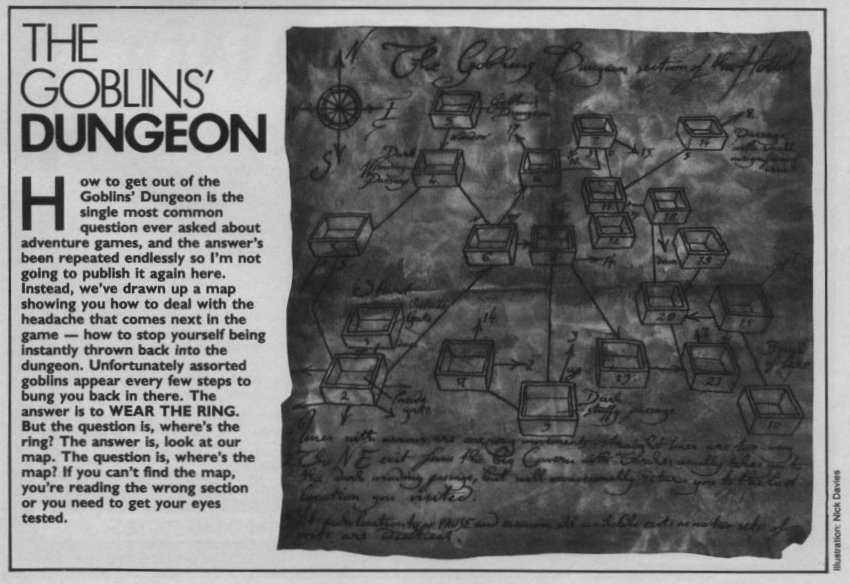
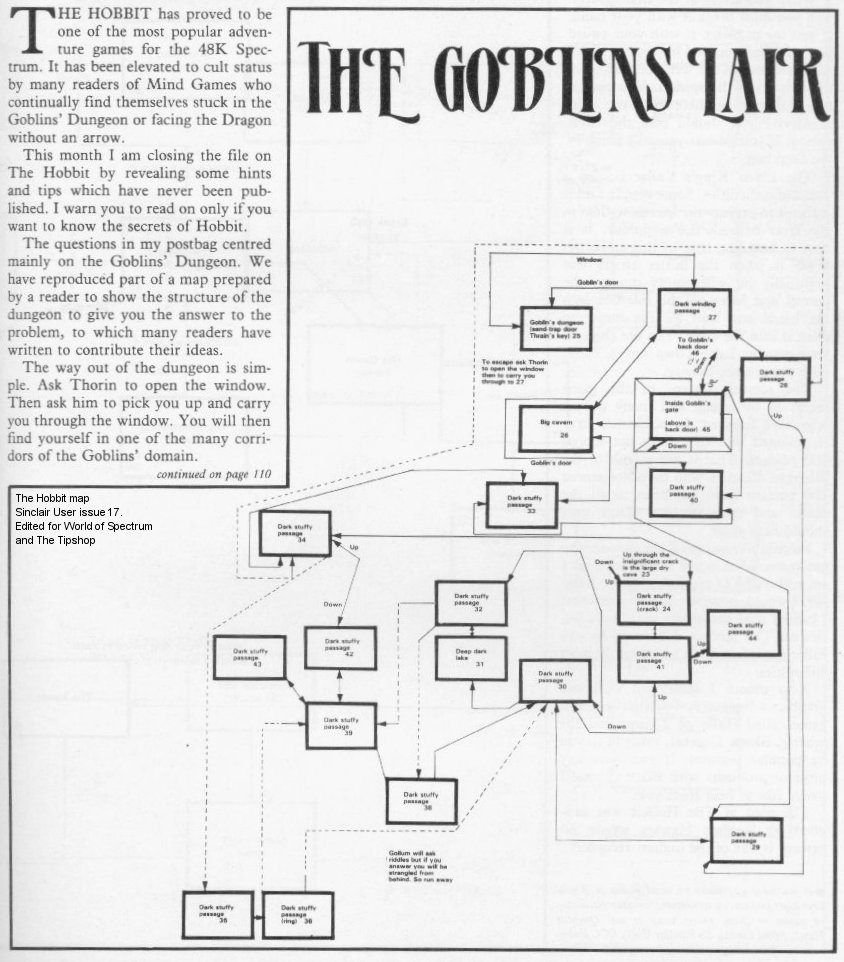
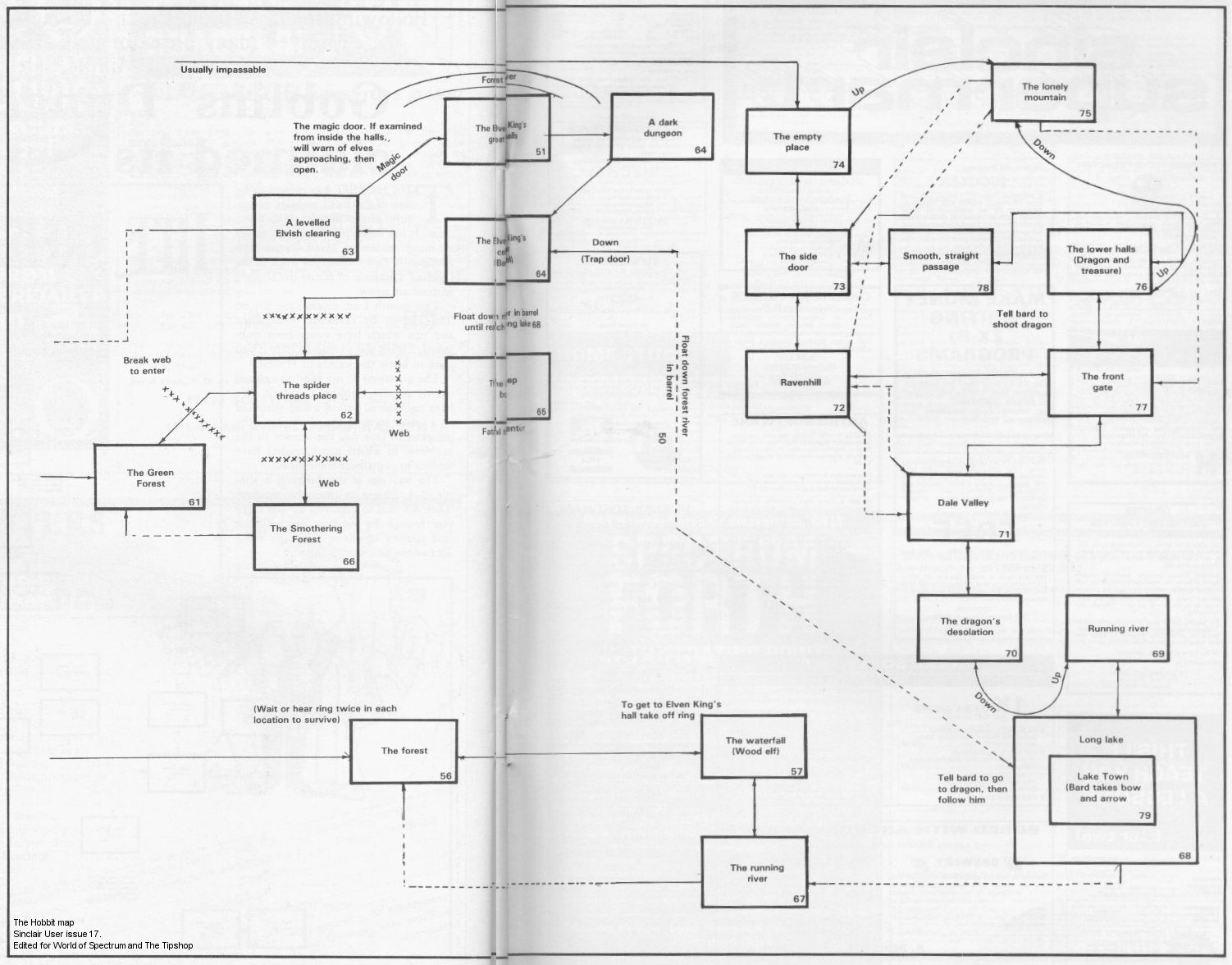
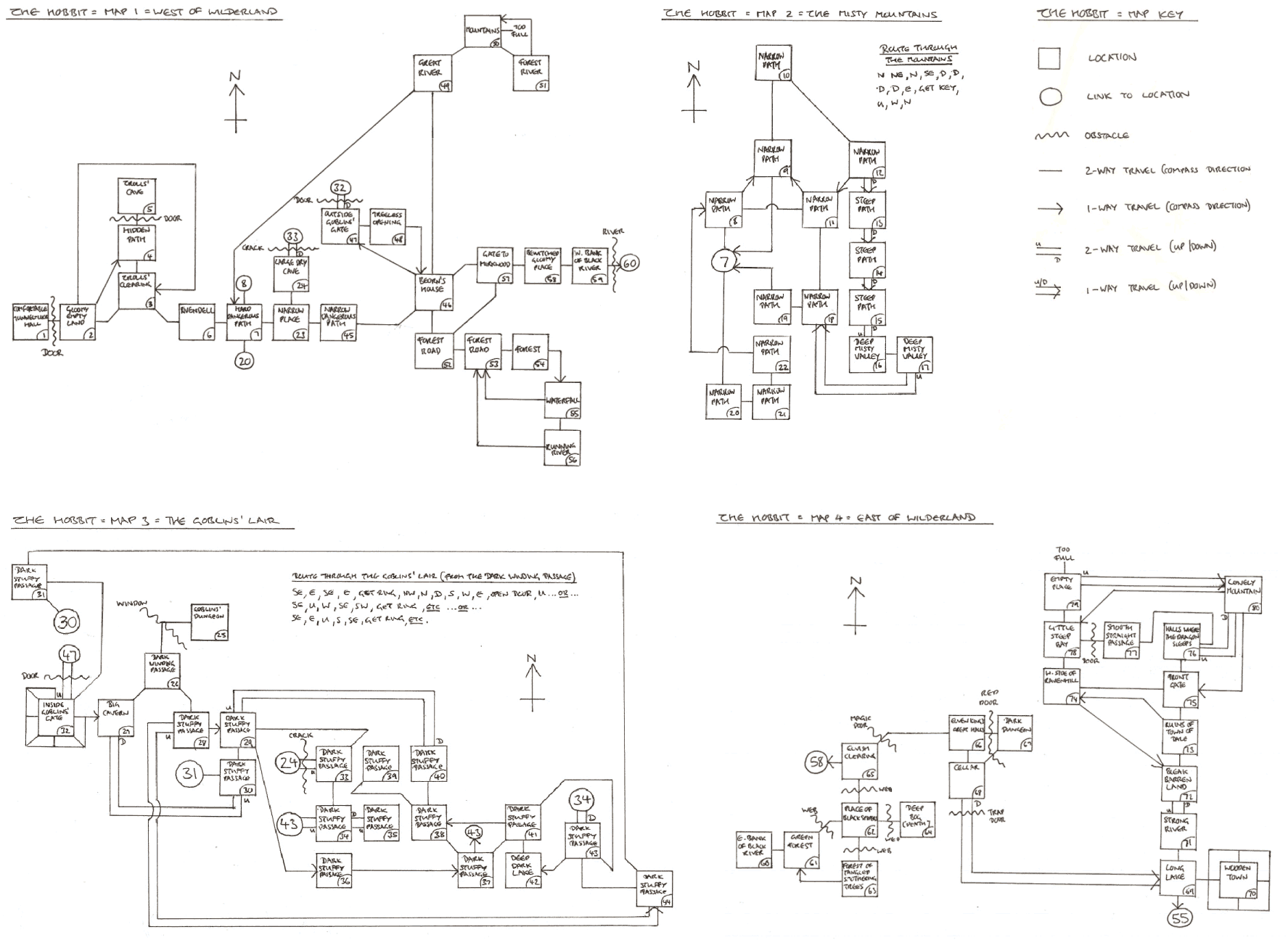
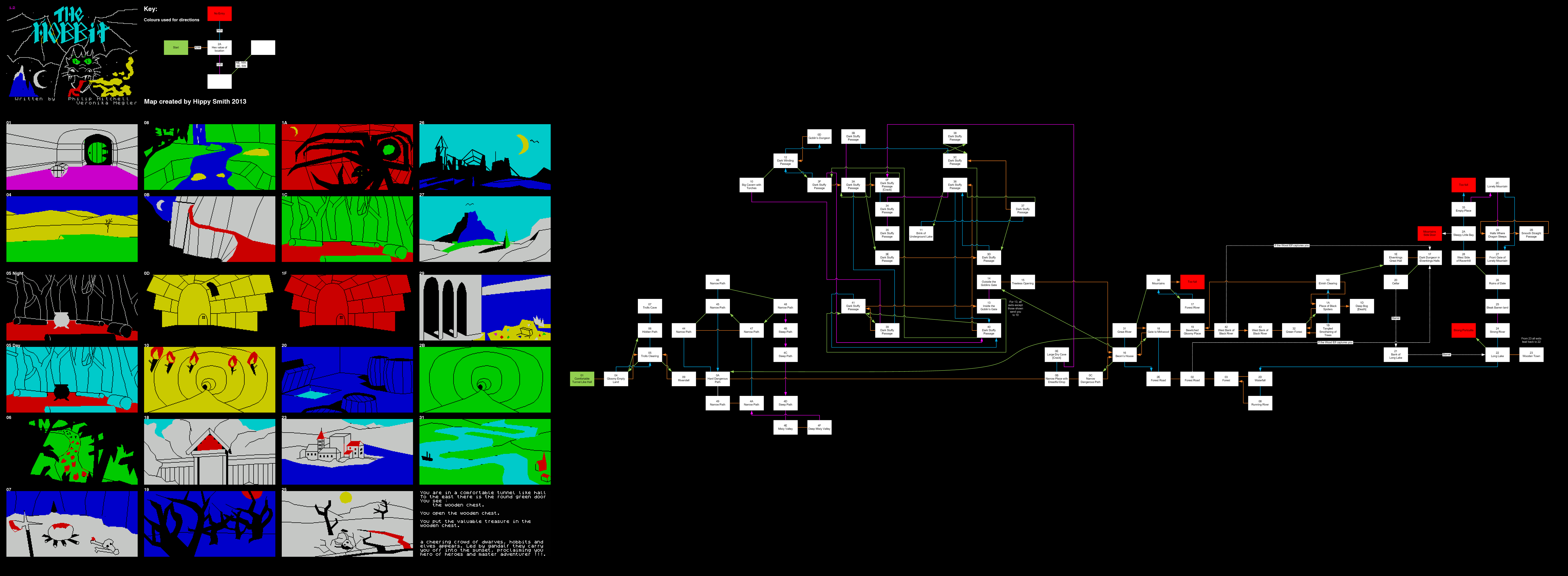
.jpg)
Discussion
Nobody has started a thread about this yet.
Remarks
ZXSR: Originally came with book, also re-issued at £9.95 without book.
This was the first Spectrum game ever to sell a million copies. Veronika remembers: "It was never released in the US, because some company owned the rights to the pictures, and wouldn't let us license it there. On the funny side - in a pre-release version I'd written in an angry dwarf that kept trying to kill you, and if you did something (I don't remember what) it became a randy dwarf, and kept following you around and propositioning you. But Fred and Phil decided that was a little too much, and made me take it out again."
Awards
Rank #01 - 1984 Sinclair User Top 50 Spectrum Software Classics
Known Errors
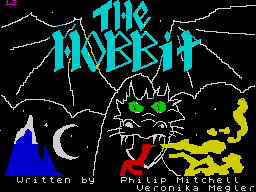
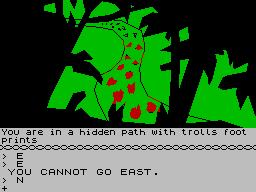
In the original version 1.1 of the game it was impossible to kill the dragon. That's because you couldn't go east from the town in the middle of the Long Lake. This has been corrected in version 1.2, mind. It sounds like it was a slight fault in the routine where you must ask Elrond to read the map for you, and the route he tells you about is only actually filled in on the map at that point. If you don't have him read the map to you then the route won't exist. The way to spot the difference between the versions is that the names of the programmers have been added on the loading screen for 1.2. (Ian Ormesher in Your Sinclair #5 page 62)
Releases
- 1982Melbourne HousePound sterling 14.95
- 1982Sinclair Research Ltd
Play
- hobbit.rzxRZX playback file
- HobbitTheV1.0.tzx.zipTape image English30 KB
- HobbitTheV1.2.tzx.zipTape image English31 KB
- HobbitTheV1.2(TextOnly).tzx.zipTape image English31 KB
- HobbitTheV1.0.tap.zipTape image English45 KB
- HobbitTheV1.2.tap.zipTape image English33 KB
- HobbitThe(SinclairResearchLtd).tzx.zipTape image English30 KB
Documents
- HobbitThe(EN).pdfInstructions English244 KB
- HobbitTheV1.0.txtInstructions English28 KB
Other files
- Hobbit, The (1982)(Melbourne House).pokPOK pokes file 0 KB
Files and rights
Distribution permission is on record, granted to another archive rather than to this one. Screens and pictures are copied here; everything else links to the archive that holds it.
- AllowedSinclair Research Ltd → WorldOfSpectrum
Credits
- Philip Mitchellcredited
- Veronika Meglercredited
- Con AslanisInlay/Poster Art
Sign in to credit somebody, or say what these people did.
Awards
Scores
In the magazines
- Sinclair User #121983 · Gilbert Factor9/10
- Sinclair User #121983 · Gilbert Factor9/10
- Sinclair User #321984 · Gilbert Factor9/10
- ZX Computing #301986 · OverallGreat
Elsewhere on the web
- WorldOfSpectrum 207 votes8.54
Awards and competitions
Big K - Readers Poll 1984
- 2Adventure Game of the Year
C&VG Spectrum Top Ten 1983
Golden Joystick Awards 1983
- 1Strategy Game of the Year
- 2Game of the Year
In the magazines 269
ZX Computing #30Oct 1986 · p.88ZX Computing GlobellaGreatGreat
ZX ComputingZX Computing Globella
Overall Great
Peter Sweasy Great
Melbourne House £9.95 When The Hobbit first came out, I was not as amazed as all the reviewers of the time. In fact I disliked the game. I was unimpressed by the "independent" characters (all that "Thorin sits down and sings about gold" rubbish); and I objected to some of the hefty £14.95 (which seemed vastly expensive when compared with an average of £5 per cassette at the time) paying for a book which I, like many other people, already owned. Since then I have become an adventure reviewer and know what makes a good game. The ridiculous hype has died down and I can appreciate the program's good points, which are numerous. Furthermore, I can review it honestly without being in awe. That said, it is deservedly a classic - and the game responsible for introducing so many people to the wonderful world of adventures. The program has aged remarkably well; its speed and presentation still compare favourable with anything on the market, as does the friendly vocabulary and the responsive, helpful replies, the graphics are variable; some duff, some still good, but none really poor. They tend to improve the further you progress. The location descriptions are far briefer than I remembered, perhaps too short by today's standards. However, with all the messages and characters wandering around, there remains a reasonable amount to be read. The game has some lovely - and now classic - puzzles. You haven't lived until you've escaped the Goblin's dungeon! Another admirable feature that is rare even today is that many problems can be solved in a variety of ways, as can the game itself; gaining the treasure is by no means the sole task. This helps add realism to the computer controlled world and I begin to see what everyone was raving about. Character interaction is a vital part of the game, and well handled, though not so mind-boggling these days. What did happen, by the way, to the other twelve dwarves? In many respects I prefer this to the first Lord Of The Rings game. The Hobbit has nothing like the same complexity, but is much more enjoyable to play, and I feel captures the atmosphere of the book better (no photographs or heavy metal here!), hen again. The Hobbit is a far less complicated story. The only real problem is the price. I would have thought past sales would have paid for The Hobbit's development many times over by now; yet at £10 there's virtually nothing more expensive. Considering the book is no longer included, its price has hardly changed. I'm sure some shops have been selling The Hobbit off as old stock for much less, and at a mid-budget price of £5, or as one of Elite's "Classics", this would be a monster hit. As it stands, I would say it's still worth playing, but make your own judgment as to whether it is the best use for your adventuring budget.
Sinclair User #32Nov 1984 · p.39/10
Gilbert Factor 9/10
The world of computer games is divided into two types of people - those who have escaped the goblins' dungeons and those who are still stuck there. The Hobbit was ahead of its time when released in 1982 and remains the adventure by which all others are judged. You must follow the footsteps of Tolkien's Bilbo Baggins in his quest for the treasure of the dragon, Smaug. The game features illustrations, character interaction, and a text interpreter allowing the input of English sentences. The plot changes each time you play it, and the list of possible solutions is still growing. Position 1/50
Crash #5Jun 1984 · p.109
E. Munslow
The Hobbit has clocked up huge sales on the Spectrum and has been converted on to three other home micros, as the game has established itself in the affections of millions of computer owners as the most popular adventure game ever. Strange as it may seem, though, as adventure games go it is not nearly as good as it could have been. Certainly, to experienced micro-adventurers, it is fairly easily mapped and solved, since it only offers 60 or so locations to be visited, which is pretty small beer by today's standards of cheap RAM. With available memory of the order of 40K in many micros, it is feasible to squeeze well over 200 locations into a game, producing a scenario which has possibilities to test the most seasoned adventurer. The great attraction of the Hobbit lies not in its basic complexity, but in the novel (and very sophisticated) approach its writers have chosen with regard to its operation. To begin with, its recognition of input from the player is amazing, compared to all currently available adventures. Scorning the usual limitations of a two-word input, consisting of a verb-noun pair such as TAKE SWORD or GO EAST, The Hobbit can accept lengthy and quite complex sentences of up to 128 characters in length. It is a great annoyance to players to be given the response 'I can't do that' when a game lacks the vocabulary to carry out a simple instruction. The vocabulary of the Hobbit is high - three or four times that of the average, so the possibilities of action are correspondingly large. If the program does not recognise a word, it makes the fact clear, and differentiates between this and whether the desired action is possible. It is this quality of input analysis which explains the attraction of the game for first-timers: the Hobbit has been the first game played on a micro for many purchasers of the Spectrum, and very few will have been let down, as the game is so easy to get into, and enjoy, without being too easy. There are two other great attractions of the Hobbit. Most obvious is that the game has popularised the use of graphic illustrations. Although not the first to use pictures of locations (the Apple has had several such adventures for some time) it was the first on a truly popular micro, and has generated a flock of imitators. In fact, there are less than 30 of the simplistic drawings, but they do add a certain something to the game, without wasting too much memory, and point to the future of Sinclair adventures, when a couple of hundred such pictures can be called from the Microdrive. Their only disadvantage in the Hobbit is that they cannot be turned off and when slowly drawn for the fiftieth time they can begin to grate on the patience. The second novel feature is the apparent independence of action (named animaction by Melbourne) of the other characters in the game. Your co-adventurers, Thorin and Gandalf, as well as the elves, trolls, spiders and dragon encountered later, all seem to behave independently of you and each other, and so, if no entry is made from the keyboard, action will continue. Gandalf will flit in and out, Thorin will, at random, decide to help or hinder your efforts to escape from dungeons, and other inhabitants will appear to live out their lives as the game progresses. The object of the game is to regain the treasure of Smaug, the dragon, but to do so you will need to explore and map the locations, collecting swords, keys and magic rings, on the way. Everything about the game exudes class, from the stunning loading screen to the thorough documentation provided. This comprises a 16-page booklet which describes the game and outlines some of the allowed vocabulary and a copy of the original Tolkien book that the game is based upon. The latter is invaluable for hints, particularly concerning the trolls' clearing and the wine cellar - problems which would otherwise be very difficult to solve. As an added extra, not usually provided for in adventure games, it is very easy to send screen output to the ZX printer, to be re-read at leisure. The Hobbit has set the standard for micro adventure games and although rather highly priced compared with most, its extreme elegance, it not its complexity, makes it well worth the outlay - a great starter for the novice adventurer and, hopefully, not the last Tolkien adventure on the Spectrum.
Micro Adventurer #8Jun 1984 · p.32
John Fraser
BOOKING-UP SOFTWARE GAMES John Fraser evaluates the book and software packages currently available. "You've read the book, now play the game" seems to becoming an increasingly popular slogan in advertisements for adventure games. Since the spectacular success of The Hobbit several other companies have moved into producing bookware, books combined with software cassettes in one package. Sometimes, however, the games bear little resemblance to the books on which they are supposed to be based and the attractive packaging can be quite misleading. Indeed, the diversity of approaches, not only to the games but even to the books, makes choosing a suitable package all rather confusing for the new enthusiast. Almost all the currently available bookware falls into the general categories of science fiction or fantasy, which raises several interesting questions. For example how suitable are these genres for translating into micro adventures? How closely do the games follow the books? What are the advantages and disadvantages of these to mediums? Are such packages all that they claim to be? First of all there are several obvious but nevertheless fundamental differences between books and software which concern their physical formats alone. For one thing a book is portable. You can read a book anywhere, whereas you cannot - at least not yet - take your micro on a train journey and play adventure games, except with printed versions such as The Warlock of Firetop Mountain and subsequent titles. ESCAPE Nor do you have to wait before you can read a book. A long adventure like The Hobbit takes several minutes to load and even then you may experience loading difficulties or find that the game does not always do what it should. My copy of The Hobbit for example, crashes when I try to escape through the trap door in the Elvenking's cellar and this has been known to happen with other copies. It is easy, too, to keep your place in a book. If you wish to return to a particular page you can do so almost instantaneously. Although you can save your current game position in many adventures, the process is time consuming and much less convenient. Nevertheless, it is a useful option if you have just spent several hours exploring the farthest reaches of Middle Earth and dread the thought of having to start all over again the following night. For those with printers, The Hobbit enables you to obtain print-outs of the adventure windows so that you can examine your progress at any time. Effectively, you have your own program-generated story in which you decide the course of the action. One wonders whether fiction writers will eventually be churning out best selling novels with special novel-writing programs? With the memory limitations of home micros full length novels or, for that matter, text adventures of a similar size, are out of the question, although Gilsoft's new adventure-writing program The Quill, now means that anyone can write their own adventures without any previous experience of programming. From what has just been said it might appear that adventure games are too much of a hassle to be worth playing. As I hope to show, however, this is certainly not the case since the different formats that the games can take are extremely varied. The book may be a straightforward novel or story such as Colin Kapp's The Pen and the Dark or may be arranged, as in The Warlock of Firetop Mountain, in the manner of a programmed learning course whereby the reader selects different options at each stage of the narrative and so becomes an active participant in the adventure. On the other hand, the games may be pure text adventures which follow the story closely (The Pen and the Dark); text and graphic adventures (The Hobbit); arcade maze games which bear little resemblance to the book (Warlock); or adventures offering selected incidents from the story with strategy or arcade type games (Korth Trilogy). The imaginary worlds of science fiction and fantasy are natural choices for software writers. One of the advantages of producing a game based on a previously published novel or story is that you have a ready-made scenario and here there is no shortage. The Hobbit was an early classic which has inspired fantasy writers ever since. Originally published in 1937, the book appeared well before the first mainframe computer became operational, but if ever there was a ready-made scenario this was it. HEROES The plot is virtually a blueprint for fantasy adventures: a journey across a vast and often inhospitable land in search of precious gold. Along the way Bilbo, a hobbit, in the company of dwarfs meets all sorts of creatures - goblins, elves, trolls and ultimately the evil dragon, Smaug. Warlock concerns a similar quest, although in this case you take on the role of the hero and have to locate the Warlock's treasure, hidden deep within the dungeons of Firetop mountain. The Pen and the Dark and the Korth Trilogy represent two ends of the science fiction spectrum. The Pen and the Dark is the only one to be based on a strictly scientific premise and is one of five stories by Colin Kapp, about the various anomalies investigated by Fritz Van Noon of the Unorthodox Engineers. In this story he attempts to solve the mystery of the Dark, a vast mushroom-shaped artefact left by an alien intelligence. The Dark appears to be indestructible, absorbing all the energy that the Unorthodox Engineers can unleash. Surrounding the Dark itself is the Pen, the region which negates all energy. The Korth Trilogy tells of how three young heroes eventually save the earth from repeated attacks by the mighty Korth empire. This is sheer space opera, cowboys and Indians among the stars following in the wake of Star Wars and the kind of simple scenario one finds in so many arcade games. Even though all these books are quite different from each other they nevertheless have one common feature. They describe imaginary worlds that are subject to the same laws that govern our own or else possess an internal consistency which the reader can believe in. Even in Middle Earth, where magic rings and fire-breathing dragons are taken for granted, logical limitations are imposed. Bilbo has very human weaknesses and emotions, and is the sort of reluctant hero the readers can readily identify with. There are several factors which ought to be considered whether you are setting out to convert your favourite book into a mammoth adventure or merely trying to decide which package to spend your money on first. Clearly, if you happen to be familiar with any of the books you are on surer ground. Although these considerations inevitably overlap to some degree, they fall roughly into three main areas which I shall look at in turn. ATTACK Believability: is the fictional world so credible that the reader becomes thoroughly immersed in the events, characters and places in the book? The Hobbit is one of those rare books that people read again and again, and yet the story remains the same each time. So does the game add anything to the reader's enjoyment of the book? And what about those games which only portray selected incidents from a story? if the book is not essential to playing the game is it of any value? Interest: are some games so complex that you would rather just sit down with the book and passively absorb the story, leaving the game alone? In The Hobbit events proceed slightly differently each time you play the game. There is an element of the unexpected, with the possibility of being attacked at any moment. It is also possible to interact with the main characters so that the story becomes more your own creation. The Pen and the Dark, in contrast, is a fixed adventure, but the problems raised in the game are sufficiently complex to sustain your interest for hours. Warlock and the Korth Trilogy are graphic adventures only and cannot really be compared to the text from which they are derived. Ease of Play: this overlaps to some extent with the need to capture the player's interest. Without clear and complete documentation you are only going to find the game too frustrating to play. With some packages fairly comprehensive booklets are included that offer advice on such things as communicating with the other characters, crossing rivers and so on. With others you can obtain a sheet of hints for solving most of the problems that you encounter, although without giving too much away. The graphic adventures such as Warlock and the Korth Trilogy are self-contained, with full instructions appearing on the screen. Having now established some criteria for assessing bookware, let us take a closer look at each package in turn and see how the software writers have tackled the problem of converting a book into an adventure game. Each combination of book and software cassete illustrates different features which I shall focus on. The obvious example to begin with is The Hobbit, since the game has been a bestseller for some time and is often regarded as the adventure by which all others should be judged. It also contains several innovations which are either difficult or quite impossible to reproduce in book form. It is not difficult to see why The Hobbit has been so highly praised, even though more recent examples, such as Valhalla, have extended the possibilities of adventures still further, so that you can now actually see the characters moving in accordance with your instructions. But The Hobbit was revolutionary because it not only combined a text adventure with high-resolution graphics, but also displayed some degree of artificial intelligence. The player could communicate with the characters in the story using plain English, or Inglish, as the publishers have chosen to call it. Naturally there were limitations to the Inglish language but this novel feature was a considerable advance. The ability of the characters to lead independent lives also enhanced the appeal of the game enormously. Elrond invariably gives you different directions each time you ask him to read the map. Often Thorin refuses to co-operate when you ask him to help you escape from the goblin's dungeon. And, on rare occasions, you may be captured in Beorn's house and find yourself in the Elvenking's Hall. In fact, there is no one solution to The Hobbit. As anyone who claims to have finished the game will know, you may still be making new discoveries each time you play it. REPRODUCED The textual descriptions are concise and, unlike pure text adventures, there are no lengthy descriptive passages. You are not told what Gollum or a vicious warg looks like because all that is in the book. What you do get is a basic description of your location, such as "You are in a dark dungeon in the Elvenking's Hall. To the south west there is a red door..." and there is an attractive picture of the dungeon on the screen. The book fills you in on the atmosphere of the place and describes Bilbo's predicament and his reactions to it, in a way which no text and graphics could hope to do. The real time element, however, cannot be reproduced in book form. As you ponder over your next move all the other characters are going about their business, which means you cannot spend too long hanging around. Thorin will soon tell you to hurry up or he will sit down and start singing about gold. The game also allows you to explore various locations. You may look through doors and windows to see what lies beyond or who might be waiting for you. You can follow characters, examine objects, eat and drink. In fact live out a surprisingly real existence. There are some slight departures from the book, though the sequence of events are much the same. One significant difference is that Bilbo has lost 13 dwarfs and only has the chief dwarf, Thorin, and the wizard, Gandalf, to accompany him. Another is that the answer to Gollum's riddle is not the same as it is in the book. Then again, you may find objects which do not appear in the book at all, such as the golden key in the Misty Valley. OPTIONS The success of the game has a good deal to do with how much it involves the player in the action. But it is equally due to Tolkien's own fertile imagination which created the evocative land of Middle Earth and its host of characters in such convincing detail. Tolkien's world has long had a steady stream of visitors and now newcomers, or already hardened travellers, have the opportunity to become in a sense part of that creation. With The Warlock of Firetop Mountain we are on somewhat different ground, although the invented worlds of Middle Earth and the Warlock's lair have a good deal in common. It was first published in 1982 and since then more than one million copies have been sold. The book offers a comparatively cheap means of adventure gaming, which has more in common with dungeons and dragons type role-playing games: your initial characteristics are determined beforehand by rolling die and recording the results on an adventure sheet. You start with the minimum of equipment - a sword, rucksack with food and drink and a shield. You may find other objects along the way. To restore your skill, stamina or luck points you can take a magic potion at any time. Whenever you have to fight a creature there is an elaborate combat system and escape options are sometimes provided. The book attempts to simulate a degree of randomness by continually providing different options for the player and facilities whereby he can test his luck and so on. While this is a demanding and time-consuming adventure, you do get the satisfaction of being able to deal with all sorts of nasty creatures yourself and, should you succeed, the additional enjoyment in having discovered the treasure. Unlike Bilbo's quest there is only one route to your journey's end, although it can take you several attempts before you find the correct one. As a marked contrast the game is an arcade type in which you manoeuvre a figure through a complex maze and have to collect 15 keys to unlock the treasure chest and find the way out. All manner of creatures may attack you, but you have to react quickly for this is a very fast game. Often, there are lengthy periods when little happens at all. The book conveys far more of the atmosphere of the place than the game does. You cannot really imagine the dark dungeons and slimy walls when zapping around the maze; nor do you have much time to think things over. The book does not fall victim to the memory limitations of many home micros and so can afford to devote far more space to description. As in an exciting novel you feel compelled to read on, only here you take on the role of the hero which adds greatly to the suspense. Will some loathsome creature be waiting for you behind the door? Will you manage to cross the fast-flowing river? Will you even survive the journey to the Warlock's treasure? The element of suspense is lacking in the game. The emphasis falls more on fast reactions and good co-ordination. For the experience of being involved in a fully realised world of fantasy you need the book, but at least the combination offers a choice of formats for less than the price of many adventures. The Korth Trilogy consists of three book/software packages. There are three games on each tape representing episodes from the narrative. While some of the games are of the arcade variety, others are strategic with layouts that resemble board games on which the player moves his men around usually in an attempt to infiltrate the alien base. The inside cover of each book gives notes on the accompanying programs, together with page references to the incidents in the story. But the games can quite easily be played without having to read the books. Sufficient information is provided on the screen. It is best, though, to make notes before trying to play them because there is a good deal to remember. In the first book, Escape from Arkaron, the heroes test-fly a newly developed ultra light ship. When tests prove successful they venture out to an inner planet of the Sirius system, where they make their first contact with the Korth empire. The related games tape contains Testrun, an uninspiring game which shows the simulator developed after the first test run. The object is to fly either to Sirius or Pluto, avoiding the continuous stream of meteors that scroll jerkily down an oblong window in the centre of the screen. There is a similar simulation game on the second tape, which is a lunar lander type and adding little to your enjoyment of the book. There are other games which allow the player to participate in the more exciting incidents, such as Prisoner in which your mission is to rescue one of your men from the Korth prison and have to fight your way along a maze of corridors to free him from the cell. In Alpha, on the second tape, you must find and reprogram the computer responsible for sending unmanned Korth ships towards the solar system. You can move up the floors via lifts or stairs, though you do have to watch out for unfriendly guards along the way. One game even portrays events which supposedly occurred before the story opens. In Empire you must have to run the empire while the computer is being repaired. You must deal with uprisings, shortages, overproduction and so on. This is perhaps the most interesting game in the trilogy although, as the situation does not arise in the story, the books are of no help at all. CONTRIVED For your children these packages are worthwhile. The games will doubtless encourage the child to read the books and vice versa. Sometimes, however, the pace of the story momentarily slackens. When the trio is testing the revolutionary space drive, for example, the reader is bombarded with technical data which might have been better relegated to an appendix for all the good it does in advancing the plot. It is almost as if the stories were written after the games and the incidents slotted into place around them. Books written specifically for computer games are more likely to be contrived, because the writer has written to a predetermined formula rather than sought inspiration from his imagination. In the case of the Korth Trilogy the same writer was responsible for the books and the games. But effective characterisation, literary style makes for entertaining fiction which can so easily be discarded as the player presses on with the action. An exciting story, though, is what children generally want to read and, on the whole, this is just what the Korth Trilogy, with its intergalactic battles and desperate missions and character development, provides in abundance. FRUSTRATING For a more intellectually demanding adventure you may prefer The Pen and the Dark, which follows the main events in Colin Kapp's ingenious story: the engineers' investigations of the Pen and their attempts to gain entry into the Dark. The game introduces new problems concerning how to obtain and use the equipment necessary to complete your objective. Fortunately a hints sheet is available from the publisher, although even then, you may well find yourself in extremely frustrating situations. You can spend much of the time trying to open doors which cannot be opened until you have completed some other task, if only you knew what that other task was. At least there is no real time element to contend with, so you can take as long as you like over a problem without feeling threatened. The instructions recommended that you read only the first section of the story before playing the game, otherwise your enjoyment of finding out the secrets of the quest and perhaps the conclusion of the story for yourself may be considerably reduced. Like The Hobbit the text is minimal, but often the program will respond to meaningless inputs in a rather more humorous vein. At the same time the responses can be irritating when you have tried everything you can think of and do not seem to be making any headway. While The Pen and the Dark lacks the innovative features of The Hobbit, it certainly throws out a challenge to anyone who delights in problem-solving. It is very much a matter of personal taste which sort of game is to be preferred. And, of course, as with literary awards, no two players will agree on what they consider to be the best package. COMPLEMENT In any case it is not a question of whether one is better than another; the games are simply different. Which is not to say that book/software packages cannot be evaluated at all. At least we can affirm a general principle: that adventures, whether text, graphics or both, should not be a substitute for the book, but that one should complement the other. Ideally, playing the game will lead to a greater appreciation of the book, while reading the book at the appropriate stage leads to a greater understanding of the game. Book/software packages are becoming increasingly popular with software writers and publishers. While taking plots from existing books may be less work for programmers short on original ideas, established book publishers are recognising the enormous potential that such packages can have. REVOLUTION Numerous projects are reported to be under development, among them Harry Harrison's Stainless Steel Rat from Mosaic, a Tolkienesque fantasy from Century and, for the BBC micro, The War of the Worlds from CRL. And Quicksilva's recent release based on Raymond Briggs children's book The Snowman is bound to be a great success. Like the Korth Triology this is not an adventure game, although it does involve the child in ways that are unusual. Whether we are heading for the software revolution that some writers are forecasting remains to be seen. But certainly bookware shows all the signs of being a growth area, and the sort of combinations likely to be dreamed up over the next few months is very much open to speculation. ((c) Sunshine Books for UK magazine rights - otherwise ((c) John Fraser).
Crash #4May 1984 · p.56
Jaswant Singh
I stood at the edge of the Black River (not very wide across) and pondered my situation. I had the short strong sword and the rope courtesy of two dead (literally stone-cold dead) trolls, and the valuable golden ring snatched after great effort from under the nose of a now dead Gollum. (It seems pathological killers are well catered for in this game.) I had been incarcerated in, and escaped from, the notorious Goblin's Dungeon with a little help from my friends. I had met the friendly elf Elrond, and found refuge in Beorn's House. My companions, a singing dwarf and a wandering wizard, had long been left behind. Well armed and supplied, I had crossed mountains, killed goblins and acquired maps. Familiar with the almost certain fatality encountered by taking some routes, I had now reached an impasse, I could see no way of finding the dreaded dragon, Smaug, or his hoard of treasure. However, the game's superiority over other adventures available to me, and its unique feature of independently moving characters, persuaded me to persevere, and my capture by a wood elf led me deeper into this comp game. Eventually, by following the plot in the famous book, I found and killed the dragon and laid claim to his treasure. Unfortunately that is only half the game, as the treasure has to be carried back to a now far-distant starting point. The most remarkable features of this game strike you very quickly. The high resolution graphic displays promised are delivered in the title page when the game is loading; Smaug the ferocious dragon belches such realistic flame at you that I almost felt the need for an asbestos shield! Any adventure played for the first few times invariably seems to result in frequent death, and after restarting a few times the second powerful feature becomes apparent: the characters move independently of you, so you are never sure whether your two companions will help you in the next location or whether they will hurriedly depart to leave you in the company of vicious thugs like wargs or goblins who will quite happily decapitate you despite your pleas for mercy. Yes! I said pleas for mercy because you can communicate with friend or foe depending on your inclination. This device is very helpful in exploiting the abilities of your companions, and much of the game depends on successfully communicating your ideas to allies. These features, in addition to the fantastic scenario and depth of imagination used in Tolkien's book (whose plot seems tailor-made for conversion into an adventure game), make this program a remarkable achievement. The high-resolution pictures, of which there are about 30, were drawn with the help of an artist whose eye for colour and detail provoke the atmosphere of Tolkien's book at the various locations: the Bewitched Gloomy Place is dark and forbidding while the Bleak Barren Place is suitably inhospitable. The Hobbit is accompanied by the original book, which is followed faithfully, and many clues are to be found therein. An instruction booklet is also contained in the package and explains the highly flexible user-friendly language 'Inglish' which the game understands. This, incidentally, was developed by a linguistics expert and allows for longer more complicated sentences without the limit of one objective per sentence. The instruction booklet is well written and the game is easily entered into. The high-resolution colour displays help your imagination to envisage The Hobbit's world, and the response to instructions is very quick. Quick responses are also required of the player as The Hobbit plays in real time, thus adding to the excitement. I can wholeheartedly recommend this game as it is easy for the novice and provides the veteran with a welcome change from the limited uninspired text-only adventures. A scoring system (mine is 77.5%) allows for friendly competition. At £14.95 it is very good value.
CRASH REVIEWERS COMPETITION In the first issue of CRASH (February) we ran a competition designed to discover the best reviewers of games from among readers. The results of this competition should have been announced in the third issue (April). We had, however, overlooked the fact that, as they say, everyone's a critic at heart. By the time the third hundred review dropped into the IN tray, we realised that there was no way it would be possible to process all the entries in time. Hence the one-month delay.
In addition to the winner and five runners-up, the following get a special mention, and extracts or whole reviews will be appearing in following issues. Vic Groves, Regent's Park Estate, London NW1 A. J. Green, Toddington, Beds Rob Holmes, Wirksworthy, Derbyshire David Branston, Hall Green, Birmingham S. Guillerme, London W8 R. Norfolk, Scholar Green, Stoke-on-Trent H. J. Lock, Wallington, Surrey David Dursley, Clifton, Bristol J. E. Price, St Albans, Herts
JUDGING CRITERIA What we were really looking for were reviews that managed to provide a good, concise description of the game in question and combine it with a sense of humour, personal observation and, of course, an ability to write in a fluent, interesting way. We did say that entries would not be judged on spelling ability, although it would be important to be literate. In the event, there seemed to be very few bad spellers. A number of entries tried to ape the style of presentation as seen in CRASH, which was not necessary at all, although this did not affect the outcome of the final decision; and other writers steadfastly stuck to the format that other well-known computer magazines offer. The winner and five runners-up have provided a varied selection of titles, and although it was felt that the winner stood out, he did so from the runners-up by a faint margin. All in all it was a hard Choice. And so to the most important part - the results.
Readers were asked to write three reviews of titles picked from a selection of 79 games, divided into five categories: Arcade, Adventure, Strategy /board games, Simulations, Utilities and Educational. Each review was supposed to be of between 500 and 900 words. However, due to a rather ambiguous use of language (sorry) entrants were a bit confused as to whether they should write three reviews of this length or three reviews which together added up to this length. As it was our error, no one has been penalised for picking either figure. As it turns out, it was just as well that there was a large selection of choice, but, in the main, the majority of reviewers opted for the more obvious games and there were numerous versions of Jetpac, Hobbit, Penetrator and Zoom. From among the utilities The Quill and Melbourne Draw proved favourites. We were pleasantly surprised by how many educational reviews we received, showing that this is a vital area of interest for quite a number of readers. Choosing a winner and five runners-up has been a difficult task, not only because there were so many entries, but also because the standard was extremely high throughout. A factor common to many entries was the tendency to pick games obviously well enjoyed by the reviewer, thus allowing said reviewer to rhapsodise over the game's finest points rather than actually criticise it. It's always much easier to say nice things about something than to say unpleasant things in a constructive manner. On the other hand, there were a few entries which positively reveled in tearing a program to shreds as a sort of revenge against the computer game in general!
THE WINNERS ENTRIES It would only be fair to say that in the opinion of the Editor there were several entrants who were able to provide more detailed descriptions of the games than those that will be found in the winner's reviews. But the winner managed to combine most successfully the ability to enthuse over a game while at the same time keeping a sense of overall perspective. He was able to describe the games adequately and in a very personal way. Most importantly, all three reviews start off in a highly original and entertaining manner, creating instantly an atmosphere which makes the reader want to carry on reading. As printing all the winning entries in one go would take up too much room, we have had to split them up into two sections. This month the winner, J. Singh, and runners-up John Minson and Phil Morse; next month runners-up Gary Bradley, E. Munslow and Steven Wetherill. The following month we will be printing some further entries which deserve a special mention. May we thank everyone who wrote in to take part in the competition.
WINNER - CRASH REVIEWERS COMPETITION Jaswant Singh is 19 and lives in Hadley, Telford, with his family: mother, father, two sisters and brother. He went to Manor School, just down the road from where he lives, and he left with 10 O-levels and four A-levels. He now works for Lloyds Bank. The CRASH Reviewers' Competition isn't the first competition that Jaswant has won. In May 1982 he won second prize of £300 as an A-level student in a competition organised by Barclays, writing on teaching and the microchip. He was also a runner-up in a nationwide competition organised by The Observer and Whitbread of the subject, How the Chip Will Change Society. Jaswant bought his first Spectrum in October, and says he prefers playing arcade games. He does not use a joystick, although he is thinking of getting one soon. We hope that Jaswant will be joining the team of CRASH reviewers very soon.
WINNER CRASH REVIEWERS' COMPETITION J. Singh, Hadley, Telford, Salop RUNNERS-UP (Not in order of merit) Steven Wetherill, Kexboro, Barnsley, S. Yorks E.Munslow, West Bromwich, W. Midlands Gary Bradley, Glasgow John Minson, Muswell Hill, London N10 Phil Morse, Welwyn Garden City, Herts
Crash #4May 1984 · p.59
John Minson
Chess is one of the oldest table-top games, but fantasy role playing (frp) is among the more recent. Its computer equivalent is adventure gaming, and here The Hobbit has been acclaimed as state of the art. The Hobbit goes much further than most adventures in allowing for the human elements of frp. Input is in Inglish, using simple sentences rather than the more usual two-word commands. Characters have a semblance of independent life too as they wander about the landscape, and you can even converse with them. The aim is to locate a realistic country within the Spectrum. To do all this in 48K is impressive. It also provides simple but effective graphics, but sensibly only on first encountering a scene, or when requested. The documentation is good, and the inclusion of Tolkien's novel adds to its scope. After which it seems churlish to criticise, but for me The Hobbit failed to live up to its reputation. The independence of the characters was too obviously random. Gandalf in particular wanders aimlessly. As to conversing with them, the usual response is less than helpful, and sometimes totally illogical - a 'No' followed by the request being met! Keyboard response can be a little strange, and with so much to type in a beep would have been useful. The program is not bug free either, though to be fair the booklet admits that this is to be expected in a work of this scale. I have found that the only way to continue the adventure did not appear as an option on one occasion! The game also lacks the epic prose of the book, and I don't know that the vividness of more words wouldn't have been preferable to the pictures. I feel that The Hobbit suffers from falling between the two stools of tightly structured brain-teasing adventures and the open, human moderated frps. It is probably worth £14.95 despite this, because it is still addictive, but it left me wanting something better.
CRASH REVIEWERS COMPETITION In the first issue of CRASH (February) we ran a competition designed to discover the best reviewers of games from among readers. The results of this competition should have been announced in the third issue (April). We had, however, overlooked the fact that, as they say, everyone's a critic at heart. By the time the third hundred review dropped into the IN tray, we realised that there was no way it would be possible to process all the entries in time. Hence the one-month delay.
In addition to the winner and five runners-up, the following get a special mention, and extracts or whole reviews will be appearing in following issues. Vic Groves, Regent's Park Estate, London NW1 A. J. Green, Toddington, Beds Rob Holmes, Wirksworthy, Derbyshire David Branston, Hall Green, Birmingham S. Guillerme, London W8 R. Norfolk, Scholar Green, Stoke-on-Trent H. J. Lock, Wallington, Surrey David Dursley, Clifton, Bristol J. E. Price, St Albans, Herts
JUDGING CRITERIA What we were really looking for were reviews that managed to provide a good, concise description of the game in question and combine it with a sense of humour, personal observation and, of course, an ability to write in a fluent, interesting way. We did say that entries would not be judged on spelling ability, although it would be important to be literate. In the event, there seemed to be very few bad spellers. A number of entries tried to ape the style of presentation as seen in CRASH, which was not necessary at all, although this did not affect the outcome of the final decision; and other writers steadfastly stuck to the format that other well-known computer magazines offer. The winner and five runners-up have provided a varied selection of titles, and although it was felt that the winner stood out, he did so from the runners-up by a faint margin. All in all it was a hard Choice. And so to the most important part - the results.
Readers were asked to write three reviews of titles picked from a selection of 79 games, divided into five categories: Arcade, Adventure, Strategy /board games, Simulations, Utilities and Educational. Each review was supposed to be of between 500 and 900 words. However, due to a rather ambiguous use of language (sorry) entrants were a bit confused as to whether they should write three reviews of this length or three reviews which together added up to this length. As it was our error, no one has been penalised for picking either figure. As it turns out, it was just as well that there was a large selection of choice, but, in the main, the majority of reviewers opted for the more obvious games and there were numerous versions of Jetpac, Hobbit, Penetrator and Zoom. From among the utilities The Quill and Melbourne Draw proved favourites. We were pleasantly surprised by how many educational reviews we received, showing that this is a vital area of interest for quite a number of readers. Choosing a winner and five runners-up has been a difficult task, not only because there were so many entries, but also because the standard was extremely high throughout. A factor common to many entries was the tendency to pick games obviously well enjoyed by the reviewer, thus allowing said reviewer to rhapsodise over the game's finest points rather than actually criticise it. It's always much easier to say nice things about something than to say unpleasant things in a constructive manner. On the other hand, there were a few entries which positively reveled in tearing a program to shreds as a sort of revenge against the computer game in general!
THE WINNERS ENTRIES It would only be fair to say that in the opinion of the Editor there were several entrants who were able to provide more detailed descriptions of the games than those that will be found in the winner's reviews. But the winner managed to combine most successfully the ability to enthuse over a game while at the same time keeping a sense of overall perspective. He was able to describe the games adequately and in a very personal way. Most importantly, all three reviews start off in a highly original and entertaining manner, creating instantly an atmosphere which makes the reader want to carry on reading. As printing all the winning entries in one go would take up too much room, we have had to split them up into two sections. This month the winner, J. Singh, and runners-up John Minson and Phil Morse; next month runners-up Gary Bradley, E. Munslow and Steven Wetherill. The following month we will be printing some further entries which deserve a special mention. May we thank everyone who wrote in to take part in the competition.
WINNER - CRASH REVIEWERS COMPETITION Jaswant Singh is 19 and lives in Hadley, Telford, with his family: mother, father, two sisters and brother. He went to Manor School, just down the road from where he lives, and he left with 10 O-levels and four A-levels. He now works for Lloyds Bank. The CRASH Reviewers' Competition isn't the first competition that Jaswant has won. In May 1982 he won second prize of £300 as an A-level student in a competition organised by Barclays, writing on teaching and the microchip. He was also a runner-up in a nationwide competition organised by The Observer and Whitbread of the subject, How the Chip Will Change Society. Jaswant bought his first Spectrum in October, and says he prefers playing arcade games. He does not use a joystick, although he is thinking of getting one soon. We hope that Jaswant will be joining the team of CRASH reviewers very soon.
WINNER CRASH REVIEWERS' COMPETITION J. Singh, Hadley, Telford, Salop RUNNERS-UP (Not in order of merit) Steven Wetherill, Kexboro, Barnsley, S. Yorks E.Munslow, West Bromwich, W. Midlands Gary Bradley, Glasgow John Minson, Muswell Hill, London N10 Phil Morse, Welwyn Garden City, Herts
Crash #4May 1984 · p.74
Producer: Melbourne House, 48K £14.95 To date the great adventure, based on the famous Tolkien novel of the same name, which is included for the price. This game has a largish vocabulary and allows sentence with link words. Artificial intelligence of a kind enlivens the action as the characters continue their lives regardless of what you do. It's possible to inter-relate with them to some degree, depending on their feelings towards you. Some even get killed without you knowing about it until you stumble across their bodies! I've forgotten what the quest is, but it's hardly important - playing the game is. Very long and totally absorbing. A classic.
Crash #2Mar 1984 · p.66
Producer: Melbourne House, 48K £14.95 To date the great adventure, based on the famous Tolkien novel of the same name, which is included for the price. This game has a largish vocabulary and allows sentence with link words. Artificial intelligence of a kind enlivens the action as the characters continue their lives regardless of what you do. It's possible to inter-relate with them to some degree, depending on their feelings towards you. Some even get killed without you knowing about it until you stumble across their bodies! I've forgotten what the quest is, but it's hardly important - playing the game is. Very long and totally absorbing. A classic.
Crash #1Feb 1984 · p.63
Producer: Melbourne House, 48K £14.95 To date the great adventure, based on the famous Tolkien novel of the same name, which is included for the price. This game has a largish vocabulary and allows sentence with link words. Artificial intelligence of a kind enlivens the action as the characters continue their lives regardless of what you do. It's possible to inter-relate with them to some degree, depending on their feelings towards you. Some even get killed without you knowing about it until you stumble across their bodies! I've forgotten what the quest is, but it's hardly important - playing the game is. Very long and totally absorbing. A classic.
Personal Computer Games #3Feb 1984 · p.29
THE HOBBIT This month's selection from the Good Buy is a brilliantly original adventure with graphics, advanced language and real characters. Your name is Bilbo Baggins, the hobbit, and you are about to embark on a fabulous quest to recover treasure from a dragon's lair. To do it you'll be you'll be using one of the most remarkable programs yet produced on a home computer. The Hobbit, now available on four different micros (see Buzz, page 6) is an improvement on the traditional computer adventure game in three different ways. First there's the graphics. Instead of just text descriptions, many of the 50 adventure locations are depicted in beautiful high-resolution colour drawings. They're completely successful in capturing the atmosphere of Tolkien's book on which the adventure is based. Then there's the introduction of different characters. In traditional adventures, characters are usually tied down to a single location and are capable of doing only a single thing - which they do every time the game is played. In The Hobbit an attempt has been made to give each character his own personality, and he's free to move through different locations interacting with Bilbo in many different ways. These vary from game to game. If Bilbo isn't doing anything, the other characters probably are. To that extent, the game is played in real time. The third innovative feature of the game is the language-handling ability. Whereas the usual mode of communication in adventures is in two-word sentences, the authors of The Hobbit have developed a language called INGLISH which is remarkably sophisticated. Verbs can be modified by adverbs, and nouns by adjectives: instead of the command 'ATTACK ORC', you can say 'ATTACK ORC VICIOUSLY', or even 'ATTACK THE LARGE ORC VICIOUSLY'. You can adlso add indirect objects as in 'ATTACK THE LARGE ORC VICIOUSLY WITH THE SWORD'. Finally, Bilbo can talk to the other characters, seeking advice or help. For example, you can enter 'SAY TO GANDALF "UNLOCK THE CUPBOARD WITH THE SMALL KEY".' Other helpful program features are a score which tells you how much of the adventure you've completed, the ability to SAVE and VERIFY your current position on tape, and a very nicely produced instruction booklet. The adventure is also faithful to the Tolkien story, and your only hope of solving it is to read this carefully, an act which should in itself give you considerable pleasure. A copy of the book is included with the program, which costs £14.95 and is worth every penny.
C&VG (Computer & Video Games) #21Jul 1983 · p.130
Keith Campbell
DWARVES WHO SPEAK ENGLISH The parallel I drew a few months ago between an Adventure game and a story is exemplified in The Hobbit from Melbourne House, which runs on a 48k Spectrum. The game is presented very much like a book - the "front cover" with full colour illustrated title is displayed whilst the program loads. The game is a fairly close representation of the book, which is itself supplied as part of the package. The action of the game takes place in over 50 of the locations described in the book and depicted on the map of Middle Earth. On the first visit to a location, a full colour picture of the surroundings unfolds, adding to the impression of a story-book game. But the player should beware of gazing at the attractive pictures for too long - another feature of the game is "Animaction", whereby the various creatures go about their business inside the computer. Messages appear spontaneously on the screen from time to time as a result of this background activity, which has an effect on the course of the game. While you dither, don't be surprised to see Gandalf or Thorin, up and leaving either. The possible commands are very flexible. A language recognition program called "Inglish" is incorporated, and "ATTACK THE TROLL CAREFULLY WITH THE SWORD" is recognised as easily as "RUN". The game is linked to the story by a 16-page booklet which explains the grammar and vocabulary of "Inglish", the split-screen mode of display, plus hints and tips on playing the game. If you are a Hobbit fan then you will enjoy playing the book and reading the game I think? The cassette costs £14.95 as it is sold with a paperback version of the Tolkien classic. If you don't know the story of Bilbo, Gandalf, Gollum and the dwarves and their epic journey across Middle Earth, it will provide a few clues to playing the game. Reviewer: Keith Campbell
ZX Computing #6Apr 1983 · p.76
Phil Garratt
Phil Garratt, after a brief sojourn in Middle Earth, takes time off to tell us what he found there. Once upon a time, a young professor, bored to distraction with marking School Certificate exam papers, wrote on a blank sheet of paper 'In a hole in the ground there lived a hobbit'. That was over fifty years ago, and at the time neither the professor, JRR Tolkien, nor anyone else had any idea what a hobbit was. Eventually the story was told, and ever since, The Hobbit has been one of the most popular and best loved children's books. Its popularity and that of The Lord of the Rings which followed, is matched only by the seriousness with which some Tolkien fans dissect the books for allegorical meaning, never intended by the author. So it takes a brave group of people to set out on an 18 month adventure to re-write The Hobbit as a computer game. Fortunately for 48K Spectrum owners, the team at Melbourne House have managed it, and in pretty good style too. You may wonder how it could have taken 18 months, when the Spectrum has been available for less than a year. The answer is that the program was originally being developed on a TRS-80, but was converted to the Spectrum in order to make use of high resolution colour graphics. The plot of the adventure has been designed to follow the original book as closely as possible, in fact to such an extent that a copy of the book is supplied with the program in order to provide additional clues. Also part of the package is a 16 page book of instructions, although if you find the prospect of digesting them not to your liking, there's nothing to stop you rushing headlong into the enterprise. After all. that's what Bilbo did! The instruction book is well-structured and clearly laid out, although disappointingly lacking in hints! ENTER THE DRAGON The game is set in Middle Earth during its Third Age, when it was inhabited by all manner of creatures, long before the world was overrun by Man. You take the role of Bilbo, the hobbit of the title, and your task is to steal treasure from a dragon, 'a most specially greedy, strong and wicked worm called Smaug'. In the book. Bilbo has 13 dwarves to help him get there and (hopefully) back again, but in the program you have just one companion, Thorin Oakenshield. He is an 'enormously important dwarf' not least because we are warned that if he gets killed, Bilbo is most unlikely to survive. Along the way you will meet elves, wolves and orcs as well as the famous wizard, Gandalf the Grey, who is usually not far away. The program is written in 40K of machine code and data, so it takes about four minutes to load. While you are waiting, you have an impressive picture to look at of Smaug and the Lonely Mountain which contains his lair. The program starts by drawing a colour picture of Bilbo's nice bright hobbit-hole, complete with round green door and wooden chest waiting to be filled with dragon's plunder. The use of graphics is one of the features which makes The Hobbit special. The adventure contains something like 80 locations, of which no less than 30 are illustrated. The graphics are based on drawings commissioned from the artist Kent Rees, and while none of them are quite as elaborate as the picture of Smaug, they do contain a remarkable amount of detail. By using special techniques, each picture is stored in only 3,000 - 4,000 bytes. The outline is drawn very quickly, but the filling in with colour is done line by line and so does take a few seconds. It can be slightly tedious when the same picture keeps being re-drawn, but this is only a minor drawback as the addition of graphics as good as these adds a whole new dimension to the adventure. PICTURE THIS Once you have admired the pretty picture, pressing any key gives the written description of the location. This also has some special features. Firstly, the screen is split into two 'windows', the top 17 lines being used for the illustrations, the narrative descriptions and responses from the various characters. This is in upper and lower case, and by redefining the character set. the output is displayed with 42 characters per line. The bottom 5 lines make up the 'communication window' in which you type your commands and if the computer doesn't understand or cannot carry out your request, a message is displayed here. The lower display is made up of standard 32 characters per line capitals. Some keys have special meanings - '?' means repeat the command, 5, 6, 7 and 8 can be used to move West, South, North and East, 0 deletes the last character entered and Shift 0 deletes the whole line. Commands are entered using what the authors have named Inglish, which they claim is the most sophisticated natural language recognition program yet developed on any micro. You can enter quite long sentences, such as 'Attack the warg carefully with the knife' and 'Pick up the rope and sword'. More than one sentence can even be entered, up to a maximum of 128 characters. The authors claim a vocabulary of more than 500 words, which is extraordinarily large. Yet, despite the size it is very quick, although the system is not perfect. For example 'light' is a command common to many adventures, and is accepted in The Hobbit, although nothing happens and the curious message 'You light' is displayed. Similarly, if you attempt to cross the enchanted river by saying 'Cross', the program says 'You cross', but when you look around you find that you are, in fact, still stuck on the original side. CRIES FOR HELP... Several special commands are also available. 'Print' copies everything in the upper, narrative window to the printer. The graphics displays are not copied, which is perhaps just as well as it would slow down the game if they were, and also the black and white result wouldn't do justice to the colourful designs. Your commands are not sent to the printer, so you cannot necessarily use the output to follow an earlier path. Still, Bilbo is meant to be fond of making and reading maps! 'Noprint' turns the printer off. 'Save' saves your current position on tape; just the necessary data is saved, so it only takes 30 seconds. The program doesn't use the standard ROM routine, and I found that the tape position was important as starting too early gave a tape loading error. The data saved can also be verified before continuing, and is reentered with 'Load'. 'Score' tells you how far into the adventure you have delved, based on the percentage of the locations you have discovered. I never managed to get very far at all before a troll, warg, or some other unidentified creature drastically rewrote the book by killing me off and sending me back to the start. 'Help' is a very useful command, and will quite often give a hint as to the way out of your latest predicament. Two other features of The Hobbit that the authors are very proud of are 'Animtalk' and 'Animaction'. The first allows you to speak to anyone present so, for example, you can enter 'Say to Thorin "examine the map'", and he will either respond or say 'No', depending on his mood. 'Animaction' refers to the fact that all the animals and individuals have an independent character and will be moving around and making decisions on their own, without waiting for you to do anything. So far about the only animaction I have witnessed is Gandalf behaving uncharacteristically indecisively, by continually giving and then taking back a curious map. Also, Thorin seems to either wait, enter, say 'Hurry up' or start singing about gold, apparently at random. A WIZARD GAME Despite having only explored little more than an eighth of 'Wilderland', I have seen nine graphic locations and picked up which I assume will have some purpose. ! haven't yet found a way into the roots of the Misty Mountains, but I hope I will as I greatly look forward to the riddle contest with Gollum (incidentally the riddles are different to the ones in the book, not surprisingly!). At a couple of recent micro exhibitions I have noticed that the staff on the Sinclair stand (when not selling hundreds of Spectrums) have been deeply engrossed in playing The Hobbit rather than any of the dozens of other programs available on their stand. The fact that they had neither solved nor tired of this program says quite a lot! It is certainly a marvellous game, which should set the standard for future Spectrum adventures. However, in spite of the excellent graphics and packaging, I feel that £14.95 is a rather high price for a program which is clearly going to sell many thousands of copies. The Hobbit is available from Melbourne House, [redacted] and branches of WH Smith.
Some sample screen illustrations from the program, The Hobbit.
C&VG (Computer & Video Games) #17Mar 1983 · p.410/109/109/10
Getting Started 10/10
Value 9/10
Playability 9/10
Keith Campbell
As The Hobbit loads, an illustrated title page is displayed, rather like the cover of a book. Indeed, the book The Hobbit by J.R.R. Tolkien is supplied as part of the package, and it is advisable to read this before playing, since the game follows the theme quite closely. Another booklet describing how to play the game is provided and includes hints on the plot and how "Inglish", the command language works. In play the screen is split in two. A "communication window" at the bottom scrolls independently from the "adventure window" above which gives details about the location and action. On his first visit to a location the player is rewarded with a colour illustration of it. The action is continuous, since The Hobbit is played in real time. The creatures go about their business whilst the player is thinking. Whilst head-scratching is in progress it is quite likely that more messages will appear on the screen, such as "Thorin goes east through the green door" or "Gandalf gives you the map". The publishers call this feature "Animaction", and it means there is no unique solution, the game being slightly different every time it is played. A charming Adventure, requiring considerable time to complete. The Hobbit comes from Melbourne House for the 48K Spectrum at £14.95.
CHILDHOOD FANTASY Adventure is what all small boys - and most bigger ones - long for. Remember all those childhood books that took you into a world at excitement and fantasy? Didn't you, like me, wish you were one of the Famous Five? Adventure gaming will take you one step nearer to your dreams. In the comfort at your own home. Originally written tor large mainframe computers, these games have now been brought to the masses via the micro. Adventures are being published in ever increasing numbers for every popular machine. An Adventure game makes you the would-be here. You move about from one location to another, examine things, pick up and manipulate objects, and solve puzzles. But all the time danger lurks and hidden enemies may strike at anytime. Your goal may be anything from collecting priceless treasures to saving the world from disaster. You become part of the story, the computer working to calculate what your actions will achieve within the plot devised by the author. Don't expect fancy graphics in an Adventure - although there are graphic Adventures. Expect words. Your imagination will provide the pictures - just like it does when you read a good book. And like a good book, you will find it just as difficult to put down. When buying an Adventure first discover if the scenario and degree of complexity suit your tastes. Games reviews will help here. Find out if the speed of the game is right for you as there is a great deal of variation. From my experience a minimum of 16K of memory is required for a decent adventure and from there on up the bigger the better. A "save game" feature is useful as it enables you to return to a game where you left it at a later stage without having to leave the machine running all night. If your computer has sound and colour these will enhance game. But for the purist a good plot is enough. Keith Campbell
GAMES GLOSSARY If you can tell a Pacman from a Defender and a Galaxian from a Space Invader you probably know your way around computer games. But if some of the game terms we have used in this supplement, or in the issue itself, are new to you, then this page should supply the answers. In it we take some of the best known types of computer game and describe how they are played and what features these games normally incorporate. So, if we claim that Penetrator is a "Scramble-type game" and that leaves you just as much in the dark about what to expect, then below there is a full description of Scramble to put you in the picture. ASTEROIDS The Asteroids came into the arcades courtesy of Atari. It features a small dart-shaped craft controlled by the player which can rotate left or right and thrust or fire in the direction it is facing. There is one further control, the panic button (hyperspace) which lets you travel to another part of the screen chosen by the computer. The enemy is mainly made up of large asteroids which sweep across the screen in large deadly groups of rock. When blown up these break into smaller fragments worth extra points. There is extra danger supplied by two UFOs. The first larger creature you'll meet fairly early on. It tends to spray shots in all directions and often crashes into an asteroid. The smaller variety is far more deadly in its own shooting and also more difficult to hit. Each cleared screen means you start again with extra asteroids. DEFENDER You can't expect to keep a finger on every control button in Defender or you'd end up in knots. The action, which takes place above an alien landscape, involves some seven control buttons and takes patience to gain proper mastery of your lone craft. That patience can be rewarded though, as Defender is challenging from the word "Go". The Defender craft can go: up, down, thrust forward, reverse direction, fire, smart bomb and hyperspace. Ten humanoids wander on the landscape and these may fall prey to raiding alien creatures known as Landers. Landers pick up the humanoids and take them to the top of the screen. If they succeed in getting there the Landers turn into fearsome mutants hellbent on your destruction. In all there are six alien opponents. On top of Landers and Mutants, these are: Pods are quite harmless but contain the small and persistent Swarmers; Bombers seed space with white bombs and Baiters only appear if you take too long clearing a screen of the rest of the aliens. If all 10 humanoids are captured, the planet explodes and all remaining alien life attacks your craft at once. Defender games usually feature a small radar screen which shows what is going on at all parts of the planet surface. FROGGER Frogger has spawned a whole host of computer games with a similar theme. This game features a frog hero who must jump across a road and make his way across a river torrent to five frog-holes in the bank. The busy road usually features live streams of traffic travelling in both directions at varying speeds, between which the player must hop his frog without wrapping it around any fenders. Once across the road, the river can be crossed by leaping onto floating logs and onto the back of swimming turtles, until our frog can enter a vacant spot in the far bank. Turtles have a habit of diving though so don't let a frog dally too long on one. Being carried off the edge of the screen (by log or turtle) also results in a note in the funeral column of Amphibians' Weekly. When all five frog-holes have been filled, the game becomes more difficult with extra traffic being added to the road, snakes traversing the bank between road and river and alligators appearing instead of logs in the river. A timer running down on each frog also adds to the difficulties. The arcade original also featured a small lady frog who could be "picked up" on the logs and offered a lift home for a bonus. Other bonuses can be scored by entering a frog-hole in which a tasty fly meal has come to rest. DONKEY KONG Donkey Kong is the strange name for a climbing and jumping game which features a starlet-grabbing monster gorilla. Often referred to as Crazy Kong or Crazy Climber in the computer circles, it has only just found its way onto the home screen. The game features a gorilla holding a girl captive at the top of the screen and an intrepid hero (Mario the carpenter), who starts at the bottom of the screen. Between the two is a connecting network of platforms and ladders up which Mario must run to achieve his rescue. Kong hurls barrels down the screen and Mario makes use of his "jump" button to leap over them. He can also grab a hammer and smash the barrels as they approach him. Once at the top of the screen a new complex is built with Mario, again starting from the bottom with a view to rescue. This time the screen features a series of conveyor belts and deadly fires which travel around on the ladders and belts. GALAXIANS The Galaxians were the sons of Space Invaders. Instead of proceeding down the screen at a leisurely pace, they wavered at the top of the screen before swooping down in batches of two or three (or more often on a solo mission) firing bombs. The player has the usual left, right and fire controls on his laser base and must take care not to get trapped in a corner. He scores double points for a galaxian hit in mid-swoop and there are bonus points for taking out the red fleet commanders, who usually descend flanked by their generals, dispersing bombs at such a rate that the first instinct is to flee for cover. That is the essence of Galaxians but with each destroyed platoon, new waves appear at screen top and their attacks become more frequent, more accurate and, all too often, more deadly! PACMAN The ghostly world of Pacman is made up of a dot-filled maze, a hungry dot-eater and four pursuing spectres. Pacman variations can be found under a whole range of titles from Vic-men to Gobbleman, Snapper to Super Glooper and many others. Most dot-eating games are related to it. The main character is the dot-eater, which travels around the maze, eating every dot he touches. His objective is to clear the screen of dots. He is hampered in this by the four chasing ghosts whose touch is lethal. The Pacman's main defence against the ghosts, who usually number four, are energiser dots. These pulse in the four corners of the maze and, upon being eaten, reverse the roles for a short while. This means that Pacman can turn the tables on the ghosts and eat them for bonus points. He is allowed only a few seconds of dominance before the usual hunter and hunted rules come back into operation. It is also usual for fruits to appear on the screen occasionally and these too can be consumed by Pacman for bonus points. When Pacman has cleared the screen, it refills with dots and the game restarts except that this time the ghosts are a little livelier and a new fruit, worth extra points, appears at this level. SCRAMBLE Scramble should have a big one-way sign on its cabinet. The screen rolls from right to left, taking the player's craft along it into ever-increasing danger. Scramble variations often contain the word "Mission" or "Attack" but there are some weird and wonderful titles about. The player controls a craft heading right across the screen over hilly terrain His craft can never turn around and opt out of its mission but he does have some control over his destiny. His controls are up and down, fast and slow and he can both bomb and fire at his enemies. The Scrambler is not usually equipped with enough fuel to complete his task, but it is normal to obtain more fuel by bombing fuel tanks on the ground and so (mysteriously) replenish his own stocks. The enemies come in all shapes and sizes. Most common are missiles which fire up from the ground as your craft passes overhead and alien invader creatures which frequently inhabit caves and fly at the player's craft. The original Scramble game sent the player through a series of different terrains with new challenges in each section. And most computer Scrambles attempt to duplicate this with a number of different stages. Scramble requires a cool head which can find the right control in a crisis, but it makes an ideal computer game as success naturally leads to new and more difficult stages. INVADERS Space Invaders started the whole computer game craze back in 1977 and most gamers know the format backwards. Still, just a brief resume... The invaders come in waves above the ground and move in rows across the screen one step at a time, firing missiles earthwards. When one row of the aliens reach an edge of the screen, the whole platoon jump down a line and return back the way they came. When they achieve their slow progression to the bottom of the screen, the game ends. The player controls a laser base which moves left to right and fires directly up from its position. His aim is to blow up the entire fleet before it reaches the bottom of the screen. Flying saucers move across the top of the screen in both directions and can be hit for a mystery bonus score. In the arcade original, top saucer scores of 300 were achieved by firing 22 shots before shooting at the first saucer, then firing 14 shots in between each subsequent saucer. Some computer versions have copied this technique.
Sinclair User #12Mar 1983 · p.629/109/10
Gilbert Factor 9/10
John Gilbert 9/10
SINCLAIR ACTS TO IMPROVE THE STANDARD OF ITS NAMED SOFTWARE John Gilbert looks at the latest group of cassettes issued by Sinclair and finds that it is now setting the standards. A new batch of Sinclair Research software for the ZX-81 and Spectrum shows a marked improvement in the quality of programs and a continuation of fine artwork on the cassette inserts. The reason is that the company is selling programs from other independent companies, such as Melbourne House and Artic, instead of continuing to rely on Psion, Mikro-Gen and ICL. The Hobbit which takes first place in the new releases for quality and value for money. This adventure game, which the makers claim uses artificial intelligence, is discussed in Mind Games on page 93. VU-3D, for the 48K Spectrum, is another good offering from Psion. It allows the user to create a three-dimensional representation of an object on the television screen. The object can then be rotated and viewed from any angle. The objects can be displayed as wirework figures or can be shaded. They can also be magnified and reduced. It is possible to store the figure on tape in a data file and re-load it to view again. The program costs £9.95 but even though it has some good features it still seems over-priced. Games feature strongly in the new tapes. Sinclair is selling the Artic range of adventures, A, C and D. Adventure A works on the 16K or 48K Spectrum and 16K ZX-81 and is called Planet of Death. You are stranded on a planet and must return to your spaceship. There is no guide to the keywords but with a little thought you can discover the help command. At times the suggestions can be very unhelpful and it is a good idea to construct a map, as some of the help suggestions may make you retrace your footsteps. The next adventure so far released is C, called Ship of Doom. It can be run on the 48K Spectrum and 16K ZX-81. Your ship is captured by aliens who are searching for humanoids to replace their brains with microchips. The object of the game is to escape from the alien craft by breaking the gravitational field. To do so you must find the control room of the alien ship. The help command is a little more useful in this game and it is easier to get further when playing the game. Adventure D, called Espionage island, can be used on the 48K Spectrum or 16K ZX-81. You must escape from an aircraft which is about to crash into the Atlantic. You must the reach the island safely, avoid capture, and try to discover the secret of the island. The game is more difficult than the others and many people have not managed to get out of the aircraft, even though there is a parachute. All the adventures cost £6.95. Leaving adventure games, Reversi, or Othello as it is sometimes called, can be played on the 16K Spectrum or 16K ZX-81. The game has nine levels, from novice to expert, and the computer is difficult to beat. The makers claim that Reversi reflects the strict contemporary morality of Victorian society but we believe that it can traced to Arabic origins. Reversi costs £7.95. An interesting addition to the range of software is the Artic 1K Chess. It takes some technical wizardry to squeeze this kind of game into the unexpanded ZX-81. The game can be played using one of two opening moves. Because of the lack of memory, castling, pawn promotion and capturing en passant are not allowed. The game loads in approximately 40 seconds and that is ideal for someone who wants a quick game of chess without having to load from a tape which takes several minutes. The computer also makes its moves very fast for the amount of memory available to it. 1K Chess costs £4.95. Super Glooper is an amusing game of Pac-man on the 16K ZX-81. Glooper must paint the maze before the aliens kill him. Unfortunately it is difficult to evade those aliens using the standard ZX-81 keyboard but it is not impossible. Glooper can also pick up one of the shields at the corners of the maze to protect himself and chase the aliens. On the other side of the tape is Frogs, a game of Frogger. You must get the frogs over the river via the moving boats to the jetties on the other bank. If froggie falls into the river, it drowns. You score points for each frog you get across the river and you can have eight frogs to send to their deaths. Super Glooper and Frogs cost £4.95. Another game with a familiar-sounding theme is Through the Wall. It is based on Breakout and is available for the 16K ZX-81. On the other side of the cassette is Scramble, also a familiar theme. Both games on one cassette represent good value at £4.95. A package for the 1K ZX-81, called 1K Games, has also been released. The games include Jackpot, in which you must try to win the 25 pence jackpot from a one-armed bandit; Etch and Sketch, where you can draw pictures on the screen; and Maze Game, where you must find your way out of the conventional maze. The release of this cassette, costing £4.95, is a good idea at a time when so many people are buying ZX-81s. A basic Toolkit is available for the 16K ZX-81. It provides a series of machine code routines to make the job of programming easier. It includes a re-number routine, a search and replace routine, a merge routine to put together two separate Basic programs, and a routine to put a Basic program above RAMTOP and out of the way of the NEW command. The Toolkit costs £5.95. Two database programs are available in the range for the 48K Spectrum. They are called Collector's Pack and Club Record Controller. Collector's Pack can be used to store information about coins, stamps or even records. The Club Record Controller will store information about people such as addresses and telephone numbers. It would be useful to schools or even someone who runs a private club. Both packages are easy to use and cost £9.95. Adventure B, Inca Curse, for the 48K Spectrum is an upgrade of an adventure which Artic wrote for the 16K ZX-81. The adventurer is exploring in the jungle when he finds an Incan Temple. The aim is to go in and drag out all the treasure, or as much a you can carry. It all seems so easy until you enter the game and step into the temple. The authors have managed to cram a good deal into this adventure and the Artic top score of 3,200 points will take some beating. We must admit that it is not one of the adventures in which we have made much progress. Adventure B costs £6.95. The latest release of tapes is certainly better than the previous one. The games, utility, and business areas have been covered well but there is still a lack of good educational software. The only tapes available tend to be multi-choice and question-and-answer sessions. The Psion tapes seem to be the best for quality at the moment and the ones with the most interesting concepts. None of the cassettes reviewed was bad but The Hobbit, Vu-3D, 1K Chess, and Super Glooper seem best.
Sinclair User #12Mar 1983 · p.939/109/10
Gilbert Factor 9/10
Quentin Heath 9/10
NEW CASSETTE CAN BE HOBBIT-FORMING Tolkein's tale has captured the imagination. Quentin Heath attempts to get to the ring but finds he wastes too much time. Sales of The Hobbit, an adventure game for the 48K Spectrum, have been going very well, according to Melbourne House, the company which produces it. It is one of the most complex games for the Sinclair machines I have seen and that is one of the reasons why it is selling so well. The plot follows closely that of Tolkien's book and there are added dangers to make it more interesting. There are many objects in the game which cannot be used until certain situations have been passed or conditions met. They tend to take up a fair amount of time on this adventure. Much time can be wasted by checking objects which prove to be useless. For instance, many people who see the chest in the hobbit hole at the beginning of the game usually are tempted to look inside. The player may suspect that the chest contains weapons or armour but there is nothing inside, That may cause further consternation and a furious search. All that has happened to most victims of the game I know, including several people in the Sinclair User office. Usually a chest is for putting things into and at the beginning of the game there is nothing to store in the chest. The one thing to remember is that the most ordinary and unmysterious objects usually prove the most useful. At all costs you must be practical, as examining objects which seem mysterious may lead you into the dark. The Inglish language specially developed by the makers, which all the games characters speak fluently, is causing problems for some people. Most of the time Gandalf and Thorin wander around saying 'Hurry up', 'What's this', or 'No' at the slightest provocation. You should not give up, though - experiment by talking to Thorin, Gandalf and Elrond. The information one of them will give you is certainly not misguided. If you have managed to obtain more information from any of the characters, I would be interested to hear. In the early stages of the game it is best to follow one direction when going forward and that is explained in the Hints and Tips column. If in doubt, follow that direction and it will usually get you out of trouble. There are some very odd moves which you can make during the course of the game. For instance, if you have a sword you could kill Elrond when you visit Rivendell. That is very easy to do but your blood lust could prevent you learning Elronds secret. That may not seem very important at the time but it could make a difference to the outcome. A sword is a basic piece of for any adventurer and can be of use against most foes, as well as Elrond. Your sword is provided for you in the early part of the adventure and it is a good idea to pass the trolls to get it. The secret of the sword is difficult to unlock but you must remember that problems are not half so bad in the daylight. There are two other problems which adventurers in The Hobbit are meeting. The first is the maze in the misty mountains. If anyone has managed to get out alive I would like to know. The second problem is that the program sometimes crashes when you have battled your way through the Elven Kings Halls, got into one of the barrels in the cellar and plunged into the underground river. One correspondent has had that happen several times. The makers of the game believe that it is the fault of the particular tape copies.
HINTS AND TIPS - READ ONLY IF DESPERATE Go east when all else fails or north when past the mystic Elves. A stone troll is the key to the door when day dawns. Beware of pitfalls in Beorn's house. Turn west at the wooded gate to the north. When pale eyes are about to sting, retrace your steps.
Your Computer #1Jan 1983 · p.50
Simon Beesley
SPECTRUM SOFTWARE Simon Beesley brave attacks by trolls, bombardment by meteoroids, alien invasions and even English literature to bring you up to date with Spectrum software. The quality of Spectrum software has improved since our last survey but originality remains in short supply. Most of the programs looked at are games programs and the bulk of these are modelled on the arcade classics, Space Invaders, Pac-Man, Defender and Asteroids. Perhaps this is because the games-buying public is only interested in games that fall into a recognisable category. Some of the programs are written entirely in Basic. This need not count against them unless the program displays moving graphics. The Spectrum's keyboard is not very suitable for fast-moving games although Quicksilva and Softek offer a joystick option on some games. Sinclair has released a large range of programs written for them by ICL and Psion. By and large the ICL programs compare badly with those from Psion and have a rather amateurish look to them. Each of the tapes in the ICL games series, Games 1 to 4, contains four short Basic programs with titles such as Galactic Invasion, Skittles and Train Race. These are the sort of programs a reader might like to key in from a listing in a magazine. They are fairly simple and afford a limited entertainment for a short period. In view of their variety each package represents reasonable value although they are perhaps more suitable for young people. ICL has also produced five titles in a Fun to Learn series covering Music, History, English Literature, Geography and Inventions. They present a variety of quizzes on their respective subjects. Players can compete against each other in a race in which correct answers send them further along the track. It is difficult to know who these programs are aimed at. One soon runs through the stock of questions and the same names appear in different types of question. Some of the information presented is too obscure or eccentric to make the programs suitable for schools. In the English Literature quiz, for example, Ian Fleming rubs shoulders with Shakespeare and little-known seventeenth century playwrights. Psion's collection of programs is far more satisfactory. Hungry Horace is loosely related to Pac-Man but has a number of original features. Horace has to eat the flowers in a park while avoiding the park guards. Sinclair gives a fair description of Horace as a subtle and amusing cartoon-style game. Psion's 48K chess program was written in conjunction with Microgen. It plays a remarkably strong game even at the lower levels. As an averagely competent player I found it quite hard to beat at level two, although its play seemed to come adrift under pressure. The program's response time is quick and the pieces are quite easily distinguished. Space Raiders and Planetoids are Psion's versions of the arcade games Invaders and Asteroids. Anyone who still has an appetite for these games will find the Psion products more than adequate. With Vu-Calc, Psion has scaled down a Visi Calc-type program to the dimensions of the home micro. These programs, which are commonly used on business micros, are usually described as providing a financial spreadsheet. They enable the user to lay out financial data in rows and columns and enter formulae to run calculations on parts or all of the table. Vu-Calc supplies a range of commands for entering data, text or formulae and performing calculations. Basic programs which have been compiled by Softek's compiler, Super C, run - typically - 10 times faster. The compiler sits at the top of memory above RAMtop and is unaffected by a New command. It leaves room for a Basic program of up to 8K and a further 10K for data. The present version cannot cope with decimals, arrays or string variables. These limitations need not be too constricting. Strings, at least, can be stored in the data areas as ASCII codes and accessed through Peeks. At £14.95 this is good value; particularly since it enables people to write commercially respectable programs without having to master machine code. However Softek insists that anyone planning to sell programs created with the compiler should negotiate for the rights. Softek claims that trace elements have been included to detect code written with Super C. The arcade game Asteroids crops up on almost every micro. Softek's version Meteoroids is one of the fastest for the Spectrum with good colour and sound. Softime supplies the Spectrum with a digital clock and alarm at the top of the screen which remains there while other programs are loaded and running. The last program in Softek's list is Zolan Adventure, a standard text adventure game which has the merit of fitting into 16K. Quicksilva gave Time Gate considerable advance publicity claiming it would make as great an impact on the computer games' world as had Atari's Star Raiders. As it turns out the game closely resembles Star Raiders. Given that the Atari is a rather more sophisticated computer it is not surprising that the Spectrum version of the game does not match the original. Time Gate presents a view from the cockpit of a spaceship. An instrument panel below contains a long-range scanner and a variety of other indicators giving information on the ship's position and damage incurred. Your mission is to clear 18 galactic sectors of enemy craft. The business of locating and firing on enemy ships is not as interesting as attending to all the other procedures. The controls are not as responsive as on the Atari. Nonetheless this is an elaborate game with excellent graphics - certainly one of the best so far for the Spectrum. In an impressive piece of synthesised speech Quicksilva's chess program announces itself at the beginning with 'this is the Chess Player'. Rather startlingly the packaging relates how the Chess Player, an Evil Being, has called for a challenger from Earth. The planet's survival hangs on your game - and you thought you were just going to have a quiet game of chess. In the event the program plays quite a strong game with the option of six levels of play. The board is clearly displayed and the pieces are well designed. Psion's chess program, however, is probably the better player. Meteor Storm, another version of Asteroids, also announces itself but rather indistinctly. There is not much to choose between this and Planetoids or Meteoroids. The major problem for software companies writing an Asteroids-type game must be in finding an alternative title. Spectres from Bug-Bvte gives a novel twist to the Pac-Man concept. Eddie the electrician has to rewire a haunted house. Instead of eating or picking up objects in his path he lays down light bulbs. Reaching one of the four power generators enables him to illuminate the house and drive off ghosts. The game has a highly individual flavour. The characters which glide around at a fairly leisurely pace, are engagingly different from the standard Pac-Man figures. This is one of the more original games yet to appear for the Spectrum. Gulpman from Campbell Systems is also based on Pac-Man but refreshingly breaks away from the standard format. It offers a choice of 15 different mazes and allows the speed of play to be set. At the highest levels your little man dashes around the maze at quite a pace. By contrast Jega's Specman, written in Basic, is dismally slow. Sometimes the ghosts seem to be stricken with paralysis and unwilling to take up the chase. Escape from New Generation Software is a variation on the maze theme which involves escaping from dinosaurs. The dinosaurs - brontosauri, pterodactyls and such like - pursue the player's character with considerable animation through the maze which is shown in bird's-eye view. Silversoft's games Orbiter and Ground Attack are probably the best Spectrum versions of the arcade games Defender and Scramble. Ground Attack requires the player to fly a plane through a series of caverns and avoid or destroy missile attacks from the ground. Scramble from Work Force is similar but marginally slower. Likewise Avenger - Abacus' version of Defender - is competent but not quite as accomplished as Silversoft's. MYSTERY MEETING A gold sundial worth £6,000 is the prize for the first person to solve all the clues in the adventure game Pimania. As in Kit Williams' book Masquerade, deciphering all the clues will lead the winner to a meeting at a specific time and place with representatives from the authors of the game, Automata Ltd. The other side of the program tape contains a disco single. Automata say that the clues are scattered in the music, the program and the graphics. Although we did not proceed very far with the quest the music and opening graphics seemed to bear out Automata's claim that the world of the Pi Man is totally bizarre. Melbourne House has based The Hobbit, on the novel by Tolkien. It helps to have read the book in finding your way about. The Hobbit is claimed to be an advance on other adventure games because it introduces other characters from the book who react to the player in the role of Bilbo with an independent life of their own. It also allows you - in a limited fashion to enter sentences rather than single words as commands. In practice these extra features do not amount to much and give the program greater scope for the sort of inconsistencies adventure programs are prone to. Thorin, for example, repeatedly enters the scene and tells you to hurry up. This is irritating because you were unaware that he had left and he seems to be totally devoid of constructive ideas. It is not a good idea, however, to kill him off since he sometimes proves too strong for your attack. Furthermore the manual suggests that you should stay on good terms with the other members of your party if you are to succeed in your quest. Many of the locations in the adventure are illustrated by some excellent graphics. We only managed to complete 7.5 percent of the game during which the text was accompanied by six different pictures. The graphics coupled with a more varied plot than usual make The Hobbit superior to any other adventure games available for the Spectrum. Both the assemblers tested, from ACS and PI software, require Z-80 mnemonics to be entered in Rem statements and both allow addresses to be replaced by labels. The ACS assembler, Ultraviolet, costs twice as much at £7.50 but offers several extra features. It allows multiple statement lines and provides five pseudo-instructions such as DEFS, which inserts a string of ASCII characters at the current assembly position. ACS also supplies a disassembler, infrared. Like the assembler this has two different versions for 16K or 48K machines. The program is easy to use and docs all you might expect from it. Company: SN Program Name: Games 1-4 Memory Required: 16K Price: £4.95 Company: SN Program Name: Hungry Horace Memory Required: 16K Price: £5.95 Company: SN Program Name: Fun to Learn Memory Required: 16K Price: £6.95 Company: SN Program Name: Chess Memory Required: 48K Price: £7.95 Company: SN Program Name: Vu-Calc Memory Required: 48K Price: £8.95 Company: SN Program Name: Space Raiders Memory Required: 16K Price: £4.95 Company: SN Program Name: Planetoids Memory Required: 16K Price: £4.95 Company: QS Program Name: The Chess Player Memory Required: 48K Price: £6.95 Company: QS Program Name: Time Gate Memory Required: 48K Price: £6.95 Company: QS Program Name: Meteor Storm Memory Required: 16K Price: £4.95 Company: SF Program Name: Super C Memory Required: 48K Price: £14.95 Company: SF Program Name: Meteoroids Memory Required: 16K Price: £4.95 Company: SF Program Name: Softime Memory Required: 16K Price: £3.95 Company: SF Program Name: Zolan Adventure Memory Required: 16K Price: £4.95 Company: SS Program Name: Orbiter Memory Required: 16K Price: £5.95 Company: SS Program Name: Ground Attack Memory Required: 16K Price: £5.95 Company: MH Program Name: The Hobbit Memory Required: 48K Price: £14.95 Company: AU Program Name: Pimania Memory Required: 48K Price: £10 Company: WF Program Name: Scramble Memory Required: 16K Price: £4.95 Company: AB Program Name: Avenger Memory Required: 16K Price: £4.95 Company: CS Program Name: Gulpman Memory Required: 16K Price: £5.95 Company: JS Program Name: Specman Memory Required: 16K Price: £5.95 Company: AC Program Name: Ultraviolet Memory Required: 16K Price: £7.50 Company: AC Program Name: Infrared Memory Required: 16K Price: £6.75 Company: PI Program Name: Assembler Memory Required: 16K Price: £3.75 Company: NG Program Name: Escape Memory Required: 16K Price: £4.95 Company: BB Program Name: Spectres Memory Required: 16K Price: £8
Top and above: The Hobbit
C&VG (Computer & Video Games) #15Jan 1983 · p.19
JOIN BILBO ON HIS DRAGON HUNT The Hobbit - J.R.R. Tolkien's masterwork of imagination and lyrical prose has been converted to the computer. Your mission is to seek out the evil Dragon and return the treasure he hoards back home. As a secondary concern, you must look after Thorin the Dwarf and protect him. Should he be killed during the adventure, it is most unlikely you will be able to survive the dangers ahead of you. You will meet many of your favourite characters from the book including Gandalf, Thorin, Gollum, the Elves, and many others. Each of these characters has the ability to make decisions, interact, and communicate not only with the player but also with the other characters. The program is part graphic part Adventure game. The Hobbit runs on a Sinclair Spectrum in 48K. It comes complete with a full colour instruction manual and a copy of the book. The Hobbit, The package is available at £14.95 from Melbourne House publishers of Leighton Buzzard.
The Tolkien Trilogy carries this game and has 6 references of its own.
Tips106
- ZX MagazínJun 1992 · p.10
- Your Sinclair #48Dec 1989 · p.76
- Your Sinclair #46Oct 1989 · p.55
- Your Sinclair #44Aug 1989 · p.56
- Your Sinclair #42Jun 1989 · p.72
- Your Sinclair #41May 1989 · p.60
- MicroHobby #180Nov 1988 · p.47
- Your Sinclair #34Oct 1988 · p.106
- Crash #52May 1988 · p.41
- Crash #48Jan 1988 · p.59
- Your Sinclair #24Dec 1987 · p.102
- Your Computer #11Nov 1987 · p.45
- Your Sinclair #23Nov 1987 · p.78
- Crash #46Nov 1987 · p.108
- Sinclair User #67Oct 1987 · p.74
- Crash #44Sep 1987 · p.70
- Crash #44Sep 1987 · p.71
- Crash #42Jul 1987 · p.64
- Your Sinclair #18Jun 1987 · p.72
- Sinclair User #62May 1987 · p.81
- ZX Computing #37May 1987 · p.52
- Crash #40May 1987 · p.58
- Sinclair User #61Apr 1987 · p.81
- Your Sinclair #16Apr 1987 · p.82
- Your Sinclair #15Mar 1987 · p.54
Advert33
- Sinclair User #34Jan 1985 · p.153
- Crash #12Jan 1985 · p.177
- C&VG (Computer & Video Games) #39Jan 1985 · p.131
- Home Computing Weekly #85Oct 1984 · p.7
- Your Computer #9Sep 1984 · p.175
- Your Spectrum #7Sep 1984 · p.16
- Micro Adventurer #11Sep 1984 · p.10
- C&VG (Computer & Video Games) #35Sep 1984 · p.90
- C&VG (Computer & Video Games) #35Sep 1984 · p.91
- C&VG (Computer & Video Games) #34Aug 1984 · p.82
- Home Computing Weekly #77Aug 1984 · p.16
- Home Computing Weekly #69Jul 1984 · p.16
- Home Computing Weekly #65Jun 1984 · p.48
- Home Computing Weekly #67Jun 1984 · p.17
- Sinclair User #26May 1984 · p.42
- Sinclair User #25Apr 1984 · p.89
- Your Computer #4Apr 1984 · p.15
- Sinclair User #24Mar 1984 · p.89
- Sinclair User #24Mar 1984 · p.92
- Your Computer #3Mar 1984 · p.35
- Sinclair User #23Feb 1984 · p.93
- Sinclair User #23Feb 1984 · p.96
- Your Computer #2Feb 1984 · p.179
- C&VG (Computer & Video Games) #28Feb 1984 · p.92
- Personal Computer News #35Nov 1983 · p.32
News/Note31
- Your Sinclair #19Jul 1987 · p.79
- Sinclair User #53Aug 1986 · p.96
- Your Sinclair #8Aug 1986 · p.73
- Your Sinclair #7Jul 1986 · p.15
- ZX Computing #27Jul 1986 · p.8
- Computer Gamer #16Jul 1986 · p.6
- Popular Computing Weekly #19May 1986 · p.18
- C&VG (Computer & Video Games) #42Apr 1985 · p.12
- Popular Computing Weekly #3Jan 1985 · p.39
- Popular Computing Weekly #27Jul 1984 · p.43
- Popular Computing Weekly #28Jul 1984 · p.38
- Sinclair User #27Jun 1984 · p.13
- Your Computer #6Jun 1984 · p.61
- Your Spectrum #4Jun 1984 · p.7
- C&VG (Computer & Video Games) #32Jun 1984 · p.159
- Personal Computer Games #7Jun 1984 · p.108
- Crash #4May 1984 · p.43
- Micro Adventurer #7May 1984 · p.6
- Computer ChoiceMay 1984 · p.9
- C&VG (Computer & Video Games) #31May 1984 · p.165
- TV GamerMay 1984 · p.8
- Popular Computing Weekly #12Mar 1984 · p.45
- Personal Computer Games #3Feb 1984 · p.4
- Popular Computing Weekly #49Dec 1983 · p.57
- C&VG (Computer & Video Games) #24Oct 1983 · p.138
Two-page ad17
- Popular Computing Weekly #28Jul 1984 · p.14
- Your Computer #5May 1984 · p.18
- Sinclair User #25Apr 1984 · p.90
- Computer Answers #15Apr 1984 · p.80
- Micro Adventurer #5Mar 1984 · p.26
- Popular Computing Weekly #10Mar 1984 · p.28
- Sinclair User #22Jan 1984 · p.76
- Your Computer #1Jan 1984 · p.256
- Sinclair User #21Dec 1983 · p.90
- Home Computing Weekly #40Dec 1983 · p.8
- Sinclair User #20Nov 1983 · p.132
- Your Computer #11Nov 1983 · p.246
- Sinclair User #19Oct 1983 · p.104
- Your Computer #10Oct 1983 · p.40
- Popular Computing Weekly #42Oct 1983 · p.30
- Sinclair User #18Sep 1983 · p.56
- Your Computer #9Sep 1983 · p.74
Feature14
- ACE (Advanced Computer Entertainment) #41Feb 1991 · p.63
- Computer Gamer #5Aug 1985 · p.22
- Sinclair User #35Feb 1985 · p.76
- Sinclair User #32Nov 1984 · p.146
- Games ComputingNov 1984 · p.47
- Computer Answers #15Apr 1984 · p.61
- Computer ChoiceFeb 1984 · p.56
- Personal Computer Games #3Feb 1984 · p.29
- Popular Computing Weekly #43Oct 1983 · p.13
- Popular Computing Weekly #25Jun 1983 · p.37
- Sinclair User #12Mar 1983 · p.93
- Popular Computing Weekly #9Mar 1983 · p.31
- Popular Computing Weekly #11Mar 1983 · p.12
- Your Computer #1Jan 1983 · p.50
Letters11
- C&VG (Computer & Video Games) #56Jun 1986 · p.85
- Micro Adventurer #8Jun 1984 · p.4
- Personal Computer Games #7Jun 1984 · p.108
- Micro Adventurer #6Apr 1984 · p.5
- Popular Computing Weekly #17Apr 1984 · p.7
- Micro Adventurer #5Mar 1984 · p.5
- Micro Adventurer #3Jan 1984 · p.5
- Micro Adventurer #2Dec 1983 · p.5
- Micro Adventurer #1Nov 1983 · p.5
- Popular Computing Weekly #25Jun 1983 · p.7
- Popular Computing Weekly #19May 1983 · p.7
Solution10
- ZX MagazínJan 2002 · p.8
- Die Speccy CDJan 1996
- ZX MagazínFeb 1993 · p.8
- ZX MagazínJan 1993 · p.2
- MicroHobby #215Nov 1991 · p.53
- MicroHobby #210May 1991 · p.59
- MicroHobby #208Mar 1991 · p.52
- MicroHobby #197Mar 1990 · p.56
- MicroHobby #189Jun 1989 · p.48
- Sinclair User #69Dec 1987 · p.128
Full-page ad7
- Your Computer #4Apr 1985 · p.19
- Sinclair User #16Jul 1983 · p.82
- Sinclair User #13Apr 1983 · p.4
- Sinclair User #12Mar 1983 · p.45
- Sinclair User #10Jan 1983 · p.44
- Your Computer #1Jan 1983 · p.17
- Your Computer #12Dec 1982 · p.4
CompoResult6
- Sinclair User #54Sep 1986 · p.22
- Crash #32Sep 1986 · p.89
- C&VG (Computer & Video Games) #46Aug 1985 · p.60
- Games ComputingFeb 1985 · p.39
- Micro Adventurer #3Jan 1984 · p.50
- Popular Computing Weekly #11Mar 1983 · p.27
CompoEntry6
- Sinclair User #53Aug 1986 · p.96
- Crash #30Jul 1986 · p.72
- Popular Computing Weekly #28Jul 1986 · p.22
- C&VG (Computer & Video Games) #43May 1985 · p.76
- Micro Adventurer #1Nov 1983 · p.50
- Popular Computing Weekly #9Mar 1983 · p.31
Hack/Poke3
- Your Sinclair #10Oct 1986 · p.69
- Your Sinclair #7Jul 1986 · p.73
- Crash #8Sep 1984 · p.82
Review3
- TV GamerJun 1984 · p.24
- TV GamerApr 1984 · p.29
- Practical Computing #4Apr 1983 · p.147
Map2
- Your Sinclair #17May 1987 · p.73
- Sinclair User #17Aug 1983 · p.117
Classified2
- Popular Computing Weekly #7Feb 1983 · p.26
- Popular Computing Weekly #2Jan 1983 · p.32
Information1
- SSD-IISep 1999
Licensed from
- The HobbitBookJ.R.R. Tolkien
Related
- Compilations
- The Tolkien Trilogy, The Spectrum
- Ports
- (Amstrad CPC), (BBC Micro), Hobbit, The (tape version) (Commodore 64), (MSX), (Commodore Plus/4), (Dragon 32), (Macintosh)
- Elsewhere
- Speccy Screenshot MapsWikipediaGitHubCASACentre for Computing HistoryCentre for Computing HistoryMobyGamesRZX ArchiveThe TipshopUVLRZX Archive - YouTubeSpectrum Computing RZX - YouTubeModern ZX-Retro Gaming
- Same entry at
- Spectrum ComputingZXInfo
Reviews from people here
Sign in to write about this, or make an account. It takes a minute and lets you correct the catalogue too.
Everything ZXDB can hold about this is here.
Sign in to correct or add to this.
Hold the rights to this and want it taken down?