
The Inferno
Adventure Game: Text/Illustrated · ZX-Spectrum 48K · 1 players · English
Richard Shepherd Software Ltd · Jun 1984 · Pound sterling 6.50
Discussion
Nobody has started a thread about this yet.
Play
- inferno.rzxRZX playback file
- InfernoThe.tzx.zipTape image English26 KB
- InfernoThe(different).tzx.zipTape image English27 KB
- InfernoThe.tap.zipTape image English29 KB
Documents
- InfernoThe.txtInstructions English3 KB
Files and rights
No permission is on record either way. Screens and pictures are copied here on a take-down basis: if you hold the rights and want something removed, say so and it goes.
Credits
- Pete Cookecredited
Sign in to credit somebody, or say what these people did.
Scores
In the magazines
- Sinclair User #291984 · Gilbert Factor7/10
- Crash #81984 · Overall Value8/10
- Big K #81984 · Overall2/3
Elsewhere on the web
- WorldOfSpectrum 10 votes6.60
In the magazines 38
ZX Computing #16Dec 1984 · p.63
Greg Turnbull
This is the latest graphic program from the well-known Shepherd stable. It has extremely fast, colourful and quite pretty graphics which can be switched off. The game is based on Dante's 13th century book "Inferno". Your quest is to explore the underworld, travelling through the nine circles of Hell, to reach the centre and finally escape. Some of the areas to be explored include: The city of Dis, the marsh of Styx, plains of ice and many others. Your actions can influence the behaviour of other characters, but I found that I didn't use this interaction feature much. You must try not to be too violent as most other characters are stronger than you are. The SAVE routine is incredibly fast and can be used often, without boredom. There is no (%)SCORE routine as such, although occasional humour can be found: EXA(mine) your shield and you get, "You can see something horrible, no, it's just your reflection!" Seasoned adventurers should have little problem with this program. However, the boat can be tricky to use in crossing the Styx. In conclusion, an impressive looking game, but somewhat lacking in text substance to make it totally enthralling. It can be recommended with some reservations.
Big K #8Nov 1984 · p.142/31.5/32/32/32/3
Graphics 2/3
Playability 1.5/3
Addictiveness 2/3
Overall 2/3
Dave Rimmer 2/3
FROM: Richard Shepherd Software FORMAT: cassette PRICE: £6.50 What The Hobbit is to Tolkien's novel, The Inferno is, I suppose, to Dante's epic of the same name. Not that I've actually read the thing, you understand. And comprising as it does three volumes of rather murky medieval Italian verse, only a nutter would start looking in it for help with an adventure like this. Anyway, tat traditional guide to the Underworld, Virgil, acts as a sort of Thorin except that he does actually lead the way sometimes and mercifully never once sits down and starts signing about gold, Meanwhile, you descend into the several circles of Hell, beat off harpies, lob bricks at Cerberus the three-headed dog, wade through foetid swamps and crawl across windswept plains. All very gloomy but, as far as it goes, pretty entertaining. The trouble is, as with a lot of adventures these days, the problems you're presented with seem to be either pathetically simple or so subtle you don't even guess there's something there to be solved. Whatever, despite having descended to the fifth circle a few times, I still can't work out how I've got past Minos in the Hall of Judgement (an early obstacle) each time. Seems if you just hand around long enough he lets you through. Otherwise, a graphic adventure with a smallish vocabulary that's neither duff nor particularly revolutionary. And if I can't work out how to get into the devilish Castle of Dis…
Personal Computer News #76Sep 1984 · p.18
Bob Chappell
ADVENTURES CAPITAL Bob Chappell surveys the scene to evaluate the influence of new crop of innovative adventures. Melbourne House's The Hobbit and Legend's Valhalla were both important watersheds in the development of the adventure, but how much has the adventure moved on since their launch? Like them or not, these two games set new standards in two fields, most obviously in graphics, but also in popularising semi-intelligent characters (in addition to the one usually found sitting at the keyboard). So, post Hobbit and Valhalla, you might have expected the floodgates to open for a new breed of adventures. A look at a representative sample of some of the latest releases should give us an indication of the state of this particular art. FANTASIA DIAMOND Spectrum £8.95 Hewson Consultants, [redacted] This one is Hewson's follow-up to Quest. The plot is hardly original, being littered with stolen treasure, elves, castles and the like, but there's no doubt that Fantasia Diamond is one of the most sophisticated of the current wave. It shows clear signs of the influence the Hobbit has had on the genre. The command analyser is powerful, allowing the player to enter compound commands such as 'OPEN THE DOOR AND GO EAST', 'GET THE FOOD AND THE WINE' or 'LOOK THROUGH THE WOODEN DOOR'. You can also communicate with the various characters in the adventure with the syntax 'SAY TO THE GNOME "GET THE ROD"'. The characters themselves lead separate lives, and will go about their business as you go about yours. Many of the locations also include simple graphics, and if you know the Hobbit, they will seem fairly familiar. Hewson has obviously taken the lessons of the Hobbit to heart by combining a powerful command parser, character communication, independent characters, graphics and a large scale mission. The end result is a fantasy adventure that is both sophisticated and stimulating, and offers a great challenge. WAXWORKS Commodore 64 and others £9.95 Channel 8, [redacted] Fresh from the fertile mind of Brian Howarth comes yet another in the popular Mysterious Adventure series. Originally these adventures were text only, but they've been updated, in keeping with the trend towards graphically depicted locations. One excellent feature of this particular series - apart from the fact that it is available for a wide range of micros - is that you can switch the graphics on or off at any time during the adventure. Waxworks follows a theme beloved of devotees of spook stories. You've been visiting a waxworks museum and you've fallen asleep - in this respect it's a bit like visiting the House of Lords - and you wake up to find you've been locked in for the night. The adventure breaks no new ground in terms of technical development - apart from the graphics it's a traditional verb/ noun command driven game - but, nevertheless, like its predecessors it's a thoroughly enjoyable and entertaining adventure. GENESIS II Spectrum £6.95 Mikro-Gen, [redacted] Since the days of Noah, 'ark' has generally been what passes for intelligent conversation among ravens. But no more: MikroGen's Genesis II is the biblical tale of survival on board a galactic Noah's ark. It has a good analyser, instant response and graphics, and a vocabulary of some 300 words. There are over 100 locations to explore, and 60 objects to play around with - more than enough to satisfy the most inquisitive and acquisitive of explorers. What next, one asks? Exodus II, where the children of Israel pass through a black hole into the promised galaxy? The sky quite clearly isn't the limit ... THE INFERNO Spectrum £6.50 RIchard Shepherd, [redacted] Moving right along, we fall like Lucifer into - with apologies to Richard Shepherd Software - the pits. This latest from the Shepherd stable also exhibits signs of progress. It has a command analyser which allows the entry of compound commands, communication and interaction with the characters, and has graphics which can be switched on or off. The plot is unusual, being modeled around a plan of Dante's vision of Hell, with the adventurer having to pass through nine circles of Hell to reach the centre and escape. The theme is unusual, and overall it's an attractively presented adventure. SPOOF Spectrum £6.95 Runesoft, [redacted] Program generators are just starting to have an effect on the market, and Gilsoft's Quill is certainly the most popular of them. Since its appearance the Quill has been used to produce a goodly number of commercial adventures for the Spectrum. With its release on the Commodore 64, we can expect to see a similar outpouring of adventures for that machine. Spoof is a Quill-generated adventure, but what makes it worth special attention is its humour. There are already of a number of humorous adventures to be had, the most notable being Supersoft's Streets of London (Commodore 64), Salamander's similar Cricklewood incident (Dragon) and Infocom's superb Planetfall (various micros). But Spoof stands out from these because it is a parody of the standard adventure. In it you will come across such exotic locations as the Obligatory Mountains, the Secret Mysterious Hidden Cavern (clearly signposted) and the Necessary Forest. You will also encounter a three-headed vulture who wants a bit more than the usual food to let you pass. If you happen to have on you a bottle of wart remover, the dress of a princess, a magic rope and the ring from a pig's nose, you're in business. AFRICA GARDENS Spectrum Gilsoft, [redacted] This is one of Gilsoft's own Quill-produced adventures, marketed under the title of The Gold Collection. It's a particularly good example of the series, and is set in a mysterious hotel. It's reasonably detailed and its atmospheric text descriptions ensure the player's imagination is caught. MINDBENDER Africa Gardens, Mindbender Spectrum £5.95 Gilsoft, [redacted] The Gold Collection's contribution to mind-bending is named, aptly enough, Mindbender. It's crammed with testing puzzles and action, and starts as it means to go on by forcing you to stretch your imagination if you want to progress beyond the first couple of locations. A good sense of humour in the text helps keep you from biting the carpet when you're stuck - great stuff. WHAT'S NEXT? Certainly adventures have improved in the long term, but as yet it doesn't seem that there have been any material developments since the Hobbit and Valhalla. The standard of these two is, however, being matched regularly. And as if Movisoft (the graphics system used by Valhalla) wasn't enough, Legend is currently working on Movisoft 2 for the follow-up, to be called The Great Space Race, and due for release later in the year. The next great leap forward? We'll see...
Crash #8Sep 1984 · p.717/108/108/1010/108/108/10
Atmosphere 7/10
Vocabulary 8/10
Logic 8/10
Debugging 10/10
Overall Value 8/10
Derek Brewster 8/10
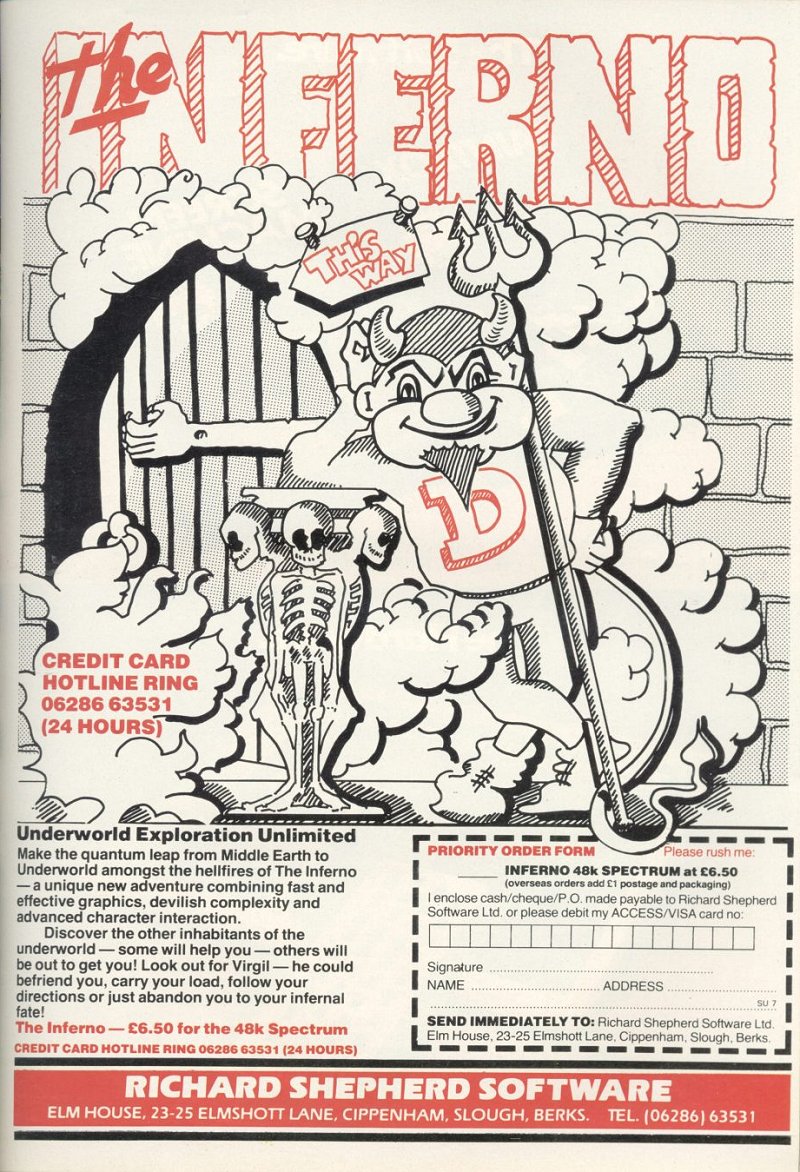
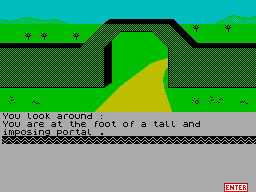
DEREK BREWSTER'S ADVENTURE TRAIL IMAGINE.... When it comes to adventures, memory is the limiting factor but, if you think that if extra memory should become available it should be used in creating even more locations to visit, then you clearly haven't played as many lifeless, unimaginative adventures as I have. Graphics adventures have proven the more commercial yet too many are burdened by mediocre or downright useless pictures that add little to what would otherwise be another lacklustre text game. Graphics should not replace vivid, imaginative text. Many text-only adventures concentrate on getting as many locations as possible into the 48K of the Spectrum and some even brag of such efforts as if this alone were any indication of the quality of a game. Inevitably, there results a loss in quality of location descriptions or even the problems themselves. The microdrive seemed at first a good opportunity to provide the memory for both the imaginative text and good graphics. Strange that no one has produced a microdrive adventure and I know of none being developed, it is true that such an adventure would be more expensive but perhaps adventures, some of which are a bit pricey in any case, might accommodate the extra cost. If and when the microdrive adventure does arrive I hope the extra room is used, not to double the length of the adventure, but to improve the vocabulary, descriptions, graphics and friendliness. Now let's think, you might combine the graphic quality of The Hulk with the rich text of Level 9-some adventure! THE INFERNO Producer: Richard Shepherd Software Retail Price: £6.50 Author: P. Cooke Richard Shepherd have always had a good reputation for high class packaging of software but more recently have created interest in the program on the tape as well. After playing and thoroughly enjoying Urban Upstart I eagerly loaded up The Inferno. The program closely follows the plan of Dante's Inferno which depicts the thirteenth centure concept of Hell. In you quest there are nine circles through which you must pass to reach to centre and escape. The style and formal mimics that first seen in The Hobbit but the graphics are very simple, although to be fair every location has a graphic. The graphic depiction of a scene scrolls up on pressing a key - in this case the ENTER key - to reveal all the text at the bottom. The word ENTER appears in the bottom right hand corner and the border changes colour when the program is ready. Were this the only distraction when playing the game there would be little cause for complaint but this constant need to press enter is coupled with the most infuriating input routine ever devised. Every so often a key depression repeats a letter and if you are not meticulous you can spend a lot of time deleting back to correct these mistakes. As it turns out this game is quite enjoyable and long delays are rare as it has a fast response time but an awful input routine is a major setback for any adventure to overcome. Sometimes the action becomes too fast to read without the foresight to switch off the graphics, for example, when getting Cerbus to limp aside to let you down to the next level. After only a few scenes you become aware of the independent characters featured in the game though they wander backwards and forwards like zombies. Virgil, like Thorin in The Hobbit, has a limited patois and generally comes out with such gems as THIS IS A DANGEROUS PLACE or WE MUST HURRY. To tell a character to do something you must begin the command with the character's name; you can also ask Virgil for his inventory by entering VIRGIL LIST. Vocabulary moves quite some way from simple verb/noun but you might be surprised at TAKE with no GET option. However T is a very useful abbreviation for TAKE. The Inferno is an adventure let down by an infuriating input routing. On the plus side the game features graphics at every location, an interesting and enjoyable storyline and the puzzles, lightened with a useful HELP command are not too difficult. COMMENTS Difficulty: Easy-average Graphics: In all locations. Scroll off. Can be turned off. Average Presentation: Black text on white. Average Input facility: Poor. Accepts full sentences Response: Normally fast, some graphics a little slow Special features: Independent characters
Micro Adventurer #10Aug 1984 · p.27
John Fraser
DANTE'S VISION MICRO: Spectrum 48K PRICE: £6.50 FORMAT: Cassette SUPPLIER: Richard Shepherd Software, [redacted] It's surprising where some people get their ideas from. Who would have thought, for instance, that a 13th century epic poem concerning the medieval concept of Hell would make an addictive adventure? Well, Richard Shepherd Software certainly did and have followed the plot of Dante's Inferno quite closely. Now for those of you who don't happen to have a degree in medieval literature (and I'm one) this classic work forms part of the Divine Comedy which describes the poet's search for an escape from the Underworld. In the poem, Dante imagines himself lost in a dark forest and meets up with Virgil who promises to lead him out of it. They come to Hell, a deep pit in the ground with nine levels, or circles, where individuals suffer torment from monsters and devils. To escape they must pass through each circle until they come to the centre. Along the way they meet all sorts of mythical and historical characters: Cerebus, the three headed dog, Monos, Judge of the Underworld and so on. The nine circles are not particularly inviting places. There is Limbo, followed by the Plain of Howling Winds, then the Circle of the Greedy and later on a River of Boiling Blood. In marked contrast the ninth circle is where traitors are frozen in ice. Not a bad scenario for an adventure is it? The game is somewhat reminiscent of The Hobbit, with castles, rivers to cross and several characters who appear to have minds of their own. Such comparisons are almost unavoidable - even more so when you consider the behaviour of Virgil, your guide and friend, who repeatedly tells you to hurry up and often replies with a blunt 'no' when you ask him a favour. I seem to recall someone in The Hobbit doing exactly the same thing. One major difference, though, is that the real-time element which contributed greatly to the realism of Middle Earth, is lacking in this adventure. It does mean you can take as long as you like before entering your next instruction. The game has one novel feature. You can switch the graphics off if you so wish, which saves time waiting for the pretty pictures to appear. Unfortunately, the descriptions are inadequate on their own and you might just as well be reading a road map: "You wade across the river. You are in the first circle of Hell, limbo. The castle is here." Nevertheless, you do face some tricky situations, which I could only resolve by referring to the hints sheet accompanying the publicity material. The help facility is also useful, although inputs which seemed obvious to me were often incomprehensible to the computer. I had no luck trying to kill Cerebus who stands stubbornly guarding the pathway to the Circle of Hoarders and Wasters. 'Throw stone' merely brought the response 'throw where?' and whatever I keyed in wasn't understood. And attacking Cerebus with the stone is no good either; a long snake-like tail hurls me back to the entrance to Hell and the game begins again. This is an adventure which will no doubt keep me occupied for some time yet; without the sophisticated animation of The Hobbit, it may not have such lasting appeal.
Sinclair Programs #22Aug 1984 · p.37
June Mortimer
We look at the best and the worst releases in a month which offers new games from top software houses Fantasy and Ultimate. THE INFERNO The Inferno is an adventure game with an ambitious theme, a screen layout similar to that employed in The Hobbit, and a character with whom conversations can be held in much the same way as they can be with Gandalf in The Hobbit. The scenario is the 13th century European image of hell, through which the player must travel to escape. Unfortunately the adventure is too easy. The first seven rings can be crossed quickly with the aid of the help facility and there is little difficulty in visiting every location and collecting all necessary objects. Produced for the 48K Spectrum by Richard Shepherd Software, [redacted]. The Inferno costs £6.50.
Sinclair User #29Aug 1984 · p.377/10
Gilbert Factor 7/10
HELL AND DAMNATION Memory: 48K Price: £6.50 In the fifth circle of Hell the damned stare glassy-eyed from the depths of gelid marches. Not in the imagination of the latest swords n'sorcery film director but in the great religious epic poem Inferno by 15th Century Italian poet Dante. Dante's symbolic world of hellfire and lost souls is the setting of Inferno from Richard Shepherd Software. You take the role Dante wrote for himself - a pilgrim to the underworld, with the Roman poet Virgil as your guide. Inferno is a text adventure with graphics depicting each location, somewhat in the style of The Hobbit. As you travel deeper into Hell, you will meet the damned and the monsters which guard and torment them. You will have to find a way into the City of Dis and pass through the Forest of Despair before you finally reach your goal. With such an imaginative idea for a game and the works of the great poet as a source of images it is a pity the graphics are not more inspiring. One can only assume that Richard Shepherd Software felt the true picture might be too horrific for gentle Spectrum owners. That said, the game moves at a fair pace and, although there are not so many problems to be solved as in some adventures, the atmosphere is maintained well and provides some compensation for a simple plot.
Personal Computer Games #9Aug 1984 · p.837/106/107/106/10
Complexity 7/10
Atmosphere 6/10
Interaction 7/10
Value 6/10
Steve Cooke
ESCAPE FROM HELL PCG's in-house mystic, the White Wizard, takes a trip to hell, survives a nuclear holocaust, has trouble with trees and explains the secrets of Valhalla. All this, plus news, reviews and hot tips from the land of Adventures. The White Wizard is well aware that the names of Artic, and Richard Shepherd software are both inscribed in the Adventure Rolls for outstanding services to Spectrum owners. He is therefore pleased to announce new programs from both companies, both of which will have you in the hot seat. Richard Shepherd's inferno is (very) loosely modelled on Dante's vision of Hell, whereas Artic's game Ground Zero is modelled on the Home Office documents relating to civil defence in the case of nuclear attack. In each case your objective is the same - don't get fried if you can help it. First Ground Zero. Artic have already gathered a reputation for trick text-only adventures with their Island of Death series and other games. These programs have been the cause of many a nervous breakdown and Ground Zero is no exception. Who wouldn't have a nervous breakdown when the three minute warning goes, I'd like to know? Your objective is to build a nuclear shelter from available materials and gather rations and water to enable you to survive until it's safe enough to come out into the open again. To make best use of the limited time available you are advised to travel from location to location by taxi - and make sure you remember your Highway Code. Looters, dozy neighbours, sirens, and ringing phones all help to make this an enjoyable but very tricky game - typical Artic fare. Artic's game is two-word input only, but Richard Shepherd's Peter Cooke (programmer of Urban Upstart) has gone on to greater things with complex input and interactive characters. In Inferno you must penetrate the nine circles of Hell to escape. The usual Richard Shepherd split-screen format has some rather average graphics and a scrolling text-window below. Commands can be joined together by 'and' and other characters can be addressed by prefacing a command with their name. For example, 'Virgil go south' may persuade Virgil to go south, provided he is in the right mood. There are ten characters in the plot, each of whom may help or hinder you, though to be honest only one of them, Virgil, plays a major role. You cannot solve the adventure without Virgil's help, and his disposition towards you depends to a certain degree on what you do. Both of these games provide good value for money for Spectrum owners, but, strangely, I enjoyed Artic's game rather more than Richard Shepherd's. Somehow the relevance of the theme to the present day gave it a more compelling atmosphere than Inferno, though the latter is undoubtedly the more complex program. Ground Zero MACHINE: Spectrum 48K FROM: Artic, £6.95 Inferno MACHINE: Spectrum 48K FROM: Richard Shepherd Software, £6.95
Your Spectrum #5Jul 1984 · p.7
TO HELL WITH SOFTWARE Richard Shepherd Software, revealed recently in YS as the recipient of one of our coveted Strangled Turkey awards has launched another game in its 'Adventures Into Imagination' series. The offering, entitled The Inferno is based around Dante's concept of Hell - as laid out in his book, Inferno. Hobbit fans will probably feel at home with the interactive characters. Here, however, the idea is taken one step further in that any character may befriend you, or become your enemy. The Inferno was released on June 1st, and retails at £6.50 for the 48K Speccy. More details from Richard Shepherd Software, [redacted].
Tips9
- Sinclair User #56Nov 1986 · p.90
- Your Sinclair #11Nov 1986 · p.69
- Sinclair User #53Aug 1986 · p.74
- Sinclair User #52Jul 1986 · p.56
- C&VG (Computer & Video Games) #56Jun 1986 · p.87
- Sinclair User #48Mar 1986 · p.67
- Popular Computing Weekly #42Oct 1985 · p.17
- Sinclair User #40Jul 1985 · p.93
- Crash #16May 1985 · p.123
Advert8
- Popular Computing Weekly #36Sep 1984 · p.33
- Popular Computing Weekly #38Sep 1984 · p.29
- Popular Computing Weekly #35Aug 1984 · p.9
- Popular Computing Weekly #27Jul 1984 · p.23
- Popular Computing Weekly #25Jun 1984 · p.22
- Popular Computing Weekly #24Jun 1984 · p.23
- Popular Computing Weekly #23Jun 1984 · p.25
- Popular Computing Weekly #22May 1984 · p.37
Full-page ad5
- Sinclair User #31Oct 1984 · p.139
- Sinclair User #30Sep 1984 · p.131
- Micro Adventurer #10Aug 1984 · p.47
- Sinclair User #28Jul 1984 · p.59
- Micro Adventurer #9Jul 1984 · p.41
News/Note4
- ZX Computing #15Oct 1984 · p.15
- Your Spectrum #5Jul 1984 · p.7
- Home Computing Weekly #65Jun 1984 · p.8
- Personal Computer News #63Jun 1984 · p.34
CompoResult1
- Sinclair User #32Nov 1984 · p.10
CompoEntry1
- Sinclair User #29Aug 1984 · p.125
Review1
- Popular Computing Weekly #22May 1984 · p.48
Licensed from
- The InfernoBookunofficialDante Alighieri
Related
- Same entry at
- Spectrum ComputingZXInfo
Reviews from people here
Sign in to write about this, or make an account. It takes a minute and lets you correct the catalogue too.
No description, tag recorded.
Sign in to correct or add to this.
Hold the rights to this and want it taken down?