
Jewels of Babylon
Adventure Game: Text/Illustrated · ZX-Spectrum 48K · 1 players · English
Interceptor Software · 1985 · Pound sterling 5.50
Also known as The Jewels of Babylon (English)


Discussion
Nobody has started a thread about this yet.
Play
- jewelsofbabylon.rzxRZX playback file
- JewelsOfBabylon.tzx.zipTape image English29 KB
- JewelsOfBabylon(different).tzx.zipTape image English29 KB
- JewelsOfBabylon.tap.zipTape image English31 KB
Documents
- JewelsOfBabylon.txtInstructions English3 KB
Files and rights
No permission is on record either way. Screens and pictures are copied here on a take-down basis: if you hold the rights and want something removed, say so and it goes.
Credits
- David M. BannerCode
- Terry GreerIn-game Graphics
- Terry GreerInlay/Poster Art
- Terry GreerLoad Screen
Sign in to credit somebody, or say what these people did.
Scores
In the magazines
- Personal Computer News #891984 · Overall8/10
- Sinclair User #371985 · Gilbert Factor4/10
- Crash #131985 · Overall Value6/10
- Big K #111985 · Overall2/3
- C&VG (Computer & Video Games) #441985 · Personal Rating6/10
- Personal Computer Games #141985 · Overall6/10
Elsewhere on the web
- WorldOfSpectrum 11 votes7.27
In the magazines 29
ZX Computing #21Oct 1985 · p.71
Brian Robb
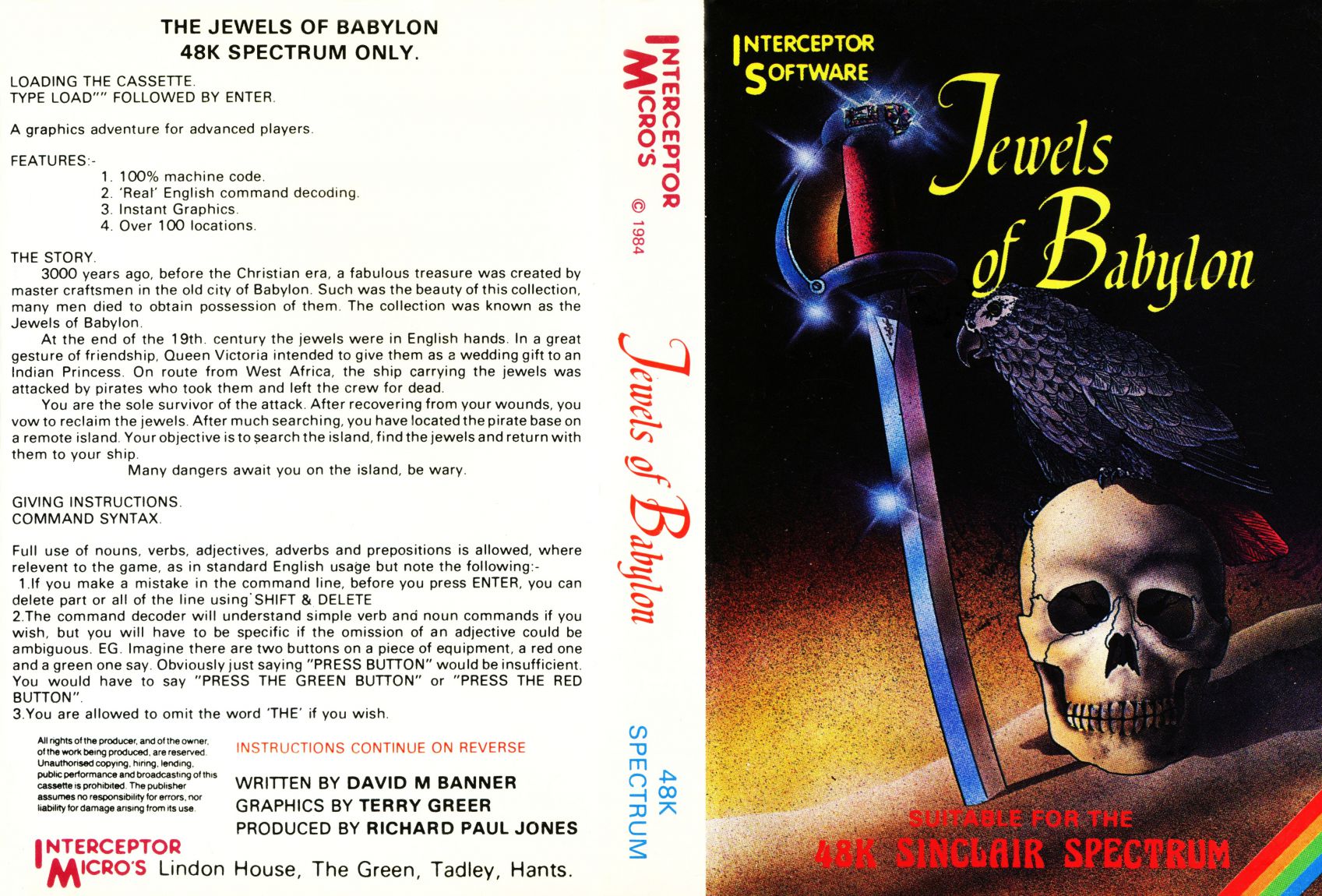
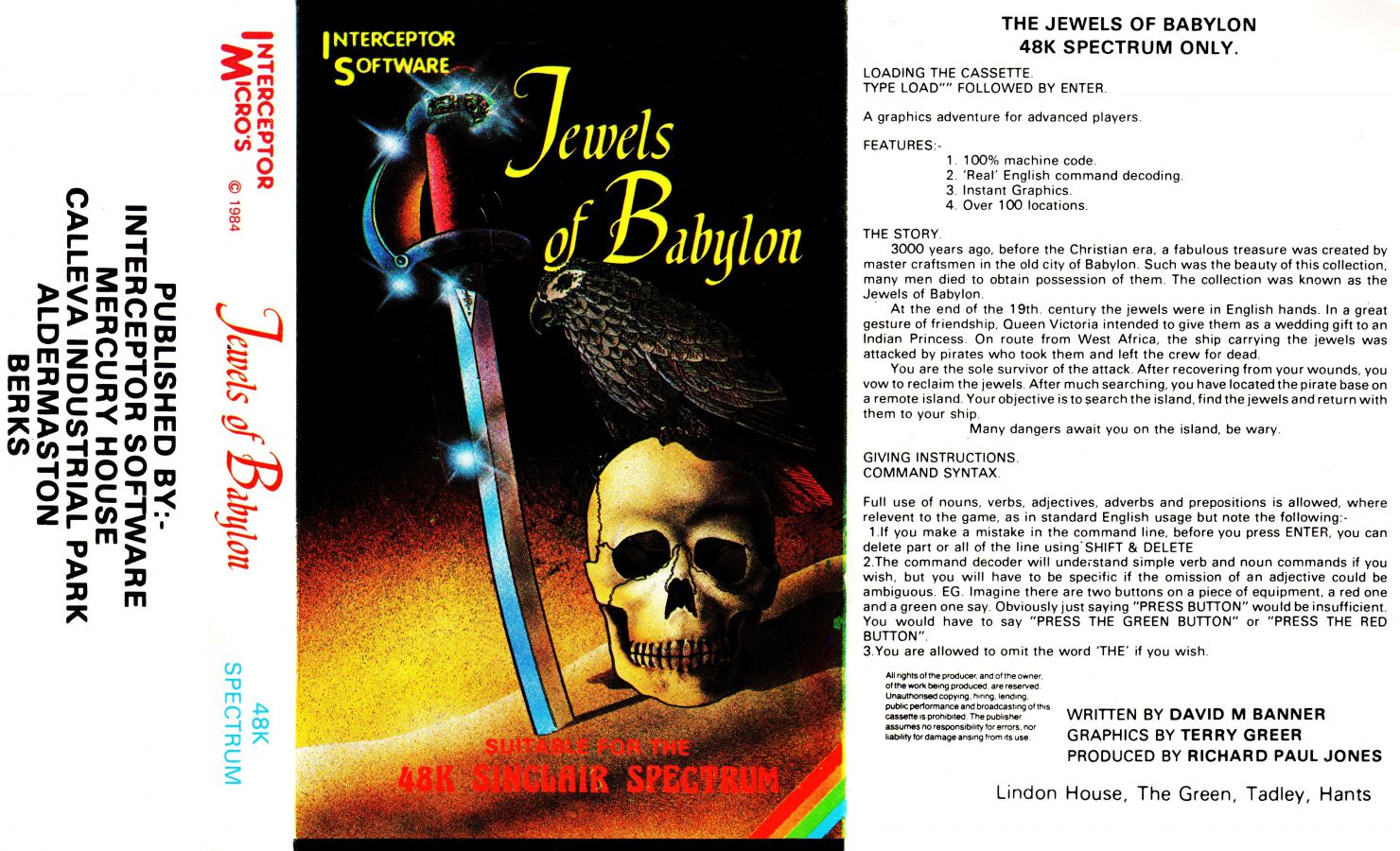
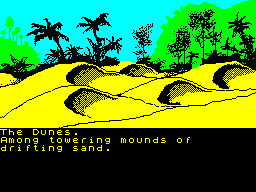
Interceptor Micros £5.50 The cover artwork for the cassette inlay of Jewel Of Babylon is strikingly similar to that for Mordon's Quest, as both feature skulls and swords. This is the only thing between the games which is similar because where Mordon's Quest is full of atmosphere with lengthy text descriptions. Jewels Of Babylon is not, despite the brilliant graphics which accompany certain locations. The story goes thus: in Babylon, 3000 years ago, master craftsmen created a set of jewels, so beautiful that men would kill for them. By the end of the 19th Century, the jewels' bloody history had brought them into the possession of Queen Victoria, who intended to give them as a wedding gift to an Indian Princess. The ship carrying the jewels though, is attacked by pirates who leave the crew for dead and take the jewels. You have survived the attack and plan to regain the jewels. You travel to the pirate's island, which you must search to find the jewels, and return with them to your ship. Several of the locations boast excellent graphic pictures, which give highly detailed views of your surroundings. The text descriptions though, are very sparse and don't adequately support the pictures. There are few taxing problems and it is possible to visit about half the game's locations with very little trouble at all. The adversaries for these first few locations are the island's wildlife - snakes, crocodiles, spiders and lions. Most of them are easily dealt with or easily avoided. There is very little challenge until you reach the later stages, despite the fact that the game claims to be for 'advanced players". The game goes beyond the standard Verb/Noun input, but uses non-standard vocabulary which makes it more difficult to tell the game exactly what you wish to do. To leave your rowing boat, rather than CLIMB ASHORE or LEAVE BOAT, you have to enter CLIMB OUT BOAT. Small points like this increase the difficulty of the game, but in the wrong way. Rather than having difficult problems which need ingenious solutions, Jewels Of Babylon makes it difficult to find the correct phrases to use to get the response you want, which just results in annoying the player. Rather than playing a game, you're simply trying various phrases until you hit upon the right one. A more user friendly attitude would have improved the game. Jewels Of Babylon is packaged in the video style cassette case which seems to be all the rage now with software houses. Fancy packaging does not make up for a poor game and only increases the price. If Jewels Of Babylon had been a £2.50 Firebird game then it would have been well worth the money. Of the two graphic adventures reviewed this issue Subsunk and Jewels Of Babylon, Subsunk has simpler graphics but a far better game, whereas Jewels Of Babylon consists of excellent graphics but a very poor game. Overall then, Jewels Of Babylon is a simple 'pirate and treasure' type game with spectacular graphics, but little game. If you want a graphic adventure then get Subsunk. If you want a REAL adventure, then get Mordon's Quest. Give Jewels Of Babylon a miss.
C&VG (Computer & Video Games) #44Jun 1985 · p.1036/106/10
Personal Rating 6/10
Paul Coppins 6/10
3,000 years ago some fabulous jewels were created by master craftsmen in the old city of Babylon. They came into English hands in the 19th century, but were lost to pirates who left all but one of the crew of the boat that was carrying them for dead. This is where the Adventure begins, for you are the one who survived and have vowed to reclaim the jewels. So it is that you find yourself on a bright pink ship off some remote island. Yes, it's bright pink, and no amount of fiddling with the TV will make it go the colour you thought 19th century ships were supposed to have been. The island itself is a place of golden sand and clear blue skies, just the place to spend a holiday - except for the cannibals! The graphics are more less instant and are among the best I have seen on a Spectrum. The text allows full-sentence input, although in most cases you have to get the wording just right. Babylon is said to have over 100 locations, although most of them are maze rooms, making pen and paper a must for this Adventure. So is a "save" tape, for there is plenty of wildlife about and a spider might just happen to drop from the trees onto your shoulder, or a water snake give you the once over as you battle your way across a swamp. Most of the time, such encounters are just for fun, but there is always that chance that the spider will sink its fangs into your neck! Most of the puzzles seem to be the "find your way around" or "get past something" type and, although they all seem to have logical answers, it's getting the right words in the right order that's the real trick. That made playing Babylon a little on the difficult side at times, but still a very interesting Adventure with lots of action.
Sinclair User #37Apr 1985 · p.244/104/10
Gilbert Factor 4/10
Richard Price 4/10
JEWELS OF BABYLON Interceptor Memory: 48K Prices. £5.50 Wow, you think, as soon as you've loaded Jewels of Babylon, what faberooney graphics! Don't get overexcited though - there aren't that many. The setting would do justice to Desert Island Discs - a remote, tropical sea-girt spot with dunes and palm trees. Somewhere in the interior lie concealed the jewels of the title. Promising? Possibly, but first try to get into the wee rowing boat. Enter boat? Climb down? No - it's got to be 'Climb into boat'. The interpreter is not hyper-friendly. Once ashore you explore. There are a few objects littered about but it is possible to wander around like a total wally for endless stretches. Endless perserverance may well get you somewhere but personally I play games to be entertained.
Big K #11Feb 1985 · p.173/32/32/32/32/3
Graphics 3/3
Playability 2/3
Addictiveness 2/3
Overall 2/3
John Conquest 2/3
GEM MAKER: Interceptor FORMAT: cassette PRICE: £5.50 Sole survivor of a pirate attack on a ship carrying the fabled Js of B, you have found the pirate's islands base and set out to recover the hot ice. In standard Interceptor style, it's a mainly text adventure, 100+ locations, with periodic and brilliant, if rather unnecessary, graphics, far superior to those of their earlier Forest At World's End. A very sophisticated command analyser makes it possible, and necessary, to enter complex actions. Getting off your ship, for example, is done by 'climb down ladder'. There are three maxes, jungle, swamp and thicket, very early on with not much in the way of loose objects to use for mapping them. Beyond them lie further hazards, such as lip-licking cannibals, before you get to the main course. Fraught and exciting.
Crash #13Feb 1985 · p.966/105/106/1010/106/106/10
Atmosphere 6/10
Vocabulary 5/10
Logic 6/10
Debugging 10/10
Overall Value 6/10
Derek Brewster 6/10
DEREK BREWSTER'S ADVENTURE TRAIL PUBLIC IMAGE You know, when I buy a piece of software, or have it dropped through my letterbox, I expect the packaging and instruction leaflet to inform me on why this game exists and why it should merit my attention. Gilsoft's The Curse has a sparse cover which give more prominence to copyright and warning notices than to the substance of the program. One can only assume there is nothing worth mentioning and so what impression does this give? It hardly augurs well. Indeed, the cover supplies the name of the artist who decorated the inlay but there is no mention of the author of the program itself. Don't get me wrong about artwork, certainly packaging should have good artwork but this must reflect the quality of the program within, and not exceed it. The artistic details of Tower of Despair shows how artwork can add appreciably to the atmosphere and enjoyment of an adventure. But surely the software business has much in common with the music industry; the public will remain loyal to good programmers and seek out quality from whichever quarter it emanates just as loyalties to artists and the unearthing of excellence goes on even in the music world. Packaging and leaflets provide the room for two important aspects, the storyline and instructions. A storyline mustn't be so small as to fit in the window at the back of a cassette casing but should be full and enlightening enough to ensure a substantive background to develop in the player's mind before play begins and to encourage a feel for how the game might be tackled. Alas, I have witnessed so many storylines tagged on to a finished program to round off the marketing exercise. It should, of course, be in existence before coding begins so that the plot and theme are integral parts from the off, ensuring a sense of consistency and credibility pervades the whole. Instructions find a natural home on the cassette cover where browsing in a computer store may tell something of the game and should not reside in the program as this would then represent an unforgivable waste of memory (some Quilled games are guilty here) and neither should they reside on the tape before the game proper as this is then a waste of the game player's time (Knight's Quest, for example). All this brings me round to great and ever-fluctuating debate in software retailing, namely, should the package be large and flamboyant or small and utilitarian. Cynically, a large package is justified by the greater price charged for it, representing a greater capture of the consumer's money for the software business merry-go-round - packaging, printing, publicity. This last is a significant point as a large package is its own advert. Who can forget Valkyrie 17 in all the shops before Christmas? Perhaps there is a deeper message here, playing on the psychology which has it that if a company has gone to all the trouble of producing a large, expensive package, then what is on the tape must be worth something. Alas, I can think of many examples where this reasoning is misleading. What a large presentation can afford is a suitably glossy booklet giving in-depth playing instructions and a greater insight into the complexities therein. Certainly, no one would complain of the extra expense entailed to this purpose in the Midnight Trilogy. But what of the many where the supporting literature is thin on the ground and the cassette wallows in a sea of moulded plastic? It would seem the packaging here is only a precept for charging more. Unfortunately, you can not tell whether a large package has much supporting literature until you buy it, as shops are reluctant to leave anything on the shelves which might tempt petty thieving. Well, here is the crux of the matter; I myself, on the whole, prefer cassette-sized packs because they are easier to carry back home and are more utilitarian in a futuristic way. It is similar to my regard for the Spectrum - there is some fascination in a computer with 48K RAM which takes up just a little more room than a pocket calculator and can be unplugged and carried around with the ease of a book. So with cassettes. A world of adventure packed in to a s mall plastic box with neat, precise artwork, and playing instructions unfolding like a concertina. But if large packages grabbed the attention, and the shelf space, over the festive season one development had them cast as dinosaurs. Not only could you allot the big packs a position with the cassette-sized packs neatly stacked in cassette racks and cases, but, when browsing in shops their absence amongst the chart displays was very noticeable - they just could not fit into displays like the Boots Top Twenty! JEWELS OF BABYLON Producer: Interceptor Software Memory Required: 48K Retail Price: £5.50 Language: Machine code Author: D. Banner, T. Green Jewels of Babylon follows in the footsteps of Message from Andromeda and Forest at World's End and if you were to buy this latest offering there would be few surprises, for all intents and purposes this is the same program but with a pirate/desert island backdrop. In effect it's the same cake with a different flavoured icing. It's almost inconceivable that a programmer could continue to churn out the same old game without attempting any improvements to refine the product, but this is the case we have here. All the old criticisms concerning the first two games still hold strong. Impressive, high quality graphics appear very quickly and only appear automatically on your first visit to a location, which is a nice touch, but when you count up, there really aren't that many graphics. The input routine has opted for neatness as opposed to efficiency; there is no cursor and no beep on entry although to be fair input remains mostly error-free. Descriptions are short and unimaginative giving the whole a weak impact and there is no score. This game uses some awful system of text scrolling whereby the top part scrolls up and off when you input at the bottom. The game boasts 100 locations. I went through 50 without solving a single problem, unless you count making the natives' supper a solution to a problem. Like its predecessor, Forest at World's End, it often falls back on cliche and is about as interesting as a jumblesale paperback book. Three thousand years ago, before the Christian era, a fabulous treasure was crafted by the master craftsmen in the old city of Babylon. Such was the beauty of this collection, many men died to obtain possession of it. At the end of the nineteenth century the jewels were in English hands. In a great gesture of friendship, Queen Victoria intended to give them as a wedding present to an Indian Princess. On route from West Africa the ship carrying the jewels was attacked by pirates who took them, leaving the crew for dead. You are the sole survivor of the attack. After recovering from your wounds, you vow to reclaim the jewels. After much marching you locate the pirates' base on a remote island. Your objective is to search the island, find the jewels and return them to the ship. The vocabulary often goes beyond verb/noun but despite the instructions suggesting adjectives, adverbs and prepositions are needed to avoid ambiguity, there are many cases where this is demonstrably not so and all the extra input required does is to make the language that bit more unfriendly. Take, for example, your first task - to get into the boat from from the ship to enable you to go ashore. CLIMB LADDER and ENTER BOAT are not accepted, but CLIMB DOWN LADDER and CLIMB INTO BOAT are. I admit there is a thin dividing line between greater sophistication and unfriendliness, but the program could provide more prompts to coax you along the right path. When you see a smooth, vertical slab of rock on your travels, you can't move or push it, but surely you should be able to examine it? If, for you, an adventure is not complete unless it has a maze then here you can get all dizzy amongst no less than three. Amazing. Jewels of Babylon shows all the traits of a game knocked off an assembly line. Some of its shortcomings are common to many while the conspicuous absence of any real problems is more typical of this series from Interceptor. If variety is the spice of life then this game is one big amorphous lump of monosodium glutamate. COMMENTS Difficulty: quite difficult Graphics: very few but are fast and well designed Presentation: has awful habit of scrolling description off as soon as new input is introduced. No use is made of colour Input facility: often pedantic requiring more than verb/noun for no good reason
Excellent graphics in THE JEWELS OF BABYLON, but the program doesn't really live up to the pictures.
Personal Computer Games #14Jan 1985 · p.1135/107/105/106/106/10
Atmosphere 5/10
Complexity 7/10
Interaction 5/10
Overall 6/10
Steve Cooke 6/10
MACHINE: Spectrum, Amstrad PRICE: £5.50 If you think the screen-dump of the bridge on the opening page of Adventureworld is impressive, then check out Jewels of Babylon from Interceptor, because there are plenty more where that came from. Ever since Heroes of Karn the company seem to have made a point of including high-quality graphics in their games, and this one is no exception. At the beginning of the game you find yourself in a boat moored a short distance from a tropical island. To get into the adventure proper you must enter your rowing boat, row north, and on landing at the island your adventure begins. Not all the locations have graphics, but those that do are beautifully depicted. Your objective is to explore the island, find the treasure, and return to your ship. The cassette cover gives you the impression that the program will understand 'standard English', but this is not the case. Here's a typical sequence from the game to illustrate the point: Computer: You can see: a smooth vertical slab of rock. Player: Examine rock. Computer: Please rephrase that Player: Examine slab Computer: I don't know the word 'slab' Player: Look rock Computer: Please rephrase that. ...and so on. The moral is that just because a program 'makes full use of nouns, verbs, adjectives, adverbs, and prepositions' (as this one claims to do) doesn't mean it's going to be any easier to get along with. Other niggles about this game include random death, where the player gets killed off by poisonous spiders falling from above without warning, and very scanty location descriptions, though I suppose the graphics make up for the last shortcoming. Perhaps I was just having a bad day, but I didn't find Jewels of Babylon an easy game by any means. Even the maze had me foxed for quite a while, since there aren't an enormous amount of objects for you to collect and then use to drop and mark your position. I kept ending up in a native village at supper time, only to find out that it was guess-who on the menu. As a result I'm determined to get back to this game and crack it, so I have to admit that, for me anyway, it possesses addictive qualities. The game boasts over 100 locations, so there's going to be quite a bit of exploring going on in the Wizard's cave over the next few days.
The rope bridge from The Jewels of Babylon.
Personal Computer News #89Dec 1984 · p.488/108/10
Overall 8/10
Mike Gerrard 8/10
PRICE: £5.50 PUBLISHER: Interceptor Micro's [redacted] Jewels of Babylon were turned into a beautiful collection of treasures by master craftsmen more than 3,000 years ago in Babylon, and after many men had died in their pursuit they wound up in English hands by the end of the 19th century. Queen Victoria offered them as a wedding present to an Indian Princess, but the boat carrying them was attacked by pirates after leaving the shores of West Africa. The crew were left for dead, and all perished except for... guess who? Yes you. At the start, you have tracked the pirates down to their island, and the game opens with a beautifully drawn scene of the deck of your ship, the rigging, and the island off which you're anchored. Only a limited number of the locations have an accompanying picture, but they are all well drawn and appear instantly. The picture only appears the first time you visit a location, but can be recalled at any time by typing 'Look', which otherwise reprints the text. The program allows for full English sentences to be entered, though of course you can use the terse 'Go North, get coconut' if you wish. In some ways this expands the potential of the responses, but in other ways it limits them. In the first location on board ship, for instance, you can see 'A ladder leading down to a small rowing boat alongside.' Type 'Down' and 'You can't go in that direction.' Climb down? 'Please rephrase that. 'Go down?' I don't know the word Go. 'Climb down ladder? Eureka, you're in the boat. Exploring the long sandy beach provides you with a plank, and in the palm trees above there's a coconut, and a bottle. Closer examination reveals this contains rum. There are very few objects around at first, and the game does rely rather too heavily on mazes. There were three in the first 30 or so locations (over 100 in all) - a swamp, a jungle and a thicket. The maze of paths in the very thick thicket led eventually to a cannibal village, where the beauty of the graphics was not matched by the looks on the faces of the natives, who had seemingly not given up their cannibal habits. You usually get a slight warning of impending death, so the SAVE option should get a healthy use, and while an initial island walkabout gave the impression that this wasn't going to be the toughest of adventures (I may regret that later), it nevertheless had a very nice feel.
Tips14
- Your Sinclair #45Sep 1989 · p.55
- C&VG (Computer & Video Games) #66Apr 1987 · p.63
- Your Sinclair #15Mar 1987 · p.60
- C&VG (Computer & Video Games) #64Feb 1987 · p.105
- Your Sinclair #11Nov 1986 · p.69
- C&VG (Computer & Video Games) #59Sep 1986 · p.58
- C&VG (Computer & Video Games) #54Apr 1986 · p.70
- C&VG (Computer & Video Games) #53Mar 1986 · p.71
- Crash #25Feb 1986 · p.87
- C&VG (Computer & Video Games) #52Feb 1986 · p.71
- Popular Computing Weekly #42Oct 1985 · p.20
- Crash #21Oct 1985 · p.115
- Popular Computing Weekly #36Sep 1985 · p.32
- Popular Computing Weekly #9Feb 1985 · p.36
Full-page ad3
- Computer Gamer #1Apr 1985 · p.76
- Home Computing Weekly #100Feb 1985 · p.48
- C&VG (Computer & Video Games) #40Feb 1985 · p.4
News/Note2
- Crash #14Mar 1985 · p.7
- Personal Computer News #87Nov 1984 · p.46
CoverGame1
- Sinclair User #88Jul 1989 · p.8
Letters1
- C&VG (Computer & Video Games) #50Dec 1985 · p.3
CompoEntry1
- Home Computing Weekly #100Feb 1985 · p.7
Related
- Compilations
- Sinclair User issue 88: Megatape 17
- Ports
- (Amstrad CPC), (Commodore 64)
- Elsewhere
- CASAMobyGamesRZX ArchiveThe TipshopUVLRZX Archive - YouTubeSpectrum Computing RZX - YouTube
- Same entry at
- Spectrum ComputingZXInfo
Reviews from people here
Sign in to write about this, or make an account. It takes a minute and lets you correct the catalogue too.
No description, tag recorded.
Sign in to correct or add to this.
Hold the rights to this and want it taken down?