
Boxing Manager
Sport Game: Management · ZX-Spectrum 48K · 1 players · English
Cult Games · 1988
BoxingManager, 1 of 2
_Back.jpg)
_Back.jpg)
_Front.jpg)
_Front.jpg)
_Front.jpg)
.png)
_Media.jpg)
Discussion
Nobody has started a thread about this yet.
Releases
- Unknownpublisher not recorded
- 1988Cult Games
- UnknownD&H Games
- UnknownEDOS
Play
- BoxingManager_2.tap.zipTape image English12 KB
- BoxingManager(CultGames).tzx.zipTape image English16 KB
- BoxingManager(CultGames).tap.zipTape image English18 KB
Documents
- BoxingManager.txtInstructions English3 KB
Files and rights
No permission is on record either way. Screens and pictures are copied here on a take-down basis: if you hold the rights and want something removed, say so and it goes.
Credits
- Ian Williamscredited
Sign in to credit somebody, or say what these people did.
Scores
In the magazines
- Crash #501988 · Overall86%
Elsewhere on the web
- WorldOfSpectrum 8 votes6.62
In the magazines 1
Crash #50Mar 1988 · p.8274%60%46%90%86%86%
Presentation 74%
Graphics 60%
Rules 46%
Playability 90%
Overall 86%
Philippa Irving 86%
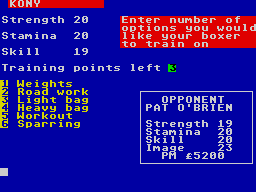
FRONTLINE With Philippa Irving THE ROLE OF RULES The strategy and wargame genre is the only one still offering a realistic market for the back-bedroom producer. This month which has been dominated by home-grown releases, and next month I'll be reviewing another game from a very small concern. The situation comes about largely because the flashy packaging and elegant programming characteristic of 'big business' releases cannot, in this type of game, be self-justifying. Yes, beautiful graphics are aesthetically pleasing, and in a computer game - whether arcade or arcade adventure - which seeks to create its own world, they can make an important contribution to the gameplay. But in a strategy game, the elements of play are more easily and more starkly exposed. That's why a simple, straightforward strategy game like this issue's Boxing Manager, which uses nothing but sequential text messages and very BASIC animation, can be extremely addictive. Computer arcade games are like no other game ever invented. But strategy and wargames are directly related to games that can be played by hand, in this fundamental way: they have to be genuinely well-designed to be any fun at all, and physical components do not necessarily affect one's enjoyment. And of course computer wargames are directly derivative of board wargames. This brings up the interesting similarity between the types of game which come under the auspices of Frontline, because on the surface a 'pure' strategy game and a simulation would seem to be different. I've never really been into the real wargaming scene, mostly because I can't afford to buy regiments in miniature metal and I certainly can't afford the time to paint them. But it seems to me - from the outside - that the reconstruction of a historical battle is a genuine objective. Board wargames shade slightly off to the less starkly realistic, probably because they tend to recreate large-scale campaigns like the entire Second World War or the Normandy landings, and therefore have to have more abstract rules. But an abundance of rules is a characteristic of simulation games. The more the better; as many modifiers as one can imagine, so that one can describe exactly how far a treadless tank could move in heavy rain through four feet of mud while shooting at a foot regiment. The objective is to pin all reality down with numbers, and it doesn't matter at all how many hours it takes to work out each turn so long as everything is being done thoroughly. The fun of such a game can often lie not in winning or losing - for if one takes the side which lost in a hopeless battle then, unless there's some obvious alternative strategy which eluded the generals of the day, history is honoured. At the opposite extreme are games played with an ordinary pack of cards which epitomise the utilitarian medium. After all, there is nothing inherently interesting in a pack of playing cards, and though they may be beautifully painted most aren't. The impact of a card's design has been dulled by long familiarity, and it certainly makes no difference to the enjoyment of card games. I happen to think that most card games are dull anyway, but bridge certainly is not. Bridge is one of the most addictive games known to man - particularly when its rubber rather than duplicate bridge. Its rules are simple, and it only has two 'screens' (bidding and play), but the strategic and social variations possible within its framework make it very difficult to give bridge up to eat and sleep. And for another type of mind, the same can be said about chess. Successful computer strategy games reproduce this combination of easy, structured rules and rich strategic variation. Curiously enough, traditional games are usually extremely boring when translated literally to the computer; without human interaction, they seem pale. What works instead is 'computer interaction' - but the framework remains the same. Computer wargames may have complex simulation-type rules, but because modifiers and calculations to put them into effect are done invisibly by the computer the emphasis has to be on a simple rule framework. A computer wargame which allowed the player no chance of winning at all (perhaps a successful spoof compilation could be Six Hopeless Historical Battles?) would satisfy no-one. BOXING MANAGER Producer: Willysoft UK, [redacted] Author: Ian Williams Price: £2.95 (mail order from producer) Boxing is being knocked into disrepute, even in the establishment which has traditionally supported it: only a few months ago, it was formally ousted from the timetable of one distinguished public school. And medical experts are forever producing reports which describe the effects of being repeatedly hit on the head. Though this game is exactly what its name implies - a straightforward management game in the classic pattern of Football Manager - author Ian Williams espouses anti-boxing views. He decided to write it after seeing Barry McGuigan knocked senseless defending his title at Caesar's Palace, to make the point that boxing is a barbaric 'sport' that 'leaves grown men with the vocabulary of a four-year-old'. But what Williams has produced - as he himself ruefully admits - is a fiercely addictive game which entirely fails to put its moral across. And whatever one's view on boxing, this is probably just as well; a game which is balanced on a soap box is rarely much fun to play. Boxing Manager puts the player in charge of a single boxer (whom you can name). He has five characteristics: strength, stamina, skill, image and 1Q. Strength determines how much damage he does to an opponent when he hits him. Stamina corresponds roughly to 'hit points' and is temporarily drained in a fight; therefore it affects how long he can keep going. A high skill rating increases the probability of your boxer hitting his opponent in the first place. Image is an abstract indication of how well-known and respected your boxer is - and it is the statistic that, ultimately, you are aiming to increase. IQ goes down every time the boxer is hit on the head, though its decrease seems arbitrary. The player, as manager, has a bank balance which - as always in games of the type - dominates the gameplay. Several things cost money: unless you own your own gymnasium you have to rent one, a trainer demands a fixed fee per fight, and if the boxer has been injured the player is expected to shell out for private medical treatment. The only way to increase money is to win fights, and as the boxer's image uses he is offered more lucrative engagements. The game is played in series of rounds, each starting with a menu which gives the player the opportunity to sack his current trainer and hire another one. The trainers'abilities are well-known in advance - trainer 1 can increase the boxer's scores by 1 point and trainer 6 by 6 - though their fees per fight vary alarmingly. The player can hire and fire trainers without compunction, for it seems to raise no bad feeling. If having graduated to an expensive trainer and then lost a lot of money the player would like to return to a cheaper one, the less able trainer displays no unworthy sense of pride and is happy to be reemployed. The player can also buy a gymnasium as a long-term investment from the round-opening menu; it's fantastically expensive, but it generates income by opening to the public, and at least with a gymnasium you don't have to pay regular fees to use somebody else's. The round continues as two opponents are offered for the player's boxer. They are each given a name and a number, which seems to correspond roughly to a rating. The player can't see an opponent's statistics till he's chosen him, but the boxer with the higher rating is always more formidable - sometimes considerably so - than the other. Fighting him means more prize money and greater prestige. Before the fight, the trainer gets the chance to improve the boxer's ratings. The trainer has a fixed number of points to distribute, according to his fee; the player chooses exactly where to spend these. You can improve any one of the boxer's statistics except IQ and Image. So the points will really start to pile up after you've made a lot of money and can afford to hire a trainer with plenty to give away. Now I would have thought that if one were to train for any physical activity the most dramatic increase in strength, stamina and skill would come at the beginning: then a plateau would be reached and improvement would come more slowly (lots of role-playing systems simulate this tapering-off in their character advancement schemes). But in Boxing Manager whatever happens to your boxer, unless you go bankrupt by losing a large number of successive fights, you're bound to end up with a pretty good fighting force eventually. The quality of opponents increases as the game advances, in rough parallel with the boxer's own progress, and the length of each fight goes from three rounds to what seemed to me an indefinite number. The player is told before the fight gets under way whether there is going to be any bonus publicity: a fight can be covered in the local paper, broadcast on local radio, or featured in the national press, and the dizzy height of popular achievement is to be broadcast on national N. If you win after such a media circus, your image increase is much higher. But if you lose, your humiliation and Image decrease are proportionally greater. The fight is dramatised onscreen, where the graphics are - well - minimalist. Two tiny stick insects stand on a boxing 'ring' (it looks more like a platform), dancing and stabbing at each other. But the blows, when they land, really are registered by the program. Though the very brief instructions don't mention the factor, it seems to me that blows to specific parts of the body have definite values. If an injury like a broken nose occurs during the round the player is notified, but the afflicted boxer soldiers on. A round lasts its time limit, and at its conclusion the player is put back to the boxer's statistic screen for the few seconds allowed for rest. During that time, the boxer's stamina, drained during the bout, climbs back; but it almost never returns to full capacity, instead decreasing every time. Quite often, one boxer is knocked to the ground. Sometimes he manages to clamber up before the countdown from ten reaches zero, but if he doesn't victory automatically goes to his opponent. The victorious boxer does a dance while the program plays the sort of silly and gratuitous tune traditionally associated with games like these. The fight, far from being a horrific condemnation of a senselessly violent sport, is great fun to watch. Despite its primitive BASIC animation it's involving, and has the element of spectator drama that can only really be generated by exactly this (rare) type of game. You've already made all the decisions - nothing you can now do will affect the outcome. You can only watch, and quietly scream encouragement at your stick insect. Once you've built up your boxer's reputation and he's getting into contests lasting as long as eight rounds, the fight can be slightly too drawn-out. But this is not a major criticism: the main trouble is that it's almost impossible to drag yourself away from the game. If the boxer wins, he is awarded prize money and his prestige grows. The turn ends with a breakdown of the past month's accounts, and unless you're really unlucky it's easy to make a steady profit on the easiest level. If the boxer loses, his Image goes down and he has no prize money to plug the hole in his account left by the trainer's fees and other expenses. It's not too difficult to see why the moral behind the game has no impact: the decrease of the boxer's IQ is supposed to affect his decision-making in the ring but has no perceptible effect on the play at all - except. I assume that if it reaches zero then the game is terminated. So the IQ factor merely imposes a'time limit' against which to pit oneself, increasing the soundness of the game design. Boxing Manager is written in BASIC; it's very much a home-grown product, in crudely-photocopied packaging with the minimum of documentation. But it's a wonderfully compelling strategy game with an addictive pull to make up for the lack of depth and complexity. There's certainly as much to it as to Just Imagine and Football Manager, similar games, and at this low price it's thoroughly recommended.
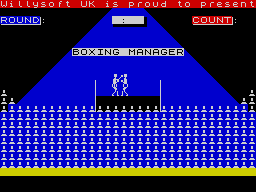
In the ring with BASIC: as manager you just sit back and tear your hair.
Morals are on the menu in Boxing Manager.
The Realm + Boxing Manager carries this game and has 1 reference of its own.
Related
- Compilations
- The Realm + Boxing Manager, ZX-Spectrum Vega
- Ports
- (Amstrad CPC), (Commodore 64)
- Tags
- Boxing
- Elsewhere
- UVL
- Same entry at
- Spectrum ComputingZXInfo
Reviews from people here
Sign in to write about this, or make an account. It takes a minute and lets you correct the catalogue too.
No description recorded.
Sign in to correct or add to this.
Hold the rights to this and want it taken down?