
King Arthur's Quest
Adventure Game: Text/Illustrated · ZX-Spectrum 48K · 1 players · English
Hill MacGibbon · 1984 · Pound sterling 7.95

Discussion
Nobody has started a thread about this yet.
Play
- kingarthur.zipRZX playback file
- KingArthursQuest.tzx.zipTape image English70 KB
- KingArthursQuest.tap.zipTape image English42 KB
Documents
- KingArthursQuest.txtInstructions English16 KB
- KingArthursQuest(EN).pdfInstructions English364 KB
Files and rights
No permission is on record either way. Screens and pictures are copied here on a take-down basis: if you hold the rights and want something removed, say so and it goes.
Credits
- Five Ways Software Ltdcredited
- Linda GarlandInlay/Poster Art
- Roger GarlandInlay/Poster Art
Sign in to credit somebody, or say what these people did.
Scores
In the magazines
- Sinclair User #341985 · Gilbert Factor4/10
- Sinclair Programs #271985 · Rating50%
- Crash #141985 · Overall Value5/10
- Big K #101985 · Overall2/3
Elsewhere on the web
- WorldOfSpectrum 11 votes6.00
In the magazines 38
Crash #14Mar 1985 · p.995/103/108/1010/105/105/10
Atmosphere 5/10
Vocabulary 3/10
Logic 8/10
Debugging 10/10
Overall Value 5/10
Derek Brewster 5/10
DEREK BREWSTER'S ADVENTURE TRAIL THERE IS A FAULT, PLEASE ADJUST YOUR SETS I read George Orwell's book way before 1984 but found it strange the way everyone last year went to great lengths to point out how modern society bore little relationship to the one portrayed in the novel. I was one of the few people to take the opposing view. If I remember rightly, and it is a long time since I read Orwell (at Primary school - it was slotted in between the Red and Orange Books and Peter and Jane go Ferreting) the book tells of how telescreens impose a highly ritualised life-style on the island's inhabitants. Statistics were used to show how things were getting better when it was plain things couldn't get much worse. What of our society? During the last cold winter the electricity board met with very high demands on electricity, supplying in excess of 45,000 megawatts. Although this demand, brought on by the severe temperatures, was exceptional it was exceeded by the confluence of the end of a final episode of a BBC television series and a commercial break in a film on ITV. What this tells us about society is startling and leads me to think the power wielded by television is out of all proportion to its authority. To give Orwell's novel renewed topicality, simply substitute the word telescreen with the word television. Or to paraphrase a learned Canadian, if the medium is the message then I'm afraid the news isn't good. So what has all this got to do with software? Well let's first take newspapers as an example. The light-weights of Fleet Street would have little to do with TV during its infancy yet now find it profitable to devote up to two-thirds of their space to the gogglebox and its plethora of soap operas and petit politics. The crucial point with software is not that tie-ins with programmes is a bad thing in itself, it's just that, if TV is not quite Big Brother, it is large enough to intimidate anyone with the idea of buying rights to a TV programme into parting with a considerable amount of money. The point is, big business, delightfully absent in the early days of software, scares me an awful lot because big business needs a big turnover to realise big profits to get even bigger. It can get to the ridiculous stage where you either buy what they tell you to or you buy nothing at all. (If you don't think things could ever get that bad try buying a decent pair of shoes in the High Street). Remember, you can't beat the imagination of one lone programmer or a small team huddled in deep thought around a project and also, TV seldom comes up with new ideas itself but in almost every case relies on a steady stream from books, stories, newspapers or the good old radio. It would be nice to think that we could choose what we particularly like from books, comics etc, rather than wait for some comfy TV people to decide this for us. And I would hope the same could be true for software. KING ARTHUR'S QUEST Producer: Hill MacGibbon Retail Price: £7.95 Author: Five Ways Software Ltd Earlier this year a film of a famous book from the sixties, produced at great expense and supposedly the smash of '84 finally reached provincial cinemas. Despite great billing, it was quickly relegated to a smaller screen. Bad reviews, and the inevitable poor public response following closely behind were to blame. The film was 'Dune' (which, incidentally, I thought wasn't so bad) and it played second fiddle to a product fresh from the endless Spielberg production line. King Arthur's Quest is, in some ways, rather similar. It is a finely constructed commercial package with Hill MacGibbon publishing a very smart product which has made space for itself along the computer shelves of one or two major department stores. The code on the tape is proficient enough and the graphics are interesting and colourful - but I'm afraid it will not meet with good reviews. Not long after you start to play you get that uncanny feeling that you are the first person to play it. You'd love to write off to the author and suggest how such a clever idea might be developed, polished and made commercially sound. Alas, it is too late, and so here we have a new entrant onto the professionally incompetent software scene. Unlike early games software this program has good, high-class packaging, seemingly instructive manual and neat (if overlong) program presentation on the screen. What it doesn't have is an ounce of sense. Over the months, reviewing many games, I have developed much patience, but I got a little angry to find on playing this game that I'd just researched a right load of bile. Let's take the seemingly instructive glossy booklet contained in this large package. Commendably, it is well printed and very clearly laid out with sections on 'Getting Started', 'Exploring the Landscape' and 'Running the Program' giving details on the logistics of loading the Spectrum, mapping the adventure and working the game. It is only when you come to actually read the manual that you discover that either no-one checked it over, or that whoever did knew nothing about the game and, by inference, didn't want to know about the game. After struggling through the booklet, my guess is you won't want to know about the game either. I was never one to excel in history at school (although, admittedly, schools are the last place to learn about anything) but what on earth has the Aztec world got to do with King Arthur? And why are the instructions inconsistent and confusing? Diagrams, numbers and text do not match or attempt to link up, and if it wasn't for the consecutive page numbering you would assume that some pages had been removed. Unfortunately, the game itself is also just a little off-the-rails, or to put it more bluntly, deranged! There are several different areas to the game, each consisting of a 10 x 10 grid. On the screen you can see two grid squares in front of you, and one to either side. After reading the manual you should be ready for anything, but as you begin mapping it becomes apparent that you are not where you are - or to be precise, you are somewhere else! You are in fact on the first square directly in front. You are looking at yourself in front of you. YES, I know, I'm becoming as incoherent as this program, so let's just leave it as: when you move adjacent to, say, a door, and you turn to face it and go through it, it isn't there - it has seemingly moved down a block. With a little effort you soon get used to this glaring inconsistency, but why didn't the programmer do something sensible about it? Although I didn't learn much geography at school, I began to get the hang of it when I left. It soon became clear that unless you position a map so that it points northwards, it is difficult to read and to get your bearings from it quickly. In the game you discover a compass early on and, like all the objects you collect, it is revealed on the right hand side of the screen. As you move it rotates to show you which way you are heading - but just to annoy those who are not such good map readers, it only shows north, when it would have taken minimal programming courtesy to have it indicate all directions. A minor point, admittedly, but you are still left wondering why it should be so unhelpful. Perhaps the sense of annoyance it creates is to do with the most damning point about this game. It is so boring you just want to get through it as quickly as possible, and after waiting for the sluggish response you can't wait to get on with you next move. King Arthur's Quest is a huge disappointment. I warmed to the theme and certainly, the packaging (which includes a spell-breaker poster) is colourful and interesting. The programmer has brought some skill to bear on the project but what this game lacks is not programming time, but design time. It has been thrown together with what can only be described as glossy incompetence. COMMENTS Difficulty: quite easy Graphics: simple, often confusing Presentation: average Input Facility: single key entry Response: reasonable Special Features: played in real time
Your Computer #3Mar 1985 · p.45
Hugo North
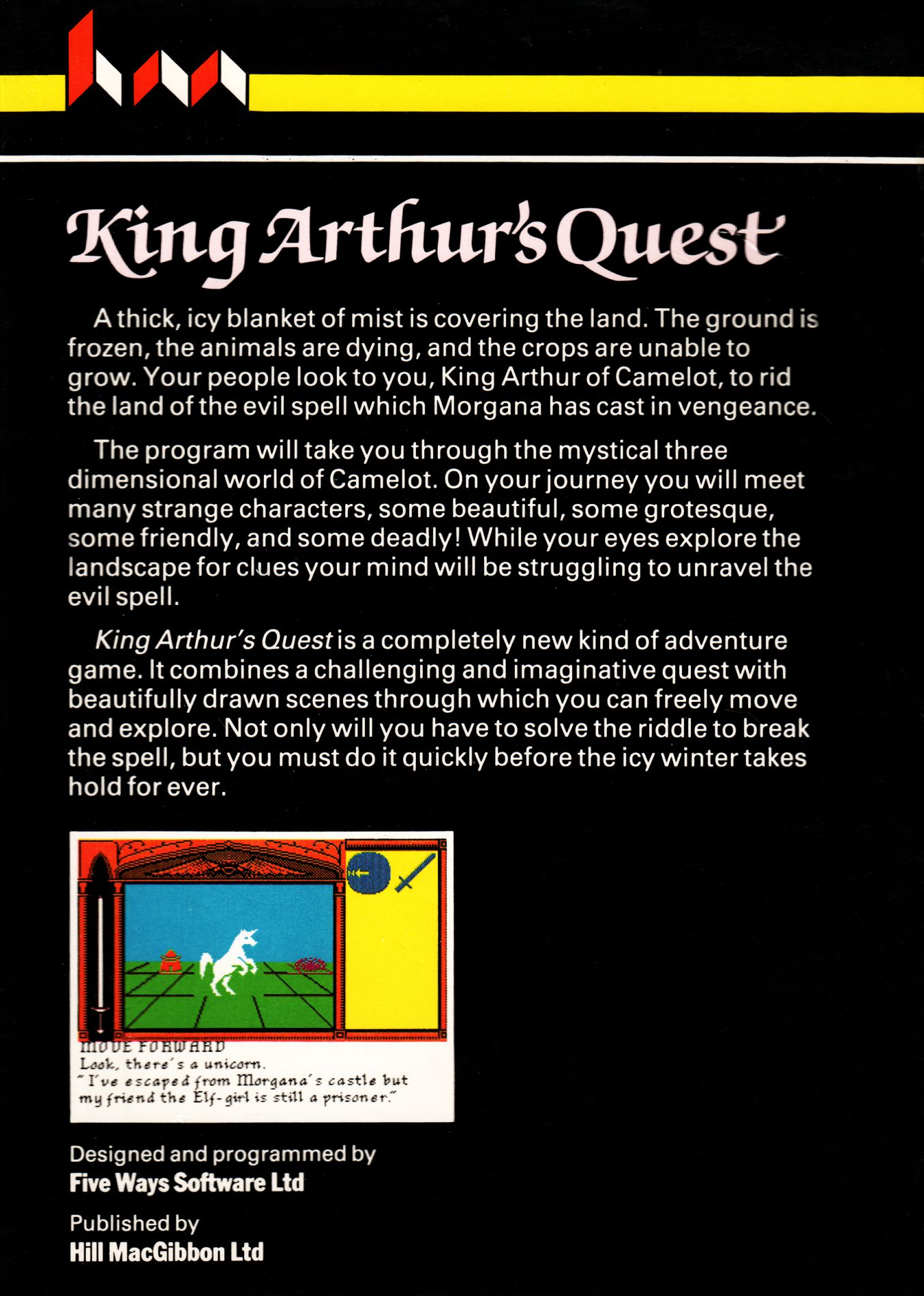
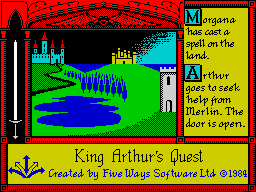
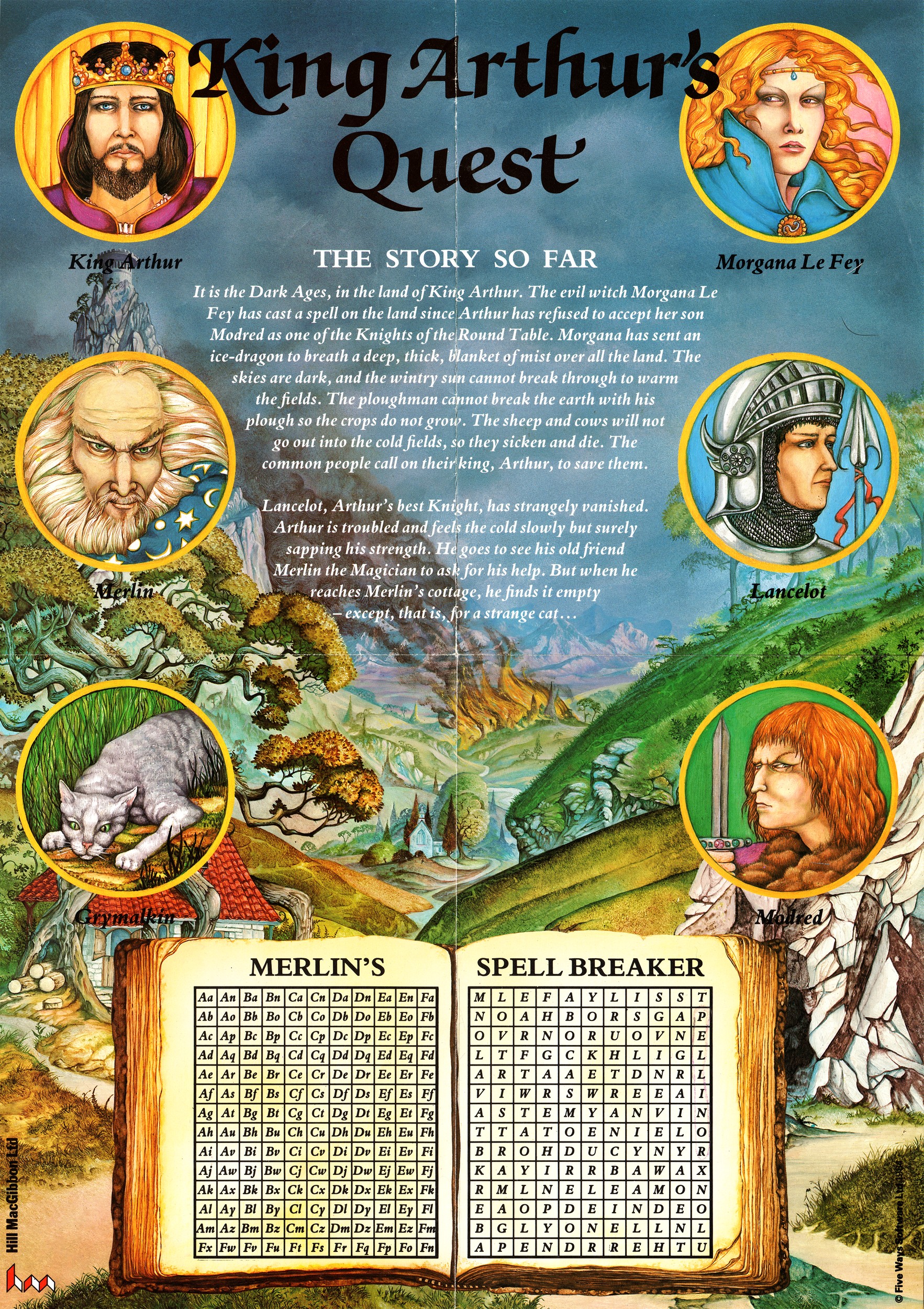
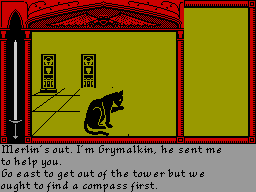
48K Spectrum £7.95 Hill MacGibbon King Arthur's Quest is a graphics and text adventure that takes you through Camelot, currently under Morgana's wintry spell. The land is split into eight areas: Merlin's Tower - where you start, the wilderness, enchanted forest, keep, chapel, crypt, cavern and Morgana's Castle. Each area is based on a grid of 10 by 10 squares. Every time you move, you progress one square and are presented with a forward view of the surrounding area. Permanently on view are Excalibur which slowly turns red as your life-force diminishes and a picture of every object in your possession. The bottom of the screen is used as a scrolling text window, recording your commands and allowing Grymalkin the cat, your faithful companion, to furnish information on objects, incidents, etc. Commands are gives by single-bey entries. You don't have to memorise them - a keyboard overlay is provided. There are only eight actions you can perform: turn left or right, move forward, take, leave or use an object, eat/drink and cast a spell. You can also repeat a description, cancel a command, save and restore a game. Among the characters you'll encounter are a jester, griffin and owl. Characters may help you - if you help them. The graphics are simple but effective and the text character-set has been designed to look like authentic manuscript. Some sound effects have been included. An enjoyable game of exploration and discovery for the younger adventurer.
Big K #10Jan 1985 · p.362/32/32/32/32/3
Graphics 2/3
Playability 2/3
Addictiveness 2/3
Overall 2/3
John Conquest 2/3
CAMELOT COUNTDOWN MAKER: Hill MacGibbon FORMAT: cassette PRICE: £7.95 A full graphic 3D journey through the land of Camelot in the shoes of King A, trying to undo a spell cast by Morgana la Fey that's freezing the joint. Not only do you have to work out all the usual adventure game problems, vocabulary, movement, uses of objects, spatial relationships and tricky little puzzles, but you also have to solve a riddle and do all this before you start imitating a metallic anthropoid. Hill MacGibbon don't give you much help either. Apart from a spell-breaker code and a very general blurb, all you get is an overlay for the top row of the Spectrum keyboard, which gives you eight effective commands - left, right, forward, drop, get, use and spell. The mechanics you have to work out for yourself, which takes a lot, and I mean a lot of trial and error. The get/use/drop actions are particularly baffling. Compounding all these problems is the need to reload the game completely whenever you get wiped out, which isn't hard. The graphics are adequate, though the 3D field isn't very deep, giving you a rather limited visibility range, and the whole thing is laid out in chess board like squares, round which you shuffle feeling fairly pawn-like how to load and save would have been in order, not to mention some pointers on the commands.*
* Since above review was written a full and comprehensive manual has been received - Ed.
Sinclair Programs #27Jan 1985 · p.1650%50%
Rating 50%
June Mortimer 50%
PRICE: £7.95 GAME TYPE: Maze Adventure There are months when mapping aversion overcomes software reviewers. Indications of this are desks covered with enormous, badly-glued-together sheets of paper, a worn 'hold' button on the keyboard, and reviewers sitting in the corner of the room, murmuring through gritted teeth, "Take the right fork at the lion's den, swallow the mouldy cheese, bounce across the lake, turn left..." Time comes, of course, when the editor drags them screaming to their type writers. "Show you know the game", she hisses, "but don't go on about the maps". It is true, though. Buy any good game this month and you will be showing the same symptoms. They all need maps. King Arthur's Quest and Aztec: Hunt for the Sun God are cases in point. They are both maze adventures, with excellent graphics. You move from one location to the next, able to see those locations a short way in front of you. You collect objects, and use them as you think necessary. Some will kill you, some are essential to your progress. You can never see objects in a location, until you have been there. Each game has 800 locations, the majority of which can be visited. To avoid missing objects or walking round in circles, it is necessary to map each location. Make a mistake, and making the right decision is based largely on chance, and you will have to begin again. The story lines are charming, the graphics effective, but the games themselves are little more than tests of your patience and mapping ability. Produced for the 48K Spectrum by Hill Mac-Gibbon, [redacted].
Sinclair User #34Jan 1985 · p.524/104/10
Gilbert Factor 4/10
Richard Price 4/10
ARTHUR'S UNORIGINAL ADVENTURE Memory: 48K Price: £7.95 Remember the old dinosaur mazes? Moving along one square at a time you could turn right or left to enter side passages. King Arthur's Quest uses a similar type of movement system, though the countryside and rooms depicted are not bounded in the same way. The wicked Morgana Le Fay has put a spell upon the land. The world is slowly dying and you must save it from the Enchantress and her magic. You begin in Merlin's cottage and must examine the grids to collect useful objects or meet the various characters. There are nine basic actions each carried out by a single key press - a rather flimsy overlay is provided to show the relevant keys. This is not a normal text adventure, given the very limited range of input, and may consequently appeal to a younger age group. The graphic displays are sufficiently pleasant, though unoriginal in style, and the response time is fast. There is a microdrive transfer facility but if you are killed during play you must reload.
Micro Adventurer #13Nov 1984 · p.39
John Fraser
ADVENTUROUS ARTHUR AND THE AZTECS John Fraser reviews King Arthur's Quest and Aztec Few adventurer's can have failed to notice the new breed of graphic adventures which has been emerging recently. Now, in the wake of such epics as Lords of Midnight, come two more games which allow the player to roam through a three dimensional world. King Arthur's Quest and Aztec are the first adventures to be released by Hill MacGibbon, and very impressive they are too. Although their graphics are not animated, each time you move your view alters accordingly. Trees, towers, etc, become larger as you approach them. Amazingly, if you walk into something the picture sways drunkenly with such realism that at first I thought I needed to adjust my TV. The first thing you will notice is that the screen is divided into three or four areas, depending on which game you have loaded. The rectangular window in the centre gives you your view of the land. To the right of this is a smaller one which displays the objects you have picked up. Beneath these windows is a third in which messages from the various characters appear, and these scroll independently. In King Arthur the sword Excalibur is also shown, glowing brightly at the start of the game. Then, as the game progresses, its brilliance diminishes until it has faded altogether and your time has run out. There is also a time limit with Aztec, but in this case you see the sun (top right hand corner) sinking slowly towards an Aztec god; when he finally grasps it the game is over. With both games you are restricted to using the top row of keys for movement, picking up and dropping objects, drinking, and using spells. Obviously with this one key system for inputting instructions it's impossible to have any sort of dialogue with the characters or to perform more than a narrow range of actions. To some extent the 'use' key compensates for this deficiency. If you wish to, say, unlock a door, you press '7' on the keyboard followed by space until the object's name appears in the communications window. Then, when you press enter, the door will be opened. It's as simple as that. Casting spells is just a little more difficult, as you have to decode clues which you will find on your journey. This entails consulting the 'spell breaker' on a colourful poster which is provided with the game. One of the attractions of these games is that, unlike many adventures, your movements are not confined to a particular route. You are free to explore as much of the land as time permits, although unless you keep track of where you are you may find yourself retracing your steps frequently. The ground over which you travel is divided into ten by ten squares; you can see this crosshatching before you as you move. Each game has eight such areas and they take a while to explore thoroughly. When you take into account the time taken to cast spells and so on, you will have to set aside several hours for play. Although the landscape is sometimes flat and monotonous, the objects and creatures you encounter are drawn in high resolution graphics and the medieval lettering is superbly done. What defects there are seem trivial when you consider the novelty of approach. Make sure, however, that you get a properly printed instruction booklet with the game you buy. The ones with my review copies were mixed up and I had a job sorting out which page referred to which game. The scenarios draw on the mythology of the Aztecs and King Arthur's Camelot for inspiration. In King Arthur you assume the role of the legendary King Arthur (no not Arthur Scargill) who must rid the land of the evil witch Morgana Le Fey. In Aztec you are a young coppersmith who dreams that rainclouds will come and drown the sun. When you wake you find that the sun had failed to rise and so you set off on a quest to discover the meaning of your dream which you hope will enlighten you. These poetic metaphors are translated into imaginatively conceived and constructed adventures which transform the traditional text and graphic adventure almost beyond recognition. The shape of things to come, perhaps?
Advert21
- Sinclair User #35Feb 1985 · p.68
- Sinclair User #34Jan 1985 · p.128
- TV GamerJan 1985 · p.4
- Personal Computer Games #14Jan 1985 · p.42
- C&VG (Computer & Video Games) #39Jan 1985 · p.90
- Games ComputingJan 1985 · p.107
- Big K #10Jan 1985 · p.55
- C&VG (Computer & Video Games) #38Dec 1984 · p.196
- TV GamerDec 1984 · p.67
- Big K #9Dec 1984 · p.40
- Home Computing Weekly #91Dec 1984 · p.4
- Games ComputingDec 1984 · p.69
- Micro Adventurer #14Dec 1984 · p.46
- ZX Computing #16Dec 1984 · p.11
- Sinclair User #33Dec 1984 · p.185
- TV GamerNov 1984 · p.67
- Home Computing Weekly #89Nov 1984 · p.2
- Home Computing Weekly #87Nov 1984 · p.2
- Micro Adventurer #13Nov 1984 · p.16
- Big K #8Nov 1984 · p.36
- Home Computing Weekly #85Oct 1984 · p.2
News/Note4
- Crash #12Jan 1985 · p.171
- Home Computing Weekly #90Nov 1984 · p.5
- Home Computing Weekly #88Nov 1984 · p.6
- Micro Adventurer #10Aug 1984 · p.7
Review3
- TV GamerJan 1985 · p.48
- Home Computing Weekly #92Dec 1984 · p.27
- Popular Computing Weekly #42Oct 1984 · p.68
CompoEntry2
- Personal Computer Games #14Jan 1985 · p.116
- Micro Adventurer #14Dec 1984 · p.58
CompoResult1
- Micro Adventurer #16Feb 1985 · p.42
Feature1
- Micro Adventurer #13Nov 1984 · p.37
Related
- Ports
- (Commodore 64)
- Elsewhere
- CASASpectrum +2A/+3 IncompatibilityMobyGamesRZX ArchiveThe TipshopUVLModern ZX-Retro GamingRZX Archive - YouTube
- Same entry at
- Spectrum ComputingZXInfo
Reviews from people here
Sign in to write about this, or make an account. It takes a minute and lets you correct the catalogue too.
No description recorded.
Sign in to correct or add to this.
Hold the rights to this and want it taken down?