
Fire on the Water
Adventure Game: Graphic · ZX-Spectrum 48K · 1 players · English
Arrow · 1984 · Pound sterling 8.95
Also known as Lone Wolf 2 (English)
Lone Wolf, 2 of 3


Discussion
Nobody has started a thread about this yet.
Remarks
cheaper price is without book
SPOT: Lone Wolf 2
Play
- fireonthewater.rzxRZX playback file
- FireOnTheWater.tzx.zipTape image English55 KB
- FireOnTheWater.tap.zipTape image English58 KB
Documents
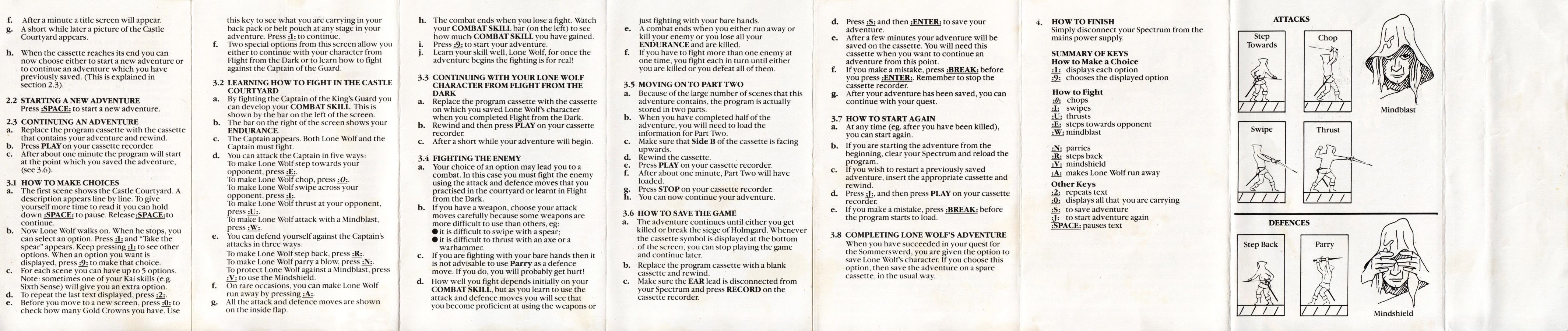
- FireOnTheWater.txtInstructions English13 KB
Files and rights
No permission is on record either way. Screens and pictures are copied here on a take-down basis: if you hold the rights and want something removed, say so and it goes.
Credits
- Five Ways Software Ltdcredited
- Gary ChalkInlay/Poster Art
Sign in to credit somebody, or say what these people did.
Scores
In the magazines
- Personal Computer Games #131984 · Overall5/10
- Crash #141985 · Overall Value5/10
- C&VG (Computer & Video Games) #411985 · Personal Rating6/10
Elsewhere on the web
- WorldOfSpectrum 27 votes8.04
In the magazines 17
C&VG (Computer & Video Games) #41Mar 1985 · p.166/106/10
Personal Rating 6/10
Simon Marsh 6/10
What is a quest? Well we reckon it's an Adventure with more than a hint of classic Dungeons & Dragons game about it. Here Keith Campbell, Paul Coppins, Simon Marsh and new recruit Jim Douglas take a look at some Adventures inspired by D&D. FIRE ON THE WATER I have to say that I usually hate any game that is not pure Adventure - that is, one that does not require logic to solve problems. Adventure games, to my mind, should be of the original type and not so-called "Arcade Adventures". Lone Wolf's Fire on the Water is the exception to that rule. Although the game is not an arcade Adventure, it does rely on graphics for the fighting scenes and is a role-playing game. You are a Kai warrior, a sort of Samurai warrior who has powers to communicate with animals, and whose mind can attack other minds with a power called "mind force". As a student from the Kai monastery, you start off in the game being taught to fight and soon get used to being well and truly trounced by your master. You are later sent out to collect firewood as a punishment for inattention in class and, as luck would have it, whilst you are out, the monastery is destroyed by the Dark Lords, and all the Kai Lords are killed It is your task to avenge their deaths and warn the King of the threat of attack. The game now starts in earnest and many battles and problems confront you. Movement takes place by menu-type commands and, although this may put you off, it is offset by the graphic fighting scenes which are great. There's an accompanying book with the game which is great fun but, as I'm no role-playing expert, I passed it over to a friend, Paul Cleden, who is into that sort of thing and he promptly solved it in half an hour without cheating! In his opinion, it is a book for beginners which I can quite believe, as it took me three days to complete! The book and game can be bought in two ways. You can get the game only for £6.95 or the combined package for £8.95. The book alone can be obtained for £1.50, so if you are thinking of buying the combined package, do a quick bit of arithmetic first! "Nuff said!" as the Chief Examiner would probably remark!
Crash #14Mar 1985 · p.1006/104/106/108/105/105/10
Atmosphere 6/10
Vocabulary 4/10
Logic 6/10
Debugging 8/10
Overall Value 5/10
Derek Brewster 5/10
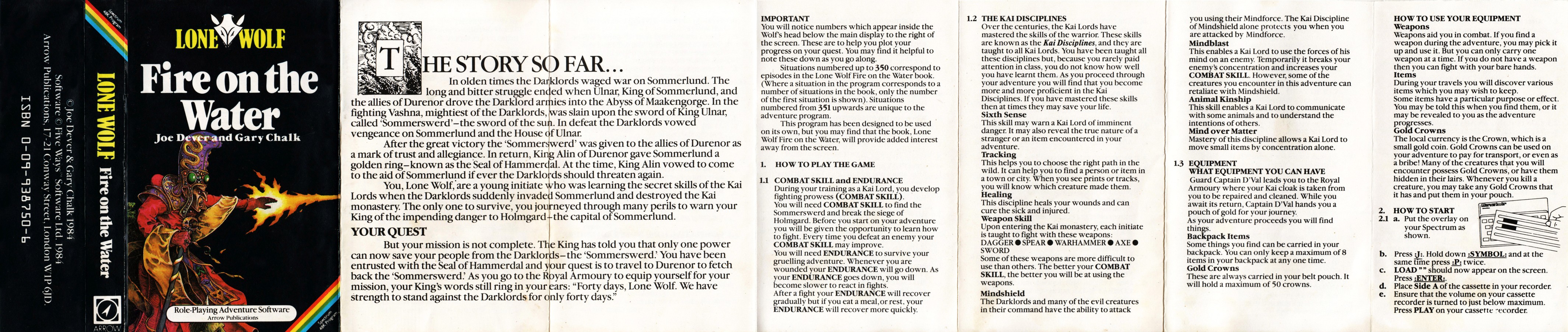
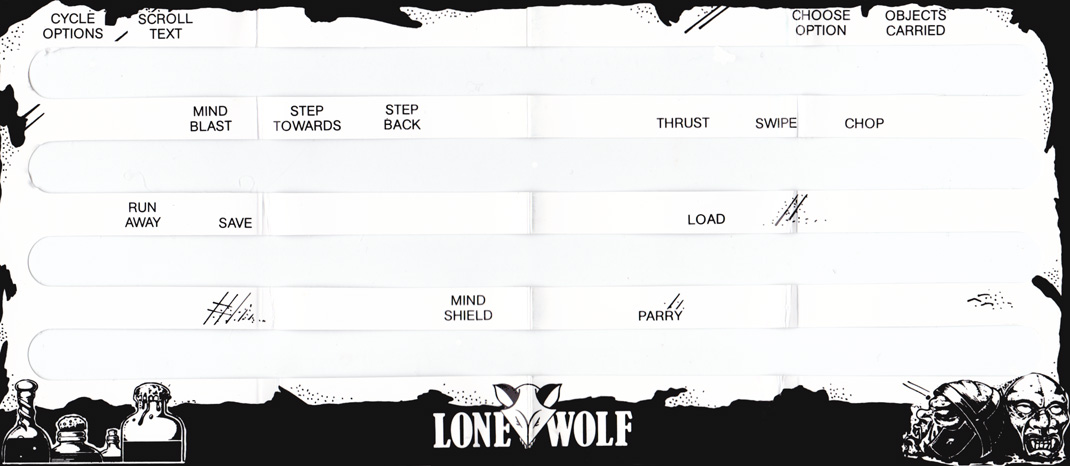
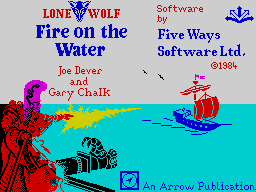
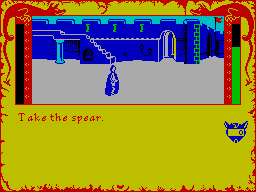
DEREK BREWSTER'S ADVENTURE TRAIL THERE IS A FAULT, PLEASE ADJUST YOUR SETS I read George Orwell's book way before 1984 but found it strange the way everyone last year went to great lengths to point out how modern society bore little relationship to the one portrayed in the novel. I was one of the few people to take the opposing view. If I remember rightly, and it is a long time since I read Orwell (at Primary school - it was slotted in between the Red and Orange Books and Peter and Jane go Ferreting) the book tells of how telescreens impose a highly ritualised life-style on the island's inhabitants. Statistics were used to show how things were getting better when it was plain things couldn't get much worse. What of our society? During the last cold winter the electricity board met with very high demands on electricity, supplying in excess of 45,000 megawatts. Although this demand, brought on by the severe temperatures, was exceptional it was exceeded by the confluence of the end of a final episode of a BBC television series and a commercial break in a film on ITV. What this tells us about society is startling and leads me to think the power wielded by television is out of all proportion to its authority. To give Orwell's novel renewed topicality, simply substitute the word telescreen with the word television. Or to paraphrase a learned Canadian, if the medium is the message then I'm afraid the news isn't good. So what has all this got to do with software? Well let's first take newspapers as an example. The light-weights of Fleet Street would have little to do with TV during its infancy yet now find it profitable to devote up to two-thirds of their space to the gogglebox and its plethora of soap operas and petit politics. The crucial point with software is not that tie-ins with programmes is a bad thing in itself, it's just that, if TV is not quite Big Brother, it is large enough to intimidate anyone with the idea of buying rights to a TV programme into parting with a considerable amount of money. The point is, big business, delightfully absent in the early days of software, scares me an awful lot because big business needs a big turnover to realise big profits to get even bigger. It can get to the ridiculous stage where you either buy what they tell you to or you buy nothing at all. (If you don't think things could ever get that bad try buying a decent pair of shoes in the High Street). Remember, you can't beat the imagination of one lone programmer or a small team huddled in deep thought around a project and also, TV seldom comes up with new ideas itself but in almost every case relies on a steady stream from books, stories, newspapers or the good old radio. It would be nice to think that we could choose what we particularly like from books, comics etc, rather than wait for some comfy TV people to decide this for us. And I would hope the same could be true for software. FIRE ON THE WATER Producer: Arrow Publications Retail Price: £7.95 Author: Joe Dever and Gary Chalk Fire on the Water consists of a self-contained cassette (which can be bought separately through mail order) with a very instructive concertina inlay and a full roleplaying book of the same name, Book Two in the 'Lone Wolf' series (Flight from the Dark was number one, while the third will be The Caverns of Kalte). With numbered paragraphs throughout, these books create something akin to a computer adventure where the options open to you at each turn lead to different paragraphs. Action Charts, a Combat Result Table and a random number page form the machinery which drives the story along. Within the inside cover of the book lies a map of the Lastlands depicting some of the places mentioned in the inlay: the Kai Monastery, Holmgard and Durenor. Sparrow Books, the publishers, tell us something of the author and the illustrator. Joe Dever became a full-time musician and while on a business trip to Los Angeles discovered D&D, becoming so engrossed he went on to win the Advanced Dungeons and Dragons Championship in America in 1982. Gary Chalk began playing war games some years ago when only fifteen and has now turned his BA in design to good design to good effect in Cry Havoc, Starship Captain and Battlecars (co-designed with Ian Livingstone). This is how we are introduced to Book Two. The Darklords invaded Sommerlund and destroyed the Kai Monastery but you, Lone Wolf, survive the attack and travel to your King enthroned in the capital, Holmgard. Only one power can now save your people - the Sommersword, sword of the sun, bestowed upon the allies of Durenor to the east as a mark of allegiance that exists between the two kingdoms. In return the King of Durenor gave Sommerlund the golden ring known as the Seal of Hammerdal. If ever the shadow of the west should rise again, Durenor would come to the aid of Sommerlund. On loading you see a castle courtyard with fine detail of battlements, turrets, doors and ropes. The redesigned character set is in keeping with the flavour of the adventure. The text scrolls slowly upward through the bottom half of the screen after which a characters enters stage left, making a distinctive clip clop' sound - a noise which become familiar as it accompanies all movements by characters throughout the game. (The analogy with a stage is apt, since the backgrounds are indeed backcloths with only one, two or perhaps three characters moving along the front of the stage). Lone Wolf, who appears a distinguished chap with a cloak, is offered a choice of weapons between spear, sword or hammer but when you make your choice you should note that it is difficult to swipe with a spear or thrust with a hammer. NB: if you choose to fight with your hands, it is inadvisable to parry! The significance of the terms SWIPE, THRUST and PARRY lie in their use a keywords on the keyboard overlay supplied with the game. Another keyword, CYCLE OPTIONS, scrolls the options open to you at any one stage, one by one, so you can press CHOOSE OPTION when the most attractive one appears. At this point I chose a sword to help Lone Wolf whereupon a sword appeared on the screen in his hands. Keeping CHOOSE OPTION depressed also cycles the spear and hammer through his hands if you are curious as to how they look. Pressing OBJECTS CARRIED tells me I have a sword and thirty-two gold coins in my pouch. As I progress I can carry up to eight items in my backpack. The next choice is straightforward enough - off to train with the King's Guard which develops Combat Skill, shown by a bar along the left side of the screen. Training is completed when Lone Wolf loses his endurance (shown by a baron the right) and the fight. Your first effort will no doubt, like my own, be ignominious because the keyword buttons STEP TOWARDS, STEP BACK, THRUST, SWIPE, CHOP etc take some getting used to. More mystical are the activities of Mind Blast which momentarily breaks the enemy's concentration and increases your Combat Skill, and Mind Shield whereby those creatures who use mind force against you find their powers curtailed. In the bottom right of the screen is a wolf's head which bears a number. Numbers up to 350 correspond to episodes in the book. It won't take long after realising this to discover something rather fundamental governing the whole Fire on the Water project, principally, that the book develops the story to a far greater depth than does the software and in many cases provides more routes to explore the adventure to the full. Hence it can be said that not only does the book provide a more intricate plot but it also offers this for the price of £1.50. The implications are obvious to anyone with limited funds at their disposal. Fire on the Water is something different for the adventurer. It is a precis of an accompanying role-playing book but it is not dependent upon it, and indeed the software, if need be, can be purchased separately. The quality of the graphics varies with the backdrop but they are always colourful. The first scene and many more which follow are highly detailed and well laid out. Movements of characters, and the occasional movement within the backdrops leg the bird and the ship) are slow and give the whole a plodding, laboured feel. A small graphic of a cassette appears at the side of the screen at moments opportune for saving the game - and the opportunity should be seized, as the game cannot be restarted once you have lost a life. The combat action is good with diagrams on the cover depicting exactly what stance is represented by CHOP, SWIPE, THRUST etc. Watching fights take place and guiding your character through them is the chief advantage the software has over the book. The book, however, wins on most counts with a greater depth to its storyline and the fact that it provides more routes through which the adventure may be explored. Although it's not strictly necessary to read the book to enjoy the software, a knowledge of the book does improve your play as familiarity with the larger picture can influence your route through the program. COMMENTS Difficulty: Quite easy Graphics: On all locations, and with moving characters Presentation: Good Input facility: Single key input Response: A touch slow due to character movement Special features: Real time combat, multiple choice adventure
Personal Computer Games #13Dec 1984 · p.1107/104/10N/A5/105/10
Atmosphere 7/10
Complexity 4/10
Interaction N/A
Overall 5/10
Steve Cooke 5/10
SPOILT FOR CHOICE The White Wizard investiagtes the latest releases. GAME: Return To Eden PRICE: £9.95 MACHINE: Amstrad, Atari, BBC, CBM64, Nascom, Memotech, Spectrum GAME: Sorceror of Claymorgue Castle PRICE: N/A MACHINE: Apple, Atari, BBC, CBM64, Dragon, Electron, Tandy, Spectrum GAME: Fire on the Water PRICE: £6.95 MACHINE: Spectrum GAME: The Prince PRICE: N/A MACHINE: Spectrum GAME: Macbeth PRICE: £14.95 MACHINE: CBM 64 Anyone know of a secluded retreat, with ample supplies of tinned owls livers and lettuce opium? So much software has flooded into the White Wizard's cave this month that he is at his wits' end and badly in need of a very long holiday. However, the good news is that there are some hot new releases out this month. Level 9's Return to Eden hits the streets and, of course, there's the Sorceror of Claymorgue Castle from Scott Adams. Not only that, but there are also one or two new games that offer the adventurer something quite different from any programs that have come before. First, however, let's Return to Eden with Level 9. This is the eagerly-awaited sequel to Snowball and will be available on the usual extensive Level 9 range of machines, from the Memotech right through to the Amstrad. You don't, by the way, need to have played Snowball to enjoy Return To Eden. This game marks a radical departure from Level 9 tradition by including gasp - GRAPHICS. Have the die-hard, text-only gents from L9 taken leave of their senses?? No, mein wizardlings, zay haf zimply produced a better game, ja! (Yes, the White Wizard is proficient in all languages including Numenorean Provincial). Frankly, the White Wizard found Snowball a very trying game and wore out at least a dozen wands exploring its secrets. Return to Eden is rather easier in my opinion and certainly as enjoyable as its predecessor. The only thing about the graphics, is that some of them are rather poor... Sacrilege, I know, to speak ill of a Level 9 game but really they aren't that hot with the pastels. Even the old Mysterious Adventure range comes out on top here. However, this game oozes with atmosphere as you explore a distant planet populated by some very strange creatures, including the invaluable See Bee, the very necessary Ouija bird, and the undesirable leviathan. You can jump off cliffs, fight squirrels (well, be attacked by squirrels), and die of radiation. This is the sort of thing Wizards enjoy and that's only the beginning. From the exotic forest you move on to the daunting task of penetrating the different zones surrounding a robot constructed city. Very hazardous this, and I guarantee you'll need to spend at least a week driving yourself round the bend before you reach the city - by which time you'll be only about halfway through the game! 200 locations, the usual extensive vocabulary, and a great scenario make this every bit as good as previous Level 9 games. Don't expect the locations to be quite so fully described as other Level 9 games - after all you do get the graphics which take up a lot of memory. There's a strong 'conservationist' slant to the story, centring on the moral questions surrounding the destruction of alien life forms. No, I'm not kidding, and the White Wizard very much approves of this sort of thing. The more adventures we have that reflect real-life problems like this the better in my view. The only slight reservation I have about Return to Eden (and all other Level 9 games) is that it doesn't tell you which words it fails to understand. It simply replies with the famous 'Arfle Barfle Gloop?' which isn't much help when you are trying to unravel vocabulary problems. It has to be said, however, that one doesn't often have vocabulary problems in a Level 9 game. Another important recent release is Scott Adams' Sorceror of Claymorgue Castle. This is available for the Commodore, Spectrum, Apple, Atari, BBC, Dragon, Electron, and Tandy... phew! Quite a list. The White Wizard has dabbled enjoyably in the Spectrum version, which features some very pretty graphics indeed. It's worth noting that the Spectrum conversion was done by Brian Howarth who writes the Mysterious Adventures, to which this program bears some superficial resemblance. Well, what can one say about Scott Adams' adventures? They've been around for a very long time now in one form or another, but the fact is that whenever a new one comes out it is always a good buy. Sorceror of Claymorgue Castle is no exception. As in most Scott Adams' games, the object of the game is simple - you must collect a certain number of readily identifiable treasures and store them in a particular location. The challenge of the games is in overcoming the different puzzles, most of which are encountered when you try to move from location to location. None of Scott's games have that many places to visit, but that doesn't mean they're a doddle by any means. Sorceror is definitely a case in point here. You start off behind a castle and I guarantee that you won't enter it inside ten minutes of cursing, howling, and (as it happens) holding your breath. Once you get inside, you'll still have to try every trick in the book to explore more than about six locations. Just to tantalise you, one of the treasures is plonked almost right in front of your nose at the beginning - but try picking it up and you'll see that all is not as easy as it seems. So that's two new games for your shelves - and both available on a wide range of machines. Now let's take a look at something quite different - three releases each of which offers something rather unusual. LONE WOLF The first is the Lone Wolf series for the Spectrum, though I imagine that there will soon be similar offerings for other machines. There are two games in the series so far - Escape from the Dark and Fire on the Water. Both titles offer excellent animated graphics and a very unusual format. The cassettes come either on then own or with an accompanying book that gives some idea of what to expect from the games themselves. The books are split up into numbered sections each of which contains a stage in the development of the plots. I say plots rather than plot, because the story changes as you read. This is because whenever you come to a crucial point in the story, you have to make a decision. Depending on the decision you make you are then directed to another numbered section where you continue reading. This, of course, is very much like playing an adventure game on a computer, so it's only natural that Arrow, the publishers, have decided to offer a game as well. The format is as follows - there's a graphics screen surrounded by an attractive border and a scrolling text window below. You place a keyboard overlay on top of your Spectrum. The storyline scrolls on the screen, and whenever you have to make a decision you press the appropriate key and the program jumps to the next stage in the story. There are also extensive fight routines, requiring diligent pressing of Parry, Thrust, Chop, and Swipe keys. Your fighting skill and energy are monitored on the screen, and when you run out of energy Lone Wolf (that's you) bites the dust. The fight sequences are well-animated, and after a couple of hours playing I decided that there really was a tactical element which made them much more satisfying than the usual 'You-stab-the-Dire-Wolf' routines that other games tend to offer. Escape from the Dark and Fire on the Water are consecutive games, and a character developed in the first can be loaded into the second ready for action. So what's different about these games? The first thing to notice is that the program itself dictates your movements. For instance, you can't type in 'Go West' unless that is presented to you as an option to be selected. In this respect the game is more limited than a traditional adventure. However, all the space saved by the absence of complex 'parsing' routines (the bits of the program in a normal adventure that scan your inputs and generate appropriate responses) means more room for graphics and animation. There is still a good deal of scope for the player to shape the game - you can sometimes run away rather than fight. You can choose your own routes to your destination, and investigate a number of dead-ends, some of which are more rewarding than others. The White Wizard gives these games the thumbs-up and looks forward to more along the same lines. They are very different in feel to the traditional text/graphics games, but I think they have at value all of their own. It is, incidentally, worth getting the books as well as the games - you can then use them as crib-sheets if you find the going too tough! THE PRINCE If you think Lone Wolf sounds different, wait 'till you get a LOAD of the next game an interactive program for four players from CCS called The Prince. This game apparently won the Cambridge Award 1984, though I'm a hit hazy as to what exactly that means. However, it is a very interesting piece of software that should be carefully examined by adventurers and particularly those with a D&D background. The scenario is as follows: in Castle Ravencrag the Lore-Master has disappeared and is believed dead. By law, succession to this desirable post is by 'presentation of the tokens' - a ritual ceremony in which the applicant begs an audience with the Prince of Ravencrag and hands over the tokens. Your task, and that of your three human opponents, is to find out what the 'tokens' are, get hold of them, and present them to the Prince. You then become Lore Master and win the game. Each player takes on one of four characters - Grasper, a landlord; Ambrose, a cleric; Porcus, the merchant; and Fernandon, the tipstaff (magistrate to you and me). Each player has certain advantages related to his profession - money, for example, in the case of Porcus. Having chosen characters the players then take it in turns to recruit help from the Castle retinue and purchase items from Gump, the Castle trader. During this phase only one player at a time looks at the screen, so other players will not know who is working for you or what you possess. Occasionally, for example, a servant may serve two masters and knowledge of his double-dealings could benefit either player. Each player has a passcode which he must enter during the game in order to play. This stops other players from cheating when you pop out for a slice of toast and honey - or whatever you fancy. During your turn you find yourself inside the castle as in a traditional text adventure. You have only 10 inputs in each turn and must find out as much as possible. You can call your spies and ask them to report, or get your less desirable -helpers ('henches') to attack your opponents servants. During this phase you will find that the vocabulary of the game is rather limited but, of course, it's the same for all four players. What's special about The Prince, however, is that it is one of the first computer games I've come across that permits intelligent and enjoyable collaboration between the human players. As in D &D you will find yourself involved in complex negotiations with your opponents (or allies, depending on how you deal with them). Nothing is too fair or too foul to be considered - you could, for example, ally yourself with Fernando, find out who his spies are under pretence of helping him, then have your spies knock them all out! You unscrupulous devil you, of course you wouldn't do a thing like that, would you? Oh yes you would... Like the Lone Wolf games The Prince is very far from being a trad adventure. It is, however, a game that will appeal to adventurers who enjoy a get together and the chance to outwit each other. Again, the White Wizard, while granting this game a place on his now crowded shelf, would be pleased to hear from other adventurers as to what they think of this new breed. MACBETH Finally - in the 'New Trends' department - we have Macbeth from Creative Sparks for the Commodore 64. This is quite a handful, this one. Two tapes, four games, plus a copy of the Shakespeare play. Each of the four games is related to part of the play, and each is in a different style. All four games feature graphics to a greater or lesser extent and the standard of these is extremely high. In each game you must achieve certain objectives that will allow you to achieve the goals of the character you are playing. In the first and last games you play Macbeth, in the second game you are Lady Macbeth, and in the third you are one of the Three Witches' assistants. With the exception of game number 3, these are all text-games with graphics added in places. Unfortunately, they rely very heavily on your ability to phrase your inputs correctly. Although they will tell you which words are not understood (by highlighting them in red) they are not very hot on understanding the traditional vocabulary. This is particularly true in game 3, which is almost entirely graphics based and doesn't understand words like 'North' or 'South', The display plays a very important role here and you must pick out items in the picture and use them as appropriate, although you may not have been told explicitly that they are there. I'm not sure that Macbeth will appeal to many adventurers unless you have a particular interest in Shakespeare or Scottish history. Some of the sequences are very good, but of 14.95 seems a lot to pay for them. The other drawback with the game - and this applies to one or two other book-based adventures - is that you can't succeed without reading the play, and having read the play, you know what's going to happen. The whole program is rather lacking in the excitement of discovery that makes a good adventure. However, there is one very interesting innovation that is worth a mention. At the end of each game the program gives you the opportunity to load a program called 'Psycho'. This is a very novel routine in which the computer poses as a psychiatrist and questions you in your role as the character you have just been playing. 'Remember that session we had years ago when we got rid of your meat phobia?' enquires the computer of Lady Macbeth (i.e. you) and then goes on to find out just why you behaved as you did in the play - or the program. Computer buffs will no doubt realise a similarity here between Psycho and Eliza - a program that simulated a psychiatrist and gave apparently intelligent replies to the questions put to it. Psycho isn't nearly as complex, but it's still good fun. But why does the White Wizard mention this curiosity, I hear you cry. Well, I reckon it's only a matter of time before we see more variations on the traditional adventure theme. Using a routine like 'Psycho', for example, you could carry on an enjoyable - even if perfectly meaningless - conversation with Thorin in The Hobbit, for example... and just look at Sherlock, where you can 'Tell...' a character things you think they ought to know. Well, that's all for this month my friends. Next month's issue will be absolutely packed to the brim, and will include a couple of goodies that I've had to leave out in this issue because of lack of space. In the meantime, I have a special favour to ask of you all, in recent months we've had a number of new games that one can't really call adventures, but still seem to have some sort of claim to a mention on these pages. I'm thinking particularly of so-called 'arcade adventures' like Gisburne's Castle, or novelties like the Lone Wolf games I've mentioned above. Well, what do YOU think? Are these games worthy of our attention? What do you think is the definition of an 'adventure game'? Shall we stick to the straight and narrow path of the traditional adventure, my fellow explorers of the unknown lands, or shall we allow ourselves to sally forth into new realms? The White Wizard humbly awaits your reply, and will how to your judgement.
D&D-style interaction for four players in The Prince from CCS.
Superbly animated fight sequences make Fire on the Water a cut (and thrust!) above the ordinary.
Micro Adventurer #13Nov 1984 · p.38
Noel Williams
FIRE ON THE KEYBOARD Noel Williams tackles Hutchinson's new computer games, Flight From the Dark and Fire on the Water, based on the Lone Wolf game book series. It's getting harder to make the distinction between computer gamer, wargamer, roleplayer, adventurer and reader of fantasy novels. Joe Dever and Gary Chalk have produced something to make the distinction even less clear - the Lone Wolf programmed adventure books, which have now been turned into computer adventures. It's easy to see why the computer games have been written. A programmed scenario in book form is only a couple of removes from a computer adventure, as the description 'programmed' tells us. Any competent programmer can turn such a book into a simple game with ease. In fact this is probably the easiest way to write an adventure. Using a computer to play such a paragraph game has various advantages over the book version. No pages to turn, no risk of losing your place or forgetting the next paragraph number, no need to throw dice or to keep records on scraps of paper. But if you are looking for an interesting computer game you want more than this, especially if the game is based on a book with the same structure and which is a third of the price. Most people would have a shopping list of additions which would include things like 'attractive graphics', 'animation', 'real time action', 'significant differences from the book in plot', 'use of sound'. Five Ways Software, the company which programmed the games, clearly know this and has gone some way towards ticking off all the items on your shopping list. You get real time combat, illustrations of each setting, moving characters and use of sound. However there does not seem to be much in the way of variation from the original books - in fact you can proceed through the programs in many situations by using the book as a reference guide. What variations there are are generally by way of reducing descriptions and missing events out. Occasionally this becomes a real problem. For example in the first four 'paragraphs' of Fire on the Water so much has been taken out of the original that you are given no choices at all and have to play through three combats. Unless you start with a well trained character you stand little chance of surviving this onslaught. Real time combat on the Spectrum replaces the combat system of the books. The conflict in the computer versions is the most detailed and novel aspect of the program. You have choice of weapons and choice of tactics, including the psychic modes and mind blast and mind shield, and have to move your character to the most advantageous position on screen for striking a particular kind of blow. Movement is only in one plane (left to right) and you cannot change weapons halfway through a fight, but simply remembering which keys govern which tactic makes the contest quite hard. Different weapons add different values to combats and the most effective tactic also depends on the chosen weapon (it's quite hard to stab someone with a mace!). However the Spectrum's keyboard means that timing of blows is haphazard - you never know if a particular keystroke has led to a particular blow and I found that sometimes my blows were 'queued' so that the figure went on striking even when my fingers were not on the keyboard. Nor is the feedback of effects during combat all that it might be. You do not get the usual constantly updated stats on performance. Instead your own endurance and combat skill are represented by two green thermometer like columns. When the liquid in endurance has run out, you are dead. As for the monsters, they sometimes indicate weakness by adopting slightly crumpled postures, but in other cases you have no real idea if you are doing the right thing or not. The combination of these devices means that combat feels more haphazard than it probably is. In practice you tend to bash away at the keys in no particular order (because you have no indication of which does best) until your endurance gets low, when you attempt to retreat (and, if you are like me, you hit the wrong key only to find that you have killed the monster by mistake). It seems a little silly to design a complete system which the player is totally ignorant of. Another novelty is that, instead of being given a character to start with who has pre-generated skills, you must undergo a training session to establish your basic skill. This takes the form of a fight with one of the elders. Apart from the report at the end of the fight you do not get a good indication of how well you are doing and the whole business is a little mystifying the first time round, but it is quite a good idea and works well once you know what is supposed to be happening. The graphics themselves are somewhere between The Hobbit and Valhalla. They certainly offer no major advances on previous games. The backgrounds are rather better than those in The Hobbit with a better use of colour and some shading. Some are more imaginative but others less well drawn than Valhalla. The moving figures are less convincing than Valhalla's despite being better drawn and on a larger scale. The silliest thing is the way that your own character hops around the place on a single leg. The other leg is supposedly hidden by a cloak but the visual effect resembles an amputated Kermit imitating Little Red Riding Hood. On the other hand some of the monsters are quite well done, and the combat sequences produce some credible combinations of hacking and slashing. However our copy was a pre-production model and we are told some of the weaker graphics may change by the final version.
Two-page ad9
- Micro Adventurer #15Jan 1985 · p.28
- Big K #9Dec 1984 · p.28
- Micro Adventurer #13Nov 1984 · p.8
- Big K #8Nov 1984 · p.28
- C&VG (Computer & Video Games) #37Nov 1984 · p.166
- Your Computer #10Oct 1984 · p.182
- C&VG (Computer & Video Games) #36Oct 1984 · p.104
- Big K #7Oct 1984 · p.28
- Micro Adventurer #12Oct 1984 · p.18
CompoEntry1
- Big K #10Jan 1985 · p.67
Feature1
- Micro Adventurer #13Nov 1984 · p.37
Review1
- Home Computing Weekly #83Oct 1984 · p.22
News/Note1
- Micro Adventurer #10Aug 1984 · p.6
Licensed from
- Fire on the WaterBookGary Chalk, Joe Dever
Related
Reviews from people here
Sign in to write about this, or make an account. It takes a minute and lets you correct the catalogue too.
Everything ZXDB can hold about this is here.
Sign in to correct or add to this.
Hold the rights to this and want it taken down?