
Long Way Home Volume 2: The Ludoids
Adventure Game: Text/Illustrated · ZX-Spectrum 48K · 1 players · English
Bug-Byte Software Ltd · 1985
Also known as The Ludoids (English), The Ludoids Adventures (English)
Long Way Home, 2 of 2
(Bug-ByteSoftware)_Back.jpg)
(Bug-ByteSoftware).jpg)

(Bug-ByteSoftwareLtd).png)
_Media.jpg)
Discussion
Nobody has started a thread about this yet.
Releases
- Unknownpublisher not recorded Sold as The Ludoids Adventures
- 1985Bug-Byte Software Ltd Sold as The Ludoids
Play
- longwayhome2.zipRZX playback file
- LongWayHomeVolume2-TheLudoids.tap.zipTape image English139 KB
- LongWayHomeVolume2-TheLudoids(LudoidsThe)(Bug-ByteSoftwareLtd).tzx.zipTape image English78 KB
- LongWayHomeVolume2-TheLudoids(LudoidsThe)(Bug-ByteSoftwareLtd).tap.zipTape image English80 KB
Documents
- LongWayHomeVolume2-TheLudoids.txtInstructions English2 KB
Files and rights
No permission is on record either way. Screens and pictures are copied here on a take-down basis: if you hold the rights and want something removed, say so and it goes.
Credits
- Barry C. Thornecredited
- Jim Danncredited
Sign in to credit somebody, or say what these people did.
Scores
In the magazines
- Crash #241986 · Overall6/10
Elsewhere on the web
- WorldOfSpectrum 3 votes7.67
In the magazines 10
ZX Computing #23Feb 1986 · p.36
Brian Robb
Bug Byte £2.95 This is a real time four part adventure with animated graphics, taking you on a journey through time and space to defeat the Ludoid menace. It's not bad either! So, just who are these Ludoids? Apparently, they are a group of cosmic Vegans (don't ask what they are!) who have infiltrated the corrupt 'Newtonian Rocket Co.' with the aim of disrupting the galactic Free Trade's revolutionary Trans Mat transport system. Your aim is to hunt out and destroy Trans Mat jamming equipment planted around the galaxy by the Ludoids, and so ultimately defeat the Ludoid menace! This is a fairly original variation on the old quest plot and the game features several original, humourous touches such as the Rambo of the micro world - Rambot! This depressive killer robot is out to get you and provides an extra hazard in your wanderings around the galaxy in search of the jammers. The game is a 'Quadraplex Adventure", which is Bug Byte's way of saying it's split into four parts. The first part is set in the 'CapShift' space bar(!), with the following three on the planets ofg Glacia (pretty cold), Vacatia (nice and relaxing) and Aqua (lifejacket required). There is plenty of tongue in cheek humour throughout the game which certainly helps to brighten it up. As to the graphics, well they are slightly animated. For instance after ordering from the food machine a tray complete with munchies appears to drift from the machine. The graphics are full screen illustrations, most of them very good, which scroll off the screen to allow the text to take over and the majority of locations feature an illustration. At the end of each of the games four sections you find coded co-ordinates left by friendly agents which give you access to the next section. The friendly agents, though, are not friendly enough to give you a hand in completing your task to overcome the Ludoids! All in all, a very enjoyable and entertaining game, with nice touches. I look forward to the Ludoids return in the not too distant future.
Crash #24Jan 1986 · p.1687/106/106/107/106/106/10
Atmosphere 7/10
Vocabulary 6/10
Logic 6/10
Addictive Quality 7/10
Overall 6/10
Derek Brewster 6/10
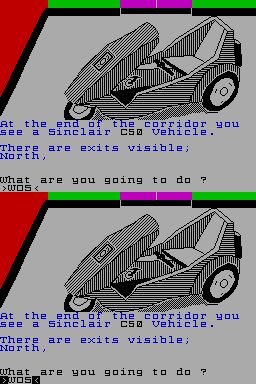
DEREK BREWSTER'S ADVENTURE TRAIL YOUNG AND INNOCENT (DADDY, WHAT WAS THE FUTURE LIKE?) It is always a difficult task summing up a year in home computing. Even more difficult is to try and predict what the coming twelve months might unleash upon us. I say unleash because whatever else might be said about the home games world, it is never dull: the competition is ruthless, and it is peopled by the sort of mathematical genius who is past his mental zenith at the age of twenty-five years, give or take a few million brain cells. The press and media are at a loss to explain why Britain, a rather insignificant and petty nation, should concern itself with such an exciting and blatantly intellectual pastime. After all, isn't this a country in decline, a divided nation where the people who read the lightweight newspapers await an answer to all the problems while the people who read the heavyweights are struggling hopelessly with the economic conundrums of interest rates and exchange rates. Perhaps it's time to start thinking straight and doing things which come rather more easily to nations not so schizophrenic. Buying your own country's goods isn't a bad start. I remember when I was at school, and it wasn't all that long ago, much time in geography lessons would be spent learning about the manufacturing base of the British Isles. In Lancashire they had the cotton industry, in the coalfields of the Midlands and North they had steel, while in the mountains that divided these areas you had hydroelectric power, sheep, and mineral mines. I'd give away a whole shelf-load of silly pencil-top gonks to sit in such a geography lesson now (just how many different breeds of sheep are there)? The House of Lords, by far the most coherent chamber as, despite the participants' ages, they are not honour-bound by political allegiance, stated Britain should look to the new technologies as herein lies the next revolution. Couldn't agree more. And so it would seem to be with the public who went out and bought the Sinclair computers despite much in the press about the unreliability of the machines. Much was made of the lack of sound when everyone knew full well that Sinclair's competitors were caught in the no man's land between beeps and buzzes and the full-bodied melodies of a synthesizer. The truth is the sound on these machines grinds after a short time and the demure bleeps of the Spectrum come as a blessed relief. I read a local paper recently that put forward the reasons behind buying a microcomputer this Christmas. Quite rightly some of the points they raised included amount of software available, price, and whether little Johnny's friends had the micro. It was curious to find the article extolling the BBC computer over the Spectrum. Let me put this as bluntly as I can. The Spectrum microcomputer is a brilliant device both for learning BASIC etc, and for playing games. I own, or have owned, an Atari, a BBC, an Amstrad, and a C64 and all have some major flaw in design, screen layout, add-on capability or available memory. What is more, the Spectrum was quite merrily computing away long before the others and so has a quantity and breadth (and availability) of software which leaves the others looking nice in the shops. As for the QL, yes, the microdrives are unreliable, but we live in times where rapidly-developing technology must be offered at an affordable price, and who would begrudge Clive Sinclair when NASA's budgetry constraints had DIY men throughout the world laughing at some tiles which just wouldn't stick. And it's no use laughing at the C5 while you pollute the atmosphere in your heap of rusting junk whose technology has changed little since its inception. Arthur C Clarke's (and Daddy's) visions of the future, with the printless world, gigantic space colonies, and the kind of mentality that goes with them, may not ever be quite as anticipated, but there is no need for the cynical technofear as displayed in such media mishmashes as Tomorrow's World and Micro Live. I suggest the first person who had the ludicrous idea of making technology more palatable in this dreadful manner go and write some techno-fear soap operas and leave the task to someone who is prepared to deal with the facts sensibly and reliably. Admittedly, this would remove any chance of political tampering with the facts, but it is a political reality that the new technologies are coming whether we like it or not. Any nation which actually gets to grips with the technology as opposed to the 'subject for discussion' will reap the undoubted rewards. 1985 was notable for the demise of MSX. MSX was a good idea, making a range of machines between which software was fully compatible. The only problem was, there was already a great deal of compatibility between the Spectrums that everyone was buying in droves. The Spectrum has, and will, last longer than either myself or other commentators thought possible. This year was notable for the escalation in the tie-in battles with major film titles such as Gremlins, Rambo, View to a Kill and Never Ending Story gracing the computer store shelves. The advantage to these deals is the recognition a product gets through the public's familiarity with the concept and storyline. TV tie ins can be even more effective in terms of public awareness of the product. These thoughts lead me on to an area which, to me, has really made itself plain over the last year. The perceivable age of the home games playing market seems to have dropped steadily down through the teens to the point where anything beyond a platform game is seriously questioned in terms of its likely viability in the market place. There's nothing inherently wrong or worrying about the spectre of a carry-cot Spectrum attachment with that all important fire button within reach of tiny hands, it's just that one shudders to think what popular music there would be right now if it wasn't for the older listeners pulling the whole standard of music up by its bootstraps. It is my guess that if the reading age of Sounds and NME fell by a few years those who, on paper, would benefit by such a fall would loose interest in the whole ostensibly uplifting exercise. And all this brings me back to adventuring (believe it or not). The demise of the intelligent, text-only, adventure epitomised by Level 9's Snowball, and mourned in SIGNPOST, is a part of this lowering of the intellectually exacting nature of computer games. In a nutshell, programs have become simpler. Utilities such as the Quill and Illustrator will continue to figure prominently in adventuring, and it doesn't take much of a jump to realise that they will be more important in all games' design in the near future. In America the computer games market is older because the machines Americans own are larger and more expensive, and more useful to the whole household. In Britain home computers are toys. It remains to be seen whether the market is going for the gutter or searching for the stars. LUDOIDS Producer: BugByte Price: £2.95 Language: BASIC & machine code Author: Barry Thorne, James Dann Ludoids is a quadruplex adventure which means it comes in four parts. These parts are loaded separately but are linked by the codewords left, in the first part for example, by a graffitti-inspired agent who presumably has passed this way before you. In the first part you are disguised as a spacetrucker who must search a robot space-station, in the second you trans-mat down to the planet Glacia which is rather cold and has igloos and things, in the third you take a kind of Westworld holiday on the planet Vacatia, and in the fourth a submarine provides you with one or two problems. As you might guess from the above Ludoids is a curious adventure. Each part has full screen pictures at a number of locations, many of which are rather evocative and pleasing. A few of these pictures have simple animation such as clouds rolling by, a burger sliding out of a food dispenser on a tray and beacons flashing. The character set has been tastefully redefined being both futuristic and readable. It's a shame the whole lot, pictures and text scrolls off, but on the whole the game is attractively presented. What is remarkable is the short length of each part. This may be partly due to the machine code introduction sequences which greet each mini-adventure, which are delightful in themselves, but surely cannot explain the brevity of the adventures which follow. Your overall mission is to find the Ludoids and destroy their trans-mat jammers with the wrist detector given to you at the beginning. Many of the pictures, like that of a Sinclair C5 seen early on, are very impressive but the plot that links them together is flat-footed and it wouldn't take much from any adventurer to complete the whole four parts within one afternoon. It's not as if the codewords you need to carry on from one part to another create much of a challenge. At the beginning of part two the following gem comes up onto the screen:- 'If you found the key behind the desk you will have been able to find the code-word that you need'. The code-word for part three, hidden within part two, is somewhat obvious as it is highlighted by an arrow leading from the word HINT. Since this adventure clearly won't take much solving by anyone, I suppose you could say it's the gourmet equivalent of boil-in-the-bag for the adventurer who is too busy to play adventures. One of the most interesting parts of the game, and certainly the most difficult, is the gun duel in the western world of Vacatia. To draw your gun and then fire it with a different key is very difficult in the split second allowed you by your opponent. Your first few efforts will no doubt see you biting the dust. Ludoids is a curious piece of software as it comes in four parts, each of which is very short and very easy. There are a number of machine code routines to bring the adventure alive and there are many worthy pictures. It is hard to see what attraction the game would offer to hardened adventurers but it may offer some entertainment for the adventure dabbler or the young at heart. COMMENTS Difficulty: easy Graphics: rather good Presentation: good Input facility: a little beyond verb/noun Response: fast
Games Compendium carries this game and has 13 references of its own.
Solution2
- Sinclair User #103Sep 1990 · p.46
- Sinclair User #101Jul 1990 · p.46
Tips2
- Sinclair User #81Dec 1988 · p.95
- Sinclair User #78Sep 1988 · p.79
News/Note2
- ZX Computing #23Feb 1986 · p.10
- Computer Gamer #9Dec 1985 · p.6
Advert2
- Computer Gamer #10Jan 1986 · p.86
- Crash #23Dec 1985 · p.133
Related
- Compilations
- 16/48 Magazine Tape 13, 16/48 Magazine Tape 15, 16/48 Magazine Tape 16, 16/48 Magazine Tape 17, 16/48 Magazine Tape 18, 16/48 Magazine Tape 20, 16/48 Magazine Tape 21, 16/48 Magazine Tape 22, Games Compendium, K7 Magazine issue 00, Spectrum Computing (Norway) issue 4, Spectrum Computing (Norway) issue 5
- Same entry at
- Spectrum ComputingZXInfo
Reviews from people here
Sign in to write about this, or make an account. It takes a minute and lets you correct the catalogue too.
No description recorded.
Sign in to correct or add to this.
Hold the rights to this and want it taken down?