
Not a Penny More, Not a Penny Less
Adventure Game: Text/Illustrated · ZX-Spectrum 48K · 1 players · English
Domark Ltd · 1987 · Pound sterling 14.95
Discussion
Nobody has started a thread about this yet.
Play
- NotAPennyMoreNotAPennyLess.rzx.zipRZX playback file 126 KB
- NotAPennyMoreNotAPennyLess.z80.zipSnapshot image English31 KB
- NotAPennyMoreNotAPennyLess.tzx.zipTape image English70 KB
Documents
- NotAPennyMoreNotAPennyLess.txtInstructions English15 KB
- NotAPennyMoreNotAPennyLess(EN).pdfInstructions English163 KB
Files and rights
No permission is on record either way. Screens and pictures are copied here on a take-down basis: if you hold the rights and want something removed, say so and it goes.
Credits
- Robin Waterfieldcredited
- Adrian Ludleycredited
Sign in to credit somebody, or say what these people did.
Scores
In the magazines
- The Games Machine #21987 · Overall59%
Elsewhere on the web
- WorldOfSpectrum 4 votes6.25
In the magazines 13
The Games Machine #2Dec 1987 · p.7962%51%59%59%
Atmosphere 62%
Interaction 51%
Overall 59%
Rob Steel 59%
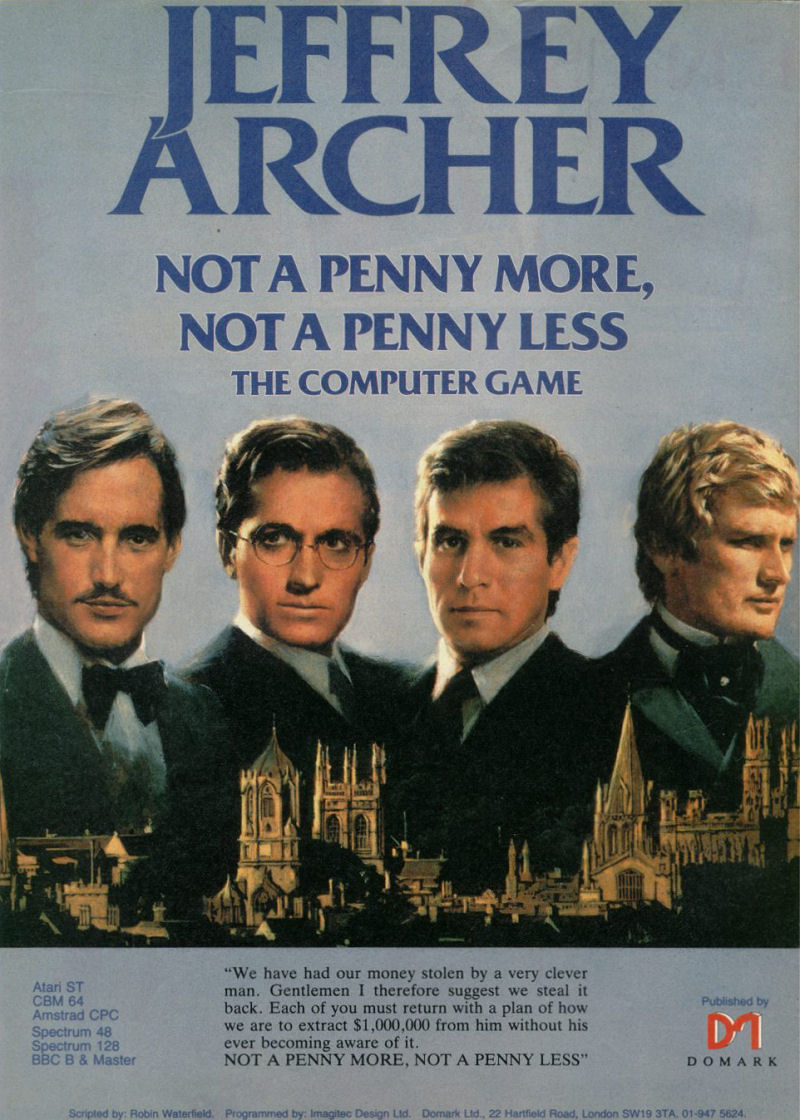
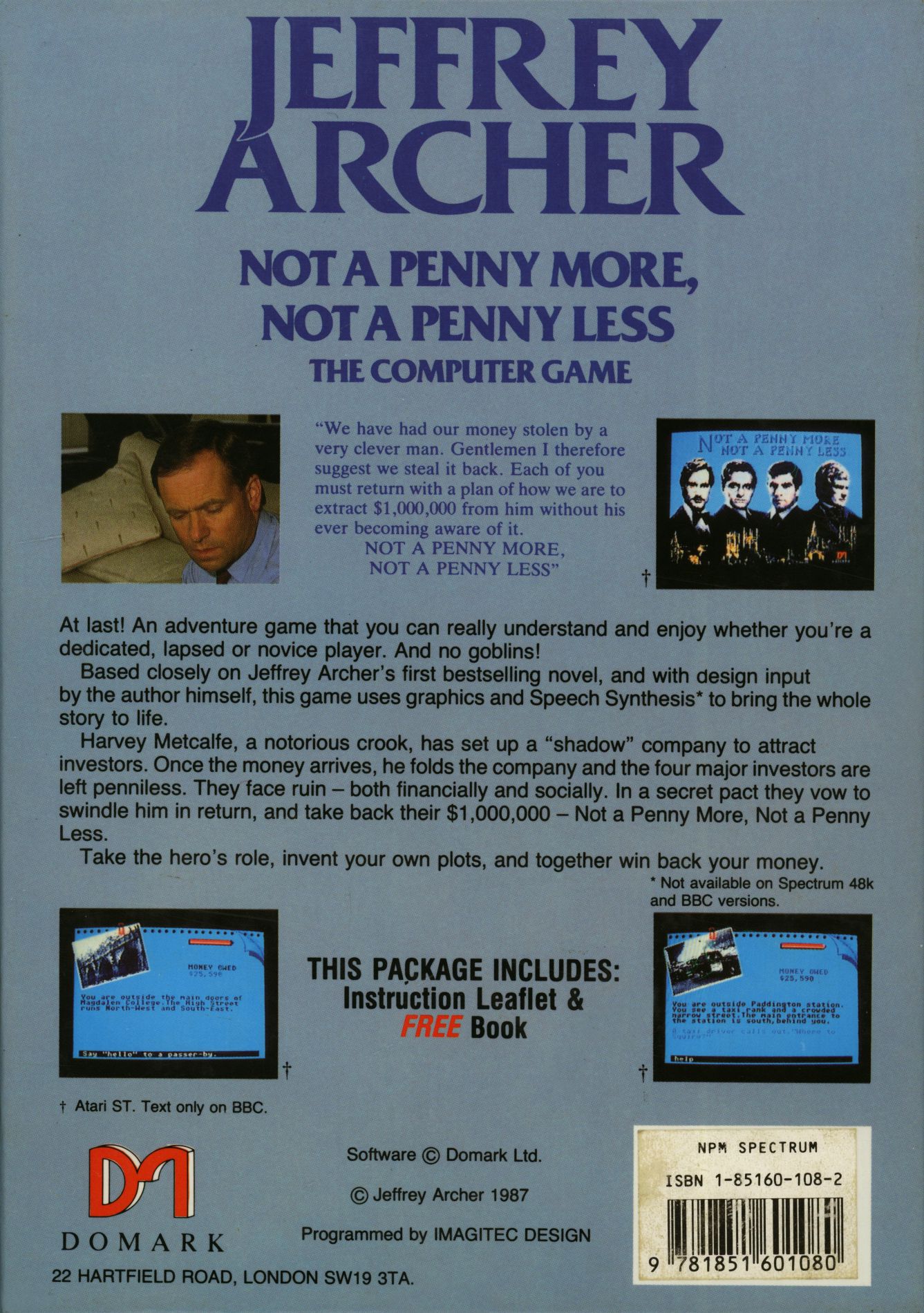
Atari ST Diskette: £19.95 Spectrum 48/128 Cassette: £14.95 Amstrad Cassette: £14.95, Disk: £19.95 Commodore 64 Cassette: £14.95, Diskette: £19.95 BBC Cassette: £14.95, Diskette £19.95 Jeffrey Archer is the author of six bestselling novels to date, including A Quiver Full Of Arrows, Shall We Tell The President and Kane And Abel. Born in 1940 Archer was educated at Brasenose College, Oxford and became the youngest member of the House of Commons when he won the by-election at Louth in 1969. Not A Penny More Not A Penny Less was his first novel, published in 1974, it was an instant success - just as well as it was written to make him a lot of money to recover from a huge loss he had taken after being conned in a manner very similar to that in the story itself. If all this makes Jeffrey sound like a computer wizkid as well, then just read Mel Crouchers piece on page 21 - in fact the game scenario was written by Robin Waterfield (who has also written a role-playing game based on the story for this issue of THE GAMES MACHINE - see page 97), and the programming was taken care of by Imagitec Design. Not A Penny More Not A Penny Less, the computer game, puts the player right in the middle of the action. Taking the role of Stephen Bradley, the game opens in his office with the knowledge that he has just been swindled out of $200,000. Left virtually penniless by the collapse of the company Stephen worked for (caused by the unscrupulous owner Metcalfe), Bradley, aided by other victims of this evil man, aims to get his money back - to the penny. Unfortunately the forces of law and order have no proof that Metcalfe carried out this dastardly deed and can therefore be of no assistance, the four victims are on their own. They decide to use Metcalfe's own modus operandi, and Stephen must now attempt to control his vengeful comrades as they each carry out the sting using their own methods. I played the ST version, visually it looked quite professional, set out as a piece of paper with the graphics resembling a black-andwhite photograph which slides to the top of the page and is clipped into position. Below this are the very brief descriptions of where Stephen currently is and what he can see. A single line is reserved for text input at the bottom of the page. The basic aim of the game is to fill Stephen's folder with information about Metcalfe and his other three victims and then use it to gain revenge. The voice of Jeffrey himself vibrates out of the monitor at the very beginning of the game and orally describes certain situations throughout the 'adventure', although both the graphics and sound may be switched off to speed gameplay up. Text input may be edited via the cursor and delete keys. The size of the text may be selected as 40 or 80 column depending on how good your eyesight is. Although most of the usual adventuring words can be used in Not A Penny More Not A Penny Less, the way they are implemented is somewhat frustrating. For example, all puzzles in every location must be solved before the player can move on to another place. Movement itself is sometimes achieved in an unconventional way, the game does include the usual compass directions (though not in abbreviated form and only when the game specifies the availability of these exits), but to visit certain people one must input EXAMINE (persons name) - very odd. I did find that in the first location I could type EXAMINE ROBIN and the game would reply OK, but I was still in Stephen's office. The parser expects precise input, typing EXAMINE LIST is no good if you want to study the telephone numbers list, it has to be EXAMINE TELEPHONE NUMBERS. There are other annoying little glitches within the program such as when the cupboard has been opened and the magazine therein read, the screen changes to the show the folder and its contents, and when it returns to the location description the inventory of the cupboard has disappeared. If the player has forgotten what was in there the rigmarole of closing the cupboard and opening it again has to be performed. Once the game's idiosyncrasies have been learned the actual depth of play is revealed - doesn't take long. Overall I would say the computer game is no match for the book (which incidentally is supplied as part of the packaging) and is certainly very frustrating to play. But it is by no means a terrible program and definitely worthy of some perseverance. All versions of the game except BBC and Spectrum have both speech and graphics.
Metcalfe on his way to ruin - Atari ST screen.
News/Note5
- Your Sinclair #23Nov 1987 · p.7
- Your Computer #10Oct 1987 · p.10
- Your Sinclair #22Oct 1987 · p.6
- Crash #45Oct 1987 · p.10
- C&VG (Computer & Video Games) #71Sep 1987 · p.12
Full-page ad3
- Sinclair User #68Nov 1987 · p.6
- C&VG (Computer & Video Games) #72Oct 1987 · p.38
- The Games Machine #1Oct 1987 · p.65
CompoResult1
- Your Sinclair #36Dec 1988 · p.100
CompoEntry1
- Your Sinclair #30Jun 1988 · p.6
Feature1
- The Games Machine #2Dec 1987 · p.97
Preview1
- Sinclair User #66Sep 1987 · p.94
Licensed from
- Not a Penny More, Not a Penny LessBookJeffrey Archer
Related
- Ports
- (Amstrad CPC), (BBC Micro), (Commodore 64), (Atari ST)
- Tags
- Bookware
- Elsewhere
- CASAMobyGamesThe TipshopUVL
- Same entry at
- Spectrum ComputingZXInfo
Reviews from people here
Sign in to write about this, or make an account. It takes a minute and lets you correct the catalogue too.
No description recorded.
Sign in to correct or add to this.
Hold the rights to this and want it taken down?