
Peter Pan
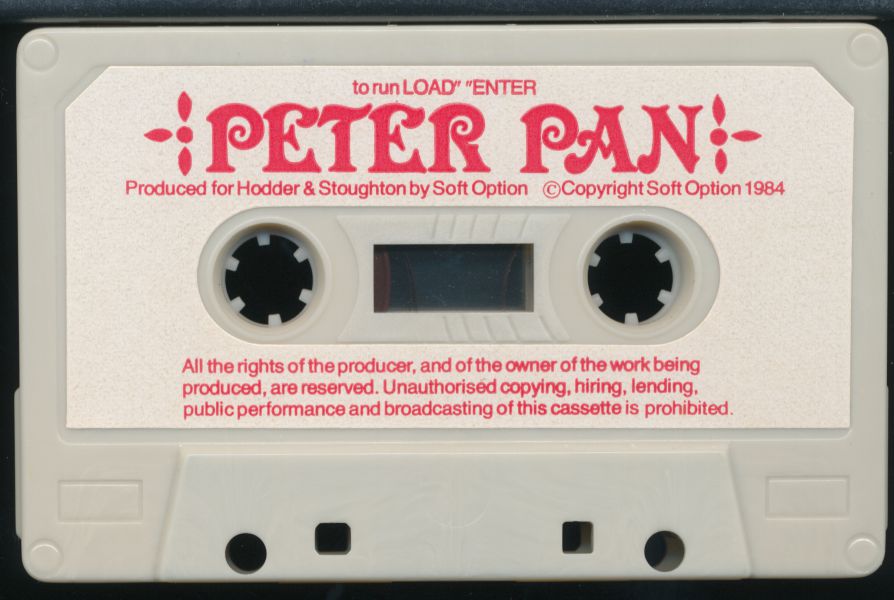
Adventure Game: Text/Illustrated · ZX-Spectrum 48K · 1 players · English
Hodder & Stoughton Ltd · 1984 · Pound sterling 9.95
Also known as Peter Pan - The Adventure Game (English)
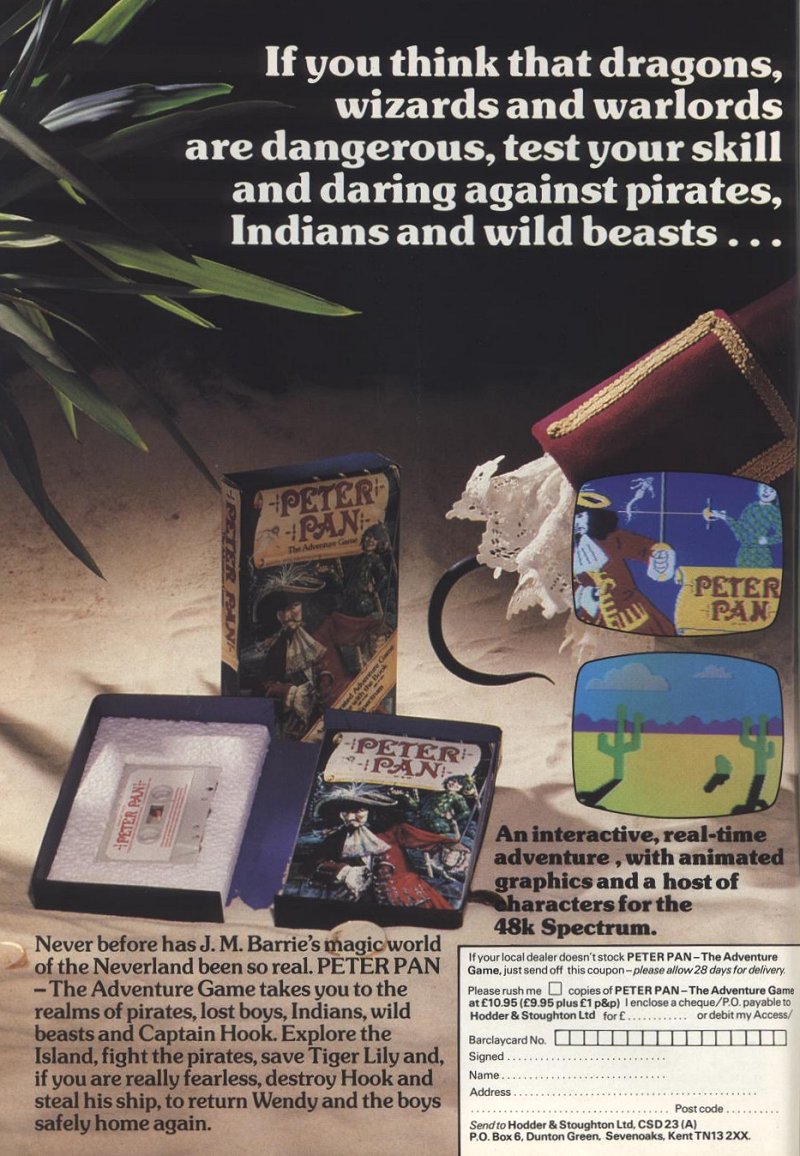
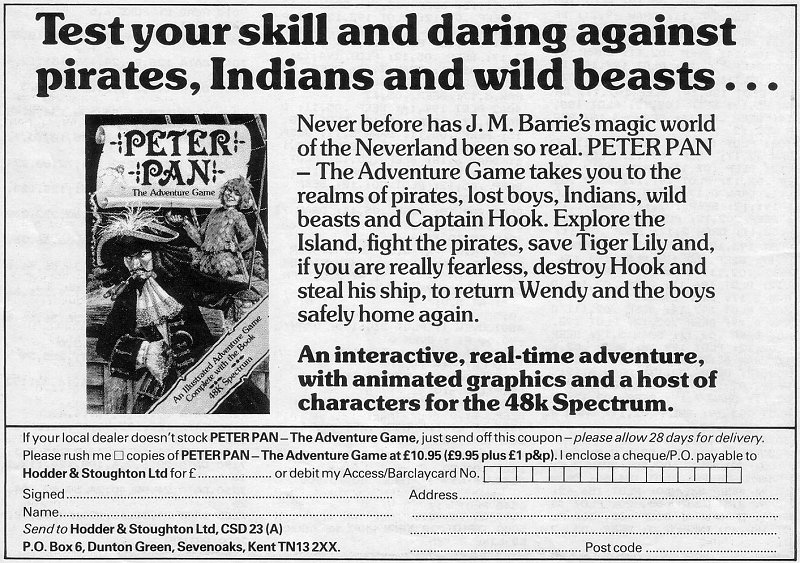
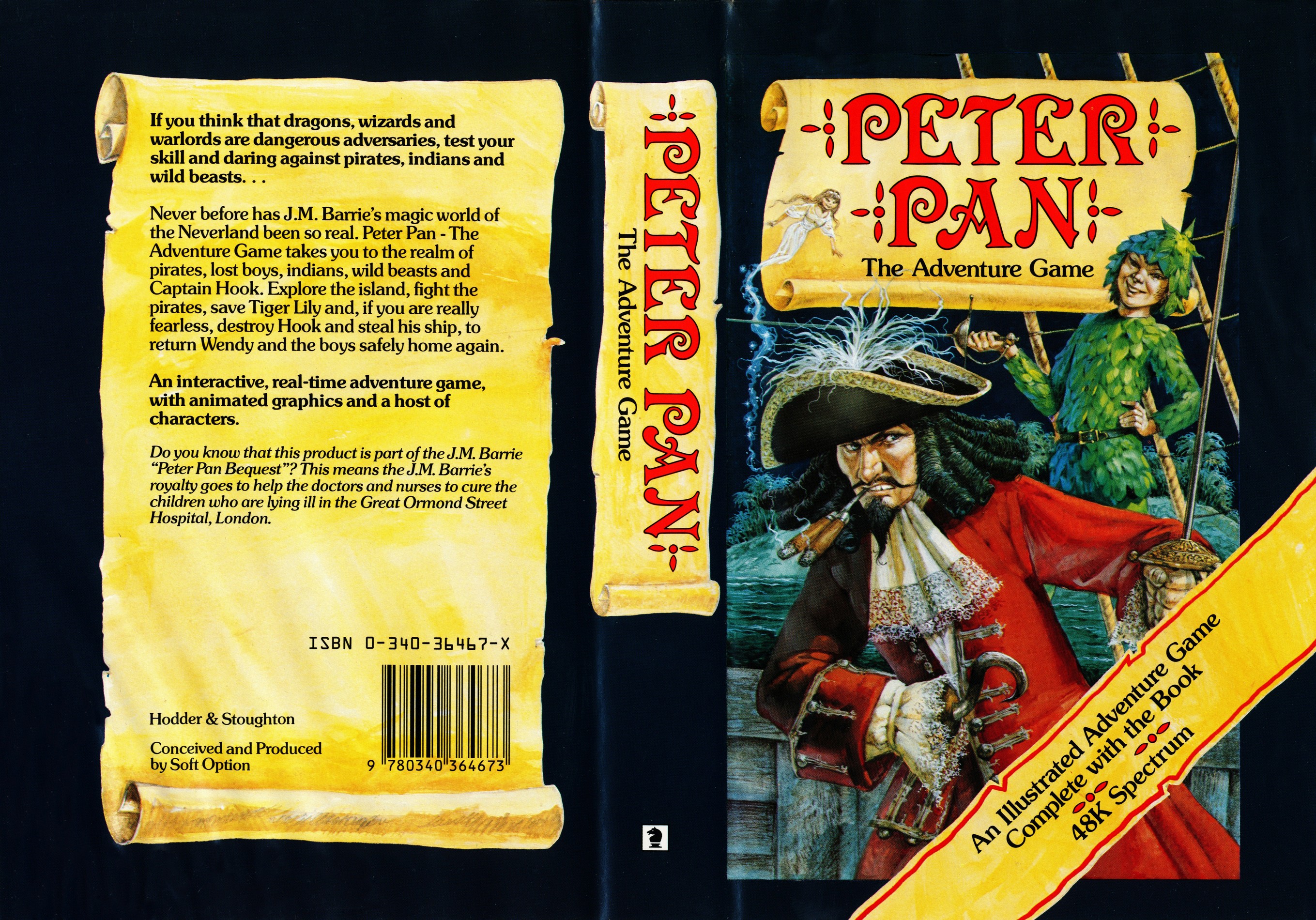
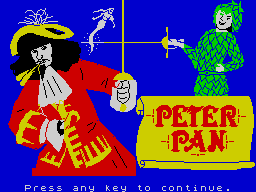
Discussion
Nobody has started a thread about this yet.
Play
- PeterPan.rzx.zipRZX playback file 124 KB
- PeterPan.tzx.zipTape image English21 KB
- PeterPan.tap.zipTape image English25 KB
Documents
- PeterPan_Book.pdfComplete book English7,687 KB
- PeterPan.txtInstructions English4 KB
- PeterPan(EN).pdfInstructions English1,072 KB
Files and rights
No permission is on record either way. Screens and pictures are copied here on a take-down basis: if you hold the rights and want something removed, say so and it goes.
Credits
- N.D. Headcredited
Sign in to credit somebody, or say what these people did.
Scores
In the magazines
- Sinclair User #331984 · Gilbert Factor6/10
- Personal Computer Games #141985 · Overall4/10
Elsewhere on the web
- WorldOfSpectrum 4 votes7.25
In the magazines 19
Personal Computer Games #14Jan 1985 · p.1146/104/105/104/104/10
Atmosphere 6/10
Complexity 4/10
Interaction 5/10
Overall 4/10
Steve Cooke 4/10
MACHINE: Spectrum 48K PRICE: £11.05 The game Peter Pan draws all its ideas from the book. As with The Hobbit, if you've read the original then you'll find yourself able to solve most of the puzzles in the adventure without too much difficulty. The game has one or two unusual features. The first are the graphics, which have some very attractive animated features. You'll see shark fins cutting through the water, children flying, and Indians sending up smoke signals amongst other things. Don't get too excited, however, since the graphics take several thousand years to draw. Sadly, the responses to your inputs also take a long time in appearing. This isn't a game that you can play in a hurry. Perhaps that's just as well, because there aren't a huge number of locations (about 40 by my count) for you to explore as you wander around Neverland trying to defeat the infamous Captain Hook. Peter Pan takes place in 'real-time', with the program monitoring your inputs and flashing up 'You wait...' if you don't enter anything for a while. Other characters. Including Wendy, the Lost Boys, pirates, Indians, and crocodiles wander about at random. This is a very competent, though somewhat limited, adventure. It's a pity about the slow pace, and I can't help feeling that if you want to a visit the Neverland, you're better off reading the book than tackling the adventure.
C&VG (Computer & Video Games) #38Dec 1984 · p.167
Keith Campbell
A CHRISTMAS ADVENTURE! A title that can do nothing but act as a magnet for parents with fairly young children at this time of year is Peter Pan. Peter Pan is one the ever growing list of Adventure games based on popular fiction and the book is included with the software. In fact, the J.M. Barrie royalty from the sales is bequeathed to the Great Ormond Street hospital for sick children - a fact that in itself might commend the package to a prospective purchaser. The player has to follow the story fairly closely. Events commence in the Darling children's bedroom after the goodnight story. You, Peter, fly in with Tinker Bell. To fly away to Neverland, you must have Fairy Dust and be complete with shadow attached. Of course, this is one of the Adventure problems. My verdict is - if you are parents with children in the 5 to 8 age range, read them the book and then play the game to them. Let them join in, even. You will get a break for beer and ciggies every now and again, whilst you are in flight, for example! Serious dragon-bashers though - steer clear! This is NOT for you! Peter Pan is for the 48K Spectrum, from Hodder and Stoughton.
Sinclair User #33Dec 1984 · p.356/106/10
Gilbert Factor 6/10
Richard Price 6/10
TALKING OF TINKER BELL Memory: 48K Price: £9.95 Bookware seems to be the up and coming style in adventure these days. Hodder & Stoughton have entered the field with a rendering of JM Barrie's Peter Pan, a much loved classic. The program was written by Soft Option and is an interactive adventure with graphics. The action follows the book closely. All the usual characters show up and you will have a tough time avoiding Hook and his villainous crew, the crocodile and the multitude of dangers in Neverland. Descriptions are full and the atmosphere is improved by the finely drawn graphic screens. Those are animated in the sense that some motion will be included in the picture. The children are shown flying across the sky, shark fins cut the water in the bay and puffs of smoke will rise from the chimney on the little house. The graphics are very attractive but do take a little time to draw. If you are impatient the pictures can be turned off. Peter Pan has most of the standard adventure features though it is not too good at understanding abbreviations. The characters move quickly around the landscape and it can be quite an effort to keep up with some of them. The intrepreter is not as obviously sophisticated as The Hobbit's. Nevertheless, the game is well produced and should have a strong appeal to fans of the boy wonder and his band of lost adventurers. It is also nice to know that Barrie's royalties will be passed onto Great Ormond Street children's hospital. Peter Pan should make a good Christmas present.
Your Spectrum #10Dec 1984 · p.66
David Nicholls
Peter Shaw
SPECTRUM ADVENTURES Avid adventure fanatics Peter Shaw and Dave Nicholls get to grips with Eureka, Hampstead and Peter Pan. And if you're lost or just plain suicidal in adventure-land, phone for the YS Adventure Helpline... PETER PAN Hodder and Stoughton £9.95 Peter Pan is the first adventure - in fact the first game of any kind - from book publishers Hodder and Stoughton. The package includes a large plastic video box containing the cassette, a copy of the original book and a four-page introductory leaflet which explains the aims of the game and some of the more useful commands. Out of the retail price, a contribution is made to the Great Ormond Street Children's Hospital as part of the 'Barrie Bequest' - a worthy cause indeed. Peter Pan's format owes a lot to The Hobbit, with full screen graphics and independent characters. There are, however, several differences - many purely technical but one in particular that centres around the actual solving of the adventure. Whereas in The Hobbit average punter can do quite well without reading the book, in Peter Pan knowledge of the text is essential. So if like me you never quite got around to reading it (the sad indicator of a miss-spent youth) you'll find Tinkerbell dying with alarming regularity and a few other strange things happening besides! On the technical side, one has to say that it drops below the ' Hobbit standard' on almost every count. The commands, like most other adventures, are single verb/ noun pairs (with the exception of the SAY command which allows you to speak), and the input routine is slow - as is the response to commands. But PP does manage to serve up some very good graphics. Actually, despite all the forgoing, I think Peter Pan really is a reasonable adventure... it's just that it suffers from an overdose of bad programming. I wouldn't recommend it to everyone, but if you've read the book - or if you're one of those avid adventurers - you'll probably find it quite enjoyable.
A Hobbit-like sortie into Never Never Land - but make sure you read the book first!
Micro Adventurer #13Nov 1984 · p.33
Gren Hatton
PETER PAN ADVENTURE Gren Hatton joins Peter Pan and the Lost Boys - and Wendy and Tinkerbell - in Never Never Land. With Christmas round the corner, what better stocking-filler than that good old nursery faithful Peter Pan, now given a new look by software house Soft Option, who have conceived and executed a mixed text and graphic adventure following very faithfully the story-line and settings (and even the mood) of JM Barrie's classic childrens' fantasy. Publishers Hodder and Stoughton have put their name to this new product, and the product is well marketed, with imaginative and appropriate illustrations on the case, and when you eventually switch on and boot up, some well-drawn 'location shots' as the adventure unfolds. The brand new 1984 Puffin paperback edition of the book is included in the package. Funnily enough, Hodder had to buy these off Puffin, to whom they had sold the paperback rights! The game itself is a stimulating mixture of text and graphics, as we have come to expect from every good game since The Hobbit. Unlike such games as Valhalla, the graphics are scrolled off the screen by any subsequent text; and the generation of graphics, being necessarily dependent on PLOT/DRAW commands in machine code in order to squeeze in the maximum number of location pictures, is rather slow. The slow pictures are an inevitable consequence of putting lots of pictures into the 64K address space of an 8-bit machine - and the program realises this limitation by drawing them only on the first visit to each new location, and thereafter assuming that you remember what the picture looks like. The gradual disappearance of the graphics in this game could perhaps have been dealt with slightly more elegantly using standard tricks such as a scrolling window for text, or even a simple CLS command at the right point. As for the story-line, it sticks closely to the book; and there are a number of tricks and traps which depend on a good knowledge of the plot together with patience and a sound memory to thread your way through a maze or two so as to pick up 'essential' objects. As you might expect, some of the objects have to be won in some way (try getting the dagger without killing Tinker Bell, for instance! - it can be done once you discover the right way), and you can expect to die several times before solving each of the more devious problems. Adults will probably find that there are not enough problems, and that many of the essential objects are in fact far too easy to acquire, but this seems an attempt on the part of the author to fit the level of the game to the most likely age-group of the players, say eight to 14 or so. In essence, like most games of this type, success usually boils down to discovering the precise words to use to talk productively to the computer. This game has one or two new words in the vocabulary and you don't get to the Never Land in the first place unless you can string together the correct sentence of reasonable grammatical complexity, with a subordinate clause and proper (though terse) grammatical construction. However, there are only one or two grammatical high-spots of this nature, and many of the dialogues with the computer are a bit frustrating, as you try to decide which (out of the fifty or so vocabulary words which we discovered) is the correct twoor three-word combination to solve a particular problem. Another element of this game is the way in which the Lost Boys, Wendy, the Pirates, wild beasts and Indians wander about in a random fashion. They also occasionally interact with each other (pirates and Indians generally fight if they happen to meet). It's a good feature, and any adventure benefits a lot from the equivalent of D&D's Wandering Monsters. However, like the peripatetic heroes and gods in Valhalla, Peter Pan's cronies are a restless and illogical crew. You may have spent ages looking for Wendy, when she suddenly trundles up in an unexpected spot; then, before you can react (and although it is obvious that you need to be together) she wanders off again without even realising that you are there. Nonetheless, some of it is well done, and you should find that, for instance, the Indians no longer attack you after you have rescued Tiger Lily. The game is, to some extent, acted out in real time. For example, if Tinker Bell is taken ill and you take no positive action for about two minutes, she will die. However, for most of the game this feature is dormant, and you can lurk in the forest or swim in the river for days on end without ever getting hungry, thirsty, tired or eaten by monsters, so it could have been handled more consistently. There is a SAVE-game feature, and this is a much less tedious way of re-entering the game after being killed off than by starting again from scratch. However, we found that with a little practice you can start from scratch and reach the Never Land in well under three minutes, and thereafter you can overcome already-familiar obstacles at the rate of about one or two minutes each. One notable lack is that you have no measure of how well you have done apart from intuitive 'feel' - it should not have been too difficult to add encouragement after each failure by saying "Well done, you completed 28% of the adventure" or some such formula. I have to some extent been damning Peter Pan with faint praise, and that is not fair, for the product is well thought out and sensitively written in a way which I am sure would have appealed to the book's author. It has a distinct fairy-tale atmosphere which should fit nicely into the games-chest of many Spectrum owners, and it is ideally timed for the Christmas holidays. Even the text is a cut above many adventures, with only one or two minor punctuation errors which we could detect.
Royalties on Peter Pan - the Adventure Game go to the Hospital for Sick Children, in Great Ormond Street. The game costs £9.95.
Sinclair Programs #25Nov 1984 · p.32
June Mortimer
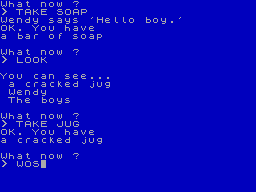
AS THE CHRISTMAS SOFTWARE GOES ON SALE SPECTRUM OWNERS ARE SPOILED FOR CHOICE. The creation of Peter Pan: The Adventure Game was an excellent idea. The transfer of the magical world of Peter Pan, of flying, crocodiles and pirates to the computer where flying seems possible and the player can take the part of Peter Pan. What a pity it all went wrong. The package comes complete with the Puffin book, Peter Pan, which is enjoyable and fun to read. Then you load the computer game. You are immediately transported from the flowing prose of Barrie to a one-dimensional world of short descriptions and limited conversation. Having read the book you know exactly what to do. Open the drawer, find your shadow, try to stick it on with soap. Look in the jug and find Tinkerbell. Now wake Wendy, so that she can sew your shadow to your feet. A little fairy dust, a little flying practice, and then off to Never Never Land for wonderful adventures. Of course, life in adventures is not that simple. The computer does not understand half the things that you want to do, Tinkerbell is more irritating than you could have imagined, Wendy stubbornly refuses to have anything to do with you, and you are trapped in one room wondering why you ever enjoyed the book. Some conversions from book to computer work brilliantly, while some lose all their sparkle. Peter Pan unfortunately falls into the latter category. If you want to become involved in the story of Peter Pan, go and see the pantomime, for that will bring it to life far more than your Spectrum. Peter Pan is produced for the 48K Spectrum by Hodder and Stoughton, [redacted] and costs £9.95.
News/Note5
- C&VG (Computer & Video Games) #38Dec 1984 · p.24
- Micro Adventurer #12Oct 1984 · p.7
- Crash #9Oct 1984 · p.41
- Your Computer #10Oct 1984 · p.39
- Home Computing Weekly #79Sep 1984 · p.5
Advert3
- Sinclair Programs #25Nov 1984 · p.8
- Popular Computing Weekly #40Oct 1984 · p.16
- Popular Computing Weekly #41Oct 1984 · p.20
Full-page ad2
- Sinclair User #32Nov 1984 · p.48
- Crash #9Oct 1984 · p.10
CompoResult1
- C&VG (Computer & Video Games) #41Mar 1985 · p.117
CompoEntry1
- C&VG (Computer & Video Games) #38Dec 1984 · p.15
Review1
- Home Computing Weekly #87Nov 1984 · p.20
Licensed from
- Peter PanBookunofficialJ.M. Barrie
Related
- Tags
- Bookware
- Elsewhere
- CASAThe TipshopUVL
- Same entry at
- Spectrum ComputingZXInfo
Reviews from people here
Sign in to write about this, or make an account. It takes a minute and lets you correct the catalogue too.
No description recorded.
Sign in to correct or add to this.
Hold the rights to this and want it taken down?