
The Quest for the Holy Grail
Adventure Game: Text/Illustrated · ZX-Spectrum 48K · 1 players · English
Dream Software Ltd · 1984 · Pound sterling 5.95
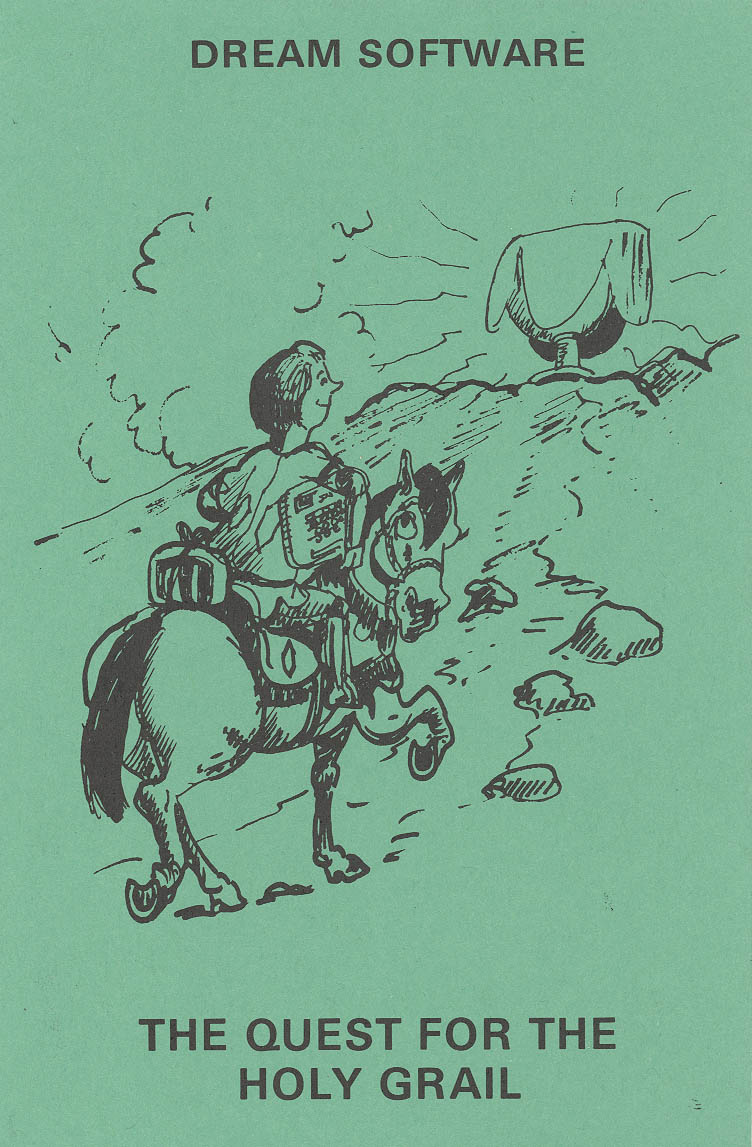
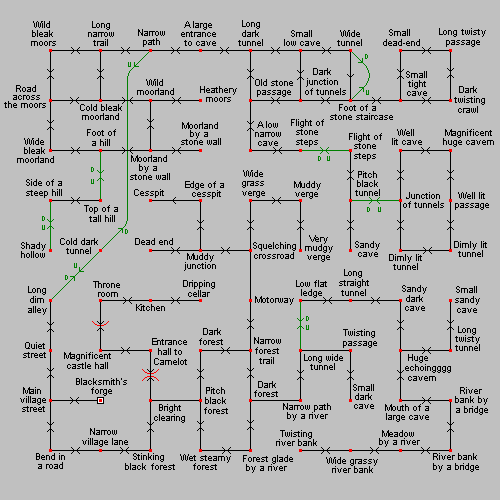
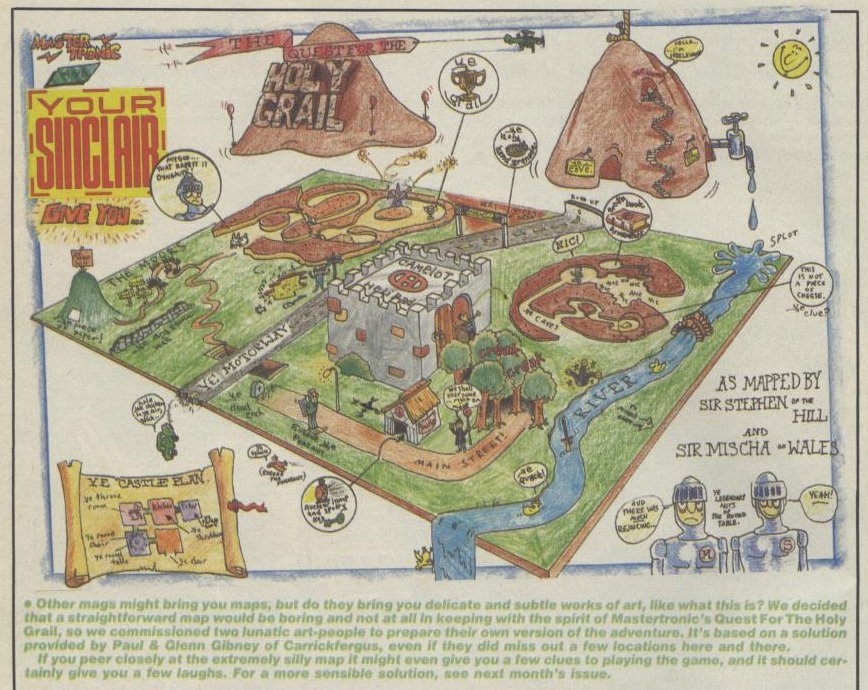
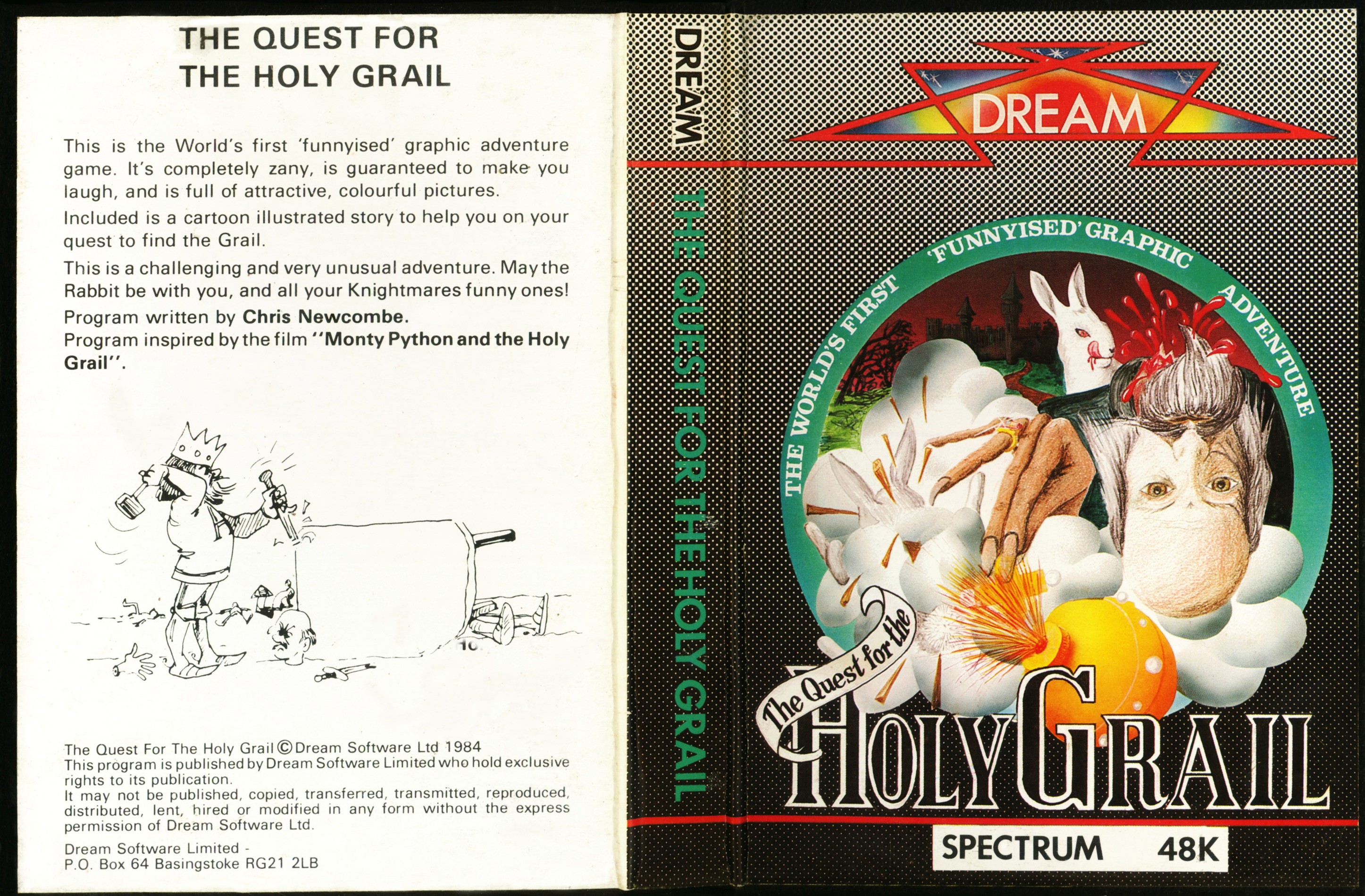
_Back.jpg)
.jpg)
_Media.jpg)
Discussion
Nobody has started a thread about this yet.
Releases
- 1984Dream Software LtdPound sterling 5.95
- 1984Mastertronic LtdPound sterling 1.99
Play
- questfortheholygrail.rzxRZX playback file
- QuestForTheHolyGrailThe.tzx.zipTape image English19 KB
- QuestForTheHolyGrailThe.tap.zipTape image English22 KB
- QuestForTheHolyGrailThe(MastertronicLtd).tzx.zipTape image English19 KB
Documents
- QuestForTheHolyGrailThe.txtInstructions English1 KB
- QuestForTheHolyGrailThe(EN).pdfInstructions English250 KB
- QuestForTheHolyGrailThe.zipScanned instructions English731 KB
Files and rights
No permission is on record either way. Screens and pictures are copied here on a take-down basis: if you hold the rights and want something removed, say so and it goes.
Credits
- Chris Newcombecredited
Sign in to credit somebody, or say what these people did.
Scores
In the magazines
- Crash #41984 · Overall73%
- Big K #71984 · Overall1/3
- Sinclair User #461986 · Overall4/5
- Crash #241986 · Overall7/10
Elsewhere on the web
- WorldOfSpectrum 17 votes5.94
In the magazines 49
ZX Computing #23Feb 1986 · p.37
Brian Robb
Mastertronic £1.99 This game, I seem to remember, was released quite a while ago by Dream Software. It now appears under the Mastertronic banner as part of their assault on the budget software market. Mastertronic have produced several adventures at a budget price, but none of them have been particularly original or imaginative. The Quest For The Holy Grail claims to be Monty Python with chips! Unfortunately, the game doesn't live up to this tag. It attempts to emulate the Python teams humour, but I can't help feeling that John Cleese and co. would be embarrassed to be associated with this game. While it is a passable adventure, the Monty Python connection is very loose. Something I would like to see would be an OFFICIAL Monty Python game - that could be interesting! Back to the game in hand. Your aim is to guide bold Sir Tappen through the medieval terrors in search of the legendary Holy Grail. The landscape is filled by several weird characters who do strange things. There is the three headed knight who has a lot on his shoulders and others with odd names such as NC, LC and SC. To be avoided at all costs is the rampant killer white rabbit, who literally has an explosive personality. All this is mildly amusing but never 'zany' as claimed on the cassette inlay. The text part of the adventure is quite enjoyable, humorous in places, but, nothing remarkable. The real problem with this game is it's graphics. These really show the game's age, being square chunky block graphics with the occasional sparse line drawing . The graphics are really disappointing. Compared to these the graphics of Never Ending Story are positive masterpieces. This game could have been so much more but, unfortunately at no point does the game live up to the inlays promise that it is '...the computer game to surpass all others.' It most definitely is not. It's more a very average game with touches of humour and outdated graphics.
Your Sinclair #1Jan 1986 · p.86
Mike Gerrard
Mastertronic £1.99 Reviewer: Mike Gerrard Hmmmm! Haven't I seen this game somewhere before? Wasn't it back in 1905 or thereabouts? Well, at least it'll probably be cheaper now it's being distributed by Mastertronic. Cheaper it may be but good it's not. It's full of naff jokes and everytime you make a move you're a gonner. I mean, what's so funny about being cut off in your prime by being shot at with great green lumps of snot! Ugh! You play the part of Sir Tappin who's in search of the Holy Grail but I reckon you'll soon get tired of tappin' those keys. The graphics aren't that hot either, and they're even the same for different locations occasionally. It'll take you ages to get anywhere in the game 'cos the program kills you off at every opportunity. Still, it is cheap. Perhaps that's all that matters... perhaps!
Sinclair User #46Jan 1986 · p.764/54/5
Overall 4/5
Richard Price 4/5
RICHARD PRICE SEARCHES FOR A GENUINE HERO... In the pages of a dusty book. Judging by some of the mail I get, it seems that many adventurers think that game reviewers possess some form of magical amulet to help them solve any and every adventure without so much as a drop of perspiration. Not so. Like everyone else I've wasted hours, sometimes days, locked in cells, stuck in wells or straddled across some vertiginous chasm waiting for the stroke of genius that will get me home safe with the treasure, or the breathtakingly lovely princess. Verily the sweat has poured forth on those occasions. There's quite a lot of help around if you investigate. Naturally, you will first write to the Fat One at the Ogre. His Vastness' drinking habits put him in touch with many rumours and tips. Companies are surprisingly helpful and many provide help sheets - but remember, they won't give complete solutions. Level 9, Artic, Incentive, Adventure International and many others give help, though some may charge for booklets which list problems in more than one of their games. Modem users can access the accumulated knowledge of many dedicated players on Prestel Clubspot 810. There are pages giving hints on specific games and a large section for those seeking help. I've also been sent a mailshot from the Adventurers Club - [redacted]. They offer help, newsletters, discounted games and a telephone helpline. The subscription fee is £10.95 for those living in the UK. So, to business. Movie spin-offs are big business these days and it's often difficult for programmers to produce games of a film or TV series without causing pain to those punters who've already formed a clear view of the fantasy or storyline. Disappointed players of The Tripods game will know what I mean. QUEST FOR THE HOLY GRAIL Publisher: Mastertronic Price: £1.99 Memory: 48K As far as I recall, The Quest for the Holy Grail isn't a new game and was originally by Dream Software. Whatever the case, Mastertronic has snapped up this mixed text and graphics game for their £1.99 range. Python aficionados will remember the bizarre film of the same name with an Arthurian Britain populated by anarcho-syndicalist mud gathering peasants and cowardly knights, some of whom tended to say odd things like 'Nic' unless quickly dismembered. The computer program adopts the same whacky approach to the subject matter and you must wander the evil wasteland in search of the fabled cup, adopting the guise of Sir Tappin. Both Camelot and the surrounding country- side is populated by a variety of weird creatures - exploding white rabbits, three-headed knights, CND demonstrators, and holy hand-grenades. There are also the knights who say odd things - beware particularly of the knight who says 'Sic'... he really means it. Somewhere within this medieval horror jumble - with liberal doses of anachronism - lies the cup that cheers. The graphics are fairly slow as are the responses. 'Examine' is not always fruitful but in general the replies are humorous and sometimes downright cantankerous. On asking for an already described object to be examined I was first told, 'Why didn't you pay attention the first time?'. A second request was met with a simple 'No'. Camelot is easily found but it's not so simple to get past the violently nauseous retainer who bars the way. Before you do that you will probably want to seek out the jester's Hat of Invisibility to escape the murderous intentions of Eugene, Wielder Of the Vic-20. Asking for help is also often fraught with difficulty as the interpreter will sometimes refuse, saying, 'Get lost, I'm sulking!' The Quest for the Holy Grail, despite its rather dated programming, is still a humorous game with a cheeky interpreter and some silly messages mixed into the bizarre problems. You could do a lot worse at two or three times the price.
Crash #24Jan 1986 · p.1687/107/107/107/107/107/10
Atmosphere 7/10
Vocabulary 7/10
Logic 7/10
Addictive Quality 7/10
Overall 7/10
Derek Brewster 7/10
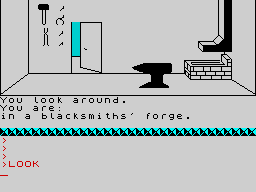
DEREK BREWSTER'S ADVENTURE TRAIL YOUNG AND INNOCENT (DADDY, WHAT WAS THE FUTURE LIKE?) It is always a difficult task summing up a year in home computing. Even more difficult is to try and predict what the coming twelve months might unleash upon us. I say unleash because whatever else might be said about the home games world, it is never dull: the competition is ruthless, and it is peopled by the sort of mathematical genius who is past his mental zenith at the age of twenty-five years, give or take a few million brain cells. The press and media are at a loss to explain why Britain, a rather insignificant and petty nation, should concern itself with such an exciting and blatantly intellectual pastime. After all, isn't this a country in decline, a divided nation where the people who read the lightweight newspapers await an answer to all the problems while the people who read the heavyweights are struggling hopelessly with the economic conundrums of interest rates and exchange rates. Perhaps it's time to start thinking straight and doing things which come rather more easily to nations not so schizophrenic. Buying your own country's goods isn't a bad start. I remember when I was at school, and it wasn't all that long ago, much time in geography lessons would be spent learning about the manufacturing base of the British Isles. In Lancashire they had the cotton industry, in the coalfields of the Midlands and North they had steel, while in the mountains that divided these areas you had hydroelectric power, sheep, and mineral mines. I'd give away a whole shelf-load of silly pencil-top gonks to sit in such a geography lesson now (just how many different breeds of sheep are there)? The House of Lords, by far the most coherent chamber as, despite the participants' ages, they are not honour-bound by political allegiance, stated Britain should look to the new technologies as herein lies the next revolution. Couldn't agree more. And so it would seem to be with the public who went out and bought the Sinclair computers despite much in the press about the unreliability of the machines. Much was made of the lack of sound when everyone knew full well that Sinclair's competitors were caught in the no man's land between beeps and buzzes and the full-bodied melodies of a synthesizer. The truth is the sound on these machines grinds after a short time and the demure bleeps of the Spectrum come as a blessed relief. I read a local paper recently that put forward the reasons behind buying a microcomputer this Christmas. Quite rightly some of the points they raised included amount of software available, price, and whether little Johnny's friends had the micro. It was curious to find the article extolling the BBC computer over the Spectrum. Let me put this as bluntly as I can. The Spectrum microcomputer is a brilliant device both for learning BASIC etc, and for playing games. I own, or have owned, an Atari, a BBC, an Amstrad, and a C64 and all have some major flaw in design, screen layout, add-on capability or available memory. What is more, the Spectrum was quite merrily computing away long before the others and so has a quantity and breadth (and availability) of software which leaves the others looking nice in the shops. As for the QL, yes, the microdrives are unreliable, but we live in times where rapidly-developing technology must be offered at an affordable price, and who would begrudge Clive Sinclair when NASA's budgetry constraints had DIY men throughout the world laughing at some tiles which just wouldn't stick. And it's no use laughing at the C5 while you pollute the atmosphere in your heap of rusting junk whose technology has changed little since its inception. Arthur C Clarke's (and Daddy's) visions of the future, with the printless world, gigantic space colonies, and the kind of mentality that goes with them, may not ever be quite as anticipated, but there is no need for the cynical technofear as displayed in such media mishmashes as Tomorrow's World and Micro Live. I suggest the first person who had the ludicrous idea of making technology more palatable in this dreadful manner go and write some techno-fear soap operas and leave the task to someone who is prepared to deal with the facts sensibly and reliably. Admittedly, this would remove any chance of political tampering with the facts, but it is a political reality that the new technologies are coming whether we like it or not. Any nation which actually gets to grips with the technology as opposed to the 'subject for discussion' will reap the undoubted rewards. 1985 was notable for the demise of MSX. MSX was a good idea, making a range of machines between which software was fully compatible. The only problem was, there was already a great deal of compatibility between the Spectrums that everyone was buying in droves. The Spectrum has, and will, last longer than either myself or other commentators thought possible. This year was notable for the escalation in the tie-in battles with major film titles such as Gremlins, Rambo, View to a Kill and Never Ending Story gracing the computer store shelves. The advantage to these deals is the recognition a product gets through the public's familiarity with the concept and storyline. TV tie ins can be even more effective in terms of public awareness of the product. These thoughts lead me on to an area which, to me, has really made itself plain over the last year. The perceivable age of the home games playing market seems to have dropped steadily down through the teens to the point where anything beyond a platform game is seriously questioned in terms of its likely viability in the market place. There's nothing inherently wrong or worrying about the spectre of a carry-cot Spectrum attachment with that all important fire button within reach of tiny hands, it's just that one shudders to think what popular music there would be right now if it wasn't for the older listeners pulling the whole standard of music up by its bootstraps. It is my guess that if the reading age of Sounds and NME fell by a few years those who, on paper, would benefit by such a fall would loose interest in the whole ostensibly uplifting exercise. And all this brings me back to adventuring (believe it or not). The demise of the intelligent, text-only, adventure epitomised by Level 9's Snowball, and mourned in SIGNPOST, is a part of this lowering of the intellectually exacting nature of computer games. In a nutshell, programs have become simpler. Utilities such as the Quill and Illustrator will continue to figure prominently in adventuring, and it doesn't take much of a jump to realise that they will be more important in all games' design in the near future. In America the computer games market is older because the machines Americans own are larger and more expensive, and more useful to the whole household. In Britain home computers are toys. It remains to be seen whether the market is going for the gutter or searching for the stars. THE QUEST FOR THE HOLY GRAIL Producer: Mastertronic Price: £1.99 Language: BASIC & machine code Author: Chris Newcombe The Quest for the Holy Grail may seem a familiar title. For one thing, it was the name of a Monty Python film which formed for itself a cult following. Normally thrifty and reserved persons would loose all poise and decorum and rush out to the nearest bookshop and buy the script to the film thereby causing the sort of arguments which raged throughout the land; who would play the geezer (John Cleese in the film) who says in a French accent (now thought essential in all TV comedies) 'I empty my nose in your general direction' or something to that effect. Now, I don't wish to be seen as a kill-joy, but this game leans rather heavily on the film and will now presumably sell more copies than when marketed by Dream Software (under which company's banner it was reviewed in the May 84 CRASH). So one must wonder at the legal implications after many a harmless Star Trek derivative was forced from the market by overbearing directives sent out by Paramount Pictures. In a nutshell this game is a Hobbit look-alike. The differences lie in its speed (it is written in BASIC and seems unnecessarily slow by today's standards), its simpler graphics, and its lack of real time. As in The Hobbit it often takes a key depression to scroll up the location description before you can start to input. You begin in a blacksmith's forge where you are at once confronted with the humour which gives the game its distinctive flavour and cult following. 'You see - the nuclear powered lamp. A CND picket. The yellow/green spotted key. The CND picket is sitting next to the lamp chanting, 'We shall, we shall not be moved!!' When you take the nuclear powered lamp the CND picket walks off in a huff. Having said that this game looses out technically to The Hobbit it does in fact have many features to commend it. The use of the full gamut of Spectrum colours is noteworthy, both in pictures and borders and within the text. The problems, so often featured in adventure helplines, are really entertaining and funny, and, as is always the case with problems pitched at just the right level of difficulty, they give a real buzz when finally solved. The Quest for the Holy Grail is an old program first marketed by Dream Software. It had a cult following in its old format due to its association with a very funny film and its own highly unusual and entertaining problems. What the game lacks in technical competence it compensates with super text and funny goings-on. Well worth the asking price. COMMENTS Difficulty: easy Graphics: average Presentation: good Input facility: basically verb/ noun Response: slow
C&VG (Computer & Video Games) #37Nov 1984 · p.124
Keith Campbell
Meeting Terry Jones recently reminded me of a game I had played briefly some time ago but never got around to reviewing. Quest for the Holy Grail is a game based on the Monty Python film, so I dug the tape out and started playing it again. I found it a very difficult game to play. It has graphics and a split-screen presentation. The picture displays fairly slowly and under it, but above the split, follows a text description of what can be seen. Unfortunately, there is insufficient room for all of this text, so it is necessary to press a key to scroll the picture up and bring the rest of the text into view. This wouldn't be so bad if only the pictures were worth viewing, but many locations are motorways and verges and one particularly fatuous picture was of a slowly-filling strip of grass with a strip of blue sky above! However, much of the Python humour is there. "... the French guard unclogs his nose in your direction. You die a horrible green death...", is one such example (although I didn't think it was his nose he unclogged - but never mind!) Reader Paul Stllard found the game hilarious, although "somewhat unforgiving of stupid mistakes", he said. So unforgiving, in fact, that his Spectrum blew up before he could complete the game! No doubt it will get a decent burial in a quiet shrubbery! I would agree with Paul's assessment and feel the game would have been much better with no graphics and an expanded vocabulary and plot. As it was, the amusing short story introduction provided with the tape was by for the most enjoyable part of the Holy Grail. The Quest for the Holy Grail is for 48k Spectrum, from Dream Software.
Big K #7Oct 1984 · p.161/31/32/31/31/3
Graphics 1/3
Playability 1/3
Addictiveness 2/3
Overall 1/3
Steve Keaton 1/3
SILLY WALK MAKER: Dream Software FORMAT: cassette PRICE: £6.95 Hugely unfunny text 'n' graphics adventure that wants desperately to be zany. "It's 932 AD (After Dinner)," proclaims the manual, "and Arthur, King of the Britons is looking for his Knights. No, there hasn't been a burglary of the Royal Chess Set..." Splutter. It's your misfortune to play one of these missing knights, the not-so-amusingly named Sir Tappin the Basic. Your task is to track down the Holy Grail, a quest inherited no doubt from Sir Python of Olde. Author Chris Newcombe is clearly a fan as there's a gamut of swipes on offer, from carnivorous white rabbits to the Knights Who Say Nic (and other similar oaths). While the quest is quite playable you'll need a strong stomach to suffer such witty retorts as "Take what? Berk!!!" and "A French guard unclogs his nose in your direction. You die a horrible green death!" Laugh? I didn't start.
ZX Computing #15Oct 1984 · p.135
Greg Turnbull
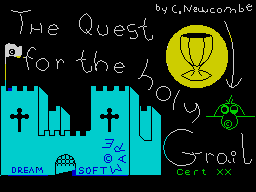
This is a new graphic adventure game from an up-and-coming company; Dream Software. The current trend for flashy presentation packaging is continued. The instruction pamphlet (like the program itself) contains witty notes and very few clues. As usual the tape takes forever to load; although the screen display is claimed as 'Cert. XX'. Once loaded you are straight into the adventure, with very little to help you. The screen display is horizontally split Hobbit-style, with scrolling pictures and text. From the name you might expect this to be purely a medieval adventure, like 'Knight's Quest'. You would be wrong; it's right up to date including: CND pickets, nuclear powered lamps, motorways etc. When a picture of a modern road with street-lights appears, the text says: "This picture is 500 years before its time, but who cares!" There are also various references to other programs, for example: Eugene from Inagime, and if you ask 'who' you get "This isn't 'Valhalla' you know." The usual adventure facilities save/load/quit are provided. Plus graphics on/off, for when you get sick of seeing them time after time. However no help or score routines are available, nor is character interaction allowed. Don't be tempted to use bad language if you get frustrated; the program doesn't like it. It can even get insulting and will call you a nerd, or a berk on some incorrect entries. The response are quick, as is the screen drawing. Unfortunately the pictures don't help the action much, and are really just padding. It is incredibly easy to get killed; this is where the program lets itself down. You can be battered to death with a VIC20, or suffer one of numerous other equally nasty fates. For example: if you try to enter the cesspit, it says: "You're not God, and haven't learnt to walk on water yet." The program abounds with such humorous touches; one aspect which is good fun. Eventually you may manage to reach Camelot castle; just as you were thinking you had loaded the wrong tape by mistake. Once inside I was immediately killed by the French guard. He unclogs his nose in your direction, and you die a horrible green death! The film buffs among you will recognise this as a reference from the hilarious "Monty Python and the Holy Grail." This appears to have been the inspiration for the program; those who have seen the film will therefore be at an advantage. For instance: You can die at the hands of the knights who say 'NIC'; and get frizzled into a pile of bile salts! (Your fate can be quite gruesome at times.) Ultimately you get frustrated with going through the early stages so often. The terminal boredom sets in; as dying is so easy, and happens very quickly. You merely get transported back to the start to try again. So for all its comic touches this program is already out of date by today's high standard of games. The copying of a Hobbit-style screen and the addition of Monty Python ideas doesn't manage to hold your interest. The text and scenarios soon become tiresome, causing you to lose any incentive to try and progress further. Sorry Dream, better luck with the next attempt.
Micro Adventurer #9Jul 1984 · p.19
Phil McDonald
NOT MUCH SUCCESS ON QUEST MICRO: Spectrum 48K PRICE: £5.95 FORMAT: Cassette SUPPLIER: Dream Software, [redacted] Based on the film Monty Python and the Holy Grail, this program is advertised as the world's first funnyised graphic adventure. A big claim but does it live up to it? I must say that having been a Python fan for 15 years I was more than pleased to give this the once over. The packaging is excellent, being a well-illustrated box in full colour. During the five minute load, a very good title page is displayed. By now I was delving into the illustrated leaflet which was supplied. It is well written and includes amusing semi-cryptic clues. Plunging straight into the fray, I found myself in a well-displayed blacksmiths forge. During my explorations, I also came across caverns, hills, Camelot, of course, and a cesspit. In all, I visited approximately 80 locations. I am pleased to say that this adventure is laid out well, making map-making easy. Another plus is the fast response times. The graphics can be switched on or off, though I left them on permanently, as they are drawn very quickly. With the exception of one or two locations such as the blacksmith's forge and Camelot, the graphics are fairly nondescript and a lot of them are used for more than one location. This adventure does bear a passing resemblance to the film, with the three-headed knight and the knights who say 'nic' making guest appearances. Not to be forgotten is the French guard, who will claim that your grandfather smelled of elderberries or make unsociable noises in your general direction. He also does something with his nose which I shall not describe as this review is all in the best possible taste. Problem solving is fairly straightforward, and this was the program's main downfall in my opinion. I completed the whole of the adventure on a Sunday morning. As for the claim of funnyised, well yes, I did smile once or twice, but really there's not enough humour there to substantiate it. I would have liked to see a lot more Pythonesque items and phrases. The overall plot and layout of the adventure were more than adequate, but there are not many objects to manipulate and hence not enough problems to be overcome. Also, having few objects, it does seem a bit pointless to have such a large number of locations, only to be told at the vast majority of them that you see nothing. Having said all that, I did enjoy the Grail, but would have felt somewhat annoyed it I had bought the adventure and completed it in a mere couple of hours.
Your Computer #6Jun 1984 · p.61
Hugo North
Spectrum 48K £5.95 Dream Software If you have seen the Monty Python film of the same name, you will have an idea of what this adventure is about. Included in the plot are such creations as the Knights that go "Nic!" - always on the lookout for a nice shrubbery; an extremely unpleasantly behaved French Guard; a ferocious white rabbit and a three-headed knight. The adventure offers both text and graphics, the latter being fairly simple pictures of each location. There are plenty of locations but not very many objects or characters. The "Save/Load Game" feature is very fast, making it little bother to save a position at any perilous point. The quest is rather easy to complete and as such is more suitable for the novice adventurer.
Crash #4May 1984 · p.11769%67%78%77%72%76%73%
Use of Computer 69%
Graphics 67%
Playability 78%
Getting Started 77%
Addictive Qualities 72%
Value For Money 76%
Overall 73%
Unknown
Unknown
Unknown
Producer: Dream Software Memory Required: 48K Retail Price: £5.95 Language: Machine code Author: Chris Newcombe This claims to be the world's 'funnyised' graphics adventure. It is 'inspired' by the film Monty Python and the Holy Grail, and its cover includes a salacious white rabbit sanguinely licking its bloody chops. For those who have seen the movie, the reference will not only be obvious, but bring chills of fear you may have thought you had been able to forget! Packed in a sturdy cardboard box, the cassette comes complete with a small, amusing booklet which places you firmly in the correct period, that is 932 AD (after dinner), not 932 BC (before computers). You are Sir Tappin the Basic, a knight of Arthur's round table, and as one of his elite band you are about to embark on the Quest for the Holy Grail. Things aren't going to be too easy, however. One problem is that the peasantry of Mercia are not exactly convinced Arthur is their true and rightful king as they don't readily believe in the 'farcical aquatic ceremony' as they have come to call it, when Arthur attempted to discard Excalibur. Then there's a peasant called Eugene (imagine this a software industry in joke coming) who doesn't like Arthur at all, and therefore not his knights. Bumping into Eugene at the wrong time can result in death for having trampled on an Inagime advert. You can contemplate your folly as he batters you to death with a worn-looking Vic 20. Finding the Grail is a problem, getting back to Camelot is another, and getting in is yet another. Watch out for the French guards with his distasteful habits - remember, handkerchiefs had not been invented in 932 AD. The scene is set at the start, where you find yourself in a blacksmith's forge populated by a nuclear powered lamp, a CND picket and a yellow/green key. The CND picket are singing, 'We Shall Not Be Moved,' what next... COMMENTS Response: medium fast Graphics: generally reasonable, some quite detailed
Never mind stinking forest, watch out for guards with their filthy foreign ways...
Tips23
- Your Sinclair #89May 1993 · p.24
- Sinclair User #109Mar 1991 · p.39
- Crash #54Jul 1988 · p.53
- Sinclair User #70Jan 1988 · p.74
- C&VG (Computer & Video Games) #66Apr 1987 · p.64
- Popular Computing Weekly #8Feb 1987 · p.22
- Crash #37Feb 1987 · p.56
- Sinclair User #58Jan 1987 · p.92
- ZX Computing #33Jan 1987 · p.60
- Sinclair User #56Nov 1986 · p.90
- C&VG (Computer & Video Games) #59Sep 1986 · p.59
- ZX Computing #29Sep 1986 · p.42
- C&VG (Computer & Video Games) #57Jul 1986 · p.79
- C&VG (Computer & Video Games) #56Jun 1986 · p.87
- Sinclair User #51Jun 1986 · p.58
- C&VG (Computer & Video Games) #55May 1986 · p.71
- C&VG (Computer & Video Games) #54Apr 1986 · p.70
- C&VG (Computer & Video Games) #50Dec 1985 · p.24
- Popular Computing Weekly #42Oct 1985 · p.20
- Crash #20Sep 1985 · p.96
- C&VG (Computer & Video Games) #46Aug 1985 · p.107
- C&VG (Computer & Video Games) #44Jun 1985 · p.95
- Crash #8Sep 1984 · p.75
Advert5
- Personal Computer Games #12Nov 1984 · p.86
- Personal Computer Games #11Oct 1984 · p.118
- Personal Computer Games #8Jul 1984 · p.88
- Popular Computing Weekly #16Apr 1984 · p.23
- Popular Computing Weekly #12Mar 1984 · p.14
News/Note3
- C&VG (Computer & Video Games) #51Jan 1986 · p.102
- Crash #23Dec 1985 · p.16
- Personal Computer News #56Apr 1984 · p.5
Review3
- Popular Computing Weekly #45Nov 1985 · p.12
- Home Computing Weekly #66Jun 1984 · p.16
- Popular Computing Weekly #12Mar 1984 · p.60
Feature2
- Home Computing Weekly #105Mar 1985 · p.19
- Crash #10Nov 1984 · p.122
Solution1
- Die Speccy CDJan 1996
Map1
- Your Sinclair #9Sep 1986 · p.82
CompoEntry1
- Crash #10Nov 1984 · p.122
Related
- Compilations
- Sinclair Game Compilation
- Ports
- (Commodore 64)
- Tags
- Medieval Legends
- Same entry at
- Spectrum ComputingZXInfo
Reviews from people here
Sign in to write about this, or make an account. It takes a minute and lets you correct the catalogue too.
No description recorded.
Sign in to correct or add to this.
Hold the rights to this and want it taken down?