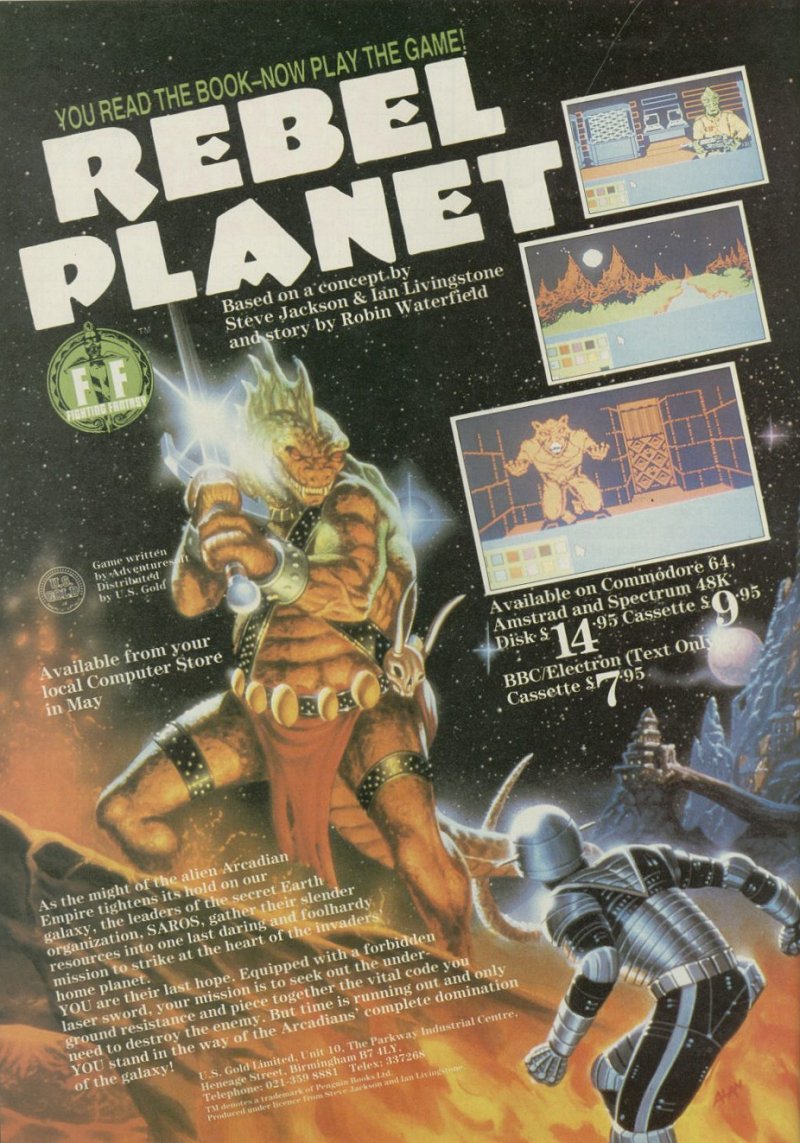
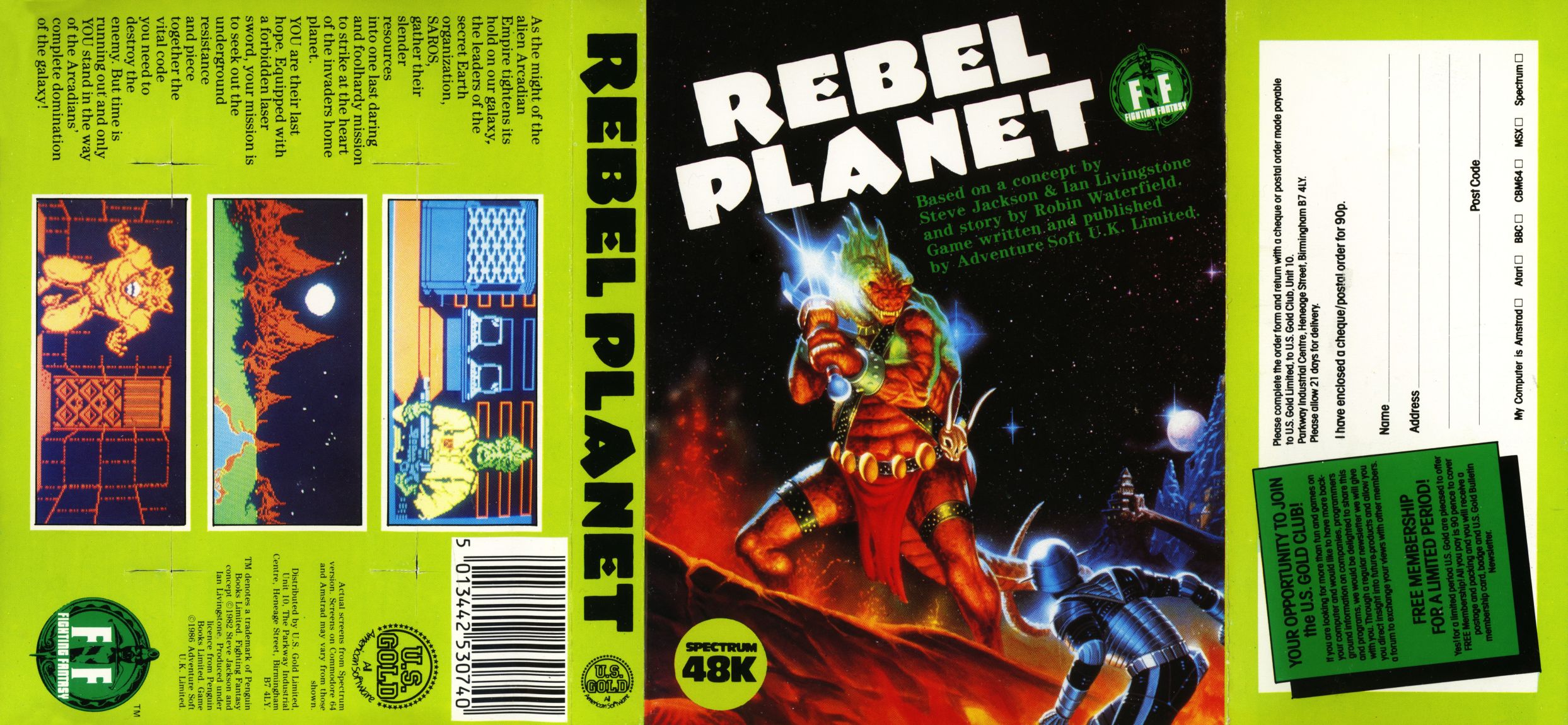
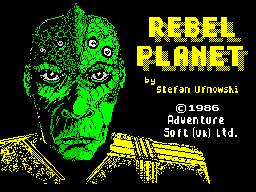
Rebel Planet
Adventure Game: Text/Illustrated · ZX-Spectrum 48K · 1 players · English
U.S. Gold Ltd · 1986 · Pound sterling 8.99

Discussion
Nobody has started a thread about this yet.
Remarks
separate +48k price £9.99
Play
- rebelplanet.rzxRZX playback file
- RebelPlanet.tzx.zipTape image English36 KB
- RebelPlanet.tap.zipTape image English39 KB
Documents
- RebelPlanet.txtInstructions English9 KB
- RebelPlanet(EN).pdfInstructions English480 KB
Files and rights
No permission is on record either way. Screens and pictures are copied here on a take-down basis: if you hold the rights and want something removed, say so and it goes.
Credits
- Stefan F. Ufnowskicredited
- Alan CraddockInlay/Poster Art
Sign in to credit somebody, or say what these people did.
Scores
In the magazines
- Sinclair User #531986 · Overall4/5
- Your Sinclair #91986 · Overall7/10
- Crash #311986 · Overall85%
- Your Sinclair #231987 · Rebel Planet7/10
Elsewhere on the web
- WorldOfSpectrum 19 votes8.00
In the magazines 55
Your Sinclair #9Sep 1986 · p.867/106/106/107/107/107/10
Graphics 7/10
Playability 6/10
Value For Money 6/10
Addictiveness 7/10
Overall 7/10
Mike Gerrard 7/10
FAX BOX Title: Rebel Planet Publisher: US Gold Price: £9.95 Reviewer: Mike Gerrard Rebel Planet is the first release from Adventure Soft UK Ltd, which was recently set up by Mike Woodruffe. For the past year or two he was running the UK arm of Adventure International, best known for the Scott Adams, Questprobe and Mysterious Adventures series. Released in conjunction with US Gold, Rebel Planet's based on Penguin Fighting Fantasy book number 18 by Robin Waterfield. Wouldn't you just know it, the galaxy's in danger yet again, and who's called into sort it all out but the ever willing YS reader. Does the galaxy know the debt it owes to this fine band of mugs... sorry, people? The problem this time is that the mighty Arcadian Empire is tightening its stranglehold on the galaxy, and this is deemed to be a pretty bad show, all things considered. Hope rests in SAROS, the earth-based Search and Research of Space organisation. But a full-scale military attack is out of the question, on the grounds that you're outnumbered and outpowered by zillions, so a solo mission is instigated, with the aim of destroying the Arcadians' queen computer, the one that controls and organises the minds of the troop. Now it's a bit unlikely that you'd be allowed to fly straight to the planet of Arcadian and ask if you can destroy their computer (even if you said 'please'), so your cover is that you're a merchant. But first you must visit the planets of Tropos and Halmarus, trying to make contact with your spies in these places while simultaneously avoiding suspicion - those Arcadians are everywhere! Your merchant ship is the Caydia, and it's on the command deck your Mission Almost Impossible begins... The screen straight away has that familiar Adventure International look to it, the top half given over to graphics, the bottom to text. The first thing you notice is that the graphics in this first screen are moving - nothing stunning, some flashing display screens and a few stars and planets whizzing across before you as you head for Tropos. The program also has the familiar slight carelessness reminiscent of AI - the exits in the location descriptions all come complete with a comma , so the last exit each time has a comma followed by a full stop. Elsewhere, when examination of a dispenser tells you to 'insert card', you type INSERT CARD only to get the response: "Add a sensible object to that sentence." But card is a pretty sensible object to try to insert, surely! INSERT ACCESS CARD gets the same response, and only INSERT CARD IN DISPENSER produces the right result. No matter, I am equipped with a limcon suit and the Caydia gives me seven locations to explore. After a while a message comes through that the ship is being followed by a UFO. To evade or not to evade, that is the question. Neither seems to have any immediate disastrous consequences, but you'll pay for a wrong move later. Always remember that you're trying to avoid suspicion. Eventually you're told you're able to disembark, and the first problem is getting out of the ship! This kept me puzzling for a while, but it turned out that I'd had the means initially. Amazing how you're on a life or death rescue mission to save the entire galaxy, and the things you need to keep yourself alive are hidden away so you can't get at them! Who equipped this ship, that's what I want to know. Landing on Tropos the first time saw me well and truly nicked, my possessions confiscated, and I was bunged in a cell where it seemed the only possibility was to rot slowly away. QUIT! One curiosity of the program is that you can SAVE GAME but can't directly load a saved game. The instructions tell you that "it is essential to load the program first before attempting to reload a Saved game." Not so, all you need to do is QUIT, whereupon you're whisked back to the start and given chance to restore a saved game. I found this first section irritating, in that you had to retrace your steps again and again, starting at the beginning almost every time, slowly working out what was happening and what you could do about it. It's worth persevering with, though, as the adventure does pick up once you get through customs, as the city on Tropos opens up to you - and you'll need to do some very careful mapping because the architecture leaves something to be desired, with all the streets looking the same. The latest technology vid-phones are available, if only you knew what number to dial. Eventually I found the well-named Trosleeze Hotel. But there's another example of irritating program design here. You don't enter the hotel by a direction, but with the command ENTER HOTEL. Once inside there are two directions you can take, east or west. I chose one, but that took me out to the street again, only this time ENTER HOTEL had no effect, so I was left wondering where the other direction would have taken me. I had to QUIT again to find out, and I wished I hadn't bothered. Yet another quick death. In fact there were far too many deaths for my liking, and the other bits of carelessness meant that I didn't take to the time as much as I might have. Still enjoyable, and intriguing enough to keep me playing, but I don't think it's the best of debuts for Adventure Soft.
Crash #31Aug 1986 · p.7489%85%87%86%85%85%
Atmosphere 89%
Vocabulary 85%
Logic 87%
Addictive Quality 86%
Overall 85%
Derek Brewster 85%
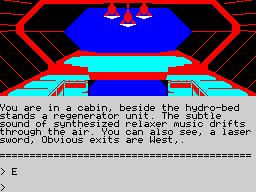
DEREK BREWSTER'S ADVENTURE TRAIL CHICKEN AND EGGHEADS The 128K Spectrum has been around now for some time, and apart from some early commissioned software, and the exemplary efforts of Mastertronic, every software house old enough to remember computers like the Oric. Enterprise, and Memotech is saving its efforts until the 128 has a proven sales record. Admittedly, there have been question marks over the computer's future since the takeover by Alan Sugar, but everyone knows that it may take some time to produce a successor, and that when it arrives it will no doubt be fully compatible with the 128. May I just put forward the argument that if the successor is not compatible then this is a matter for Alan Sugar to worry about and not any potential 128 purchaser. There has been much advice on this issue in magazines and the general consensus is that the public should wait and see. All I can say is heaven knows what would have happened to the Sinclair phenomenon if such advice was offered in 1982 amid rumours of the 48K's unreliability. Presumably, everyone would have ended up with Atari microcomputers which were (and still are) superb value for money, and the home software industry might never have gained the poise and standing it has now earned for itself. Alan Sugar is caught in a marketing quandary over the positions of his Amstrad and Spectrum concerns. He claims far too much for the likes of the CPC 464 and its derivatives and is too dismissive of the huge Spectrum games world he has inherited. I suggest the potential micro purchaser keeps well clear of such political manoeuverings and simply goes out and buys the microcomputer which offers the best software backup at the most competitive price. If this be the 128 Spectrum then so be it. Sold in sufficient numbers, the 128 will ensure both software support in the near future, and hardware compatibility in the longer term - no matter who provides them. SOMETHING TO CROW ABOUT? Adventuring began with the mainframe Colossal Cavern and due to the inherent limitations of mainframes, text without pictures was the order of the day. Along came the ZX Spectrum in 1982 and, although many adventures remained text-only, mimicking the original, the first faltering steps were taken towards full-blown illustrations with the likes of The Hobbit and Fantasia Diamond. Some time later, graphics (as pictures on computers are invariably called) became quite sophisticated, and respectable even, as some specialist graphic computer artists got to grips with the Spectrum, most notably Banner of Interceptor (Jewels of Babylon, Warlord) and Teoman Irmak of the old Adventure International (Gremlins, Touchstones of Rhiannon). Now, you might think it a little hypocritical to mention these games. After all, when they were released I refused to be swayed simply by their graphics but instead reviewed the adventure as a whole - remember this was when Level 9 were releasing games with simple graphic styles but immense intricacies of plot and composition, and games as good and innovative as Sherlock and Lords of Midnight were about. The reason why good graphics could not co-exist with complexity of gameplay was simply the restriction on memory. Surely now with 128K, adventures can combine the two and produce something worth crowing about. REBEL PLANET Producer: Adventuresoft Retail Price: £9.95 Author: Stefan Ufnowski, Robin Waterfield Err, right, err, I'm going to try and tell you some of the history of this one without actually knowing quite what the heck I'm on about, but there again, what's new. Well, there was the advertised SWORDMASTER series and if I'm not mistaken that had something to do with Steve Jackson and Ian Livingstone, the names behind the book which led to this one here. Then it surfaced some time later as FIGHTING FANTASY and the game was Seas of Blood, and it had those stalwarts of computer coding, Mike Woodroffe and Brian Howarth behind it. That game had an animated dice sequence, a combat routine, and a status page showing skill, stamina and strength. Well this game is much more mainstream without any gimmicks but is very well constructed and has an interesting set of rules, as you might expect from the style of the FIGHTING FANTASY books (these work by giving a set of choices which lead to pages further on into the book). Take a look at Pete Tamlyn's article on page 46 of this issue if you're still confused... Your spaceship is called the Caydia. It is a merchant ship. You - well, you're some sort of agent, in fact the finest, as you've been chosen for your courage, resourcefulness and dedication to the liberation of the peoples of Earth. Your cover has been well researched: you will travel as a merchant to the planets of Tropos, Halmurus, and Arcadian all of which are a part of the Arcadian Empire. If you are to take on the might of the huge Arcadian Empire. which tightens its grip on the galaxy by the hour, then you will need the might of some huge organisation behind you. SAROS stands for Search and Research Of Space, and has managed to send spies on ahead to gather intelligence before your arrival. Of course, it wouldn't be an adventure if this information was just placed in your lap you'll have to work out where it is. There is a building on the planet Arcadian which houses the all important queen computer. This can be entered (and this information is proffered quite openly) by using a numerical code of nine binary digits. The underground spy network may know something to help you discover these digits. Your mission, then, is to locate the rebel leaders, learn the digits, and destroy the queen computer before it destroys you. The program boasts an extensive vocabulary. Commands range from simple two word instructions to multiple action out of the observation window, hardly move in true 3D motion but at least bring some movement to an adventure screen. To the south is an access corridor with a dispenser attached to one wall. The powerful EXAMINE command comes in handy here and we learn it is a sustenance system, an Arcadian one in fact, which surprised me as I thought this was one of our commands. Take a look at these examples. ASK THE DROID FOR HELP, ATTACK THE POLICER WITH THE LASER. GET THE WRENCH, THE CRYSTAL AND THE BOOK. OPEN THE DOOR, GET THE GRENADE AND THEN PULL THE PIN. You are advised to use WAIT 5. WAIT 10 and so on when you've missed the pneumatube on Halmurus. By the way, last month's review of Human Torch was a touch inaccurate when I reported it in the summary as being only verb/noun. It is, like this one here, quite a way beyond simple verb/noun input. There are some useful hints on play in the instructions. Caydia has a pre-programmed flight plan (which you are warned not to alter) and it's only a matter of time before it docks at its first port of call, Tropos. The only thing is, you might not be ready when it does. However, you can fool around with time with the curious commands ADVANCE CT and RETARD CT, CT standing for Caydia Time. Fooling around without knowing what you're doing could lead to the Caydia taking off without you. Its worth noting that the Arcadians have banned humans from carrying weapons and you should therefore keep your laser sword out of sight until you plan to use it. The first frame is stylish and attractive. The stars before you, ships. There again, I probably dozed while I was reading the instructions and have probably missed something. Inserting a card gives you the sustenance, something you will need otherwise you could find yourself running out of steam later on. To the east is a cabin with hydro-bed and regeneration unit. Stepping into the unit has zetri waves bathing you after which you feel ready to take on the challenge and pick up the laser sword lying here. Across the corridor to the west is passenger cabin 1 with its lite-kube which, on examination, reveals a jet pak and a fuel capsule. Only thing is you can't pick them up quite yet. Typical! Rebel Planet is a good adventure by any standards, what with its decorative graphics, sound plot, and useful vocabulary. It has enough to make the grade. COMMENTS Difficulty: difficult after a while Graphics: good, often mirror images. Presentation: blinding white background. Input facility: complex sentence analysis Response: Sluggish
The view from the spaceport on the way to save life as we know it from being destroyed by the Arcadians.
Sinclair User #53Aug 1986 · p.694/54/5
Overall 4/5
Graham Taylor 4/5
Label: US Gold Author: Adventuresoft Price: £9.95 Memory: 48K/128K Reviewer: Graham Taylor Rebel Planet is a graphic adventure taken from the Fighting Fantasy gamebook of the same name. These gamebooks written by Steve Jackson and Ian Livingstone have so far given rise to quite a number of computer programs. Rebel Planet is quite a loose derivative since it doesn't feature the chance and role playing elements so important to the books. What we have, in fact, is simply another graphic adventure with no special technical features and a plot vaguely related to the events of the book. The program has been written by Adventure Soft UK who were Adventure International and who were also responsible for the Marvel comic-derived games - Spiderman etc. It shows. The graphics, syntax analysis, input routines and general style are very similar in Rebel Planet, which is a mixed blessing. Idiotic reviewers such as myself are supplied with a cheat sheet for the adventure which lets us fumble our way through most of the locations without the need for serious thought. It also lets us assess how 'fair' the solutions to the puzzles are in the sense of being reasonably logical or otherwise. Having wandered through most of the game, I reckon the puzzles in Rebel Planet are mostly very fair and sometimes quite ingenious. The opening section of the game provides a particularly telling example of good adventure design. The game opens the cockpit of the ship, there are perhaps half a dozen rooms easily accessible containing some assorted goodies which seem important, a laser sword for example. The problem is that just as you start to congratulate yourself on cleaning up the opening screens you die - your protein levels having sunk to zero. The food is, obviously, in the dispensing machine which, equally obviously, wants a coin or card inserted into it to make it cough up those goodies. The solution to the problem of getting the food turns into a different problem - how to open the hatch door behind which you just know lurks the means of getting food out of the machine. Getting the hatch door open may take you many moves - you could spend a lifetime kicking and hitting the damn thing before you start wondering what this thing on your arm is for... The syntax analysis system passes two simple tests: when it doesn't understand you it doesn't always say the same thing, and it doesn't usually fail to understand reasonable sentences. The game will handle multi-part sentences where each instruction is separated by a comma. The plot is the usual 'lone freedom fighter against the might of an intergalactic dictatorship'stuff (an adventure game in which you play a right-wing terrorist dedicated to overthrowing a perfectly peaceful democracy I'd really like to see) but there are some genuinely inventive ideas nevertheless. I particularly liked the real time elements. The spaceship, the Caydia, has a pre-programmed flight sequence which means, simply, that if you tarry too long on your mission it will leave without you There are ways of slowing its clock however... The graphics are colourful and detailed, and even, in a small way. animated here and there. They add a little to the game but aren't, it seems to me, so stylish that they really excite the imagination in the way that some of the interceptor offerings did. Rebel Planet is well above average among Spectrum adventures if not in the first division.
All alloy strip and a space scooter in the cargo hold. Can the strip be used to repair the scooter'. What if the scooter is a ploy to make you waste time'. Those fastened containers look tempting but there is no obvious way to open them. if you are playing the game for the first time about now you should start getting messages that your protein level is running low. Don't hang around...
Surely that 'rectangular Pak' must be significant. But if it doesn't could the hydro bed be anything other than a joke? East leads back to the central corridor.
The opening screen of the game. Dodging the UFO may be wise but suspicious movements could alert the authorities. Which to do?. Going south leads to the central spaceship corridor.
C&VG (Computer & Video Games) #55May 1986 · p.749/1010/1010/1010/10
Vocabulary 9/10
Atmosphere 10/10
Personal 10/10
Keith Campbell 10/10
SUPPLIER: US Gold/Adventure Soft MACHINE: Spectrum 48K, Commodore 64, Amstrad, BBC and Electron (text only) PRICE: 9.95 (Spectrum, C64, Amstrad), £7.95 (BBC/Electron) The mighty Arcadian Empire is tightening its grip on the galaxy, and leaders of the secret earth organisation SAROS prepare you for a daring mission to strike at the heart of the invaders - to destroy the QUEEN computer that controls and orgranises the Arcadian troops. Travelling asa merchant, you must seek out earth spies who have sent on ahead to discover the nine binary digits that will let you into the building housing the computer. Standing on the command deck of the Caydia - your ship - you follow a pre-programmed flight path to the planets Tropos, Halmurus, and Arcadian. As you near Tropos, the Caydia computer reports an unidentified craft following your flight co-ordinates. You try evasive action, and in doing so intercept a message from the craft: UHILOL EK IKA GRAZDXZ. A sinister alien tongue or a secret coded message? Meanwhile, you make a quick tour of the ship, to equip yourself for your visit to Tropos. Should you take the space scooter for land-borne transport? Chance would be a fine thing - but never mind, your repair droid has that situation well in hand! Well, perhaps on the next planet... The faint smell of domestadroid reaches your nostrils as you explore the passenger cabins. Obviously the hydrobeds have recently been serviced. Eventually, armed with rations, a weapon, and a few other essentials (or perhaps they are completely useless?) the Caydia lands and, after wrestling with the airlock controls, you disembark. Passing through customs at Tropos can be a tricky business. Leaving the spaceport itself can be even more damaging - but as you won't have time to sample the night life perhaps you will persuade the natives to let you through. Now to seek out your contact, and start in earnest on the mild the binary code you need for the grand finale. Is he in Cos-Mop, the not-so-friendly galactic store (motto: You buys it, you keeps it), or perhaps the local hotel? The game is full of humour, and there are plenty of strange gadgets to learn to use, such as the Phonic Fork, or Zelta Blanket... Let me warn you now -- Stefan Ufnowski has not only produced some excellent graphics, but he has a mind so evil that before completing the game, you may well wish you had never taken the cassette out of its case! Many of the graphics are animated. You will be able to watch the universe unfolding through the observation port, (but only when Caydia is in flight), and you will actually witness the death throes of one of your contacts, as he slumps in agony during his last moments. Will you be able to help him in time to gain the vital information he has? Using a split-screen format, the location text is always displayed, with conversation scrolling beneath. The locations are described with continuous text, using "flannels" and as the game proceeds, the script updates. For example: "You are standing on the Caydia's command desk, display screens flicker, control lights flash; through the observation port the universe unfolds before you" is what you read as the story commences. After Caydia lands, the description is still one sentence, but ends: "...through the observation port, maintenance droids are visible refuelling docked spacecraft." Although based on the Fighting Fantasy book of the same name by Steve Jackson and Ian Livingston, Stefan openly admits that the adventure only loosely follows the book. "What really frustrates me in an adventure, is getting stuck and not being able to do ANYTHING else without solving a particular problem," he complains. So in Rebel Planet, he has arranged things so that if you get stuck on one planet, you can go on and try to sort out the problems on the next one, and so on. "Of course, in the end you must solve all the problems to complete the game, but it does give the player a chance to tackle the whole game" If Stefan enjoyed writing the game, then I had twice as much fun playing it. It has a fresh approach and that devious sort of wit that has one laughing with rage on discovering the answer a problem. Hang on! I think my droids sorted the scooter problem out for me! I'm off. I've been dying to take it for a spin ever since I came across it in the cargo bay! But before I go, a quick warning! Beware the Cragsnapper!
Summer Gold carries this game and has 3 references of its own.
Tips31
- Sinclair User #111May 1991 · p.28
- Your Sinclair #54Jun 1990 · p.59
- Your Sinclair #45Sep 1989 · p.55
- Your Sinclair #38Feb 1989 · p.56
- Your Sinclair #37Jan 1989 · p.92
- ACE (Advanced Computer Entertainment) #12Sep 1988 · p.75
- C&VG (Computer & Video Games) #82Aug 1988 · p.54
- Crash #48Jan 1988 · p.59
- Sinclair User #69Dec 1987 · p.129
- Crash #46Nov 1987 · p.109
- C&VG (Computer & Video Games) #72Oct 1987 · p.107
- Sinclair User #67Oct 1987 · p.79
- C&VG (Computer & Video Games) #71Sep 1987 · p.91
- C&VG (Computer & Video Games) #70Aug 1987 · p.75
- Crash #43Aug 1987 · p.75
- Sinclair User #64Jul 1987 · p.72
- C&VG (Computer & Video Games) #69Jul 1987 · p.71
- Crash #42Jul 1987 · p.63
- Sinclair User #63Jun 1987 · p.79
- C&VG (Computer & Video Games) #68Jun 1987 · p.87
- Crash #41Jun 1987 · p.70
- Crash #40May 1987 · p.58
- Crash #39Apr 1987 · p.55
- Sinclair User #60Mar 1987 · p.89
- Crash #37Feb 1987 · p.56
Review6
- Your Sinclair #23Nov 1987 · p.64
- Computer Gamer #19Oct 1986 · p.36
- Popular Computing Weekly #37Sep 1986 · p.18
- Popular Computing Weekly #33Aug 1986 · p.17
- MicroHobby #88Jul 1986 · p.15
- Popular Computing Weekly #25Jun 1986 · p.16
Full-page ad6
- Crash #29Jun 1986 · p.104
- C&VG (Computer & Video Games) #56Jun 1986 · p.44
- Crash #28May 1986 · p.54
- C&VG (Computer & Video Games) #55May 1986 · p.60
- Sinclair User #49Apr 1986 · p.66
- Computer Gamer #13Apr 1986 · p.47
Advert3
- Sinclair User #58Jan 1987 · p.90
- Crash #35Dec 1986 · p.70
- C&VG (Computer & Video Games) #62Dec 1986 · p.60
News/Note3
- Crash #30Jul 1986 · p.110
- Popular Computing Weekly #16Apr 1986 · p.49
- Crash #27Apr 1986 · p.110
Solution2
- Die Speccy CDJan 1996
- MicroHobby #184Jan 1989 · p.57
Licensed from
- Rebel PlanetBookunofficialIan Livingstone [1], Robin Waterfield, Steve Jackson
Related
- Compilations
- Summer Gold
- Ports
- (Amstrad CPC), (BBC Micro), (Commodore 64), (Acorn)
- Elsewhere
- Speccy Screenshot MapsWikipediaCASAMobyGamesRZX ArchiveThe TipshopUVLSpectrum Computing RZX - YouTubeRZX Archive - YouTube
- Same entry at
- Spectrum ComputingZXInfo
Reviews from people here
Sign in to write about this, or make an account. It takes a minute and lets you correct the catalogue too.
Everything ZXDB can hold about this is here.
Sign in to correct or add to this.
Hold the rights to this and want it taken down?