
Ruby Runabout
Adventure Game: Text/Illustrated · ZX-Spectrum 48K · 1 players · English
Scorpio Software · 1984 · Pound sterling 6.95
Discussion
Nobody has started a thread about this yet.
Play
- RubyRunabout.z80.zipSnapshot image English11 KB
- RubyRunabout.tzx.zipTape image English10 KB
- RubyRunabout_2.tzx.zipTape image English11 KB
Files and rights
No permission is on record either way. Screens and pictures are copied here on a take-down basis: if you hold the rights and want something removed, say so and it goes.
Credits
- Andrew Reedcredited
Sign in to credit somebody, or say what these people did.
Scores
In the magazines
- Crash #101984 · Overall Value6/10
- Big K #71984 · Overall2/3
Elsewhere on the web
- WorldOfSpectrum 8 votes4.88
In the magazines 16
Crash #10Nov 1984 · p.1103/104/103/109/106/106/10
Atmosphere 3/10
Vocabulary 4/10
Logic 3/10
Debugging 9/10
Overall Value 6/10
Derek Brewster 6/10
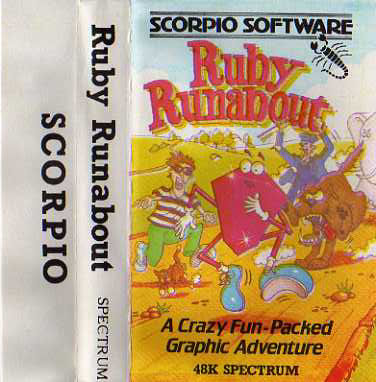
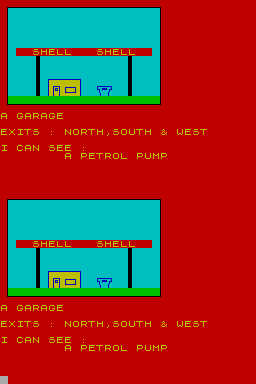
DEREK BREWSTER'S ADVENTURE TRAIL BACK TO BASICS There has been for some time a body of opinion which puts forward the view that machine code is superior to Basic, per se. Arcade games, where speed is the deciding factor, may well lend themselves to this argument but some strategy, and all adventure games can be better served by some Basic routines. The reason for this apparent anomaly is clear to anyone who has taken the time and effort needed to master machine code. Although machine code is ideally more malleable in any given situation, coding in reality proves to be certainly slower and often less flexible, and crucially, the program is less easily altered. After playing and reviewing many adventures this contradiction has made itself plain. The complexities of machine code lead to stilted adventures unless the author allows much development time. The economic vagaries of the games market alas, would make it far more worthwhile for such a successful author to produce two or even three arcade games in such a space of time with the certainty of a far higher income. The Quill, as is often plaudited on cassette inlays results in an all machine code program but the structure of each Quilled game is necessarily the same. What is less apparent is the use of similar devices by other software houses in order to reduce the development time of adventures. Herein lies the paradox. Even though machine code should be the more flexible, due to its time-consuming coding it is rarely so in effect and it would seem the case that it is the adventure which makes some use of Basic which shows the originality both in display, theme and plot. So the next time you examine a cassette inlay don't fall into the trap of making judgements based upon the divisive argument - Basic vs. machine code. Where the documentation tells of an all machine-coded program this in itself gives no indication of the quality of the game as an adventure. Basic is devalued by its simplicity and it familiarity but adventure is a more sophisticated market than arcade since at a time when the Spectrum has been pushed to its limits, imagination, theme and plot are now the decisive factors. RUBY RUNABOUT Producer: Scorpio Software Retail Price: £1.99 Author: Andrew Reed Ruby Runabout describes itself as a crazy fun-packed adventure. The cassette cover depicts a scene of fun and frolic with larger than life cartoon characters. The game's price leads one to expect a very ordinary adventure and in many ways this proves to be the case. You play Reggie the Ruby Robber, the alliterated antihero who has his sights set on the Rocksalmon Ruby, the most priceless gem in the world. He runs a garage, when he's not busy thieving, and your adventure starts at the petrol pumps. is this comment directed at garage owners I ask myself or is it just the crummiest plot ever to package a computer game? Your quest is to get to the ruby first, but if you take too long you may find it has moved, so don't waste time. Having played the game and discovered some of its more dubious secrets, I can reveal that I have not got the foggiest what these instructions are about. But if you endeavour to shed any light on this matter don't write to tell me about ft because this is the sort of game where if things don't quite make sense it doesn't really matter. It could be the price, or the thin plot, or perhaps it's the grievance felt when every programmer worth his microdrive is struggling with the limitations of 40K of memory, this programmer has, with an inefficient style, ventured to fill up as much possible with redundant code. The game uses no memory saving techniques, and no wonder, since only 31K is actually used leaving 9K idle. Simple memory conservation could almost have halved the length of the program. To give two examples: variable names are up to eleven characters long while graphics use reams of Plot and Draw representing a vast waste in memory and is, these days, unacceptable in games thought to have any commercial value. Surely you expect a commercial program to offer something beyond that which the average hacker could achieve, no matter what the asking price. Back to the cassette cover. You'll discover forty locations, twenty of which have graphic illustrations, and using your imagination and sense of humour, survive the journey to locate and remove Rocksalmon Ruby. The only humour remarkable enough to remember is the comment that greets you when you examine the tape to be told - it's a Sony. That is unless you count the instant death meted out by the policeman should you be caught dropping a toffee wrapper. 'A policeman approaches you with a truncheon; you look at him so he hits you over the head with it for dropping litter.' Such occurrences are common, where attempting to kill almost anything will mark your early departure from the game. Anything from a park attendant to a lowly wasp can present a threat but could you really expect an altercation with a car wash to be fatal? At times it can seem that everything you try ends up killing you for little justifiable reason. I admit it's just possible I may have missed some of the humour as my interest finally flagged before completing the game. As for using your imagination you will indeed need it since the game requires mental contortions to explain the odd juxtapositions of locations and objects. An oil rig lies directly south of a post box, a wigwam is in close proximity to an igloo, while by a building site - what's this? - The Suez. Oh! Uh? Many other locations are mysteriously unyielding. You seem unable to cross the budge or swim the river. Further, no access can be made to a single building you meet. As for the objects, would you really expect to find a blowtorch in a gym, or a file in a flower bed? You don't find the petrol at the petrol station but at the windmill. There is no strong storyline to explain these discrepancies. Inserting a coin at the fruit machine thankfully does not result in death. In fact you win with your first attempt. Sadly you win on each subsequent attempt and you neither lose the coin you've used or gain the coins you win. You can sense any atmosphere fading away. Later the game has you scaring an elephant with a very elusive mouse and another scenario has you creeping over pressure pads sure in the belief that your step will be that much daintier dressed in slippers. The graphics are simple but effective enough. So as not to hold up what is an entirely Basic program the graphics are marked out with simple Draw and Plot commands. The colour changes at every location but some of the colours used do not mix well. The bridge appears blank on a b/w TV and only reveals a black bridge against a red background clearly on a favourably adjusted colour set. A lot of input scrolls up to push the picture and location description up off the screen. Ruby Runabout is a short and unimaginative adventure with a weak plot and no theme to speak of. There are too few problems and too many early exits. Good features include a pleasant intro tune and a very quick response time. This game is about a third of the price of many classic adventure games and I can't help feeling that here you get a third of an adventure, both as regards size and quality. Difficulty: Moderate Graphics: Small graphics in some locations. Presentation: Average - Good Input Facility: Spectrum input Response: Quite fast
C&VG (Computer & Video Games) #37Nov 1984 · p.124
Keith Campbell
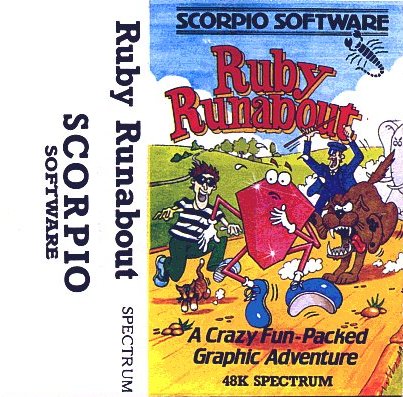
"A crazy fun-packed graphic adventure" is how Ruby Runabout is described on the inlay. Well, it wasn't enough to drive me crazy, for the problems aren't difficult. Come to think of it - what problems? And it is packed with about is much fun as a cemetery on a wet Sunday afternoon. The author of Ruby Runabout has difficulty in expressing himself. "You are the Adventurer..." start the instructions. Well I never! They continue "...you play the part of Reggie the Ruby Thief and hope that you get to find the ruby first or you might find it has gone." Mindblowing, isn't it? There are said to be 40 locations, of which 20 have a graphics illustration. Perhaps there is no room for further pics, though I doubt it. If so, then it is hardly surprising for a program that uses lashings of space on such variable names as REMOVECOVER and SLIPPERWEAR. The locations seem linked only in the sense that one leads to another - from a petrol station to an arcade, a gym and an oil-rig? Objects are found in all sorts of unlikely places - any location convenient for them to be left lying around. And, of course, it is a sudden death game. "You have the lit blowtorch here. This house is made of ice. The roof falls on your heads..." What, all four of them? "You pick up the letter and it blows up in your hand. It was a letter bomb!" I suspect that the author had a traumatic experience at the hands of authority in his youth, for he has a policeman batteting the poor Adventurer to death with his truncheon for dropping an object (litter lout!) and a park-keeper turning vicious and calling his killer guard-dog. Still, there's fun to be had reading some of the replies! "You cut the wire and dissemble the alarms," is one of the more classic examples. How it is possible to disguise alarms in this way I'm none too sure - I would have thought that cutting the wires would more likely dismantle them. Ruby Runabout is typical of poor quality Adventures that, for some reason or other, tend to flock to the Spectrum more frequently than other computers. I suppose that if you do buy this inconsequential software yourself, you can re-use the tape and you won't be too much out of pocket. Ruby Runabout, priced £1.99, is for 48k Spectrum from Scorpio Software.
Two scenes from Ruby Runabout.
Big K #7Oct 1984 · p.142/32/3
Overall 2/3
Steve Keaton 2/3
HOT ROCK MAKER: Scorpio Software FORMAT: cassette PRICE: £x.95 Reggie the Robber is a nasty piece of work. He'd sell his pet hamster to Pedigree Chum if he thought he'd make a bob or two. So imagine his delight when he hears of the fabulous Rock Salmon Ruby, a hefty hunk of stone worth more than the monthly pay packets of both T. Tyler and R. Burton combined! (Cheap humk of rock, huh? - Ed & Asst Ed). Thus the scene is set for your adventure is set. You must aid Reg the tea-leaf in his attempt to purloin the gem and abscond to foreign parts. However, it's unlikely that this task will take very long. The game features only 40 locations, 20 of which are neatly (and quickly) illustrated. Hardly a challenge by current standards. There's little freedom of input for the player. Experienced explorers are unlikely to find the game of much interest. Still, response times are good and the demeanour of the piece is bright and colourful. I guess if you wanna buy a prog for your kid sister this could be the one to go for.
Personal Computer Games #11Oct 1984 · p.994/105/104/106/10
Complexity 4/10
Atmosphere 5/10
Interaction 4/10
Value 6/10
Steve Cooke
MACHINE: Spectrum 48K PRICE: £1.99 I was tapping my wand impatiently as I strode from location to location in search of excitement in Ruby Runabout from Scorpio Software (for 48K Spectrum). The locations have the briefest of descriptions, but the occasional graphic illustration brightens things up a bit. The locations however are very oddly placed. One moment you're standing by a postbox, and the next minute you're (presumably swimming) by an oil rig out to sea. Your objective in Scorpio's game is to search for rubies, which you do with the aid of a rather limited vocabulary. Its one of those games where in order to succeed you must simply visit every object. There are numerous spelling mistakes, and the occasional attempts at humour are not entirely successful. However, Ruby Runabout will only set you back £1.99 which makes it one of the cheapest adventures I've ever played. At that price one doesn't expect too much, so the White Wizard is content to grant this game a place on the shelf rather than in the bin.
Micro Adventurer #11Sep 1984 · p.36
John Fraser
REGGIE'S RUBY MICRO: Spectrum 48K PRICE: £1.99 FORMAT: Cassette SUPPLIER: Scorpio Software, [redacted] With a title like Ruby Runabout, you might have expected a fast arcade-style adventure along the lines of Jet Set Willy. In fact, what you get is a mildly amusing text and graphic adventure of the more traditional kind - forty locations to explore, half of which have graphics, puzzles to solve and lots of objects to pick up and try and find a use for. You are Reggie the garage owner, who is desperate to own the world's most precious gem, the Rocksalmon Ruby. Your objective is to retrieve the ruby and take it home. But there's no time to lose, for if you delay you may find it has moved. To accomplish this task you have to avoid numerous hazards which may hinder your progress or even terminate it altogether. There are lots of red-herrings; in fact you are likely to spend most of your time trying to decide what on earth to do with the odd collection of objects in your possession. Some locations are also potentially dangerous to explore. On a few occasions your path is blocked by a person or an animal and excessive violence against either is not tolerated, so beware. Mapping is straightforward and the screen presentation is clear and simple, although the descriptions are minimal 'a garage', 'a bridge' - while the inputs are of the basic verb-noun type. Unfortunately, there appear to be several strange anomalies in this game. For example, although the verb 'light' is accepted, I can't find anything to light. And the request to 'open door' merely brings the response, 'the key isn't in the door.' If it's not in the door, then where is it? One or two locations stand out as being rather out of place in this adventure, which generally takes place in familiar every day places. Take the oil rig, for instance. How many of those do you see when walking down the street? Then there is the bridge, which the screen shows as nothing but a black rectangle. For me, though, the most infuriating feature of the game is the inadequate help facility. This is extremely short on replies, some of which are obvious if you've read the documentation, while others don't provide any clues other than telling you what you are trying to do already. One response simply says 'I'm as lost as you are', which may be funny once, but becomes tiresome after half a dozen times. Despite these criticisms, the game offers a challenge which should keep players busy for hours. Even though I've examined and tried to pick up, open and light just about everything possible, I've still only scored 30%. So now I sit and think, wondering how to grasp that elusive ruby...
Personal Computer Games #10Sep 1984 · p.67
Steve Cooke
FORGET THESE TREASURES! Some of the games that have made their way to the White Wizard's Fortress of Solitude this month are pure rubbish. First into the bin was The Five Treasures of Ryzar from Space Age Software. This 'original and exciting adventure' is about as original and exciting as a spell for making lizards burp. 'You are not limited to single-letter commands' boasts the press release. Big deal. You are, however limited to a very small vocabulary and an extremely repetitive scenario. The display shows a line drawing of the room you happen to be in. You can choose between 'Olde Englishe Text' and the normal Spectrum character set; and a brief message tells you the number of the room and which direction you're facing in. The direction is really pretty pointless since the program doesn't understand words like North, South etc. You have to type in 'Go forward' or 'Go backwards' to move about. Most of the time you type in instructions you are told that 'You can't do that here', without it being at all clear why you can't. Every time you enter a new room another ugly line drawing, featuring a number of blank walls and a door or two, is flashed onto the screen. Sometimes you appear to be in a new room but the display tells you that you are still in the old one. All very confusing. Your task is to collect the five treasures of Ryzar from the five different levels below the city, but however exciting the objective may sound, the game, I assure you, isn't. CLASSIC I was getting rather depressed by this stage, but the next offering, Odyssey of Hope, from Martech, cheered my up considerably. Martech's game looks different from the start. The instructions are printed on the pages of a book that turn as you read them. The adventure itself has scrolling text with attractive graphics at the top of the page that draw instantly and are among the best adventure graphics I've seen on the Sinclair machine. You have to travel around the classical world of ancient Greece hunting for Hope, which has been stolen, and restore it to Mount Olympus. Compared to Five Treasures of Ryzar, Odyssey of Hope seemed like game of the year. In fact, it's a rather average adventure that is perked up with some surprising additions. First, the sound effects. Standing in the temple, you hear a hissing sound between inputs. Hang about too long and you get bitten by a snake. After that, in another location, you can be sure I didn't stick around to find out what the buzzing sound was. Being stung to death by savage bees isn't my idea of a Greek holiday. The responses are a bit slow in Martech's game, but otherwise I found it an attractive if rather unexciting game. One thing that annoyed me was the response to my entry 'Use loom'. 'What!', the program replied, 'That's women's work!'. The assumption that only men, boys and wizards play adventures is not only incorrect, but also, I think, a little insulting to half the population. WILD WEST However, it's very much a man's world in West, a new game for the 64 from another company jumping on the adventure bandwagon, Talent Software. This is a rather unusual game, a text-adventure but with a real-time element which can make play rather bizarre, to say the least. The setting is an old, decaying town in the Wild West, and droves of gun-toting bank robbers are on the loose. When you encounter one you have to type in 'SHOOT' at top speed or you're liable to bite the dust with a bullet in your back. Since we wizards have always preferred spells to touch-typing, this proved a most demanding ordeal. Even stranger is that when you die you are simply returned to the starting point minus all your possessions, including your gun. So you must immediately hare hack to the site of your death where you will discover 'a familiar corpse' from which you can recoup all your property. Unfortunately there are some locations you can't return to safely should you die in one of these you might as well reload the tape (takes 15 minutes) although you do have the option of loading a previously saved position. Since you have 30 lives, it's not long before the locations you visit are populated by 'familiar corpses' of you and your trusty steed and, as the text keeps telling you, 'the stench is awful'. Another unusual feature is that should you happen to pick up a pack of cards, you're likely to be challenged to a game of Pontoon, the rules of which are explained in the cassette inlay. You can keep playing as long as you like and if you lose you'd better have some money With you or guess what happens. Mind you, if you win the robbers don't seem to take that very kindly either. Other features which won't appeal to the purist are the rather bald nature of the descriptions and the fact that many common words such as 'Wait' and, more ominously, 'Help' are not understood. But the instructions claim a vocabulary of up to 200 words, and there seems to be quite a large number of locations. The aim in West is to track down the bank robbers' loot and escape from the town in one piece. Could appeal to anyone fed up with battling dragons, trolls, and serpents - but look out for the rattlesnake! Dorcas Software are a company I haven't stumbled across before. Their game Oracle's Cave for the 64 is one of those 'hit points and heal wounds' programs where you go for a wild romp through a maze of caves, attacking ogres and cackling with glee at the sight of gold. Dorcas' game is different because of the quality of the graphics. There's a display of the cave you find yourself in at the top of the screen. Below is a status display and a map of the caves which is added to as you explore them. In each location you are presented with different choices depending on what you're up against. Commands are entered with single key-presses and the results are then displayed graphically on the screen. Move straight ahead and a little figure walks hesitantly along the tunnel. He can also climb up and down ladders, fight with assorted monsters and, of course, collect treasure, food, potions, and all the other curiosities to be found in your local cave complex. The White Wizard is not, as I've said before, a great fan of this type of game. I prefer to have the opportunities (and even, sometimes, the frustrations) of proper text input. I also prefer to have something more to do than just go around collecting treasure and fighting. However the graphics did add to the atmosphere and I enjoyed it more than most programs of this type. POT OF GOLD The troubles at Dragon came at a particularly unfortunate time for adventure players because Dragon Data have just produced two excellent games for the Welsh machine. Shenanigans and Sea Quest are among the first games for the Dragon with decent text/graphics displays. You get a picture in the top half of the screen and a scrolling text-window below, with both upper and lower case letters. The graphics are great - and in Sea Quest they even boast the occasional animated effect as waves cross the screen, or a waterfall plunges down onto a beach. Both games have you searching for treasure. Shenanigans has, as the name may suggest to you, a distinctly Irish flavour. Searching for the pot of gold at the end of the rainbow, you'll have to solve a number of tricky puzzles with the aid of a decent vocabulary and an excellently presented program. What I liked about both these games was the logic behind them. In Shenanigans one of the first puzzles concerns a mail box. How do you open your mailbox in the apartment building unless you know which mail box is yours? The White Wizard struggled with this for quite some time, and eventually gave up in despair. The solution (given me by a very helpful man at Dragon) was so blindingly obvious and so logical that I couldn't help laughing. What was it, I hear you cry? Check out next month's tips grid to find out. Meanwhile, rush out and buy the game. Sea Quest is every bit as enjoyable as Shenanigans. Instead of leprechauns you'll be rubbing shoulders with mermaids and sharks, buying goods on credit, and finally humping your hard-earned treasure back to a cave on the beach. Definitely a game to dive for. Both programs are two word input only, but this never seems to be a limitation and each game is quite clear about telling you what it understands and what it doesn't. These two adventures are easily comparable to games on the Spectrum in presentation and content. I only hope that despite Dragon's troubles they will continue to be readily available in the shops. Ah well, as Mark Ormiston pointed out in a letter last month, Dragons are a persecuted minority. And on that note, fellow adventurers, I take my leave and wish you well. GAME: The Five Treasures Of Ryzar MACHINE: Spectrum 48K PRICE: £5.20 Complexity: 4/10 Atmosphere: 1/10 Interaction: 1/10 Value: 2/10 GAME: Ruby Runabout MACHINE: Spectrum 48K PRICE: £1.99 Complexity: 4/10 Atmosphere: 5/10 Interaction: 4/10 Value: 6/10 GAME: Odyssey Of Hope MACHINE: Spectrum 48K PRICE: £5.95 Complexity: 6/10 Atmosphere: 6/10 Interaction: 5/10 Value: 6/10 GAME: West MACHINE: CBM 64 PRICE: £9.95 Complexity: 7/10 Atmosphere: 6/10 Interaction: 6/10 Value: 6/10 GAME: Oracle's Cave MACHINE: CBM 64 PRICE: £7.95 Complexity: 3/10 Atmosphere: 5/10 Interaction: 2/10 Value: 4/10 GAME: Shenanigans MACHINE: Dragon PRICE: ? Complexity: 7/10 Atmosphere: 7/10 Interaction: 6/10 Value: 7/10 GAME: Sea Quest MACHINE: Dragon PRICE: ? Complexity: 7/10 Atmosphere: 8/10 Interaction: 6/10 Value: 7/10
Advert8
- Personal Computer Games #12Nov 1984 · p.141
- Personal Computer Games #11Oct 1984 · p.63
- Personal Computer Games #10Sep 1984 · p.61
- Personal Computer News #79Sep 1984 · p.49
- C&VG (Computer & Video Games) #33Jul 1984 · p.66
- Personal Computer Games #8Jul 1984 · p.116
- C&VG (Computer & Video Games) #31May 1984 · p.162
- TV GamerMay 1984 · p.50
Review1
- TV GamerOct 1984 · p.57
News/Note1
- Popular Computing Weekly #21May 1984 · p.52
Related
- Elsewhere
- CASAThe TipshopUVL
- Same entry at
- Spectrum ComputingZXInfo
Reviews from people here
Sign in to write about this, or make an account. It takes a minute and lets you correct the catalogue too.
No description recorded.
Sign in to correct or add to this.
Hold the rights to this and want it taken down?