
The Runes of Zendos
Adventure Game: Graphic · ZX-Spectrum 48K · 1 players · English
Dorcas Software · 1984 · Pound sterling 7.95
Discussion
Nobody has started a thread about this yet.
Play
- RunesOfZendosThe.tzx.zipTape image English27 KB
- RunesOfZendosThe.tap.zipTape image English33 KB
Documents
- RunesOfZendosThe.txtInstructions English8 KB
Other files
- Runes of Zendos, The (1984)(Dorcas Software).pokPOK pokes file 0 KB
Files and rights
No permission is on record either way. Screens and pictures are copied here on a take-down basis: if you hold the rights and want something removed, say so and it goes.
Credits
- Chris Dorrellcredited
Sign in to credit somebody, or say what these people did.
Awards
- Crash SmashCrash12 · 1985
Scores
In the magazines
- Sinclair User #351985 · Gilbert Factor6/10
- Sinclair Programs #281985 · Rating67%
- Crash #121985 · Overall Value8/10
- Big K #121985 · Overall2/3
Elsewhere on the web
- WorldOfSpectrum 20 votes8.00
In the magazines 41
Your Computer #3Mar 1985 · p.45
Hugo North
48K Spectrum £7.95 Dorcas Software Zendos is an animated graphics and text adventure with some similarities to its predecessor, Oracle's Cave. If you liked that, then chances are you will enjoy this one. The screen is divided into two, the top half displaying a side-on view of part of a room which scrolls horizontally or vertically in response to your chosen movement. The lower half is used textual commands and responses. Commands can range from the terse - L for go left - to the verbose - attack the guard with the mighty axe. You are shown as a small white-clad figure whose mission it is to seek our and destroy the wicked wiazrd Zendos. He has separately imprisoned the spirit of each month - you must find and release all 12 spirits. Each auction of the castle is split into several chambers. Since each of the spirits is located in a different section, the program kindly lets you move instantaneously from section to section with a single command. Effectively, you get to play 12 connected sub-adventures. Apart from you own walkabouts, the animation mostly comes from simply stylised battles with many of the characters you meet. These characters, as in Oracle's Cave, are solidly presented an imaginatively designed. As well as fighting, cracking runic codes and casting spells are other major activities. As an animated adventure, Zendos works out very well. If you want a change from text only adventures, this should fill the bill.
Big K #12Mar 1985 · p.232/32/32/32/32/3
Graphics 2/3
Playability 2/3
Addictiveness 2/3
Overall 2/3
John Conquest 2/3
DIRTY DOZEN MAKER: Dorcas FORMAT: cassette PRICE: £7.95 Sequel to Oracle's Cave, perhaps the first animated adventure, Zendos is a series of twelve adventures working on two different levels. On the simpler level, it presents a series of problems to be solved as your man roams corridors, climbs ladders and confronts various animate and inanimate obstacles. The same problems recur in different sequences in each adventure so, in theory, once you've solved them in one adventure, you can deal with them pretty handily in all the rest. However, on another level, your task is harder. At the heart of each adventure is an hour glass in which Zendos has imprisoned a month, disrupting his neighbours' lives no little. To release them, eventually getting to the final screen, you must translate the runic inscription on each hour glass. In other words, what you get is a neat, if fairly simple, animated graphics adventure combined with a rather less simple job of code-breaking.
Sinclair Programs #28Feb 1985 · p.1967%67%
Rating 67%
June Mortimer 67%
PRICE: £7.95 GAME TYPE: Adventure When Dorcas brought out their game The Oracle's Cave, it was very impressive. A fully animated adventure, with clear graphics, not tiny little characters! Very original, very good. Their follow-up is less impressive, for the idea of the animated adventure has now been taken to greater lengths than Dorcas had imagined. The Runes of Zendos sees the player wandering around one of twelve different castle layouts, searching for a Runic Hour glass. Twelve separate adventures, although the problems which you encounter, and the characters you meet will be similar in each one. In each location your options are limited. If you face unfriendly opponents without the weapon necessary to destroy them instantly you will have to fight them. The outcome relies on your strength and your weapons, but also on luck. Fights with a little luck involved are exciting, fights where too much of a random element is involved are frustrating and ultimately boring. Those in The Runes of Zendos fall into the latter of these two categories. The graphics and animation are good, but not spectacular. The problems are monotonous: find the correct objects in the right order and use them in the right way. The fight scenes are tedious. Runes of Zendos suffers more than most games from the rivalry of other programs released at the same time. It is a moderately enjoyable adventure game, but is certainly not the best of its type on the Spectrum market this Christmas. Produced for the 48K Spectrum by Dorcas Software.
Sinclair User #35Feb 1985 · p.266/106/10
Gilbert Factor 6/10
Richard Price 6/10
THE RUNES OF ZENDOS Dorcas Software Memory: 48K Price: £7.95 Dorcasia, like Camelot, was a fairly well regulated place until the evil Zendos threw the main switch and plunged the country into perpetual darkness. The 'spirit' of each month of the year was trapped in a secret rune and then tucked away in the depths of his castle. As might be expected you must search the castle and destroy the hour glasses which hold the months. There is also a runic inscription on each glass and you must decipher that to exorcise the spell on the month. As there are 12 months there are 12 separate quests, all of which interlink to some extent. To solve the full puzzle you must break a number of codes and the game becomes more difficult as you progress. Like its predecessor, The Oracle's Cave, the game features animated graphics. The explorer walks and climbs from location to location encountering various monsters and magical objects. Those are finely drawn in attractive colour and are an improvement on the Cave's rather monochromatic pictures. Text can be used as in a standard adventure and the buffer will accept reasonably complex sentences, including some adverbs. The Runes of Zendos is carefully produced and will have considerable appeal to amateur cryptologists.
Crash #12Jan 1985 · p.124Crash Smash8/105/108/1010/108/108/10
Atmosphere 8/10
Vocabulary 5/10
Logic 8/10
Debugging 10/10
Overall Value 8/10
Derek Brewster 8/10
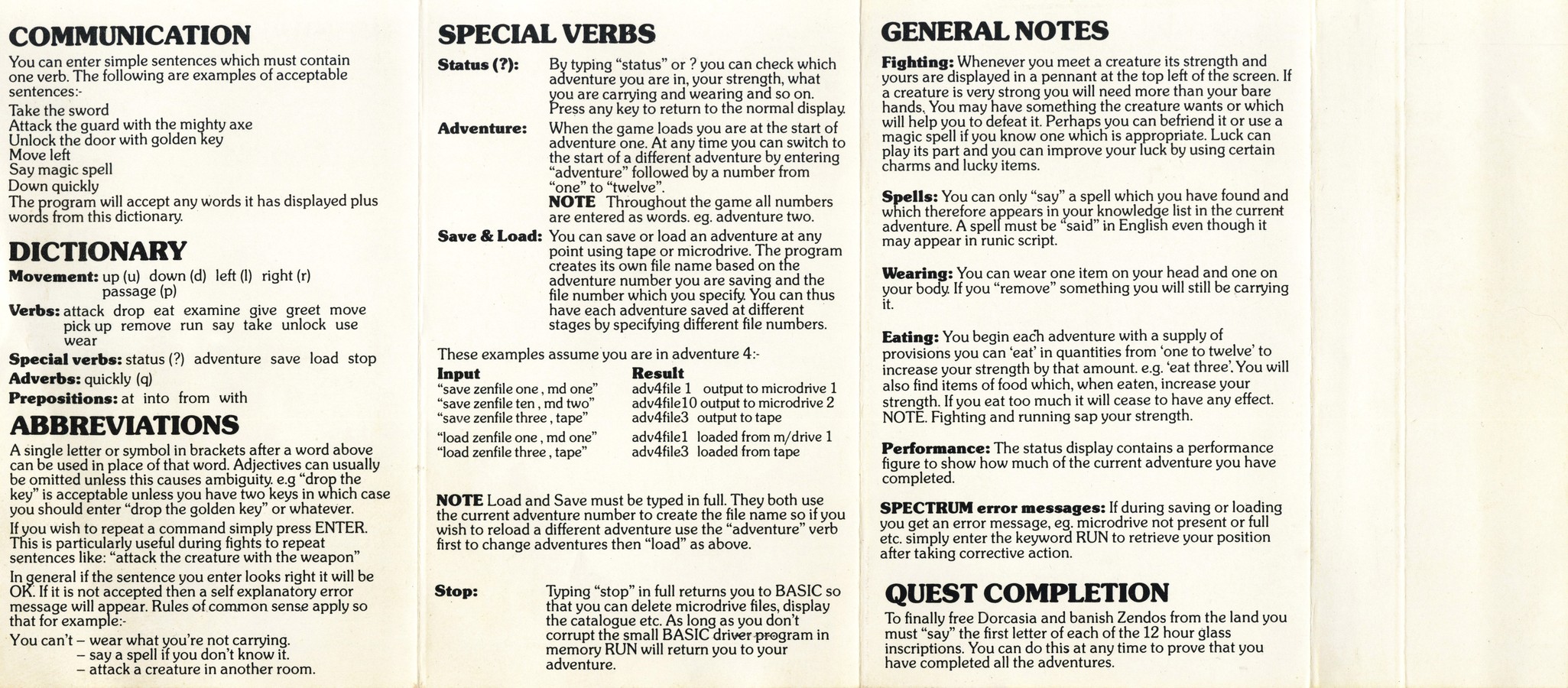
DEREK BREWSTER'S ADVENTURE TRAIL Our Adventure Trail columnist, DEREK BREWSTER, sums up his feelings about the state of Spectrum adventures as we prepare to enter a new year... THE VICTORIAN CHIP Adventuring, as so many have come to know it, began with a mainframe and a copy of Colossal Cavern which even now is available for the home micro. Why should this be so when the technical improvements in the writing and implementation of adventure has increased markedly since that time? The reason gives a due to the special attributes every popular adventure possesses, namely, a plot in which an adventurer can lose himself. The problems must be pitched somewhere in that narrow band where they are difficult and thought-provoking but, hopefully, entirely logical. But where an adventure really shows its class is when it often has the explorer preoccupied with two or more problems at the same time and can enable progress by more than one solution. In an editorial some months ago I commented on how it is unwise for a company to release too many games on a modular basis. It would seem this advice to some extent is unnecessary as market forces have forced more selective releases from both adventure and arcade camps alike. Crash was criticised some time ago for reviewing all games released instead of just those that merit distinction and yet the irony is, of the plethora of publications that line the newsagents' shelves, Crash is now the one, with its CRASH SMASH awards, to distinguish and more overtly praise those games of the highest calibre every month. These pick of the bunch, considering how far software has come in the last year, are great games indeed - a trip to the arcades is positively dull when compared to the choice and quality now available in millions of homes. Games playing has come a long way and will go much further. People's expectations of game software is much higher than when microcomputing was a fresh and novel pastime. Everyone tried their hand at programming because they thought that's what micros were for - to learn all about programming, and the standard of software was initially low enough to encourage imitation and even improvement. However, people were soon glad to see their computers do anything following their own fruitless struggles. Now the scene is different: many see their computers for what they are - games machines. Take the Spectrums main rival, the Commodore 64. When first marketed, it was as a business computer to the incredible extent that it was only to be had in business shops. The inference was you couldn't have it for anything as frivolous as playing games. Hindsight, and in particular two important factors, made things clearer. One, the arrival of a small business computer on the scene with the likes of the Advance lined up with the Spectrum and the C64, which gave the lie to the idea that a business system could cost anything less than £1000. Two, playing games isn't quite the frivolous nonentity some might have had us to believe. At a time when enforced leisure is the order of the day, playing computer games is a much better recreation than watching feeble-minded quiz shows on TV (Channel 4 made a brave attempt to keep television alive but alas their resolve faded with their fortunes). Computer games are sophisticated enough to be intellectually demanding; adventures are used in education as they are better, certainly more entertaining, than the prescribed medicine while the arcade side has given birth to genuinely instructive simulation programs. Speaking as one who is suspicious of the very word education, I think it unlikely that much good will come of educational software marketed as such; better for games to become more entertaining, thought-provoking and informative. A return to Victorian Values is one thing, being bored to brain-death is quite another. Colossal Cavern spawned many text-only adventures in the early days of home computing but some luminaries of the computing press fall woefully short of their roles to inform of the differences between a knocked-off job and the program of several months incubation. This puzzled me enough (brought to a head having read a guide-book to adventures which was the most partisan load of drivel) to encourage my own entry onto the scene and the views which follow. The modern equivalent of the original, good, mostly Basic, text-only adventure is the Ket Trilogy, a series of adventures marked by their sensibly cheap price, super atmosphere, easy and logical problems, and user-friendliness. A company that had machine code games right from the start was Artic Computing, who produced highly competent adventures with problems that lent themselves well to a new magazine phenomenon, the adventure help page, since they were very difficult and had but one solution. The early games were clinical by today's standards, needing the methodical approach of the crossword devotee with little attention paid to building up a consistent atmosphere. The early Artic software clearly had some appeal beyond that of its competitors but had one distinction which was to prove decisive in the struggle for survival in a very competitive market - the software was in your local computer shop and you could actually hand over your money and buy it. Graphics were the next obvious improvement but alas many early efforts resulted in poor graphics or slow response times. However, one game stood out like no other. Based upon one of the most famous works of fantasy fiction, it marked a new era in book/computer program tie-ins, but more tellingly, in big finance and high pressure salesmanship. A cottage industry now seemed on the brink of renting out office space throughout the land but no one was complaining over the new commercialism because it had produced a computer program every bit as good as the advertisment suggested. It was, of course, The Hobbit from Melbourne House. Years ahead of its time with super graphics and the first game to attempt true character interaction. Later a similar game to The Hobbit provided an option for those who had mastered its complexity. Fantasia Diamond from Hewson Consultants had an interesting storyline and endearing characters. Character interaction was visibly demonstrated in another megagame of 1983, Valhalla, which introduced animation to adventuring, but Basic was too slow for the project and it is doubtful whether the interactions were ever truly intelligent. Unlike The Hobbit, the game didn't quite live up to the adverts. Animation may well prove a redundant offshoot for the unmodified Spectrum since it adds little to the intelligence of an adventure but consumes a vast amount of memory - memory better used increasing interaction with the computer. Character interaction has recently reached a new level of intelligence with a further breakthrough from Melbourne House. The worthy successor to The Hobbit, Sherlock in the end proved too ambitious but nonetheless is a significant milestone on the road to intelligent characters. Perhaps with the removal of the inadequate graphics (a concession to market forces) the game could have struck out more decisively along the path of meaningful character interaction with this becoming the sole selling point. Whatever, Sherlock will become a memorable milestone. The Quill has given the chance to many who haven't got the time or inclination to program a machine code game from scratch, and who can blame them, it is debatable whether any 40K adventure needs to be 100% machine code. Gilsoft's creation has lead to a great surge of adventure releases but most, sadly, do not acknowledge the need to give the customer a much greater depth in theme and plot in return for the limitations imposed by The Quill. However, notable exceptions are classics in their own right: Denis Through the Drinking Glass, Hampstead and Tower of Despair. The Quill is just the most public face of a good number of utilities employed by many adventure software houses. Level 9 make no secret of their own 'a code' used to devise Snowball and boast an ever-increasing library of compression techniques used to instigate the likes of Return to Eden. These games are twice the length you might expect of a well-written game and are, in addition, user-friendly, highly intelligent and imaginative, with good descriptions producing a rich atmosphere. Just as some people look with suspicion toward a Quilled game (has it just been knocked-off?) s o they might well be wary of the five or six part megagame, Domark's Eureka! is composed of many parts, like Mastervision's Wrath of Magra, but it is my view that such games are overly involved and convoluted, and this apparent complexity is to smokescreen what is a shortfall in programming skills; size is simply not an important factor, anyone can write 200K of gobbledegook. Some journalists are forever going on about the great American Software invasion from across the Atlantic but perhaps it has dissipated against our shores and I am sure even a flight out to the States would only confirm that which I have long suspected - there's precious little to shout about above the razzmatazz. One game released this summer was so original and outstandingly brilliant it caught many on the hop just as they were about to forget of software innovation until the autumn. Lords of Midnight represented a significant leap in programming skills used to develop an entirely new theme. The Land of Midnight is an extraordinary invention and anyone who has not yet seen it has not seen half of what the Spectrum has to offer. The game is the crowning jewel in microcomputer games respectability. So what can we expect from the future? Well, graphics of a consistently high standard are on the menu, but more than this, they will become an integral part of the adventure and not just a decorative appendage tacked on to brighten up proceedings. Graphics will broaden out from just pictures to diagrams, charts and even to the map that at the moment is painstakingly committed to paper. The pictures will carry clues and figures showing which characters are present. These characters will be larger than life as they realistically go about their everyday lives cementing a greater belief in the whole adventure. The microdrive will finally be exploited for what it is, a refined fast storage device with immense possibilities, and the days of solitary computing may seem a thing of the past as the Spectrums networking capabilities string along the thoughts of many minds. THE RUNES OF ZENDOS Producer: Dorcas Software Memory Required: 48K Retail Price: £7.95 Language: Machine code Author: Chris Dorrell Dorcasia was a pleasant fertile land until the wizard Zendos cast the spell of darkness, plunging the country into perpetual gloom, forcing all the citizens of the tiny principality to pledge allegiance to him. A hero must take on the twelve different adventures and find and destroy the twelve runic hour glasses hidden deep within his magical castle, releasing the months and returning Dorcasia to the natural forces of the seasons. To protect the hour glasses and keep their runic inscriptions secret, Zendos has placed them in twelve separate rooms, each linked to an exterior gateway by a devious route. Each adventure has unique spells and problems to ensure a new challenge is provided on each occasion. The game features full animation, sentence input, sound effects and save game facilities to tape and microdrive. When the game loads you are at the start of adventure one. At any time you can switch to the start of a different adventure by entering, for example, 'adventure eight'. Status (or ?) gives information regarding the adventure you are in; e.g. Adventure 1, Strength 25, Provisions 25, Luck 10, Performance 80 (how much of the adventure you have completed). Further information regarding what you are carrying, the spells you know and what you are wearing is also detailed. You can wear one item on your head and one on your body; if you remove something you will then be carrying it. You begin each adventure with a supply of provisions eaten in quantities from 1 - 12 to increase your strength, e.g. EAT THREE items of food along the way replenishes strength depleted during fighting and running. Vocabulary is surprisingly particular as you must type in the exact letters to make up the required words with only a few stock abbreviations for left (l), right (r), up (u), down (d), passage (p) and quickly (q). However, editing makes full use of the Spectrum cursor movement and delete functions which greatly facilitates entry. ENTER repeats the last command even after starting to type something else if this is first deleted. Input can be, and often must be, quite lengthy and involved, e.g. ATTACK THE GUARD WITH THE MIGHTY AXE and UNLOCK THE DOOR WITH THE GOLDEN KEY. The program will accept all words it has displayed. Whenever you meet a creature its strength and yours are displayed in a pennant at the top left of the screen. If a creature is very strong you will need more than your bare hands. Fighting is seldom the only option; often befriending a creature or casting an appropriate spell marks the way forward. To cast a spell you must have found it first and which therefore will appear in your knowledge list in the current adventure. Using charms and lucky items may improve your luck. The Runes of Zendos is a very graphically entertaining adventure with smooth, scrolling animation sending your character left and right through passageways, up and down steps of ladders and striking blows in battle with the various zombies, skeletons, werewolves and all manner of exotic assailants. Much of the language is atypical of the arcade-adventure scene with l and r keys chosen for movement and TAKE with no GET option. The problems are logical, more so than in many text adventures, and the game is certain to take some time to complete as three hours were needed for the first of twelve sections. Although the game stands up as an adventure in its own right it is the superb animation which will be the more immediate attraction of what is a very fine game. COMMENTS Difficulty: quite easy Graphics: scrolling graphics with character animation Presentation: good Input facility: allows sentences. Vocabulary small and a little unorthodox Response: reasonable, scrolling graphics appear a bit slow when in a hurry
Personal Computer News #93Jan 1985 · p.34
Mike Gerrard
HOURGLASS RHYMES Mike Gerrard fumbles around in the darkness of Dorcasia, in search of a dozen ways to die. 'Success depends on good fortune and a lump of meat.' No, this isn't subtle propaganda being put out by your local butcher, but one of the messages you get to explain why you're dead yet again in The Runes of Zendos, the latest animated adventure release for the Spectrum (£7.95) from Dorcas Software, whose earlier Oracle's Cave proved so popular. But death comes in a variety of ways - in fact as there are 12 adventures in one, it comes in an almost infinite variety of ways. The mid-ground between adventure at one extreme and arcade at the other is a rather hazy area, but this animated effort is definitely at the adventure end of the market. No need for a joystick option, it's keyed in commands all the way. Any adventure with the word 'runes' in the title tells you that it's going to be set in some mythical land, whose peaceful existence has been or is about to be threatened by some evil Ewen in this case the land is Dorcasia, and the evil power belongs to Zendos the wizard. The problem? Perpetual darkness. Where do you confront Zendos? Deep within his mysterious and magical castle. What's he done? Trapped the spirit of each month of the year in a runic hourglass and hidden them all. What do you have to do? Seek and destroy, dear hero, seek and destroy. How? By reading, deciphering and incanting the mysterious runic inscription round the base of each hour glass. When you load the game up you automatically begin with adventure one, discovering that 'You are in the January hallway where you find a skull and crossbone key'. At any point, though. If you want to go to one of the other adventures you simply type ADVENTURE TWO (or whatever) to take you to the appropriate hallway. You can't leave an adventure half-completed and return to it, however - if you go back to adventure one then you begin again in the January hallway. You can, though, save your progress to tape or Microdrive at any stage. The top part of the screen is given over to the graphics. You, the hero, seem fetchingly clad in a romper suit, which doesn't altogether inspire much confidence in your fighting abilities. Beneath the picture is room for up to seven lines of scrolling text, and another couple of input lines for you beneath those. To move around, you press the initial keys for left, right, up and down, toddle along or climb ladders as appropriate. The movement is reasonably smooth, but slow. Each room you come to will present you with a new object or objects, though the majority of them have some obstacle in the way - dragons, dwarves, cooks, butlers and even singing birds. For example, taking the key from that first room and climbing up brings you to a room where a nimble, cheeky elf is guarding a tiny stone tablet. The commands that are understood allow you to ATTACK ELF, if you wish, or GREET ELF if you're feeling more friendly, or even GIVE KEY TO ELF if you're in a really generous mood. In the top left of each screen are two figures showing the relative strength of you and the other character. So the approach you take depends on that, and whether they appear friendly or not, what weapons you have, whether you have any other objects that might appeal to them, and so on. You start with 25 units of strength and 25 of provisions, with a luck factor of 10. To build up your strength you can eat your provisions. As you proceed you'll find edible objects lying around: apples, cheese and sandwiches, for instance. MUFF JOB Runes works in adventure fashion. In that if you want to get past the bird whose shrill singing pierces your ears, you have to get the ear muff from somewhere else. You also soon learn that ticking clocks are to be left well alone. The size of each adventure area is not enormous, about eight rooms or so, but you need to play through them all in order to pick up clues, which you also get from reading assorted scrolls an parchments. Other clues are obtained by making a reckless assault on some powerful individual - death is never in vain, as you're frequently told what it was you were lacking, such as the lump of meat mentioned above, or the corkscrew when you try to get past the butler. You must start piecing these together, and working out which keys open which trapdoors and gateways. The problems aren't tricky, for the most part,but making sense of everything is another matter. VERDICT It's a game that younger players would get a lot of pleasure from.and the graphics are quite well done, especially in the fight sequences. There are also a few amusing sound effects. The avid adventurer might demand a little more, but I found myself happily engrossed in it for a few hours. One glaring problem, though. Is the lack of a REDESCRIBE or LOOK feature. By the time you've seen off a beast, the location description will have scrolled off the screen and it's all too easy to forget what it was you were originally after - the graphics aren't that good, and daggers and swords tend to look similar. The only solution is to leave the location and come back again, and that means a lengthy wait. These snags apart. The Runes of Zendos is still one of the more successful attempts at animated adventure. HELP SPOT Rather more complicated problems are to be found in the land of Valhalla, as reader Richard Henriques of London SW 16 has discovered. Richard's question was 'What do I do to find the quest objects?' So far he's mapped out an 8x8 grid, and surmised that the bottom right-hand quadrant is 'Valhalla'. All I can say is that the completed map is a 9x9 grid, and Valhalla itself is a single location in that grid. If you say where the first quest object is located then that gives the game away completely, but you can make helpful general advice - such as stock up on food and wine to keep your strength up. Any you can't carry or eat and drink yourself, summon a good character to carry for you, then summon them again when you want to get the food or wine off them. This also applies to weapons - and even the quest objects. Stay on the side of the good guys... end of this week's sermon.
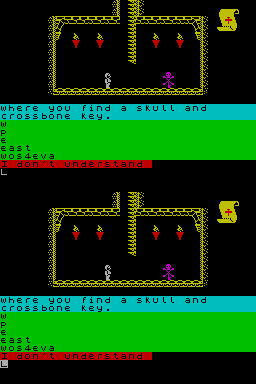
'You are in the January hallway...
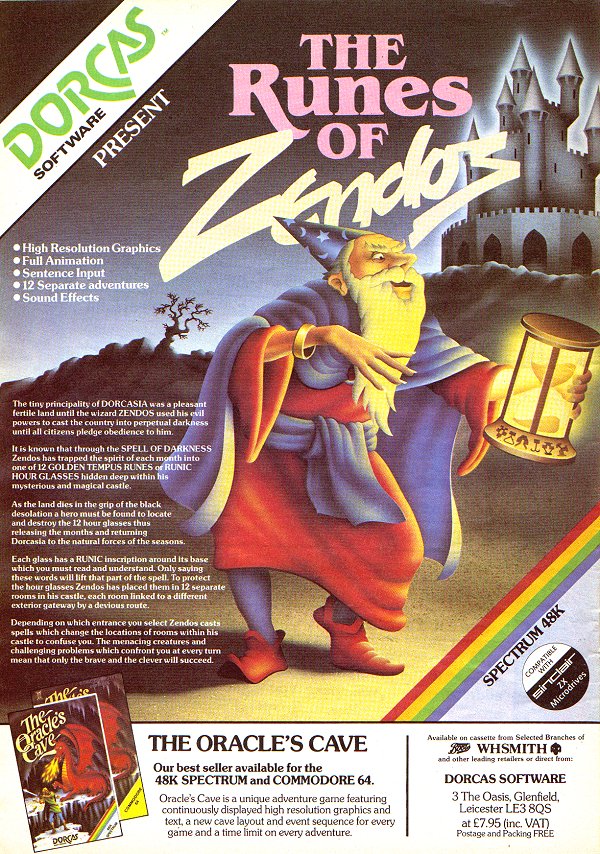
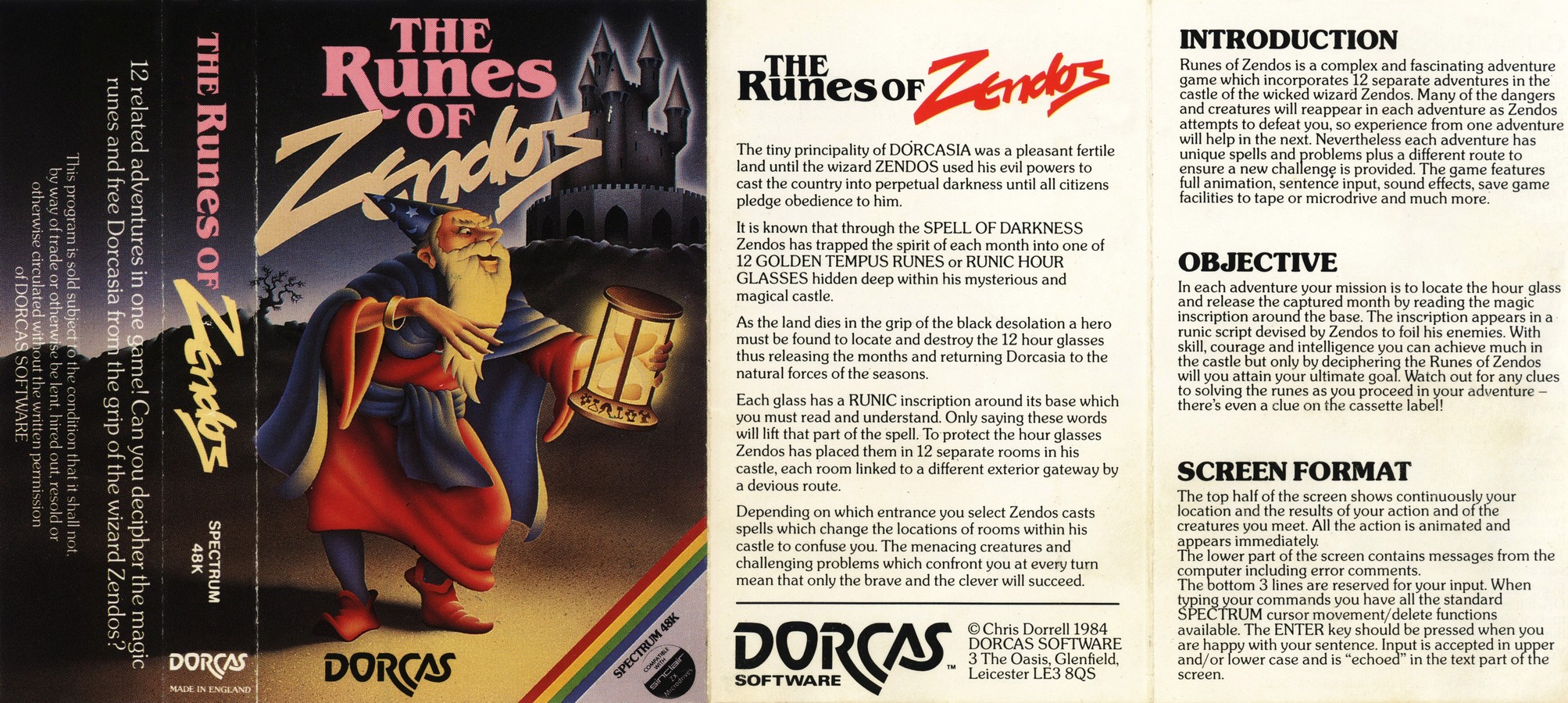
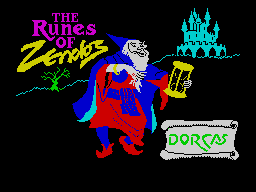
Zendos and seasonal spirit-glass.
Micro Adventurer #15Jan 1985 · p.36
Sally Glover
ZENDOS MICRO: Spectrum 48K PRICE: £7.95 FORMAT: Cassette SUPPLIER: Dorcas Software, [redacted] The Runes of Zendos is an interesting and intriguing new game that comes more in the arcventure category. Using the Spell of Darkness, the evil wizard Zendos has cast the country of Dorcasia into eternal night until all pledge allegiance to him. The 'spirits' of the twelve months have each been trapped by Zendos within the Tempus Runes or Runic Hour Glasses and placed within his labyrinthine castle. Once the game has loaded you can effectively choose twelve different starting points as each 'month' has been hidden within a different group of rooms. You can change adventures at any time simply by typing in the number of the one you wish to move to. Each screen is a high-res picture of a room, complete with animated characters representing you and, in most cases, a monster. There are large numbers of creatures and objects in each game and, although they are the same from game to game, they are 'shuffled round' so that a monster you'll meet at the end of adventure 10 might turn up near the start of adventure two. The game has combat but this is not in real time so you have a chance to think what to do, say and so on. Simple but full sentences are understood and some abbreviations are allowed. A full dictionary of verbs or prepositions is given which is very useful. Saves are allowed on tape or microdrive. Fighting is animated in a most amusing way, showing you and your opponent taking little 'digs' at one another until only one remains. Your respective strengths are shown and the first reduced to zero is dead. Some items you find in the castle aid your attacks or help you get rid of the monsters without violence. Some cunning traps are also included, like exploding clocks and hypnotising mirrors. Lost strength can be regained by eating your provisions or some of the items found in the castle. Now and again an object will add to your luck or reveal a mysterious spell or cryptic clue to aid you later on. Some objects carry mystic runes which must eventually be translated if you are to succeed in 'freeing' the months. As a start I'd advise you to get as far as you can in each of the twelve adventures to build up a list of the creatures, objects, and spells to be found. Even being killed isn't all bad - you often get a clue as to how to deal with the monster after you're dead! Overall, I found the game good fun and quite addictive. I'm sure there are many, many hours of play before you find the final solution.
Full-page ad16
- Sinclair Programs #33Jul 1985 · p.48
- Sinclair Programs #31May 1985 · p.48
- Sinclair Programs #30Apr 1985 · p.44
- Sinclair Programs #29Mar 1985 · p.18
- Sinclair Programs #28Feb 1985 · p.13
- Crash #13Feb 1985 · p.105
- Micro Adventurer #15Jan 1985 · p.52
- Crash #12Jan 1985 · p.129
- Sinclair User #34Jan 1985 · p.80
- Sinclair Programs #27Jan 1985 · p.2
- C&VG (Computer & Video Games) #38Dec 1984 · p.115
- Micro Adventurer #14Dec 1984 · p.30
- Crash #11Dec 1984 · p.107
- Sinclair User #33Dec 1984 · p.20
- Popular Computing Weekly #47Nov 1984 · p.22
- Crash #10Nov 1984 · p.102
Tips5
- Your Sinclair #85Jan 1993 · p.26
- Your Sinclair #53May 1990 · p.58
- Your Sinclair #46Oct 1989 · p.55
- Your Sinclair #33Sep 1988 · p.105
- Crash #17Jun 1985 · p.105
Advert4
- C&VG (Computer & Video Games) #43May 1985 · p.119
- C&VG (Computer & Video Games) #34Aug 1984 · p.139
- C&VG (Computer & Video Games) #33Jul 1984 · p.129
- C&VG (Computer & Video Games) #32Jun 1984 · p.161
Review3
- Home Computing Weekly #95Jan 1985 · p.20
- Popular Computing Weekly #47Nov 1984 · p.67
- Popular Computing Weekly #48Nov 1984 · p.68
News/Note2
- ZX Computing #14Aug 1984 · p.39
- Micro Adventurer #8Jun 1984 · p.8
Information1
- SSD-IISep 1999
CompoResult1
- Crash #14Mar 1985 · p.40
Feature1
- Crash #11Dec 1984 · p.66
CompoEntry1
- Crash #11Dec 1984 · p.66
Related
- Same entry at
- Spectrum ComputingZXInfo
Reviews from people here
Sign in to write about this, or make an account. It takes a minute and lets you correct the catalogue too.
No description, tag recorded.
Sign in to correct or add to this.
Hold the rights to this and want it taken down?