
The Saga of Erik the Viking
Adventure Game: Text/Illustrated · ZX-Spectrum 48K · 1 players · English
Mosaic Publishing Ltd · 1984 · Pound sterling 9.95
Discussion
Nobody has started a thread about this yet.
Remarks
20 page booklet included.
Play
- sagaerikviking.zipRZX playback file
- SagaOfErikTheVikingThe.tzx.zipTape image English29 KB
- SagaOfErikTheVikingThe(different).tzx.zipTape image English29 KB
- SagaOfErikTheVikingThe.tap.zipTape image English29 KB
Documents
- SagaOfErikTheVikingThe.txtInstructions English6 KB
- SagaOfErikTheVikingThe(EN).pdfInstructions English609 KB
Files and rights
No permission is on record either way. Screens and pictures are copied here on a take-down basis: if you hold the rights and want something removed, say so and it goes.
Credits
- Pete Austincredited
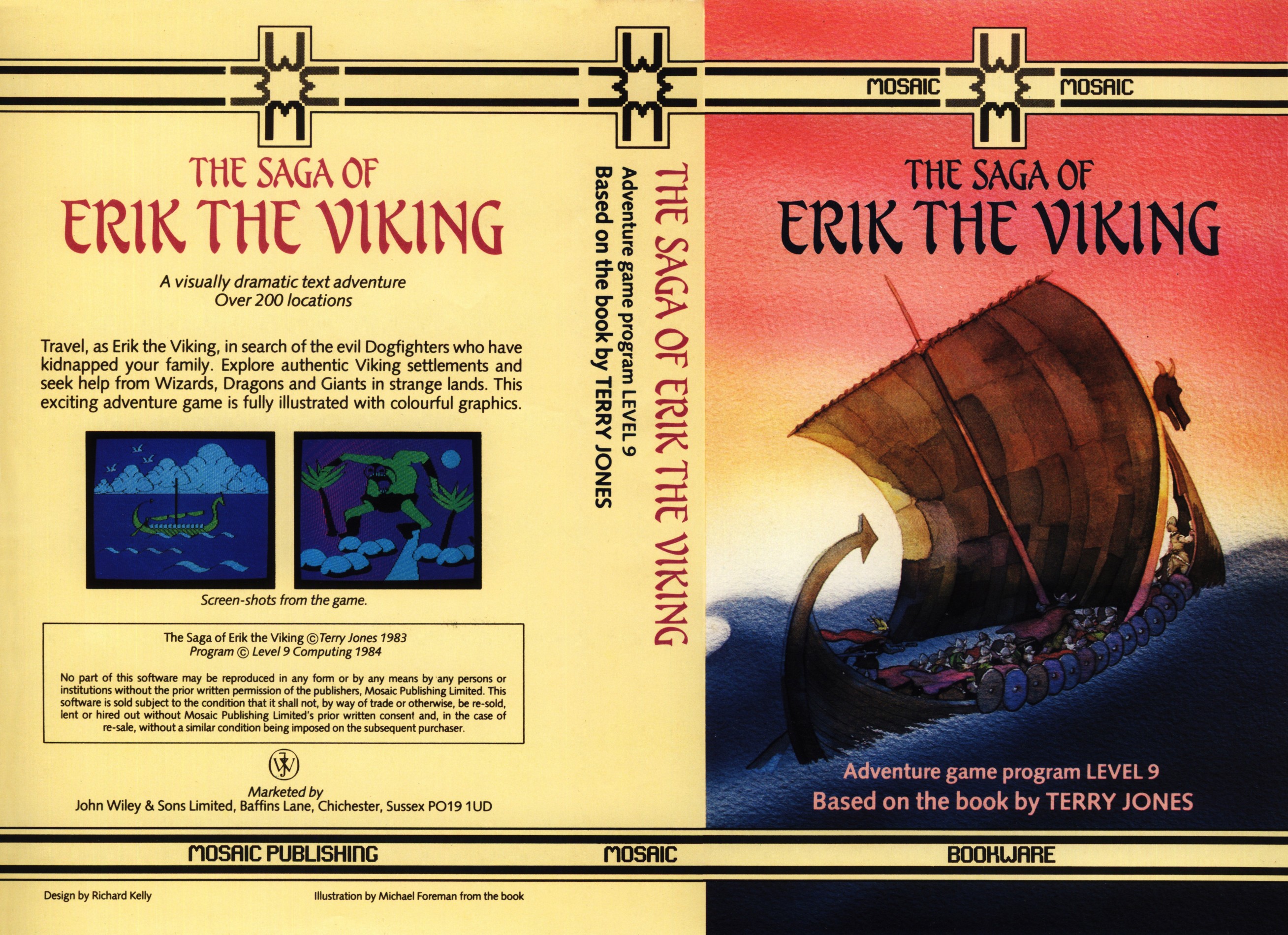
- Michael ForemanInlay/Poster Art
Sign in to credit somebody, or say what these people did.
Scores
In the magazines
- Sinclair Programs #261984 · Rating75%
- Sinclair User #341985 · Gilbert Factor8/10
- Crash #141985 · Overall Value8/10
- Big K #101985 · Overall3/3
Elsewhere on the web
- WorldOfSpectrum 17 votes7.88
Awards and competitions
Golden Joystick Awards 1984
- 2Best Adventure Game of the Year
In the magazines 54
Crash #14Mar 1985 · p.1028/108/109/108/108/108/10
Atmosphere 8/10
Vocabulary 8/10
Logic 9/10
Debugging 8/10
Overall Value 8/10
Derek Brewster 8/10
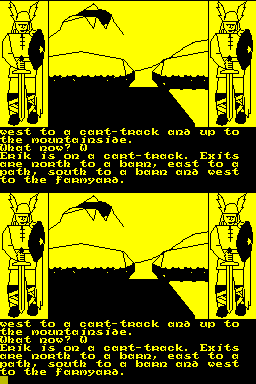
DEREK BREWSTER'S ADVENTURE TRAIL THERE IS A FAULT, PLEASE ADJUST YOUR SETS I read George Orwell's book way before 1984 but found it strange the way everyone last year went to great lengths to point out how modern society bore little relationship to the one portrayed in the novel. I was one of the few people to take the opposing view. If I remember rightly, and it is a long time since I read Orwell (at Primary school - it was slotted in between the Red and Orange Books and Peter and Jane go Ferreting) the book tells of how telescreens impose a highly ritualised life-style on the island's inhabitants. Statistics were used to show how things were getting better when it was plain things couldn't get much worse. What of our society? During the last cold winter the electricity board met with very high demands on electricity, supplying in excess of 45,000 megawatts. Although this demand, brought on by the severe temperatures, was exceptional it was exceeded by the confluence of the end of a final episode of a BBC television series and a commercial break in a film on ITV. What this tells us about society is startling and leads me to think the power wielded by television is out of all proportion to its authority. To give Orwell's novel renewed topicality, simply substitute the word telescreen with the word television. Or to paraphrase a learned Canadian, if the medium is the message then I'm afraid the news isn't good. So what has all this got to do with software? Well let's first take newspapers as an example. The light-weights of Fleet Street would have little to do with TV during its infancy yet now find it profitable to devote up to two-thirds of their space to the gogglebox and its plethora of soap operas and petit politics. The crucial point with software is not that tie-ins with programmes is a bad thing in itself, it's just that, if TV is not quite Big Brother, it is large enough to intimidate anyone with the idea of buying rights to a TV programme into parting with a considerable amount of money. The point is, big business, delightfully absent in the early days of software, scares me an awful lot because big business needs a big turnover to realise big profits to get even bigger. It can get to the ridiculous stage where you either buy what they tell you to or you buy nothing at all. (If you don't think things could ever get that bad try buying a decent pair of shoes in the High Street). Remember, you can't beat the imagination of one lone programmer or a small team huddled in deep thought around a project and also, TV seldom comes up with new ideas itself but in almost every case relies on a steady stream from books, stories, newspapers or the good old radio. It would be nice to think that we could choose what we particularly like from books, comics etc, rather than wait for some comfy TV people to decide this for us. And I would hope the same could be true for software. THE SAGA OF ERIK THE VIKING Producer: Mozaic Publishing Price: £9.95 Language: Machine code Author: Pete Austin This game represents the second saga of Erik the Viking, following the book by Terry Jones, and details the adventures of the famous warrior who lived by the North Sea with his family and servants in Norway one thousand years ago. One day Erik went to check his land and make sure all the sheep were in for shearing. Following the river which flowed past his home he soon reached the snow-capped mountains where he sat for a rest. Dozing beneath the fir-trees he had a vision whereupon strange creatures swarmed over the farm dragging everyone, including his wife, away. You play the freshly awakened Erik who must travel in search of these evil Dogfighters to rescue his family. Over two hundred locations reveal authentic viking settlements with wizards, dragons and giants populating these strange lands. Playing the game you quickly see just how easy it is to move around and it follows that this adventure will have a strong appeal for a young audience or those who find the idea of prolonged mental anguish curiously unrewarding. Objects are easy to find where they stand or on a brief search of the locality. Finding uses for them is a little more testing, but it won't be long before that super feeling of having cracked a puzzle will egg you ever onwards. As you might expect from a commercially viable package and concept, there are no silly clangers to jar the sensibilities, no North Sea Oil Rigs looming out of the mists, only fully authentic stone saunas, viking ships and Scandinavian farm holdings with backdrops of tall mountains and deep fjords. Not wishing to be thought a spoilsport, and to absorb myself in the role of Viking marauder, I didn't shave, or comb my hair, for a day; donned a thick woolly jumper, and leered at the landlady. Needless to say, the part came naturally enough (must be that easterly wind straight off the North Sea… brrr!) Included in the large, colourful packaging is a small, glossy booklet with details on playing the game along with some extracts from the hair-raising adventures taken from the book by Terry Jones including 'Erik and the Storm', 'Erik and the Sea Dragon' and 'Erik and the Dogfighters'. Dogfighters, in case you aren't already in the know, are peculiar dogheaded creatures who instill such fear in their foes that they win most of their fights straightaway: their opponents throw down their swords and cower on their knees, ready to be slaughtered by the hideous beasts. Every location has a full, well-designed picture which often adds immensely to your enjoyment of the adventure as they are really colourful and attractive. For efficiency in drawing, and to give the screen a fine layout, the picture is flanked on either side by a character who must be none other than Erik himself - he looks fearsome enough. Despite the reduced canvas, the graphics are still slow, but an option is provided through the words PICTURES and WORDS. With only WORDS, action is very fast and given there are so few barriers to overcome, you can really zip along. The character set used to display the text has been tastefully redesigned, and is both attractive and highly legible. However, owing to the constraints placed on available memory by all those detailed pictures, the quantity of text is always limited. Vocabulary is friendly, with PUSH and PULL accepted for example, and a list of twenty four handy words provided in the booklet proves to be very useful. Response to input can be random, so don't be fooled into thinking that 'I almost understand' has any significance - it hasn't. More honest are the 'Try again' and 'Try other words' responses. Since the colourful pictures (which might have been designed on another computer, which would explain the odd colour shadings) take up so much of the memory that it is not only the quantity of text which suffers. Structurally the game is flat. Only useful objects can be examined, thus those which won't stand up to examination do not really exist, and only provide decoration. The Saga of Erik the Viking is a thoroughly well-presented software package with a distinct and imaginative theme delivered in a competent, attractive manner. Given the peculiar familial relations inversion brought upon by the microcomputer (it is Dad who must wait until after lunch for young Tommy to show him how it's done), it would be unwise to say the instructions are so clear that a child could understand them. Overall, the game brings an endearing story to life both colourfully, through the entertaining graphics and theme, and in a form which is accessible to everyone as the problems it presents are not difficult. COMMENTS Difficulty: quite easy Graphics: good, and on alllocations Input Facility: usually verb/noun Response: very fast, but graphics are slow
Personal Computer News #96Jan 1985 · p.18
Bob Chappell
THOR BLIMEY! Resident Dungeon Master Bob Chapell dons his Viking cap and embarks on a rescue mission. Plenty there is to be doing in Erik the Viking, a new text and graphics adventure, and like it very much I do, ya. It has been released by John Wiley (under its Mosaic Publishing imprint), and is available for the Commodore 64, BBC B and Spectrum micros. The adventure is based on the popular children's book, The Saga of Erik the Viking, whose author is Monty Python star Terry Jones, and written by those wizards from High Wycombe, the Austin family, the Level 9 lords - so impressive stables all round. VIKINGS RULE OK The game is set around 900 AD; the Vikings control most of England and rule the lands from Greenland to Sweden and south to the north of France. You may know that the Vikings just loved to pillage and plunder using their infamous raiding longships, but were you aware that their trading ships were called Knorrs? Now, not a lot of people know that. The reason I feed you that educational morsel is because this adventure is said to pay meticulous attention to historic detail in both graphics and text. For instance, all the buildings shown are based on archaeological reconstructions and readings from the Viking sagas. If all this academic stuff is putting you off, don't let it. The fantasy element is there all right, so you'll enjoy playing while improving your education at the same time. NORWEGIAN GOOD Erik the Viking is played by your good self, and you begin up in the Norwegian mountains new your farm. You have just finished quietly dozing beneath the fir trees - and feel vaguely disquieted. You dreamt that an army of strange creatures swept down over the farm and dragged everybody away, including your wife. When you move down the hill and back to your farm, the dream turns out to be true - everyone has vanished. I don't know what the Viking equivalent of 'Cor blimey', is but that's exactly what Erik must feel like saying. So off you go, scouring the surrounding area for clues. Well, this is an adventure, so what you're really searching for are objects that might assist you, and objects aplenty you will find - so much so that you'll be hard put to carry them all at once. There's a whetstone in the barn, some nails, a hammer and scales in the smithy and some trestle tables and assorted rushes near the Great Hall just for starters They must be of some use, so of course you take them. One thing you learn pretty smartly is to examine or search every object in sight - this proves most beneficial, as it either reveals a further object or some useful information. For example, searching one object revealed Blueblade to me. I thought, what on earth is Blueblade? Could it be some ancient Scandinavian safety razor? Last year's Danish Derby winner, perhaps? A further examination told me it was neither - it was a sword embellished with the words 'Copyright Level 9 Computing'! Cryptic, huh? The Great Hall had a distinct pong of wolves about it, and there were some mysterious paw prints down by the river bank. I've heard of cat burglars - but lupine looters? Never. I soon found my first Knorr - if I hadn't had the graphics switched on, I might never have known what it was. The graphics, while quite attractive and quickly drawn, do not add a great deal to the game and can be turned off if you wish to progress a little faster. The command worms turns them off; PICTURE turns them back on again. The ship turned out to be my own, the Golden Dragon, so no doubt I was destined to do some sailing. But how to get the thing down to to the share? A musical horn soon brought help running (pause here for cockily erudite question to Level 9; surely this should have been a lure, see Viking Age, in your Lords of Time adventure?). GANG JAWFARE The gang that turn up to aid and abet provide some delicious giggles for seasoned adventurers. From time to time the gang tell you to hurry up - they even sit down and start to sing of gold! But don't worry, Hobbit fans, the singing is not a sign you're about to meet a sudden demise. CIRCUS TIGHTROPE Big Top fans, are you constantly falling off the tightrope in Channel 8's Circus? Perhaps you have almost finished the adventure but can't work out how to get or use some petrol? Tight rope problem: 1. TENY TEFAS ADNARAEW TOOF LAIC EPSE MOSD EENU OY. 2. NWOL CFOP LEHT SILN ETEN TCER EOT. Petrol problem: 1. ROTA RENE GMORF TINO HPYS. 2. RACE VIRD NEHT KNAT LLIF.
Micro Adventurer #15Jan 1985 · p.16
John Fraser
ADVENTUROUS ERIK EXITS NORSE Mosaic bring Terry Jones' Erik the Viking to your micro - John Fraser reports from the fjords. When I first heard that The Saga of Erik the Viking was based on the highly praised childrens' book by Monty Python star Terry Jones, I half expected Erik himself to be a sort of Nordic John Cleese, strutting about the screen dressed in furs and a Viking helmet. In fact the game is a faithful adaptation of the book which vividly recounts the Second Saga of Erik, a viking warrior who lived around a thousand years ago. The Saga tells of Erik's search for the evil Dogfighters who have kidnapped his family. On his travels he meets numerous mythical beings such as the evil Enchantress of the Fjord and the Old Man of the Sea, as well as the ever popular wizards, dragons and giants. Yet despite the legendary nature of his exploits, the historical setting is absolutely genuine. In the game you can explore around 200 locations, many of which are illustrated with what are arguably the most impressive and authentic scenes to have appeared in a Spectrum adventure. Mosaic's interpretation has become firmly established with several games based on science fiction stories and novels by well known writers. With Erik, however, you don't get the book with the game which is a shame. One other significant departure from Mosaic's book-based adventures is that Erik is primarily a graphic adventure and was programmed by Level 9, a name more usually associated with long and challenging text adventures. The cassette comes in a large, strong box, with one of the book's fine illustrations on the cover. The accompanying 22 page instruction booklet is mostly comprised of extracts from the book, while the instructions themselves occupy a total of eight pages, six of which relate to loading on the BBC, Spectrum and Commodore machines. The playing hints are briefly covered in two pages and provide you with just sufficient information to get you started. Unless you cannot wait to play the game it would be more beneficial to read through the booklet first so that you have some idea of what is involved in the quest. When ready, the screen depicts the mountain scenery of your homeland. In the narrow window at the bottom of the screen you read: 'Welcome to the Saga of Erik the Viking from Level 9 computing. What now?' When you type Look you get a basic description of your location and visible exits, which scrolls independently while the graphics remain on the screen. Although it is possible to switch the graphics off the booklet doesn't tell you how. In any case, it's difficult to see why anyone should want to do this as you would lose a good deal. The text is generally uninspiring and lacks atmosphere: 'Erik is on the mountainside. The only exit is down to a path.' Still, the facility is quite a useful one when you've just retraced your steps for the umpteenth time and want to move on quickly. It's not that the graphics take long to be drawn, they don't, but you can't type in any instructions until they have been completed. The game has a wide vocabulary and a small selection of words are listed in the booklet. To save you having to type in the name of each object you wish to pick up, you can follow 'Take' or 'Drop' with 'everything', although it would have been more convenient to have had the shorter 'Take all'. Another point regarding taking or dropping things is that the program doesn't tell you when the action has been performed. Instead of the usual 'OK' message you get 'What now?', but type 'Inventory' and you'll see the object is in your possession. With Level 9's careful mapping it's possible to go back to previous locations and explore Viking settlements with considerable freedom of movement. Around 20 or so locations may be visited before you finally set sail in your Viking longship The Golden Dragon and journey to strange new lands. Your immediate objective is to collect whatever you will need for the voyage. To do this you'll need to examine everything you find thoroughly as many objects are concealed within other objects. Next, it's vital to ensure that the ship is seaworthy before you drag it down to the beach, a feat which cannot be accomplished alone. As I've no wish to spoil your enjoyment of the game, I don't propose to enlighten you further except to suggest you write to Mosaic for a clue sheet, which is all you are told to do when you type Help. Should you accept this offer Mosaic will supply (on receipt of a sae) an alphabetical list of objects, creatures and places together with what virtually amounts to the complete solution. Now a word of warning. On my review copy the text sometimes filled the communication window and ran onto the cursor line so that I couldn't enter any instructions until I pressed caps shift. Once, the text refused to scroll and after stabbing at the Spectrum keyboard for a while, the program crashed. Despite any problems which may have been encountered, the game achieved almost instant fame. Just two weeks after its launch in autumn 1984 it reached WH Smiths' Spectrum Games Top Ten list and has already been reprinted to meet demand. Smiths' also hosted their very first signing session for software with Terry Jones. While the game owes much to the splendid childrens' book on which it is based, it is also (as Terry Jones has remarked himself) an extension of the book rather than simply a retelling of the story. What's more, Erik is one of the few adventure games I've seen which not only entertains but educates as well, as it's very likely to stimulate further interest in the Vikings. By the time you read this Christmas will be over, so why not spend the extra cash you were given on Erik. All the family will probably want to play it too, even those people with a natural aversion for graphic adventures. Although you don't get the book included in the package (that costs another £6.95) the game has a fascination all of its own and will take some time to solve. I can't think of a better way to spend these long dark nights than journeying to Scandinavia.
Sinclair User #34Jan 1985 · p.388/108/10
Gilbert Factor 8/10
Richard Price 8/10
THE TALES OF VIKING ERIC Memory: 48K Price: £9.95 Based on the book by Terry Jones, Erik the Viking, although published by Mosaic, has been programmed by Level 9. The adventure does not simply rehash the original but uses extracts from it to provide background and clues for a new saga. Erik has settled down to become a prosperous farmer. While his sons go a-viking in the summers he prefers to sit by his hall fire and hear their tales. His contentment is short-lived and one day, as he snoozes under a tree out on his pastures, his farm is raided by strange creatures from the outlands. He wakes to find his family and wealth have been taken. The game begins at this point and Erik's task is to get his ship and crew together and then head down the fjord to the open sea. Appalling danger and powerful magic await him. The program is attractively presented and the location graphics are well made, giving a fair flavour of the period. They take a little time to draw but can be removed by entering 'words'. The scenario is imaginative and full of event. There are enchanters, goddesses, sea monsters and vicious enemies. The puzzles appear to be quite complex, as we might expect from Level 9, and Erik's journey is full of choice and decision. Even setting off requires a lot of forward planning. The interpreter does not seem to have suffered too badly from the space given over to graphics though there were times when it could have been more helpful. In general, though, Erik the Viking is entertaining, complex and very good to look at. Even with a few minor criticisms Level 9 games are well above the normal standard of most adventures and this one is no exception, a blend of heroic adventure and detective story.
Big K #10Jan 1985 · p.173/33/32/33/33/3
Graphics 3/3
Playability 3/3
Addictiveness 2/3
Overall 3/3
John Conquest 3/3
WHERE'S THE SPAM? MAKER: MOSAIC OTHER: BBC, CBM 64 FORMAT: cassette PRICE: £9.95 Last Christmas the outstanding, best-selling and prize-winning children's book was Erik The Viking by Terry Jones, with illustrations by Michael Foreman. The Yule Mosaic, who are almost alone in the extremely intriguing, and potentially explosive middle-ground between book and software publishing, are hoping that the full graphic computer game of the book will be as successful. The pedigree is certainly there, with the programming done by Level 9 of text adventure fame, here embarking on their first ever graphics project. Your task is the same as Erik The Book's was - to rescue your kidnapped family from the evil Dogfighters. You wake on a mountaintop and must recover the various items left behind or hidden during the fracas at the farm, assemble your friends, launch your ship, the Golden Dragon, and set sail into the unknown. The game has your usual adventure game vocabulary and style, immediately recognisable to Level 9 fans, with a useful guide in the accompanying booklet. The sketch and paint graphics are excellent (on the Spectrum at least) and, under the circs, do a reasonably good job of approximating Foreman's beautiful artwork in the book. My only query is whether it might not be a bit hard for the age group which the book was aimed at, but then I'm probably underestimating the precocious little horrors, and anyway there's always the hint sheet.
Sinclair Programs #26Dec 1984 · p.1775%75%
Rating 75%
June Mortimer 75%
PRICE: £9.95 GAME TYPE: Adventure Level 9 are well-known for their excellent adventure games for the 48K Spectrum. Erik the Viking represents a new departure for them, from the world of text-only adventure, into that of graphics adventure. The graphics are very well presented. The lower portion of the screen is left free for text, while at the top, flanked by representations of vikings, are shown pictures of the locations. The pictures are clear and detailed, although they do take some time to draw and are repeated each time you visit a location. You play the part of Erik the Viking. Erik's ship, the Golden Dragon is in the boathouse, waiting to set sail. Before you can do so, there is the farm, including ice house and sauna to be searched, weapons to be found, and a crew to be summoned. As usual in a Level 9 adventure there are almost too many clues to be found, and locations to visit although the vocabulary appears to be more restricted than usual. Published for Level 9 by Mosaic Publishing Ltd., [redacted].
Your Spectrum #9Nov 1984 · p.3
NORSE SENSE Mosaic Publishing has come up with a new fully illustrated text adventure based on the book 'The Saga of Erik the Viking' by Terry Jones of Monty Python fame. This package has been programmed by Level 9 Computing and is designed for all ages from eight upwards. Terry Jones himself thinks it's pretty good stuff and says. "It's a real extension of the book, not a re-telling of the story... playing the game, even I don't know what's going to happen to Erik next". The Saga of Erik the Viking costs £9.95 and comes with a 20-page booklet including extracts from the original book.
C&VG (Computer & Video Games) #36Oct 1984 · p.124
Keith Campbell
[ZXSR: This is not a review for the Spectrum version, but BBC. The Spectrum could easily have been added into the content.] SON OF ERIC! So what do you do after starring in the best comedy series of the past 10 years? Write a book, of course! Then along comes some computer whizz who wants to make a game based on your words! And then the best computer games magazine around organises a competition so its readers can win copies of the game. Fame and fortune all over again! C&VG's Ace Adventurer Keith Campbell has been finding out about how Monty Python star Terry Jones and his creation, Erik the Viking, became the latest stars in the ever growing universe of Adventureland. I ventured warily into the dark cave above the rocky face of the fjord and there before me was the enticing Enchantress. "Come in," she beckoned, "and close the door..." I entered, my heartbeat quickening. "Take the chalice," she whispered. I took it, entranced by her charms. "Now drink," she breathed. The Saga of Erik the Viking from Mosaic Publishing is a remarkable Adventure game. It carries all the hallmarks of a Level 9 Adventure - problem, text display and size of map - with graphics of a standard I have not yet seen before in an Adventure. The former is not surprising, since Level 9 were commissioned to write the game by Mosaic; what is remarkable is the sight of their first venture into graphics AND the fact that they have done all this on a BBC micro. The Saga of Erik the Viking is a modern book of old-fashioned fairy stories written by Terry Jones (yes, Python who always wears a tie whilst playing the piano!) and lavishly illustrated by Michael Foreman. It relates the exploits of Erik and his band who sailed the Golden Dragon in search of the land where the sun goes at night. Danger, excitement, magic and mystery are the ingredients of the book, and no less, of the Adventure game. The action takes place some years after Erik's first saga, but all his old mates are there, Ragnar Forkbeard, Thornhild et al, and many of the places Erik visits with this motley reader of the book. You, of course, play the part of Erik and your first problem is to get the necessary supplies and equipment to sail the Golden Dragon in search of your kidnapped family. If you can summon your crew, that is! The seas are laid out logically, but navigation can be aided by the use of one or two magical devices, should the Dragon not be up to the course you set. So I set sail and started to explore the many fjords and beaches where the Dragon could land. Sail to Jorvik and you might get a pet cat - if you have the price. Sail elsewhere and you will be set a monumental task of the legendary type - to return with, among other things, the root of a mountain and the beard of a woman. Erik's adventures at each port of call interconnect, for obstacles at some places must be overcome in order to achieve the full potential at others necessary to complete the game. Thus, the game is similar to the book, in which each chapter is complete in itself, but links with successive ones to form the complete saga. The text is plentiful, though obviously less varied than can be achieved with a non-graphical Adventure. I say varied, for it is fairly verbose, but just a little repetitive. The graphics are something else! The book contains many fantastic full-colour illustrations and the Adventure's computerised equivalent does them more than justice, Each picture is authentic inasmuch as it is based on extensive research, as indeed, is the setting for the whole game. You can, for example, visit a Viking loo, a sauna complete with stone stove, or take a trip to find a stave church or an Orkney croft. In this respect, it must be mentioned that there are many empty locations, but they are interesting to pass through in their own right, as the graphics make for a scenic journey. They are fast to display, with no garish colours (a la TKV) and are a credit to the design and programming capability of Level 9. Another authentic touch is the score feature. To complete the game, 1,000 points are needed, but these are arranged in five bands and if, like me, you are not too clever, you might be rated as a Thrall, or worse still, a Skraeling! Unfortunately, since the book is not available in paperback, it will not be supplied with the game, although certain passages from it will be provided to give the player sufficient background information to enable him to play and enjoy the Adventure. It is doubtful to my mind whether a paperback version of the book would do it justice anyway, since it is about A4 in size and one of those books, printed as it is on high quality paper, that is a delight to handle. I played a pre-production version of Erik on a BBC Micro (the machine on which it was developed) at the stage of beta testing. This is where a program is handed, previously unseen, to people unconnected with its development to see if they come across any nasties. I found one or two minor irritations, which I duly reported back to Level 9, and so I am proud to be able to say I actually helped in a very small way to improve the final version. On the BBC, there won't be quite so many pictures as on other micros - nevertheless, there are an incredible number. I saw the lot since they were, at that stage, on a separate program from the text game and still to be integrated. The Saga of Erik the Viking is from Mosaic Publishing for the BBC B, Commodore 64 and Spectrum 48K and will be available from mid-October at £9.95. PINING FOR THE FJORDS! One very cold night, when the snow laid on the ground, Erik and his men were lying awake in their cabin. The listened to the howling of the wolves and thought of their families wondering if they would ever live to see them again. "My son is 15 years old now," said Erik proudly, "and protecting his mother back home," And so they all joined in a discussion of their children and what ages they were. Gunnar Longshanks became quite excited when he discovered that the combined ages of his sons equalled the age of Erik's. But Erik said sadly: "Do you realise that those of us whose names begin with a vowel, all have less sons than any of you others?" "Don't be upset, Erik," said Ragnar Forkbeard, "for you do not have the least number of sans of us all and yours is the oldest of all our sons." Meanwhile, Thorkhild had noticed that he and Ragnar both had the same number of sons who, between them, were all born in successive years. The youngest of the group had been born five years ago that very night. The wind outside the hut whistled and the wolves howled and Erik's men continued their conversation. It turned out that none of Erik's men had an oldest son and only Sven the Strong had a youngest. Sven's sons' ages spanned three years and his youngest son's age was a prime number. "And what is more." added Sven, "neither of yours, Ragnar, is the same age as any of mine." Thangbrand One Hand also had something to say about Ragnar's sons. "There is the same age difference between Ragnar's sons as there is between mine," he remarked and added: "But the ages of my sons differ from the ages of all the other sons." Gunnar, who had been quiet for some time, now spoke. "The ages of my sons, too, are unielue, whereas those of Sven's sons are not," he mused. "But the age of your younger son is the same as the total ages of Thangbrand's sons," remarked Olaf Hamundson, who had more children than any of the men and twice as many as Ulf Sigfusson, whose oldest child was just one year younger than Erik's. Erik, as usual, had the last word. "Of all of us, only Sven and myself had a unique number of sons. What is more, add the ages of all our sons together and you will find that, between them, they have lived for 80 years." How many sons did each man have and what were their ages? Mosaic Publishing are offering a copy of The Saga of Erik the Viking Adventure to the first ten readers whose correct solutions are opened on 16th October. Erik is available for the 48K Spectrum, BBC Model B and Commodore 64 micros, so don't forget to mention on the coupon the computer for which you would like a copy if you are a lucky winner! Entries MUST be on the coupon provided and should be addressed to: Erik the Viking Competition, Computer & Video Games, [redacted]. Normal C&VG competition rules apply.
"There was a roar and Erik and his men turned to see a terrible creature glaring down at them."
Tips22
- Sinclair User #105Nov 1990 · p.38
- Your Sinclair #30Jun 1988 · p.87
- Crash #41Jun 1987 · p.67
- C&VG (Computer & Video Games) #66Apr 1987 · p.63
- Popular Computing Weekly #8Feb 1987 · p.21
- C&VG (Computer & Video Games) #53Mar 1986 · p.71
- Your Sinclair #1Jan 1986 · p.91
- Your Spectrum #21Dec 1985 · p.58
- Crash #23Dec 1985 · p.130
- C&VG (Computer & Video Games) #50Dec 1985 · p.24
- Sinclair User #45Dec 1985 · p.121
- Your Spectrum #19Oct 1985 · p.38
- Home Computing Weekly #132Oct 1985 · p.31
- Popular Computing Weekly #42Oct 1985 · p.18
- C&VG (Computer & Video Games) #46Aug 1985 · p.107
- C&VG (Computer & Video Games) #45Jul 1985 · p.79
- Popular Computing Weekly #23Jun 1985 · p.35
- C&VG (Computer & Video Games) #44Jun 1985 · p.95
- C&VG (Computer & Video Games) #42Apr 1985 · p.97
- Micro Adventurer #17Mar 1985 · p.32
- Sinclair User #36Mar 1985 · p.72
- Micro Adventurer #16Feb 1985 · p.35
Advert6
- Crash #19Aug 1985 · p.33
- Popular Computing Weekly #30Jul 1985 · p.2
- Big K #10Jan 1985 · p.98
- Your Computer #12Dec 1984 · p.81
- Micro Adventurer #14Dec 1984 · p.15
- C&VG (Computer & Video Games) #38Dec 1984 · p.116
News/Note6
- Micro Adventurer #14Dec 1984 · p.6
- Home Computing Weekly #88Nov 1984 · p.6
- Popular Computing Weekly #48Nov 1984 · p.54
- Your Spectrum #9Nov 1984 · p.3
- Home Computing Weekly #86Oct 1984 · p.4
- C&VG (Computer & Video Games) #36Oct 1984 · p.135
Feature5
- Sinclair User #38May 1985 · p.60
- Micro Adventurer #15Jan 1985 · p.16
- C&VG (Computer & Video Games)1985 · p.86
- C&VG (Computer & Video Games) #37Nov 1984 · p.136
- C&VG (Computer & Video Games) #36Oct 1984 · p.124
Solution4
- Sinclair User #109Mar 1991 · p.39
- Sinclair User #108Feb 1991 · p.47
- Sinclair User #107Jan 1991 · p.48
- Sinclair User #106Dec 1990 · p.54
CompoEntry2
- Crash #16May 1985 · p.121
- C&VG (Computer & Video Games) #36Oct 1984 · p.125
CompoResult1
- Crash #18Jul 1985 · p.121
Licensed from
- Erik the VikingBookTerry Jones
Related
- Ports
- (Amstrad CPC), (BBC Micro), (Commodore 64), (Commodore Plus/4)
- Tags
- Bookware, Medieval Legends
- Same entry at
- Spectrum ComputingZXInfo
Reviews from people here
Sign in to write about this, or make an account. It takes a minute and lets you correct the catalogue too.
Everything ZXDB can hold about this is here.
Sign in to correct or add to this.
Hold the rights to this and want it taken down?