
Seas of Blood
Adventure Game: Text/Illustrated · ZX-Spectrum 48K · 1 players · English
Adventure International · 1985 · Pound sterling 9.95
Discussion
Nobody has started a thread about this yet.
Play
- seasofblood.rzxRZX playback file
- SeasOfBlood.tzx.zipTape image English32 KB
- SeasOfBlood(different).tzx.zipTape image English32 KB
- SeasOfBlood.tap.zipTape image English34 KB
Documents
- SeasOfBlood.txtInstructions English12 KB
- SeasOfBlood(EN).pdfInstructions English308 KB
Other files
- Seas of Blood (1985)(Adventure International).pokPOK pokes file 0 KB
Files and rights
Distribution permission is on record, granted to another archive rather than to this one. Screens and pictures are copied here; everything else links to the archive that holds it.
- AllowedAdventure International → WorldOfSpectrum
Credits
- Mike Woodroffecredited
- Brian Howarthcredited
- Rodney MatthewsInlay/Poster Art
Sign in to credit somebody, or say what these people did.
Scores
In the magazines
- Sinclair User #461986 · Overall4/5
- Crash #241986 · Overall7/10
Elsewhere on the web
- WorldOfSpectrum 10 votes7.40
In the magazines 22
C&VG (Computer & Video Games) #52Feb 1986 · p.738/108/108/108/10
Vocabulary 8/10
Atmosphere 8/10
Personal 8/10
Keith Campbell 8/10
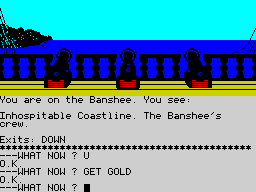
SUPPLIER: Fantasy Software/AI MACHINE: Commodore 64, Spectrum 48k, Amstrad PRICE: £9.95 Written by Mike Woodroffe and Brian Howarth, and based on the Fighting Fantasy series of books by Steve Jackson and Ian Livingstone, this is the first of a new adventure games on the Fighting Fantasy Software label, from Adventure International. AI's Adventure System, using split screen text and in-memory graphics, is now familiar to many adventurers. It was used to create Gremlins and Robin of Sherwood, as well as the UK conversions of Scott Adams' games. It is slick and fast, providing an attractive framework upon which to build an adventure story, and stands up well in this new series. You are the captain of the pirate vessel Banshee, and for a successful voyage you must return 20 treasures to the top of a mountain at the southern end of the Inland Sea. The sea is a seven by thirty grid, and the ship can be sailed by the commands SAIL (direction). You can leave the ship to go pillaging on land - should you sight it! Mind you, on land you may not find the plundering too straightforward, for as well as some typical adventure problems, you are likely to meet some stubborn resistance from natives, ghoulies, and ghosties. Some of these attack, rather to my disappointment, zapped me right out of the game without warning. I suppose I should have known better than to annoy them! During a fight, the program enters a combat mode in which the lower half of the screen depicts two dice and displays and updates the relative skill and stamina of the opponents, giving a commentary on the details of the battle. When on land the adventurer can chicken out and run, by hitting X, but at sea the fight must go on to the bitter end. During the many times I played the game luck was nearly always on my side. I am told there is worse to come, so perhaps it wasn't luck, but intended. However, I have never found computer 'fights' based on random numbers particularly credible, so I looked upon a fight as a somewhat risky way to obtain a treasure or find a hidden exit. Sailing the seas can be interesting, for as well as finding land to explore, there are wrecks to be plundered and respectable ships to be burned and looted, not to mention skirmishes with other ships. But all is not looting, pillaging and plundering - there are some real problems as well! What do the sea Sprites want? What's the best way to defeat a zombie? Aha, and there's 'the traditional red-herring in there somewhere, too' Mike Woodroofe told me! All this combines with excellent graphics to make a very good adventure, easy enough to get into - but it's not so simple to tie things up on the mountain top!
Crash #24Jan 1986 · p.1638/106/107/107/107/107/10
Atmosphere 8/10
Vocabulary 6/10
Logic 7/10
Addictive Quality 7/10
Overall 7/10
Derek Brewster 7/10
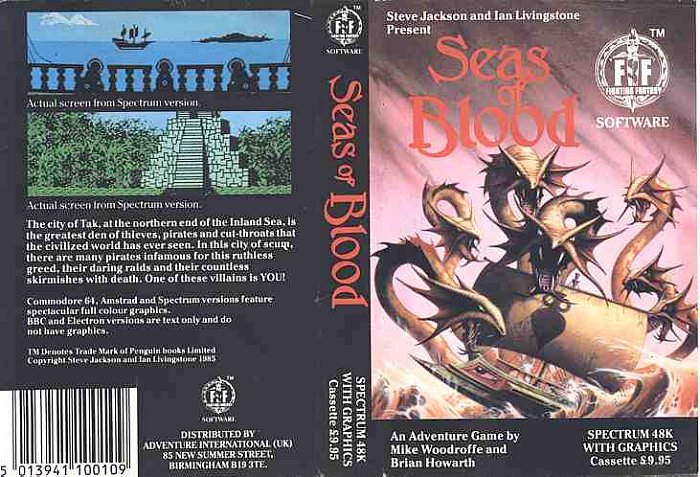
DEREK BREWSTER'S ADVENTURE TRAIL YOUNG AND INNOCENT (DADDY, WHAT WAS THE FUTURE LIKE?) It is always a difficult task summing up a year in home computing. Even more difficult is to try and predict what the coming twelve months might unleash upon us. I say unleash because whatever else might be said about the home games world, it is never dull: the competition is ruthless, and it is peopled by the sort of mathematical genius who is past his mental zenith at the age of twenty-five years, give or take a few million brain cells. The press and media are at a loss to explain why Britain, a rather insignificant and petty nation, should concern itself with such an exciting and blatantly intellectual pastime. After all, isn't this a country in decline, a divided nation where the people who read the lightweight newspapers await an answer to all the problems while the people who read the heavyweights are struggling hopelessly with the economic conundrums of interest rates and exchange rates. Perhaps it's time to start thinking straight and doing things which come rather more easily to nations not so schizophrenic. Buying your own country's goods isn't a bad start. I remember when I was at school, and it wasn't all that long ago, much time in geography lessons would be spent learning about the manufacturing base of the British Isles. In Lancashire they had the cotton industry, in the coalfields of the Midlands and North they had steel, while in the mountains that divided these areas you had hydroelectric power, sheep, and mineral mines. I'd give away a whole shelf-load of silly pencil-top gonks to sit in such a geography lesson now (just how many different breeds of sheep are there)? The House of Lords, by far the most coherent chamber as, despite the participants' ages, they are not honour-bound by political allegiance, stated Britain should look to the new technologies as herein lies the next revolution. Couldn't agree more. And so it would seem to be with the public who went out and bought the Sinclair computers despite much in the press about the unreliability of the machines. Much was made of the lack of sound when everyone knew full well that Sinclair's competitors were caught in the no man's land between beeps and buzzes and the full-bodied melodies of a synthesizer. The truth is the sound on these machines grinds after a short time and the demure bleeps of the Spectrum come as a blessed relief. I read a local paper recently that put forward the reasons behind buying a microcomputer this Christmas. Quite rightly some of the points they raised included amount of software available, price, and whether little Johnny's friends had the micro. It was curious to find the article extolling the BBC computer over the Spectrum. Let me put this as bluntly as I can. The Spectrum microcomputer is a brilliant device both for learning BASIC etc, and for playing games. I own, or have owned, an Atari, a BBC, an Amstrad, and a C64 and all have some major flaw in design, screen layout, add-on capability or available memory. What is more, the Spectrum was quite merrily computing away long before the others and so has a quantity and breadth (and availability) of software which leaves the others looking nice in the shops. As for the QL, yes, the microdrives are unreliable, but we live in times where rapidly-developing technology must be offered at an affordable price, and who would begrudge Clive Sinclair when NASA's budgetry constraints had DIY men throughout the world laughing at some tiles which just wouldn't stick. And it's no use laughing at the C5 while you pollute the atmosphere in your heap of rusting junk whose technology has changed little since its inception. Arthur C Clarke's (and Daddy's) visions of the future, with the printless world, gigantic space colonies, and the kind of mentality that goes with them, may not ever be quite as anticipated, but there is no need for the cynical technofear as displayed in such media mishmashes as Tomorrow's World and Micro Live. I suggest the first person who had the ludicrous idea of making technology more palatable in this dreadful manner go and write some techno-fear soap operas and leave the task to someone who is prepared to deal with the facts sensibly and reliably. Admittedly, this would remove any chance of political tampering with the facts, but it is a political reality that the new technologies are coming whether we like it or not. Any nation which actually gets to grips with the technology as opposed to the 'subject for discussion' will reap the undoubted rewards. 1985 was notable for the demise of MSX. MSX was a good idea, making a range of machines between which software was fully compatible. The only problem was, there was already a great deal of compatibility between the Spectrums that everyone was buying in droves. The Spectrum has, and will, last longer than either myself or other commentators thought possible. This year was notable for the escalation in the tie-in battles with major film titles such as Gremlins, Rambo, View to a Kill and Never Ending Story gracing the computer store shelves. The advantage to these deals is the recognition a product gets through the public's familiarity with the concept and storyline. TV tie ins can be even more effective in terms of public awareness of the product. These thoughts lead me on to an area which, to me, has really made itself plain over the last year. The perceivable age of the home games playing market seems to have dropped steadily down through the teens to the point where anything beyond a platform game is seriously questioned in terms of its likely viability in the market place. There's nothing inherently wrong or worrying about the spectre of a carry-cot Spectrum attachment with that all important fire button within reach of tiny hands, it's just that one shudders to think what popular music there would be right now if it wasn't for the older listeners pulling the whole standard of music up by its bootstraps. It is my guess that if the reading age of Sounds and NME fell by a few years those who, on paper, would benefit by such a fall would loose interest in the whole ostensibly uplifting exercise. And all this brings me back to adventuring (believe it or not). The demise of the intelligent, text-only, adventure epitomised by Level 9's Snowball, and mourned in SIGNPOST, is a part of this lowering of the intellectually exacting nature of computer games. In a nutshell, programs have become simpler. Utilities such as the Quill and Illustrator will continue to figure prominently in adventuring, and it doesn't take much of a jump to realise that they will be more important in all games' design in the near future. In America the computer games market is older because the machines Americans own are larger and more expensive, and more useful to the whole household. In Britain home computers are toys. It remains to be seen whether the market is going for the gutter or searching for the stars. SEAS OF BLOOD Producer: Fighting Fantasy Price: £9.95 Language: Machine code Author: Mike Woodroffe & Brian Howarth Seas of Blood is a game fashioned by big names from both the Fantasy Game and Adventure worlds. From the role-playing, Fighting Fantasy book corner come Steve Jackson and Ian Livingstone, who wrote the book of the same name. From the Adventure corner we have Mike Woodroffe and Brian Howarth who are the names behind Adventure International's impressive Robin of Sherwood. Put them together and you could get something which might knock the spots off the opposition, or you might end up with something just that bit smaller than either of these two giants. Read on to find out which is true... Seas of Blood has been specifically written to encompass both the playability of the fighting fantasy combat system and the problem solving of the adventure world. The game features over 300 locations, all with graphics, together with an animated dice sequence that represents the fighting fantasy combat system. The city of Tak, at the northern end of the Inland Sea, is the greatest den of thieves, pirates and cut-throats the civilised world has ever seen. In this city of scum there are many pirates infamous for their ruthless greed, daring raids and countless skirmishes with death. One of these scoundrels is you, the captain of the pirate vessel Banshee. Together with your band of seasoned cut-throats you search for treasure around the Inland Sea which is the vehicle of much of your exploration. To be a successful pirate you should locate and retrieve 20 treasures and take them to the top of the mountain on Nippur at the southern end of the Inland Sea. Movement around this sea is achieved with the use of commands like SAIL NORTH. Leaving and boarding the ship is achieved with SWIM white at sea, with GO ASHORE when adjacent to land, and GO BOAT when by another vessel. BOARD BENSHEE takes you back onto your own vessel. This is one of those adventures where you could either say'I've seen all this before' or 'this really has got a number of new features'. The curious thing is neither of these statements is incorrect it's just that the overriding feeling is more in line with the 'I've seen it all before' argument. Yes folks this is yet another Brian Howarth implementation of a big idea. The reason I take this tone is not because it is necessarily a bad thing when a programmer takes on many such projects. No, not at all, it is only a bad thing when that programmer keeps churning out the same string of programming faults so painstakingly picked over in this very column time and time again. When a programmer stands still its bad news in an industry which never will. A glaring white background is bad enough (especially on a colour set which often needs resetting just to play the one inconsiderate game after all, how often do TV broadcasts choose white as a background colour: send your answers to Adventure International) but when it is constantly removed and flashed up again as in this game it becomes irritating in the extreme. Whenever something is picked up or dropped, or the ship you captain is moved along, the whole screen is taken away and placed back up again. It is particularly strange when you choose to sail in a direction which is not permissible and the screen does its ridiculous flash routine. On the new features front the game can offer one or two surprises. The best of these is the combat routine. This ties in with a status page that can be called up along with the inventory by pressing the letter I. On this page are you and your crew's vital statistics: Log, Provisions, Skill, Stamina, Crew Strike and Crew Strength. The number of days you have spent on the voyage are recorded under Log while Provisions generally decrease accordingly as one provision can maintain a ship for one day at sea. Provisions are not used on shore and food can be found under various guises as you go on your pirating way. Skill is your personal skill as a fighter and you will probably want to compare it to that of your opponent in any hand-to-hand combat. Its value is important as during combat its figure is added to the random figure which is the sum of the values shown on the two faces of dice which spin and stop before you, Your opponent's dice are stopped from spinning by the computer, while your dice spin until you chance your arm. The spin of the dice is shown by very quickly changing figures as well as dice faces. These figures are in random sequences. Stamina will generally decrease as you are wounded during a battle but hopefully not as quickly as your opponent's who is seen off once his Stamina reaches zero. Crew Strike and Crew Strength are of greatest interest during ship-to-ship conflict where Strike represents the attacking power of your crew while aboard the Banshee, and Crew Strength shows how the shipmates are holding up to the onslaught of the battle. Seas of Blood is a very entertaining game but will not automatically attract those adventurers, both experienced and novice, who delighted in the sheer slickness of Robin of Sherwood. One obvious reason might be the lack of the kind of stunning graphics found in Touchstones of Rhiannon as the skills of the artist Teoman Irmak were not available for this game. Another might be the less than friendly vocabulary, or the lack of the GET EVERYTHING and AGAIN commands which bring a touch of class to adventure games (the A for AGAIN command would have been very useful when sailing repeatedly in the same direction). The problem is, Adventure International have set themselves very high standards to maintain and we reviewers are easily disgruntled. The plusses, like the combat system, are welcome additions - it's just the minuses begin to jar a little in this one. COMMENTS Difficulty: difficult to get into but then easier Graphics: good Presentation: white glares on colour TV (still) Input facility: verb/noun Response: reasonable
Your Sinclair #1Jan 1986 · p.86
Mike Gerrard
Adventure International £9.95 Reviewer: Mike Gerrard Yessir! Seas Of Blood is just the sort of thing a depraved, bloodthirsty cavalier like myself is looking for! When you get this one slotted into your tape deck, the first thing that comes up on the screen is 'found blood!' More! Give us more! And more you'll certainly get. Forget the goody-goody nonsense, and get stuck into this meganumber from Messrs Livingston and Jackson of Fighting Fantasy book fame. You take the part of a vile, blood-spilling pirate who has nothing better to do than sail the Inland Sea getting into scrapes and pinching other people's riches. You start off on board your good ship the Banshee with your evil smelling crew. You must 'Sail North' for 'South', or wherever the fancy takes you) until you come across a port or another ship. You'll have more fun meeting a ship, though, 'cos it's tally ho and into the fray! The combat routines are great fun and quite similar to those used in the original books. Whenever you encounter the enemy, two sets of die (one for you and one for the opposition) start spinning on the screen to determine the outcome. After a few throws one or other of you will end up as food for the sharks! When you come across a port, you can 'Go ashore' or 'Go (name of port)' and engage the natives in a battle of the die, or should that be a battle to the death? At the start of the game most of them give up without much of a struggle, but later on you'll find they're very unwilling to give up their gold! As far as the pics and descriptions are concerned, this game's pretty standard Adventure International fare. It's programmed by Gremlin's Mike Woodroffe and Brian Howarth and looks very similar to their earlier creations - Robin Of Sherwood in particular. Remember how you found your way around Sherwood Forest by keeping a close eye on the display? Well, you can do the same thing here, should you find yourself lost in the inevitable jungle. The trouble with this game though, is that it ignores everything it doesn't understand - that wouldn't be too bad, but it also ignores some things that it does understand! For example, if you type 'Wear helmet' (and you haven't picked it up), the program replies 'You can't do that yet', so you 'Get helmet' and then find that 'Wear helmet' is ignored! if you check the inventory you'll find you're actually wearing it. This is a real bloodthirsty megaromp that no pirate should be without. The blurb claims 300 graphic locations but a lot of these are just stretches of empty ocean. By the way - you certainly ain't gonna find it easy to map. Stick to the shore till you've found your way about. Stick to this game me hearties and you'll have a ho, ho, ho and a bundle of fun.
Your Computer #1Jan 1986 · p.95
Hugo North
Various £9.95 Adventure International The Fighting Fantasy (FF) gamebooks of Steve Jackson and Ian Livingstone have been a huge success. Two of these books were later used as the bases for computer games. The first adaptation, Warlock of Firetop Mountain, was very disappointing, being an arcade game with little connection with the book. The second, The Forest of Doom, and released by Penguin books themselves, was excellent. This was virtually a straight conversion of the book's contents and in my opinion deserved far greater success than it actually achieved. Now comes a third adaptation, Seas of Blood, from Mike Woodroffe and Brain Howarth whose earlier Gremlins and Robin of Sherwood have proved very popular. The game is in the usual text and graphics style of Adventure international, plenty of attractive pictures, locations (over 300) and puzzles. A new element is the addition of a combat system, capturing more of the flavour of the book. This involves attributing various aspects - strength, stamina, etc - to you and your opponent and determining the outcome of combat by throwing dice. The plot concerns Tak, a city chock-a-bloc with cut-throats, thieves, pirates and assorted dregs.
Sinclair User #46Jan 1986 · p.764/54/5
Overall 4/5
Richard Price 4/5
RICHARD PRICE SEARCHES FOR A GENUINE HERO... In the pages of a dusty book. Judging by some of the mail I get, it seems that many adventurers think that game reviewers possess some form of magical amulet to help them solve any and every adventure without so much as a drop of perspiration. Not so. Like everyone else I've wasted hours, sometimes days, locked in cells, stuck in wells or straddled across some vertiginous chasm waiting for the stroke of genius that will get me home safe with the treasure, or the breathtakingly lovely princess. Verily the sweat has poured forth on those occasions. There's quite a lot of help around if you investigate. Naturally, you will first write to the Fat One at the Ogre. His Vastness' drinking habits put him in touch with many rumours and tips. Companies are surprisingly helpful and many provide help sheets - but remember, they won't give complete solutions. Level 9, Artic, Incentive, Adventure International and many others give help, though some may charge for booklets which list problems in more than one of their games. Modem users can access the accumulated knowledge of many dedicated players on Prestel Clubspot 810. There are pages giving hints on specific games and a large section for those seeking help. I've also been sent a mailshot from the Adventurers Club - [redacted]. They offer help, newsletters, discounted games and a telephone helpline. The subscription fee is £10.95 for those living in the UK. So, to business. Movie spin-offs are big business these days and it's often difficult for programmers to produce games of a film or TV series without causing pain to those punters who've already formed a clear view of the fantasy or storyline. Disappointed players of The Tripods game will know what I mean. SEAS OF BLOOD Publisher: Adventure International Price: £9.95 Memory: 48K Everyone who enjoys Steve Jackson's and Ian Livingstone's fighting fantasy adventure books will be glad to see Seas of Blood from Adventure International. The game, in Adventure International's regular style, is based on one of the duo's plots and casts you as a pirate captain. With your villainous crew and trusty ship Banshee you set sail from Tak, den of cut-throats and thieves, to plunder the Inland Sea. You can pilot your ship around those landlocked waters and attack the trading vessels that ply between ports like Assur, Lagash and Calah. When you reach a port you can go ashore and explore the mysterious lands outside the towns. There you'll find ancient dead cities, tombs and catacombs, oases and hapless caravans loaded with plunder and provisions all for the taking. Your final aim is to collect 20 treasures and take them to the top of the great mountain in Nippur at the southern end of the inland Sea. The Jackson-Livingstone format is well implemented by the use of text, graphics and combat routines which allow you to fight both ships and the men and monsters you will encounter on the land. The movement and messages are handled as in a normal text adventure with different instructions for land or sea journeys. When aboard you must always use 'Sail' followed by the direction - written in full. When ashore you can use the normal N,S,E,W abbreviations. As in the books, combat is decided by simulated dice throws added to your stamina figure - which may well decrease if you are repeatedly wounded or hit. Your crew must be kept provisioned if they are not to mutiny so you have the added task of searching out victuals to keep them sweet. All that gives a variety of game tasks which help to keep the pace up. You cannot afford to be complacent or idle if you want to survive this violent world. The graphics are well up to the company's usual standard, being fast and colourful. The interpreter is friendly and informative though the descriptions are not big - with detailed graphics for almost every location that doesn't seem to be a problem. Remember that you can board some of the vessels you attack - the stately Barge is quite important from that point of view - and generally you can only go ashore at ports. It is wise too to keep a weather eye on your status screen to check out your provisions and crew strength. You may have to hire crew when too many have been killed, though I never got that far. The variables make for an action- packed adventure which keeps you on your toes and the programming quality is just as good as the company's other games. Recommended for swashbucklers and armchair Long John Silvers.
Tips6
- C&VG (Computer & Video Games) #66Apr 1987 · p.64
- Crash #36Jan 1987 · p.154
- Your Sinclair #11Nov 1986 · p.69
- Popular Computing Weekly #28Jul 1986 · p.20
- Sinclair User #51Jun 1986 · p.58
- C&VG (Computer & Video Games) #55May 1986 · p.71
Advert4
- Crash #24Jan 1986 · p.167
- Crash #23Dec 1985 · p.116
- Your Computer #11Nov 1985 · p.125
- Crash #22Nov 1985 · p.130
News/Note3
- Crash #23Dec 1985 · p.17
- C&VG (Computer & Video Games) #49Nov 1985 · p.9
- Home Computing Weekly #130Sep 1985 · p.8
Solution2
- MicroHobby #207Feb 1991 · p.60
- MicroHobby #185Feb 1989 · p.56
Review2
- Computer Gamer #10Jan 1986 · p.42
- MicroHobby #63Jan 1986 · p.14
Licensed from
- Seas of BloodBookIan Livingstone [1], Steve Jackson
Related
- Ports
- (Amstrad CPC), (Commodore 64), (Commodore Plus/4)
- Elsewhere
- CASAMobyGamesRZX ArchiveThe TipshopUVLRZX Archive - YouTubeSpectrum Computing RZX - YouTube
- Same entry at
- Spectrum ComputingZXInfo
Reviews from people here
Sign in to write about this, or make an account. It takes a minute and lets you correct the catalogue too.
No description recorded.
Sign in to correct or add to this.
Hold the rights to this and want it taken down?