
Sherlock
Adventure Game: Text/Illustrated · ZX-Spectrum 48K · 1 players · English
Melbourne House · Sep 1984 · Pound sterling 14.95
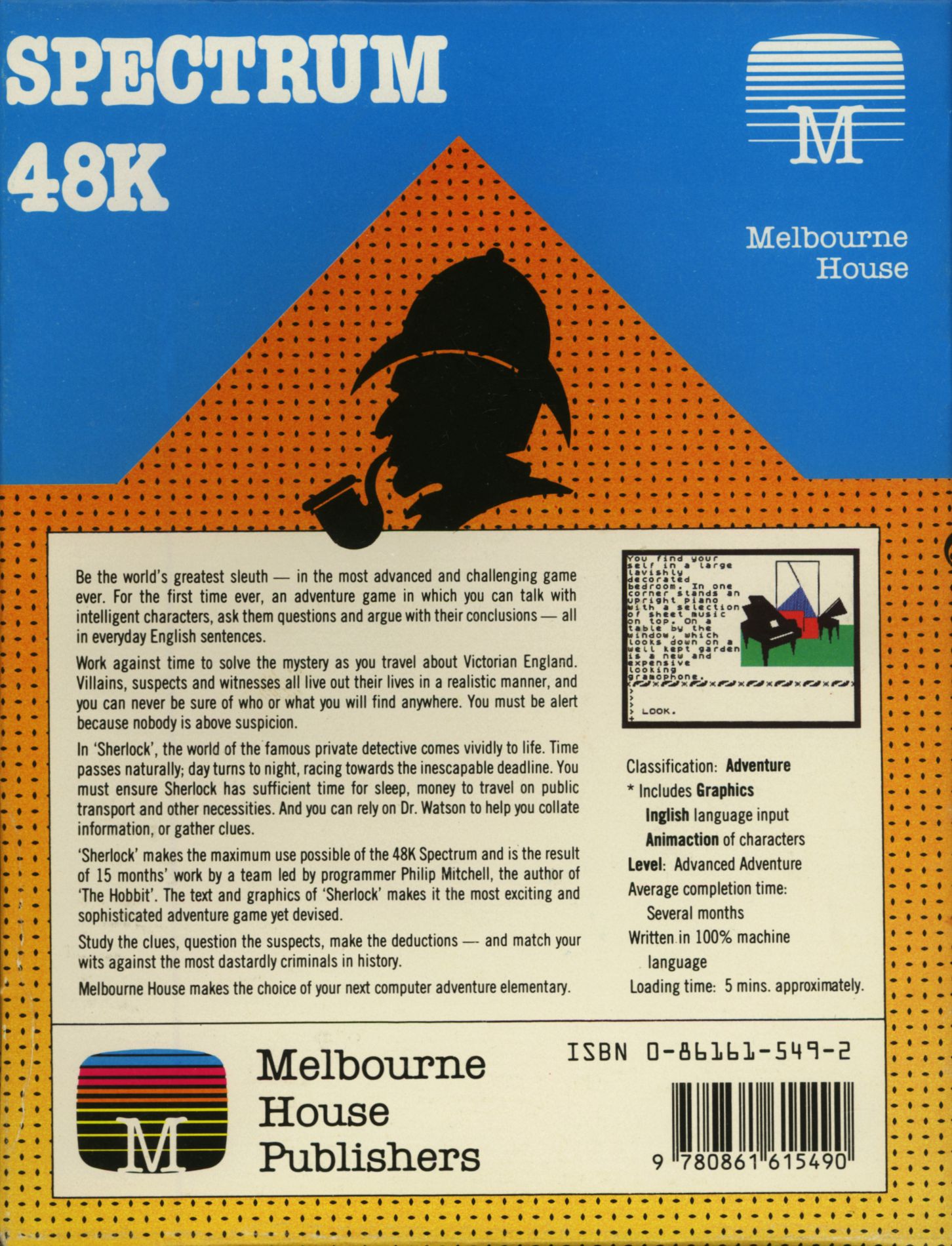
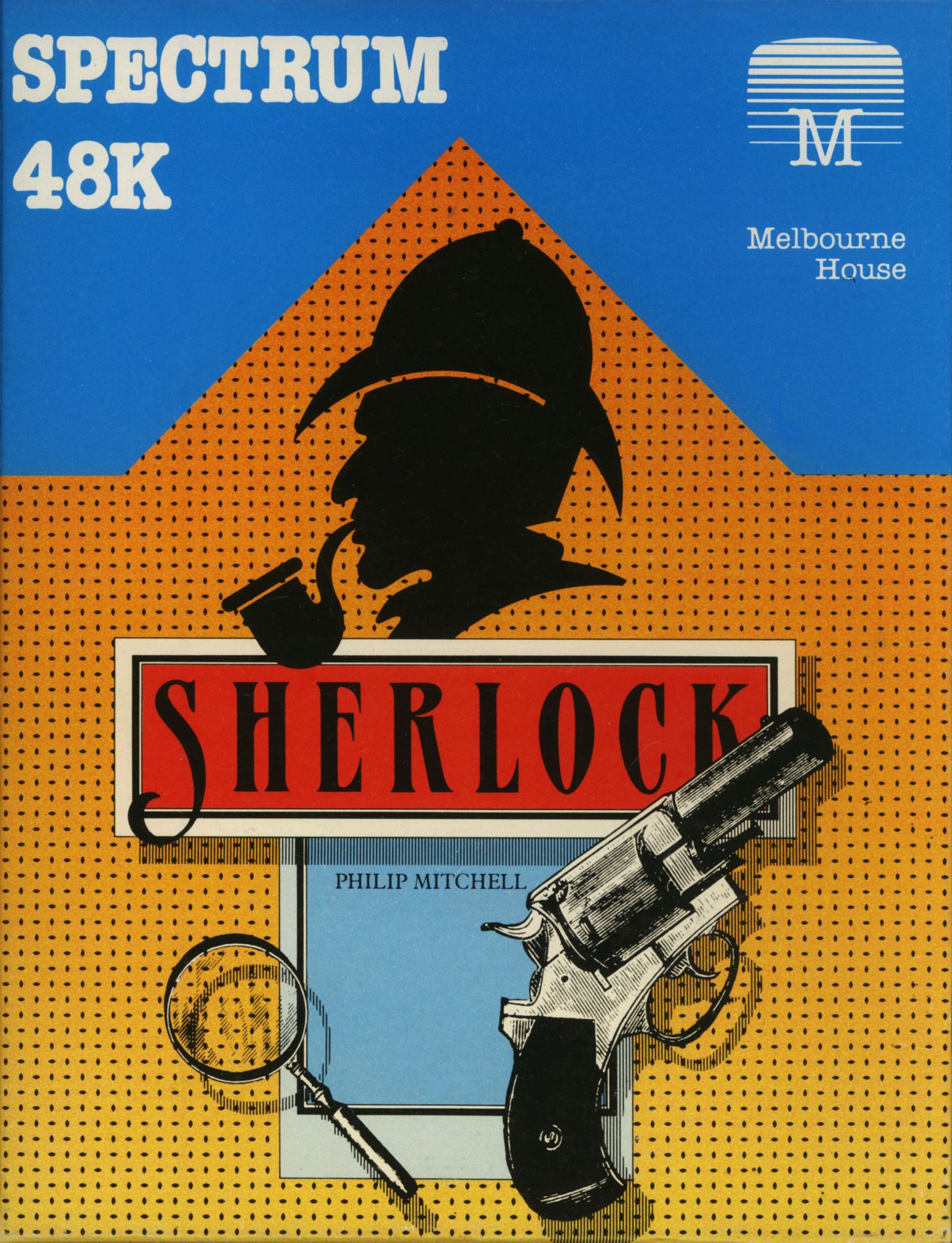
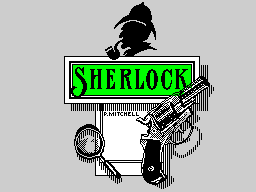
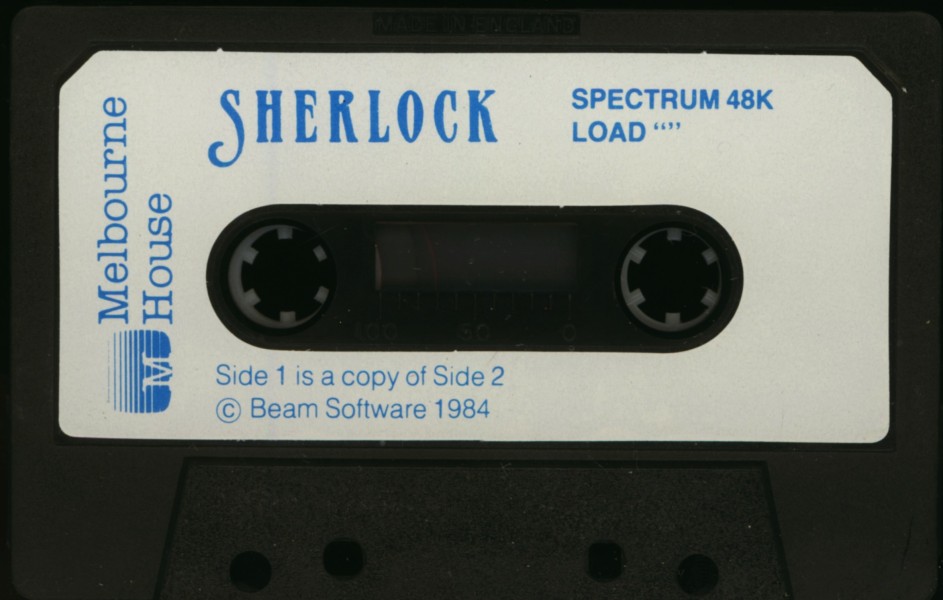
Discussion
Nobody has started a thread about this yet.
Awards
Rank #24 - 1984 Sinclair User Top 50 Spectrum Software Classics
Publication
Melbourne House published a revised version of this game called v2.0. According to "Changes to Sherlock" sheet, the main change is the WAIT UNTIL command, that can be now interrupted by the user.
Play
- sherlock.rzxRZX playback file
- Sherlock.tzx.zipTape image English33 KB
- SherlockV2.0.tzx.zipTape image English33 KB
- SherlockV2.0.tap.zipTape image English40 KB
Documents
- Sherlock_HintSheet.pdfInstructions English129 KB
- Sherlock(EN).pdfInstructions English2,494 KB
- Sherlock.txtInstructions English36 KB
- Sherlock_WhereToBeginGuide.zipScanned instructions English326 KB
Files and rights
No permission is on record either way. Screens and pictures are copied here on a take-down basis: if you hold the rights and want something removed, say so and it goes.
Credits
- Philip Mitchellcredited
- Lynda WarnerInlay/Poster Art
Sign in to credit somebody, or say what these people did.
Awards
Scores
In the magazines
- Sinclair User #311984 · Gilbert Factor9/10
- Crash #91984 · Overall Value8/10
- Personal Computer Games #121984 · Overall9/10
- Personal Computer News #841984 · Overall10/10
- Sinclair User1985 · Gilbert Factor9/10
Elsewhere on the web
- WorldOfSpectrum 62 votes8.44
Awards and competitions
Big K - Readers Poll 1984
- 3Adventure Game of the Year
C&VG Top Ten 1984
Crash Readers Awards 1984
- 2Best Text/Graphical Adventure
In the magazines 144
ACE (Advanced Computer Entertainment) #12Sep 1988 · p.79
ACE (Advanced Computer Entertainment)
C64/128, £14.95cs Spectrum, £14.95cs A rather older game is Sherlock from Melbourne House. When first released this adventure, with its real-time puzzles and strong detective element, was way ahead of its time. It still plays well and offers considerable challenge as you attempt to solve a murder mystery, catch trains, and find your way about a murky, misty London town. Only available on C64 and Spectrum, however.
Sinclair User1985 · p.499/109/10
Gilbert Factor 9/10
John Gilbert 9/10
SOFTWARE SCENE While some software houses are taking the Spectrum to its limits and beyond others doggedly continue to churn out ever more diabolical pieces of programmed junk. John Gilbert present a personal pick of the bunch, and Chris Bourne take an irreverent look at the dwindling ZX-81 software scene. Their talents are combinedd in listing the Top Ten Turkeys of 1984. Let the reader be warned. SPECTRUM SOFTWARE A cynic may argue that development within the software market in 1984 was non-existent. The same type of game appeared as those which took the lead in 1983, the most popular being of the arcade variety. The programs were written in the same style and to please the same type of customers. That is only a superficial view, however, and if you look at the games market as a whole, dividing it up into sectors such as strategy, arcade and adventure, you will see that substantial and sophisticated changes have taken place. Despite what some pundits have said you will find that the world of computer games is still buzzing with life. SHERLOCK £14.95 Melbourne House Text-only adventures were not forgotten by software companies during the year in which Level 9 Computing converted its classic adventures to run on the Spectrum and produced one of its best programs, Lords of Time, which won several rave reviews. The successor to the Melbourne House classic The Hobbit was released in September. Sherlock uses a format similar to The Hobbit though only few locations are shown graphically. The game casts you in the role of the famous detective and with your faithful and infuriating side-kick Dr Watson, you must solve a series of mysteries in order to crack a murder case. Characters within the adventure can be questioned, the evidence is there if you can find it and the atmosphere of Conan Doyle's Victorian world can be felt from the moment the game was loaded. It is bound to become as great a classic as The Hobbit which, incidentally, was written by the same team of programmers.
Your Spectrum #9Nov 1984 · p.29
Clive Gifford
Gary Smart
Neil Mackintosh
Peter Shaw
SPECTRUM ADVENTURES Welcome to our regular adventure page. The cast of contributors includes Clive Gifford, author of Adventures For Your Spectrum, Gary Smart and Neil Mackintosh who are all avid adventure fanatics. The Green Goblin is our own Peter Shaw, author of Creating Adventures on Your ZX Spectrum. SHERLOCK Sherlock the so-called sequel to The Hobbit is with us at last. I say 'so-called' because in actual content there's little resemblance between Middle Earth fantasy of The Hobbit and the Victorian setting of Sherlock. Again, Sherlock is an adventure which has yet to be beaten. It's based (of course) around the famous series of books and follows the detail of the Sherlock Holmes mystery stories quite accurately. The Melbourne House team, headed by Hobbit programmer Phillip Mitchell, has made a good use of detail and the overall effect is most realistic. From taking a Hansom cab or train from Baker Street (Sherlock Holmes never walked unless he had to), to paying for everything in pounds, shillings and pence, one's taken realistically back to the Victorian streets and submerged in a really impressive adventure setting. Presumably sheer size and realism have taken their toll of available memory, so the result is simpler than The Hobbit, though not by much. Sherlock also boasts Animtalk and Inglish. Animtalk is a development that allows the player to converse and instruct the other characters in the adventure - including the amiable Watson, the baffled Inspector Lestrade and a host of 'nasties' (from the humblest housebreaker to... no, that would be telling.) Inglish is a more significant development. It allows you to talk to the characters and control Holmes in a language that's far closer to plain English than has previously been achieved with Spectrum adventures. A sentence like 'pick up the note and take the lamp out of the house', or 'open the window quietly with the large stick' will be happily accepted and acted upon by the computer. Is Sherlock as good as The Hobbit? I'd say yes and possibly (though further playing would reinforce this) even a little better.
Sherlock - an elementary program from Melbourne House - looks set to top The Hobbit!
Sinclair Programs #25Nov 1984 · p.30
June Mortimer
AS THE CHRISTMAS SOFTWARE GOES ON SALE SPECTRUM OWNERS ARE SPOILED FOR CHOICE. Melbourne House have done it again. Their new adventure game, Sherlock, is as exciting, as intriguing, and as puzzling as The Hobbit. The game begins at Baker Street, with Sherlock Holmes and Watson sitting in armchairs. Somewhere there is a mystery to be solved, but what that mystery is, and where the clues can be found must be discovered by the player. Like Thorin in The Hobbit, Watson can prove to be a help, a hindrance or just plain annoying. You can discuss matters with him, but his response of "Brilliant" to simple statements of Holmes is an uncritical response and of little help. It is also possible to talk to many other characters in the game. Without talking to a cab driver you will never be able to leave Baker Street, and without questioning the witnesses in detail you have little hope of solving the crime. Timing is of vital importance in this game. It is not possible to just sit down and wait for things to happen. The clock on the screen shows the passing of time, which passes at the same speed whether you are travelling, sleeping or working. While you remain still the other characters are moving quickly. Watson has patients to visit, Lestrade of Scotland Yard has work to do. Even more importantly, the police cannot be expected to leave murdered bodies lying in the garden indefinitely, and may tidy them away before you arrive on the scene of the crime. Also, it must be remembered that Sherlock Holmes is not part of the establishment, and nobody is prepared to wait for him to solve the crimes. As soon as Lestrade feels he has solved the crimes satisfactorily the game will end, no matter how much of the game you have completed. An infuriating aspect of many adventures is that you occasionally know exactly what you want to do, but cannot find the correct words with which to convince the computer of your intentions. Melbourne House have overcome this problem. After all, detectives often know what they want to discover, but have to find exactly the right questions to ask suspects or witnesses. It is possible to feel that your problems are due not to your computer's stupidity but to your inept questioning and the criminal's skill. Sherlock is produced for the 48K Spectrum by Melbourne House, [redacted] and costs £14.95.
Micro Adventurer #13Nov 1984 · p.21
John Fraser
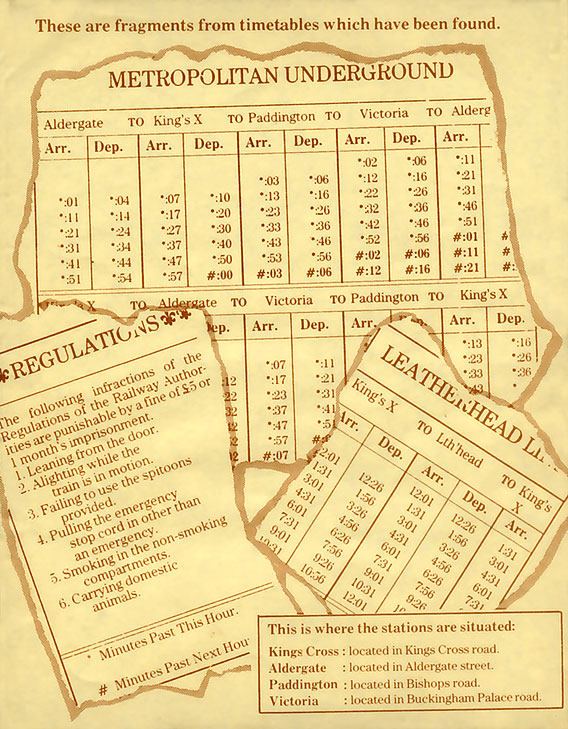
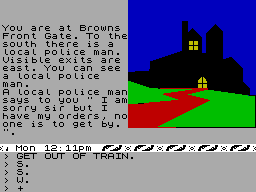
A SEVEN PERCENT SOLUTION? John Fraser gets on the track of the world's greatest detective. Melbourne House has acquired a formidable reputation as the publisher of some of the most innovative adventures around. Now, after 15 months work, Philip Mitchell and his team have finally completed their most ambitious game yet, a graphic adventure which recreates the world of fiction's most famous detective, Sherlock Holmes. Sherlock utilises much the same techniques that made The Hobbit such a success: real-time action, interactive characters and a vocabulary so large that one can communicate with them in ordinary English sentences. As if that wasn't enough, it's also possible to discuss matters with the characters and even argue with their conclusions. The object of the game is to solve a number of murders and this involves visiting the scenes of the crimes, interrogating suspects and generally doing everything that Holmes himself would have done. This is far from easy, so you'll need to familiarise yourself with the instruction booklet which is a mine of information on just about everything from the Inglish language to London Transport. There is also a sheet depicting fragments of train timetables which, as you will soon discover, is particularly useful. At the start of the game a full screen of text describes your Baker Street lodgings in detail. Holmes (that's you) and Watson are sitting there one Monday morning when Watson reads a report of a murder in the Daily Chronicle. In fact two murders have been committed, both apparently with the same weapon but in separate incidents, and Inspector Lestrade is to go to the scene that morning. Extracting this information out of Watson can be difficult and he delights in making sarcastic comments such as: "This is brilliant Holmes. I don't know how you do it." The first time I played, I got fed up with him and went off on my own. I returned later to see whether he had changed his mind but found a note saying he had gone to see his patients and wasn't available. Another time he stubbornly refused to join me at all and the screen filled with: Watson remarks, "Sorry, I cannot do that now." When Watson did finally decide to follow me I was faced with having to use London Transport. In keeping with Holmes' lazy character, I travelled either by train or hansom cab. Sometimes the cabbie appeared to be deaf and kept asking me where I wanted to go, even when I told him. Then if I didn't pay the correct fare he would become exceedingly agitated. If I didn't pay at all he would hurl abuse but take no further action. At the other extreme you do get change when you pay too much. I was also constantly missing trains; they seemed to arrive and depart without allowing me to get on. Eventually when I did manage to get on one, I realised I had no idea where I was going. It later transpired that I had been standing on the wrong platform. Still, I suppose I shouldn't really complain as the trains appear to be free. As in The Hobbit events proceed in real-time. A real-time clock is displayed throughout the game and you can even instruct the computer to wait until a specific time. This has the effect of speeding time up but does not prevent the other characters going about their business. As in real life, day turns to night or I supposed to, though I have found myself riding along in a cab at midnight with the sun shining on my face. While it's not too difficult to find you way to the scene of the crime it is possible to lose Inspector Lestrade just as you can lose Thorin in The Hobbit. More than once I ended up wandering aimlessly along winding paths or being shot by one of the suspects as I went on my way. The Inglish language first made its appearance in The Hobbit and in Sherlock, the vocabulary is around 800 words, which enables some quite complex sentences to be used, as long as you observe a few simple rules. As Sherlock features 'animtalk' you can tell the other characters what you would like them to do, although since they remain independent they won't necessarily cooperate. The 'say to' format is used, though you only have to type in 'say to' once at the start of a conversation as opposed to repeating the phrase each time as in The Hobbit. You can ask anyone about anything using the command, 'Tell me about...' For example: Say to Watson, "Tell me about the pistol." Unlike The Hobbit there is no Help facility, so you have to depend entirely on your own initiative to solve the case. However, there is a Print command which sends the contents of the adventure window to the printer and this is useful as it enables you to record your progress and go over events at your leisure. The screen presentation is excellent. The graphics appear in a small window to the right, while the text scrolls alongside. At the bottom of the screen is the communications window where you type in your instructions and this scrolls independently. Sherlock's graphics were created by Russell Comte of Mugsy fame but are less detailed. Nevertheless, they are quite adequate. With a little more crash-proofing Sherlock should appeal to the most discerning adventurer. If its success is anything like that of The Hobbit (and there is every reason to believe it will be) we can no doubt expect the inevitable flood of articles and help columns devoted to assisting budding Holmes. Sophisticated, rich in atmosphere and amazingly detailed, Sherlock is a game which no Spectrum owner will want to be without. Not only do the characters react to your inputs but they also react to the behaviour of others, which means that the problems are slightly different each time you play the game. If you're looking for something different from the usual fantasy or space adventures then why not try your hand at Sherlock. I suspect even Holmes himself would have difficulty solving this one.
C&VG (Computer & Video Games) #37Nov 1984 · p.134
Keith Campbell
NOT SO ELEMENTARY! My copy of Sherlock arrived before the instruction booklet was ready and I found it frustratingly difficult to do anything worthwhile. After spending more than two hours before I succeeded in leaving the first room, I found I could not progress much further without consulting Melbourne House. The problem was not what to do, but how to phrase it. Sherlock, like its predecessor The Hobbit, features Inglish - MH's name its multi-word input implementation. Unfortunately, Inglish is not like what English is spoke! When the instruction booklet finally arrived, it was very clear about the language required, and anyone about to embark upon Sherlock should read booklet very carefully before commencing the game. Even then, they will not discover how to exit the first room - OPEN MY DOOR or OPEN YOUR DOOR will do the trick, but not OPEN DOOR, OPEN THE DOOR, or OPEN SITTING ROOM DOOR. There are other glaring inadequacies in Inglish. For example, in a room with two armchairs, SIT DOWN gives "I do not know the verb DOWN SIT", and GET UP is similarly converted to UP GET. OK - that's the tortuous input covered, what about the output? There's little doubt in my mind that the dreaded Hobbit-bug will soon be a thing of the past! The trend will be towards the more advanced, state-of-the-art Sherlock-bugs! There is a phrase or two that will set the cabbie off in a complete circle around London for a couple of hours, constantly repeating the phrase "Well, are we goin' anywhere guv'nor?" There are also some blindness bugs, as in the kitchen which, if you try to examine, elicits the response "I see no kitchen". Sherlock even has a half-letter-delete bug. When this appears, you should abandon the command and enter it again in full. These frustrating features spoil an otherwise excellent mystery Adventure. Although its opening sequences strongly remind me of The Curse of Crowley Manor, what follows is quite different. If you do the right things, you will learn that a double murder has been committed and you, as Sherlock, must solve it. The murder hunt takes you out of town into the sticks and this is where, by taking action appropriate to a super-sleuth, you can come by much useful information. Lestrade will allow you to witness his scene-of-the-crime activities and you can listen in on his cross-examination of the suspects. But of course, being Holmes, you will no doubt decide to wander off the straight and narrow and carry out a more detailed investigation of your own! On screen, the game performs well when it fails to crash or be obtuse. A split screen is arranged so that conversation scrolls below a band displaying the time. The narrative is to the left of the graphics (if any, for not all locations have a picture) and these scroll above the band. The graphics are speedy, but nondesript to the point of being superfluous. Far better to have dispensed with them altogether and made the program more intelligent. The interesting thing is the display of the time in the separating band and this puts the game almost in a class of its own (not quite, though, for it has been done before - notably in Pettigrew's Diary.) The game commences at 08.00 am and, should you decide you have a train to catch, you'll need to make sure you're at the station before it leaves! If you fail to move fast enough, then time will tick away and Lestrade will catch it without you, leaving you high and dry! I get the feeling that Melbourne House, with Sherlock, is trying to do an Infocom without requiring the use of a disc system. Infocom games have full sentence input, using a system called Interlogic and it works well. Inglish doesn't quite make it. My overall impression of Sherlock is of an intriguing and absorbing game written for the wrong machine by someone who doesn't speak the vernacular. A game featuring Sherlock Holmes and Dr Watson should a least recognise and preferably understand the word ELEMENTARY. Otherwise, there is just no answer Watson's occasional admiring words: "That is brilliant, Holmes!" Sherlock Holmes is 48k Spectrum from Melbourne House, priced £14.95.
Personal Computer Games #12Nov 1984 · p.113PCG Hit9/1010/108/109/109/10
Personal Computer GamesPCG Hit
Atmosphere 9/10
Complexity 10/10
Interaction 8/10
Overall 9/10
Martyn Smith
Richard Boniface
Steve Cooke 9/10
SHERLOCK IS HERE! The White Wizard was rudely awoken the other morning by an ill-mannered dwarf clutching a small parcel, which contained - No! It cannot be! It is! The legendary Sherlock from Melbourne House has finally arrived. Drop wand, grab Spectrum, and here we go... You are in your sitting room. There is no graphic display because, to tell the truth, there aren't many graphics in the game - just the occasional 'illustration'. Watson is sitting in his armchair. You attempt to follow Watson's example, but the program tells you that it can't see a chair for you to sit in. You enter 'armchair', your entry is accepted, and you settle down bra nap. At this point, Watson usually pipes up with a story from the paper he's reading. It appears that a couple of ladies in Leatherhead have been rubbed out by a mysterious villain and the police are baffled. Sherlock Holmes to the rescue! Yes, it looks as if Melbourne House have done it again. Sherlock is an excellent adventure, bursting with atmosphere, challenge, and inventiveness. It's extremely difficult to solve, but the joy of it is that there is enough scope within the game for the player to enjoy failing in his quest almost as much as succeeding. Take getting to Leatherhead for example. To reach your destination you'll have to first get a cab, then a train - and make sure it's the right one! Otherwise you could end up at Aldersgate, Victoria, or even Paddington. And of course, you'll have to have enough money to pay your fare. What's more, everything in the game, including travelling, takes just as long to do as it would in real life - and in the case of travelling to Leatherhead that's quite a time, believe me. You can however speed up the passage of time by typing WAIT or WAIT UNTIL followed by a particular time. Because Sherlock is so complex, it takes some time to get used to. This is particularly the case with minor actions, like getting in and out of trains for example. The program won't understand 'Get into train' or 'Board train' - you have to 'Climb into train'. You also have to climb into your armchair (not your chair, please note) and be similarly energetic about getting into cabs. Once you've got the hang of it you can talk to other characters, but in a more comprehensive fashion than in any other game. Not only can you tell them to do things, but you can also ask them questions about what they know, and even tell them things about the case you're working on if you feel the information would be valuable to them. All the characters are entirely independent of you and play a much more active role in other games. It has to be said that this degree of complexity has its drawbacks. All too often you'll ask a character to 'Tell me about so-and-so' and the character will reply 'I'm afraid I can't help you with that'. Watson also has a strange habit of telling you how brilliant you are when you merely happen to be passing the time of day with him. One intriguing feature mentioned in earlier publicity by Melbourne House was the ability to send notes to other characters. This has unfortunately been left out of the finished program, but the new methods of communication outlined above are still very impressive. The game comes with a 20 page booklet of instructions and a train-timetable. The vocabulary is claimed to be in the region of 800 words and you can enter complex instructions using commas and full stops up to 128 characters long. Yes, the White Wizard can heartily recommend Sherlock. This is a complex adventure that will challenge you, frustrate you, and reward you for long after you've bought it. What's more, unlike The Hobbit, it doesn't matter a jot if you've read the Sherlock Holmes stories or not. For once, here's a game that was really worth waiting for. TKV Spectrum owners have been particularly fortunate this month, since in addition to Sherlock, Bug-Byte's Twin Kingdom Valley is now available for the Sinclair machine, Incredibly this new version is every bit as good as the Commodore original. The graphics are astounding - considering that there are over 150 full-screen illustrations (even MORE than on the 64). If you haven't had a crack at this game, then it's a must. Interactive characters (of Hobbit standard), tricky puzzles, good vocabulary and an assortment of varied challenges to keep you interested right through to the very end. The graphics draw extremely quickly, and there are a number of control options to select different location descriptions/illustrations. For those of you who don't know, TKV has you searching for treasure and, ultimately for the Secret of Life. Definitely not to be missed. KENTILLA Also this month for the Spectrum, a very impressive offering from Micromega of Code Name Mat and Full Throttle fame. This is their first adventure, called Kentilla, and it is well worth a place on anyone's shelf. Armed with the legendary sword Kentilla, you must destroy Grako and rid the land of evil. There are some very attractive (though rather small) graphics, and you will be accompanied by at least one other character on your travels. Kentilla has a reasonable vocabulary, simple input that nevertheless stretches occasionally to allow interaction with other characters, and a very good feel to the game. You'll meet some unusual creatures (well, their names are pretty unusual) and have to do quite a bit of sword-wielding to get anywhere. You'll also have to be very cautious because death is never very far away. It's good to see another company entering the adventure market, and Kentilla is a very worthwhile first attempt - come on, Micromega, let's have another. GATEWAY TO KAROS Meanwhile, Acornsoft have been busy on behalf of Beeb owners, and come up with Gateway to Karos. This is a traditional text-only treasure hunt in which you explore the legendary land of Karos hunting for the Talisman which you must then return to your starting point. As with Gisburne's Castle (reviewed last issue), the size of this game makes up for a lot of shortcomings. There are 250 locations to explore, not all of which are easily mappable, and visiting each one will take you quite a while. While you're roaming the countryside. however, you rapidly become aware of the program's deficiencies. First, the vocabulary is extremely limited. You can't even EXAMINE objects, let alone do anything like WAIT in a location. Furthermore the program does not tell you which word it doesn't understand when it rejects an input. For the most part this is a lonely adventure. The few other characters you'll come across can't leave their locations and have very limited roles. You can QUESTION a character or ASK simple questions and sometimes they'll answer you. In essence, the characters function as occasional HELP commands who will give you a hint if asked. The word HELP itself is not understood by the program. This isn't a bad game as Beeb adventures go. The puzzles aren't difficult but the game will keep you busy for a few hours and location descriptions are detailed enough to generate an atmosphere of exploration and discovery. QL GAMES The White Wizard was particularly intrigued to receive two adventures for the QL recently from talent Software. This machine is obviously a promising candidate for some impressive adventure software because of its memory and advanced processing capabilities, so I was interested to see whether these new arrivals lived up to my expectations. West is a conversion of Talent's existing game (reviewed in the September issue) and is made no more impressive by being on the QL. It's fast real-time action if you can keep up with it, but handy 128K blockbuster. Zkul is a much more promising program and while still in real time is much more a game for hardened adventurers. Your task is to find the Domed City of an ancient dwarf civilisation in which a wizard has hidden the last secret of its people. Along the way you explore the mountain domain of the dwarves picking up treasures and trying to find your ultimate goal. It is not just a matter of exploring, though. since there are problems to be solved and real-time battles with the occasional dwarf or adventurer who pops up. The game has obviously been some while in production and this is demonstrated by the size and complexity of both the locations and the vocabulary. There are, unfortunately, no graphics. One original touch is the ability to save a message when stopping the game so that you can remind yourself of where you had got to, and how, when you reload it, For QL owners starved of software it was a welcome relief to see such a good adventure to start the machines software career. Far from being a rushed-out conversion or an inferior game it is an excellent adventure likely to sell well and perhaps become a classic as the first great QL program. Sadly, the cost of microdrives is going to put a premium on QL software, so expect to pay between £15 and £20 for Zkul, although the exact price has yet to be announced. ZIM SALA BIM Finally a brief word about Zim Sala Bim for the Commodore 64. This unusual offering from Melbourne House is an arcade adventure where you use a joystick to control an animated figure on the screen as he wanders about a horizontally scrolling landscape. When I first saw Zim Sala Bim I was inclined to dismiss the program as a gimmick, but having played it more I'm not so sure. First, unlike most arcade adventures, there are some decent puzzles to he solved and the program generated a considerable atmosphere by the clever use of some excellent music. Playing the game you guide your figure from side to side and enter appropriate but limited instructions via the keyboard. Different locations have different tunes, all with a delicious oriental flavour, and although the graphics aren't exactly bursting at the seams with detail they are of a quite acceptable standard. My only complaint about ZSB was the way the pace of the game was dictated by the speed with which you could move the character about Moving from one place to another takes some time. However there are some very nice touches - enter LOOK for example and the figure looks all about him before the program tells you what he's seen. I doubt whether ZSB will appeal to hardened traditionalists, but I expect that newcomers to adventuring - and certainly younger children - will get a lot out of it. Melbourne House are planning another game along similar lines, so possibly the 'joy-stick adventure' is here to stay. Meanwhile it's worth noting that Kyle Hodgetts, the Australian author of Zim Sala Bim, is also bringing out games in conjunction with Interdisc (who produced the arcade hit Hercules). We'll be looking at one of these in the next issue. The next couple of months look like being a gold-mine for adventurers, so make sure you don't miss out on December's issue. In the meantime, the White Wizard wishes you a charmed life and keen blade in all your adventuring. GAME: Sherlock MACHINE: Spectrum 48K Atmosphere: 9/10 Complexity: 10/10 Interaction: 8/10 Overall: 9/10 GAME: Twin Kingdom Valley MACHINE: Spectrum 48K Atmosphere: 8/10 Complexity: 7/10 Interaction: 8/10 Overall: 8/10 GAME: Kentilla MACHINE: Spectrum 48K Atmosphere: 7/10 Complexity: 8/10 Interaction: 7/10 Overall: 8/10 GAME: Gateway To Karos MACHINE: BBC B Atmosphere: 6/10 Complexity: 7/10 Interaction: 5/10 Overall: 6/10 GAME: Zkul MACHINE: QL Atmosphere: 8/10 Complexity: 8/10 Interaction: 7/10 Overall: 8/10 GAME: Zim Sala Bim MACHINE: CBM 64 Atmosphere: 7/10 Complexity: 6/10 Interaction: 3/10 Overall: 6/10
Astounding graphics in Twin Kingdom Valley.
Sherlock to the rescue in this great, challenging adventure.
Zim Sala Bim: not just a gimmick.
Sinclair User #32Nov 1984 · p.26
The successor to the number one classic, The Hobbit. The game was released after eighteen months of development, six months later than expected. Drawing heavily on the concepts of Inglish and character interaction pioneered in the earlier game, Sherlock takes things further by introducing a wide variety of characters and increased sophistication of commands. The game requires you to unravel a typically intricate mystery complete with plenty of incident detail to create an atmosphere faithful to the original Sherlock Holmes stories. Despite poor graphics the game is tremendous fun and sure to gain a permanent place in the hearts of adventure gamers. Position 24/50
Sinclair User #31Oct 1984 · p.359/109/10
Gilbert Factor 9/10
Chris Bourne 9/10
BRILLIANT HOLMES! Memory: 48K Price: £14.95 The great Holmes would no doubt have been appalled by the sensationalism accorded to his powers by the new Melbourne House game, but the company has produced an adventure in Sherlock to rival The Hobbit in terms of atmosphere and sophistication. The most striking feature is the way in which the characterisation has been developed. Hobbit fans will recall how characters had a habit of wandering off in all directions or sitting on the ground and singing about gold. In Sherlock you can not only talk to other characters, of whom there are at least thirteen, and ask them to do things for you, but you can also interrogate them and even discuss the case. For example, saying to Watson "Tell me about the gun" may or may not elicit information, whereas a sentence such as "Watson killed the Major" will, even if addressed to nobody in particular, register with other characters in the same location who may alter their actions accordingly. That, coupled with the Melbourne House use of Inglish whereby the player's input is not limited to nouns and verbs but includes natural sentences such as "Quickly open the front door, go through the door and immediately hail a cab", ensures a high degree of realism. It is unnerving to have other characters, notably Inspector Lestrade of Scotland Yard, asking you questions such as "Well Holmes, have you any evidence to prove Watson killed Major Ffoulkes yet?" based on what you said earlier in the game. The game itself opens in Holmes'study in Baker Street, with Watson seated in an armchair with the daily newspaper. It is up to you to discover what the case is about, and throughout the game, as in The Hobbit, you will need to use other characters to help you. Without wishing to give anything away, we can warn you the crime is fiendish, and the plot very complicated. We twice thought we had solved the crime after many hours playing, only to discover a new piece of evidence which blew each theory to pieces. There are few of the logic problems whereby you need a specific object to continue to new locations, but plenty of evidence is lying about to be pieced together. As in the original stories, Holmes not only has to worry about solving the crime, but also saving the innocent, as the bumbling and self-satisfied Lestrade - beautifully portrayed - rapidly makes up his own mind as to who is guilty. Thus the game is also a race against time, and a clock is provided on screen showing the time of day to the nearest minute. That is of the utmost importance not only as a guide to how well you are doing but also for catching trains on time. Since there is no train timetable provided, you will have to find out the schedule for yourself. Do not be surprised if your first few attempts are spent wandering around Victorian London; you will have to use the Underground system and hansom cabs very efficiently in order to be at the right place at the right time. The graphics are not up to Hobbit standard. They occupy only a small section of the screen - about a quarter - but given that limitation are pleasing to the eye. We also discovered the odd bug in the program. At one point a previously impeccably polite cabbie said "You bloody snob. Don't ever try to get into my cab again", whereupon the program printed out a long list of locations, and promptly crashed. On the other hand, probably deliberately, when night fell and we suggested to Watson that he go to sleep, the faithful old coot replied: "Brilliant, Holmes". He even tried to climb into Holmes' armchair when Holmes was sitting in it. Conan Doyle would have turned in his grave. Melbourne house say in the instructions that the game cannot be guaranteed bug-free, because of the enormous number of possible events involved with character interaction. That did not seem to put people off The Hobbit, and the discovery of new Hobbitbugs became a minor growth industry in its own right. Since we can probably expect similar cries of delight from the hackers over Sherlock, perhaps Melbourne House should be given the benefit of the doubt. Familiarity with the Sherlock Holmes stories will help you play the game, although not as directly as a knowledge of Tolkien helps solve The Hobbit. In particular, you should remember that Holmes never unravelled a case by deduction alone, but had great powers of observation. You cannot solve the mystery without the aid of the police, but you will need to strike out on your own account to improve on their performance. The police are also capable of obliterating the evidence, so make sure you see what you need to see early on. Then you can start checking the various suspects' alibis and begin to draw conclusions. Although there it no book with the game as in the case of The Hobbit, the instruction booklet contains a few clues in the form of examples to help you start. At £14.95 Sherlock cannot be considered cheap, but on the other hand it did take 18 months to develop, and has finally been released six months later than expected. The wait has been worthwhile.
Crash #9Oct 1984 · p.70Crash Smash10/108/1010/104/108/108/10
Atmosphere 10/10
Vocabulary 8/10
Logic 10/10
Debugging 4/10
Overall Value 8/10
Derek Brewster 8/10
DEREK BREWSTER'S ADVENTURE TRAIL CLAMBER UP THE TREE AND DELVE INTO THE NEST Reviewing adventure games is not a simple matter when compared to arcade games. For one thing, it takes a lot longer to do a game justice and the reviewers own prejudices can bear more upon an adventure. Leaving aside the fundamental text vs graphics, the vocabulary a game accepts can either reassure or perversely cloud the reviewer's conscience. Some adventurers have GET, others TAKE and some have both. Some use ENTER, and others GET IN, some GO object as in GO DOOR. Some adventures have tried to establish, and keep to, a standard or a reasonably uniform use of words. Others have entered the market with little prior knowledge of what is the vogue. My opinion has changed in order to fall in line with the concensus. I at first viewed GET and GO DOOR as crude but now accept these expediencies both for their ease of use and more importantly, for the simple reason that many good adventures use them, and therefore many seasoned adventurers will approach a new game expecting to be able to use them unless the cassette packaging expresses some substitutes. Dollarsoft have produced some games that display many aspects that lead me to the belief that they either haven't consulted the rest of the adventure market or have done so and rejected much of what they have found, Their adventures are strange but Black Tower, it has to be said, is original. Adventurers, judging by the mail I receive, do not dedicate their computer time to just one adventure and its problems, but have many on the boil at one time. This suggests to me that, as far as vocabulary is concerned, a few familiar commands might help ease the explorer into the adventure and any original or nonstandard features should be clearly marked on the packaging. A game that reduces me to a swearing moron all because its hallowed maker assumes my idea of an adventure is to match the first phrase that came into the author's head ,, well, that game will not endear itself to me, even if it be Sherlock itself. SHERLOCK Producer: Melbourne House Memory Required: 48K Author: P. Mitchell Rumours of an adventure from the Melbourne House stable to match the universal popularity of The Hobbit were rife in February early this year. So complex has the game proved to be that it's taken until this time to issue a working copy and the game even now, at this late date, shows signs it may require some more work before it can be released. Sherlock is an amazingly complex program based on the famous Sir Arthur Conan Doyle books featuring the super sleuth Sherlock Holmes, fiction's most famous detective. You proudly take the role of Holmes assisted by your ever-faithful companion and fellow lodger, Dr. Watson. The story is authentically set in the dimly gaslit, foggy streets of Victorian London. The plot has intrigue, suspense and danger but much of the early game is about shrewd observation, analysis and deduction as you quiz the suspects at the scenes of the murders. Your objective is to solve a number of different crimes and to avoid getting yourself killed. A subset of English, Inglish, first seen in The Hobbit, is used to communicate with the program which utilises a large vocabulary of 800 words. Each sentence must have a verb and there are a few simple, and mostly obvious, rules governing the use of adverbs and adjectives. Several actions or sentences can be linked in a manner which allows many different permutations. ANIMTALK is another strong feature, which allows you, Sherlock Holmes, to instruct the other characters what you would like them to do - but each character remains independent and can refuse to cooperate. Where this form of conversation proves most useful is when discussing the case with Watson and Lestrade, an Inspector from Scotland Yard. You can pick their brains generally or direct their thoughts to a particular item or incident. Conversations, as The Hobbit, are structured around the general format: SAY TO WATSON "TELL ME ABOUT (THE PISTOL)". Common modifiers are "TELL ME ABOUT YOUR ALIBI" and "TELL ME ABOUT YOUR ADDRESS". Sherlock Holmes never walked where he could take a hansom cab or catch a train and so one of your first tasks once you hit the London streets is to hail a cab. Here you confront one of the strangest things - the cabbie is not familiar with anything other than street names. But before you rush out and buy up all the London A-Z guides the only roads I needed were Buckingham Palace Road (for Victoria Station) and Baker Street. To catch a train you will need to go to the appropriate railway station and find the correct platform. You may be surprised to find steam trains running around the underground which takes you from Victoria to Kings Cross to catch a train to Leatherhead! I'm sure Melbourne House have researched all this and found it authentic - but what a surprise. Movement through houses and around Leatherhead is greatly facilitated by use of the arrow keys. Time passes as in real life when in a cab or train which can be profitably used conversing with Watson or examining objects. Of course, being an impatient reviewer I just WAITed... This method of accelerating the passage of time can be disorientating since other characters in the adventure do not stop carrying out their actions. Each independent character will act in a manner befitting his/her personality and will vary each time you play Sherlock. The literature even suggests a crass approach to a suspect or witness may not elicit a response. Playing the adventure has you in the sitting room around breakfast-time, where you sit with Dr. Watson, surrounded by the paraphernalia that marks the place as their abode - pipe rack, charts, diagrams, oil lamp, sofa and acid stained table. You sit and talk to Watson for about 10 minutes but it is only when you open the plain door that he decides to spill the beans on what's been engrossing him. It's an article in the Daily Chronicle. Two close friends, Mrs. Brown and Mrs. Jones, were murdered last night in separate incidents although apparently with the same weapon. The crimes took place in Leatherhead. Inspector Giles Lestrade from Scotland Yard has taken an interest in the case and will be going to the scene this morning. It's reasonably straightforward to get out of the house and into Baker Street. In the street you are told that to the north lies the front door. Baker Street is a north-south street but since I don't live in London I won't push the point. GET IN CAB seems in order once I've hailed one but it really is some measure of how pedantic this game is if I tell you that this order brings the reply 'I see no cab that you can get' yet GET INTO CAB brings the most welcome 'You get into the hansom cab'. Isn't a game getting too sophisticated for its own good when it appears so unfriendly as to be unable to accept either IN or INTO in this instance? For that matter what's so wrong with ENTER? If The Hobbit set new standards in its time for graphics then surely this adventure does the same for descriptions. These are so copious the game more resembles a novel than an adventure game. Here is the comparatively terse description of your cab journey: 'You talk to the cabbie. You are travelling the streets of London in a hansom cab, the sun shines through the windows onto your face. You can see a hansom cab. In the hansom cab there is a cabbie.' Notice the clinical end which typifies many descriptions in the game. This clinical behaviour is also seen if you EXAMINE ALL where 'You cannot examine me' and 'You cannot examine Watson' appear in the bottom part of the screen! The examine reports mostly consist of the nauseatingly honest 'You examine the oil lamp. You see an oil lamp.' Here again you just get that inkling that the game's too big for its boots. As in The Hobbit you must be careful with long scrolling descriptions where a key depression which you thought to be your next input is taken to be a signal to carry on with the scrolling. By the way, about that cab journey, try and be a dishonest Holmes and dodge your fare. After the cab comes the Underground which, like the railway trains, appear to be free - or did I just miss the ticket office? While I'm with money; during a slack time I counted my money. I had five dollars and 7/6. So Sherlock Holmes was just another American tourist! Back to the railway and you must note that Kings Cross is the terminus for Leatherhead but what I can't tell you is how to get onto the trains. Half the trouble at this stage is getting on a train that comes in without it immediately pulling out on you. Very infuriating. 'You see a steam train. In the steam train is Inspector Lestrade.' At last I've actually managed to get to Kings Cross before he's left for Leatherhead - should have a super long and informative discussion of the case on the journey with him. But No! What's this! 'Inspector Lestrade with a surprised look on his face, says "Well, Holmes fancy seeing you here." The train pulls out of the station.' This program was just designed to annoy me. Although the game clearly has a lot to offer there are one or two niggles. The silent key entry is as error prone as you might expect after being wooed by all those sophisticated beeps and buzzes that are liberally activated in most modern adventures these days. That bane of all illiterate code pushers - the spelling mistake, raises its conspicuous head, and then there's that enigma; why is Mrs. Brown's house dark at 1.53 p.m.? Sherlock is an incredibly sophisticated program. The most impressive feature is the convincing way in which the leading characters go about their interrogations and how these can be followed up with meaningful discussion between the protagonists. The unfriendly language is no worse than with The Hobbit and the word matching this entails will be good for the endless articles and help pages which will necessarily ensue. The game can make you feel faintly ridiculous when, after typing in a suitably long and complex sentence, you are greeted with 'I do not understand the word murder.' Difficulty: Difficult but playable Graphics: Not many, average Presentation: Black on white. Poor on colour TV Response: Fast Special Features: Interactive characters
Big K #7Oct 1984 · p.15Big K Pick of the Month
IDEAL HOLMES The world's most famous detective made his first appearance 100 years ago in a magazine story called 'A Scandal in Bohemia'. Today, he lives on in the form of a computer adventure from those Wizards of Oz, Melbourne House, Evening was falling over Baker Street and Sherlock Holmes and I, as was our habitual wont at this time of day, were smoking our pipes and reading the evening newspaper. "Great news, Watson!" said my friend. tapping his pipe out on my knee, while simultaneously measuring out a "fix" of cocaine. "The game's afoot, Holmes?" I replied hopefully - for life in our Baker Street lodgings had, of late, been dull indeed. "The game, old friend; replied he, "is more than a foot. It's ahead!" I laughed - somewhat dutifully. I confess, since I had not the faintest idea what he was talking about and feared that the evil drug already coursing through his veins was rendering him incoherent. "Ahead of what'?" I ventured, eyeing the revolver on the nearby table and wondering if I could possibly get to it before he did. "Of the competition, dear boy!" replied my friend. "See, it is here, in the newspaper. Melbourne has struck again!" I replied that I did not know the gentleman, adding that I presumed it was yet another alias adopted by our old adversary, Professor Moriarty. Holmes eyed me with a measure of impatience. "Sometimes. Watson, I wonder about you..." he sighed, then his gaze resumed its original piercing quality, "Melbourne, " he said, "is not Moriarty. It is a company with, I believe, Australian connexions. "Their line of trade is the manufacture of analytical games of a questing nature, to operate in conjunction with the Babbage Analytical Engine. I realise that this is possibly new to you, but then, you, with all your sterling qualities, do not follow scientific developments as closely as I. In brief, then: the company has already scored a remarkable commercial success with a game titled, I believe, The Habit. Naturally there has been pressure upon the directors to produce what is termed a 'follow up', and here, in the Daily Chronicle, is a report on the new product. Allow me," he continued, overriding my protests, "to read it to you. If there are any unfamiliar terms I shall explain them in due course." He picked up the Chronicle, which crackled in his steely grip. I was pleased to note that the drug-induced brightness in his eyes had given way to the old eager glitter. "'Mellbourne's new potential blockbuster plays many of the licks and trademarks which made its predecessor so famous: real-time action, a tough and intricate plotline, sturdy if transitory graphics, and a truly enormous vocabulary made relatively easy to handle by the use of Inglish' - that's English with an 'I', Watson." ALIMENTARY "With an eye?" I responded feebly, for I had already found he had been correct: I barely understood a word of the report. "Aye," he replied, and continued reading aloud. "'The story starts with the two main protagonists in the famous Baker Street sitting room. They are reading the Daily Chronicle. News in the paper of a murder in Leatherhead sets the famed pair off on the scent, by hansom to Victoria Station. In taking up the quest for the murderer(s) they are once again up against Inspector Lestrade of Scotland Yard.'" "The same Lestrade?" I asked, astonished. "The same," he replied, and continued to read. "Getting Watson to read the paper is difficult, as the old boy seems almost paralytic with stupidity' - I beg you, Watson, allow me to continue - 'but perseverance brings its own reward and soon you find yourself in the street.'" "The bounder who wrote this calumny will find himself in the street fast enough once I get through with him!" I roared, for I was incandescent with rage. Holmes smiled thinly and continued to read. "'Use of the Animtalk technique allows the player to give instructions to other characters in the game, a method first pioneered in its predecessor. However, asking Watson to, for example, pay the cabbie produces the usual dim-witted non-response and in the end you have to pay the man yourself.'" "By God - " I raved, stamping in fury at this unmitigated libel. "At least the old codger doesn't hang around singing of gold - a small mercy but welcome enough.'" At this point I snatched the paper from my hawk-featured friend and read it myself. "As Hohnes, you will find yourself extraordinarily lazy. You never walk anywhere it seems, but stick to trains and cabs - in keeping with the great detective's naturally indolent character." Holmes frowned, but already I was feeling slightly mollified. "'Moreover, real time passes, kept track of - poor English there, Holmes, I fancy - 'by a digital clock on the screen. Incidentally, Typing the word NO produces what is colloquially known as a "crash".'" There was a long pause. Downstairs, there was a thunder of crockery as Mrs Hudson, dead drunk as usual, fell over while bringing up our suppers. "Was that what the writer means by a crash?" I asked timidly, for Holmes was apparently in a trance. "Eh? What? No!" replied my friend. "Then what does he mean? And what is the other word digital?" But there was no reply from the Best and Wisest Man I Have Ever Known. So after some minutes of silence I refilled my pipe from the Persian Slipper and sat down at the desk to compose a letter to my solicitor. Conan Doyle.
Personal Computer News #84Oct 1984 · p.48PCN Star Game10/1010/10
Personal Computer NewsPCN Star Game
Overall 10/10
Bob Chappell 10/10
PRICE: £14.95 PUBLISHER: Melbourne House [redacted] I was just smoking my Stradivarius and playing a snatch of Baker Street Blues on the old meerschaum when Melbourne House popped Sherlock, their latest adventure, through my letter-box. It's been worth the wait. Sherlock has all the features of its illustrious predecessor, The Hobbit and then some. The graphics may be fewer and simpler but in every other respect I take my deerstalker off to it - a winner if ever there was. You take on the role of Sir Arthur Conan Doyle's famous detective, Sherlock Holmes, out to solve some inexplicable murders. Faithful Dr Watson, a dim old buffer as ever, is on hand and you also get the opportunity to meet another famous character from the Holmes canon - Inspector Lestrade of Scotland Yard. Having a large brain obviously puts extra strain on the legs - you move between most locations by taking a hansom cab or train. You have to first hail and then direct the cabbie to the required destination or, if letting the train take the brain, go tote right station and platform. Being a world-famous sleuth doesn't entitle you to free travel either - try sneaking off the cab without paying and your ears will burn. En route, you can use the time for quiet reflection or engage a fellow passenger in conversation. Yes, you can talk and give orders to other characters, just as you could in The Hobbit, but Sherlock is far more sophisticated. First, you can make remarks to other characters for them to mull over or respond to in their own good time. In this way, you can discuss aspects of the case with another character. Heaven help you if you pick Watson. I confronted the saintly codger with "YOU KILLED BROWN" and was told "That is brilliant Holmes, I do not know how you do it!"" Was Watson doing his usual impersonation of two short planks or had he discovered a subtle method of blowing a raspberry at Holmes? Second, you can interrogate characters, asking them to tell you about certain objects or other characters. As a hypothetical example, you might say to Lestrade "TELL ME ABOUT THE GUN" or "TELL ME WHAT HAPPENED." As you might deduce from the examples, input can be quite complex. Just like The Hobbit, Sherlock makes full use of 'Inglish,' a set of about 800 words with which over 53 different actions can be performed. You can use adjectives to distinguish similar objects from each other (EXAMINE THE PLAIN DOOR), adverbs to qualify a particular action (READ THE DAILY CHRONICLE CAREFULLY) and prepositions to make your commands more specific (PUT THE BAG IN THE CUPBOARD). The adventure takes place in real time, so while you are sitting staring at the ceiling for inspiration, the other characters are getting on with their lives. You may elect to wait and can even do so until a specific time (WAIT UNTIL 9.30AM). Day eventually turns to night and there are some places even Holmes wouldn't go without a light. You can also take naps - if you need one, perhaps some of the others might. Two scrolling windows are used in the screen layout. The top three-quarters provides the narrative window while the bottom quarter displays your commands. The two areas are separated by a thick band, decorated with pistols and displaying the day and time. Some locations are represented graphically, such pictures occupying one side of the top window. Judging by the few I have seen, they are fairly simple depictions. If you've ever played Infocom's Deadline or Witness then you'll have a good idea of the basics of Sherlock for there are marked similarities. It doesn't quite manage to come up to the very high standard of those two adventures but to be fair, they are disk-based and so effectively have a lot more memory to play around with. Nevertheless, in terms of sophistication, Sherlock is a long way ahead of the rest of the competition. Sherlock is tough, perhaps one of the hardest adventures currently available. If this program doesn't train you to acquire a Homesian genius for observation and deduction, nothing will. It took me a while just to get out of my lodgings in 22b Baker Street, and that's where the adventure begins. I wasted valuable time fiddling (sorry, Holmes) with windows, armchairs and pipe racks before stumbling on to what was after all a startlingly obvious solution. We a pity that if you stop the game, you have to reload it once more from the beginning. Given the complexity of the program, perhaps it was unavoidable but it's still a pain. At times, you may find yourself wondering just who the heck you are. The program allows you to preface objects with 'your' or 'my' (but not 'Holmes' - it isn't recognised). Just a mite confusing, that. Watch out if you decide to don a disguise - for example, a china mans (sic); the program starts referring to a Chinaman (it's you). Thus, taking an inventory reveals: "The china man is carrying your money". There's no doubt in my mind that Sherlock is a super program and will provide many hours (hours? months more likely) of stimulating entertainment. Elementary, my dear Watson? Well, Holmes never did utter those immortal words - and I doubt whether you will, either.
Tips39
- Crash #58Nov 1988 · p.41
- Sinclair User #75Jun 1988 · p.93
- Sinclair User #69Dec 1987 · p.129
- C&VG (Computer & Video Games) #69Jul 1987 · p.71
- ZX Computing #37May 1987 · p.52
- C&VG (Computer & Video Games) #66Apr 1987 · p.64
- C&VG (Computer & Video Games) #63Jan 1987 · p.71
- Your Sinclair #12Dec 1986 · p.78
- Your Sinclair #10Oct 1986 · p.71
- Crash #30Jul 1986 · p.80
- C&VG (Computer & Video Games) #56Jun 1986 · p.86
- C&VG (Computer & Video Games) #52Feb 1986 · p.71
- Sinclair User #47Feb 1986 · p.8
- Your Sinclair #1Jan 1986 · p.91
- Sinclair User1986 · p.39
- Your Spectrum #21Dec 1985 · p.58
- Crash #23Dec 1985 · p.130
- C&VG (Computer & Video Games) #50Dec 1985 · p.24
- Sinclair User #44Nov 1985 · p.97
- Your Spectrum #20Nov 1985 · p.35
- Crash #21Oct 1985 · p.115
- C&VG (Computer & Video Games) #48Oct 1985 · p.87
- Computer Gamer #7Oct 1985 · p.35
- Sinclair User #42Sep 1985 · p.89
- C&VG (Computer & Video Games) #47Sep 1985 · p.106
News/Note29
- ZX MagazínJan 2000 · p.3
- C&VG (Computer & Video Games) #60Oct 1986 · p.79
- C&VG (Computer & Video Games) #55May 1986 · p.71
- Your Spectrum #14May 1985 · p.6
- Sinclair User #37Apr 1985 · p.7
- C&VG (Computer & Video Games) #42Apr 1985 · p.97
- Home Computing Weekly #102Mar 1985 · p.5
- ZX Computing #17Feb 1985 · p.11
- Popular Computing Weekly #3Jan 1985 · p.39
- Personal Computer Games #13Dec 1984 · p.27
- Crash #10Nov 1984 · p.37
- Sinclair User #31Oct 1984 · p.7
- Your Computer #10Oct 1984 · p.38
- Crash #9Oct 1984 · p.42
- Micro Adventurer #12Oct 1984 · p.7
- C&VG (Computer & Video Games) #35Sep 1984 · p.22
- Home Computing Weekly #81Sep 1984 · p.1
- Personal Computer Games #9Aug 1984 · p.86
- Popular Computing Weekly #35Aug 1984 · p.1
- Personal Computer Games #8Jul 1984 · p.91
- Popular Computing Weekly #27Jul 1984 · p.7
- Crash #5Jun 1984 · p.44
- C&VG (Computer & Video Games) #32Jun 1984 · p.20
- Personal Computer Games #6May 1984 · p.101
- Your Computer #4Apr 1984 · p.49
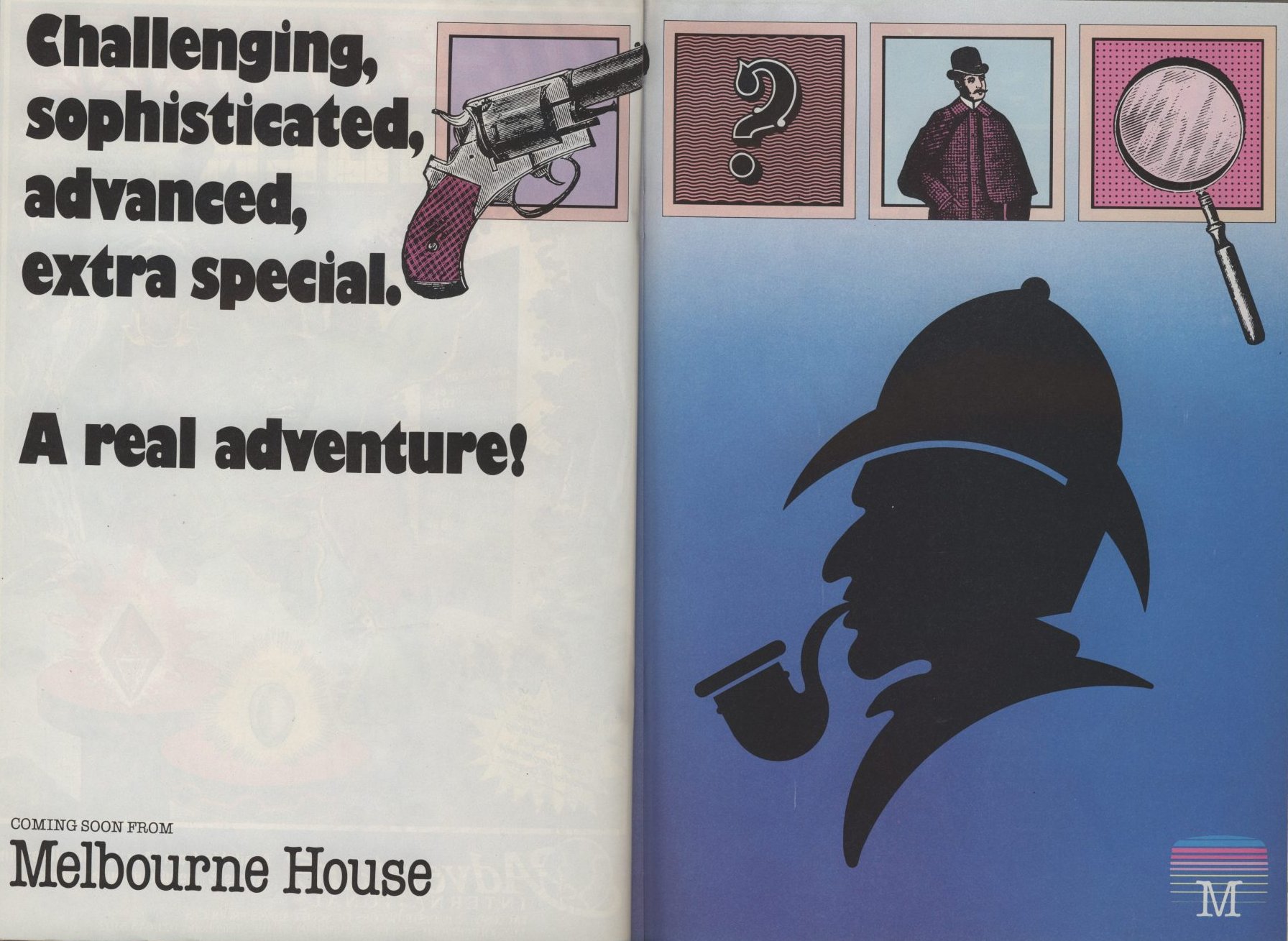
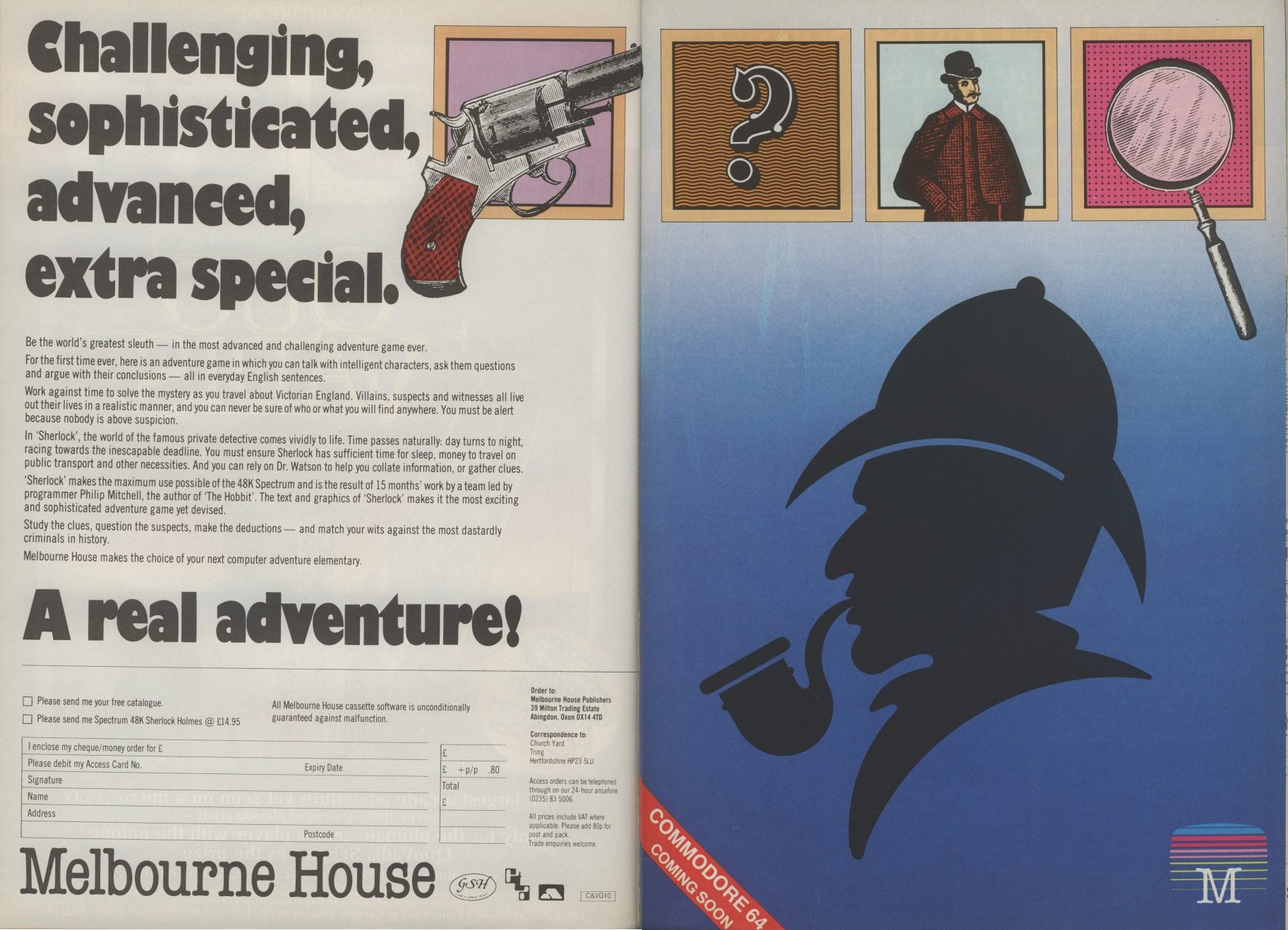
Two-page ad16
- Sinclair User #33Dec 1984 · p.72
- Crash #11Dec 1984 · p.18
- C&VG (Computer & Video Games) #38Dec 1984 · p.192
- Your Computer #11Nov 1984 · p.170
- Your Spectrum #8Oct 1984 · p.26
- Crash #9Oct 1984 · p.72
- Micro Adventurer #12Oct 1984 · p.8
- C&VG (Computer & Video Games) #36Oct 1984 · p.64
- Sinclair User #30Sep 1984 · p.38
- Your Computer #9Sep 1984 · p.26
- Home Computing Weekly #79Sep 1984 · p.16
- Popular Computing Weekly #38Sep 1984 · p.48
- C&VG (Computer & Video Games) #31May 1984 · p.94
- Sinclair User #24Mar 1984 · p.90
- Micro Adventurer #5Mar 1984 · p.20
- Popular Computing Weekly #6Feb 1984 · p.32
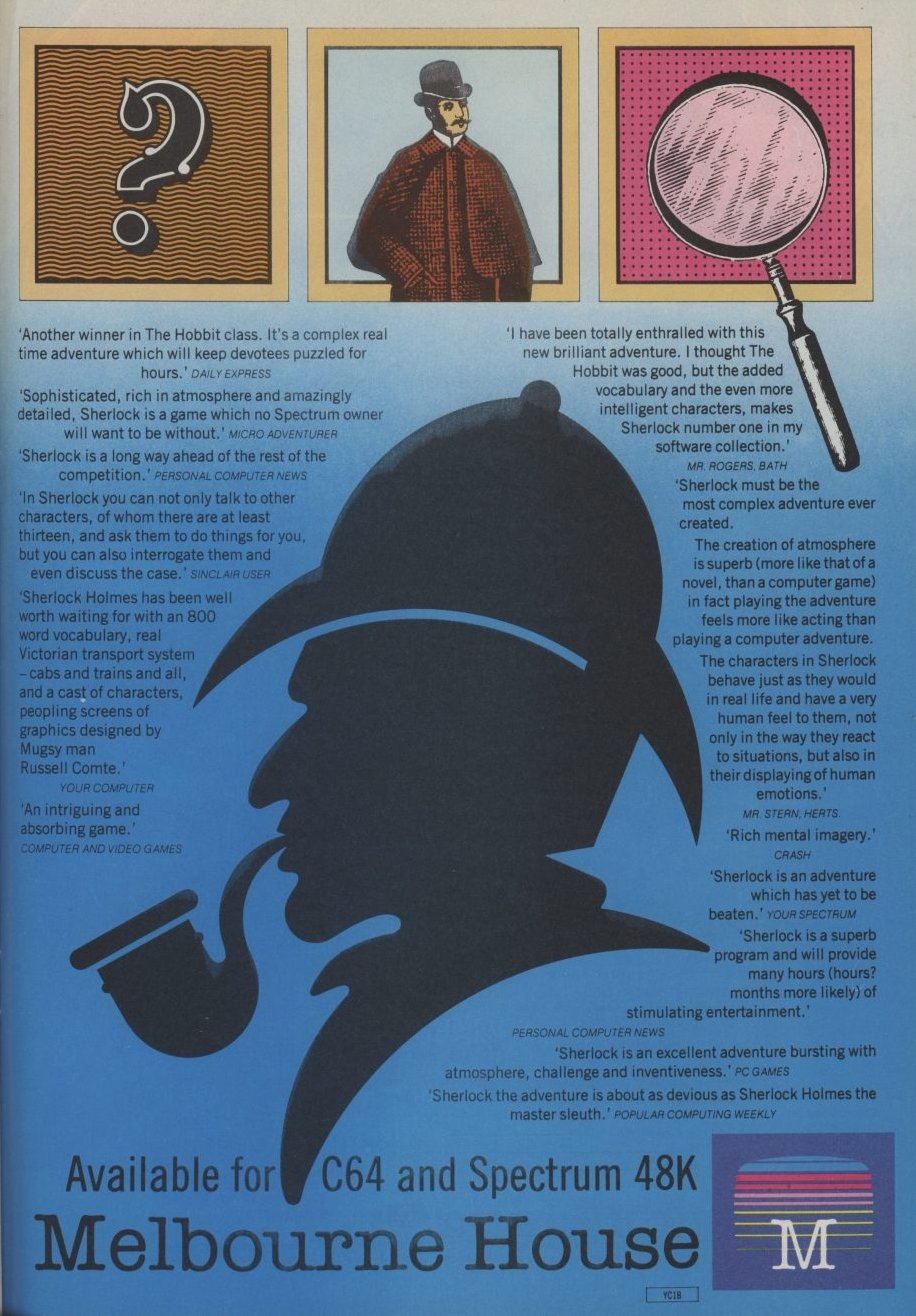
Advert12
- Sinclair User #34Jan 1985 · p.153
- Crash #12Jan 1985 · p.177
- C&VG (Computer & Video Games) #39Jan 1985 · p.131
- Micro Adventurer #13Nov 1984 · p.23
- Sinclair User #31Oct 1984 · p.101
- Home Computing Weekly #82Oct 1984 · p.34
- Home Computing Weekly #85Oct 1984 · p.7
- Your Computer #9Sep 1984 · p.175
- Your Spectrum #7Sep 1984 · p.16
- Micro Adventurer #11Sep 1984 · p.10
- C&VG (Computer & Video Games) #35Sep 1984 · p.90
- C&VG (Computer & Video Games) #35Sep 1984 · p.91
Solution7
- MicroHobby #178Oct 1988 · p.63
- MicroHobby #177Sep 1988 · p.61
- MicroHobby #175Aug 1988 · p.75
- MicroHobby #172Jun 1988 · p.67
- MicroHobby #170May 1988 · p.59
- C&VG (Computer & Video Games) #66Apr 1987 · p.84
- Crash #34Nov 1986 · p.103
Feature7
- ACE (Advanced Computer Entertainment) #12Sep 1988 · p.77
- Sinclair User #35Feb 1985 · p.76
- Sinclair User1985 · p.46
- TV GamerDec 1984 · p.29
- Your Computer #10Oct 1984 · p.62
- Big K #7Oct 1984 · p.15
- Popular Computing Weekly #43Oct 1983 · p.13
Review6
- Micro Adventurer #15Jan 1985 · p.39
- Sinclair Answers #2Jan 1985 · p.24
- MicroHobby #10Jan 1985 · p.15
- Games ComputingDec 1984 · p.60
- Home Computing Weekly #85Oct 1984 · p.19
- Popular Computing Weekly #36Sep 1984 · p.52
Letters5
- Crash #21Oct 1985 · p.114
- Crash #20Sep 1985 · p.98
- Crash #15Apr 1985 · p.106
- Crash #11Dec 1984 · p.34
- Popular Computing Weekly #45Nov 1984 · p.13
CompoResult3
- Your Computer #2Feb 1985 · p.53
- Sinclair User #27Jun 1984 · p.24
- C&VG (Computer & Video Games) #31May 1984 · p.15
Preview3
- Personal Computer Games #11Oct 1984 · p.34
- Your Spectrum #3May 1984 · p.65
- Crash #3Apr 1984 · p.56
Full-page ad2
- Your Computer #1Jan 1985 · p.119
- Popular Computing Weekly #49Dec 1984 · p.81
CompoEntry2
- Sinclair User #25Apr 1984 · p.62
- C&VG (Computer & Video Games) #29Mar 1984 · p.15
Information1
- SSD-IISep 1999
Licensed from
- Sherlock HolmesBookunofficialArthur Conan Doyle
Related
- Ports
- (Commodore 64)
- Elsewhere
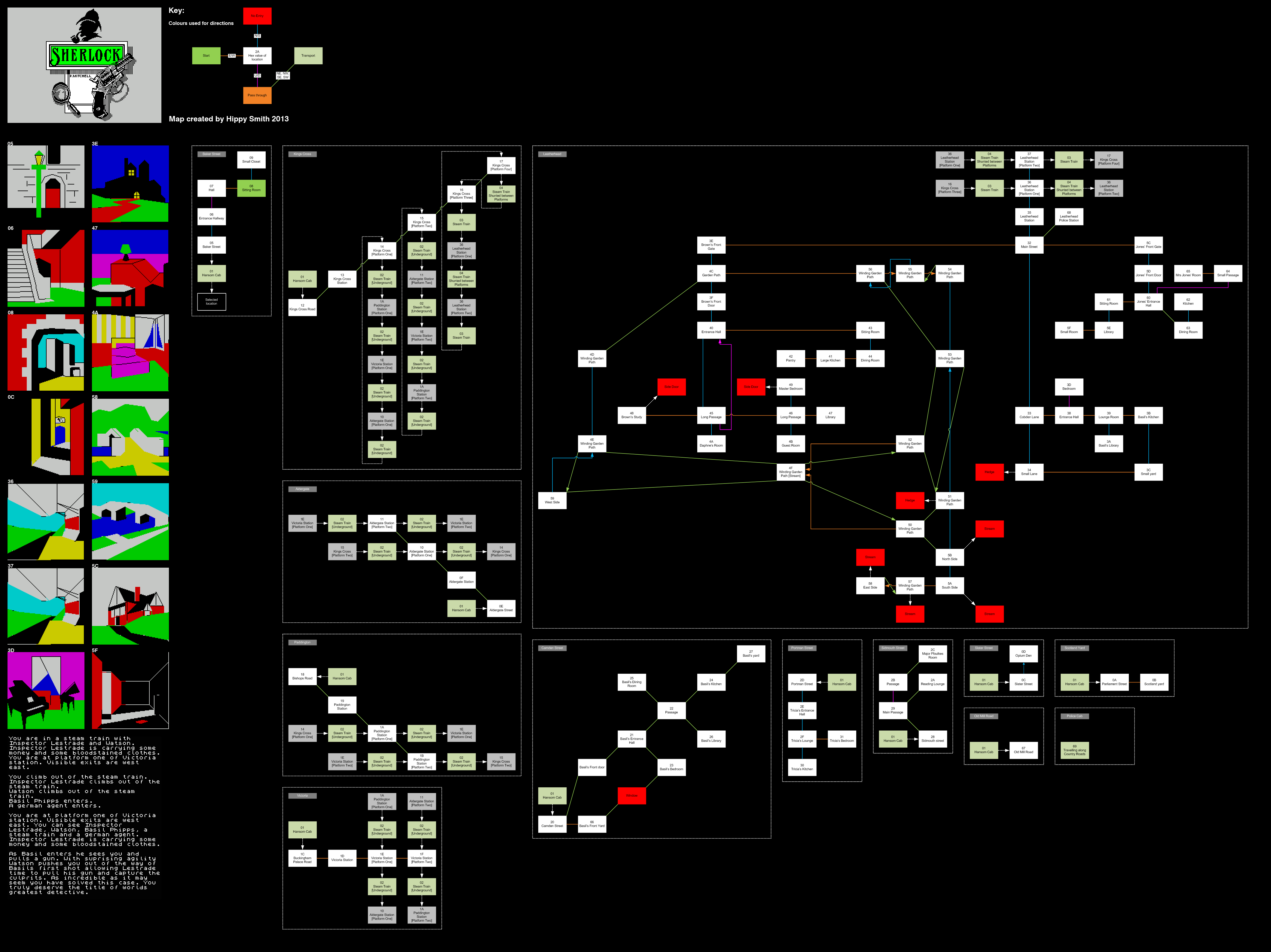
- Speccy Screenshot MapsWikipediaCASACentre for Computing HistoryMobyGamesRZX ArchiveThe TipshopUVLModern ZX-Retro GamingRZX Archive - YouTube
- Same entry at
- Spectrum ComputingZXInfo
Reviews from people here
Sign in to write about this, or make an account. It takes a minute and lets you correct the catalogue too.
Everything ZXDB can hold about this is here.
Sign in to correct or add to this.
Hold the rights to this and want it taken down?