
Shrewsbury Key
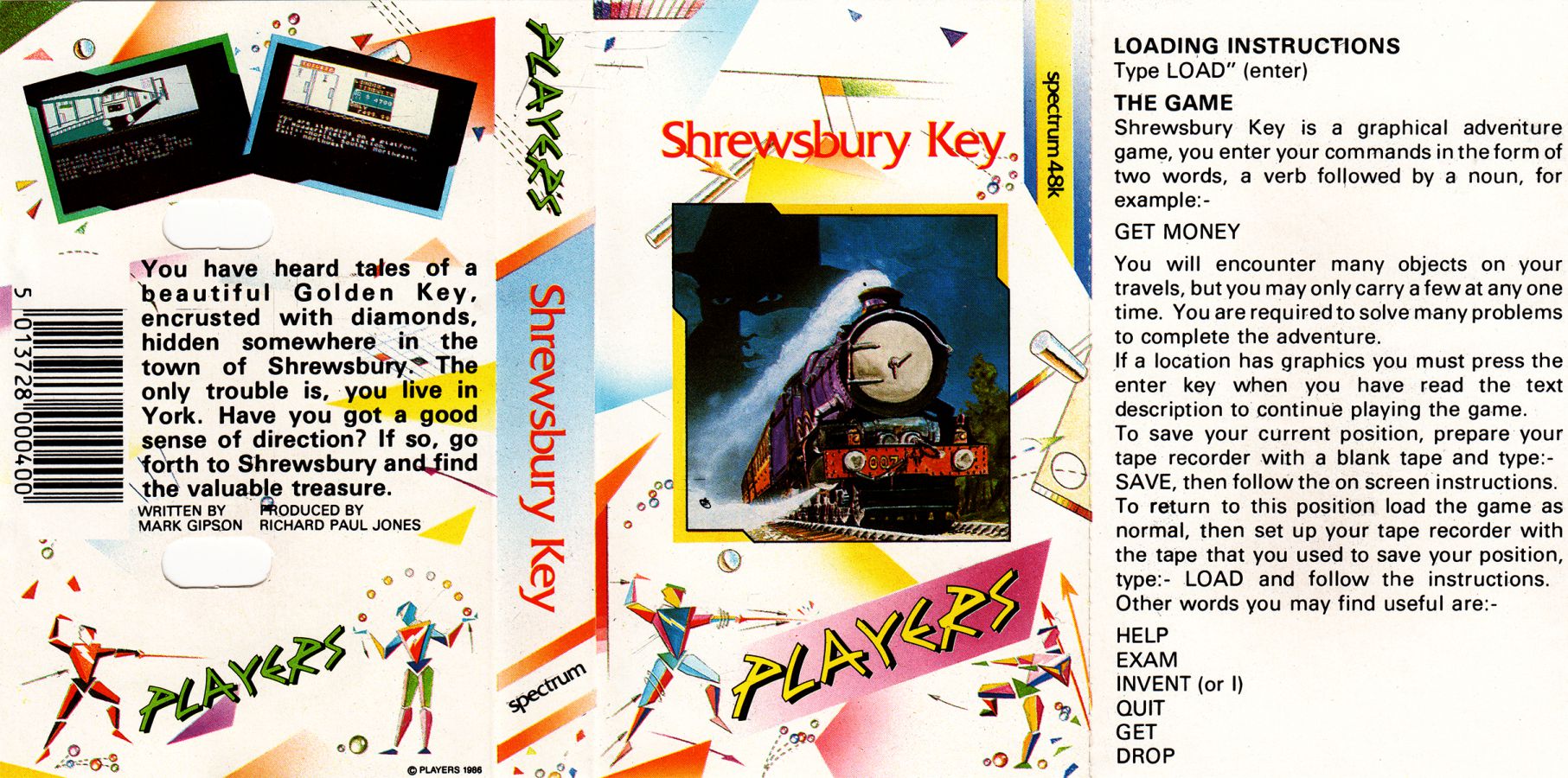
Adventure Game: Text/Illustrated · ZX-Spectrum 48K · 1 players · English
Players Software · 1986 · Pound sterling 1.99
Discussion
Nobody has started a thread about this yet.
Play
- shrewsburykey.rzxRZX playback file
- ShrewsburyKey.z80.zipSnapshot image English27 KB
- ShrewsburyKey.tzx.zipTape image English28 KB
Documents
- ShrewsburyKey.txtInstructions English1 KB
Files and rights
No permission is on record either way. Screens and pictures are copied here on a take-down basis: if you hold the rights and want something removed, say so and it goes.
Credits
- Mark GipsonCode
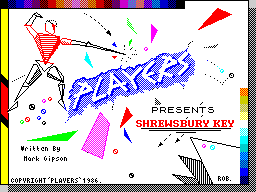
- ROBLoad Screen
Sign in to credit somebody, or say what these people did.
Scores
In the magazines
- Sinclair User #561986 · Overall2/5
- Crash #361987 · Overall68%
Elsewhere on the web
- WorldOfSpectrum 15 votes7.00
In the magazines 20
Crash #36Jan 1987 · p.15172%68%65%70%68%68%
Atmosphere 72%
Vocabulary 68%
Logic 65%
Addictive Quality 70%
Overall 68%
Derek Brewster 68%
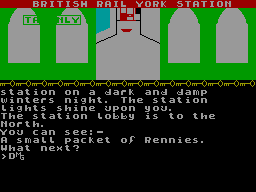
DEREK BREWSTER'S ADVENTURE TRAIL CLASS OF '86 1986 will not be remembered as the year of the adventure, even if many people, bored with the transient thrills of arcade did suddenly discover the more lasting satisfactions to be found in adventuring. The biggest game of the year, Lord of the Rings, based on the famous Tolkien work (and representing the next logical step for Melbourne House who turned The Hobbit into a classic adventure), was to many a huge disappointment as it failed to live up to the expectations raised by its pedigree. It was again Philip Mitchell, and again Melbourne House who were wrapping it all up and selling it, but the end product just wasn't in the same league as Tolkien's masterpiece. In a sense, Lord of the Ring's failure as a major piece of software was symptomatic of a broader malaise in the adventure world, as if adventuring had lost its way and was not quite sure of the path ahead. Level 9, of course, continued to champion the cause of imaginative adventuring with their much respected releases, Worm in Paradise (the final part of the Silicon Dream trilogy) and The Price of Magik. Their success is justified, as a lot of time and effort has gone into honing their own adventure system to give adventure just as much pride in the technical innovation stakes as arcade. Hand-in-hand with the technical competence is a desire to provide coherent storylines and gamesplay so the player becomes as involved with the game as with a good novel. Because adventuring is a more difficult market, Level 9 have quite sensibly diversified as much as possible within their chosen field: versions for each game span almost every known computer, and they have not been averse to dipping their fingers into many different pies, as in their link up with Mosaic's Adrian Mole books. The other big name of 1986 was undoubtedly Fergus McNeill of Delta 4 who mined quite a different seam. Humour was always an area which the medium of adventuring could develop to its full, and Delta 4 were not slow in spotting this simple fact. The Quill, for once, provided a useful vehicle to express a budding comic talent. Delta 4 had always secured a loyal following among adventure freaks, but this year saw the outfit's rise to fame and chart respectability epitomised by the tremendous amount of interest in The Boggit, a game which successfully lampoons the Melbourne House classic. However, in summing up this year it is worrying that a great number of individuals have thought it feasible to set up software houses, and then devote a great amount of time and money to launching Quilled games that are neither innovative nor remarkable in any way. There are two conflicting thoughts which cross my mind as I wade through these games every month. The first thought is one of sadness that anyone can think that a profitable, or even a breakeven situation, can be gleaned from such lackluster product. But my second thought is one of hope and optimism; if adventuring can stimulate such ground-level enthusiasm in the form of experimental Software releases, adventure clubs, and small circulation magazines, perhaps this could be the avenue to encourage the development of really challenging adventures. From the enthusiast's domain, one or two mail-order products did make it to the larger software concerns and the mass market. In this area there can be no doubt that the advent of budget software has kept adventuring alive when no full-priced games were in the offing. Mastertronic, Atlantis (not least with their famous Mafia games), and more recently Players (a derivative of Interceptor who have recently rejoined the full-priced adventure scene) have all released very reasonable adventures. Mastertronic's efforts are all the more remarkable when their no-Quilled policy is considered. With programs such as ZZZZ, experimentation with icons was not beyond this budget software producer. However, let us not forget a company which saw the same market, and was large enough to rival Mastertronic in sales of budget adventure. Firebird's Seabase Delta was an enormous hit, following on the heels of the highly successful Subsunk. The mighty Ocean games empire developed their own adventure system, seen in the competent releases Never Ending Story and Hunchback the Adventure. This system used the novel idea of forming a colourful collage of backdrop, with events and objects superimposed over it. Activision turned out the highly impressive if more traditional, Mindstone, while PSS and Mikro-Gen went a little astray in their efforts to try something new with Swords & Sorcery and Shadow of the Unicorn respectively. Despite the fact that adventuring has a dated image, with interest in pre-1986 games matching that shown for games of this year, I still think that it has a future. In fact it's encouraging to note that if authors have the presence of mind to mould together innovative programming with inventive stories, they can be assured of producing a game which will be remembered long after arcade games released around the same time are forgotten. Certainly, as with pop music, tremendous sales are there for those who cynically milk the teen market, but, as with pop music, there are also significant prizes for those who cater for a broader appeal. I hope the success of Trivial Pursuit, the computer adaptation of the cult board quiz, is significant, and marks a greater inclination on the part of software houses to look afresh at the whole world of games play. SHREWSBURY KEY Producer: Players Retail Price: £1.99 Author: Mark Gipson Shrewsbury Key is a reasonable graphic adventure with a novel storyline. The game has you start at York Railway Station and it's up to you to navigate your way to Shrewsbury, making use of the train 'The Shrewsbury Key ' to start your journey. The reason for going to Shrewsbury is to find the fabled, diamond encrusted Golden Key which lies there. There are two things I'd like to point out straight away about this game, in order to save a lot of frustration. In the instructions the game warns that it is verb/noun only, and you'd better believe it. At one stage when I was told to catch a lift, I tried CATCH A LIFT with no success, but CATCH LIFT did the trick. The second thing to be aware of is the exacting requirements set on input. You can get away with EXAM for EXAMINE, but words like TICKET must be spelt out in full, although thankfully, words such as WHEELBARROW can be shortened to WHEEL. If an awkwardness in language wasn't enough, then the plot can be pretty confusing too. At the rough wooden fence outside York station. Examining the fence gives 'The fence has a small hole which could easily be made bigger', and on KICKing the fence, ' The fence has a hole big enough to squeeze through'. But try as you might there is no way the program is going to let you through it, even after all that encouragement. It is in fact possible to complete the game without going this way, and if this is true then I take a very dim view of the tease which had me almost smashing my computer in frustration. Of the two bins in the story, the first bin can be SEARCHed, but the second cannot for some unknown reason. On this occasion, as in so many others, the replies are less than helpful. The logic of gamesplay is not good either, what with a storekeeper accepting a sneaker in exchange for a trowel. Or how about the Wheelbarrow which you buy for £30, which should leave a £20 cheque for the store (a curious way of receiving change from a store in the first place). But on checking your inventory the cheque is £30 - with no explanation as to why it should have suddenly increased in value. There are many examples of where the plot isn't quite zany enough to be amusing, but it is annoyingly quirksome enough to get you irritated. Shrewsbury Key isn't too bad for the asking price, although the pictures are simple, they are at least colourful, and the character set has been redesigned. Slightly annoying is the program's insistence on the first key entry being used as a signal for the rest of the location description to scroll up, therefore you sometimes look up to the screen to see the first letter of your input missing. Even when you learn to avoid this the program still runs more slowly because of it. The story is a bit thin, as is gamesplay. COMMENTS Difficulty: easy Graphics: cheap but colourful Presentation: alright Input facility: verb/noun Response: average
Your Sinclair #12Dec 1986 · p.83
Mike Gerrard
Wish I could say the same for Shrewsbury Key from Players at the same price. Your aim here is to travel from York to Shrewsbury and find the jewel-trimmed treasure chest hidden in the abbey church. You begin outside York station and must first do exciting things like examine a rubbish bin and buy a ticket, the major problem initially being the fussy vocabulary. Finding yourself with a train to catch, what command would you enter? GET TRAIN, CATCH TRAlN, ENTER TRAIN, GO TRAIN, ENTER CARRIAGE, ENTER DOOR... something along those lines? No, what the program wants is CLIMB ABOARD, which took me quite a bit of finding. The train's about to leave, but if you type WAIT before you SIT DOWN you fall over and break your neck as it moves out. Ho-ho-ho, end of game. Football hooligans climb aboard and you all get flung off at Huddersfield, and from there you should be able to get to Oldham, Stockport and Manchester. The game comes across as a pale imitation of Urban Upstart, and even a British Rail train journey's got more excitement than this adventure.
Sinclair User #56Nov 1986 · p.932/52/5
Overall 2/5
Gary Rook 2/5
Label: Players Author: Mark Gibson Price: £1.99 Memory: 48K/128K Reviewer: Gary Rook Shrewsbury Key is a second budget adventure from Players - and unfortunately this one does show its budget origins a little too clearly. Adventure games are renowned for having weird and wonderful plots that mix ideas taken form diverse sources, science fiction, fantasy etc. But Shrewsbury Key has one of the strangest plots I've ever come across. You live in York and have somehow discovered that there is a wonderful jewelled key hidden somewhere in the city of Shrewsbury. Travel there - by British Rail - and find the key. Why? Greed, I suppose - no other reason seems to be given. Me, I like a little more explanation to my plots. Unfortunately, far too much memory has been devoted to providing the game with some of the most simplistic graphics it has been my misfortune to see. They're terrible. It would have been far better for all concerned had the author just forgotten about the pictures and used the memory space they take up to improve the text adventure. You begin outside York British Rail station trying to get on the 12.30 train to Shrewsbury. If you go in the only direction you can at the start of the game, you find yourself in the station lobby. Search everything - don't be afraid of getting your fingers dirty. They say money is filthy. While the obvious next step, after having found the filthy lucre, is to buy a ticket, I suspect that you will need the money for something else later in the game. So why don't you try and sneak on to the platform through the fence? Don't worry about not finding the right train or the right platform - York, it would seem, only has one of each. Once you're on the train, sit down quick. If you are still on your feet when the train starts, you fall over, break you neck. and have to restart the game. Don't be too afraid of the drunken yobbos who get on the train at Leeds: they won't hurt you. They are just a convenient plot mechanism the author can use to have you thrown off the train in Huddersfield. Strange place, Huddersfield. Interesting graffiti in the toilets, but they drive like maniacs. Anyway, that was about where I gave up on this less than scenic tour of northern England. I admit I've had better train journeys, I wonder. Could British Rail sue?
Tips9
- Your Sinclair #48Dec 1989 · p.76
- Your Sinclair #36Dec 1988 · p.73
- Your Sinclair #29May 1988 · p.87
- Crash #44Sep 1987 · p.71
- Your Sinclair #20Aug 1987 · p.80
- Your Sinclair #16Apr 1987 · p.82
- Your Sinclair #15Mar 1987 · p.54
- Your Sinclair #15Mar 1987 · p.60
- Your Sinclair #12Dec 1986 · p.78
Solution5
- Die Speccy CDJan 1996
- Sinclair User #133Mar 1993 · p.24
- Sinclair User #132Feb 1993 · p.24
- Sinclair User #131Jan 1993 · p.32
- Your Sinclair #65May 1991 · p.48
News/Note2
- C&VG (Computer & Video Games) #60Oct 1986 · p.10
- Popular Computing Weekly #34Aug 1986 · p.41
Preview1
- Sinclair User #55Oct 1986 · p.109
Related
- Same entry at
- Spectrum ComputingZXInfo
Reviews from people here
Sign in to write about this, or make an account. It takes a minute and lets you correct the catalogue too.
No description, tag recorded.
Sign in to correct or add to this.
Hold the rights to this and want it taken down?