
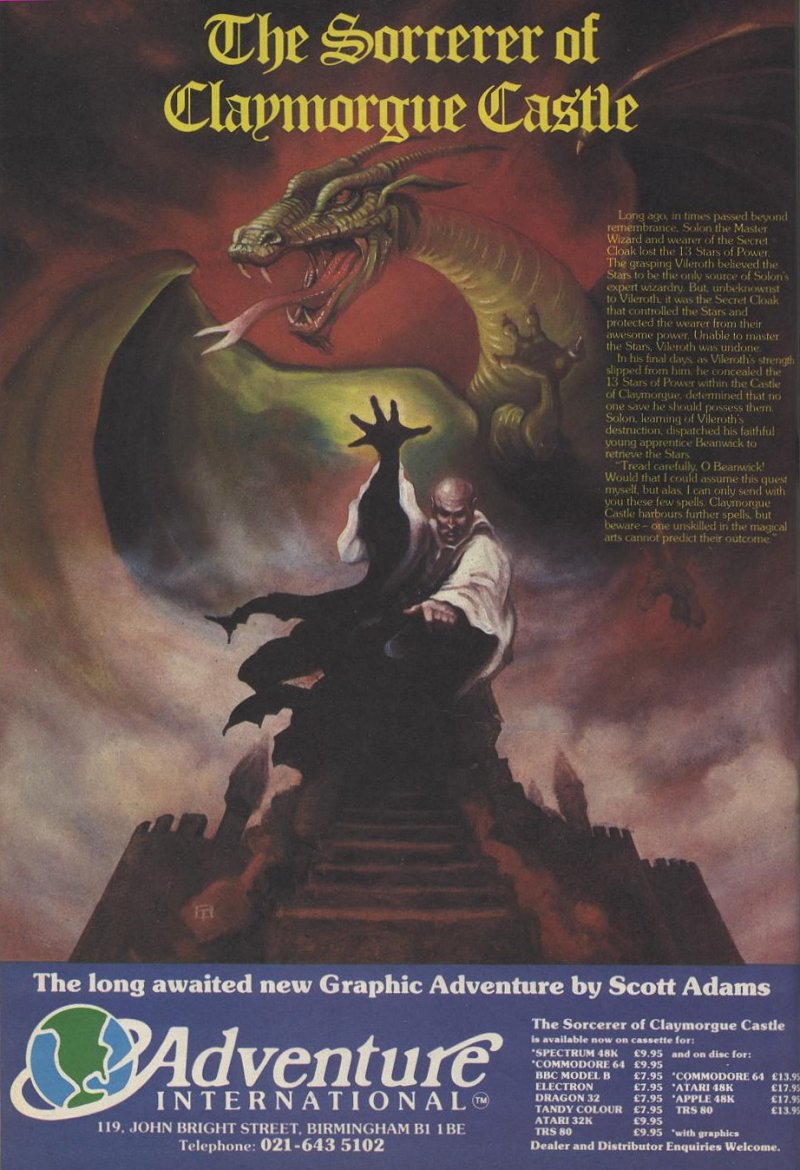
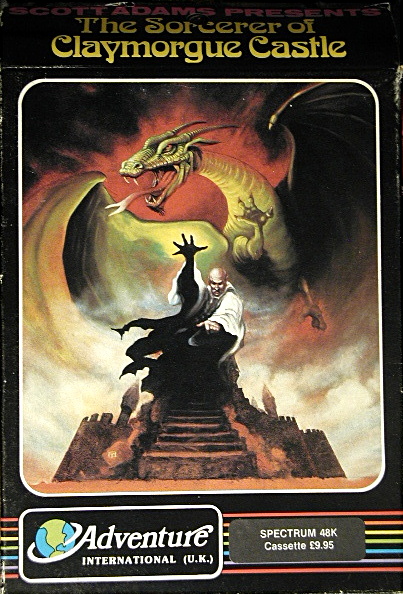
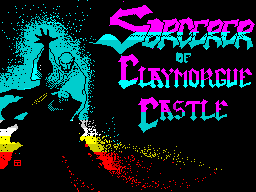
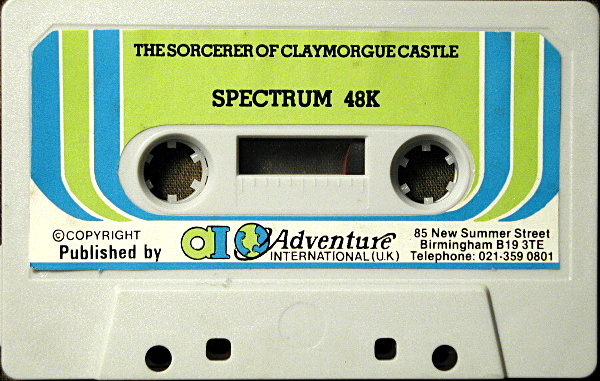
The Sorcerer of Claymorgue Castle
Adventure Game: Text/Illustrated · ZX-Spectrum 48K · 1 players · English
Adventure International · 1985 · Pound sterling 9.95
Also known as Sorcerer of Claymorgue Castle (English)
Adventureland, 13 of 13
Discussion
Nobody has started a thread about this yet.
Play
- sorcererclaymorgue.rzxRZX playback file
- SorcererOfClaymorgueCastleThe.tzx.zipTape image English28 KB
- SorcererOfClaymorgueCastleThe(different).tzx.zipTape image English28 KB
- SorcererOfClaymorgueCastleThe.tap.zipTape image English32 KB
Documents
- SorcererOfClaymorgueCastleThe.txtInstructions English8 KB
- SorcererOfClaymorgueCastleThe(EN).pdfInstructions English343 KB
Files and rights
Distribution permission is on record, granted to another archive rather than to this one. Screens and pictures are copied here; everything else links to the archive that holds it.
- AllowedAdventure International → WorldOfSpectrum
Credits
- Brian Howarthcredited
- Teoman IrmakIn-game Graphics
- Teoman IrmakInlay/Poster Art
- Scott Adamscredited
Sign in to credit somebody, or say what these people did.
Scores
In the magazines
- Personal Computer Games #131984 · Overall8/10
- Crash #121985 · Overall Value7/10
Elsewhere on the web
- WorldOfSpectrum 12 votes8.08
Awards and competitions
Golden Joystick Awards 1984
- 1Best Adventure Game of the Year
In the magazines 58
Micro Adventurer #16Feb 1985 · p.20
Ken Matthews
SAVAGE ADVENTURES Ken Matthews concludes his series of reviews of Scott Adams' Classic Adventures by looking at Savage Island Two, Golden Voyage and The Sorcerer of Claymorgue Castle. The end is nigh! This article rounds off our in-depth look at the Scott Adams classics with hints for, probably, the three most difficult adventures. Before I begin though, I will correct last month's review of Savage Island 1, where I suggested "there is no safe place to sleep". Not so! A young adventurer, Damien Meadows of Nutley, Sussex, playing on the Texas, informed ADVENTURELINE that you can sleep on the secluded ledge near the lake. I stand corrected! This makes things a lot simpler - well less hurried anyway. And so to the reviews. SAVAGE ISLAND PART TWO You begin in deep trouble! The correct password from Part I is needed which will give you an item to cover your nudity and may suggest a sharp intake of breath. Breath is the last thing you need in a vacuum of course so make sure you get rid of it if you want to survive the next few moves. Time is short, so don't stop to look at things just yet, get to somewhere you can breathe. Now you'll be able to examine things at your leisure. A little exploration and examination will be a great help towards getting some idea of what to do next and a bloom so beautiful you'll get a crush on it will solve a very old problem. If you remember that lung size is proportional to body size, psychotransfiguration may not seem so much of a drag - if you keep your head covered. You can move on with open eyes. Once you've seen me, if you see what I mean, you should reach that blinking field, at last, to be confronted with yet another problem. Don't worry, put it out of sight and mind for a moment and take a bit of exercise. Life is a treadmill? Sounds like a clue to me! Of course you'll have to unravel another mystery to tie this one up. If you can push through this location and still hold on, you'll have made a very significant 'move'. Things should really be dropping into place now and so should you, providing you have tied up all those loose ends. Clutching an alien device and a few threads of information to suggest a purpose to the whole game you should be able to rid yourself of a paradox - one that's blocking your progress. The last move is probably the most difficult in that it seems to need inspiration to suggest it. After struggling for hours to use some of the superfluous objects in the game, I finally gave up until meeting Scott at the PCW show - he told me I was only two moves from the end! To push you in the right direction all I'll say is that your two friends in Part I are your friends in Part II as well, so don't be too annoyed at one of them - he's just doing his job and helping you do yours! The final touch will yield a burst of gibberish - but, with the aid of the card in the software pack, everything will become clear and the awesome scope of the task you've just completed will be revealed. Of course, if you've got a pirate copy, everything will be as clear as mud - but the Americans have a term for that too - Tough*?!@ GOLDEN VOYAGE The second of this month's games boasts a rather outré theme - the King has lost his virility and both he and the Queen will be eternally grateful if you can seek out the elixir that will restore his vigour. Flush with Royal gold it is a simple matter to gather the items needed for your quest, weigh anchor and set sail for foreign parts. All you need is on the ship and, providing you keep a sharp look out, you'll soon find a safe landing place. Careful not to leave yourself stranded, you will be able to equip yourself completely for the rest of the game and seek out the mysterious cave shown on the tablet from the bazaar. It doesn't seem you can do too much there yet, but careful and repeated excavation will pay dividends. A rocky strand could give you a hard time but a gentle shove will put most of your troubles behind you - there really is no need for violence - but don't forget to rummage in the remains. Stepping up to the altar you might cleanse your soul to find what is missing and complete the inventory of essential small items. It might seem odd, but dropping what you've recovered could solve a puzzle and ,indicate that a little back-tracking is necessary. The right place to say a word is clearly shown so don't go too high. Don't imagine things are over yet - but you can rid yourself of a burden before sailing once again to lose the second. The world is at your feet - or nearly if you look for it! At last. you can return to the gods with a good idea of what to do next if the way is no longer 'blocked'. The cyclops is probably your worst problem - just throw everything you've got at him but be prepared for a visual shock. The rest is quite straightforward if you don't get trodden on - be assured, your reward will make it all worthwhile. THE SORCEROR OF CLAYMORGUE CASTLE The latest of Scott Adams' series is a little unusual too. To me, it bears more similarity to Infocom's Enchanter and Sorcerer than to the previous 12 adventures, in that you must find and use spells to complete your quest. The aim is simply to recover 13 lost stars from Claymorgue Castle but, as ever with Scott, this is easier said than done. Most spells work in more than one place so you must not only obtain them but also find the correct place to use them. The easiest way is to experiment but remember to save often. "Open Sesame" is not the way in, so don't go by the book - be a little more imaginative. Don't hold your breath while worrying about a monster just get down out of his way. If you've found the kitchen, I won't need to say much except that 'cabinet' is probably the noun you've been racking your brain for. A way out is simple to find but the more baffling items are certainly best left until later. Your energy might be better spent on the confines of the plain room! You should by now have unravelled a few problems, used your seed spell etc. You could see things a lot more clearly if you remember Snow White - it might help get you out of a hole - or into one! 'Raptures(?) of the Deep' is a danger to all divers but a little experimentation will get you out of trouble quite happily. If you are still content, you could move up in the world and let Mr. Newton help you crack the case. A little drink will clear the dust from your throat and help you brave one potentially fiery demise. Careful not to blow it (?) you should be no less than three stars 'the richer. Happier still, a fakir's trick would do you a favour to make you dizzy with delight. A close look at the battlements should give you something to aim at and set you up to finish the adventure. To round things off you'll need to go outside the castle. A bit of pyromania could see you glowing with pride and really getting into things (?). Having stored some stars it's time to end it all with yet another dip but this time a nice dry towel should help once you've reached the centerpiece of things. Don't Panic! You should only have one (and a half?) spells left so the last bit will be plain sailing. Regular readers of this series will notice that the clues this month are a little vaguer and more cryptic than usual. There are two reasons for this. Firstly these three are probably the most difficult of the adventures Scott himself has penned to date. It is very difficult to strike a balance between giving too much away and leaving you none the wiser for reading the hints. Secondly, I would suggest that none of these games be tackled as an introduction to Scott Adams' work - arm yourself with an early game and some back issues of Micro Adventurer. This will give you a good background in these adventures (and my writing style) and let you tackle any of the above with more confidence. Well, sadly, this series of hint-reviews closes here but, with Adventure 14 Return to Pirate Island - and Questprobe Three due for release this month I'm sure it'll be a long time before we hear the last of Scott Adams' games. Finally, thanks to you, the readers, who've called ADVENTURELINE or written in about the series. Knowing the articles have helped so many of you has made it all very rewarding. Happily, I've not been put out to grass just yet and next month I'll embark on another mammoth task - complete hintreviews of the brilliant Infocom series! In the meantime, for your Scott Adams, Infocom and many other problems try ADVENTURELINE on [redacted].
Your Computer #2Feb 1985 · p.43
Hugo North
Various Adventure International £7.95 This is the best adventure out of my leather pouch this month. I must confess to liking all of Scott Adam's adventure; but this is definitely his finest yet. You play the part of Beanwick, an inexperienced wizard, whose mission is to enter Claymorgue Castle and recover 13 lost stars. When you start you already have a number of spells and will find more on your travels. Only trouble is, you don't know what these spells actually do. If you want attractive graphics, you'll find them here.
Crash #12Jan 1985 · p.1266/108/107/1010/107/107/10
Atmosphere 6/10
Vocabulary 8/10
Logic 7/10
Debugging 10/10
Overall Value 7/10
Derek Brewster 7/10
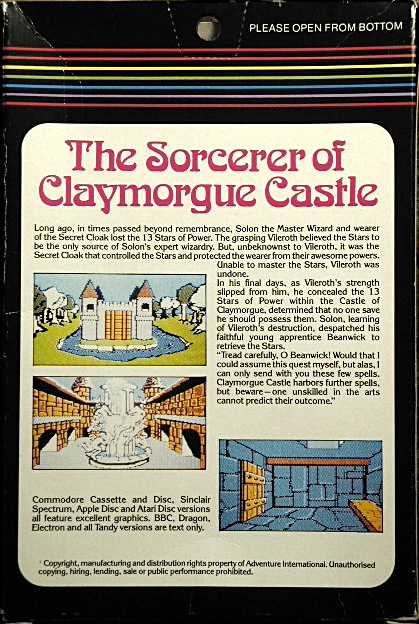
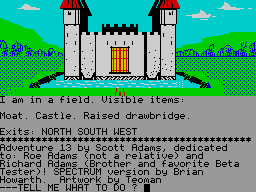
DEREK BREWSTER'S ADVENTURE TRAIL Our Adventure Trail columnist, DEREK BREWSTER, sums up his feelings about the state of Spectrum adventures as we prepare to enter a new year... THE VICTORIAN CHIP Adventuring, as so many have come to know it, began with a mainframe and a copy of Colossal Cavern which even now is available for the home micro. Why should this be so when the technical improvements in the writing and implementation of adventure has increased markedly since that time? The reason gives a due to the special attributes every popular adventure possesses, namely, a plot in which an adventurer can lose himself. The problems must be pitched somewhere in that narrow band where they are difficult and thought-provoking but, hopefully, entirely logical. But where an adventure really shows its class is when it often has the explorer preoccupied with two or more problems at the same time and can enable progress by more than one solution. In an editorial some months ago I commented on how it is unwise for a company to release too many games on a modular basis. It would seem this advice to some extent is unnecessary as market forces have forced more selective releases from both adventure and arcade camps alike. Crash was criticised some time ago for reviewing all games released instead of just those that merit distinction and yet the irony is, of the plethora of publications that line the newsagents' shelves, Crash is now the one, with its CRASH SMASH awards, to distinguish and more overtly praise those games of the highest calibre every month. These pick of the bunch, considering how far software has come in the last year, are great games indeed - a trip to the arcades is positively dull when compared to the choice and quality now available in millions of homes. Games playing has come a long way and will go much further. People's expectations of game software is much higher than when microcomputing was a fresh and novel pastime. Everyone tried their hand at programming because they thought that's what micros were for - to learn all about programming, and the standard of software was initially low enough to encourage imitation and even improvement. However, people were soon glad to see their computers do anything following their own fruitless struggles. Now the scene is different: many see their computers for what they are - games machines. Take the Spectrums main rival, the Commodore 64. When first marketed, it was as a business computer to the incredible extent that it was only to be had in business shops. The inference was you couldn't have it for anything as frivolous as playing games. Hindsight, and in particular two important factors, made things clearer. One, the arrival of a small business computer on the scene with the likes of the Advance lined up with the Spectrum and the C64, which gave the lie to the idea that a business system could cost anything less than £1000. Two, playing games isn't quite the frivolous nonentity some might have had us to believe. At a time when enforced leisure is the order of the day, playing computer games is a much better recreation than watching feeble-minded quiz shows on TV (Channel 4 made a brave attempt to keep television alive but alas their resolve faded with their fortunes). Computer games are sophisticated enough to be intellectually demanding; adventures are used in education as they are better, certainly more entertaining, than the prescribed medicine while the arcade side has given birth to genuinely instructive simulation programs. Speaking as one who is suspicious of the very word education, I think it unlikely that much good will come of educational software marketed as such; better for games to become more entertaining, thought-provoking and informative. A return to Victorian Values is one thing, being bored to brain-death is quite another. Colossal Cavern spawned many text-only adventures in the early days of home computing but some luminaries of the computing press fall woefully short of their roles to inform of the differences between a knocked-off job and the program of several months incubation. This puzzled me enough (brought to a head having read a guide-book to adventures which was the most partisan load of drivel) to encourage my own entry onto the scene and the views which follow. The modern equivalent of the original, good, mostly Basic, text-only adventure is the Ket Trilogy, a series of adventures marked by their sensibly cheap price, super atmosphere, easy and logical problems, and user-friendliness. A company that had machine code games right from the start was Artic Computing, who produced highly competent adventures with problems that lent themselves well to a new magazine phenomenon, the adventure help page, since they were very difficult and had but one solution. The early games were clinical by today's standards, needing the methodical approach of the crossword devotee with little attention paid to building up a consistent atmosphere. The early Artic software clearly had some appeal beyond that of its competitors but had one distinction which was to prove decisive in the struggle for survival in a very competitive market - the software was in your local computer shop and you could actually hand over your money and buy it. Graphics were the next obvious improvement but alas many early efforts resulted in poor graphics or slow response times. However, one game stood out like no other. Based upon one of the most famous works of fantasy fiction, it marked a new era in book/computer program tie-ins, but more tellingly, in big finance and high pressure salesmanship. A cottage industry now seemed on the brink of renting out office space throughout the land but no one was complaining over the new commercialism because it had produced a computer program every bit as good as the advertisment suggested. It was, of course, The Hobbit from Melbourne House. Years ahead of its time with super graphics and the first game to attempt true character interaction. Later a similar game to The Hobbit provided an option for those who had mastered its complexity. Fantasia Diamond from Hewson Consultants had an interesting storyline and endearing characters. Character interaction was visibly demonstrated in another megagame of 1983, Valhalla, which introduced animation to adventuring, but Basic was too slow for the project and it is doubtful whether the interactions were ever truly intelligent. Unlike The Hobbit, the game didn't quite live up to the adverts. Animation may well prove a redundant offshoot for the unmodified Spectrum since it adds little to the intelligence of an adventure but consumes a vast amount of memory - memory better used increasing interaction with the computer. Character interaction has recently reached a new level of intelligence with a further breakthrough from Melbourne House. The worthy successor to The Hobbit, Sherlock in the end proved too ambitious but nonetheless is a significant milestone on the road to intelligent characters. Perhaps with the removal of the inadequate graphics (a concession to market forces) the game could have struck out more decisively along the path of meaningful character interaction with this becoming the sole selling point. Whatever, Sherlock will become a memorable milestone. The Quill has given the chance to many who haven't got the time or inclination to program a machine code game from scratch, and who can blame them, it is debatable whether any 40K adventure needs to be 100% machine code. Gilsoft's creation has lead to a great surge of adventure releases but most, sadly, do not acknowledge the need to give the customer a much greater depth in theme and plot in return for the limitations imposed by The Quill. However, notable exceptions are classics in their own right: Denis Through the Drinking Glass, Hampstead and Tower of Despair. The Quill is just the most public face of a good number of utilities employed by many adventure software houses. Level 9 make no secret of their own 'a code' used to devise Snowball and boast an ever-increasing library of compression techniques used to instigate the likes of Return to Eden. These games are twice the length you might expect of a well-written game and are, in addition, user-friendly, highly intelligent and imaginative, with good descriptions producing a rich atmosphere. Just as some people look with suspicion toward a Quilled game (has it just been knocked-off?) s o they might well be wary of the five or six part megagame, Domark's Eureka! is composed of many parts, like Mastervision's Wrath of Magra, but it is my view that such games are overly involved and convoluted, and this apparent complexity is to smokescreen what is a shortfall in programming skills; size is simply not an important factor, anyone can write 200K of gobbledegook. Some journalists are forever going on about the great American Software invasion from across the Atlantic but perhaps it has dissipated against our shores and I am sure even a flight out to the States would only confirm that which I have long suspected - there's precious little to shout about above the razzmatazz. One game released this summer was so original and outstandingly brilliant it caught many on the hop just as they were about to forget of software innovation until the autumn. Lords of Midnight represented a significant leap in programming skills used to develop an entirely new theme. The Land of Midnight is an extraordinary invention and anyone who has not yet seen it has not seen half of what the Spectrum has to offer. The game is the crowning jewel in microcomputer games respectability. So what can we expect from the future? Well, graphics of a consistently high standard are on the menu, but more than this, they will become an integral part of the adventure and not just a decorative appendage tacked on to brighten up proceedings. Graphics will broaden out from just pictures to diagrams, charts and even to the map that at the moment is painstakingly committed to paper. The pictures will carry clues and figures showing which characters are present. These characters will be larger than life as they realistically go about their everyday lives cementing a greater belief in the whole adventure. The microdrive will finally be exploited for what it is, a refined fast storage device with immense possibilities, and the days of solitary computing may seem a thing of the past as the Spectrums networking capabilities string along the thoughts of many minds. THE SORCERER OF CLAYMORGUE CASTLE Producer: Adventure International Memory Required: 48K Retail Price: £9.95 Language: Machine code Author: Scott Adams Sorcerer of Claymorgue Castle is adventure 13 by Scott Adams, marketed by Adventure International. It follows in the footsteps of The Hulk featuring superlative graphics at every scene. Solon the Master Wizard and owner of the Secret Coat long ago lost the 13 stars of Power. The evil Vileroth, believing the stars to be the only source of Solon's power, acquired these magical prizes when in fact it was the cloak that controlled the stars. Unable to master the magical stars, Vileroth's strength slipped away leaving him with no option but to conceal the Stars of Power within Claymorgue Castle so no one else could possess them. You are Beanwick, Solon's faithful young apprentice, and your task is to retrieve the 13 stars armed with a few spells and with a few more to be found in the castle, but the problem is, how do you use them? The first location is a super graphic showing fine detail of the turrets and battlements comprising a compact, but nonetheless imposing, fortress. If I were to describe a picture of a moat, surrounding a castle with a drawbridge, being a highly skilled and cynical explorer, you will immediately imagine a tidy graphic of a drawbridge which is, of course, raised. If you should ever meet an adventure where a drawbridge is not raised, knowing the deviousness of many adventure authors, I would tread warily. This first problem is tackled, like so many in the adventure, by making use of the magic bestowed upon you from the start or to be found in the various nooks and crannies along the way. Getting the drawbridge down (the noun needs the first five letters DRAWS), you look up to see it down in the picture - a nice touch. Moving east onto the drawbridge you are met with a curious sight where you are contemplating your feet upon the bridge overlooking the moat, but it would be wise to resist the temptation to take the plunge as it may just harbour one of those nasty sleeping moat monsters. On the east side of the drawbridge you see a lever set in the western wall and you'd need to be half-baked or inappropriately impulsive to fail to appreciate the consequences of pulling it. Better to move further east into the interior of the castle and a courtyard with a highly decorative fountain set at its middle. Enter the magic fountain now and it could signal your first meeting with the horrific and very graphic depiction of a sneering skull which makes you shudder the first time you see it. If instead you content yourself for the time being with collecting the goodies here, you'll notice that the program follows what is fast becoming a trend. The fact that you have gained an object is not acknowledged as such. The only indication that you have indeed picked up an object is that object's removal from the list of visible items, this coupled with the knowledge that had you failed to pick up an object a report would draw your attention to your lack of success. By this stage you will have already worked out the use of one spell (at the drawbridge), now let's look at another two. Well, Lycanthorpe in psychiatry as a person who loves that he as a wolf, so what use the Lycanthorpe spell is I'll leave you to decide. As for the Yoho spell it sounds like yoyo and yoyos spring back to your hand when spun. Indeed, the Yoho spell takes you back to the first location; unfortunately, if you were dying on using it, you'll still die at or near the first scene. Also, surprisingly, you are told the Yoho spell works on the second occasion of its use, but on the second attempt nothing seems to happen. Further east you meet one of those situations which you just know will become a classic since it is both devious and difficult. In the ballroom is a giant chandelier secured to a wall by way of a rope. You discover the deviousness of the problem if you attempt the obvious, leading to an annoyingly obvious conclusion. The assumption is you'd be stupid enough to stand under the chandelier while untying it! Should you have had the foresight to fetch the crate from the kitchen you would be spared, presumably because the chandelier has less of a distance to fall before crashing onto your head. Incidentally, GET OFF will not see you off the chandelier, but GO BALLROOM will, rather strange when the former does work when getting off the crate. I wonder if this game has enough to keep me interested until the seventh or eighth star, never mind the thirteenth, since clearly so much effort for this adventure has been invested in producing the ultimate graphics. The vocabulary is friendly, though restricted to verb/noun such as GO (FOUNTAIN) and ENTER (COURTYARD) both accepted, and it is reasonably easy to get around until the problems become more pedantic and intractable. Sorcerer of Claymorgue Castle is an offering from a highly regarded force in adventure publishing, Scott Adam's Adventure International. Commercially it is as slick, polished and viably marketed as only American software can be. Superb graphics and a racy response give the game the edge. However, you can't help but get the feeling that beneath the razzmatazz the plot is a shade dull and uninspiring. As was said during a hamburger commercial and the US Presidential Election, where's the meat? COMMENTS Difficulty: very difficult Graphics: excellent and very fast Presentation: well laid out Input facility: verb/noun Response: very fast
Personal Computer Games #13Dec 1984 · p.1097/108/106/108/108/10
Atmosphere 7/10
Complexity 8/10
Interaction 6/10
Overall 8/10
Steve Cooke 8/10
SPOILT FOR CHOICE The White Wizard investiagtes the latest releases. GAME: Return To Eden PRICE: £9.95 MACHINE: Amstrad, Atari, BBC, CBM64, Nascom, Memotech, Spectrum GAME: Sorceror of Claymorgue Castle PRICE: N/A MACHINE: Apple, Atari, BBC, CBM64, Dragon, Electron, Tandy, Spectrum GAME: Fire on the Water PRICE: £6.95 MACHINE: Spectrum GAME: The Prince PRICE: N/A MACHINE: Spectrum GAME: Macbeth PRICE: £14.95 MACHINE: CBM 64 Anyone know of a secluded retreat, with ample supplies of tinned owls livers and lettuce opium? So much software has flooded into the White Wizard's cave this month that he is at his wits' end and badly in need of a very long holiday. However, the good news is that there are some hot new releases out this month. Level 9's Return to Eden hits the streets and, of course, there's the Sorceror of Claymorgue Castle from Scott Adams. Not only that, but there are also one or two new games that offer the adventurer something quite different from any programs that have come before. First, however, let's Return to Eden with Level 9. This is the eagerly-awaited sequel to Snowball and will be available on the usual extensive Level 9 range of machines, from the Memotech right through to the Amstrad. You don't, by the way, need to have played Snowball to enjoy Return To Eden. This game marks a radical departure from Level 9 tradition by including gasp - GRAPHICS. Have the die-hard, text-only gents from L9 taken leave of their senses?? No, mein wizardlings, zay haf zimply produced a better game, ja! (Yes, the White Wizard is proficient in all languages including Numenorean Provincial). Frankly, the White Wizard found Snowball a very trying game and wore out at least a dozen wands exploring its secrets. Return to Eden is rather easier in my opinion and certainly as enjoyable as its predecessor. The only thing about the graphics, is that some of them are rather poor... Sacrilege, I know, to speak ill of a Level 9 game but really they aren't that hot with the pastels. Even the old Mysterious Adventure range comes out on top here. However, this game oozes with atmosphere as you explore a distant planet populated by some very strange creatures, including the invaluable See Bee, the very necessary Ouija bird, and the undesirable leviathan. You can jump off cliffs, fight squirrels (well, be attacked by squirrels), and die of radiation. This is the sort of thing Wizards enjoy and that's only the beginning. From the exotic forest you move on to the daunting task of penetrating the different zones surrounding a robot constructed city. Very hazardous this, and I guarantee you'll need to spend at least a week driving yourself round the bend before you reach the city - by which time you'll be only about halfway through the game! 200 locations, the usual extensive vocabulary, and a great scenario make this every bit as good as previous Level 9 games. Don't expect the locations to be quite so fully described as other Level 9 games - after all you do get the graphics which take up a lot of memory. There's a strong 'conservationist' slant to the story, centring on the moral questions surrounding the destruction of alien life forms. No, I'm not kidding, and the White Wizard very much approves of this sort of thing. The more adventures we have that reflect real-life problems like this the better in my view. The only slight reservation I have about Return to Eden (and all other Level 9 games) is that it doesn't tell you which words it fails to understand. It simply replies with the famous 'Arfle Barfle Gloop?' which isn't much help when you are trying to unravel vocabulary problems. It has to be said, however, that one doesn't often have vocabulary problems in a Level 9 game. Another important recent release is Scott Adams' Sorceror of Claymorgue Castle. This is available for the Commodore, Spectrum, Apple, Atari, BBC, Dragon, Electron, and Tandy... phew! Quite a list. The White Wizard has dabbled enjoyably in the Spectrum version, which features some very pretty graphics indeed. It's worth noting that the Spectrum conversion was done by Brian Howarth who writes the Mysterious Adventures, to which this program bears some superficial resemblance. Well, what can one say about Scott Adams' adventures? They've been around for a very long time now in one form or another, but the fact is that whenever a new one comes out it is always a good buy. Sorceror of Claymorgue Castle is no exception. As in most Scott Adams' games, the object of the game is simple - you must collect a certain number of readily identifiable treasures and store them in a particular location. The challenge of the games is in overcoming the different puzzles, most of which are encountered when you try to move from location to location. None of Scott's games have that many places to visit, but that doesn't mean they're a doddle by any means. Sorceror is definitely a case in point here. You start off behind a castle and I guarantee that you won't enter it inside ten minutes of cursing, howling, and (as it happens) holding your breath. Once you get inside, you'll still have to try every trick in the book to explore more than about six locations. Just to tantalise you, one of the treasures is plonked almost right in front of your nose at the beginning - but try picking it up and you'll see that all is not as easy as it seems. So that's two new games for your shelves - and both available on a wide range of machines. Now let's take a look at something quite different - three releases each of which offers something rather unusual. LONE WOLF The first is the Lone Wolf series for the Spectrum, though I imagine that there will soon be similar offerings for other machines. There are two games in the series so far - Escape from the Dark and Fire on the Water. Both titles offer excellent animated graphics and a very unusual format. The cassettes come either on then own or with an accompanying book that gives some idea of what to expect from the games themselves. The books are split up into numbered sections each of which contains a stage in the development of the plots. I say plots rather than plot, because the story changes as you read. This is because whenever you come to a crucial point in the story, you have to make a decision. Depending on the decision you make you are then directed to another numbered section where you continue reading. This, of course, is very much like playing an adventure game on a computer, so it's only natural that Arrow, the publishers, have decided to offer a game as well. The format is as follows - there's a graphics screen surrounded by an attractive border and a scrolling text window below. You place a keyboard overlay on top of your Spectrum. The storyline scrolls on the screen, and whenever you have to make a decision you press the appropriate key and the program jumps to the next stage in the story. There are also extensive fight routines, requiring diligent pressing of Parry, Thrust, Chop, and Swipe keys. Your fighting skill and energy are monitored on the screen, and when you run out of energy Lone Wolf (that's you) bites the dust. The fight sequences are well-animated, and after a couple of hours playing I decided that there really was a tactical element which made them much more satisfying than the usual 'You-stab-the-Dire-Wolf' routines that other games tend to offer. Escape from the Dark and Fire on the Water are consecutive games, and a character developed in the first can be loaded into the second ready for action. So what's different about these games? The first thing to notice is that the program itself dictates your movements. For instance, you can't type in 'Go West' unless that is presented to you as an option to be selected. In this respect the game is more limited than a traditional adventure. However, all the space saved by the absence of complex 'parsing' routines (the bits of the program in a normal adventure that scan your inputs and generate appropriate responses) means more room for graphics and animation. There is still a good deal of scope for the player to shape the game - you can sometimes run away rather than fight. You can choose your own routes to your destination, and investigate a number of dead-ends, some of which are more rewarding than others. The White Wizard gives these games the thumbs-up and looks forward to more along the same lines. They are very different in feel to the traditional text/graphics games, but I think they have at value all of their own. It is, incidentally, worth getting the books as well as the games - you can then use them as crib-sheets if you find the going too tough! THE PRINCE If you think Lone Wolf sounds different, wait 'till you get a LOAD of the next game an interactive program for four players from CCS called The Prince. This game apparently won the Cambridge Award 1984, though I'm a hit hazy as to what exactly that means. However, it is a very interesting piece of software that should be carefully examined by adventurers and particularly those with a D&D background. The scenario is as follows: in Castle Ravencrag the Lore-Master has disappeared and is believed dead. By law, succession to this desirable post is by 'presentation of the tokens' - a ritual ceremony in which the applicant begs an audience with the Prince of Ravencrag and hands over the tokens. Your task, and that of your three human opponents, is to find out what the 'tokens' are, get hold of them, and present them to the Prince. You then become Lore Master and win the game. Each player takes on one of four characters - Grasper, a landlord; Ambrose, a cleric; Porcus, the merchant; and Fernandon, the tipstaff (magistrate to you and me). Each player has certain advantages related to his profession - money, for example, in the case of Porcus. Having chosen characters the players then take it in turns to recruit help from the Castle retinue and purchase items from Gump, the Castle trader. During this phase only one player at a time looks at the screen, so other players will not know who is working for you or what you possess. Occasionally, for example, a servant may serve two masters and knowledge of his double-dealings could benefit either player. Each player has a passcode which he must enter during the game in order to play. This stops other players from cheating when you pop out for a slice of toast and honey - or whatever you fancy. During your turn you find yourself inside the castle as in a traditional text adventure. You have only 10 inputs in each turn and must find out as much as possible. You can call your spies and ask them to report, or get your less desirable -helpers ('henches') to attack your opponents servants. During this phase you will find that the vocabulary of the game is rather limited but, of course, it's the same for all four players. What's special about The Prince, however, is that it is one of the first computer games I've come across that permits intelligent and enjoyable collaboration between the human players. As in D &D you will find yourself involved in complex negotiations with your opponents (or allies, depending on how you deal with them). Nothing is too fair or too foul to be considered - you could, for example, ally yourself with Fernando, find out who his spies are under pretence of helping him, then have your spies knock them all out! You unscrupulous devil you, of course you wouldn't do a thing like that, would you? Oh yes you would... Like the Lone Wolf games The Prince is very far from being a trad adventure. It is, however, a game that will appeal to adventurers who enjoy a get together and the chance to outwit each other. Again, the White Wizard, while granting this game a place on his now crowded shelf, would be pleased to hear from other adventurers as to what they think of this new breed. MACBETH Finally - in the 'New Trends' department - we have Macbeth from Creative Sparks for the Commodore 64. This is quite a handful, this one. Two tapes, four games, plus a copy of the Shakespeare play. Each of the four games is related to part of the play, and each is in a different style. All four games feature graphics to a greater or lesser extent and the standard of these is extremely high. In each game you must achieve certain objectives that will allow you to achieve the goals of the character you are playing. In the first and last games you play Macbeth, in the second game you are Lady Macbeth, and in the third you are one of the Three Witches' assistants. With the exception of game number 3, these are all text-games with graphics added in places. Unfortunately, they rely very heavily on your ability to phrase your inputs correctly. Although they will tell you which words are not understood (by highlighting them in red) they are not very hot on understanding the traditional vocabulary. This is particularly true in game 3, which is almost entirely graphics based and doesn't understand words like 'North' or 'South', The display plays a very important role here and you must pick out items in the picture and use them as appropriate, although you may not have been told explicitly that they are there. I'm not sure that Macbeth will appeal to many adventurers unless you have a particular interest in Shakespeare or Scottish history. Some of the sequences are very good, but of 14.95 seems a lot to pay for them. The other drawback with the game - and this applies to one or two other book-based adventures - is that you can't succeed without reading the play, and having read the play, you know what's going to happen. The whole program is rather lacking in the excitement of discovery that makes a good adventure. However, there is one very interesting innovation that is worth a mention. At the end of each game the program gives you the opportunity to load a program called 'Psycho'. This is a very novel routine in which the computer poses as a psychiatrist and questions you in your role as the character you have just been playing. 'Remember that session we had years ago when we got rid of your meat phobia?' enquires the computer of Lady Macbeth (i.e. you) and then goes on to find out just why you behaved as you did in the play - or the program. Computer buffs will no doubt realise a similarity here between Psycho and Eliza - a program that simulated a psychiatrist and gave apparently intelligent replies to the questions put to it. Psycho isn't nearly as complex, but it's still good fun. But why does the White Wizard mention this curiosity, I hear you cry. Well, I reckon it's only a matter of time before we see more variations on the traditional adventure theme. Using a routine like 'Psycho', for example, you could carry on an enjoyable - even if perfectly meaningless - conversation with Thorin in The Hobbit, for example... and just look at Sherlock, where you can 'Tell...' a character things you think they ought to know. Well, that's all for this month my friends. Next month's issue will be absolutely packed to the brim, and will include a couple of goodies that I've had to leave out in this issue because of lack of space. In the meantime, I have a special favour to ask of you all, in recent months we've had a number of new games that one can't really call adventures, but still seem to have some sort of claim to a mention on these pages. I'm thinking particularly of so-called 'arcade adventures' like Gisburne's Castle, or novelties like the Lone Wolf games I've mentioned above. Well, what do YOU think? Are these games worthy of our attention? What do you think is the definition of an 'adventure game'? Shall we stick to the straight and narrow path of the traditional adventure, my fellow explorers of the unknown lands, or shall we allow ourselves to sally forth into new realms? The White Wizard humbly awaits your reply, and will how to your judgement.
D&D-style interaction for four players in The Prince from CCS.
Superbly animated fight sequences make Fire on the Water a cut (and thrust!) above the ordinary.
Personal Computer News #90Dec 1984 · p.25
Bob Chappell
GREAT SCOTT! The thirteenth Scott Adams adventure confirms his status as a super-star among adventure writers. Bob Chappell hails the master. Scott Adams has just had a huge success with The Incredible Hulk, the first of the Questprobe series featuring famous characters from Marvel Comics. Meanwhile, Adams has returned to his more traditional stamping ground. If you exclude the Questprobe series, his newest adventure, The Sorcerer of Claymorgue Castle (published by Adventure International), is his thirteenth. I don't believe in superstitions, touch wood, and they clearly don't bother Adams for adventure 13 is a smasher. Like Hulk, Claymorgue offers pithy textual descriptions coupled with impressive and instantaneous high-resolution graphics. The simple verb-noun command structure is still there (Spiderman, promises a sophisticated full-sentence analyser) but the main ingredient for an Adams success is the humour and, above all, the puzzles. You don't get lavish or atmospheric text and you don't get an enormous vocabulary to juggle with. What you most definitely do get are some of the most stimulating and testing puzzles in the business - the solid gold hallmark of a Scott Adams adventure. Judging by my lack of progress so far, this one's got some humdingers. LOST PROPERTY And so to the plot - it's the favoured 'he lost 'em, you find 'em' theme. Long ago, Solon the Master Wizard (and careless buffoon in my book) lost the 13 Stars of Power to one Vileroth. Unfortunately for Vileroth, he didn't manage to get his paws on the Secret Cloak without which the Stars were useless. Just before Vileroth handed in his wand and dinner pail, he hid the Stars around Claymorgue Castle. Solon now wants you, Beanwick (a wally wizardling), to recover them. As a mere apprentice to the magical arts, you have only a sprinkling of spells to hand. Possessing or finding spells is one thing, predicting their outcome is quite a different kettle of frogs. Claymorgue Castle, its drawbridge raised, loomed before me. Not being a Dungeon Master just on account of my wizened features, I took a quick inventory before exploring further. I had the following spells: Fire, Seed, Light Squared, Yoho, Wicked Queen's and Lycanthrope. Hmmm. SPELLBOUND I decided to let loose with some of the spells to see what they could do. The Fire spell was obvious and, being familiar with Scott Adams' earlier Pirate Adventure, I had a pretty good idea what the Yoho' spell would do - so I left these two alone. With one exception, the experiment was a resounding failure, since each spell produced no obvious result. This clearly meant that I'd just have to wait until the right moment came along before casting a particular spell - always assuming that I recognised the moment when it arrived and that I hadn't already wasted the spell in foolish experiments (whoops). The one exception had lowered the drawbridge for me (I'm not saying which spell did it but beware - a dreadful Adams pun lurks nearby). Before entering the castle, I took a quick dip in the moat and met a sleeping moat monster. I drowned in my first attempt to escape. Next time round I emerged groaning but unscathed. The groans were the result of a direct hit from yet another Adams pun. TEMPTING PROVIDENCE The lever inside the castle just shouted to be pulled but I resisted. However, the magic fountain in the courtyard was just too tempting so in I went. Aha! The first Star! My glee was short lived and I came over all peculiar and expired a few moves later. Back again, I popped into the castle kitchen and took a quick look at the drains - not too appetising. The plain room was strange as it appeared to be made of Gruyere. In the ballroom, the rope stretched between the chandelier and the wall begged to be untied - exit one Dungeon Master with crushed bonce. My few minor triumphs have me well and truly hooked. This is without question another excellent adventure from the master and it's available for a wide range of micros. Hang on, world, Beanwick is on the way home.
C&VG (Computer & Video Games) #36Oct 1984 · p.134
Keith Campbell
SPELLBOUND IN CLAYMORGUE! Have you ever been led right up the garden path? No? Then you've not played The Scorcerer of Clayrnorgue Castle! Claymorque is No. 13 in Scott Adams' original series and starts off in a field separated from a castle by an enchanted moat. The drawbridge is raised (of course!). A quick dip in the moat reveals a sleeping moat monster and getting back reveals one of the most awful puns ever perpetrated! An inventory check shows you have been endowed with an impressive list of spells, but no instructions on their use! Try one and it may work or fail. In many cases, you'll be none the wiser why or what, either way! If you've played Pirate, then the YOHO spell might suggest something to you - but as for the others, they're wicked! After staggering around an enchanted forest for far too long, only to have my advances rejected by the trees, I was determined to get the upper hand. After all, I thought, I must at least be seeded in this quest! So I ferreted around and came to a courtyard. All castles have a courtyard, but as courtyards go, I've not seen one as weird as this! Its main attraction is a magic fountain - how very odd! Scott obviously means what he says about needing to be young in mind to play Adventure - but there is a limit and by the time you've solved this one you could be feeling far too old for another! There are few obvious exits from the courtyard and those appear to lead nowhere special - except more problems. Conventional thinking is a severe disadvantage in solving these! Think "What?" Think "Not!" Think "Scott!" Once your mental inhibitions are gone, you will start to progress. After a while, I was patting myself on the back, feeling I had been pretty slick ("C&VCs Adventure supremo - who else?!"), only to discover that, whilst my solutions were valid, they were not the right ones. They couldn't be! I had been tricked into thinking I was right. So the same problems had to be solved all over again - another way! And then again! A chandelier secured by rope is crying out for an accident, whilst the castle kitchen doesn't seem to be over hygienic, with its dubious drains. What is the real purpose of the large crate? How do you get rid of water droplets? What is the solution to the Adventureland lookalike problem? This one is aimed at Adventureland players are likely to get more than hot under the collar, giving Scott a devilish laugh at their expense! So get ready to SAVE your game time and again. You need to be able to test different theories repeatedly. Don't worry if few come to you at the start - they will! It is interesting to note that this is the first of Scott's games to demand four letters for the verb and five for the noun. He had the vocab neatly wrapped up, including not only necessary words, but many that you're likely to use but aren't needed, so beware! And read even the most innocuous replies carefully! Sorceror of Claymorgrue Castle is full demanding problems. For sheer puzzling and excitement, to my mind it is Scott's best. I'm glowing about it - definitely a game not to be sneezed at! If you're a beginner, I suggest get some experience in before you try to tackle it, though. It is available from Adventure International UK for a wide range of micros at varying prices, depending on whether you choose the disc or tape version, with or without graphics.
10 Computer Hits 1 carries this game and has 2 references of its own.
Tips36
- ACE (Advanced Computer Entertainment) #26Nov 1989 · p.126
- Crash #48Jan 1988 · p.59
- C&VG (Computer & Video Games) #74Dec 1987 · p.156
- Crash #46Nov 1987 · p.109
- Crash #44Sep 1987 · p.71
- Crash #43Aug 1987 · p.75
- Sinclair User #64Jul 1987 · p.72
- Crash #42Jul 1987 · p.64
- Crash #41Jun 1987 · p.68
- C&VG (Computer & Video Games) #66Apr 1987 · p.64
- Crash #39Apr 1987 · p.55
- C&VG (Computer & Video Games) #63Jan 1987 · p.71
- ZX Computing #33Jan 1987 · p.60
- ZX Computing #31Nov 1986 · p.74
- Crash #33Oct 1986 · p.99
- Sinclair User #54Sep 1986 · p.66
- Your Sinclair #9Sep 1986 · p.79
- ZX Computing #29Sep 1986 · p.43
- Crash #32Sep 1986 · p.67
- C&VG (Computer & Video Games) #58Aug 1986 · p.73
- Crash #30Jul 1986 · p.80
- Sinclair User #52Jul 1986 · p.56
- C&VG (Computer & Video Games) #56Jun 1986 · p.87
- Sinclair User #50May 1986 · p.70
- C&VG (Computer & Video Games) #53Mar 1986 · p.71
Solution7
- Die Speccy CDJan 1996
- Sinclair User #109Mar 1991 · p.39
- Sinclair User #108Feb 1991 · p.46
- Sinclair User #107Jan 1991 · p.48
- MicroHobby #175Aug 1988 · p.75
- MicroHobby #172Jun 1988 · p.66
- MicroHobby #170May 1988 · p.59
Full-page ad4
- Micro Adventurer #14Dec 1984 · p.59
- Personal Computer Games #12Nov 1984 · p.119
- C&VG (Computer & Video Games) #37Nov 1984 · p.132
- Crash #10Nov 1984 · p.42
Feature2
- Micro Adventurer #16Feb 1985 · p.20
- C&VG (Computer & Video Games)1985 · p.120
Review2
- Home Computing Weekly #98Feb 1985 · p.34
- Micro Adventurer #11Sep 1984 · p.9
News/Note1
- Your Computer #11Nov 1984 · p.55
Related
- Compilations
- 10 Computer Hits 1
- Ports
- (Atari 8-bit), (BBC Micro), (Commodore 64), (Commodore Plus/4), (Atari ST), (Commodore Plus/4), (Acorn)
- Elsewhere
- CASAMobyGamesRZX ArchiveThe TipshopUVLSpectrum Computing RZX - YouTubeRZX Archive - YouTube
- Same entry at
- Spectrum ComputingZXInfo
Reviews from people here
Sign in to write about this, or make an account. It takes a minute and lets you correct the catalogue too.
No description recorded.
Sign in to correct or add to this.
Hold the rights to this and want it taken down?