
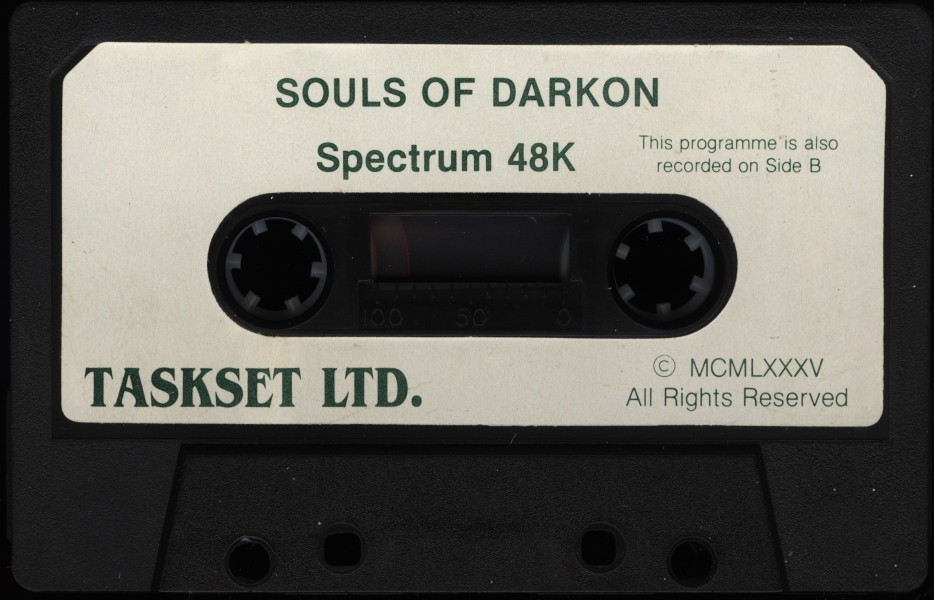
Souls of Darkon
Adventure Game: Text/Illustrated · ZX-Spectrum 48K · 1 players · English
Taskset Ltd · 1985 · Pound sterling 7.95
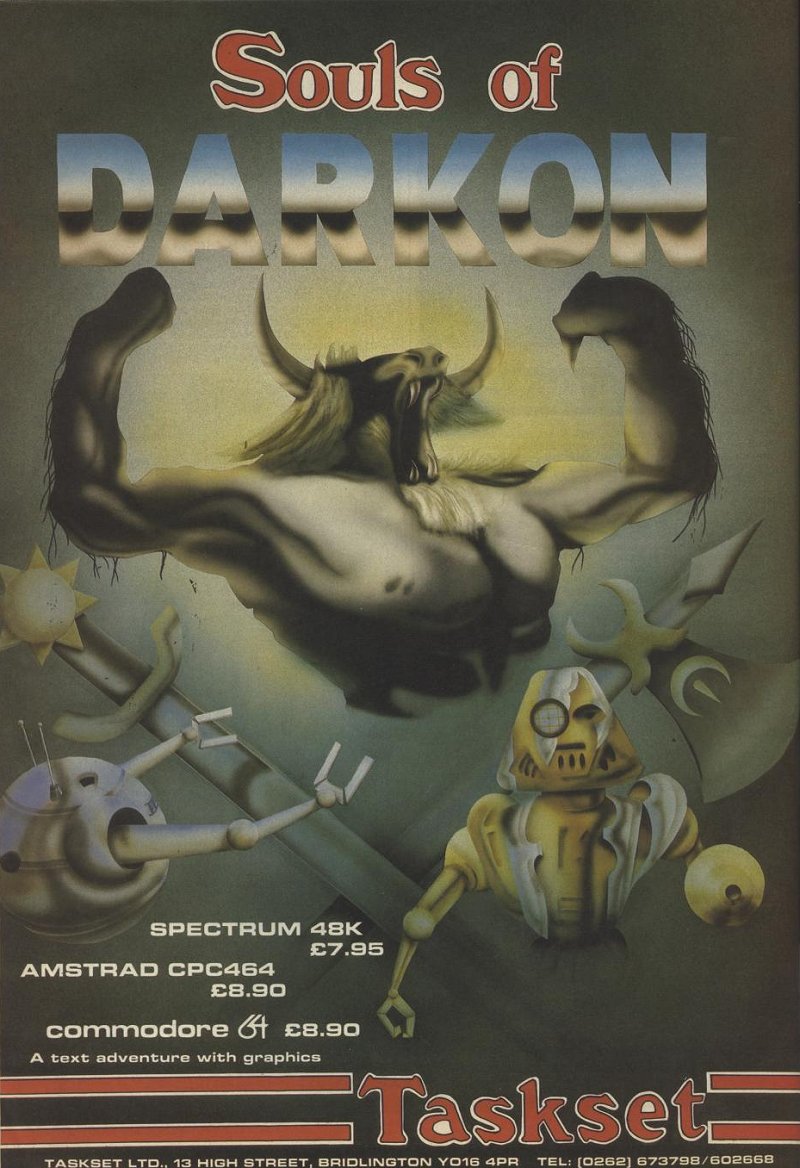
.jpg)
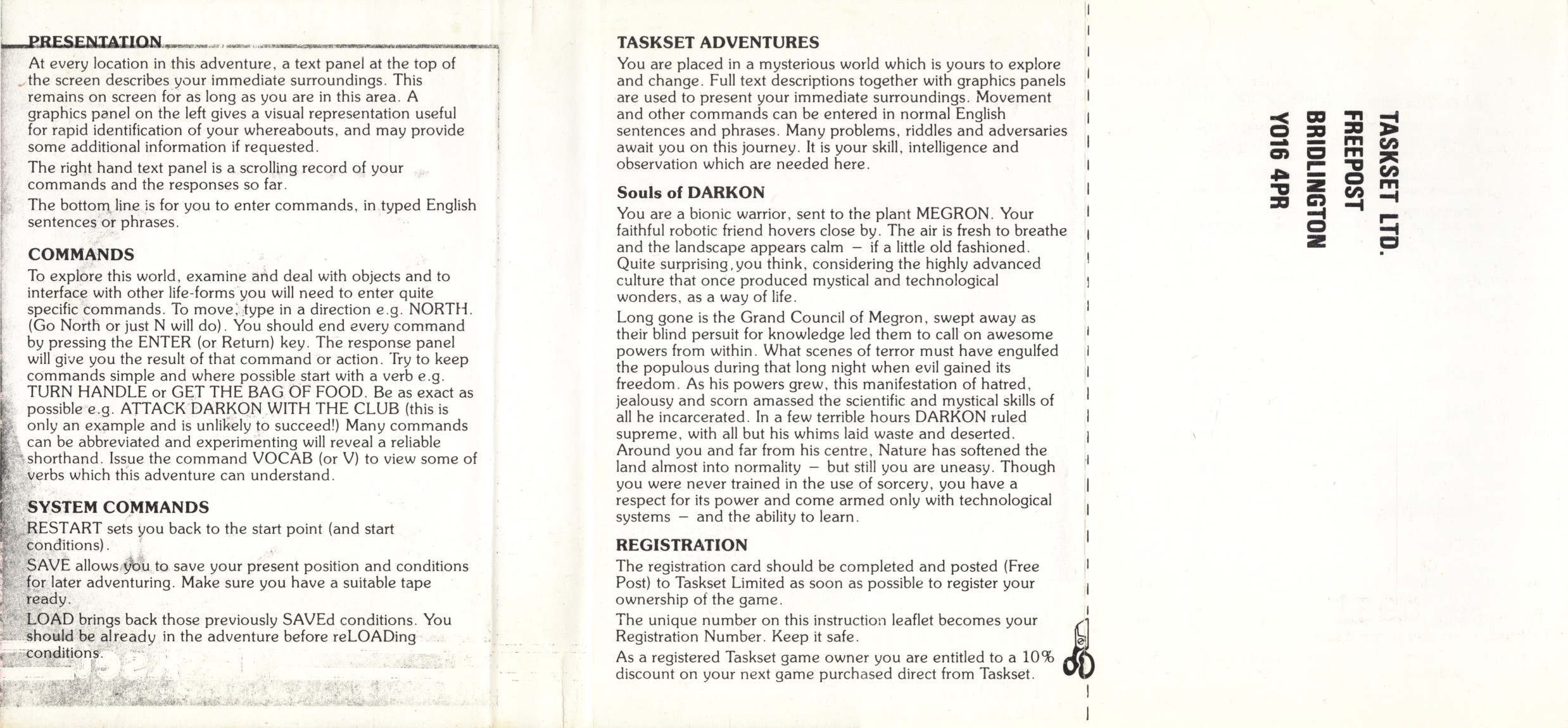
.jpg)
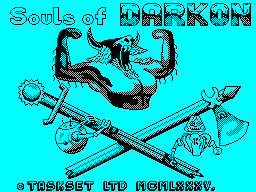
.png)
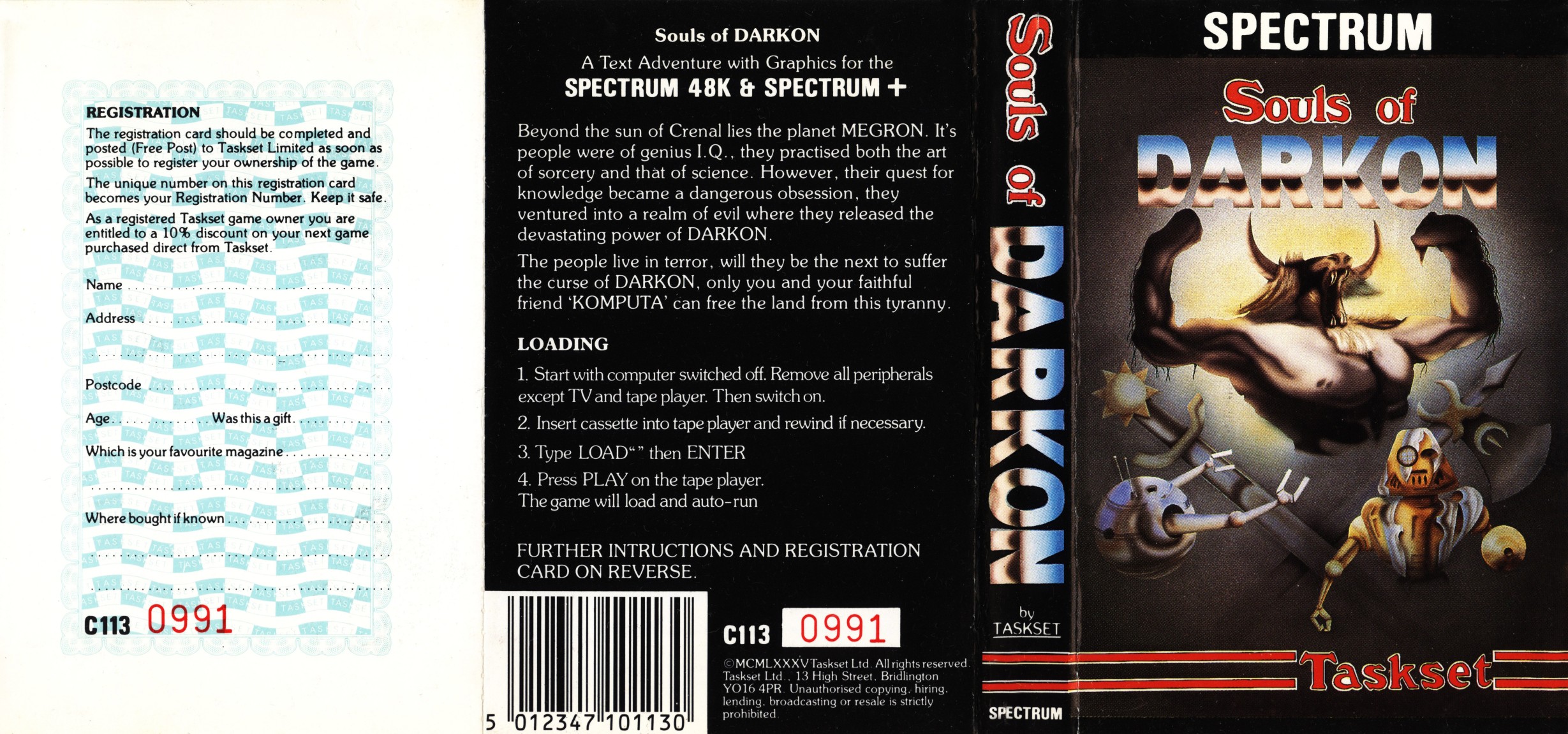
_SideA.jpg)
_SideB.jpg)
Discussion
Nobody has started a thread about this yet.
Known Errors
If you type into the input window a word wider than the display window it will scroll continuously in a loop (trying to find another line where to fit this word) and never stop.
Releases
- 1985Taskset LtdPound sterling 7.95
- 1985Bug-Byte Software LtdPound sterling 2.99
- UnknownMind Games Espana S.A.
Play
- soulsdarkon.zipRZX playback file
- SoulsOfDarkon.tzx.zipTape image English29 KB
- SoulsOfDarkon.tap.zipTape image English32 KB
- SoulsOfDarkon(Bug-ByteSoftwareLtd).tzx.zipTape image English29 KB
Documents
- SoulsOfDarkon.txtInstructions English9 KB
- SoulsOfDarkon(MindGamesEspanaS.A.).pdfInstructions Spanish16 KB
Files and rights
No permission is on record either way. Screens and pictures are copied here on a take-down basis: if you hold the rights and want something removed, say so and it goes.
Credits
- Andy Walkercredited
Sign in to credit somebody, or say what these people did.
Awards
Scores
In the magazines
- Sinclair User #471986 · Overall3/5
- Your Sinclair #121986 · Overall8/10
- ZX Computing #291986 · OverallGreat
- Crash #241986 · Overall7/10
Elsewhere on the web
- WorldOfSpectrum 5 votes7.40
In the magazines 30
Your Sinclair #12Dec 1986 · p.847/107/108/108/108/108/10
Graphics 7/10
Text 7/10
Value For Money 8/10
Personal Rating 8/10
Overall 8/10
Mike Gerrard 8/10
Title: Souls Of Darkon Publisher: Bug-Byte Price: £2.99 Reviewer: Mike Gerrard Another re-release from the new budget Bug-Byte stable, Souls Of Darkon will already have been seen by lots of you so I'll keep the comments short. Darkon is the baddy in the land of Megron, where you've just landed with the faithful robotic friend Komputa, who hovers around you wherever you go. Destroying Darkon is obviously the mission, and while the adventure is not likely to be the hardest you'll ever come across, it's beautifully presented with plenty of simple but good graphics screens and a very friendly vocabulary. In fact typing in VOCAB prints out a list of the verbs that the program recognises, saving those occasional frustrations, while there's plenty around to EXAMINE. With coins, swords, crystal fountains and blacksmiths, there's nothing very original in the early stages of the game, but that doesn't matter as the whole thing is well presented. I just hope no hardline adventurers allow themselves to be put off by a program which includes ZAP in its word list!
ZX Computing #29Sep 1986 · p.41ZX Computing GlobellaGreat
ZX ComputingZX Computing Globella
Overall Great
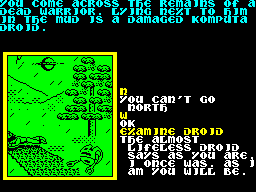
Bug-Byte £2.95 This game was released at Christmas by Taskset, and would have cost you eight pounds if you bought it then. Now, just seven months later, Taskset have disappeared and it's re-released for three pounds, a far more suitable price. You land on the planet Megron. With only Komputa, your robot, to help, you must destroy Darkon, The Evil One, who is using the awesome power of combined sorcery and science to enslave the people. On loading you immediately notice the superb presentation. At the screens top is the location description, which is usually well written if not particularly informative, and remains static; as does the picture on the left. Your commands are entered at the bottom, and are scrolled up with appropriate responses and messages in the remaining screen space. Colour is perfectly used to emphasize the text, and there's an attractive character set. The good effect is spoilt somewhat when you start to type. The input routine repeats letters too fast, even when you tap the keys lightly, so commands like 'ZZAPP ROOBOT" are common. The graphics are.. .different. They are green and black, and appear rather wishy wash and easily disregarded. Still, they are instant and hi-resolution, generally well drawn, and often respond to your actions which is a pleasant surprise. Science fiction is such a hackneyed adventure theme that to hold my interest the game must be special. This one stands out because the technological mumbo-jumbo is blended effectively into the fallen civilisation of Megron, which has reverted to a simple, medieval style life yet still retains futurist sculptures and surveillance robots. An atmosphere of bleak oppressiveness is created by the endless rain, the ancient ruins and strange relics. EXAMINE and LOOK must be used frequently to reveal important information, although the responses aren't always helpful. A command I liked was LEGEND, which, when used in certain places, describes their often sinister history and purpose. That command is not mentioned in the instructions however, which are appalling. They're incredibly brief, don't explain unusual commands like ZAP, and are mostly nonsensical. To quote: "ENTER the commands. You will need to enter specific commands... SAVE saves your current position". The scenario is incoherent, and doesn't explain your powers enough or Komputa's function. As with all the adventures reviewed this month, vocabulary is too limited at under 50 verbs. The parser is finicky about what it will accept and in particular character interaction is too difficult. Finding the right noun to examine is also tricky, and to enter buildings you must open a door which isn't mentioned in the text. There are problems aplenty, some challenging, some obvious, and some a little too obscure. The vocabulary makes them harder, and the pedantic parser provides no indication of whether you have the right idea. These faults are sadly common to a many recent adventures. Despite them, Darkon is an entertaining game which is sufficiently cheap for me to recommend to more experienced adventurers. Certainly one of the best budget adventures.
C&VG (Computer & Video Games) #52Feb 1986 · p.746/107/106/106/10
Vocabulary 6/10
Atmosphere 7/10
Personal 6/10
Keith Campbell 6/10
SUPPLIER: Taskset MACHINE: Amstrad, Commodore 64, Spectrum 48k PRICE: £7.95, cassette The brief background story to this game is rather ludicrous, for you are cast as a bionic warrior on the planet Megron, laid waste by the evil Darkon. With nothing but a faithful robot watching over you, you are presumably (for it doesn't say as much) sent to find and overthrow Darkon. The environment in which you find yourself will pass for good old mother Earth anyday, with trees and mushrooms, not to mention a log hut complete with woodman, the remains of a brewery, a blacksmiths, and the odd fountain and monument here and there. The game takes a bit of getting used to, as the text is so horribly gothic that it is almost indecipherable at first. The screen has an unusual layout, the top half describing the location in a narrative sort of way, with a picture below it to the left. The computer's replies are shown to the right of the picture, whilst the player's commands are entered at the bottom of the screen. Since the descriptions are narrative, it is necessary to type LOOK for a list of exits and objects. There are three facilities for HELP. One is to simply type the word, but more often than not you will be referred to the other two methods: LEGEND and VOCAB. The latter is simply a list of the valid words, whilst LEGEND may tell you a bit about the background of the location. The graphics are a let-down, consisting of blue line-drawings on a green background, but they are fast, and they do serve to identify where you are without the necessity of having to struggle through the location text. There are a couple of characters to be found early in the game - a toiling woodman, and a guide. Both seem rather wooden, for I have not found a way to make them listen yet, let along engage in a useful conversation, despite paying the guide for a service - he just accepts the money and then continues to ignore me! Perhaps I am using the rather limited vocab in the wrong way. There seems to be a glitch or two with the replies, as when having typed GO OUT to leave the hut, the 'narrative location' text told me I was hovering over a swamp, yet the picture showed I had remained in the hut, a fact confirmed by the subsequent reply to typing LOOK. One or two other strange messages appeared from time to time, as well. For all that, the game is quite a good one when you get used to it.
Sinclair User #47Feb 1986 · p.843/53/5
Overall 3/5
Richard Price 3/5
Publisher: Taskset Price: £7.95 Memory: 48K Heading back into the realms of text adventure we now come to the planet Megron - not a headache cure. Here you find the decaying remains of a high-tech culture apparently destroyed at its apogee. These Megronians were just too clever and managed to loose Darkon onto their unsuspecting world. He, or it, is the manifestation of all evil and hate and, within a short time after his freeing, has become the absolute ruler of Megron. The land is now returning to nature but over all broods the shadow of sorcery and terror. You, a bionic warrior accompanied by a faithful droid Komputa, have been transported to this none too pleasant place to remove the problem of Darkon. You aren't the first and will come across the remains of your predecessor along with his mangled droid. You will immediately find several knotty problems to solve. The opening section involves the gathering of objects such as the helmet of your predecessor, foodstuffs and equipment such as a hover belt, a ring and, somehow, a crystal which falls from a surveillance robot which you must zap before it sneaks on you. There is also a standing stone and an altar concealing unnamed treasure. The major task is to discover enough gold to bribe a guide to take you past Darkon's monolith and into his realm. The presentation is slick and the interpreter reacts quickly. My only real moan about the input buffer is that keys will repeat too quickly and even a light tap will result in a long string of the same letter which then has to be erased. The descriptions are concise and deliberately intended to make you 'look' a lot and examine articles. Don't assume that things aren't there because the description doesn't mention them - there is a lot of hidden detail. That applies particularly to houses. They have doors but you won't see that stated in the location text. The problems are not all simple and you will need some ingenuity to progress very far. I did feel that this was tied up with a relatively limited vocabulary, the main verbs of which are displayed if you type 'vocab'. The graphics are very fast and are displayed on the left of the screen. They will react to some of your actions - the surveillance robot, for instance, is shown both before and after zapping. The presentation is attractive, despite the key repeat problem, and there is sufficient interest in the early section to get you involved and keen to solve the riddle of the altar and the monolith. There is also action and the problems of dealing with other creatures who are not ultra-communicative unless you find their particular need or interest. Not bad.
Crash #24Jan 1986 · p.1667/107/107/106/107/107/10
Atmosphere 7/10
Vocabulary 7/10
Logic 7/10
Addictive Quality 6/10
Overall 7/10
Derek Brewster 7/10
DEREK BREWSTER'S ADVENTURE TRAIL YOUNG AND INNOCENT (DADDY, WHAT WAS THE FUTURE LIKE?) It is always a difficult task summing up a year in home computing. Even more difficult is to try and predict what the coming twelve months might unleash upon us. I say unleash because whatever else might be said about the home games world, it is never dull: the competition is ruthless, and it is peopled by the sort of mathematical genius who is past his mental zenith at the age of twenty-five years, give or take a few million brain cells. The press and media are at a loss to explain why Britain, a rather insignificant and petty nation, should concern itself with such an exciting and blatantly intellectual pastime. After all, isn't this a country in decline, a divided nation where the people who read the lightweight newspapers await an answer to all the problems while the people who read the heavyweights are struggling hopelessly with the economic conundrums of interest rates and exchange rates. Perhaps it's time to start thinking straight and doing things which come rather more easily to nations not so schizophrenic. Buying your own country's goods isn't a bad start. I remember when I was at school, and it wasn't all that long ago, much time in geography lessons would be spent learning about the manufacturing base of the British Isles. In Lancashire they had the cotton industry, in the coalfields of the Midlands and North they had steel, while in the mountains that divided these areas you had hydroelectric power, sheep, and mineral mines. I'd give away a whole shelf-load of silly pencil-top gonks to sit in such a geography lesson now (just how many different breeds of sheep are there)? The House of Lords, by far the most coherent chamber as, despite the participants' ages, they are not honour-bound by political allegiance, stated Britain should look to the new technologies as herein lies the next revolution. Couldn't agree more. And so it would seem to be with the public who went out and bought the Sinclair computers despite much in the press about the unreliability of the machines. Much was made of the lack of sound when everyone knew full well that Sinclair's competitors were caught in the no man's land between beeps and buzzes and the full-bodied melodies of a synthesizer. The truth is the sound on these machines grinds after a short time and the demure bleeps of the Spectrum come as a blessed relief. I read a local paper recently that put forward the reasons behind buying a microcomputer this Christmas. Quite rightly some of the points they raised included amount of software available, price, and whether little Johnny's friends had the micro. It was curious to find the article extolling the BBC computer over the Spectrum. Let me put this as bluntly as I can. The Spectrum microcomputer is a brilliant device both for learning BASIC etc, and for playing games. I own, or have owned, an Atari, a BBC, an Amstrad, and a C64 and all have some major flaw in design, screen layout, add-on capability or available memory. What is more, the Spectrum was quite merrily computing away long before the others and so has a quantity and breadth (and availability) of software which leaves the others looking nice in the shops. As for the QL, yes, the microdrives are unreliable, but we live in times where rapidly-developing technology must be offered at an affordable price, and who would begrudge Clive Sinclair when NASA's budgetry constraints had DIY men throughout the world laughing at some tiles which just wouldn't stick. And it's no use laughing at the C5 while you pollute the atmosphere in your heap of rusting junk whose technology has changed little since its inception. Arthur C Clarke's (and Daddy's) visions of the future, with the printless world, gigantic space colonies, and the kind of mentality that goes with them, may not ever be quite as anticipated, but there is no need for the cynical technofear as displayed in such media mishmashes as Tomorrow's World and Micro Live. I suggest the first person who had the ludicrous idea of making technology more palatable in this dreadful manner go and write some techno-fear soap operas and leave the task to someone who is prepared to deal with the facts sensibly and reliably. Admittedly, this would remove any chance of political tampering with the facts, but it is a political reality that the new technologies are coming whether we like it or not. Any nation which actually gets to grips with the technology as opposed to the 'subject for discussion' will reap the undoubted rewards. 1985 was notable for the demise of MSX. MSX was a good idea, making a range of machines between which software was fully compatible. The only problem was, there was already a great deal of compatibility between the Spectrums that everyone was buying in droves. The Spectrum has, and will, last longer than either myself or other commentators thought possible. This year was notable for the escalation in the tie-in battles with major film titles such as Gremlins, Rambo, View to a Kill and Never Ending Story gracing the computer store shelves. The advantage to these deals is the recognition a product gets through the public's familiarity with the concept and storyline. TV tie ins can be even more effective in terms of public awareness of the product. These thoughts lead me on to an area which, to me, has really made itself plain over the last year. The perceivable age of the home games playing market seems to have dropped steadily down through the teens to the point where anything beyond a platform game is seriously questioned in terms of its likely viability in the market place. There's nothing inherently wrong or worrying about the spectre of a carry-cot Spectrum attachment with that all important fire button within reach of tiny hands, it's just that one shudders to think what popular music there would be right now if it wasn't for the older listeners pulling the whole standard of music up by its bootstraps. It is my guess that if the reading age of Sounds and NME fell by a few years those who, on paper, would benefit by such a fall would loose interest in the whole ostensibly uplifting exercise. And all this brings me back to adventuring (believe it or not). The demise of the intelligent, text-only, adventure epitomised by Level 9's Snowball, and mourned in SIGNPOST, is a part of this lowering of the intellectually exacting nature of computer games. In a nutshell, programs have become simpler. Utilities such as the Quill and Illustrator will continue to figure prominently in adventuring, and it doesn't take much of a jump to realise that they will be more important in all games' design in the near future. In America the computer games market is older because the machines Americans own are larger and more expensive, and more useful to the whole household. In Britain home computers are toys. It remains to be seen whether the market is going for the gutter or searching for the stars. SOULS OF DARKON Producer: Taskset Retail Price: £7.95 Language: Machine code Author: The Taskset Team Beyond the sun of Crenal lies the planet Megron. Its people were of genius 10; they practised both the art of sorcery and that of science. However their quest for knowledge became a dangerous obsession and they ventured into a realm of evil where they released the devastating power of Darkon. The people live in terror. Will they be the next to suffer the curse of Darkon? Only you and your faithful robotic friend, Komputa can free the people from this tyranny. But can you succeed where so many have failed? Souls of Darkon is already in the shops on the Amstrad as I write, so whether or not you'll be able to buy the game in the high street is probably academic. The reasons for this game's acceptance by the shops is quite obvious as soon as you load up. Taskset have successfully met their task of taking the adventure and tidying it up. Gone are the messy lists of endlessly scrolling text and graphics. In their place we have here a neatly boxed-off picture set on the lower left hand side of the screen. Above this is the location description which does not budge an inch throughout quite an advantage over other adventures where you are constantly wondering where you are. Framed by the static picture and location description is a scrolling area carrying your input and the programs responses. The text has been clearly and atmospherically designed, in fact, what with the stylised, cartoon-like graphics, the whole program reveals a novel appearance. One minor irritation is Task set's inability to get to grips with the Spectrum's input routine (the Amstrad version works just fine). Even when you are carefully typing the auto-repeat effect can catch you out with words like L O O O O K ending up on your scrolling list of past inputs (rather embarrassingly, the input recorded is the exact word you entered and not the word from the program's own word store). Another gripe is an error which is common to many adventure instructions (Sorderon's Shadow did the very same thing last month). The error I refer to is the habit of listing a so-called example of the vocabulary going beyond the simple verb/noun couplings only to find that the program's input routine can't handle such a long sentence, for example, in this case, ATTACK THE WOODMAN WITH THE LUNAR AXE is too long to be accepted& Ac rious side effect of allowing the location description to remain on screen is the need for a LOOK command which tells you what you can see, eg a bottle, a mushroom, along with the exits. The reason for this, presumably, is the restriction of space on the location description. It may have been better to have made the adventurer work for his/her information with a more intelligent LOOK/EXAMINE command. Programming the DELETE key to act without the need of the CAPS SHIFT is a nice touch as is the list of words in the vocabulary which comes up onto the screen and stays there while you try and match up some of the words from it. Souls of Darkon is a very well presented adventure and a welcome change at a time when just about every mainstream adventure is Quilled. The cartoon-style graphics are very effective and suit the game well. COMMENTS Difficulty: easy to start, then the usual brick wall Graphics: one colour - green-but attractive Input facility: a little beyond verb/noun Response: fast
Games Compendium carries this game and has 13 references of its own.
Tips12
- Your Sinclair #54Jun 1990 · p.59
- Your Sinclair #33Sep 1988 · p.105
- C&VG (Computer & Video Games) #79May 1988 · p.81
- C&VG (Computer & Video Games) #75Jan 1988 · p.111
- C&VG (Computer & Video Games) #71Sep 1987 · p.91
- C&VG (Computer & Video Games) #70Aug 1987 · p.75
- C&VG (Computer & Video Games) #66Apr 1987 · p.64
- Your Sinclair #15Mar 1987 · p.54
- C&VG (Computer & Video Games) #64Feb 1987 · p.105
- C&VG (Computer & Video Games) #60Oct 1986 · p.79
- C&VG (Computer & Video Games) #58Aug 1986 · p.73
- C&VG (Computer & Video Games) #57Jul 1986 · p.79
Full-page ad5
- Crash #24Jan 1986 · p.28
- C&VG (Computer & Video Games) #50Dec 1985 · p.105
- Computer Gamer #7Oct 1985 · p.99
- C&VG (Computer & Video Games) #48Oct 1985 · p.49
- Computer Gamer #6Sep 1985 · p.26
News/Note4
- C&VG (Computer & Video Games) #60Oct 1986 · p.77
- ZX Computing #27Jul 1986 · p.8
- Computer Gamer #7Oct 1985 · p.32
- Home Computing Weekly #127Aug 1985 · p.6
Information1
- SSD-IISep 1999
Solution1
- ACE (Advanced Computer Entertainment) #23Aug 1989 · p.98
Advert1
- Your Sinclair #8Aug 1986 · p.19
Review1
- Popular Computing Weekly #5Jan 1986 · p.28
Related
- Compilations
- Games Compendium
- Ports
- (Amstrad CPC), (Commodore 64)
- Same entry at
- Spectrum ComputingZXInfo
Reviews from people here
Sign in to write about this, or make an account. It takes a minute and lets you correct the catalogue too.
No tag recorded.
Sign in to correct or add to this.
Hold the rights to this and want it taken down?