
Action Reflex
Arcade Game: Action · ZX-Spectrum 48K · 1 players · English
Mirrorsoft Ltd · 1986 · Pound sterling 7.95
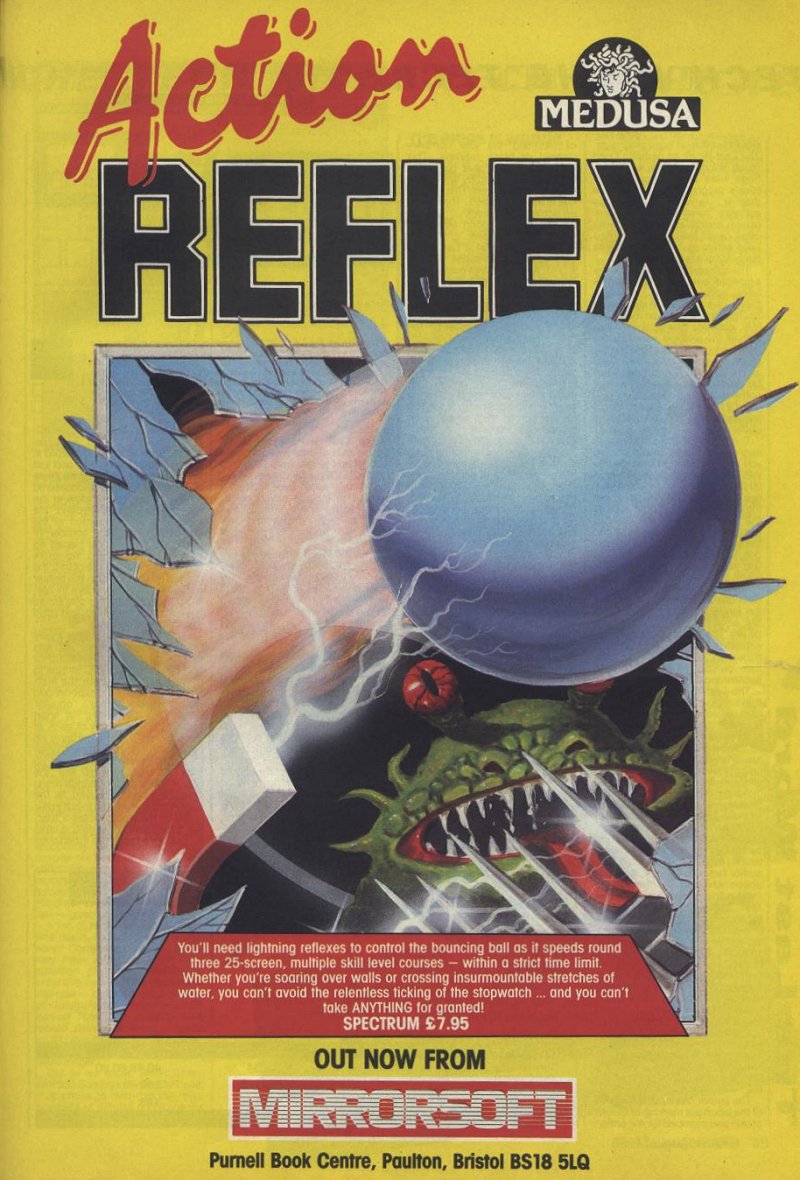
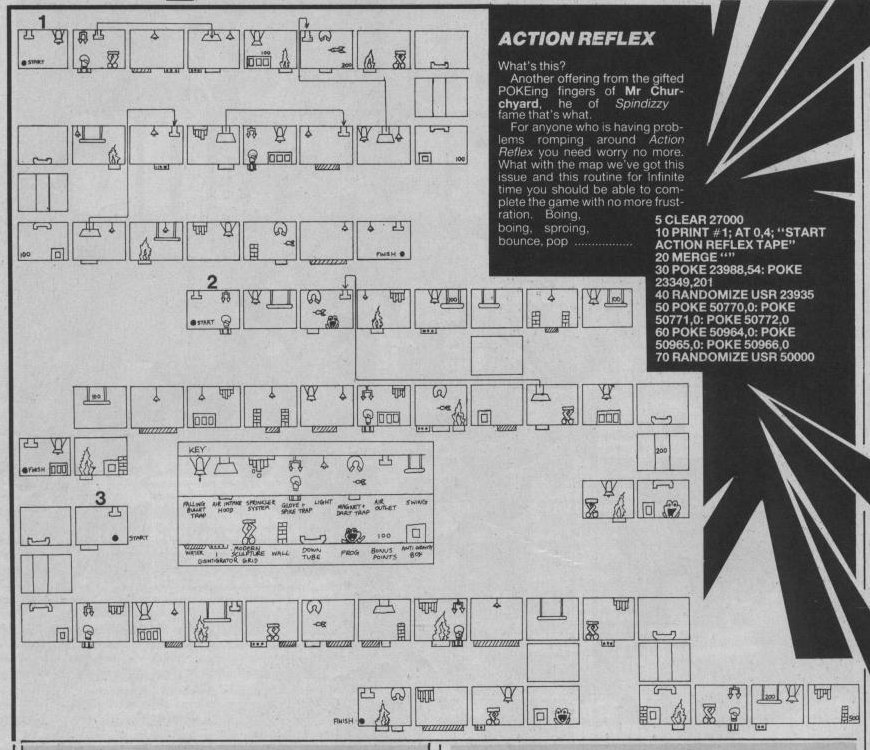
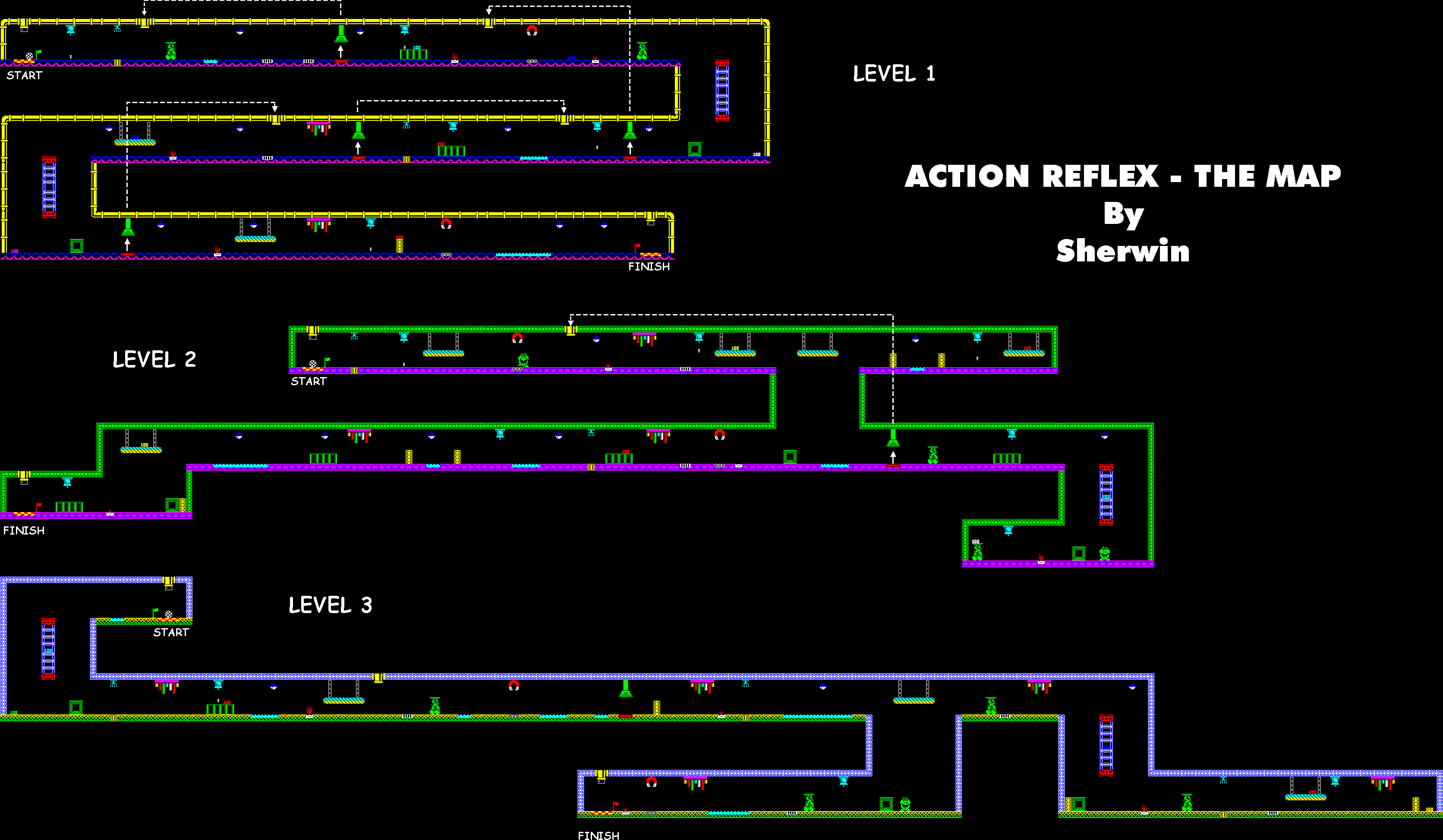
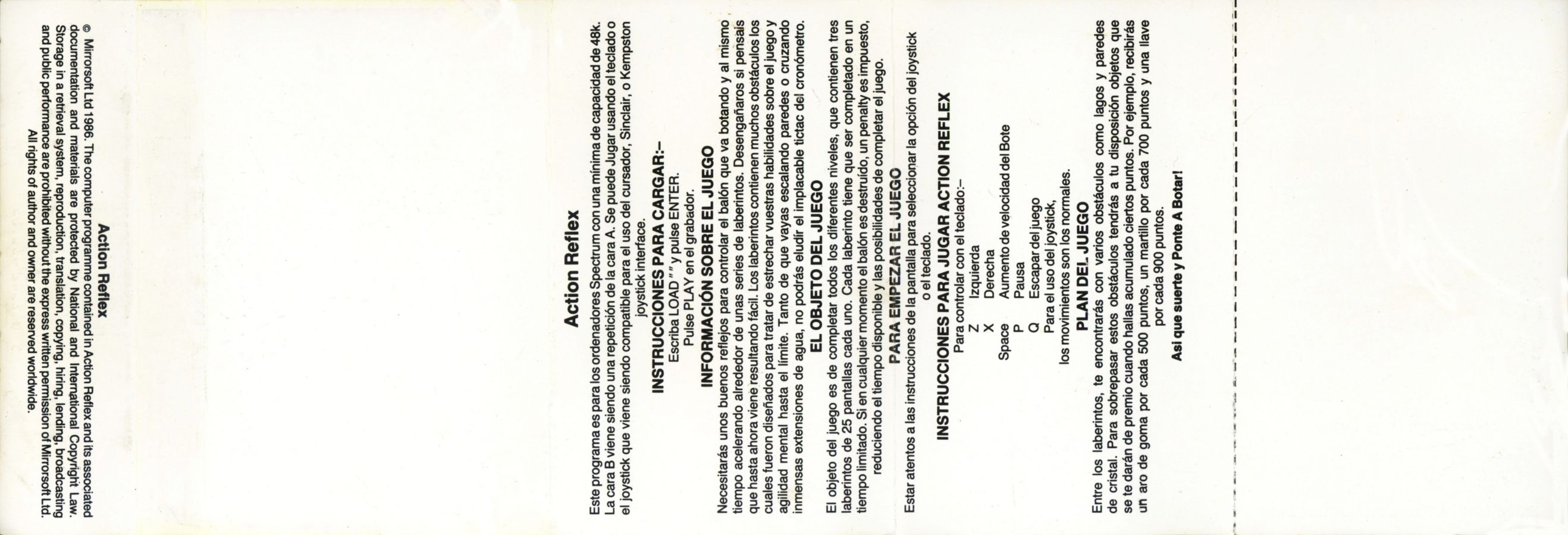
_Back.jpg)
.jpg)
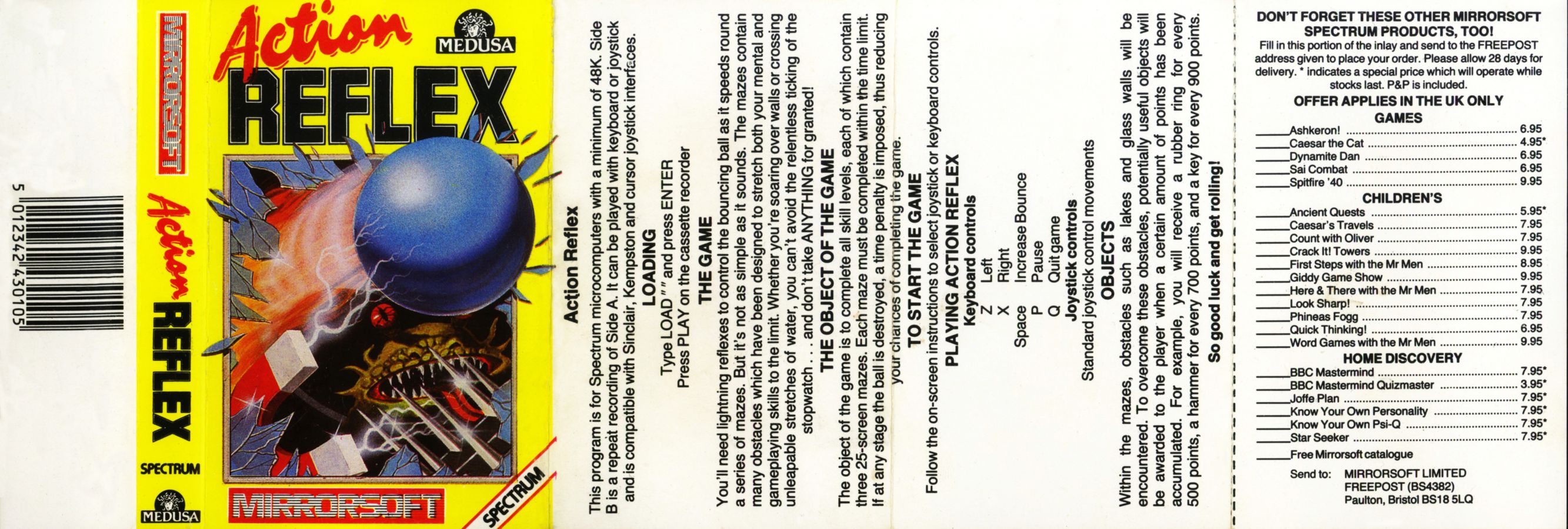
_Front.jpg)
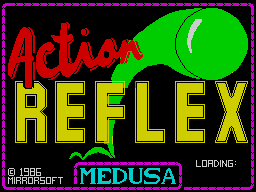
_SideA.jpg)
_Media.jpg)
Discussion
Nobody has started a thread about this yet.
- Control Option
- Cursor, Interface 2 (right), Kempston Joystick
Releases
- 1986Mirrorsoft LtdPound sterling 7.95
- 1986Zafi Chip
- 1987RicochetPound sterling 1.99
Play
- actionreflex.rzxRZX playback file
- ActionReflex.tzx.zipTape image English17 KB
- ActionReflex.tap.zipTape image English17 KB
- ActionReflex(Ricochet).tzx.zipTape image English17 KB
Documents
- ActionReflex.txtInstructions English2 KB
Other files
- Action Reflex (1986)(Mirrorsoft).pokPOK pokes file 0 KB
Files and rights
No permission is on record either way. Screens and pictures are copied here on a take-down basis: if you hold the rights and want something removed, say so and it goes.
Credits
- Christian F. Urquhartcredited
- Medusacredited
Sign in to credit somebody, or say what these people did.
Awards
Scores
In the magazines
- Sinclair User #541986 · Overall4/5
- Your Computer #71986 · Overall Rating4/5
- Your Sinclair #81986 · Overall8/10
- ZX Computing #281986 · OverallGreat
- Crash #311986 · Overall88%
- Sinclair User #721988 · Overall8/10
- Crash #561988 · Overall76%
Elsewhere on the web
- WorldOfSpectrum 58 votes8.18
In the magazines 36
Crash #56Sep 1988 · p.8876%
Overall 76%
Kati Hamza
Mark Caswell
OLDIES UNLIMITED Practically every software shop now sports row upon row of irresistibly shiny, incredibly tempting re-releases. If this array of gorgeous goodies leaves you breathless and confused (even £1.99 is a waste if it's spent on something truly bad), never fear. With years of experience on their side, a metaphorical teacup soothingly poised and plenty of calming advice, MARK CASWELL and KATI HAMZA are about to cool your troubled brow. Pause before you squander all your silver pennies. Collapse into a comfortable chair and peruse our guide to a few of the better re-releases... Action Reflex Producer: Ricochet Price: £1.99 Original Rating: 88% Written by Christian Urquhart, author of Daley Thompson's Decathlon and Xecutor, Action Reflex, originally published by Mirrorsoft, deals with the antics of a crazy bouncing ball. Trapped inside a linked series of three mazes, it must avoid a variety of static and moving obstacles, gain points to collect helpful objects and negotiate air events and planes of water - all in a desperate bid for rubber ball freedom (whatever that may be). Rather like Bounder, Cauldron II and the recently released Hopping Mad in style, Action Reflex still comes across as a very playable game. Its bright and colourful backdrops hide an immense array of dangerous hazards, helpful and harmful objects, secret passages and unusually safe short cuts. With so many different features you're practically guaranteed hours and hours of play. If you've enjoyed other ball-bouncing games, get yer hands on this! It's a little bundle of uncontrollable fun.
Has the ball lost its bounce?
Sinclair User #72Mar 1988 · p.628/108/10
Overall 8/10
Tony Dillon 8/10
Label: Ricochet Price: £1.99 Memory: 48K/128K Joystick: various Reviewer: Tony Dillon, the crisp bringer. Guess what, this is another of those bouncy ball type games. You know that type of game when you have to do all the business with avoiding obstacles and all that. Most of them games, though, are pretty boring int they? But this one's quite good. Eh? What do you mean you don't know what I'm talking about. Oh, you've lived in Somerset all your life. Why didn't you say so. I'll start again, shall I? (Hoi! I know people that live in Somerset! - Ed) In AR, you play a little chequered ball, that has to bounce down a long corridor, avoiding all the things littered about the place, like the magnets that catch you, or the holes that make you fall to your death if you land on one. Graphics are nice and clear, with the game relying more on recognisability more than realism, with huge horseshoe magnets and darts. The game scrolls along at a nice fast pace and is very very playable. One of the budget year's best buys, and if it doesn't make it into the top 10 budget games, I'll eat my granny and her bathchair (That's age-ist - Ed)
C&VG (Computer & Video Games) #60Oct 1986 · p.466/105/105/104/10
Graphics 6/10
Sound 5/10
Value 5/10
Playability 4/10
Jim Douglas
MACHINE: Spectrum 48K SUPPLIER: Mirrorsoft PRICE: £7.95 "Wait a minute," I hear you cry. "I read all about Action Reflex in the super August issue!" Well, that was the "penultimate" version. Now I've got my mits on the real one, and am going to tell you about it, whether you like it or not. The object of the game is to move through the various screens, avoiding death which is dished out by various fiendish and not-so-fiendish traps littered about the game. Just about the only difference we could find when comparing it to our pre-production copy was that there are now large green funnels which suck up your ball and spits it out somewhere else. There isn't an awful lot to the game, and the price will prohibit its inclusion in all but the most extravagant of software collections.
Sinclair User #54Sep 1986 · p.614/54/5
Overall 4/5
Graham Taylor 4/5
Label: Mirrorsoft Author: Urquhart, Chubsly and Herman Price: £7.95 Memory: 48K/128K Reviewer: Graham Taylor Action Reflex is one of those games that is entertaining without being exciting. Technically there is nothing special to say about it, it boasts no new and impressive graphic routines, it doesn't feature artificial intelligence (however artificially) and it isn't going to win any prizes. On the other hand, I found it infuriating and had a severe attack of the 'just one more go'. A bouncing ball looking suspiciously like the Amiga demo is the heart of the game (OK, it doesn't look much like the Amiga demo but it has got a checkered pattern on it). Learning to control the ball, which acts just like you would expect a bouncing ball to act is the art of the game. The challenge is provided by a series of odd but vicious traps which deflate both ego and ball simultaneously. The ball movement is a subtle affair, bounce levels can be controlled quite precisely but don't drop immediately to zero when you wish them to. In other words, the super leap you build up to help you jump the tall funny statue type thing in one screen may also hurl you uncontrollably into the deadly fire pit in the next screen - get the picture? There are some other features to the game. Some objects have to be acquired in order to pass certain obstacles. Useful objects are not collected but 'earned' - they are awarded automatically each time a certain number of points are achieved. Points are awarded for successfully negotiating certain obstacles. Sound is rather minimal, just enough to give the audible impression of a bounce. I do like the ideas behind the graphics, there are some touches of gloriously eccentric violence a la Road Runner. I particularly like the hidden boxing glove which springs from the floor and punches the ball straight into the prongs of what looks like a pitchfork. That's about it really, the key to the game is learning how to work those bounces and learning what bounce patterns are required between certain screens. Nothing amazing but I liked it.
Your Sinclair #8Aug 1986 · p.709/108/108/109/108/108/10
Graphics 9/10
Playability 8/10
Value For Money 8/10
Addictiveness 9/10
Overall 8/10
Luke C 8/10
Mirrorsoft £7.95 Reviewer: Luke C Well, I'd just like to be the first to say sorry for harping back to the Jet Set Willy classics but, although this game is completely different, its very similar. (I'm sorry I'll write that again!) What I'm getting at is that the JSW games were an exercise in getting Willy to just the right place at the right time, jumping at just the right moment, and it was the same each time you negotiated that screen. Yes? And it's the same with Action Reflex, only this time you're controlling what looks like a football... The scene is set in a series of underground caverns, full of strange obstacles, and its your task to get around 25 screens before the time limit is up. Once you've done that, you set out on the next of the three mazes. Don't ask me what happens on the third maze - I've yet to get there! The movement of the football is wonderful - whatever algorithm the programmer has used mimics the real thing perfectly. You can move the football left and right, and bounce it up and down. It does take a bit of getting used to, though, as the ball slowly accelerates and decelerates according to an exponential or parabolic curve, gathering momentum as it moves - ask your local mathematician if you're not sure what I'm talking about. Whatever... you'll soon get the hang of it within about five goes. Moving around the screens, there are all sorts of things to watch out for - like the ball disappearing into lakes, being destroyed by fire burst, being punched up to the ceiling and shot with an arrow, hitting overhead magnets and, of course, the various coloured wobbly meanies that shuffle about generally getting in the way. Within the time limit, you have an infinite number of lives - but each new life means that you lose a couple of valuable seconds... making it very difficult to get around all 25 screens before your time runs out. Points can be picked up on the way by 'walking' the ball through them - these are then accumulated so you can gain objects, such as a ring, hammer and key. These'll come in handy later on. Which brings me around to my original point about the game being a little bit like JSW and, in particular, Manic Miner (if you can bring yourself to remember that far back). When I first played Action Reflex, it took me my full time limit to get through the first five screens of the first maze. After five or six attempts, I'd sussed out a 'safe' route and managed to get through about 12 screens... and so on... until I'd cracked the first maze. But the most frustrating bit is having to get through the screens you know well, especially if you keep making silly mistakes, until you get to a screen you haven't seen before. Yes, it's very clever, and it's one of the most addictive games I've played... but I think a better title would've been 'Learned Response'.
C&VG (Computer & Video Games) #58Aug 1986 · p.296/105/105/104/10
Graphics 6/10
Sound 5/10
Value 5/10
Playability 4/10
MACHINE: Spectrum 48K SUPPLIER: Mirrorsoft PRICE: £7.95 Good grief. We've had pre-production copies. We've had preview copies, we've even had botched-up demo copies. This, however, is a first. It's a penultimate version of Action Reflex. Why companies won't just admit that the ruddy product isn't ready is beyond me! Hurumph!! Having got that off my chest, I can get on with the important issue; what the game is actually like. It's been written by C. F. Urquhart. Name rings a bell, doesn't it? Unfortunately, there's nothing that I could find which makes this game stand out from the run-of-the-mill offerings which flood the C+VG offices. The "aim" of the game is exploration. It's nicely presented, with very colourful, graphics and reasonable sound. You take control of "bounce", a sphere. Hardly the most charismatic character. Still, he's certainly got some energy; rushing around the screen like nobody's business. You control him simply by pushing the joystick left and right, and pressing fire to make him bounce. (Keyboard control is included as well). It's humiliatingly frustrating. The C+VG swear-box was filled to overflowing after only a few seconds play. Mirrorsoft says that they will be making some alterations, which "may affect game play". With any luck, it will make the thing slightly more easy. As it stands, the game is just too tough. Your progress through the various screens is hampered by an assortment of nasties - some stationary, others mobile. There are a number of traps. Crossing a suspect pad in the floor may well result in you being sprung into the air. If there is a magnet above the pad, you're in serious trouble as a dart will fly across the screen and effectively burst your ball, while you are hanging helplessly from the magnet. Water troughs and plain-old holes provide more ball-breaking problems. You can take some transport short-cuts too. Chutes and tubes will whizz you from place to place. The main problem with the program is that bounce is so bloody hard to control! Once he's started his frenetic bouncing routine it's nigh-on impossible to stop him from careering into something deadly. That's just about it. Nothing particularly special.
Crash #31Aug 1986 · p.2888%88%86%88%89%88%88%
Use of Computer 88%
Graphics 88%
Playability 86%
Getting Started 88%
Addictive Qualities 89%
Value For Money 88%
Overall 88%
Unknown
Unknown
Unknown
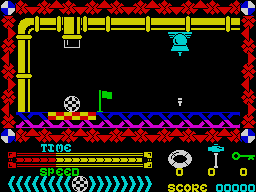
Producer: Mirrorsoft Retail Price: £7.95 Author: Christian Urquhart Another ballgame with a difference! The central character in this game is a chequered ball which has been trapped inside a linked sequence of three mazes. The sphere has to be guided through the whole course three times in all, each trip through the mazes more difficult to make, before freedom is won. Like most balls, the star of Action Reflex can roll along the floor - in this flip-screen playing environment, to the left or right. Bouncing is also in the repertoire: holding the fire button makes the Round One bounce higher and higher until maximum bounce has been achieved. The game is played against the clock, represented by a chart at the bottom of the screen. As time progresses a yellow pointer gradually moves towards the red danger zone, and if the current section of maze is not completed before the time limit expires, it's curtains. A variety of static and mobile obstacles must be avoided or evaded: bullets are shot from the ceiling; boxing gloves punch the spherical hero skywards, impaling it on dangerous looking spikes; magnets lure the bouncing ball to the top of the screen and hold it immobile until a dart comes along. Nearer ground level, drains suck the ball downwards and pools of water lurk in which unsuspecting balls can easily drown. Air vents whoosh the ball upwards through a vacuum delivery system and suck it along overhead pipeways to deliver the reluctant prisoner back to an earlier part of the maze. Whenever the ball is burst, time is lost and play restarts from one edge of the current screen. Some objects in the game can be of use to your little bouncing chum on its travels. These are not collected on the journey as in most arcade adventure games, but are awarded automatically according to the number of points that have been amassed. Points are dotted around the maze in a variety of denominations, and are collected by rolling through or bouncing onto them. Once five hundred points are nestling comfortably in your pocket, a rubber ring is thrown your way. This makes it possible for the ball to pass unscathed over a stretches of water. Seven hundred points is the price of a hammer that comes in very handy for breaking down one of the glass walls blocking off explorable areas of the maze. A key is slipped into your possession when nine hundred points have been collected, and can be used to unlock underground chutes that provide safe passage through tricky areas. These items can only be used once, and icons in the status area keep track of the quantity of each of the tools in stock. When a direction key is pressed and held, the ball gathers speed and two sets of chevron arrows under the time display give a readout of the speed of travel. Releasing a key allows the ball to slow down and come to rest - there are no brakes! The speedometer is useful when fudging large leaps or when avoiding bullets and spurts of flame which suddenly erupt from cracks in the floor. When time runs out, the game ends and a result screen pops into view to report on progress. Better luck next time, eh? COMMENTS Control keys: Z left, X right, SPACE increase bounce, P pause, Q quit Joystick: Kempston, Cursor, Interface 2 Keyboard play: no problems Use of colour: very attractive Graphics: nice animation, lots of detail Sound: good effects Skill levels: one - gets progressively harder Screens: 7
Another action snap. The unwary sphere landed on that trigger pad, which activates the magnet. A dart is then despatched to deal death to the spherical adventurer as it is held helpless...
Cameron's been practising his action photography - here's a snap of the ACTION REFLEX ball in mid flight, as it travels towards a set of ceiling spikes after being biffed by a boxing glove.
ZX Computing #28Aug 1986 · p.15ZX Computing GlobellaGreat
ZX ComputingZX Computing Globella
Overall Great
Mirrorsoft £7.95 This is an odd little game. I'd seen a couple of pre-production versions of the game and it seemed like a fairly ordinary dodge-the-obstacles type program with a bouncing ball instead of a jumping Jet Set Willy character. However, when I finally got my hands on the finished version it turned out to be to be quite a bit more challenging more challenging than I expected. You control a chequered bouncing ball that has to be guided be guided around an obstacle course. Your controls are just lelf/right and jump, and to begin with the ball is left lying on the floor of the first section of the of the course. The motion of the ball is quite tricky to handle and although this isn't an enormously fast game it can be quite challenging working out how to get past all the different types of obstacles - especially as getting past one tricky spot can send you hurtling out of control into an even deadlier one just a little further along the way. The movement of the ball is fairly realistic, in that it has inertia which causes the ball to accelerate and decelerate quite slowly at first then the speed change increases more rapidly. To get the ball bouncing first you have to stop moving left/right and press the bounce button to build up the height of your bounces. The longer you hold the bounce button, the higher the ball will bounce (though obviously this is limited by the height of the screens themselves) and once you've achieved the height that you think you need you can then bounce off along the course. This requires good judgment on your part, since once the ball is bouncing it's quite easy to misjudge the speed and height that the ball will be moving at, and if you hit something accidentally you can find yourself bouncing helplessly all over the place and getting killed by one of the traps lying in wait. There are three mazes to complete, each containing 25 screens full of traps and obstacles, and each harder than the last. The course contains some goofy green monsters which wander back and forth and a variety of fixed traps that can destroy you in all sorts of ways. There are lakes that you can sink into, tubular tunnels that need to be smashed open with a hammer, flame throwers, magnets, flying darts and many other devices guaranteed to deflate both the ball and your game-playing ego. There are also some obstacles which can't just be bounced past. These require you to collect objects that are scattered along the course (and normally in inaccessible corners guarded by monsters). The lakes can only be crossed if you've found a life raft, tunnels need a key to get through them and some locked doors have to be bashed down with a hammer. Graphically the game is fairly simple to look at - and looks a lot like any decent platform and traps game - with lots of large colourful sprites and some quite good animation, particularly in the movement of the ball itself. There is no set number of lives as you play against a time limit, but each time you get punctured you receive a time penalty so you've got to try and make some quick decisions and you don't always have time to stop and work out exactly what your next move is. Action Reflex isn't going to win any awards for the most original game of all time but it is an addictive and tricky game that needs a combination of arcade reflexes and a little bit of planning and judgment. My only doubt about it is that three mazes might not be sufficient to give the game a very long lifespan.
Your Computer #7Jul 1986 · p.424/52/54/54/54/54/5
Graphics 4/5
Sound 2/5
Playability 4/5
Value For Money 4/5
Overall Rating 4/5
Ian Nicol 4/5
Spectrum Mirrorsoft Arcade Adventure £7.95 With hundreds of new games entering the market each week and software houses struggling to meet the rising demand for new games, it seems inevitable that, eventually, programmers will run out of names for their creations. That would explain why the first game from the new Mirrorsoft Medusa label has the unlikely title of Action Reflex. Even though it sounds like a medical term for a muscle spasm, the game is very enjoyable. It involves guiding a bouncy ball through a maze of screens filled with everything from green monsters and spiked gloves to wall speakers and vacuum tubes. At various intervals along the floor of the maze there are certain places which, should you roll or bounce on them, will lead to your doom. Only trial and error will identify the safe areas, so making a map as you proceed is a very good idea. The idea of the game is to complete the maze. As you progress deeper and deeper, obstacles such as glass walls and lakes are encountered. Only by collecting certain objects along the way can they be overcome. A counter on the screen records your progress. If you lose a life, a time penalty is imposed, reducing the chance of completing the game. There are three skill levels with 25 screens on each level, a real challenge for those who can face the embarrassment of going into a software shop and saying "Action Reflex, please".
Advert10
- Sinclair User #52Jul 1986 · p.39
- Your Computer #7Jul 1986 · p.16
- Crash #30Jul 1986 · p.27
- C&VG (Computer & Video Games) #57Jul 1986 · p.16
- Computer Gamer #16Jul 1986 · p.37
- C&VG (Computer & Video Games) #56Jun 1986 · p.43
- Crash #29Jun 1986 · p.45
- Your Sinclair #6Jun 1986 · p.38
- Sinclair User #51Jun 1986 · p.37
- Your Computer #6Jun 1986 · p.55
Hack/Poke4
- YS Smash TipsAug 1988 · p.1
- Your Sinclair #13Jan 1987 · p.92
- Sinclair User #56Nov 1986 · p.20
- Crash #32Sep 1986 · p.54
Full-page ad4
- Popular Computing Weekly #38Sep 1986 · p.2
- Crash #31Aug 1986 · p.97
- Popular Computing Weekly #29Jul 1986 · p.39
- Popular Computing Weekly #26Jun 1986 · p.7
News/Note3
- Popular Computing Weekly #49Dec 1987 · p.18
- Popular Computing Weekly #39Oct 1987 · p.43
- ZX Computing #26Jun 1986 · p.5
Preview3
- Sinclair User #53Aug 1986 · p.98
- Sinclair User #51Jun 1986 · p.89
- Crash #29Jun 1986 · p.122
Review2
- Popular Computing Weekly #27Jul 1986 · p.16
- Computer Gamer #16Jul 1986 · p.67
Map1
- Crash #32Sep 1986 · p.54
Related
Reviews from people here
Sign in to write about this, or make an account. It takes a minute and lets you correct the catalogue too.
No description recorded.
Sign in to correct or add to this.
Hold the rights to this and want it taken down?