
Captain Blood
Adventure Game: Graphic · ZX-Spectrum 48K/128K · 1 players · English
Exxos · Jan 1989 · Pound sterling 9.95 · Pound sterling 14.95 disk
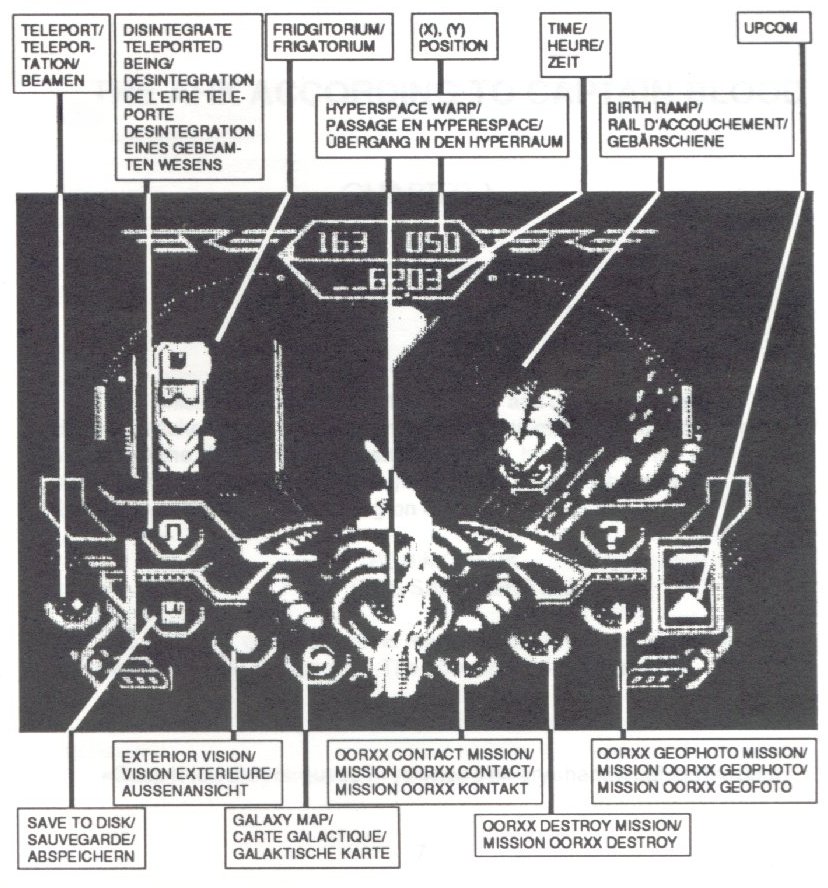
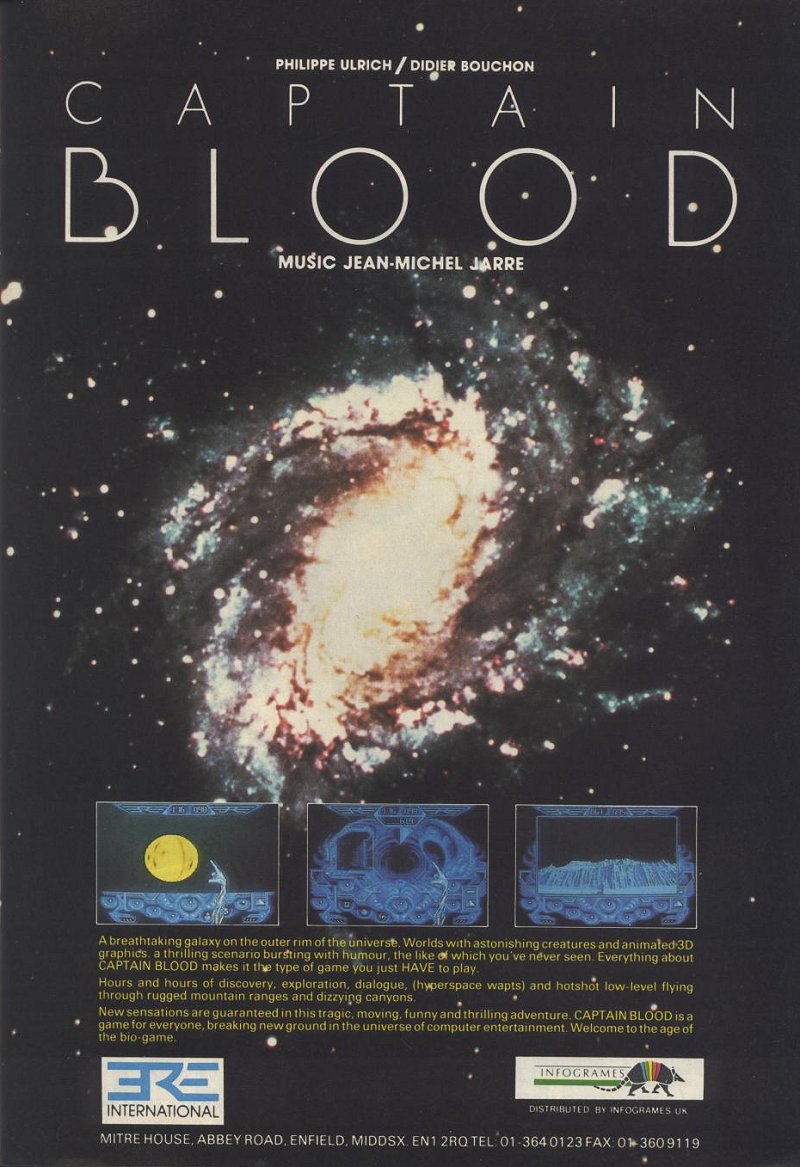
_Back.jpg)
.jpg)
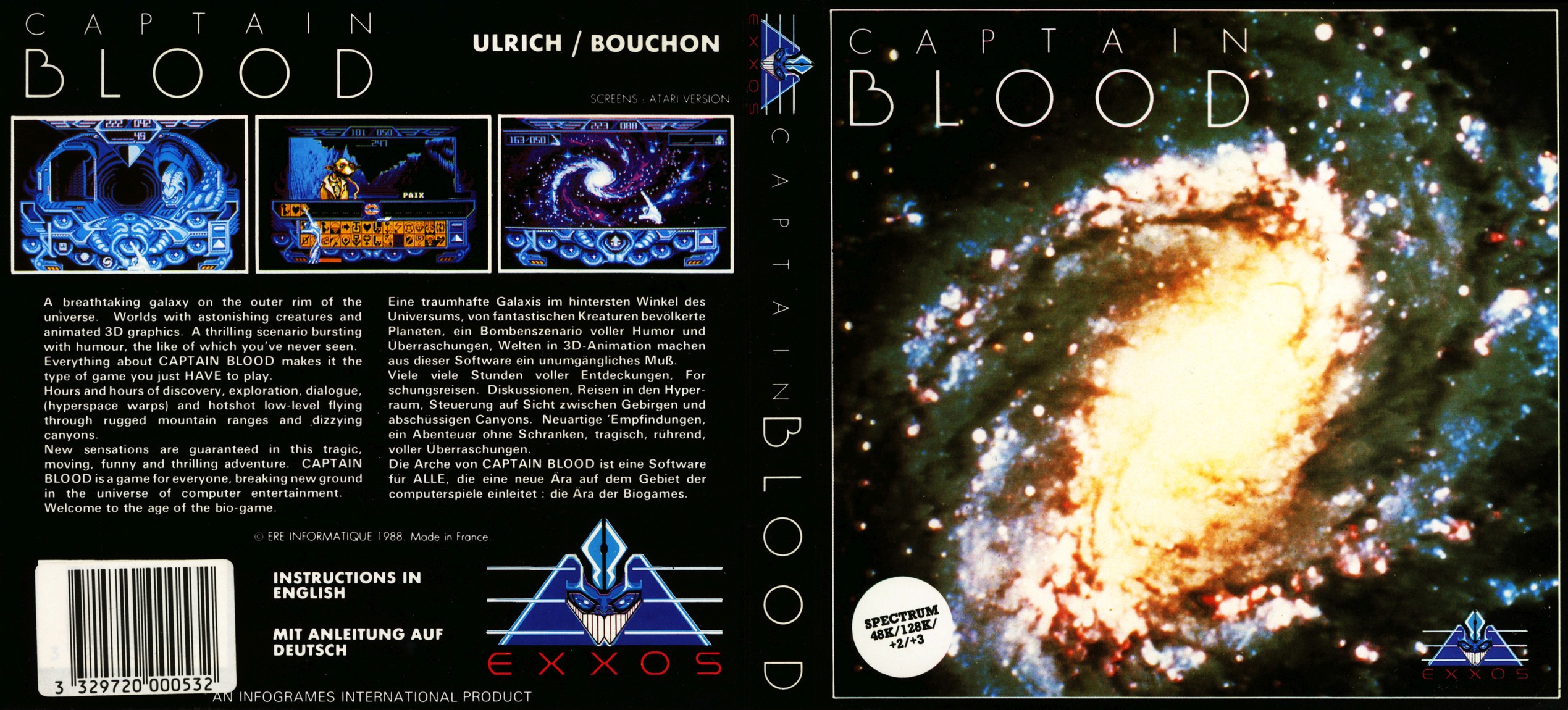
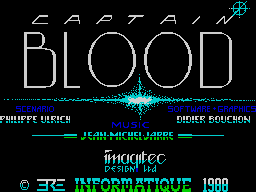
_Tape.jpg)
Discussion
Nobody has started a thread about this yet.
Remarks
ZXSR: Available on +3 disk for £14.99
Music References
Includes the following music: Jean-Michel Jarre, "Ethnicolor".
- Control Option
- Cursor, Interface 2 (right), Kempston Joystick
Releases
- Jan 1989ExxosPound sterling 9.95 · Pound sterling 14.95 disk
- UnknownEDOS
- 1990Players Software
Play
- CaptainBlood.dsk.zipDisk image English74 KB
- captainblood.rzxRZX playback file
- CaptainBlood.tzx.zipTape image English83 KB
- CaptainBlood.tap.zipTape image English56 KB
- CaptainBlood(PlayersSoftware).tzx.zipTape image English36 KB
Documents
- CaptainBlood.txtInstructions English37 KB
- CaptainBlood(MULTI-LANG).pdfInstructions Multi-language: English, French, German6,169 KB
Music
- CaptainBlood.ay.zipRipped in-game/theme music in AY format 3 KB
- CaptainBlood.mp3.zipSampled in-game/theme music in MP3 format 1,516 KB
Other files
- Captain Blood (1988)(Exxos).pokPOK pokes file 0 KB
Files and rights
No permission is on record either way. Screens and pictures are copied here on a take-down basis: if you hold the rights and want something removed, say so and it goes.
Credits
- Didier Bouchoncredited
- Philippe Ulrichcredited
- Chris Edwardscredited
- Stephane Picqcredited
- Gavin Wadecredited
- Mick Hanrahancredited
- Barry Leitchcredited
Sign in to credit somebody, or say what these people did.
Scores
In the magazines
- Sinclair User #851989 · Overall69%
- Your Sinclair #411989 · Overall68%
- Crash #621989 · Overall76%
- ACE (Advanced Computer Entertainment) #211989 · Ace Rating863/1000
- The Games Machine #181989 · Overall68%
- Your Sinclair #451989 · Captain Blood75%
Elsewhere on the web
- WorldOfSpectrum 27 votes7.32
Awards and competitions
Tilt Magazine Awards 1988
- 1Best Adventure In French Language
In the magazines 44
ACE (Advanced Computer Entertainment) #21Jun 1989 · p.78863/1000
ACE (Advanced Computer Entertainment)
Ace Rating 863/1000
Exxos, £9.95cs, £14.95dk ST version reviewed Issue 7 - ACE rating 887 It's been a long while coming, but the Spectrum interpretation of Infogrames' (now Exxos') Captain Blood has finally landed. Apart from the inevitable cosmetic differences, the game remains the same: thankfully, the arcade planet landing sequence is well represented and the adventure aspect remains intact. In fact, the only real drawback of this (and other) 8-bit incarnations, is the lack of mouse control for which the game was primarily designed.
Your Sinclair #41May 1989 · p.4062%60%90%58%68%68%
Life Expectancy 62%
Instant Appeal 60%
Graphics 90%
Addictiveness 58%
Overall 68%
Sean Kelly 68%
Exxos £9.95 cass/£14.95 disk Reviewer: Sean Kelly Eek, it's the spooky Captain Blood, brave explorer of the galaxy, setting out on a mission which would make even T'zer cry. There's a huge galaxy ahead of you (you're Cp'n Blood you see) and your task is to destroy five 'Numbers', (clones of yourself) from which you'll suck enough body fluid to continue your life without dying. Yuk! You begin the game near to an inhabited planet, which is lucky. Cos most of the planets in the game are merely a set of co-ordinates with randomly generated terrain and no life forms at all. Anyway, having found this planet you're now faced with three options. You can either send an OORX to photograph the planet surface, (this will show you if the planet has any defence systems), destroy the planet (kaboom!). or send an OORX baby to the planet surface to seek out any lifeforms. Seeing as it's in your own interest to find a 'number', it's best not to destroy the planet, but to send your OORX into check it out. Besides, if you don't you'll miss out on one of the best bits of the game, the 'Flying Over The Planet's Terrain' sequence. This is one of the most impressive sequences in the game, and screenshots cannot do justice to the visual impact of the terrain moving towards you, rising and falling as you swoop and soar over the surface in search of either a defence system or life form. Once your OORX is under way, if the planet has a defence system, lines will emerge from both sides of the screen, which means that you have been detected. When these lines meet in the middle, your OORX will be destroyed. So if you're detected, flying low and slow will give protection, but it does take time to get anywhere, and I found the best policy was to zoom along until the detection lines got close to each other, and then to dive low and stop for a moment or two while they 'lose' you. On reaching the end of a valley, you will be presented with a 'photograph' of the surface. If the planet is uninhabited, this is all you'll get, and it's time to find another. But if, joy of joys, you have stumbled on an inhabited planet, the occupant appears in a box on screen, and you can now engage it in 'conversation'. You do this by using a Planetary Phrase Book which contains such useful phrases as 'Where is the Post Office?' No, actually you use a set of around 120 icons each representing one word, which are translated from Iconese into English when you point to them. But it proves to be an unrewarding and cumbersome exercise for several reasons. Firstly, only about a quarter of the icons can be seen on screen at one time, and with so many to grasp, it's kind of impossible to remember what words you can use to communicate with, and after several hours play, I still couldn't get to grips with it. The aim of conversation is, I suppose, to get lots of useful information which will point you to the right planets to begin your search for the 'numbers. But as communication proved difficult, the playability of the game was dramatically reduced. This is a very difficult game to accurately review. In a sense, it's an adventure disguised as a pseudo-Elite strategy style game, and consequently seems to defy pigeon-holing. The graphics (and sound on the biggie versions) are excellent, and the presentation of the game is straightforward and easy to use. Though if you've got to spend several hours communicating to get anywhere, you only get to appreciate the quality of programming intermittently! Once the icon communication system is grasped, then I expect that real progress could be made in the game, and zapping round the galaxy in search of the clones could have the campaigning appeal of, say, trying to reach Elite status, or solving a massive adventure. I doubt, however, that there are many gamesters', zappers, strategists or adventurers who are willing to put the long preliminary hours in, simply to get properly involved. This is reflected in my mark, but those who chose to persevere might find an intelligent strategy game lurking here.
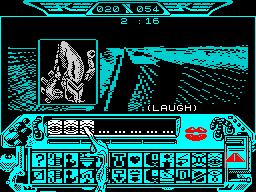
Here is your little red droid exploring a planet. Flying low avoiding detection by the planets defence system. But watch out for those mountains!
ICON DICTIONARY Yes, I will go down to shops for you Matey! No, I won't do that sort of thing, especially on our first date! I want a choccy bar! You're going to buy it for me, Alien-face. Wot's Luke Skywalker doing here?
The Games Machine #18May 1989 · p.3768%
Overall 68%
Spectrum 48/128 Cassette: £9.95, Diskette: £14.95 The Alienesque H.R.Giger-inspired organic spacecraft console doesn't lose too much to the translation to monochrome and, although grainy, the 3-D canyon sequences are effective. Hyperspace and planet-destruction graphics sequences are disappointingly crude, but Jarre's Zoolook music is enjoyable enough and so's the overall gameplay. Unfortunately, Captain Blood is showing its age now.
ATARI ST: 74% TGM007
Sinclair User #85Apr 1989 · p.4178%62%65%64%69%69%
Graphics 78%
Sound 62%
Playability 65%
Lastability 64%
Overall 69%
Chris Jenkins 69%
Label: Infogrames Author: Ulrich & Bouchon Price: £9.99/£14.99 Memory: 48K/128K Joystick: various Reviewer: Chris Jenkins Maybe it's too much garlic. Maybe it's that awful wine they drink (by the way, I have it on good authority that the French DETEST Piat d'Or). But whatever the explanation, the French write really strange games. Captain Blood should win the Prix Internationale de Strangeness, it's so strange. Let's look at the plot. The game appears to take place in the imagination of Bob Morlok, a junk sci-fi author whose alter ego, Captain Blood, is the greatest coin-op player in the world. Morlok himself taking part in a computer game where Blood is split into umpteen clone copies. As a result, his original body is disintegrating fast; to restore it, he has to search out his clones and steal their vital fluids. Blood's spaceship is a biomechanical organism complete with a machine intelligence and a number of Oorxx space fish. These Oorxx can be used as scout ships, missiles and probably dishwashers. The mechanism of the game is a bit like those ancient Star Trek strategy games; you navigate around the galaxy landing on different planets searching for clues to the whereabouts of your clones. The main screen display shows Blood's claw-like hand, which you move around the screen stabbing at the appropriate control buttons. To start off you select the planet view screen and go for a landing. This sequence involves you navigating through a cleverly-depicted vector graphic mountain scene until you reach the end. It's not very challenging though, especially if you choose not to fly at full speed, so after several landings the whole thing gets a bit dull. Having landed, you should be presented with a graphic of a grotesque alien. Your job is to communicate with him in order to obtain clues. The communication system is ingenious but long-winded. A menu of icons appears at the bottom of your control panel. Each represents a single word, and is translated at the side of the screen. You must string symbols together, check them with the translator then transmit them to the alien in the hope that he'll come up with a useful clue, like SWEAR SWEAR TAKE ME TO PLANET ASCODA THEN I TELL NUMBERS SWEAR HUMAN. If you try navigating around the galaxy without any clues, you'll inevitably end up on uninhabited and useless planets. Your one consolation is that you can blow them to bits, though this doesn't add much to the game. There are some brilliant ideas in Captain Blood, let down by a terrible novella-style manual which doesn't properly explain what on earth you're supposed to be doing, and a repetitive gameplay which obviously doesn't have all the graphic sophistication of the original Amiga and ST versions. Although the Jean-Michel Jarre music on the 128K version is suitably boppy, I don't think 48K players will get much out of the game, especially since it's been slightly cut down to fit in the machine.
Crash #62Mar 1989 · p.6382%78%70%74%73%76%79%76%74%
Presentation 82%
Graphics 78%
Sound 70%
Playability 74%
Addictive Qualities 73%
Overall 76%
Mark Caswell 79%
Nick Roberts 76%
Phil King 74%
The cloning game Producer: Infogrames Vital Fluids: £9.95 cass, £14.95 disk Author: Ere Infomatique The world is under siege from aliens, they linger everywhere, constantly attacking humans from their bases in Spectrums, arcade machines and even PC Engines. But programmer Bob Morlock has decided to stop them. He's programmed Captain Blood, a hero based on himself, together with a starship. But when Morlock runs this program he is transformed into Blood, and soon under attack from Space Invaders. A quick hyperspace seems in order, but the drive unit malfunctions, creating thirty Blood clones, all with a portion of his vital fluids! So before taking on the aliens, Blood must first find all his clones. When the game starts 25 have been found and absorbed. When you takeover Morlock's quest the first thing you notice is the excellent presentation, clearly inspired by the movie Alien. Operating this biomechanic display is done by using Blood's hand to click on icons. Options include looking at the planet's surface (to detect missiles), blowing the planet up, hyperdriving to another planet, saving the game or launching an Oorxx biomissile. In the latter case the player is given joystick control of the missile as it zooms across a wireframe landscape towards a canyon. This is the only arcade section in the game and is impressive. At the end of the canyon, an animated picture of the alien appears together with a scrolling strip of icons. When the alien talks icons appear which, by pointing at them, are translated into words. You can reply by selecting icons at the base of the screen. There is always an alien on the first planet, but with tens of thousands of planets and only a handful of aliens, it's vital you convince the first alien to give you the coordinates of other aliens. The basic idea is that you warp around the galaxy, talking aliens into giving you the locations of the clones. Some aliens will ask you to do favours for them, like destroying other planets, or taking them somewhere. And with a 45-hour time limit there's lots to do. While arcade fans will enjoy the planet-landing sequence, the icon communicating system is likely to be frustrating. Presentation is marvellous and given more time to get into the game I feel I could become really hooked. If you've the time and patience, this is an unique and demanding game which deserves serious consideration. PHIL 74% THE ESSENTIALS Joysticks: Cursor, Kempston, Sinclair Graphics: well-drawn status panel and smooth wire-frame planet landscapes Sound: fair 128K rendition of Jean-Michel Jane's title tune, varied ingame effects
Alien-like alien talking about reproduction and the planet Migrax.
Down in the canyons at the controls of a Oorxx biomissile.
BLOOD PRESSURE Try to discover the locations of other aliens by saying CODE INFORMATION HELP. Save the game position regularly to maintain your progress. If the planet has defence missiles, fly low or you'll be destroyed.
Special Action carries this game and has 16 references of its own.
Full-page ad10
- Crash #63Apr 1989 · p.30
- Sinclair User #85Apr 1989 · p.52
- Crash #62Mar 1989 · p.37
- C&VG (Computer & Video Games) #85Nov 1988 · p.57
- Crash #58Nov 1988 · p.47
- The Games Machine #10Sep 1988 · p.123
- The Games Machine #5Apr 1988 · p.75
- Popular Computing Weekly #16Apr 1988 · p.2
- ACE (Advanced Computer Entertainment) #7Apr 1988 · p.82
- C&VG (Computer & Video Games) #78Apr 1988 · p.73
Tips8
- Your Sinclair #92Aug 1993 · p.23
- Your Sinclair #70Oct 1991 · p.38
- Crash #68Sep 1989 · p.35
- Your Sinclair #44Aug 1989 · p.34
- Your Sinclair #43Jul 1989 · p.38
- The Games Machine #14Jan 1989 · p.92
- ACE (Advanced Computer Entertainment) #14Nov 1988 · p.111
- ACE (Advanced Computer Entertainment) #13Oct 1988 · p.44
Review4
- FIFO #31990 · p.22
- Your Sinclair #45Sep 1989 · p.72
- New Computer Express #4Dec 1988 · p.30
- ACE (Advanced Computer Entertainment) #7Apr 1988 · p.49
News/Note4
- New Computer Express #17Mar 1989 · p.36
- New Computer Express #10Jan 1989 · p.39
- C&VG (Computer & Video Games) #85Nov 1988 · p.15
- Popular Computing Weekly #16Apr 1988 · p.18
Feature3
- New Computer Express #7Dec 1988 · p.18
- ACE (Advanced Computer Entertainment) #13Oct 1988 · p.44
- The Games Machine #4Mar 1988 · p.14
CoverGame2
- Your Sinclair #91Jul 1993 · p.4
- Sinclair User #85Apr 1989 · p.6
Preview2
- Your Sinclair #39Mar 1989 · p.95
- Your Sinclair #38Feb 1989 · p.104
Information1
- SSD-IISep 1999
Offer1
- Sinclair User #85Apr 1989 · p.30
CompoResult1
- The Games Machine #8Jul 1988 · p.40
CompoEntry1
- The Games Machine #5Apr 1988 · p.100
Related
- Compilations
- Special Action, Sinclair User issue 85: Megatape 14, Your Sinclair issue 91: Beaut Box 6
- Ports
- (Amstrad CPC), (Commodore 64), (Amiga), (Atari ST), (Thomson MO/TO), (Macintosh)
- Elsewhere
- WikipediaCentre for Computing HistoryMobyGamesRZX ArchiveThe TipshopUVLRZX Archive - YouTubeModern ZX-Retro Gaming
- Same entry at
- Spectrum ComputingZXInfo
Reviews from people here
Sign in to write about this, or make an account. It takes a minute and lets you correct the catalogue too.
Everything ZXDB can hold about this is here.
Sign in to correct or add to this.
Hold the rights to this and want it taken down?