
Cattell IQ Test
General: Domestic · ZX-Spectrum 48K · 1 players · English
Sinclair Research Ltd · 1983 · Pound sterling 12.95

Discussion
Nobody has started a thread about this yet.
Play
- CattellIQTest.z80.zipSnapshot image English19 KB
- CattellIQTest.tzx.zipTape image English20 KB
Documents
- CattellIQTest.txtInstructions English8 KB
- CattellIQTest(EN).pdfInstructions English640 KB
Files and rights
Distribution permission is on record, granted to another archive rather than to this one. Screens and pictures are copied here; everything else links to the archive that holds it.
- AllowedSinclair Research Ltd → WorldOfSpectrum
Credits
- Victor Serebriakoffcredited
Sign in to credit somebody, or say what these people did.
Scores
Elsewhere on the web
- WorldOfSpectrum 1 votes9.00
In the magazines 15
Personal Computer News #65Jun 1984 · p.38
Bob Chappell
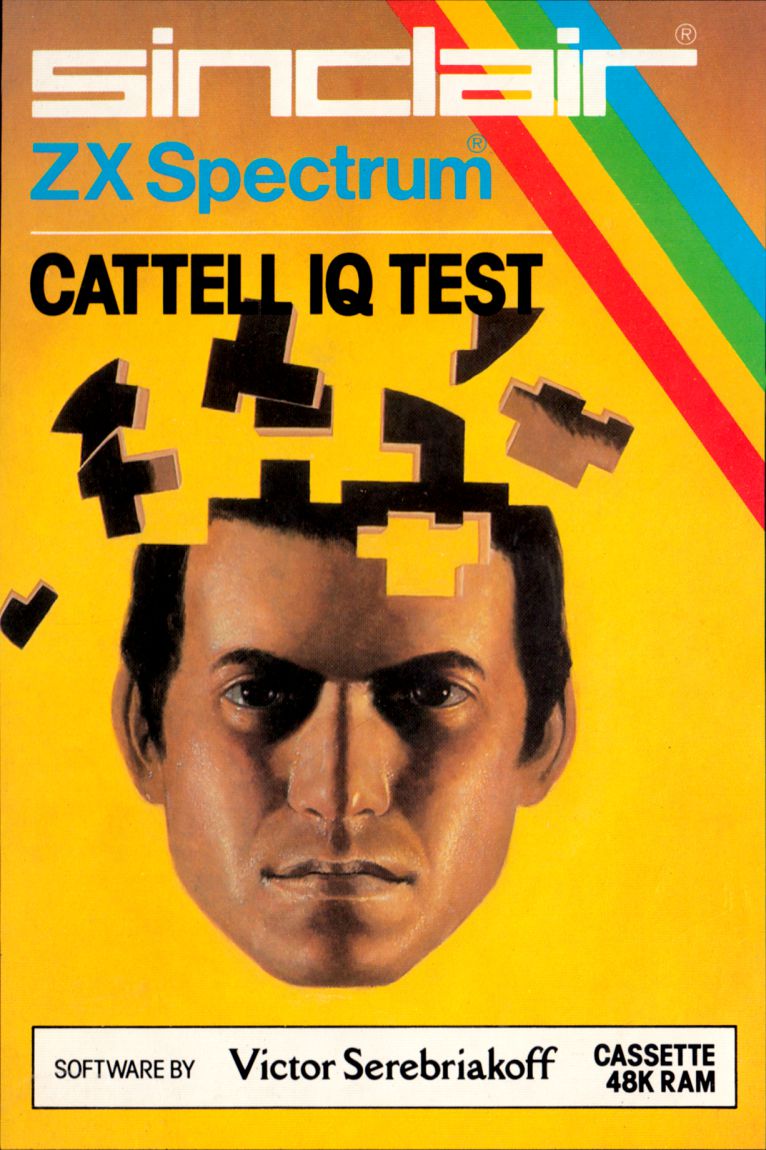
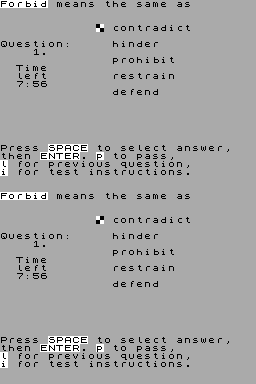
LET'S GET QUIZZICAL Bob Chappell asks some questions of BBCs and Spectrums. NAME: Grandmaster Quizzes PRICE: £12.65 SYSTEM: BBC B PUBLISHER: Acornsoft, Cambridge FORMAT: Cassette NAME: Cattell IQ Test PRICE: £12.95 SYSTEM: Spectrum 48K PUBLISHER: Sinclair, Cambridge FORMAT: Cassette Although Samuel Johnson is reputed to have said that questioning was not the mode of conversation among gentlemen, there's no doubt today that questioning exercises a strange fascination over much of the population. The popularity of quiz books and magazines, together with such long-running radio and TV shows as Brain of Britain, University Challenge and Mastermind practically settles any argument on that subject. The interest shown in question-and-answer entertainment is such that it was inevitable that they would find their way onto home computers. However, does a micro-based set of quizzes have any advantages over a book containing exactly the same quizzes, bearing in mind that the book is likely to be cheaper, quicker, and more convenient to use? Like many questions, there are pros and cons. DRAWBACKS One disadvantage with a micro-based quiz is that you've got the bother of loading in the program, and then further loading of the database of questions and answers. Where a cassette has several quizzes, each of which must be loaded separately, there's the extra trouble of locating the correct start position on the tape rather than waiting around the program searches for the desired section. Some micro quizzes attempt to match your answers against the stored ones, and this can often lead to some silliness. For example, you could type in SAINT PAUL as the answer to a question but receive the response WRONG. THE ANSWER is ST. PAUL. The better programs give the answers and leave you to allocate the marks. ADVANTAGE, HOME COMPUTER However, a computer-based quiz can set up and control a time limit for answering the questions. Even better, it might offer an automatic adjusting limit which sets the time limit for the next question at a lower or higher level, depending on how well you're doing. At the end of the quiz, it can provide the totals of both the marks and the time expended, if the program has an option for two players to participate it can keep track of whose turn it is, prompting as necessary. Also, you can't accidentally cheat by flipping over to the answer page and having your eye caught by the answer to a question you haven't yet been asked. YOUR STARTER FOR TEN Acornsoft, In association with Ivan Berg Software, have published six programs in their Grandmaster Quiz series for the BBC B micro. The programs are based on Weidenfield Quiz books and each one is devoted to a specific subject, backed by a famous name in that field. The topics are Crime and Detection (Julian Symons), History (John Julius Norwich), Music (Steve Race), Science Fiction (Brian Aldiss), Royalty (Anthony Holden), and Theatre (Sheridan Morley). Each package consists of two cassettes, one holding the master program, the other the database of 30 quizzes. As each quiz contains ten questions, you will be given a massive test (at least 300 questions, some of which require multiple answers) on your chosen subject. All the programs work to the same format and offer solo play; dual play as two competing individuals or two teams; optional time limit; auto-adjustment of time limit; self-marking (maximum two points per question); a PASS feature; and totaling of scores and timings. The questions are attractively displayed and are phrased in many different ways. They range over a wide number of topics within a subject, and may require more than one answer. Here's a few examples: Crime and Detection - Quiz 1 Elementary, My Dear Reader; Quiz 11 The Film of the Book; Quiz 13 For Chandler Addicts. History - Quiz 4 Not Upon Oath; Quiz 6 Gunpowder, Treason and Plot; Quiz 11 Dumb Friends. Music - Quiz 4 The Singer, Not the Song; Quiz 8 Operatissimo; Quiz 12 Instrumentally Speaking. The programs are pleasingly presented, the contents thoroughly stimulating. It's not an examination - the quizzes are meant for pleasure, to amuse rather than instruct. Excellent entertainment courtesy of Acornsoft and your BBC B. MENSA MATERIAL Much more scientific but equally entertaining is Professor Cattell's IQ Test, published by Sinclair for the 48K Spectrum. It is a fully standardised IQ test, the object of which is to test the general ability of adults of above-average intelligence. The whole thing takes about 1.5 hours to complete and consists of six tests. These cover synonyms, classification (find the odd one out), opposites, analogies (a is to b as c is to?), sentence completion, and inferences (problems, puzzles and reasoning tests). Each test has a time limit for completion, such as 12 minutes to answer 25 questions. If you finish early, you get a chance to review and amend any of your solutions. The possible answers to each question are given as a list; you merely have to pick out the one you think is correct. You are never told what the answer should be. Instead, at the end of the sixth test, you are given a report on your performance, your IQ score and a percentile rating. If you have an IQ of 147 and a percentile rating of 97, this means that 97 per cent of the population would have scored lower than you. Achieve this level of rating and the program will suggest you apply for membership of MENSA. An excellent program, though don't take the final results too seriously since you are not really being tested under standard conditions. Apart from the entertainment value. It will give the old grey matter a thorough shake-up.
Your Spectrum #1Jan 1984 · p.11
IQ TO U2 The so-called measurement of intelligence has always been a bit suspect, so it was with a degree of scepticism that we prised open the Cattell IQ test - one of a fistful of new programs put out by Sinclair Research itself at the PCW show in October. The package comes complete with a cassette carrying the test and an eight-page booklet explaining what to do, all at a brain-numbing £12.95. "This is the first time that a fully standardised and widely accepted IQ test has been available to the general public", says the introductory blurb. It continues with a number of disclaimers which seem to infer that unless you are of above average intelligence in the first place, the results will be questionable. (Maybe you have to take another test before you take this one to see if you are up to its standard of test taking?) But for those brainy enough, advancement is near. "Your ZX Spectrum will tell you if you reach a level at which it would be worthwhile your applying to Mensa." At this stage, scepticism became a teeny bit tinged with cynicism. For those few - people in the world who don't know, the president of Mensa happens to be one Sir Clive Sinclair. Could the product be a new means of recruiting for the society of eggheads? Perhaps too we can look forward to other such products which test, say, manual dexterity for potential brain surgeons. But to be fair the booklet does point out that you should not take the results too seriously and adds: "This test will not prove conclusively that you are a genius - and those who do not do well at the test may well have other sterling qualities." Hmmm. Your correspondent was not able to test out the quality of his own brain, but for more mundane reasons. A few days after receiving the cassette from Sinclair Research, a letter arrived telling us that there was a bug (in the program, that is) and that a replacement would soon be winging its way over. We are waiting - patiently. Watch this space.
Sinclair User #21Dec 1983 · p.64
John Gilbert
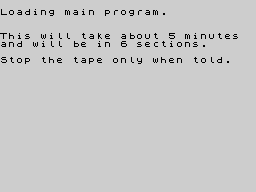
NEW COMPANIES ON THE SINCLAIR BANDWAGON John Gilbert looks at the latest additions to Sinclair Research's growing software library. Sinclair Research seems to have its eye on the rest of the software market, something which it was loathe to do two months ago. It has opened its software range to such an extent that new and smaller companies, other than Artic Computing and Melbourne House, have had a chance to enter their programs into a range which already includes such programs as The Hobbit and the Artic range of adventures. The new companies on the Sinclair Research bandwagon are Crystal Computing and Ultimate Play The Game. Crystal Computing has sold its Zeus Assembler and Monitor Disassembler to Sinclair. That means it at last has two machine code utilities, for the 48K Spectrum, in its range. The Crystal Zeus Assembler is one of the best of its kind and provides excellent facilities for beginners and experts alike. Writing assembly language using it is almost as easy as writing Basic code. Each line of source assembly code as indexed with a number, just as Basic instructions are indexed with line numbers. All the features which are found usually on assemblers have been included. Labels and expressions can be included within source code and strings of symbols can be entered into memory tables using the utilities in Zeus. One of the advantages of Zeus is that you do not have to include an ORG instruction with the program to indicate to the computer where to put the object code when it has been assembled. If you omit the ORG instruction the computer will allocate the code to a space in memory. The problem with Zeus is that you have to exit from the assembler to save the code which has been generated. If you are a beginner that can be a lengthy and nerve-racking process and you have no guarantee that you can load the code back into the computer. Apart from the lengthy preparations for loading and saving, the assembler is still one of the best on the market. It is a pity that Sinclair Research has put it into a colourful box to justify a price rise of approximately £4. The box may look pleasant and it may improve the quality of the product on the shelf, from a commercial point of view, but the box will not help you to program. The same is true of many of the other programs in the range. The boxes do not add anything to the product once you have it at home and paying up to £4 extra for packaging is unlikely to go down well with most customers. The Monitor and Disassembler for the 16K/48K Spectrum is from Crystal and the price of the product has also been increased substantially. It can be used with the Zeus Assembler and will provide a disassembly of source code from your machine code programs or from the Spectrum operating system in the ROM of the machine. The Monitor will also enable the user to assign values to the CPU registers. That means that values can be set to test machine code programs and to see how they run under certain conditions. Machine code routines can be copied from one part of memory to another and the routines can be edited in hexidecimal using the Monitor. One other useful function is to convert a hexidecimal value to decimal and vice versa when you are using the editing routines. That saves a number of calculations on paper. The Monitor and Disassembler is the perfect companion to the Assembler but at a combined price of nearly £25 it is expensive. The next two additions to the Sinclair software library for the Spectrum can both be regarded as mind games. Flippit, for the 16K or 48K Spectrum, has been put on a parallel with the Rubik Cube by Sinclair Research. It certainly is a maddening puzzle and almost impossible to master completely. The Flippit board is like a noughts and crosses grid - it has nine sectors, set out in a three-by-three grid. The computer labels those using the letters the alphabet, A to I, and numbers or dots fill each corner of each square. To complete the game you must find the correct combination of numbers so that they add to the same sum horizontally, vertically and diagonally. That means the game is nothing more than the type of magic squares we all enjoyed solving when we were at school. They can be played competitively and to emphasise the point the moves you have taken so far and the moves which you have to beat before getting the record are part of the board display. There are three playing options. The first is New Run which will make the computer re-shuffle the numbers on the board into random patterns. The next option is similar to the first and will re-run the last random setting. That means that the order in which the numbers were placed on the last shuffle is restored. Flippit seems so easy when you first start to play but when you have only two numbers out of place it can become irritating and it is easy to give up, rather than plodding along with the problem. If you are left with the numbers in the wrong places you may have to do major re-shuffle of the board. The manual is concise and to the point but includes no information about strategy or play. It tells the player only how to set up the Spectrum and what are the various play options. One other criticism is that it has no SAVE option for beginners who are puzzlers or who want to break for lunch. The other mind game in the selection is more of a test of mind power. The Cattell IQ Test provides the user with a standard reference to any intelligence quotient. It is the type of test which potential members of Mensa, the organisation whose members have high IQs, must take. On loading, the computer takes some time to set up the tests. There are six types of logic test which must be taken before the computer can give you an accurate IQ score. Those types include synonym finding, classification, opposites, analogies and inferences. The results are co-ordinated from the various individual tests to give a percentile overall rating. The Spectrum will tell you eventually whether it is worthwhile applying for membership of Mensa. After being extremely serious about the validity of the tests, throughout the manual it says in the section about the meaning of the results that the tests should not be taken too seriously and that the tests will not prove that you are a genius. Even if you cannot go around wearing a badge saying 'genius', once you have taken the Cattell test you should have some fun with the package. Unfortunately the copy we were sent of the rests was tediously slow in producing marks for the various sections and in setting-up the data. Although it looked like a production copy of the package, Sinclair Research says that it is producing a better version of the program. The final cassette-based program from the library, for the 48K Spectrum, is Chequered Flag and it is the only one not in a box. The program is from Psion and it is up to that company's usual standards. The game sets you as a racing driver over one of the number of world-famous racing tracks, such as Silverstone. You can choose which car you want to use from a visual menu describing a number of well-known racing cars. You can also choose the course on which you want to travel. The race will take place on the screen, using a three-dimensional representation of the track. Apart from the danger of crashing over the sides of the track, there is also oil on the road surface. At all costs you must avoid the oil or it could cause your car to skid. Once you have been round the track the required number of times, the chequered flag will be raised on the screen and your lap time will be given by the computer. The graphic and real-time simulation effects produced by the software are reminiscent of the Flight Simulation program, also available from Psion through Sinclair Research. There are several tracks and cars to try, so the game should provide hours of entertainment. The quality of the game and the detail included make it one of the great games for the Spectrum. The quality control and selection of software for the Sinclair software library has certainly increased with the release of this new batch of tapes. The boxes in which most of the products are now packaged are certainly an improvement on the cassette covers which were being used. One disadvantage for retailers will be that display shelves will be occupied more quickly by fewer products. That should be offset, though, by the prices which Sinclair is charging for its new software. That has already caused murmurs of discontent from customers about to buy software from a company, only to find that Sinclair has bought it and the price has been increased. If Sinclair continues to raise its prices in this way the company could sell less in the way of software and customers may go elsewhere in a large market. That would be a bad move. The 'L' Game is produced by Quicksilva. It consists of some coloured tiles on a board which are originally in the shape of an 'L' but which the computer manages to mix extremely well. The player then has to slide the tiles back into the correct order to form the 'L' in the least number of moves. It is like doing a jigsaw puzzle with no edges. Also included on the cassette with the 'L' Game are Mastermind and Pontoon. If you like puzzles, this cassette is good value for money. Flippit is from Sinclair Research and is a test of logic and arithmetic. The player has to get all the numbers or dots in a square in such a position that the values will be the same when added horizontally, vertically and diagonally. It is a puzzle which you will either love or hate. The game is like a giant magic square and if you are adept at spotting combinations and have a fast calculation rate you should be able to do the puzzle fairly quickly. So far I have managed to fit the puzzle together with only two pieces remaining out of sequence. The problem is that the instructions are not so good as the puzzle and you could have difficulty in getting started. Flippit is suited to those people who like IQ tests to learn their so-called intelligence quotient. I think that the only thing IQ tests prove is that a person can do an IQ test but if you want to learn what your rating is you might like to try The Cattell IQ Test. I would be interested to hear your views on this or any other IQ test and also the marks you gained. Do not cheat. The Spectrum is ideally suited to such an application but is the application valid. I hope that I have provided you with some ideas about the mind games on the market, especially those suitable as Christmas presents. You should not have too much difficulty deciding what to buy even though there is a wide area to cover. Melbourne House, [redacted] - The Hobbit Carnell Software, [redacted] - Volcanic Dungeon, Black Crystal, The Wrath of Magra Sinclair Research, [redacted] - Artic Adventures A, B, C, D, Flippit Quicksilva, [redacted] - 'L' Game.
'Flippit has been put on a parallel with the Rubik Cube. It certainly is a maddening puzzle and almost impossible to master completely.'
'If Sinclair continues to raise its prices in this way the company could sell less software and customers may go elsewhere in a large market.'
'The Spectrum will tell you if it is worth applying for membership of Mensa.'
Advert6
- Personal Computing Today #4Nov 1983 · p.71
- Sinclair User #19Oct 1983 · p.117
- Your Computer #10Oct 1983 · p.17
- ZX Computing #9Oct 1983 · p.69
- C&VG (Computer & Video Games) #24Oct 1983 · p.61
- Home Computing Weekly #29Sep 1983 · p.49
News/Note4
- Your Spectrum #1Jan 1984 · p.11
- ZX Computing #10Dec 1983 · p.71
- Home Computing Weekly #29Sep 1983 · p.5
- ZX Computing #7Jun 1983 · p.56
Review1
- Home Computing Weekly #48Feb 1984 · p.15
Feature1
- Sinclair User #21Dec 1983 · p.64
Licensed from
- Raymond Bernard CattellPeople
Related
- Tags
- g223
- Elsewhere
- Centre for Computing History
- Same entry at
- Spectrum ComputingZXInfo
Reviews from people here
Sign in to write about this, or make an account. It takes a minute and lets you correct the catalogue too.
No description recorded.
Sign in to correct or add to this.
Hold the rights to this and want it taken down?