
DLAN
Utility: Visual/Screen · ZX-Spectrum 16K · 1 players
Campbell Systems · 1983 · Pound sterling 7.95
Also known as Display Language (English)
Discussion
Nobody has started a thread about this yet.
Remarks
Display LANguage
Releases
- 1983Campbell Systems Sold as Display LanguagePound sterling 7.95
- 1983A. Grzegorczyk
- UnknownKellydata
Play
- DLAN.tzx.zipTape image English9 KB
- DLANDemo.tap.zipTape image English11 KB
- DLAN16.tap.zipTape image English5 KB
- DLAN48(A.Grzegorczyk).tap.zipTape image Polish10 KB
Documents
- DLAN.txtInstructions English20 KB
Files and rights
Distribution permission is on record, granted to another archive rather than to this one. Screens and pictures are copied here; everything else links to the archive that holds it.
- AllowedCampbell Systems → WorldOfSpectrum
Scores
In the magazines
- Sinclair User #241984 · Gilbert Factor7/10
- Personal Computer News #441984 · Overall Value4/5
In the magazines 25
Sinclair User #24Mar 1984 · p.77/10
Gilbert Factor 7/10
Memory: 16K Price: £7.95 Dlan, short for display language, is a system for generating textual displays for both versions of the Spectrum. By defining any number of windows on the screen you can define the text, type style, INK and PAPER colours and direction of scroll in it. You can also define a pattern round the edge of the window. All the features can be put together to produce an advertising display at far less cost than a purpose-built system. Each command is written as a REM statement, followed by a number of parameters detailing what will happen on-screen. Once complete, one USER command will set the whole thing running and it will then cycle around the commands non-stop. As with any new language, time must be spent learning it but effective results can be obtained by non-computer users in a short time. As well as all the commands to define the parameters it is also possible to build-in subroutines so that one display can call others. What sets it apart from an ordinary program is the choice of 11 typefaces, four in the 16K version. They add a touch of professionalism to the display. A good utility program which can only add to the uses to which a Spectrum can be put. It can be obtained from Campbell Systems.
Personal Computer News #44Jan 1984 · p.534/53/54/54/53/54/54/5
Features 4/5
Documentation 3/5
Performance 4/5
Usability 4/5
Reliability 3/5
Overall Value 4/5
Ted Ball 4/5
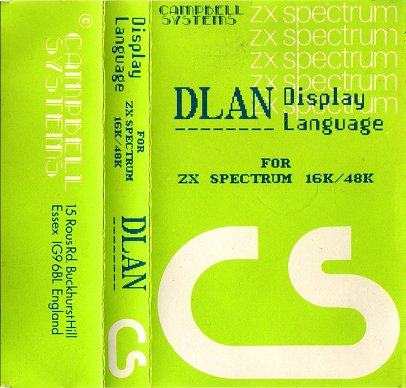
THREE NEW TEXT PRINTING PACKGES FOR SPECTRUM 16K OR 48K ARE REVIEWED BY TED BALL. NAME: Dlan APPLICATION: Animated text display SYSTEM: Spectrum 16K or 48K PRICE: £7.95 PUBLISHER: Campbell Systems, [redacted] FORMAT: Cassette LANGUAGE: Machine code OUTLETS: Mail order. MEETING NEW FACES Business applications for computers don't have to be boring things like accounts and stock control. Dlan, for the 16K or 48K Spectrum, is a simple programming language producing colourful, animated advertising displays with text in various sizes and typefaces. FEATURES With Dlan you design the displays with rectangular windows on the screen. The windows may be any size up to the full 24 by 32 screen size and may overlap, and you can use any of nine decorative borders around them. As your text is printed it scrolls into the current window from the bottom and you can later scroll the windows independently in any direction. There are 11 different typefaces in the 48K version, but only four in the 16K version, and the sizes vary from the normal Spectrum character size up to three times as high and double the width. You can use all the colours available on the Spectrum, and also the bright/dull and flashing/steady attributes. The language consists of 31 single-character commands you enter into Basic REM lines, and you can use the Basic editor in the usual way to alter your program. PRESENTATION The cassette comes in a box with an insert that seems to have been designed with Dian. The tape is recorded on both sides, with a demonstration program and the 16K and 48K versions of Dlan on each side. An eight-page booklet explains the commands and how to use Dlan, and gives hints on using the program for effective displays. IN USE Dlan is simple to use and easy to set up, with the help of the instruction booklet, it's commands are executed one at a time in the order they appear in your program and you can build up your display a little at a time, testing it as you go. The main problems you are likely to have are due to the lack of error messages. If you put invalid commands in your program Dlan will generally ignore what it does not understand and continue with the next command. For this reason it can be difficult to discover why the display is not coming out the way you want. For example, if you try to print characters that are three lines high in a window two lines high you will just get a blank window with nothing to tell you why. A suggested use for Dlan is to produce fancy labels on the ZX Printer, but the Basic copy command only sends the top 22 lines to the printer. Dlan does not include a command to copy the full 24-line screen although this is easy to implement. RELIABILITY It is almost impossible to crash Dlan because it ignores incorrect commands. The only way I found to make it go wrong was to include a Basic line not beginning with REM, and even then the worst that happens is you drop into Basic with your program intact. VERDICT Although you may have problems because there are no error messages to tell you when you have done something wrong, Dlan is a simple language, easy to learn, but still very effective for producing animated text displays.
Advert19
- ZX Computing #13Jun 1984 · p.70
- Your Computer #5May 1984 · p.168
- ZX Computing #12Apr 1984 · p.115
- Sinclair User #25Apr 1984 · p.108
- Sinclair User #24Mar 1984 · p.22
- Your Spectrum #2Mar 1984 · p.46
- Your Computer #3Mar 1984 · p.207
- Sinclair User #23Feb 1984 · p.110
- ZX Computing #11Feb 1984 · p.96
- Your Computer #2Feb 1984 · p.170
- Your Computer #1Jan 1984 · p.33
- Sinclair User #22Jan 1984 · p.106
- ZX Computing #10Dec 1983 · p.97
- Your Computer #12Dec 1983 · p.243
- Sinclair User #21Dec 1983 · p.56
- Sinclair User #20Nov 1983 · p.98
- Sinclair User #19Oct 1983 · p.86
- Sinclair User #18Sep 1983 · p.32
- Sinclair User #17Aug 1983 · p.97
Letters1
- Popular Computing Weekly #9Feb 1986 · p.6
Feature1
- C&VG (Computer & Video Games)1985 · p.84
Review1
- Popular Computing Weekly #27Jul 1983 · p.49
News/Note1
- Home Computing Weekly #15Jun 1983 · p.12
Related
- Compilations
- Outlet issue 078, Load 'n' Run issue 54
- Same entry at
- Spectrum ComputingZXInfo
Reviews from people here
Sign in to write about this, or make an account. It takes a minute and lets you correct the catalogue too.
No language, credit, tag recorded.
Sign in to correct or add to this.
Hold the rights to this and want it taken down?