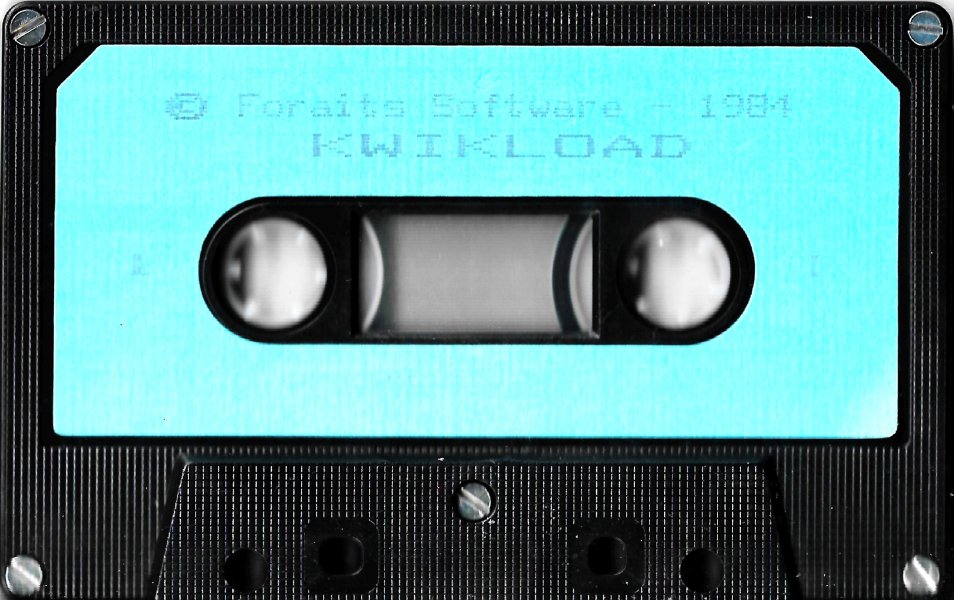
Kwikload
Utility: I/O Handling · ZX-Spectrum 48K · 1 players · English
Foraits Software · 1985 · Pound sterling 4.95
Kwikload, 1 of 2
Discussion
Nobody has started a thread about this yet.
Remarks
SPOT: turbo-load software
Play
- KwikloadV1.tzx.zipTape image English2 KB
- KwikloadV2.tzx.zipTape image English2 KB
- Kwikload.tap.zipTape image English1 KB
Files and rights
No permission is on record either way. Screens and pictures are copied here on a take-down basis: if you hold the rights and want something removed, say so and it goes.
Credits
- Foraits Softwarecredited
Sign in to credit somebody, or say what these people did.
In the magazines 32
ZX Computing #19Jun 1985 · p.117
Clive Smith
Data View Software Spectrum 48K £4.99 Kwikload, as the name suggests, enables you to SAVE or LOAD your programs three times faster than conventional methods. Not only can it be used with your own programs, but it will also convert published programs as well. They claim to cut down loading times of The Hobbit to 120 seconds and Scrabble down to 136 seconds. I think it's only fair to point out they do not condone piracy. With the tape you get a 12 page (A12) instruction booklet. This is easy to follow and anyone with average knowledge of programming should find it quite simple. The only problem I found is that you have to buy a good quality tape as the smallest gap in the oxide will cause it to fail. For the technical, the Spectrum transmits at 1500 baud and Kwikload improves this to 4500 baud. All program leaders are disposed of to improve times even more. For data protection what could be better. In fact the whole thing is a little bit like upgrading your C5 to a 3.5 litre car.
Your Spectrum #14May 1985 · p.28
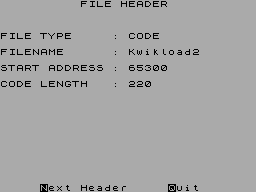
SPEED TRIALS What's slower than the C5? Loading software into the Spectrum, of course. So, speed freak, SQ Factor has stuck the go-faster stripes on his Speccy, and taken it out for a spin. But instead of aerodynamic spoilers he's gone for four fast tape loading systems. D'you remember the excitement when the Microdrive was announced? The anticipation of speed - times never before achieved on the Speccy. And then, the long haul between promise and delivery of the first not-quite-perfect Microdrives. Now you no longer have to wait an age for them and the original, ridiculous price of the cartridges has come down to an almost reasonable two notes. But the Microdrive is no longer the only way of super-charging your Spectrum. Without going the whole hog and splashing out more than the computer cost on a disk drive, you can LOAD at high speed in a number of ways - and as you'd expect YS has the dope. So, we told the dope to draw up a chart of all the info you need to help you in your search for speed. Our chart was prepared so you can compare the features of each system in a quick and easy to follow way. Everything that cannot be compared directly in the z chart is discussed separately. TIME CHECKS The times in the chart were derived by saving and loading the same program on each system. For this, we used a truly enormous BASIC program to wit 10 DIM a$(35000) Once RUN, this program is about 35K Bytes long! Several LOAD times were averaged to get the times for the Microdrive and Wafadrive - both of these require an 'access time' which lets the drive search the tape for the file, as well as the time needed to load the file once it has been found. Access time is not a problem for the systems using ordinary cassette tapes. The times for the Wafadrive were taken using a 64K wafer. THE COMMON TOUCH All of the systems: - Have a full through connection to the Spectrum expansion port - or don't obstruct it. - Need no separate power supply. - Can SAVE the usual types of Spectrum program or data or code. - Can SAVE a Basic program to autorun - though Kwikload is a struggle. And the one feature that runs through them all is tape. I would recommend in every case that you keep backup copies in the standard tape format. You could get caught out if you rely totally on any of these systems to hold your important bits. Each system has plenty of opportunity for operator error to cause loss of data, and of course, fast moving tape will wear out eventually. GET IT TAPED Both Wafa and Micro drives can corrupt a file and make it unusable if you turn the power on or off with the cartridge in the slot. Also take care because both forms of cartridge are easily damaged (though the wafer less so) and impossible to repair. In particular, if the tape is pulled out of the cartridge even a little way, it will never go back. The Sprint mechanism does not prevent you from changing directly from rewind to play, and if you do so you will probably damage the tape, as the speeds involved are higher than normal. You are warned always to use stop between functions, but it would have been better if this was built into the hardware rather than left to the user's memory. This format is standard format (just played faster) but I would still use an ordinary cassette recorder to back up really important stuff. Kwikload is bound to catch you out using the wrong numbers or trying to SAVE with the LOAD program, simply because it's fiddly, but a bigger problem may arise because it is trying to do too much with standard hardware. Unlike the Sprint, which physically runs the tape faster to get its speed, Kwikload crams three times as much data onto the same length of tape. This pushes the average cassette recorder to its limits, and you will need good tape to get away with it. TO WIND UP Used in accordance with the instructions, any of the systems will give you much faster loading than you are used to, and reasonable reliability. The Wafadrive and Microdrive have the advantage of disk-like operating systems which start the motor and find files without you having to mess with play, record and rewind controls. This is a definite plus and makes up for having to cough up more for the cartridges. A few bitter experiences with the Microdrive bias me towards recommending the Wafadrive or the Sprint, but if you're after speed then the Microdrive must be a contender. More speed than this can only come from disks but that is another subject, and one that we'll explore when we're all rich. Let us know if it happens to you! SINCLAIR MICRODRIVES The original Microdrives may not be the best, but they are the fastest system reviewed and what's more they are now reasonably priced. It's also worth noting that software producers have been known to write for them sometimes. The occasional last file and the 'full memory' bug have stopped me putting my Microdrives to serious use - but I have been known to lose files on a disk computer, so I mustn't be too hard on Sinclair. The 'full memory' bug causes a crash if a large BASIC program is LOADed or even a small one if the RAMTOP has been moved down. This is caused by the Microdrive's shadow ROM not checking properly if there is space for both the program and a 500 byte Microdrive channel before LOADing. This can be bad news as it crashes with the drives running, which can corrupt the tape when you switch off. Further evidence of 'dickiness' is the fact that microdrive cartridges format to a different size (in the region of 90K) each time you format them. You may have been advised to format repeatedly until you get the largest number possible, but I believe that the few extra K are suspect. The whole exercise may merely fool your drives into using part of the tape which is on the edge of reliability. You can connect up to eight drives to a Spectrum via Interface 1, but you only get one in the starter package. Still, you also get an RS232 port suitable for a printer (but not usable with a full duplex modem), and the Spectrum network ports. It's said that these will now pass data with the latest version of the QL. On the language front, Microdrive syntax is unnecessarily tortuous, with no defaults and lots of needless punctuation required. You have to specify drive 1 even if you only have the one. Wouldn't it be simpler if number one was assumed to be present (rather than the network, say) unless you told it otherwise? You would save six symbols, many of them needing two keys for the commands you are likely to use most often with Interface 1. Instead of LOAD*"m;1; why not use LOAD 1 for the drive and LOAD n for the network? That would activate the error routine to page in the shadow ROM just as well as * does. Microdrives were long enough coming that these rough edges should have been knocked off well before they were inflicted on you and me. OK, you may think I'm going on a bit, but it's a fact that the drives take less time to LOAD a program than it takes me to type in a command telling them to do it! There is a saving grace though - you can have a program named 'run' which will LOAD and RUN just by entering the keyword RUN. ROTRONICS WAFADRIVES The first thing you notice with Wafadrives is that you get two drives as standard. You also get a bonus of RS232 and Centronics ports. This must make them a better buy than a single Microdrive plus Interface 1 at the same price. The wafers themselves are now more expensive than Micro-cartridges, but they come in three sizes, 16K, 64K, and 128K; and the largest one has greater capacity than a Microdrive cartridge. The wafers are also physically larger and more robust than Micro-cartridges, with a sliding door to protect the tape when it is removed from the drive. The access time varies according to the size of the wafer. The shortest for the 16K version was 6.5 seconds (worst case) as opposed to 45 seconds (worst case) for the 128K wafer. If you're after speed then go for the shorter tapes, always provided they're big enough to hold your program. There is a word processor program in the package but this is probably the only software you will ever find especially written for use with the Wafadrive. However, Rotronics have converted a number of games to wafers. Transferring tape programs onto wafer is no more difficult than with the Microdrive. However, you'll use at least 2K RAM with the wafer system instead of the half K needed for a Microdrive channel. This will almost certainly make it impossible to wafer many of the larger games. Wafer syntax is less of a mouthful than the Microdrive's as defaults are used, so you don't have to specify which drive you are using in every command. Also, fewer punctuation marks are required. ( There's just no stoppin' it. Ed.) CHALLENGE SPRINT This is a fast LOADer that takes standard tape software. It is the ideal solution if you just want to get stuck in pronto without delving into the mysteries of protection busting to transfer tapes onto a faster medium. Even headerless LOADs will work with the Sprint, though be warned, it can't cope with the now common turboload. The price is the lowest of the hardware speed-ups, and it only needs the common cassette. The syntax is also the least fussy of those reviewed - the same as for ordinary tape. On top of this, programs SAVEd on the Sprint can be LOADed (at ordinary speed) by a standard cassette player. Total compatibility at a reasonable price means a critic struck dumb when trying to find a winge to put in the minus column. However, we at YS try harder (or else! Ed.), so I'll note that the cassette unit has a tinny feel, quite out of place in an item made of plastic. Just don't drop it and you'll be all right. Early models wouldn't work with some other peripherals, notably the Microdrive, but the latest version can be switched out of the memory map to avoid trouble, rI'his unit had the tichiest manual of the lot, but that's no problem. What further instructions do you need? KWIKLOAD Now to the real cheapie - a turboloader of your very own. Of course, at this price you'll have to put up with a few drawbacks. Firstly, you'll obviously have to LOAD this tape in the standard format before you can use the routine to do fast LOADs. Secondly, it has a really user-violent syntax made-up mostly of numbers which have to be worked out, even for Basic LOADs. Thirdly, it will be less reliable than the hardware upgrades because it is pushing a standard cassette recorder to its limits. And lastly, it is the least fast of the methods we've looked at. On the plus side, the routines occupy only 220 Bytes, it uses ordinary (but not cheapo) cassettes, the speed is a useful trebling of the standard rate, and since you are likely to be using the same tape machine for SAVE and LOAD, the reliability should be better than with the commercial fastloading games. And don't forget that it costs less than a tenth of the price of the Sprint. Probably the best use for Kwikload is to make turboloading copies of your favourite games rather than doing frequent backups while developing your own programs. For this purpose, the cassette contains a header reader as well, to help you ferret out the addresses needed to make such copies. There are separate programs for loading and saving, and the whole business of making fast loading copies in the first place is fiddly and time consuming. Still, the end result is a tape that has the tricky bits in a short Basic header program. So in practice, once you've done the hard work, you can just use LOAD "" to get your program to turboload. THE 35K GRAND PRIX MICRODRIVE Time to LOAD 35K: 12 seconds System Price: £99.95 Media Price: £2.00 Media Capacity: Approx. 90K Programs Available in this Format: Some RAM Used by System: 600+ Bytes Simplest Case Syntax: LOAD *"m";1;"name" Time to FORMAT: 35 seconds Approximate Actual Transfer Speed: 121 Kilobaud Worst Case Access Time: 8 seconds Size of Manual: 61 page booklet Major Plus: Fastest Extras: Four programs on two cartridges + demo + blank WAFADRIVE Time to LOAD 35K: 40 seconds System Price: £99.95 Media Price: £3.65 Media Capacity: 16K, 64K, or 128K Programs Available in this Format: Some RAM Used by System: 2K+ Bytes Simplest Case Syntax: LOAF *"name" Time to FORMAT: 2.5 minutes Approximate Actual Transfer Speed: 18 Kilobaud Worst Case Access Time: 23 seconds Size of Manual: 68 page spiral bound Major Plus: Most for Money Extras: Word processor plus 3 blank wafers SPRINT Time to LOAD 35K: 43 seconds System Price: £64.95 Media Price: £0.50 Media Capacity: 1300K (120 min. cassette) Programs Available in this Format: Almost all! RAM Used by System: None Simplest Case Syntax: LOAD "" Time to FORMAT: N/A Approximate Actual Transfer Speed: 6000 Baud Worst Case Access Time: N/A Size of Manual: 6 page leaflet Major Plus: Most compatible Extras: Off-line Switch costs £5 extra KWIKLOAD Time to LOAD 35K: 60 seconds System Price: £4.95 Media Price: £0.50 Media Capacity: 3900K Programs Available in this Format: None RAM Used by System: 220 Bytes Simplest Case Syntax: RANDOMISE 23552-35000+USER 653000 Time to FORMAT: N/A Approximate Actual Transfer Speed: 4500 Baud Worst Case Access Time: N/A Size of Manual: 18 page booklet Major Plus: Cheapest Extras: Header reader
And Microdrive takes the flag in the outstanding time of 12 seconds. A clear winner if speed's your thing.
Bonnet to bumper with the Wafadrive, the Sprint cassette is just pipped at the post by 3 seconds.
Lagging behind at the finish Kwikload, the outsider of the bunch crosses the line in a time of one minute flat.
Listed right is the complete run-down on all four fast loaders - performance and price. Check out the spec before placing your bet on the winner.
The Wafadrive has been well lapped by the leader and comes in with a time of 40 seconds - but then it is carrying two passengers!
Timings for the Wafadrive were taken using the 64K wafer Kwikload. Timings do not include the time taken to load the Kwikload routine themselves.
Classified25
- Your Sinclair #11Nov 1986 · p.109
- Your Sinclair #10Oct 1986 · p.93
- Your Sinclair #9Sep 1986 · p.92
- Your Sinclair #5May 1986 · p.93
- Your Sinclair #4Apr 1986 · p.93
- Your Sinclair #2Feb 1986 · p.84
- Your Sinclair #1Jan 1986 · p.118
- Your Spectrum #21Dec 1985 · p.73
- Your Spectrum #20Nov 1985 · p.70
- Your Spectrum #19Oct 1985 · p.62
- Your Spectrum #18Sep 1985 · p.63
- Your Spectrum #17Aug 1985 · p.63
- Your Spectrum #16Jul 1985 · p.62
- Your Spectrum #14May 1985 · p.68
- Your Spectrum #13Apr 1985 · p.69
- Your Spectrum #12Mar 1985 · p.69
- Your Spectrum #11Feb 1985 · p.85
- Popular Computing Weekly #6Feb 1985 · p.46
- Popular Computing Weekly #8Feb 1985 · p.42
- Popular Computing Weekly #9Feb 1985 · p.41
- Popular Computing Weekly #2Jan 1985 · p.41
- Popular Computing Weekly #49Dec 1984 · p.91
- Popular Computing Weekly #51Dec 1984 · p.62
- Popular Computing Weekly #45Nov 1984 · p.66
- Popular Computing Weekly #48Nov 1984 · p.60
Advert3
- ZX Computing #26Jun 1986 · p.53
- Popular Computing Weekly #30Jul 1985 · p.37
- Popular Computing Weekly #42Oct 1984 · p.37
Feature1
- Your Spectrum #14May 1985 · p.28
News/Note1
- ZX Computing #18Apr 1985 · p.21
Related
- Tags
- Load
- Same entry at
- Spectrum ComputingZXInfo
Reviews from people here
Sign in to write about this, or make an account. It takes a minute and lets you correct the catalogue too.
Everything ZXDB can hold about this is here.
Sign in to correct or add to this.
Hold the rights to this and want it taken down?