
Make Music
Utility: Music · ZX-Spectrum 48K · 1 players · English
Buffer Micro Ltd · 1984 · Pound sterling 5.95
Also known as Music (English)
Discussion
Nobody has started a thread about this yet.
Remarks
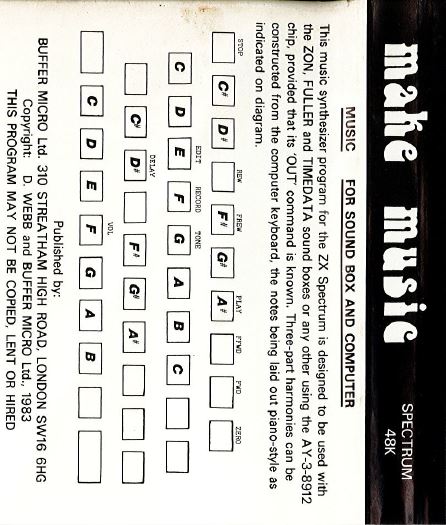
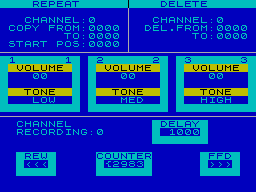
3-channel recording & editing; needs AY-3-8912 sound box
Play
- MakeMusic.tzx.zipTape image English8 KB
Files and rights
No permission is on record either way. Screens and pictures are copied here on a take-down basis: if you hold the rights and want something removed, say so and it goes.
Credits
- Dan C. Webbcredited
Sign in to credit somebody, or say what these people did.
Scores
In the magazines
- Sinclair User #301984 · Gilbert Factor8/10
In the magazines 19
ZX Computing #19Jun 1985 · p.49
£5.95 Buffer Micro Ltd. [redacted] For use with any programmable sound peripheral using the AY-3-8912 chip, this simulates a three channel recorder. Could be useful.
ZX Computing #17Feb 1985 · p.115
Ray Elder
MUSIC MICRO PLEASE! An outline of some of the more harmonious programs and devices recently produced. Ray Elder takes up the Baton and conducts the investigation. For the professional/dedicated/expert musician there is the Midi interface and synthesiser system, but for many others, including yours truly, the cost of such equipment is beyond the realms of an overdraft. For us interested but impoverished would be musicians there are a few more affordable, though much less versatile, alternatives. FORTE! An essential first step is to do something about the BEEP, there are several ways around this, you can simply amplify the thing or, if you want to get the most from the computer, then you will need to purchase a unit which incorporates a sound chip. Most of these units use a version of the AY-3-8910/8912 chip and this is a well tested and reliable chip which can produce some impressive sounds. Simple amplification of the BEEP can be achieved in several ways and is the least expensive of the two options. Beep amps either have a built in speaker or send the sound to the TV and some such units are: THE CHEETAH BEEP AMP, this puts the sound through the TV and is in the same size box as their other units, complete with a full through port for other peripherals. Cost £9.95. CURRAH MICRO SPEECH unit. This is primarily a speech unit but it also routes the Spectrum Beep through the TV and is worth considering if you want to investigate the world of speech as well. Cost £29.95. DK'TRONICS BEEP AUDIO AMP. This is a self contained unit in two parts, the amplifier interface and a separate 1" pod mounted loudspeaker. The interface has a full through port and, although lipped, fits both versions of the Spectrum securely. Cost £14.95. THE TRICHORD, a full sound box including AY chip, amp and speaker and software for both ZX81 and Spectrum, available from Newtech Developments Ltd. Cost ranges from £24.95 to £26.95 depending on model and internal amp fitted or not. WILLIAM STUART SYSTEMS sound generator unit, designed to go with their speech recognition and synthesiser units but can be used on its own (if plugged into a stereo system it sounds superb). Software is available separately and is excellent, the ARP program kept me fascinated for hours. FULLER (reinstated by Nordic) have a sound unit and a master unit which includes speech, we have not tried one out yet, but the new look packaging is nice. And finally DK'TRONICS again, identical to their beep amp in size and shape is a full Sound Synthesiser. This is based on the AY chip and is supplied with a demo tape. Cost £29.95. THE DK'TRONICS 3 CHANNEL SOUND UNIT I will give a detailed account of this unit as it is one of the few still left in my possession, most of the others had to be returned after each specific review, and anyway its one of the latest on the market, and most are similar in operation. This is supplied with an eight page booklet which gives setting up details, the volume is adjustable by a small screwdriver through a little hole in the top of the unit, full volume is loud enough for most purposes! Some demo programs are given which explain the basics of programming the beast, these are in BASIC but a machine code programmer can glean enough information to enable him/her to incorporate routines in their programs. Most of the manual is dedicated to operating instructions for the program supplied, these are brief and there are gaps which left me confused - the use of the Envelope generator for instance. The software itself is good and allows you to create tunes in 3 part harmony and is cursor controlled, this means that it can be operated by a joystick. However I found it a little tedious to use and the editing is almost non-existent, an error early on means re-entry of the rest of the line. During playback the three lines of music are shown as a letter/number representing note and octave. Without prior musical knowledge you may find it hard to get anything of worth from it. The sound quality itself is very good, the speaker handles the output with minimal distortion and many a long hour was happily spent with this program. A unit which is nicely made, looks and sounds good and is well worth considering. It also works well with other peripherals, the Technology Research Disk drive unit functioned without problems and it was easy to convert the software supplied to disk. The ZXLprint III Centronics unit also sat at the back quite happily, and of course DK's own units, joystick interface etc. proved compatible. MAKE MUSIC is a program produced by the Buffer micro shop which works in conjunction with any Spectrum sound unit using the AY-3-8912 chip and attempts to emulate a three track recorder, similar to the BBC Music Processor program. It is quite successful although rather awkward to operate, the screen display is not as informative as the BBC, and envelope control is non existent. Good, but not as versatile as it could have been, and as far as I know, the only one of its type for the Spectrum. XOR from a company called Xorsoft and described by reviewer Clive Smith as "one of the better ones" and Music Maker from Malan are two programs which help you compose simple tunes with the inbuilt Beep. Music Maker from Bellflower is an early attempt which didn't quite come up to scratch, editing and printer copies are virtually non-existent and there are irritating pauses when a new line is needed. Sinclair's own offering is Musicmaster. When it came out I said that it probably pushed this aspect of Spectrum computing to the limit and it remains a top program in this field. This has two modes of entry, note names and keyboard simulated, editing is good, replay is fast and a stave printout is provided. AND FINALLY... from a small company (you may like to play "spot the advert" for their products) comes my favourite program so far! MUSIC TYPEWRITER from Romantic Robot, [redacted] is a very professional piece of programming, easy to use, excellent screen presentation, error trapping and helpful prompts. Fast replay, versatile editing, stave and note printouts, transposing to other keys, six octaves, treble and bass clefs, 23-255MM (metronome scale), menu driven and up to 16 pieces of music held in memory at one time. Even without an amp it sounds good. Do you get the impression I'm impressed? A keyboard overlay is provided and versions of the program are available for use with a sound generator chip and even with the Midi interface if you so require. If you are interested in music and own a computer then get it. Cost £9.95. For those of you who enjoy DIY then watch out for our Beep amp hardware project and some musical programs soon to be published in ZX Computing.
Sinclair User #30Sep 1984 · p.68/108/10
Gilbert Factor 8/10
John Lambert 8/10
Memory: 48K Price: £6.95 Make Music, published by Buffer Micro Ltd, is one of the best music programs available. It permits you to create three-track harmonies, using two octaves of piano-style keyboard for each track. It is designed to be used in conjunction with any sound board which uses the AY-3-8912 chip, for example Fuller, ZON or Timedata. Using the ZXM Timedata board, you can produce good-quality harmonics with a minimum of practice. Unlike some other music programs, it allows you to hear the music as you play. It also remembers your tunes. So you play on one track at a time and hear the other two while you play. You can also ask the program to repeat sections of music automatically, or to move rapidly forwards or backwards through a recorded tune. The volume and tone of each track can be altered and recorded tunes can be edited. The only disadvantage to Make Music is that the instructions are not entirely clear and so the exact order of operations needs some thought but that does not detract from its overall quality.
Advert12
- Sinclair User #34Jan 1985 · p.103
- Your Computer #1Jan 1985 · p.146
- ZX Computing #16Dec 1984 · p.34
- Your Spectrum #10Dec 1984 · p.86
- Sinclair User #33Dec 1984 · p.176
- Your Computer #11Nov 1984 · p.46
- Your Spectrum #8Oct 1984 · p.61
- ZX Computing #15Oct 1984 · p.88
- Sinclair User #31Oct 1984 · p.70
- Personal Computer Games #11Oct 1984 · p.132
- Computer ChoiceSep 1984 · p.10
- Your Spectrum #7Sep 1984 · p.53
News/Note3
- ZX Computing #14Aug 1984 · p.35
- Personal Computer News #63Jun 1984 · p.34
- Popular Computing Weekly #21May 1984 · p.52
Feature1
- ZX Computing #17Feb 1985 · p.115
Reviews from people here
Sign in to write about this, or make an account. It takes a minute and lets you correct the catalogue too.
No tag recorded.
Sign in to correct or add to this.
Hold the rights to this and want it taken down?