Masterfile
Utility: Database/Filing · ZX-Spectrum 48K · 1 players
Campbell Systems · 1982 · Pound sterling 15.00 · Pound sterling 29.95 microdrive
Also known as Kartoteka Szefa (English), Multifichiers (French)
_Front.jpg)
_Front.jpg)
_OuterBox.jpg)
_Box.jpg)
.jpg)
(Logiciels).jpg)
.jpg)
(Nowatech).png)
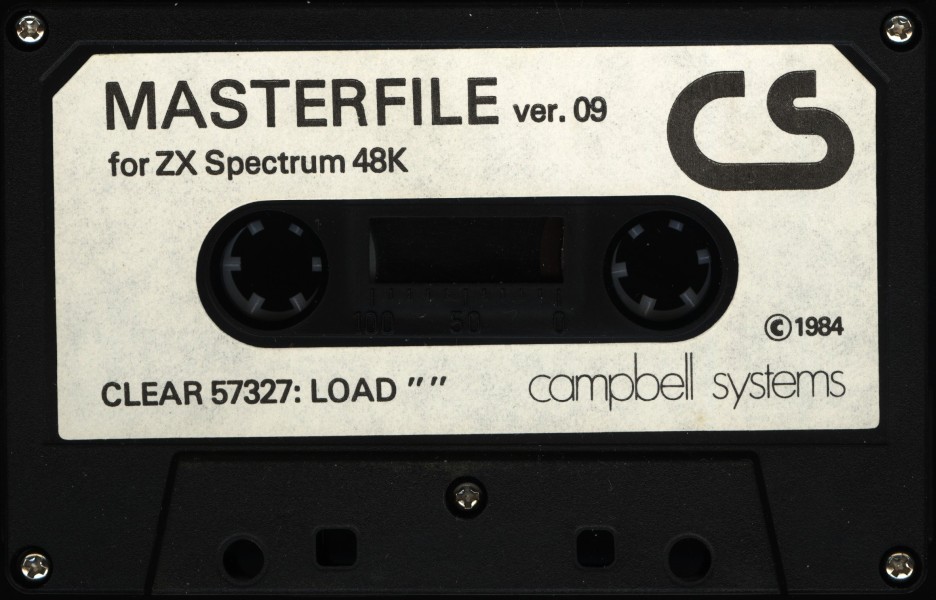
_Tape.jpg)
Discussion
Nobody has started a thread about this yet.
Remarks
From version 08 onwards Masterfile made use of {Micro-print 42/51|Myrmidon Software|0011901}.
SPOT: cf. Masterfile 9 (last version)
Releases
- 1982Campbell SystemsPound sterling 15.00 · Pound sterling 29.95 microdrive
- 1982Aackosoft
- 1984Angel Gandara
- 1984Edizioni JCE
- 1987J. Olmer Praha
- UnknownKellydata
- 1982Logiciels (Informatique Service) Sold as Multifichiers
- 1985Nowatech Sold as Kartoteka Szefa
- 1982Profisoft [1]
- 1983VentamaticSpanish peseta 2990.00
- UnknownPlansoft
Play
- MasterfileV09.opd.zipDisk image English15 KB
- MasterfileV09(Modified).mdr.zipDisk image English18 KB
- MasterfileV09_2.mdr.zipDisk image English15 KB
- MasterfileV09.mgt.zipDisk image English46 KB
- Masterfile(Plansoft).tzx.zipTape image Portuguese7 KB
- MasterfileV09(Profisoft1).tzx.zipTape image English10 KB
- Masterfile(KartotekaSzefa)(Nowatech).tap.zipTape image Polish7 KB
- MasterfileV08(Multifichiers)(Logiciels).tzx.zipTape image French17 KB
- MasterfileV1.04(J.OlmerPraha).tap.zipTape image Czech8 KB
- MasterfileV09(EdizioniJCE).tzx.zipTape image Italian11 KB
- Masterfile(AngelGandara).tap.zipTape image Spanish6 KB
- MasterfileV09(Aackosoft).tzx.zipTape image English10 KB
- MasterfileV09.tap.zipTape image English10 KB
- MasterfileV06.tap.zipTape image English7 KB
- MasterfileV04.tap.zipTape image English7 KB
- MasterfileV09.tzx.zipTape image English11 KB
- MasterfileV06.tzx.zipTape image English7 KB
- MasterfileV04.tzx.zipTape image English7 KB
Documents
- Masterfile.txtInstructions English54 KB
- Masterfile(Multifichiers)(Logiciels).txtInstructions French48 KB
- Masterfile(Plansoft)(PT).pdfInstructions Portuguese785 KB
- Masterfile(EN).pdfInstructions English852 KB
- Masterfile(Ventamatic).pdfScanned instructions Spanish20,714 KB
- Masterfile.pdfScanned instructions English
Files and rights
Distribution permission is on record, granted to another archive rather than to this one. Screens and pictures are copied here; everything else links to the archive that holds it.
- AllowedCampbell Systems → WorldOfSpectrum
- AllowedVentamatic → WorldOfSpectrum
Credits
- John A. Campbellcredited
Sign in to credit somebody, or say what these people did.
Scores
In the magazines
- Sinclair User #131983 · Gilbert Factor8/10
- Sinclair User #151983 · Gilbert Factor8/10
- Sinclair User1984 · Gilbert Factor8/10
- Sinclair User #341985 · Gilbert Factor8/10
Elsewhere on the web
- WorldOfSpectrum 1 votes10.00
In the magazines 125
ZX Computing #18Apr 1985 · p.15
S. Datoo
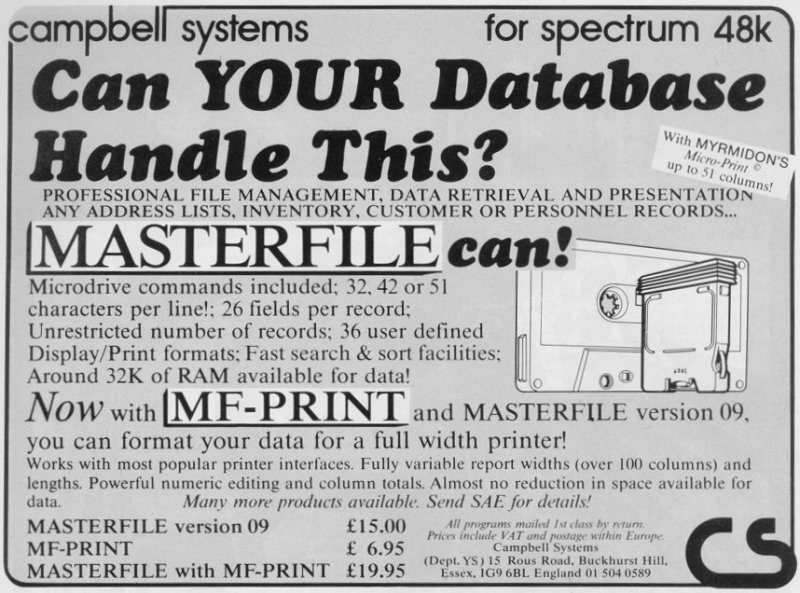
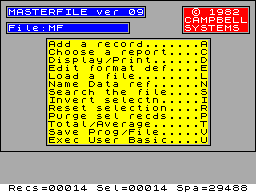
READERS' REVIEWS Once more we open our pages to the people who use the programs the most - YOURSELVES! MASTERFILE Campbell Systems S. Datoo As far as business software for the ZX Spectrum is concerned, there are several database programs available on the market. Campbell Systems advertisement for their program "MASTERFILE" asks "Can Your Database Handle This? MASTERFILE can!". Having used both version 8 and version 9 of this program I can guarantee that their claim is no idle boast! The latest version gives one the option of formatting the data to be displayed on the screen as well as being printed onto a full sized printer, but more about that later. The program loads in two parts, the first one being a BASIC program which one may manipulate to suit individual requirements provided that the default line numbers and relevant statements are not altered. The second part is fully machine coded, but even here the user can adapt the program to suit his or her taste. For example, the program as supplied will allow the user to format 26 data references for each record, but for those requiring more than this number, the manual which accompanies the tape instructs you on the method to increase the number to 43. However, with a little experimenting I discovered that this number can be further increased to 58! To verify that what I was doing to increase the number of data references was correct I telephoned John Campbell, the author of the program. I was completely bowled over by the helpfulness of Mr. Campbell, and in my experience there are not that many companies that could match his after sales customer service. Like all other database programs, "MASTERFILE" Also has a demonstration program which illustrates the versatility of the program. One is able to see the various layouts which can be designed for each file, and this is extremely useful for setting up formats that are sorted by different fields. For example, the demonstration program is a file of employees and the information held in each record gives the department that the individual works in, the salary, job title, home address, and other additional information in note form. The layouts which have been designed will sort and display the information by name, by department, or by salary, and most usefully in an address label format. The user can switch from one format to another quite literally at the touch of a button. THE MENU At each stage of the program there is a very helpful "menu" or "mini-menu" displayed which makes it very easy to use the program. The keyword throughout the program is "user friendliness". The main menu offers the following options: ADDING A NEW RECORD The number of records held in the file is displayed on line 23. The amount of space available (in bytes) is also constantly displayed on the same line. LISTING ALL THE REPORT REFERENCES This shows the reference of the various layouts that have been created. DISPLAYING OR PRINTING THE FILE The display option is also available via other "mini-menus". EDIT OR FORMAT A REPORT This is used to either review or amend a display format. LOADING A FILE OR SAVING A FILE The program is fully Microdrive compatible. SEARCHING THE FILE FOR SELECTED RECORDS INVERTING THE SELECT STATUS OF EVERY RECORD RESETTING THE SELECT STATUS OF EVERY RECORD The above three options are used together when searching for a particular record or a group of records. ERASING ALL THE RECORDS As with all erasures there is a fail-safe built into the program which asks the user to confirm before execution. EXECUTING USER BASIC This option is especially useful if one requires arithmetical functions to be carried out on numerical data held within the records. For example if one wished to express an item as a percentage of another then this is quite easily done by writing a short and fairly simple BASIC routine within the specified lines. When adding a record one may select the auto prompt option which does away with having to remember the various data references that have been named for each record. Each data item can be up to 128 characters long. When the data is displayed, "MASTERFILE" performs rudimentary word processing such that all leading blanks are ignored, a clean left margin is maintained, and word breaks are minimised. Numeric data is right justified. The vertical line character (i.e. ':' found under the S key on the SPECTRUM) has a special use in "MASTERFILE". It forces a line break so that text may be keyed in as a single line but with the vertical line characters (VLC) as line separators, so that when the data is displayed in a 4-line-deep paragraph, for example, each VLC forces a line change. This is very useful for address labels. The amount of memory that is available for storage of data per file is approximately 32K but this is reduced slightly if the full sized printer option is used. I use "MASTERFILE" with a full sized printer almost on a daily basis at work and I have found the memory available to be quite ample. i stated earlier that the user could design various formats for displaying the records on screen. In addition to this the user has a choice of having the normal 32 characters per line or opting for 42 or 51 characters per line. As far as the print option is concerned, if one wished to print the file to a full sized printer then this is achieved with the aid of an additional program entitled "MF PRINT" which is available separately from CAMPBELL SYSTEMS. "MF PRINT" will enable the user to print up to 200 columns per line. Here again, one may design the layout according to requirement. When printing to a full sized printer it is possible to have all numeric data edited so that leading symbols (e.g. £ or $) will be automatically printed. In addition, columns of figures can be totaled and thousands' commas inserted automatically. I have been using "MASTERFILE" for just over 1 year now and at present I am using it at work almost every day. If anyone is considering buying a database program then I would say this to them; I have used three database programs on the SPECTRUM and none of them can beat "MASTERFILE". "MASTERFILE" is priced £15 and "MF PRINT" is priced £6.95. If the two are purchased together then the cost is reduced to £19.95. The programs are available from CAMPBELL SYSTEMS, [redacted].
Sinclair User #34Jan 1985 · p.1518/108/10
Gilbert Factor 8/10
Mike Wright 8/10
SOMETHING OLD, SOMETHING NEW A survey of extras Unlike games software which, in general, achieves volume sales rapidly before virtually disappearing, applications software tends to sell steadily and have a much longer life. Many applications programs are developed and improved during their life. With the Sinclair Business User section just over a year old it is a good time to look at the updates to some of the programs we have reviewed. The very first review in December 1983 was of the OCP Finance Manager for the 48K Spectrum. That has been upgraded to include microdrive compatibility, allowing both the program and data to be saved separately to face. That set up routine is only used when loading from the original tape. Saving the program - to tape or microdrive - also saves the printer interface codes to give a personalised the program the option of cataloguing a cartridge is not included. The +80 version of the program, for use with full-sized printers, has had a further refinement added. Previously the program could only be used if you had the Kempston Centronics interface, now it has been programmed to offer a choice of 15 different interfaces - ten Centronics and five RS232 - or to set up the codes for any other printer inter-any microdrive attached. The program is supplied on casette and still includes a facility for saving to tape. Although the program can now be run from microdrive and data files loaded within version for subsequent use. The print-out for the +80 version shows the date of transaction, the account, the details, separate columns for debit and credit and the balance. That compares with the date, account, amount and balance on the ordinary version. OCP has upgraded its other programs in the same way. According to Francis Ainley the good news for QL owners is that he is working on an enhanced program allowing a class heading, in addition to the account and description, to be used with the transaction. The program is likely to feature some sort of windowing. Upgrading to microdrive compatibility was not possible with the Transform Sales/Purchase Ledger/Invoicing package as it was designed to run using twin microdrives anyway. Instead, improvements have been made to the Accounting program. Previously it was only possible to produce an overall total figure for all, or some, of the accounts by loading each account separately, noting totals and adding them up. Now a series of extra menus allows the list of accounts to be displayed and any combination of those to be selected and totalled. Accounts can be erased from a cartridge as another option. The package was reviewed in the November issue. The Kemp Stock Control program was reviewed in the August issue and version 3.0 has been released recently. Like any other programs which have been improved Stock Control is now microdrive compatible but the improvements do not end there. It now has the option of selecting a full-sized printer and a 64-column printout. If a full-sized printer is to be used and your printer interface needs software to drive the printer then that must be loaded each time before the program. The option of a full-sized printer must also be made every time. Although the resulting printouts are more widely spaced they are no more informative than those on the ZX printer. Other improvements include making the length of the stock numbers and descriptions user definable. The stock number can be up to ten characters long while the stock description, previously 20 characters, can now be set at any length between 4 and 30 characters. Of course, the more characters used for those fields the less room there will be for the records. Another improvement now allows up to two decimal places to be used for stock quantities. With those improvements this is now the most flexible stock control program available on the Spectrum. It is difficult to imagine many improvements which could be made to Tasword II, the word processing program from Tasman Software. Instead, Tasman has released its equivalent of Wordstar's Mailmerge program called Tasmerge. The program is designed to operate with Tasword II and the Campbell Systems Masterfile and allows you to insert names and addresses from a Masterfile database into a standard document produced using Tasword II. Now that it has a mailmerge facility Tasword II is once again streets ahead of its nearest rival, although the Softek word processor for the Wafadrive will be a strong contender if rumours of a database and a mailmerge facility are true. With Tasword II and Masterfile included as part of the microdrive/interface 1 Expansion Pack Tasmerge has a whole new market. Speaking of Masterfile, that has been improved since it was reviewed last February. The latest version - version nine - comes in a smart plastic case and now includes MF Print which allows Masterfile to print to full-sized printers. That is done by allowing the user to set up and save the outline report exactly as it is to be printed. The blank report must then be loaded before printing out the selected records. Unlike the ordinary report formats for the ZX printer only one report can be held in memory at one time. Others must be loaded when needed. In addition numeric data can be printed in a variety of formats including integer, two decimal places, with commas showing thousands and prefixing any character such as a currency sign. With those improvements the best database for the Spectrum is now even better. Campbell Systems, [redacted]. Kemp Ltd, [redacted]. OCP Ltd, [redacted]. Tasman Software, [redacted]. Transform Ltd [redacted].
Sinclair User1984 · p.228/108/10
Gilbert Factor 8/10
John Gilbert 8/10
APPLICATIONS FOR THE SINCLAIR AT HOME AND THE OFFICE Why not stop playing games and do something interesting with your computer? John Gilbert assesses the software. Both Sinclair machines can be used for storing data of any kind, such as names and addresses, telephone numbers and even an ever-changing record of appointments. The ZX-81 needs the 16K RAM pack for any kind of data storage and both information and program have to be SAVEd together. That operation can take up to six minutes and is not very reliable. The Business and Household cassette was one of the first packages available from Sinclair for the ZX-81. It contains three programs. One will keep a record of names and addresses, the next will keep a diary of events and the final program will handle all your financial transactions. The first two programs worked well but the Bank Account program on side two took six minutes to load and SAVEing the program back on to tape with the data proved very difficult. The Business and Household cassette may not be very reliable but it is good value at £3.95. One of the best data management systems available for the ZX-81 is The Fast One, from Campbell Systems. It allows the user to set up files of information in any way which suits him. The program will sort and search for specific bits of data and if numbers are being used it is possible to total them. The program is a step forward for the ZX-81 and is very flexible. It will do any kind of filing job, given the limitations of the machine. The Fast One costs £15 and has a comprehensive manual. Spreadsheet programs are an easy way to store numerical data in a format in which it can be used for calculations. The spreadsheet is a matrix, or table, on the screen and any box, or cell, in the table can be addressed by using the letters and numbers which run horizontally and vertically at the sides of the sheet. This type of program can be used to plan the family budget and calculate automatically running totals of family expenditure. That is only one of the many applications for which it can be used in the home. MiCROL produces a spreadsheet program called Matrix Planner. It is easy to use and has a spreadsheet of eight rows by 30 columns. That configuration can be changed by the user through the program variables. Approximately 300 cells can be created in the matrix before all the 16K of memory is used. Sinclair Research markets two programs similar to the Matrix Planner. Vu-Calc is a program which uses the spreadsheet. It has limitless possibilities and can be used for financial modelling, keeping track of bank accounts and even setting-up scientific experiments which rely on number-crunching for their outcome. The second is Vu-file. It is like Vu-Calc but the user can only store information and not perform calculations on data. Both programs are available for the ZX-81 and Spectrum. ZX-81 versions cost £7.95 and Spectrum versions £8.95. The arrival of the Spectrum set software houses the task of writing programs which can use data files separate from the programs. It has opened the way to storing large amounts of data on cassette and, when the Microdrive arrives, on floppy tape. There are several good programs for data storage on the Spectrum but most of them can be used only on the 48K version. The Database from MiCROL is one such program. The files can be split into documents. Those documents are useful in splitting-up topics within the machine. You can give each document a heading, such as tax, income or budget, and you can have several of them in memory at one time. Documents are split further into records, with one record corresponding to each datum. With that system it is possible to do your tax and budgets at the same time, without having to load the computer twice with information. The program can store up to 999 record lines in memory. The Database costs £9.95 and is complete with handbook. The Masterfile program from Campbell Systems is the most comprehensive of the databases available. It is the successor to The Fast One for the ZX-81 and provides fast access to large amounts of information. The user can also model the program to meet specific requirements. Data can be sorted and searched and reports can be compiled using the system. Masterfile costs £15 for the 48K version and £12 for 16K. The spreadsheets which proved so popular with the ZX-81 are starting to creep on to the Spectrum market. The best, so far, are from MiCROL and Microsphere. Both are remarkably similar. The MiCROL version costs £9.95 and provides the basic calculating power of most spreadsheet programs. It is easy to use and can help the business or home user with complicated calculations. Omnicalc is the spreadsheet from Microsphere. It is ideal for someone who has just found the spreadsheet concept but it is also a very powerful tool for anyone who has used one previously. The program seems to work faster than the MICROL spreadsheet and information can be accessed almost immediately. The screen format is easily understandable and very clear for the first-time user. The program contains a help option which lists the commands available through the spreadsheet. Omnicalc costs £9.95. It is complete with a user manual. All-Sort is an interesting utility program for the 48K Spectrum. It enables a user to sort data which has been set up within a home-built program. The data is stored initially in an array and All-Sort can sort up to four of them at once. It can be obtained from Alan Firminger. The program is useful and very fast but at £18 exclusive of VAT it is expensive. Listfile is a program which does exactly what its name suggests. The program allows a user to store lists of data, such as names and addresses, and to access that information very quickly. Data is entered in blocks which can be up to eight lines of 26 characters long. An extra line, called the info line, can be used to index information but that is not printed-out when the printer is used to list the information. Listfile is available for the 16K and 48K Spectrum and can be obtained from G and J Bobker. It costs £10 and has full documentation. Now that the Spectrum has arrived, software manufacturers are beginning to think about software uses other than games on Sinclair machines. The data processing programs could handle many tasks which are centred on the home. Databases, such as the one from MiCROL, are useful for storing textual information, such as a list of favourite records or even knitting patterns. The Microdrive could expand the data processing capabilities of the Spectrum. Information can be accessed more quickly and as a result bigger programs could be stored in memory and data could be fed in bit by bit. The capabilities of the Spectrum could be extended in this way but soon we will have to decide whether it is necessary. Most data processing programs can already deal with more information than the ordinary user needs. It may be proved that that type of application for the Microdrive is a waste of time. Sinclair Research, [redacted]. MiCROL, [redacted]. Campbell Systems, [redacted]. Microsphere Computing Services Ltd, [redacted]. Alan Firminger, [redacted]. G and J Bobker, [redacted].
'Most data processing programs can already deal with more information than the ordinary user needs.'
'There are programs for data storage on the Spectrum but most of them can be used only on the 48K version.'
ZX Computing #10Dec 1983 · p.21
Peter Shaw
SERIOUSLY NOW... A look at some 'serious' software packages for the ZX Spectrum by Peter Shaw. MASTERFILE 48K Spectrum Campbell Systems Masterfile is, as its name suggests, a comprehensive filing system, which will store anything you choose and retrieve in the manner you wish. The example program supplied was a personnel file, which supplied the deepest secrets about BA Campbell's shoe size. Masterfile lets a user display the files in any way he or she wants; the example program had four different displays, but by the look of things it is possible to have 36 displays, in full colour using high resolution displays. The file itself is very fast, one of the few to be nearly written totally in machine code. The program is completely menu-driven (which is a great help if you have a memory like mine) and can store 26 items per record with 128 characters per item. Masterfile is based on the ZX81 program, 'The Fast One', which is used by many '81 owners all over the world. Masterfile's pedigree is sure to make it sell. The price of the package is £15.00. Campbell Systems, [redacted].
Sinclair User #15Jun 1983 · p.448/108/10
Gilbert Factor 8/10
John Gilbert 8/10
APPLICATIONS FOR THE SINCLAIR AT HOME AND THE OFFICE Why not stop playing games and do something interesting with your computer? John Gilbert assesses the software. Both Sinclair machines can be used for storing data of any kind, such as names and addresses, telephone numbers and even an ever-changing record of appointments. The ZX-81 needs the 16K RAM pack for any kind of data storage and both information and program have to be SAVEd together. That operation can take up to six minutes and is not very reliable. The Business and Household cassette was one of the first packages available from Sinclair for the ZX-81. It contains three programs. One will keep a record of names and addresses, the next will keep a diary of events and the final program will handle all your financial transactions. The first two programs worked well but the Bank Account program on side two took six minutes to load and SAVEing the program back on to tape with the data proved very difficult. The Business and Household cassette may not be very reliable but it is good value at £3.95. One of the best data management systems available for the ZX-81 is The Fast One, from Campbell Systems. It allows the user to set up files of information in any way which suits him. The program will sort and search for specific bits of data and if numbers are being used it is possible to total them. The program is a step forward for the ZX-81 and is very flexible. It will do any kind of filing job, given the limitations of the machine. The Fast One costs £15 and has a comprehensive manual. Spreadsheet programs are an easy way to store numerical data in a format in which it can be used for calculations. The spreadsheet is a matrix, or table, on the screen and any box, or cell, in the table can be addressed by using the letters and numbers which run horizontally and vertically at the sides of the sheet. This type of program can be used to plan the family budget and calculate automatically running totals of family expenditure. That is only one of the many applications for which it can be used in the home. MiCROL produces a spreadsheet program called Matrix Planner. It is easy to use and has a spreadsheet of eight rows by 30 columns. That configuration can be changed by the user through the program variables. Approximately 300 cells can be created in the matrix before all the 16K of memory is used. Sinclair Research markets two programs similar to the Matrix Planner. Vu-Calc is a program which uses the spreadsheet. It has limitless possibilities and can be used for financial modelling, keeping track of bank accounts and even setting-up scientific experiments which rely on number-crunching for their outcome. The second is Vu-file. It is like Vu-Calc but the user can only store information and not perform calculations on data. Both programs are available for the ZX-81 and Spectrum. ZX-81 versions cost £7.95 and Spectrum versions £8.95. The arrival of the Spectrum set software houses the task of writing programs which can use data files separate from the programs. It has opened the way to storing large amounts of data on cassette and, when the Microdrive arrives, on floppy tape. There are several good programs for data storage on the Spectrum but most of them can be used only on the 48K version. The Database from MiCROL is one such program. The files can be split into documents. Those documents are useful in splitting-up topics within the machine. You can give each document a heading, such as tax, income or budget, and you can have several of them in memory at one time. Documents are split further into records, with one record corresponding to each datum. With that system it is possible to do your tax and budgets at the same time, without having to load the computer twice with information. The program can store up to 999 record lines in memory. The Database costs £9.95 and is complete with handbook. The Masterfile program from Campbell Systems is the most comprehensive of the databases available. It is the successor to The Fast One for the ZX-81 and provides fast access to large amounts of information. The user can also model the program to meet specific requirements. Data can be sorted and searched and reports can be compiled using the system. Masterfile costs £15 for the 48K version and £12 for 16K. The spreadsheets which proved so popular with the ZX-81 are starting to creep on to the Spectrum market. The best, so far, are from MiCROL and Microsphere. Both are remarkably similar. The MiCROL version costs £9.95 and provides the basic calculating power of most spreadsheet programs. It is easy to use and can help the business or home user with complicated calculations. Omnicalc is the spreadsheet from Microsphere. It is ideal for someone who has just found the spreadsheet concept but it is also a very powerful tool for anyone who has used one previously. The program seems to work faster than the MICROL spreadsheet and information can be accessed almost immediately. The screen format is easily understandable and very clear for the first-time user. The program contains a help option which lists the commands available through the spreadsheet. Omnicalc costs £9.95. It is complete with a user manual. All-Sort is an interesting utility program for the 48K Spectrum. It enables a user to sort data which has been set up within a home-built program. The data is stored initially in an array and All-Sort can sort up to four of them at once. It can be obtained from Alan Firminger. The program is useful and very fast but at £18 exclusive of VAT it is expensive. Listfile is a program which does exactly what its name suggests. The program allows a user to store lists of data, such as names and addresses, and to access that information very quickly. Data is entered in blocks which can be up to eight lines of 26 characters long. An extra line, called the info line, can be used to index information but that is not printed-out when the printer is used to list the information. Listfile is available for the 16K and 48K Spectrum and can be obtained from G and J Bobker. It costs £10 and has full documentation. Now that the Spectrum has arrived, software manufacturers are beginning to think about software uses other than games on Sinclair machines. The data processing programs could handle many tasks which are centred on the home. Databases, such as the one from MiCROL, are useful for storing textual information, such as a list of favourite records or even knitting patterns. The Microdrive could expand the data processing capabilities of the Spectrum. Information can be accessed more quickly and as a result bigger programs could be stored in memory and data could be fed in bit by bit. The capabilities of the Spectrum could be extended in this way but soon we will have to decide whether it is necessary. Most data processing programs can already deal with more information than the ordinary user needs. It may be proved that that type of application for the Microdrive is a waste of time. Sinclair Research, [redacted]. MiCROL, [redacted]. Campbell Systems, [redacted]. Microsphere Computing Services Ltd, [redacted]. Alan Firminger, [redacted]. G and J Bobker, [redacted].
'There are programs for data storage on the Spectrum but most of them can be used only on the 48K version.'
Sinclair User #13Apr 1983 · p.378/10
Gilbert Factor 8/10
CAMPBELL MASTERFILES SPECTRUM Anyone who has used The Fast One, a filing system for the ZX-81, and has now upgraded to the Spectrum will be pleased to hear that Campbell Systems has a similar program, Masterfile, for the 48K Spectrum. The author describes the program as a business and domestic filing system which allows files to be SAVEd and LOADed independently of the program. The program is menu-driven. Files are made up of records which can be designed in any way the user chooses. Each record can contain up to 26 items of up to 128 characters for each item. There are several options which allow the user to manipulate a file or a record. They include searching by character or numeric value, updating or copying a record, totalling or averaging items, and erasing records. If a user has special requirements the program can be tailored to suit through the User Basic option. The program is also open-ended. That means a Microdrive option can be written into it. On average, there is 32K of memory space available for data storage. That makes the system ideal for business use so far as memory is concerned but for full advantage the program needs to be run with a mass storage device, such as the Microdrive, with fast access to large amounts of data. Masterfile is available from Campbell Systems, [redacted]. It costs £15.
Advert110
- Sinclair User #48Mar 1986 · p.34
- Sinclair User #46Jan 1986 · p.98
- Sinclair User #45Dec 1985 · p.39
- ZX Computing #22Dec 1985 · p.17
- Sinclair User #44Nov 1985 · p.96
- ZX Computing #21Oct 1985 · p.21
- Sinclair User #42Sep 1985 · p.91
- ZX Computing #20Aug 1985 · p.41
- Sinclair User #40Jul 1985 · p.48
- Sinclair User #39Jun 1985 · p.76
- ZX Computing #19Jun 1985 · p.43
- Sinclair User #38May 1985 · p.77
- Sinclair User #37Apr 1985 · p.93
- ZX Computing #18Apr 1985 · p.66
- Sinclair User #36Mar 1985 · p.119
- Sinclair User #35Feb 1985 · p.99
- ZX Computing #17Feb 1985 · p.92
- Sinclair User #34Jan 1985 · p.127
- Sinclair Answers #2Jan 1985 · p.41
- Sinclair User1985 · p.29
- Sinclair User #33Dec 1984 · p.238
- Your Computer #12Dec 1984 · p.212
- ZX Computing #16Dec 1984 · p.138
- Sinclair User #32Nov 1984 · p.118
- Your Computer #11Nov 1984 · p.72
Feature7
- Popular Computing Weekly #33Aug 1988 · p.13
- MicroHobby Especial #3Jun 1986 · p.5
- Sinclair User #34Jan 1985 · p.151
- Popular Computing Weekly #48Nov 1984 · p.23
- Sinclair User #23Feb 1984 · p.1
- Sinclair User1984 · p.22
- Sinclair User #15Jun 1983 · p.44
News/Note2
- Crash #62Mar 1989 · p.57
- Sinclair User #22Jan 1984 · p.18
Related
- Compilations
- Outlet issue 075, Business Cartridge
- Tags
- Masterfile
- Same entry at
- Spectrum ComputingZXInfo
Reviews from people here
Sign in to write about this, or make an account. It takes a minute and lets you correct the catalogue too.
No language recorded.
Sign in to correct or add to this.
Hold the rights to this and want it taken down?