
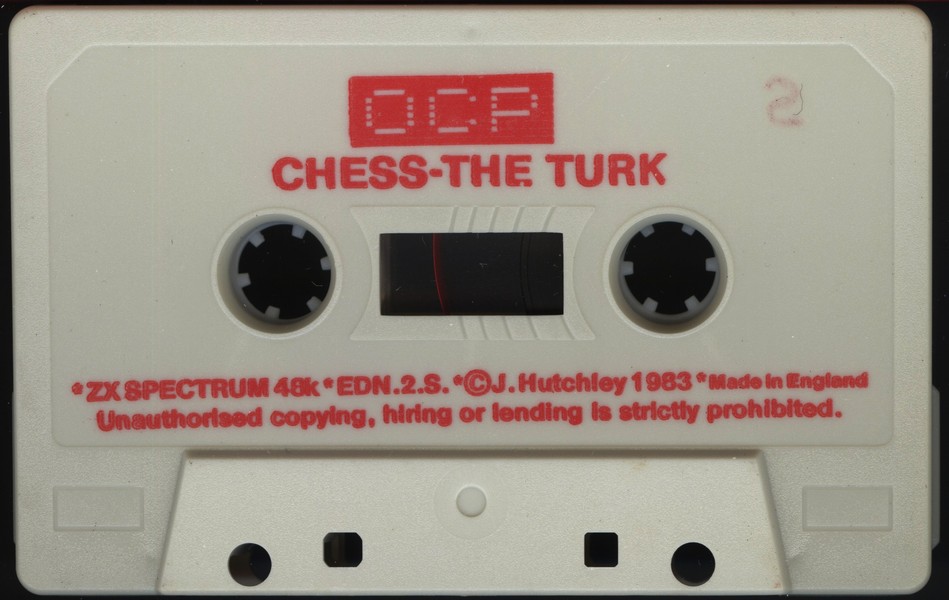
Chess - The Turk
Game: Board · ZX-Spectrum 48K · 1 players
Oxford Computer Publishing · 1983 · Pound sterling 8.95
Also known as Ajedrez Karpov Profesional (English), Schach (German)
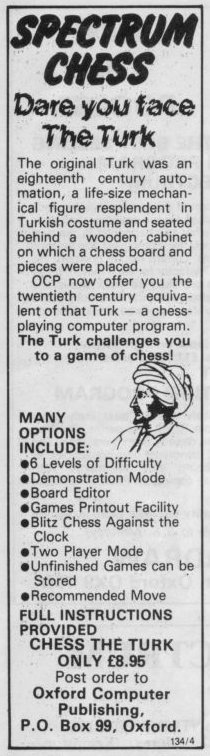
_Back.jpg)
(IndividualSoftwareService)_Back.jpg)
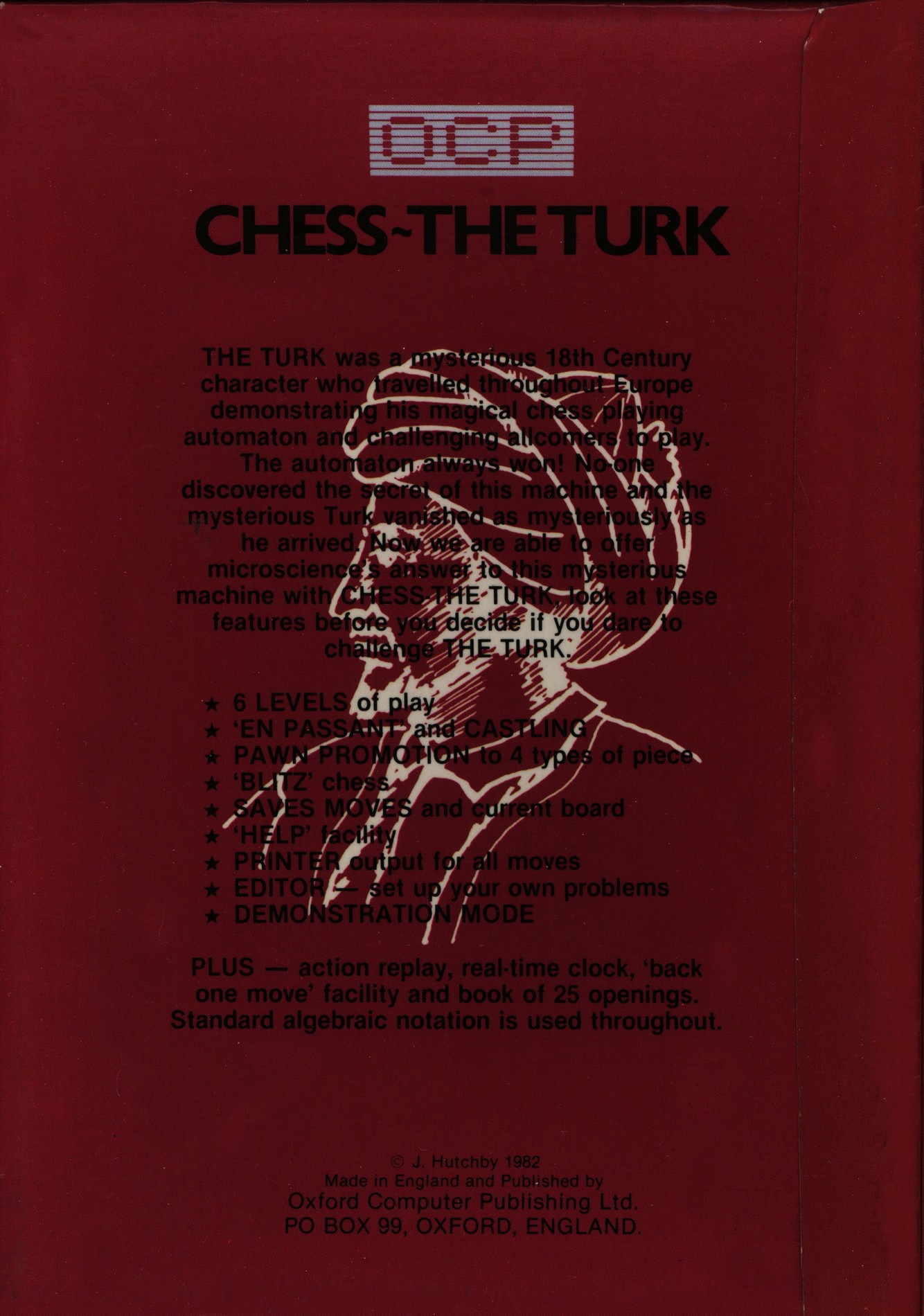
.jpg)
_Front.jpg)
(MicroparadiseSoftware).jpg)
(IndividualSoftwareService)_Front.jpg)
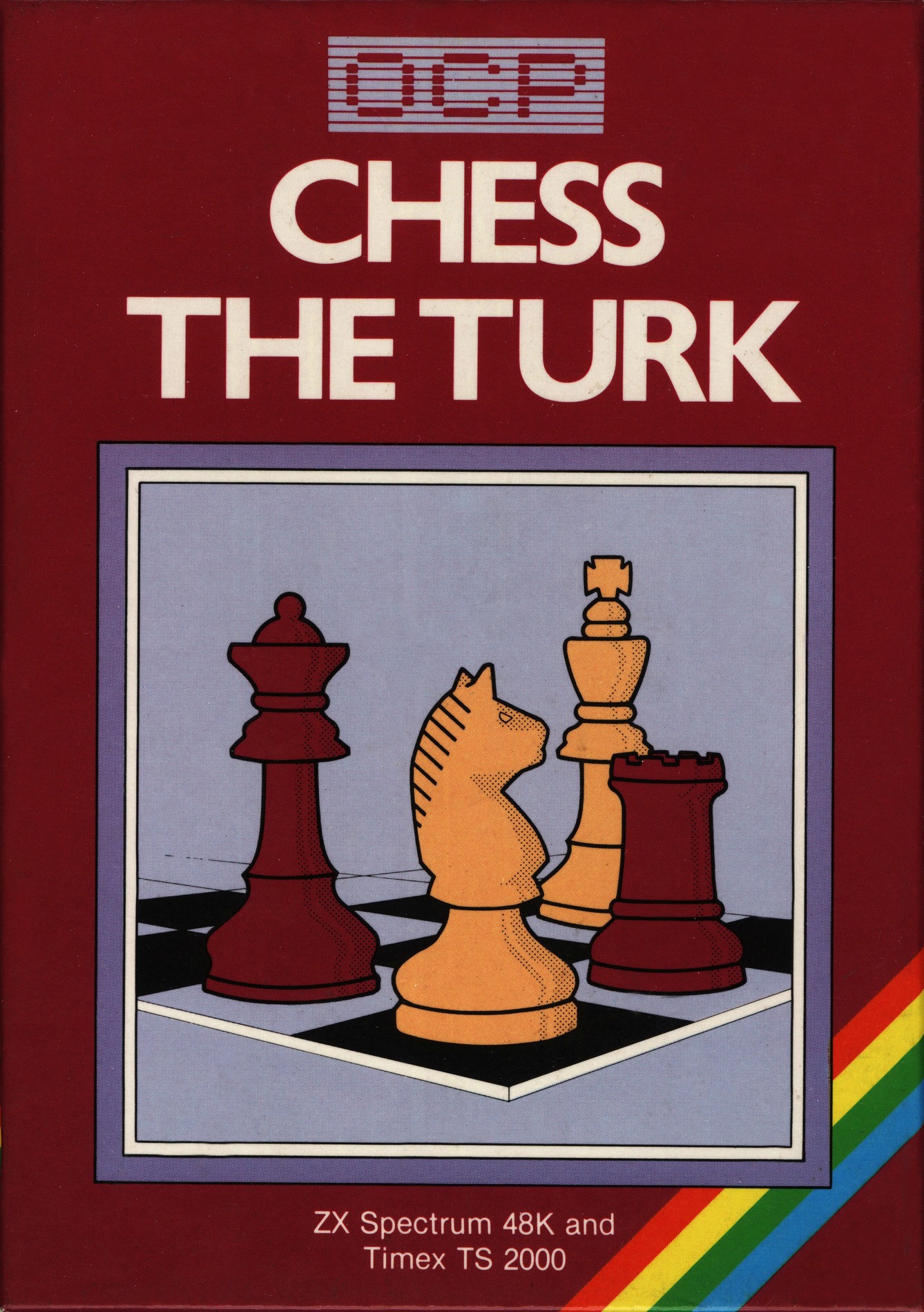
_Front.jpg)
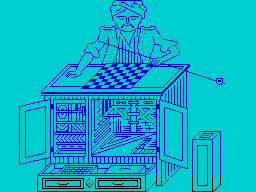
(MicroparadiseSoftware).png)
Discussion
Nobody has started a thread about this yet.
Releases
- 1983Oxford Computer PublishingPound sterling 8.95
- 1983ABC Soft
- 1984Microparadise Software Sold as Ajedrez Karpov Profesional
- 1983Individual Software Service Sold as Schach
Play
- chessturk.rzxRZX playback file
- Chess-TheTurk(AjedrezKarpovProfesional)(MicroparadiseSoftware).z80.zipSnapshot image Spanish19 KB
- Chess-TheTurk.tzx.zipTape image English31 KB
- Chess-TheTurk(French).tzx.zipTape image French21 KB
- Chess-TheTurk(different).tzx.zipTape image English14 KB
- Chess-TheTurk.tap.zipTape image English23 KB
- Chess-TheTurk(ABCSoft).tzx.zipTape image Spanish21 KB
- Chess-TheTurk(Schach)(IndividualSoftwareService).tzx.zipTape image English31 KB
Documents
- Chess-TheTurk(EN).pdfInstructions English255 KB
- Chess-TheTurk(Schach)(IndividualSoftwareService)(DE).pdfInstructions German380 KB
- Chess-TheTurk(ABCAnalog).txtInstructions Spanish9 KB
- Chess-TheTurk.txtInstructions English10 KB
Files and rights
No permission is on record either way. Screens and pictures are copied here on a take-down basis: if you hold the rights and want something removed, say so and it goes.
Credits
- James Hutchbycredited
Sign in to credit somebody, or say what these people did.
Scores
In the magazines
- Sinclair User #211983 · Gilbert Factor8/10
Elsewhere on the web
- WorldOfSpectrum 25 votes8.04
In the magazines 81
ZX Computing #25May 1986 · p.20
Brian Beckett
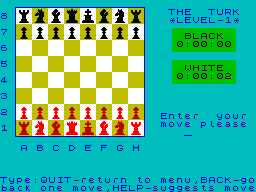
CHECKMATE Brian Beckett assesses the leading chess programs currently available for the Spectrum and QL. The late Norbert Wiener, founder of cybernetics, predicted a day when playing chess would be about as intellectually stimulating as a game of noughts and crosses. Both are zero-sum games of perfect information and (if neither side makes a mistake) ideal play will end in a draw. The reason noughts and crosses is boring and chess is still seen as a great mental challenge is simply that even the ablest grandmaster is incapable of sorting through the seemingly endless possibilities opened up in any one game. Computers, however, might some day be capable of playing error-free chess and Wiener foresaw fallible human opponents' interest in the game declining as a result. Wiener, who worked in the pioneering days of mainframe computers did not however imagine the speed with which chess playing micros would become commonplace. The capabilities of your piece of Sinclair gadgetry would have cost a small fortune only a few years ago but (if you are a chess player) it fortunately still fulls far short of Wiener's super intelligent beast. But, if you don't happen to be a budding grandmaster, a game against your QL or Spectrum can still be pretty damaging to the ego. Sir Clive's little black boxes play passingly good games at even the lower skill levels and can mimic a logical intelligence quite capable of beating an unwary master at the higher one. It's worth having a look at some of the better Sinclair chess programs available both as a guide to buying one and - by highlighting some of their weaker lines of play - avert Wiener's nightmare of the faultless chess computer. Someone is bound to bring out a chess program for the 128K Spectrum pretty soon but all we have now is several packages for the 48K Spectrum and one for the QL. It's not a case of finding the "best" program - the Spectrum packages share similar features, comparative prices and roughly the same skills while Psion's QL chess has the advantage of being both an excellent product and the only one available - but rather a case of choosing the one or more that you happen to like more than the others. CHALLENGE Assuming that you're buying a chess program to play it yourself, you want one that offers you a challenge as well as being able to defeat your neighbour's computer. QL Chess, for example, came first in a microcomputer knockout championship which included some dedicated chess computers but, against certain Queen's Gambit play, is marginally easier to beat than Psion's Spectrum program. The programs looked at here are QL Chess (marketed by Sinclair at £19.95 and developed by Psion) and the three leading packages for the 48K Spectrum: Sinclair's Masterchess (again written by Psion), Artic Computing's Spechess II and OCP's Chess: The Turk. For the historically curious, The Turk takes its name from an eighteenth century, chess-playing automaton dressed in Turkish costume that was the wonder of Europe and - as many believe - probably contained a legless Russian soldier who selected the plays and moved the gears. The Turk costs a reasonable £5.95 making it the cheapest of the Spectrum programs but a watchful eye can usually get the other two at a bargain. The Sinclair/Psion program, for example, is often found in specially priced game packs and many Spectrum owners probably already have one. All chess programs have several levels of play that are a function of the amount of time that the computer is allowed to consider its move. They range from a few seconds at the lower levels to several hours at the higher ones. For a skilled chess player, this can be a problem as the lower levels don't offer a challenge and the higher ones can take forever. Here QL Chess wins hands down as its top "tournament" level (Number 11) occupies the computer for an average of only four minutes a move. If you want, you can set the QL to match your average move time or (if you have a great deal of time on your hands) play at infinite time where the computer will consider its move until you force it to play with a keyboard command. QL Chess has the additional feature of considering its possibilities while waiting for you to move. Shutting off this feature with the "Easy" command in effect doubles the number of levels. For the Spectrum, Artic's program is probably the best for selecting a level of play - you simply type in the move-time you want. This makes level selection a continuous function of time rather than a choice of quantum leaps which might not match what you want. The Turk is the worst in this respect as it increases the Spectrum's move time from 90 seconds at Level-3 to 10 minutes at Level-4 and one hour at Level-5. The jump from 90 to 600 seconds is a bit too large as it's in this sort of time range that a player of medium skill finds himself with a challenge. The Turk, however, will often move in far less time than the maximum allowed at say Level-4. MAKING MOVES As far as graphics go, there is little real difference between the Spectrum programs: the screen shows a top view of the board with the pieces in profile. Personally speaking, Spechess is marginally poorer and The Turk a bit better. The Turk has the added clever feature of toppling over the King upon checkmate or. If you quit the game, your King upon what it always and cheerfully considers your resignation. QL Chess offers a choice of the traditional image or a superb 3D view that is a credit to the programmer's skill. The pieces are moved with a cursor in QL Chess but, in the Spectrum programs, you type in moves using an algebraic notation that replaces the traditional chess codings. Unlike the others, the Psion program does not require you to ENTER your move - the computer does it automatically when you type the last code number - which is nice for speed but unfortunate if you make a mistake. All the programs allow you to quit and start another game (only The Turk gloats about it) and QL Chess enables the player to change sides at any time. I suppose there is a reason for this feature but its only obvious purpose would seem to be a consolation prize to poor players. If you can't win any other way, you can always allow the QL to push you to the brink of defeat and then switch colours at the last minute. The Turk and QL Chess allow you to take moves back and, while this is handy if you make a silly mistake, it also encourages sloppy chess thinking. All the programs allow you to play from a pre-set position after placing the pieces as you wish. They all use the cursor to set-up the pieces except for Spechess where the piece, colour and square are typed in. The QL cursor is quite easy to use but the others can be a bit cumbersome which is why I prefer Artic's method for the Spectrum. Levels of skill can be selected for set-up as well as normal play in each program and QL Chess has the additional feature of eight problem solving levels. As with traditional problems, the idea is to ask the QL to find a mate in say five moves. Each program will recommend a move to the player if asked. This is a useful feature for beginners or those who wish to examine the computer's chess reasoning in some detail. Otherwise if you have to ask the computer for its opinion on your best move, you're playing at too high a level. After all. the object of the exercise is to win and not to do what you're electronic opposition thinks you ought to do. COUNTDOWN All the programs allow you to save the game to tape or to a printer. The Turk has an option for playing blitz chess which is a nice feature. The on-screen clock starts counting down from five minutes and the first side to run out of time loses if (as is likely) no checkmate has occurred. On-screen chess clocks are standard save with Spechess. QL Chess has the very useful feature of declaring a stalemate if a sequence of moves is repeated for three consecutive plays. Otherwise it's pretty much up to you to declare a draw by perpetual check or repeated moves - against any of the programs - by simply quitting the game. All the programs recognise checkmate immediately except for Spechess which, when it's defeated, uses up most of its allotted time before declaring your victory. While there is absolutely no harm in this, I personally find it a bit annoying. Both The Turk and QL Chess have demonstration modes where the computer will play itself, replay options where the computer re-displays a game on screen move by move and the capability to "referee" a game between two players. In the latter mode, the computer simply asks for move inputs from both sides, displays the moves on the screen after ENTER and keeps track of the times. Of the Spectrum programs, The Turk has the largest reservoir of extra features while the Psion package has been honed down to the bare essentials but it does play a good, aggressive game. Next month I'll be setting some classic chess problems for your Spectrums and QL's and showing how even the best chess software is vulnerable to the shrewd sacrifice.
Crash #4May 1984 · p.62
Producer: OCP 48K £8.95 Author: J Hutchby The strange title refers to the famous 'turk', a chess playing machine built in 1769 for the Viennese Court. The modern 'Turk' is your computer. This chess version has arguably the best graphics of any available, very clearly defined classic pieces on a white and beige ground. A 14-option menu allows for a wide variety of play, printing, listing and editing and includes a demo mode and 'Blitz' game, where a time limit is set for the game. The computer can also be used to display the moves of 2 players, or it can set up a board in any configuration you like for playing newspaper chess problems out. There are 6 levels of play with response times ranging from a few seconds up to 8 hours. Moves are made with the traditional algebraic notation and the game allows for castling, en passant capture and promotion to queeen. Certainly one of the most flexible, playable and best looking chess games for the Spectrum.
Crash #1Feb 1984 · p.59
Producer: OCP, 48K £8.95 None of our reviewers have actually seen this program yet, but it has been generally highly regarded by most critics. We will deal with it in more detail at a later date.
Sinclair User #21Dec 1983 · p.488/10
Gilbert Factor 8/10
TURK'S CHESS A DELIGHT FOR PLAYERS Pit your wits against an emissary from the past. This is no space invader but an automaton called the Turk who will give you a good game of chess. Chess - The Turk is for the 48K Spectrum and contains many options which are unusual in chess games for the computer. Before you play you can see how good the Turk is by watching the program play against itself. Levels of play range from one to six and will take a few seconds on level one to six hours on level six. If you are an average good player for your age you may care to try level two, or perhaps three at most, as they will give you at least some chance of winning. If you have been adept at the game for some time you might like to take on the program at Blitz Chess. The name is apt as our board looked like a map of London after the war in just 20 minutes of torment. The reason is that Blitz Chess is against the clock. The game will allow all legal moves, including en passant and pawn promotion. It also allows you to switch sides during the game or, if you want to cheat even more, remove the Turk's queen from the board. Chess - the Turk is well-packaged. It can be obtained from Oxford Computer Publishing, [redacted]. It costs £9.95
Advert64
- ZX Computing #24Apr 1986 · p.73
- Crash #24Jan 1986 · p.155
- Sinclair User #46Jan 1986 · p.77
- Your Sinclair #1Jan 1986 · p.11
- Crash #23Dec 1985 · p.19
- Your Spectrum #21Dec 1985 · p.7
- Sinclair User #45Dec 1985 · p.11
- Crash #22Nov 1985 · p.31
- Your Spectrum #20Nov 1985 · p.6
- Sinclair User #44Nov 1985 · p.12
- Sinclair User #43Oct 1985 · p.81
- Sinclair User #42Sep 1985 · p.73
- Popular Computing Weekly #34Aug 1985 · p.39
- Home Computing Weekly #120Jul 1985 · p.2
- Home Computing Weekly #117Jun 1985 · p.2
- Your Computer #12Dec 1984 · p.266
- Your Computer #11Nov 1984 · p.243
- Your Computer #10Oct 1984 · p.211
- Your Computer #9Sep 1984 · p.190
- Sinclair User #29Aug 1984 · p.27
- Sinclair User #28Jul 1984 · p.108
- Your Computer #7Jul 1984 · p.180
- Your Computer #7Jul 1984 · p.65
- Your Computer #6Jun 1984 · p.7
- Your Computer #6Jun 1984 · p.214
Classified6
- Your Computer #4Apr 1984 · p.228
- Your Computer #3Mar 1984 · p.231
- Your Computer #12Dec 1983 · p.326
- Your Computer #5May 1983 · p.212
- Popular Computing Weekly #12Mar 1983 · p.34
- Home Computing Weekly #2Mar 1983 · p.44
Feature3
- ZX Computing #26Jun 1986 · p.30
- ZX Computing #25May 1986 · p.20
- Computer ChoiceMay 1984 · p.34
Review2
- ZX MagazínMar 2001 · p.8
- Home Computing Weekly #57Apr 1984 · p.29
Offer1
- ZX Computing #26Jun 1986 · p.34
News/Note1
- Home Computing Weekly #8Apr 1983 · p.7
Licensed from
- ChessBoard/Tabletopunofficial
Related
- Compilations
- Chess - The Turk + Psi-Games
- Same entry at
- Spectrum ComputingZXInfo
Reviews from people here
Sign in to write about this, or make an account. It takes a minute and lets you correct the catalogue too.
No language, description, tag recorded.
Sign in to correct or add to this.
Hold the rights to this and want it taken down?