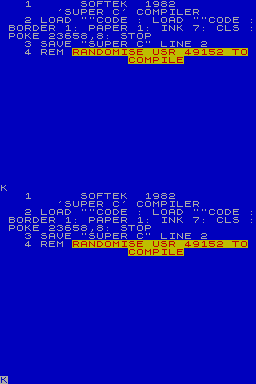
Softek 'Super C' Compiler
Programming: BASIC · ZX-Spectrum 48K · 1 players
Softek · 1982 · Pound sterling 14.95
Also known as Compiler (English), CS Compiler (English)
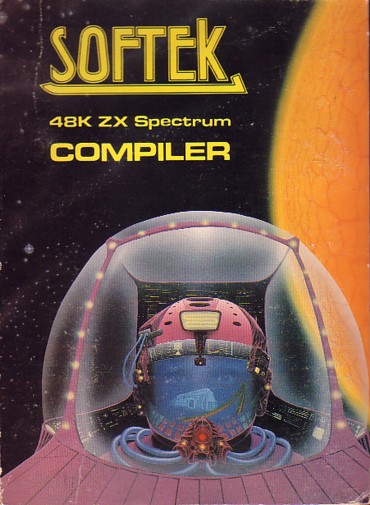
(InvestronicaS.A.).jpg)
(ElettronicaCS).jpg)
(ElettronicaCS).png)
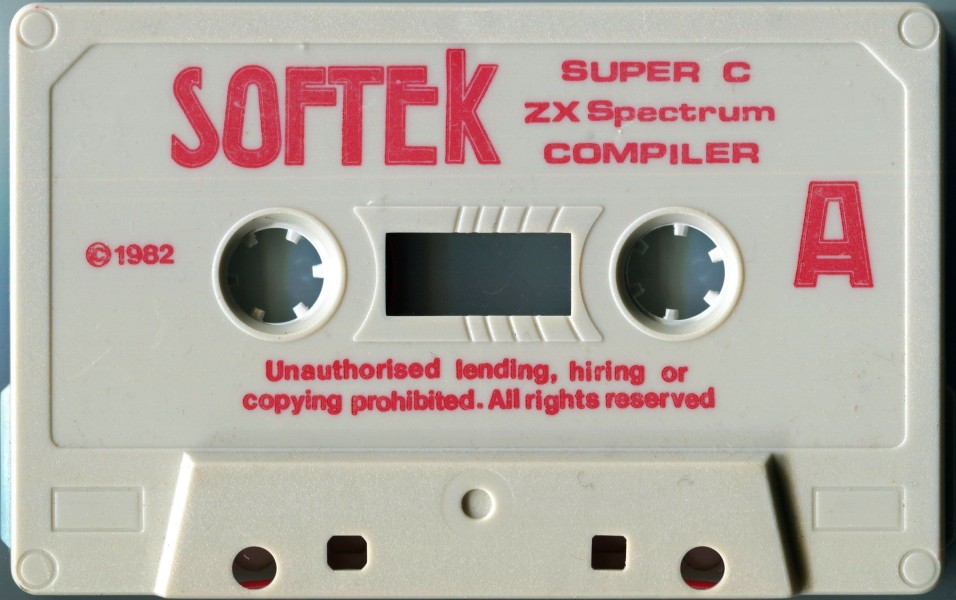
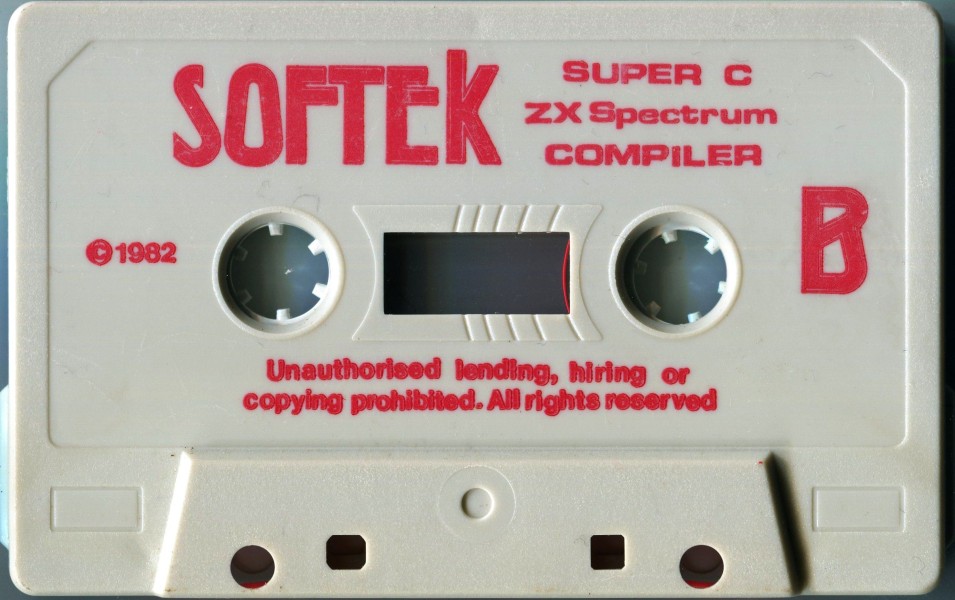
Discussion
Nobody has started a thread about this yet.
Remarks
BASIC (not C) compiler
Releases
- 1982SoftekPound sterling 14.95
- UnknownAackosoft
- 1983Elettronica CS Sold as CS Compiler
- 1983Investronica S.A. Sold as CompilerSpanish peseta 2675.00
Play
- SoftekSuperCCompiler.tzx.zipTape image English3 KB
- SoftekSuperCCompiler.tap.zipTape image English3 KB
- SoftekSuperCCompiler(CSCompiler)(ElettronicaCS).tzx.zipTape image Italian4 KB
- SoftekSuperCCompiler(Compiler)(InvestronicaS.A.).tzx.zipTape image English3 KB
Documents
- SoftekSuperCCompiler(Compiler)(InvestronicaS.A.).txtInstructions Spanish14 KB
Files and rights
No permission is on record either way. Screens and pictures are copied here on a take-down basis: if you hold the rights and want something removed, say so and it goes.
Scores
In the magazines
- Sinclair User #131983 · Gilbert Factor6/10
In the magazines 9
Big K #9Dec 1984 · p.69
Fin Fahey
THE EXTENDED SPECTRUM Fin Fahey checks out a smattering of utility programs for Old Rubber Keys. System Software, as we old computer industry hacks call programming tools, is hardly destined to set the world alight. It smacks of hard work and late night sessions over a hot keyboard and seems light years away from the glamour and fun of, say, a new Melbourne House adventure release. But for people interested in stretching their minds, and their machines, some of these trusty workhorses may well turn out to have hearts of gold. But why go beyond the facilities offered by Sinclair BASIC? (One may well ask.) Quite simply, no machine, and particularly no BASIC interpreter, fills all the needs of the budding programmer, and for a lot of requirements like arcade games, just hasn't got the speed. There area fair number of - packages which just add a few useful commands to BASIC extensions r programmer's toolkits, these generally give you the sort of goodies you've always needed to develop your BASIC programs. There's no line Renumber command on the Spectrum, and for this you'll have to buy a toolkit. The same goes for many other 'system' commands. Trace, to give you a continuous listing of program lines being executed, Map, to tell you which variables have been specified, and Block Delete, so you can get rid of more than one line at a time, to name but a few. Super Toolkit, from Nectarine, has all of these plus such things as a Crunch command, to get all those useless spaces and REMs out of your program before running. It clocks up a total of 12 commands, as does Toolkit from IMS Software, which includes an Auto line-numbering routine. Slightly fewer facilities on CP Software's Spectrum Extended BASIC, only 10 commands in this case, and the only one unique to this package is Find, which will look fora specific string text in your program. CP, however also do Supercode, a machine code toolkit, incorporating a hundred off-the-shelf machine code routines. These include an impressive range of scrolling effects, high-resolution diagonal scroll, low-resolution shutter and ripple scrolls and many others. There are four sound effects generators too, but the truly impressive thing is that you can include CP's code in your own BASIC and machine code programs, an amazing bit of altruism. Each routine has full in-program documentation and a demo mode shows you what they can do. It's got to be good value. From off-the-shell machine code to creating your own. If you've decided that BASIC's too slow for your program design, then you'll probably want to write machine code. Some people seem quite happy programming this byte by byte as BASIC POKEs, but for really effective development you'll need an assembler. Assemblers allow you to put Z80 code in assembly language, a much more understandable form, even though it's a lot more obscure looking than BASIC. A good assembler will allow you to specify addresses and constants as meaningful labels which makes the code a lot easier to follow. In such a symbolic assembler, the JP instruction (equivalent of BASIC GOTO) could be rendered JP LOOP instead of giving an actual address, say JP $4000. But before actually using one of these things, you may need to learn what it's all about. To help you, there are a number of tutorial programs, and some of these actually allow you to set up and test code. Sinclair's Beyond BASIC offers a tutorial on the internal structure of the Z80 plus lessons on each assembler instruction. These are illustrated with simple moving graphics. There is an experimenter section where you can watch the effects of your own code on memory and registers. Sadly, this one doesn't cover the entire instruction set. More complete is New Generation's Machine Code Tutor. This comes on two cassettes and covers everything. Once again, you can write your own code and 'run' it on a diagrammatic simulator. Although this is rather harder work than Sinclair's, I think it gives a closer feeling to using an actual assembler. Dream Software also have a simulator. This has much nicer printed documentation than the other two, but unfortunately it describes an imaginary chip which resembles the Z80 in many respects. I think that this may be unnecessarily confusing, but as long as its borne in mind, the transition to the real chip shouldn't be too hard. So now you can get down to some real coding... Sinclair themselves market the Zeus Assembler, which allows full symbolic instructions. Lines of code are entered much as in BASIC, and editing is similar, so this should be an easy one for beginners to move to. Picturesque's Editor/Assembler, on the other hand, has a rather better editor than the Spectrum, but the key response seemed a bit slow to me. This latter program is very tolerant about the format in which you enter code. Very different from these two is Oasis Software's Spectre Macro-assembler, and I certainly wouldn't recommend this one for beginners. It's a very professional product, but using it is more like learning a new computer language than anything else. It doesn't use Z80 instructions directly; they have to be set up as procedure definitions much as in high-level languages like Forth or Pascal. This makes it very powerful, since it's just like building your own interpreter. But, as I say, not for newcomers. An indispensable tool when developing machine code is some sort of Monitor. A Monitor provides easy ways of getting at memory, moving it, changing it, searching it for particular values, that sort of thing. You can also usually get dumps of Z80 register values and step through a machine code program. The Zeus assembler has a reasonable monitor with it, but Sinclair do a more extensive version as a separate product. This also allows you to Disassemble code, which means to translate machine code back to assembly format. Useful for looking at the ROM, but maybe you'd be better off buying one of the 'Spectrum ROM disassembled' type books which also give explanatory notes. Picturesque's Editor/Assembler has no attached monitor and you have to buy theirs separately, although both programs can be loaded at the same time. Agai, there's a disassembler. Assembly language isn't the only way of getting fast code. Scope II, from ISP, is a simple language aimed at producing fast machine-code animation. The makers call it a medium-level language, as it's mid-way between BASIC and assembler. I feel it's rather closer to machine code, but it's certainly a lot easier to use. Once you've written code in SCOPE II, it is boiled down by the program to machine code routines, which can be run without Scope being present, so you develop commercial products, or give copies of your games to your friends without fear of committing piracy. This process of boiling down machine code is known as compilation, and it's possible to do it to BASIC. The only BASIC compiler we had available to look at was Softek's. This is certainly fast. From running a few simple loops, it looks roughly about 150-200 times faster than interpreted BASIC. It does have some serious drawbacks, though. For one, there a quite a few BASIC functions it can't translate, floating-point arithmetic and arrays among them. More seriously, compiled programs will not run without Softek's run-time routines being present. Unfortunately, the company is being quite prickly about this, and are claiming that if you develop your program and compile it with their program. then they've suddenly acquired a share in it, Whatever the legal position, this seems a little dubious to me, and it's certainly a discouragement to using Softek's product for commercial development. The final approach to fast code is to use Forth. This high-level language is closer to machine code than BASIC, and for most purposes runs up to ten times faster. Not spectacular maybe, but it can make a difference. The speed saving is nice, but it's not really the central point about Forth. The language takes a fundamentally different approach to BASIC, and one which provides a much sounder design discipline. It would certainly be easier to write good machine code after a grounding in it. Forth is known as a 'procedure-oriented' language. That means there's no more complaining about there not being a command in BASIC to do something. If it's not there in Forth, then you just write your own command, which is compiled into the language vocabulary. Although you can theoretically do this in BASIC by using subroutines, compiled procedures are much faster and easier to use. Forth is easier to structure too. There are at least four versions of Forth available on the Spectrum. It's hard to decide between them, but Melbourne House's Abersoft Forth is the only one recognised by the independent Forth interest Group. Sinclair also do a Forth which to my relatively untutored mind seemed much the same, both in terms of speed and usability. Both versions have minimal printed documentation, since they rely on the user going out and acquiring a Forth manual. The sad thing about Forth is that. unless you're a fan of the ill-fated Jupiter Ace, you can't market any of your programs since they won't run without someone else's product. While on the subject of languages, Logo has been stirring up interest as a teaching language, particularly for younger children. Unfortunately, the version I looked at, Snail Logo by CP Software, really merited its name. Logo is high-resolution graphics oriented, and the user commands a 'turtle', or in this case a snail, to draw shapes on the screen. The CP interpreter turned out to be written in BASIC, so every command is interpreted twice. Slow? I can't imagine anyone, adult, or child, having the patience to work through the manual, let alone use it. Something of a weirdie, but one I find particularly fascinating, is Micro -Prolog, from Sinclair. Prolog represents yet another direction in new languages, and is particularly suited for Artificial Intelligence and linguistic purposes. Its very odd to use after command oriented type languages like BASIC, or even Forth, because a program in Prolog (it stands for PROgramming in LOGic) is mostly a way of organising data, not of setting up a fl ow of commands. Now I've got the point, I want to know more about this one. Sinclair Micro-Prolog's documentation isn't bad either. Dr Ming back to the problem of generating programs, if you're an adventure game writer, you haven't really got one, The Quill, from Gilsoft, and Dream's Dungeon Builder can both be used to generate adventures of any complexity. We've reviewed them before, and they're both good value. Dungeon Builder has the edge in user-friendliness, and can be used to add graphics to adventures, while Quill has a more mechanistic approach. Both Gilsoft and Dream are perfectly happy for people to market games produced with their packages. Right on! On which cheery note I'll roll the credits and fade to black, but not before noting that this is far from being a complete survey, so if you've discovered an utterly wonderful, or unspeakably awful bit of useful/useless software in this field let us know. BASIC EXTENSIONS: SUPER TOOLKIT from NECTARINE TOOLKIT from IMS Software SPECTRUM EXTENDED BASIC from CP Software Price: £9.95 SUPERCODE from CP Software Price: £9.95 MACHINE CODE TUTORIALS: BEYOND BASIC from Sinclair Price: £9.95 THE COMPLETE MACHINE. CODE TUTOR from New Generation Software Price: £7.95 MACHINE-CODE FOR BEGINNERS from Dream Software Price. £0.00 ASSEMBLERS: ZEUS ASSEMBLER from Sinclair Price: £12.95 EDITOR/ASSEMBLER from Picturesque Price: £8.50 SPECTRE MAC-MON from Oasis Software Price: £14.95 MONITORS: MONITOR/DISASSEMBLER from Sinclair Price: £12.95 SPECTRUM MONITOR from Picturesque Price: £7.50 COMPILER from Softek Price: £9.95 LANGUAGES: SCOPE II from ISP Price: £11.95 FORTH from Sinclair Price: £14.95 ABERSOFT FORTH from Melbourne House Price. £14.95 SNAIL LOGO from CP Software Price: £9.95 MICRO-PROLOG from Sinclair Price: £24.95 ADVENTURE GENERATORS: THE QUILL from Gilsoft Price: £11.95 DUNGEON BUILDER from Dream Software Price: £9.95
ZX Computing #12Apr 1984 · p.51
David Harrison
READERS REVIEWS Tell us what you think about the software that's on the market. This feature provides space for you to air your views on any software, be it for the ZX80, ZX81 or ZX Spectrum. If you've had a good or bad experience of any of the commercial software packages available for your micro, why not write and tell us. Your reviews should contain your critical thoughts about the software and the relevant details concerning the availability of the package, the price etc. If you can provide any screen dumps to illustrate the review, so much the better. Any reviews published in this section of the magazine will be rewarded with the price of the tape you review. So, if you buy a cassette and send in a review that gets published, you'll get your software for free! SUPER C COMPILER Softek MCODER 2 COMPILER PSS David Harrison Wouldn't it be lovely to write a program in "slowly but surely" Sinclair BASIC and, at the touch of a button, convert it into machine code to run at between 20 and 100 times the original speed? Well, that's what Softek and PSS claim in their adverts for these two compilers. But do they work? Both compilers cost £9.95 but each has its own characteristics and idiosyncrasies. There are some things, however, that both compilers have in common. Both work with integer numbers only and can handle numbers from -32768 to 32767, while Super C also handles numbers from 0 to 65536 on a simulated INPUT. Most BASIC commands can be compiled, with a few exceptions. Neither complier can handle LOAD, SAVE, VERIFY or string arrays. However, MCoder 2 can handle strings (but not string splicing), where Super C can't. This is the big difference between the two utilities. The Super C manual does tell you how this can be done but it is fiddly, involving PEEK and POKE. MCoder 2 can also handle numeric arrays (one dimensional), LEN, LPRINT and INPUT. Super C cannot cope with these but instead, can use STEP in FOR-NEXT loops and SCREEN$ (with code), where MCoder 2 can't. RND is special on each compiler, giving an integer number between 0 and 32767. This is fiddly to work into a BASIC program but, on MCoder 2, you can simulate this function with: LET R = USR 59997 This is useful when testing your BASIC program before compilation. REM, on both compilers, is put to very good use. On Super C, you can use REM to enable the BREAK key to run machine code (which follows the REM in the line, in decimal), or to erase everything, including the Compiler, without pulling the plug. (Both compilers can survive NEW). On MCoder 2, REM #n, gives a choice of the mode in which the compiled program will run: Mode 0 - Gives the fastest code disabling the BREAK key. Mode 1 - Gives longer and slower code by enabling the BREAK key. Mode 2 - Gives code that runs at almost the same speed as BASIC, with TRACE on. By default, Mode 1 is chosen. Both compilers have good error messages, if a bit concise at times. Only MCoder 2 gives you the number of bytes which your code takes up, after compilation. It seems that the only way to save a compiled program is to save the whole of memory, machine code, compiler, work space, the lot. However, this is not difficult, and, with a microdrive, hardly time consuming. One important point to note is that Super C allows only A to Z as variable names, giving only 26 available, without POKEing into memory. MCoder 2 on the other hand, happily accepts, 'LIVES' 'HS' and 'SCORE' without question. Both compilers are called with simple RAND USR commands. Finally, to documentation, MCoder 2 was supplied by return of post in a cassette case with an inlay-card size, eight sides of "manual". This, however, tells you enough to make full use of the compiler, including a full description of all the commands available. Super C took more than three weeks to arrive, and was sent in a large package, about the size of a video cassette box. Super C's manual can only be described as a work of art. Written by Tim Langdell, it gives a superb description of everything about the compiler including the commands, the error reports and just about everything else, finishing off with a plug for the rest of their programs. If I had to choose between these two very powerful packages, I would prefer to use MCoder 2 from PSS, mainly because it can handle strings and can use more than 26 variables. It is also a little easier to use. However, since about June, Softek have been promising an enhancement package for Super C allowing for string arrays, string splicing and floating point. This will probably push up the price to around £15.00. Whether this will ever become available, we shall have to wait and see. At the moment, MCoder 2 still represents the best value for money. For further information on the cassettes reviewed in this article you can write to the following addresses: Silversoft Ltd, [redacted]. New Generation Software, [redacted]. Red Shift, [redacted]. Artic Computing, [redacted]. Automata UK Ltd, [redacted]. Abacus Programs, [redacted]. Bug Byte, [redacted]. Softek Software, [redacted]. PSS, [redacted].
Sinclair User #13Apr 1983 · p.366/10
Gilbert Factor 6/10
SPECTRUM COMPILER Machine code compilers are starting to creep on to the Sinclair scene. The Softek compiler for the 48K Spectrum is called Super C. The manufacturer claims that the code compiled from Basic into machine code will run faster than many other languages, including Pascal and Forth. The program will compile approximately 90 percent of the Basic language commands. The problem newcomers to machine code may have is how to use arrays and variables within compiled programs. The compiler cannot handle string or numeric variables or arrays. If the user knows something about machine code the situation can be remedied by setting-up a data area in memory with all the variable values set in it. Super C has an instruction booklet which includes tips for modifying Basic programs to run without using statements which cannot be compiled. Compiled programs can be run easily by typing RUN instead of having to worry about RAND USR. The compiler is useful in programs which use animated graphics but, until Softek produces promised modifications, the program may prove difficult to use for some beginners. The Super C compiler costs £14.95. It is available from Softek, [redacted].
Your Computer #1Jan 1983 · p.50
Simon Beesley
SPECTRUM SOFTWARE Simon Beesley brave attacks by trolls, bombardment by meteoroids, alien invasions and even English literature to bring you up to date with Spectrum software. The quality of Spectrum software has improved since our last survey but originality remains in short supply. Most of the programs looked at are games programs and the bulk of these are modelled on the arcade classics, Space Invaders, Pac-Man, Defender and Asteroids. Perhaps this is because the games-buying public is only interested in games that fall into a recognisable category. Some of the programs are written entirely in Basic. This need not count against them unless the program displays moving graphics. The Spectrum's keyboard is not very suitable for fast-moving games although Quicksilva and Softek offer a joystick option on some games. Sinclair has released a large range of programs written for them by ICL and Psion. By and large the ICL programs compare badly with those from Psion and have a rather amateurish look to them. Each of the tapes in the ICL games series, Games 1 to 4, contains four short Basic programs with titles such as Galactic Invasion, Skittles and Train Race. These are the sort of programs a reader might like to key in from a listing in a magazine. They are fairly simple and afford a limited entertainment for a short period. In view of their variety each package represents reasonable value although they are perhaps more suitable for young people. ICL has also produced five titles in a Fun to Learn series covering Music, History, English Literature, Geography and Inventions. They present a variety of quizzes on their respective subjects. Players can compete against each other in a race in which correct answers send them further along the track. It is difficult to know who these programs are aimed at. One soon runs through the stock of questions and the same names appear in different types of question. Some of the information presented is too obscure or eccentric to make the programs suitable for schools. In the English Literature quiz, for example, Ian Fleming rubs shoulders with Shakespeare and little-known seventeenth century playwrights. Psion's collection of programs is far more satisfactory. Hungry Horace is loosely related to Pac-Man but has a number of original features. Horace has to eat the flowers in a park while avoiding the park guards. Sinclair gives a fair description of Horace as a subtle and amusing cartoon-style game. Psion's 48K chess program was written in conjunction with Microgen. It plays a remarkably strong game even at the lower levels. As an averagely competent player I found it quite hard to beat at level two, although its play seemed to come adrift under pressure. The program's response time is quick and the pieces are quite easily distinguished. Space Raiders and Planetoids are Psion's versions of the arcade games Invaders and Asteroids. Anyone who still has an appetite for these games will find the Psion products more than adequate. With Vu-Calc, Psion has scaled down a Visi Calc-type program to the dimensions of the home micro. These programs, which are commonly used on business micros, are usually described as providing a financial spreadsheet. They enable the user to lay out financial data in rows and columns and enter formulae to run calculations on parts or all of the table. Vu-Calc supplies a range of commands for entering data, text or formulae and performing calculations. Basic programs which have been compiled by Softek's compiler, Super C, run - typically - 10 times faster. The compiler sits at the top of memory above RAMtop and is unaffected by a New command. It leaves room for a Basic program of up to 8K and a further 10K for data. The present version cannot cope with decimals, arrays or string variables. These limitations need not be too constricting. Strings, at least, can be stored in the data areas as ASCII codes and accessed through Peeks. At £14.95 this is good value; particularly since it enables people to write commercially respectable programs without having to master machine code. However Softek insists that anyone planning to sell programs created with the compiler should negotiate for the rights. Softek claims that trace elements have been included to detect code written with Super C. The arcade game Asteroids crops up on almost every micro. Softek's version Meteoroids is one of the fastest for the Spectrum with good colour and sound. Softime supplies the Spectrum with a digital clock and alarm at the top of the screen which remains there while other programs are loaded and running. The last program in Softek's list is Zolan Adventure, a standard text adventure game which has the merit of fitting into 16K. Quicksilva gave Time Gate considerable advance publicity claiming it would make as great an impact on the computer games' world as had Atari's Star Raiders. As it turns out the game closely resembles Star Raiders. Given that the Atari is a rather more sophisticated computer it is not surprising that the Spectrum version of the game does not match the original. Time Gate presents a view from the cockpit of a spaceship. An instrument panel below contains a long-range scanner and a variety of other indicators giving information on the ship's position and damage incurred. Your mission is to clear 18 galactic sectors of enemy craft. The business of locating and firing on enemy ships is not as interesting as attending to all the other procedures. The controls are not as responsive as on the Atari. Nonetheless this is an elaborate game with excellent graphics - certainly one of the best so far for the Spectrum. In an impressive piece of synthesised speech Quicksilva's chess program announces itself at the beginning with 'this is the Chess Player'. Rather startlingly the packaging relates how the Chess Player, an Evil Being, has called for a challenger from Earth. The planet's survival hangs on your game - and you thought you were just going to have a quiet game of chess. In the event the program plays quite a strong game with the option of six levels of play. The board is clearly displayed and the pieces are well designed. Psion's chess program, however, is probably the better player. Meteor Storm, another version of Asteroids, also announces itself but rather indistinctly. There is not much to choose between this and Planetoids or Meteoroids. The major problem for software companies writing an Asteroids-type game must be in finding an alternative title. Spectres from Bug-Bvte gives a novel twist to the Pac-Man concept. Eddie the electrician has to rewire a haunted house. Instead of eating or picking up objects in his path he lays down light bulbs. Reaching one of the four power generators enables him to illuminate the house and drive off ghosts. The game has a highly individual flavour. The characters which glide around at a fairly leisurely pace, are engagingly different from the standard Pac-Man figures. This is one of the more original games yet to appear for the Spectrum. Gulpman from Campbell Systems is also based on Pac-Man but refreshingly breaks away from the standard format. It offers a choice of 15 different mazes and allows the speed of play to be set. At the highest levels your little man dashes around the maze at quite a pace. By contrast Jega's Specman, written in Basic, is dismally slow. Sometimes the ghosts seem to be stricken with paralysis and unwilling to take up the chase. Escape from New Generation Software is a variation on the maze theme which involves escaping from dinosaurs. The dinosaurs - brontosauri, pterodactyls and such like - pursue the player's character with considerable animation through the maze which is shown in bird's-eye view. Silversoft's games Orbiter and Ground Attack are probably the best Spectrum versions of the arcade games Defender and Scramble. Ground Attack requires the player to fly a plane through a series of caverns and avoid or destroy missile attacks from the ground. Scramble from Work Force is similar but marginally slower. Likewise Avenger - Abacus' version of Defender - is competent but not quite as accomplished as Silversoft's. MYSTERY MEETING A gold sundial worth £6,000 is the prize for the first person to solve all the clues in the adventure game Pimania. As in Kit Williams' book Masquerade, deciphering all the clues will lead the winner to a meeting at a specific time and place with representatives from the authors of the game, Automata Ltd. The other side of the program tape contains a disco single. Automata say that the clues are scattered in the music, the program and the graphics. Although we did not proceed very far with the quest the music and opening graphics seemed to bear out Automata's claim that the world of the Pi Man is totally bizarre. Melbourne House has based The Hobbit, on the novel by Tolkien. It helps to have read the book in finding your way about. The Hobbit is claimed to be an advance on other adventure games because it introduces other characters from the book who react to the player in the role of Bilbo with an independent life of their own. It also allows you - in a limited fashion to enter sentences rather than single words as commands. In practice these extra features do not amount to much and give the program greater scope for the sort of inconsistencies adventure programs are prone to. Thorin, for example, repeatedly enters the scene and tells you to hurry up. This is irritating because you were unaware that he had left and he seems to be totally devoid of constructive ideas. It is not a good idea, however, to kill him off since he sometimes proves too strong for your attack. Furthermore the manual suggests that you should stay on good terms with the other members of your party if you are to succeed in your quest. Many of the locations in the adventure are illustrated by some excellent graphics. We only managed to complete 7.5 percent of the game during which the text was accompanied by six different pictures. The graphics coupled with a more varied plot than usual make The Hobbit superior to any other adventure games available for the Spectrum. Both the assemblers tested, from ACS and PI software, require Z-80 mnemonics to be entered in Rem statements and both allow addresses to be replaced by labels. The ACS assembler, Ultraviolet, costs twice as much at £7.50 but offers several extra features. It allows multiple statement lines and provides five pseudo-instructions such as DEFS, which inserts a string of ASCII characters at the current assembly position. ACS also supplies a disassembler, infrared. Like the assembler this has two different versions for 16K or 48K machines. The program is easy to use and docs all you might expect from it. Company: SN Program Name: Games 1-4 Memory Required: 16K Price: £4.95 Company: SN Program Name: Hungry Horace Memory Required: 16K Price: £5.95 Company: SN Program Name: Fun to Learn Memory Required: 16K Price: £6.95 Company: SN Program Name: Chess Memory Required: 48K Price: £7.95 Company: SN Program Name: Vu-Calc Memory Required: 48K Price: £8.95 Company: SN Program Name: Space Raiders Memory Required: 16K Price: £4.95 Company: SN Program Name: Planetoids Memory Required: 16K Price: £4.95 Company: QS Program Name: The Chess Player Memory Required: 48K Price: £6.95 Company: QS Program Name: Time Gate Memory Required: 48K Price: £6.95 Company: QS Program Name: Meteor Storm Memory Required: 16K Price: £4.95 Company: SF Program Name: Super C Memory Required: 48K Price: £14.95 Company: SF Program Name: Meteoroids Memory Required: 16K Price: £4.95 Company: SF Program Name: Softime Memory Required: 16K Price: £3.95 Company: SF Program Name: Zolan Adventure Memory Required: 16K Price: £4.95 Company: SS Program Name: Orbiter Memory Required: 16K Price: £5.95 Company: SS Program Name: Ground Attack Memory Required: 16K Price: £5.95 Company: MH Program Name: The Hobbit Memory Required: 48K Price: £14.95 Company: AU Program Name: Pimania Memory Required: 48K Price: £10 Company: WF Program Name: Scramble Memory Required: 16K Price: £4.95 Company: AB Program Name: Avenger Memory Required: 16K Price: £4.95 Company: CS Program Name: Gulpman Memory Required: 16K Price: £5.95 Company: JS Program Name: Specman Memory Required: 16K Price: £5.95 Company: AC Program Name: Ultraviolet Memory Required: 16K Price: £7.50 Company: AC Program Name: Infrared Memory Required: 16K Price: £6.75 Company: PI Program Name: Assembler Memory Required: 16K Price: £3.75 Company: NG Program Name: Escape Memory Required: 16K Price: £4.95 Company: BB Program Name: Spectres Memory Required: 16K Price: £8
Feature2
- MicroHobby Especial #2Mar 1986 · p.20
- Your Computer #1Jan 1983 · p.50
News/Note2
- Home Computing Weekly #38Nov 1983 · p.3
- Popular Computing Weekly #21May 1983 · p.1
Review1
- Popular Computing Weekly #21May 1983 · p.14
Related
- Tags
- Softek Compilers
- Same entry at
- Spectrum ComputingZXInfo
Reviews from people here
Sign in to write about this, or make an account. It takes a minute and lets you correct the catalogue too.
No language, credit recorded.
Sign in to correct or add to this.
Hold the rights to this and want it taken down?