
Star Seeker
General: Education · ZX-Spectrum 48K · 1 players · English
Mirrorsoft Ltd · 1985 · Pound sterling 9.95
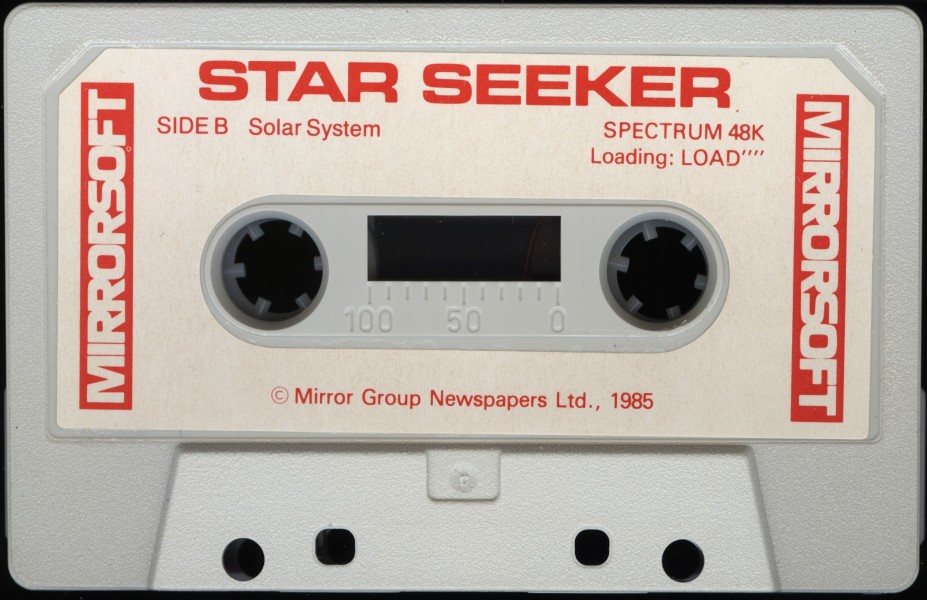
Also known as Solar System (English)
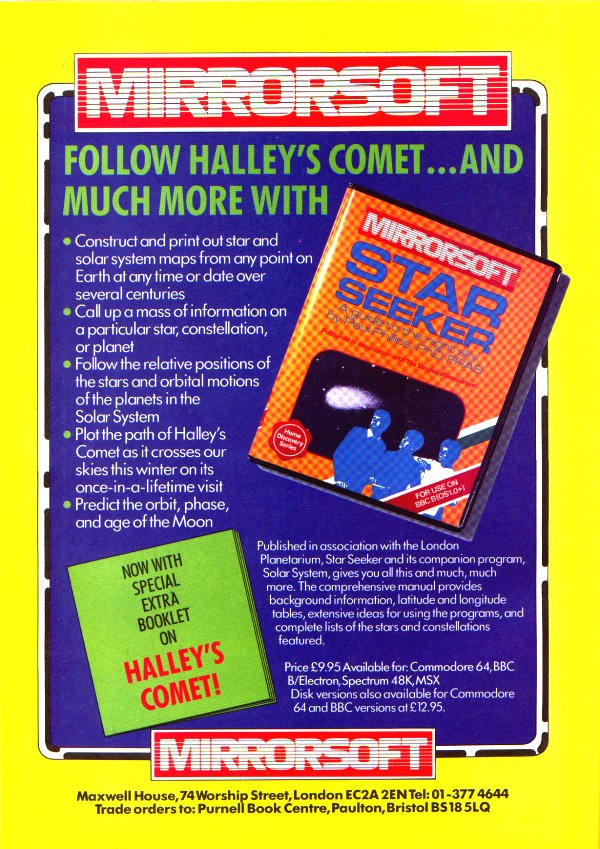
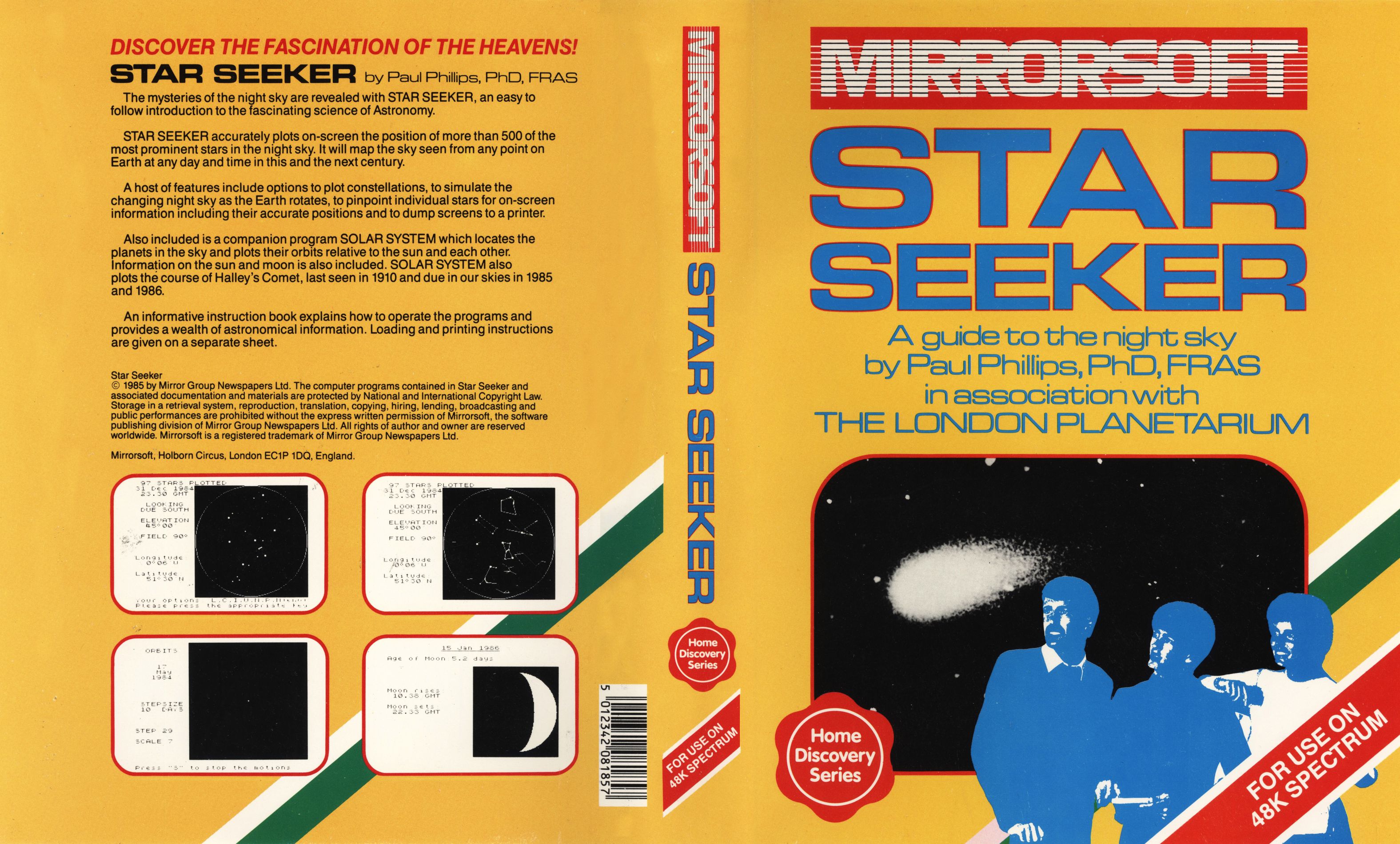
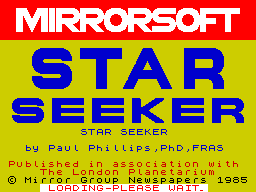
.png)
Discussion
Nobody has started a thread about this yet.
Remarks
ZXSR: Came as a two-program package. Star Seeker and Solar System.
Releases
- 1985Mirrorsoft Ltd Sold as Solar SystemPound sterling 9.95
- UnknownAackosoft
Play
- StarSeeker.z80.zipSnapshot image English26 KB
- StarSeeker.tzx.zipTape image English54 KB
Documents
- StarSeeker(EN).pdfInstructions English2,005 KB
Files and rights
No permission is on record either way. Screens and pictures are copied here on a take-down basis: if you hold the rights and want something removed, say so and it goes.
Credits
- Paul Phillipscredited
Sign in to credit somebody, or say what these people did.
In the magazines 18
Crash #38Mar 1987 · p.47
Rosetta McLeod
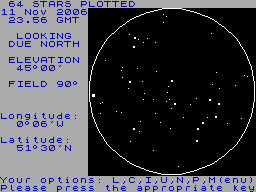
CRASH COURSE By Rosetta McLeod STAR SEEKER Producer: Mirrorsoft Retail Price: £9.95 Age Range: Older children/adults If you've ever been to the London Planetarium, you might have been tempted to find out more about the night sky. Star Seeker attempts to bring the Planetarium into your own living room! The package actually contains two programs, Star Seeker and Solar System. The first of these is a program which gives views of the night sky from any point on the earth's surface, at any time from 1800 to 2200hrs. It holds information on 500 stars in 76 different constellations, including all the most prominent ones, and may be used as an interesting introduction to astronomy, enabling the novice to learn about the stars visible in the night sky. It may also be of use to the amateur astronomer as a reference guide and practical tool. To begin, the user is asked to input certain information. First of all the location on Earth from which the night sky is to be 'viewed'must be provided. This must be specified by the longitude and latitude in degrees, and for convenience, a table in the accompanying booklet gives the exact position of selected cities. Next, the program asks for the direction in which you want to view the sky - North, South, East, West or overhead, though you can also position the centre of your field of vision towards any direction in the Sky and alter the size of the field of view displayed. Once you have provided this information, the program begins to plot the requested star map and displays it on the screen. A menu then allows a variety of options. The computer can list the names of the different constellations, with the stars in each flashing briefly when the name is given. It is also possible for a constellation map to be drawn, defining the shape of that constellation and making it easier for the user to learn to recognise the individual star groupings. You can also obtain quite detailed information on any of the plotted stars, and even obtain a printout of the star map. The second program, Solar Systern, provides information on the Sun, Moon, planets and Halley's comer. This program locates planets in the sky and can plot their orbits relative to the sun and each other, and can plot the course of Halley comet (which has recently been in view for the first time since 1910). One of the options allows you to watch the motions of the planets and the comet as they orbit the sun, and a great amount of factual information is also obtainable. A very detailed booklet describes the operation of the programs, as well as giving a wealth of additional astronomical information. COMMENTS Control keys: mostly single key commands Keyboard play: responsive Graphics: clear and appropriate Use of colour: limited
C&VG (Computer & Video Games) #45Jul 1985 · p.40
Tom Sato
STAR SEEKER Watch the skies this autumn and you'll see a spectacular sight. Halley's Comet is streaking across the heavens and will be close enough to be observed with the naked eye by the end of this year. It only comes around every 76 years - so don't miss it! While you're waiting for the comet to turn up, you could be observing other interesting objects in the skies - not just passing UFOs either. Our MSX expert, TOM SATO, who also used to study astronomy and often spent time overseeing observation work at the University of London Observatory in North London, now looks at the odd goings on in the night sky and some of the new astronomy software which can help you enjoy the wonders of the real universe... There's no doubt that the arrival of Halley's Comet will be one of the most spectacular celestial events of the decade. This comet has punctuated our history every 76 years with awesome display. The earliest record of its appearance was in 87BC. For many centuries the great comet terrified people. It was blamed for famine, revolution, plague, and wars. Now we know better, but it was not until 1682 that astronomer, Edmond Halley discovered that the comet approaching that year was the very same one that had appeared in 1456, 1531 and 1607. He did some calculations and predicted that the comet would appear once again in the year 1758. When the comet returned on cue, it was named Halley's Comet to honour the astronomer! Between November this year and March 1986, you too will be able to witness this great event. It will appear low in the western sky just after sunset. It will be more easily observed in the southern hemisphere but it should be visible to the naked eye in the skies above this country. You'll also be able to watch it on television. The Americans, Russians, and Japanese are sending spacecraft to take a closer look at this fascinating object. The European Space Agency is also sending a probe, called Giotto (pronounced Jotto), using the Ariane launch rocket. The space craft Giotto is now being built by British Aerospace and will approach the comet as close as 300 miles to take TV pictures of the comet's surface. Many astronomers now widely believe that comets are just huge snowballs containing rocks. When they approach the Sun, the intense radiation evaporates the surface of the comet and gas and dust are blown away as a glowing -plasma at an extremely high temperature. The solar wind, then carries this plasma away from the comet nucleus to form the "tail". While you are waiting for the comet, you could still see some amazing sights in the night sky. It's good fun solving the mysteries of the universe and there are many fascinating phenomena you can observe simply by looking up. If you go hill walking in midsummer, and if the air is clear enough and city lights far enough away, you can see many streaks of light appearing in the sky. Often the streaks are so faint that you might think that you were seeing things. However, what you are seeing is a typical meteor shower. A good meteor shower to see is the Perseids in mid-August. You'll see about 12 meteors per hour! What are meteors? Well, they are dust particles smaller than a grain of sand floating about in space. When they come near to the Earth, the gravitational pull of the Earth attracts these grains and they start to fall. When they reach the Earth's atmosphere, the particle starts to burn because of the friction. Most meteors just burn up in the upper atmosphere and rarely make it to the ground but every day the Earth is showered with these objects. Occasionally, the Earth passes through a patch in space where there are a lot of these floating dust particles. It's thought that they are left over from passing comets. As comets whizz around the solar system, they gradually break up, and leave a dust trail behind them. These dust particles tend to travel together and that's why there are streams of meteors which the Earth passes periodically. Recently a number of software houses have realised the potential for astronomy software to cater for the growing interest in astronomy, as Halley's Comet approaches. Three astronomy programs have just been released which are now available for the BBC: Star Gazer by Century, Star Seeker by Mirrorsoft and Astronomy by BBC publications. Star Gazer and Star Seeker are star map programs which show you what can be seen by the naked eye. The Mirrorsoft Star Seeker program was devised by Dr Paul Philips of University College London. Star Seeker allows you to move the cursor to the position of a star and find out all the facts about it of which over 300 are covered. This package includes a program called Solar System which shows the position of the planets and also works out where Halley's Comet is. Most useful in the coming months. Star Gazer is also a star mapping program but it includes a 100 page book on astronomy written by Heather Cooper, who is the current President of the British Astronomical Association. If you would like to hear up-to-date news on astronomy, why not give British Telecom's Spaceline a ring. It is run by Dr David Whitehouse and updated every week. To hear the recording. phone [redacted]. Spectrum owners can look to the heavens using software packages like Starsphere from the aptly named Eclipse Software. Starsphere can plot 355 stars in 45 constellations and is menu driven. It gives a map of the entire night sky which can be rotated to show how the star patterns change with the passage of time. Space Scan from MacMillan is an educational package. It won't give you star maps - but it will show you the shape and position of any one of 15 constellations. You also get a quiz option to test your knowledge. Eaglesoft's The Solar System is a sort of Hitch Hiker's Guide to the objects "captured by the gravity of the Sun". The menu allows you to select various text information about various subjects - combined with graphic illustrations. STAR SEEKER MACHINE: BBC B/C64/Spectrum/MSX Price: £9.95 FORMAT: cassette PUBLISHER: Mirrorsoft STARFINDER MACHINE: BBC B Price: £12.95 FORMAT: cassette PUBLISHER: Century Communications STARSPHERE MACHINE: Spectrum Price: £6.95 FORMAT: cassette PUBLISHER: Eclipse Software SPACE SCAN MACHINE: Spectrum Price: £5.95 FORMAT: cassette PUBLISHER: MacMillan THE SOLAR SYSTEM MACHINE: Spectrum Price: £3.50 FORMAT: cassette PUBLISHER: Eaglesoft
News/Note4
- ZX Computing #19Jun 1985 · p.15
- Personal Computer News #109May 1985 · p.33
- ZX Computing #17Feb 1985 · p.81
- Home Computing Weekly #86Oct 1984 · p.4
Advert4
- Your Spectrum #10Dec 1984 · p.70
- Home Computing Weekly #88Nov 1984 · p.5
- Your Spectrum #9Nov 1984 · p.46
- C&VG (Computer & Video Games) #34Aug 1984 · p.145
Full-page ad3
- Your Computer #11Nov 1985 · p.36
- Home Computing Weekly #132Oct 1985 · p.2
- Home Computing Weekly #107Apr 1985 · p.9
Feature2
- Crash #19Aug 1985 · p.114
- C&VG (Computer & Video Games) #45Jul 1985 · p.40
CompoResult1
- C&VG (Computer & Video Games) #48Oct 1985 · p.77
CompoEntry1
- C&VG (Computer & Video Games) #45Jul 1985 · p.41
Review1
- Home Computing Weekly #113May 1985 · p.15
Related
- Compilations
- Outlet issue 130
- Ports
- (BBC Micro), (Commodore 64), (MSX)
- Tags
- Home Discovery
- Elsewhere
- ZXAAA
- Same entry at
- Spectrum ComputingZXInfo
Reviews from people here
Sign in to write about this, or make an account. It takes a minute and lets you correct the catalogue too.
Everything ZXDB can hold about this is here.
Sign in to correct or add to this.
Hold the rights to this and want it taken down?