
Chinese Patience
Casual Game: Card · ZX-Spectrum 48K · 1 players · English
Atlantis Software Ltd · 1985 · Pound sterling 1.99
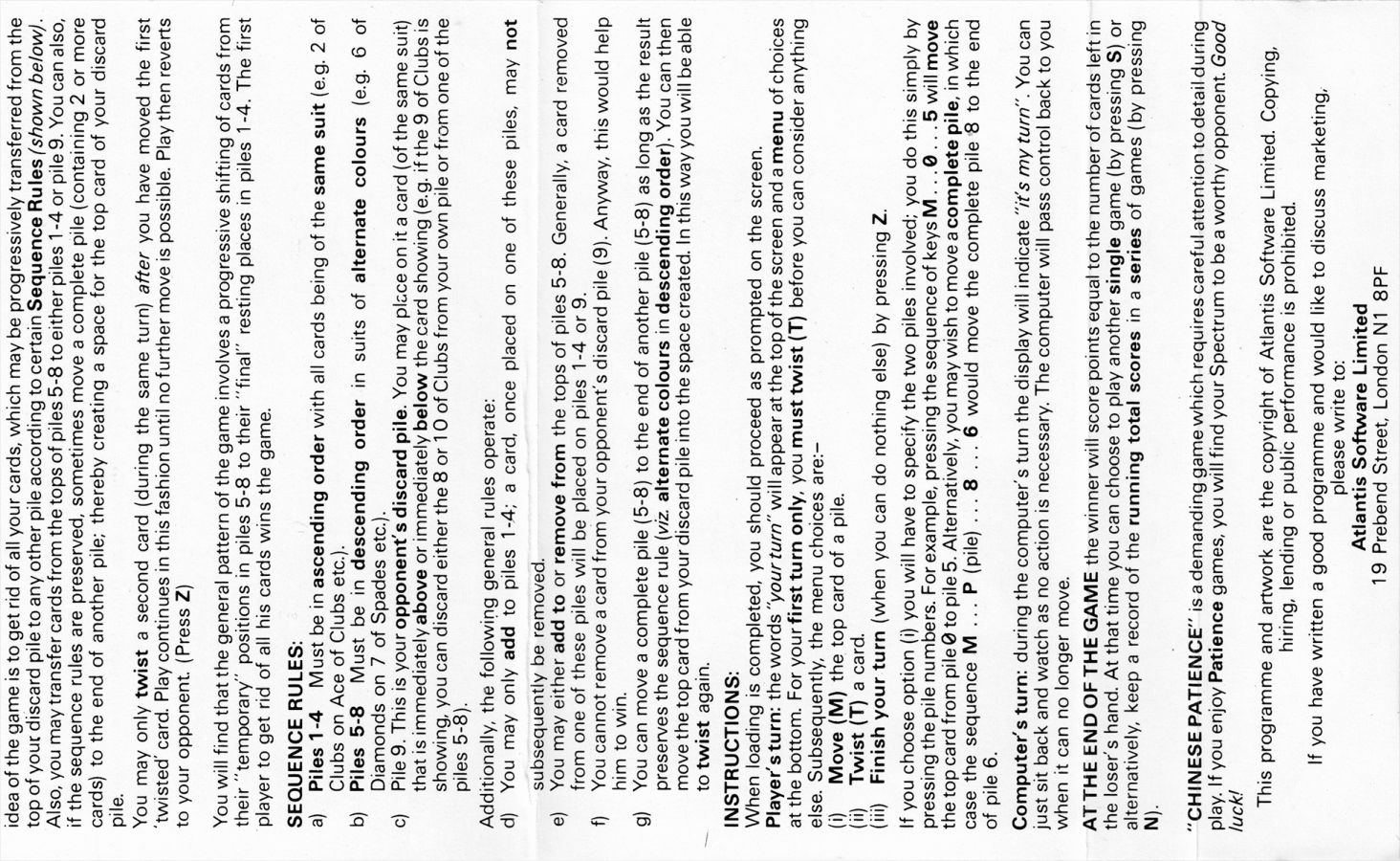
.jpg)
Discussion
Nobody has started a thread about this yet.
Releases
- 1985Atlantis Software LtdPound sterling 1.99
- 1987Z CobraSpanish peseta 399.00
Play
- ChinesePatience.z80.zipSnapshot image English16 KB
- ChinesePatience.tzx.zipTape image English16 KB
- ChinesePatience(ZCobra).tzx.zipTape image English16 KB
Documents
- ChinesePatience(ZCobra)_English.pdfInstructions English30 KB
- ChinesePatience(ZCobra)_Spanish.pdfInstructions Spanish11 KB
Files and rights
No permission is on record either way. Screens and pictures are copied here on a take-down basis: if you hold the rights and want something removed, say so and it goes.
Credits
- David Simoncredited
Sign in to credit somebody, or say what these people did.
Scores
In the magazines
- Sinclair User #441985 · Overall4/5
- ZX Computing #221985 · Overall4/5
- Crash #201985 · Overall68%
Elsewhere on the web
- WorldOfSpectrum 9 votes7.44
In the magazines 5
ZX Computing #22Dec 1985 · p.574/54/54/5
Graphics 4/5
Addictiveness 4/5
Overall 4/5
Atlantis £1.99 I remember Atlantis' card game program Eights which I still play on occasion and so was pleased to receive this program. Chinese Patience is another card game and matches you against the computer, and boy does the machine play a mean game! The instructions take up the whole of the inside of the insert plus the flap, reading them makes the game seem very complicated. However once I ran through the game a couple of times I got the hang of it and found it frustratingly absorbing. The graphics are well designed and the screen layout is clear and uncluttered, the program is well error trapped - try pressing break! There is a fairly lengthy wait while the computer makes its moves but no so long that you get bored. I found I took much longer than the computer to decide on my moves. If you have rhe patience and like card games (and even if you don't I suggest you try this one), then this will keep your mind ticking over for many a long winter's night. Unusual in this day and age is the loading system, using LOAD "" CODE is a bit amateurish, but this is only my criticism.
Sinclair User #44Nov 1985 · p.344/54/5
Overall 4/5
Colette McDermott 4/5
Publisher: Atlantis Software Price: £1.99 Memory: 48K Patience, the solo card game, is usually classed as a non-competitive game. Against an opponent it becomes more a battle of wits. But playing against a computer has to be the ultimate challenge. The rules involve taking a card from a face-down deck and placing it upon one of eight piles - four piles being filled in ascending order with cards of the same suit, four with descending cards in alternating colours. You can twist - take the next card from the face-down pack - once in a turn or each time you place the previous card. The game concludes when you have run out of cards, or moves. Chinese Patience sets you against the computer. Players start with an equal number of cards; the winner is the first to get rid of all their cards. The rules are now extended to allow legal dumping of cards on each other's pile. Taking turns, you progress through the game; both able to see each other's current card and the state of play on the piles. Your interest is maintained throughout the computer's turn as you watch it block your path and you plot revenge. The graphics, though basic, are clear and well presented. There are a lot of instructions, but those can be quickly grasped while playing. The computer will catch you out on every point at first, but with practice your wits will sharpen and satisfaction is yours when you beat it. You can choose to play in single games, but it is more fun if you play in matches; the computer keeps the scores, announcing the winner with great zeal. It is an excellent low priced game which will fill a small gap in the market.
Crash #20Sep 1985 · p.3962%64%67%65%71%70%68%
Use of Computer 62%
Graphics 64%
Playability 67%
Getting Started 65%
Addictive Qualities 71%
Value For Money 70%
Overall 68%
Unknown
Unknown
Unknown
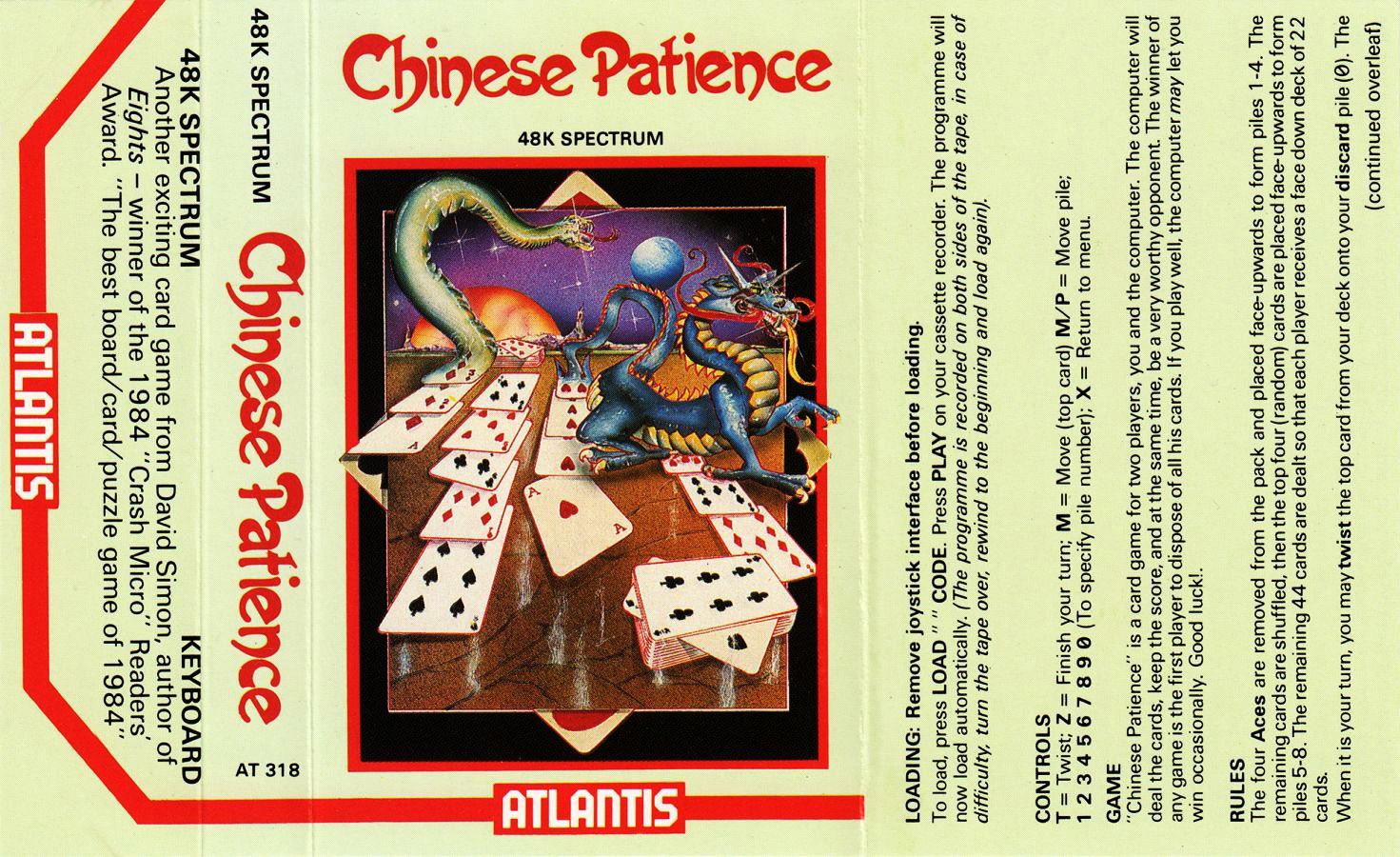
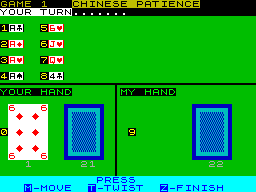
Producer: Atlantis Memory Required: 48K Retail Price: £1.99 Language: Machine code Author: David Simon Whether or not the Chinese really do play this version of Patience is irrelevant; David Simon, author of Eights which was voted best board/card/puzzle game in the 1984 CRASH Readers' Awards has produced another cunningly programmed card game in which one player pits wits with the Spectrum. The 'Chinese' version of patience follows the basic rules of one player patience, with a few twists and turns needed to make it into a competitive two-player game. The rules are quite straightforward, and although they sound a bit complicated on paper they are very easy to pick up once you start playing. The four aces are removed from the pack and dealt face up in a row. Four more cards are laid out, face up, to form a second row of cards. The remaining cards are dealt to the two players, who receive twenty two cards each, which are kept face down in a pile. The player who starts, 'twists' a card from the top of his deck and places it face up on his discard pile. The object of the game is to get rid of all your cards first which you do by moving cards from the top of your discard pile, placing them on one of the other nine piles of cards showing. The piles of cards which grow on top of the Aces follow suit and are added to in ascending order; the four piles which start with the other dealt cards follow the traditional pattern of patience, and grow in descending order in suits of alternate colours. You can also put a card on your opponent's discard pile, providing the card you add is in the same suit and is adjacent in value in other words if his top card is a nine of hearts, you can add either the eight or ten of hearts to his stack. Just to complicate matters a little further, while cards added to the Aces cannot be moved, you can move single cards from the end of the other four piles, adding them to the suits or to the top of your opponent's discard Pile. A complete pile of cards can be moved from one descending order pile and added to the end of another, providing the sequence of alternating suits is maintained. Each time a player moves a card from the top of his discard pile he can twist another card from his deck and, during a turn, a player keeps twisting and moving cards until no more can be moved. The first player to get rid of all his cards wins, and scores points according to how many cards are left in his opponent's hand. Successful play requires close examination of all the cards on show, and careful thought it's easy to finish your turn, hand over to the computer and then suddenly realise you missed something obvious. The computer plods through all the options open to it and grinds your mistake into your face. Running Mr Simon's software, the computer plays a near perfect game, proving a worthy opponent. It also acts as tutor if you observe the plays it makes carefully, you should be up to the same standard as the machine before long, only losing by your mistakes or on account of very unfavourable deals. COMMENTS Control keys: M to move card, T to twist, Z to end turn, 0-9 to specify pile, P to move a whole pile Joystick: keyboard play only Use of colour: plain and simple - fine for a card game Graphics: Tidy, but nothing flash Sound: a few tunes and prompts, repetitive Skill levels: one Lives: you win or lose! Screens: one
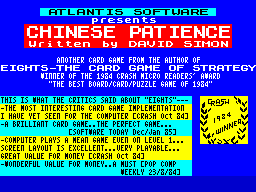
I'm Thinking ... say the honlable Splectlum, while pondering the next move at the start of a new game of CHINESE PATIENCE. Velly cunning stuff it thinks, too.
Review2
- Popular Computing Weekly #34Aug 1985 · p.15
- Home Computing Weekly #123Jul 1985 · p.14
Licensed from
- Patience/SolitaireCardunofficial
Related
- Compilations
- ZX-Spectrum Vega
- Elsewhere
- UVL
- Same entry at
- Spectrum ComputingZXInfo
Reviews from people here
Sign in to write about this, or make an account. It takes a minute and lets you correct the catalogue too.
No description, tag recorded.
Sign in to correct or add to this.
Hold the rights to this and want it taken down?