
Here and There with the Mr. Men
General: Education · ZX-Spectrum 48K · 1 players · English
Mirrorsoft Ltd · 1985 · Pound sterling 7.95
Also known as Here & There with the Mr. Men (English)
FirstStepsWithTheMrMen, 2 of 6
Discussion
Nobody has started a thread about this yet.
Play
- HereAndThereWithTheMr.Men.z80.zipSnapshot image English9 KB
- HereAndThereWithTheMr.Men.tzx.zipTape image English11 KB
Documents
- HereAndThereWithTheMrMen(EN).pdfInstructions English2,249 KB
Files and rights
No permission is on record either way. Screens and pictures are copied here on a take-down basis: if you hold the rights and want something removed, say so and it goes.
Credits
- PrImer Educational Softwarecredited
Sign in to credit somebody, or say what these people did.
Scores
In the magazines
- Big K #101985 · Overall2/3
Elsewhere on the web
- WorldOfSpectrum 2 votes6.00
In the magazines 7
Crash #14Mar 1985 · p.110
Daniel Fenn
Rosetta McLeod
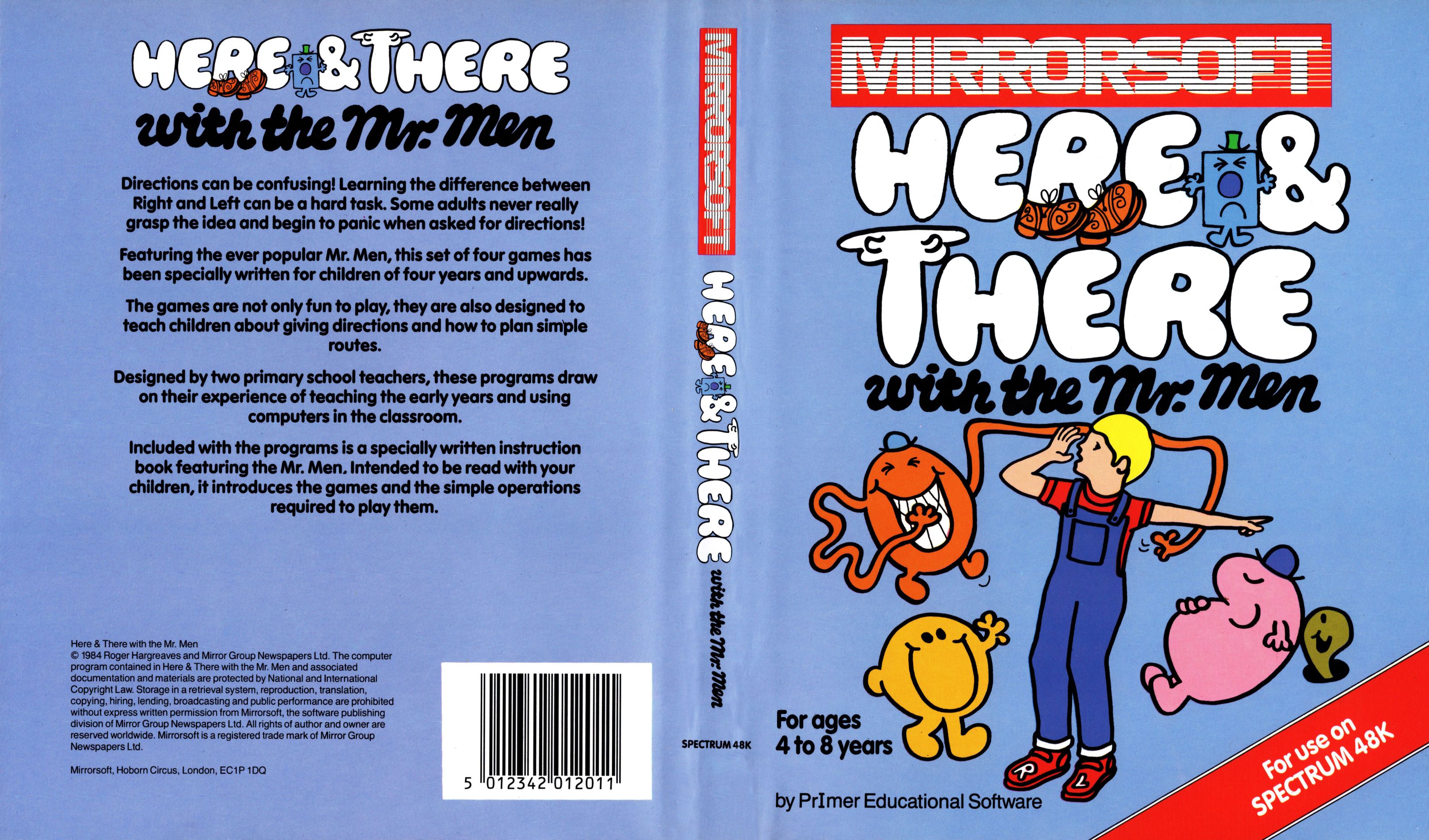
LEARNING THROUGH PLAY Rosetta McLeod, aided by Daniel Fenn, aged 4. Many people have an educational motive in mind when they set out to purchase a micro-computer. To justify the monetary outlay, they may have had to convince themselves that the purchase is not a frivolous one, that the computer will not be used merely for playing games, but will be put to worthwhile use. If you are a parent, you may have been 'conned' by your child into buying a micro 'to help with schoolwork' - indeed most of my pupils admitted to me (but perhaps would not admit to their parents!) that this was the case, but that the reality of the situation was that they used their computers solely for the playing of simulations, arcade or adventure games. Now, however, more and more publishers are producing software aimed at the education market, the majority of programs being specifically intended for use in the home rather than in schools - though an increasing number of schools are now making use of them. These educational programs fall into several categories: 1 programs which encourage parents to work with the very young child who is ready to learn the letters of the alphabet, basic reading skills, number work, etc; 2 tutorial-type programs which pick up an educational concept that the older child is familiar with, and attempt to reinforce it by providing a variety of examples to be worked through, usually at graded levels of difficulty; 3 teach yourself programs - eg how to sail -, aimed at anyone, child or adult, who wants to learn a specific skill; 4 adventure games, like the Hill-MacGibbon Games to Stretch the Mind, aimed at a younger audience. These are primarily leisure games, though they may have a secondary educational role, particularly if the child is helped by and adult who, through discussion, can guide the child towards working Out the eventual solution. What all these programs do is to cash in on the child's fascination with the computer. The sheer novelty value of using the machine usually results in increased motivation and the development of a greater concentration span. The programs often exploit the popular arcade game's format, so making work which is normally mundane and repetitive appear more interesting. Attractive presentation alone, appeals to children very strongly. How, then, should we assess the educational games on offer? What criteria can we use when judging them? Obviously, any game which purports to have a worthwhile educational aim should have that aim clearly explained, and ideally, educationalists should have been involved in its preparation. Software which demands a simple YES/NO response from children should be avoided, as it doesn't really teach anything. The instructions, both in an accompanying booklet and on the screen, must be clear and easy to follow. Games ought to have several levels in order to cater for children of varying abilities, and should include suggestions for follow-up activities. All too many games, however, are presented as entities in themselves with no suggestions as to how the knowledge acquired can be extended or applied to other situations. The following reviews cover games listed in the first category given earlier - those aimed at the very young child. Parents are often unsure as to how much they should be teaching a child who hasn't started school. It is important that the program package should give some reassurance or advice - preferably driving home the point that children mature at vastly different rates and reminding parents that a game described as being suitable for 4-6 year olds may well be beyond the abilities of some 4 year olds, who are simply not ready for it. Bearing in mind that the child is the consumer when it comes to educational software, I felt obliged to work with a partner and engaged the services of Daniel Fenn (aged 4) to help me with the following reviews. HERE AND THERE WITH THE MR MEN Producer: Mirrorsoft Memory Required: 48K Retail Price: £9.95 Age Group: 4-8yrs The games in this package are based on the popular Roger Hargreaves 'Mr Men' characters, which are very appealing to young children and are ideal for use in conjunction with the many books available in the series. The educational aim of this program, as stated in the 'Notes for Parents' is: "...to lead children in an amusing and stimulating way from 'Go that way' (pointing), to'Move to your right' (my left)...." There are four different games in the package. In the first one, 'Mr Tickle's Jigsaw Puzzle', the player has to complete a simple jigsaw using the arrow keys; the other games are of increasing levels of difficulty, and build up to the point where the child has to be able to distinguish between left and right. The games make a worthy attempt at teaching the concepts of up, down, right and left, and are certainly an enjoyable way of teaching and reinforcing them. Although they are aimed at children from 4 years upwards, younger children would also enjoy working on them with the help of a parent. It is doubtful, however, whether children of 7 or 8 would be very receptive to the games, as some of them are not particularly difficult. Daniel, (my Chief Tester) particularly enjoyed the 'Mr Tickle and Mr Grumpy' game in which the player can make the task as difficult (interesting) as he wishes by inputting commands which determines the complexity and length of the route taken by Mr Tickle. Daniel, however, who is a bright child, found the other games rather too easy. COMMENTS Control keys: moves from arrow keys to L, R, U, D. ENTER and DELETE are also used. Keyboard play: very good Use of colour: very bright and clear Graphics: very good. The Mr Men characters translate well into into computer graphics.
Big K #10Jan 1985 · p.192/32/31/32/32/3
Graphics 2/3
Playability 2/3
Addictiveness 1/3
Overall 2/3
Nicky Xikluna 2/3
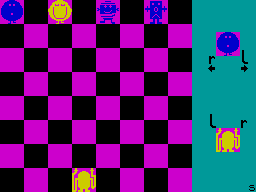
HO, HO, HO MAKER: Mirrorsoft FORMAT: cassette PRICE: £7.95 Before I begin, I'd like to point out that there is no particular reason why the Reviews Ed should hand me a Mr. Men game that teaches left from right and is clearly marked 'For Ages 4-8'. Just because I fell into his desk five times last week doesn't mean that I am directionally dyslexic. He should learn to keep his drawers closed. Assuming that your are of the right age are a Mr. Men fan, have a younger sibling in mind - or are simply a dimbo - Here and There is a well crafted and cheerful educational compilation. There are four short and simple programs with clear, FAT, Mr Men sprites and a booklet containing easy-to-follow instructions. Each section is more complex than the last, and requires increased planning and thinking ahead to obtain the reward (an animated sequence). The first shows pieces of a puzzle which must be aligned exactly before they spin together to reveal a portrait of Mr. Tickle. We then progress to a bit of route planning. You must guide the Tickle chappie's arm through the geography of Mt. Grumpy's house. This is done by tapping in a series of commands in advance (left, right, up, down etc). When you hit 'enter', Mr Tickle's arm will speed round the corners and tickle Mr. Grumpy making him convulse with laughter. Ho, ho, ho. The last sequence is a game of draughts played with Mr. Men as pieces. Again you direct your players with left and right commands. Altogether a solid piece of worthyware from Mirrorsoft. Hang -n - perhaps Here and There was created with Mr. Maxwell in mind? He also seems to have problems distinguishing left from right!
Advert3
- Your Computer #2Feb 1986 · p.28
- Your Computer #12Dec 1985 · p.38
- Your Computer #11Nov 1984 · p.113
News/Note1
- ZX Computing #17Feb 1985 · p.81
Review1
- Popular Computing Weekly #45Nov 1984 · p.26
Licensed from
- The Mr. MenCartoonRoger Hargreaves
Related
- Ports
- (Amstrad CPC), (BBC Micro), (MSX), Here & There with the Mr. Men (Commodore 64), (Acorn)
- Elsewhere
- UVL
- Same entry at
- Spectrum ComputingZXInfo
Reviews from people here
Sign in to write about this, or make an account. It takes a minute and lets you correct the catalogue too.
No description recorded.
Sign in to correct or add to this.
Hold the rights to this and want it taken down?