
Shakespeare - Macbeth
General: Education · ZX-Spectrum 48K · 1 players · English
Penguin Study Software · 1984 · Pound sterling 5.95
Discussion
Nobody has started a thread about this yet.
Play
- Shakespeare-Macbeth.tzx.zipTape image English26 KB
Files and rights
Distribution permission is on record, granted to another archive rather than to this one. Screens and pictures are copied here; everything else links to the archive that holds it.
- AllowedPenguin Study Software → WorldOfSpectrum
Credits
- John Mahoneycredited
- Stewart Martincredited
Sign in to credit somebody, or say what these people did.
Scores
In the magazines
- Sinclair User1986 · Overall3/5
In the magazines 12
Sinclair User1986 · p.603/53/10
Overall 3/5
Theodora Wood 3/10
A FIRST CLASS ROMP Theo Wood finds that educational software is a boon to teachers. One feature which stands out when you look back on 1985 is the increasing sophistication of software in the learning field. While previous years saw a mass of new software the quality was not necessarily good. There was a feeling that publishers were keen to jump on the bandwagon and produce software quickly for a perceived, rather than an actual, market. Some of those programs were distinctly dull, but 1985 saw an increase in the games element and the fun/educational borderline became blurred. PRESCHOOL LEARNING For the pre-school and infant age group Romper Room from Beyond is another attempt at using the Spectrum for initial alphabet teaching. Romper Room is much more lively than previous programs of this type. It features a character called Max who illustrates each letter with an action. The screen picture above is one example. On the first game, Watch the Letters, both capital and small letters are shown together with a small sentence to be read by the parent. Max then sets the word, such as dancing for D. That is much more fun than a static graphic of an object. The three other games in the package, Press a Letter, Find a Letter, and Letter Quiz work from that basis. Letter Quiz is the hardest of the games, where the player has to observe Max's action, determine the initial letter, and then press the letter on the keyboard. Education publisher Macmillan has produced games which follow on from the kind of skills learnt in Romper Room. Tops and Tails and Castles and Clowns are designed with the help of Betty Root, who is the 1985 President of the United Kingdom Reading Association. Those games are involved with the recognition of initial sounds and Tops and Tails introduces sound blends. Both feature games and, interestingly, two people can play. That is really useful when you have two children squabbling over who should play with the computer. Mr T Meets His Match by Good Housekeeping, deals with memory skills. The players have to pick out pairs of animals as they turn over cards on the screen. The one-player option allows Mr T to be a forgetful or clever computer opponent. At a higher level the animals on the cards change to geometric shapes. The other game, Switcheroo, provides food for thought as the task is to change one animal into another in four moves. That can be done by changing the size, colour, or animal. Mr T Meets His Match is an interesting package which deals with non-verbal skills using entertaining graphics. Paddington's Garden Game is a gentle arcade frolic in which Paddington has to go around the garden to find a pot of marmalade, catching butterflies as he goes. The butterflies are released at the end of the game. Joystick control ensures easy use. The game is innocent enough for the younger age group for which it is designed. Paddington fans should enjoy it, while practising hand/eye coordination. SIMPLE ARITHMETIC While today's educational thinking encourages calculators for yesterday's burdensome tasks of long division and multiplication, elementary numeracy cannot be ignored. Several programs work on that problem and are so designed as to deal with varying skill levels from five to 11. Mirrorsoft's Ancient Quests pack age has a game called The Count which provides practice of simple counting to more complicated sums such as division and multiplication. Moving around the castle you must solve the problems posed before reaching the library where the Count can be overcome. The other game, King Tut's Treasure includes arcade action. You must move Professor Diggins around the screens, avoid the hazards and dig for the matching shapes, match a fraction with a decimal or fraction with a name. Psion and ASK collaborated on two of the year's best programs which deal with numbers. Estimator Racer is another arcade classic in which you have to race around a track as fast as possible. The faster you go the more frequently you have to answer questions. The speed and level can be selected and depend on the type of car and player's control. Estimator Racer is different from other similar programs in that it is not the correct answer which is needed but the one nearest to the answer. That skill is useful when using a calculator, and encourages quick thinking without the need for complete accuracy. Number Painter is another program with the same pedigree. This time the aim is to reach the target number by painting out other numbers - such as +2, +3 - until the target is reached. Based on a platform and ladders game, and operating at a number of different skill levels, Number Painter is great fun and has enough action to appeal to players who are hooked on games. ADVENTURES Adventure games have proved popular and the format is selling well in adventure books with multiple choice options. Taking an active role in the development of the plot, young readers are encouraged to improve their reading skills. Mirrorsoft's Phineas Frogg must be considered a classic of its type for eight to 10 year olds. A story book is provided to fill in the plot background before you start the game, and a multiple choice of action is shown on each screen. There are also several arcade games which have to be played to solve the mystery, which is to save the scientist Mole from the Secret Lair of the Terrible Hamsters - SLOTH for short. Jack in Magiciand could be played by the same age group, or as with Phineas, with younger non-readers as an alternative to reading a story. Based on the old tale it too has options. As a text-only adventure it lacks some of the interest of Phineas, but that is compensated by using a more descriptive text. SIMULATIONS Simulations are one way of introducing a subject and practising skills. Weathermaster by Sinclair/Macmillan is one of my favourites. Using it you can play at being a weather forecaster. Onscreen you see a picture of the British isles and the frontal systems moving over the chart. The aim of the game is to provide a correct forecast. That must be done for each region until the whole country has been covered. If you can do that you can become a weathermaster - no mean feat. Oilstrike is another in the Science Horizons series from Sinclair/Macmillan. It is a simulation similar to Weathermaster but this time you have to survey and drill for oil. The secret is to find suitable oil-bearing strata before drilling, otherwise costs mount turning the operation into what could prove to be a fruitless exercise. The success of sports simulations in the software charts proves their popularity. Two sports simulations which require more skill than usual are Yacht Race and Run For Gold, both from Hill MacGibbon. Yacht Race is an introduction to the art of sailing and comes with a printed chart of the different courses. There are six levels of difficulty which allow the novice to learn by coping with steering the dinghy before moving on to trimming the sails and setting the balance. Run For Gold similarly requires a learning curve to fully master the pace and steering of your two chosen runners. Setting the pace too high for your runners will quickly tire them out. The object of the game is to increase your fitness level in local meets, before moving on to reach Olympic standard. The Spectrum is not noted for its musical capability but one program stands out which uses what little there is to the full. Music Typewriter, from Romantic Robot, enables you to print out a score on to a wide selection of printers and interfaces. The product is a real aid to budding composers who are working with a musical instrument. You can ENTER the notes with the help of the keyboard overlay which is provided, and edit the tune bar by bar. A substantial section dealing with setting key changes, rhythm or tempo, as well as right or left-hand play options, means that the package can cover a wide variety of musical styles. You cannot use chords, but that is a failing of the hardware. MORE LOGO LOGIC Sinclair's own version of Logo was a critical success in 1984 and provided Spectrum owners with the chance to experiment with a full implementation of the language. Two Logo lookalikes were released in 1985 which offer Logo facilities of Logo at a reduced price. Spectrum Logo Graphics from Sigma deals purely with turtle graphics. Using a keyboard overlay the main commands can be ENTERed with single key stroke. Spacing between commands is added automatically. That may be of some help to younger children but the entry of commands will not deter most children. The big drawback with the program is, however, that routines cannot be SAVEd. The second Logo program was Picture Logic, from Addison Wesley. The program is a reworking of Heather Govier and Malcolm Neave's earlier program Logo Challenge. Picture Logic adopts the structured approach to turtle-type graphics. The book accompanying the software takes you through the first stages and beyond by a series of exercises, called challenges, with many hints and tips to help beginners. In neither of the two programs is there any list processing facility which can be found in the full Sinclair version. If, however, you want turtle graphics and want a structural approach Picture Logic is the best buy. One package which is easy to use and provides access to the Spectrum's graphics capability is New Generation's Light Magic. The program allows you to draw onscreen, change brush size and generally play around with colour and pattern without any programming skills. A program such as that can give some insight into how a graphic system works as well as being instantly usable. BOOKWARE For 11 to 16 year olds the Century Communications book Maths Tutor for the Spectrum is to be recommended. It is not a revision package but a self-contained maths course in book form with a tape for a few pounds extra. A maths course could well be very difficult to follow but author Robert Carter has brought a masterly use of language into play which ensures that the whole subject does not become too dry. The explanations in the book are oustandingly clear and simple, and use of the programs in the book reinforces understanding of the mathematical concepts required up to O Level. Revision programs are the mainstay of the program lists for secondary school age. The best of those on the science side are the Pan/Hill MacGibbon packages, called Pan Course Tutors. They cover all the usual science subjects and come with a text book. There are diagnostic tests at the beginning of the programs which help students to identify weak spots in their study course. The student is then directed to a suitable module. The modules make extensive use of screen windows, with one for the explanation, one for a question and a third for hints. Penguin has released more titles in its study range, which mostly cover English Literature. Those operate on database techniques which allow you to browse through and follow characters in a novel or play. As the study of English Literature is largely interpretive, and the space for text is extremely limited, it would seem that those and other, similar, packages offer little real advantage over revision notebooks. WORLDLY WISE A program for older students which does not concern revision is Worldwise, a study of nuclear weapons. It operates as a database as well as providing a basis for playing negotiation simulations. It is meant as a factual program and not, in itself, an opinion former. The Richardson institute for Conflict and Peace Research, at Lancaster University, operates an update system for members of the user group WUG - Worldwise Users Group, membership £2.00. Extra copies and microdrive versions can be obtained through the group at a special price. Programs such as Worldwise can be used to provide the basis for intelligent discussion in an area which is renowned for bias and emotion, frequently unsupported by hard facts. All in all, 1985 has been a good year for educational software. As it becomes less easy to rely on simple rule and drill exercises, producers of software are showing imagination and wit in their programs. In doing so the packages are becoming more attractive to use and more fun to play.
Ancient Quests, opposite.
Phineas Frogg, below.
Personal Computer News #62May 1984 · p.27
Clare Gurton
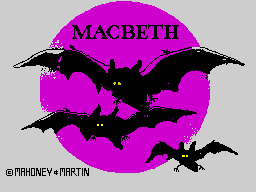
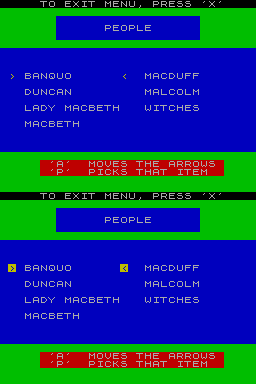
Clare Gurton looks at some recent educational software, in particular an aid to studying Shakespeare. SPECTRUM SCHOLARS Shakespeare's Macbeth is among Penguin's newly-launched Study Software series featuring programs written by teachers to give CSE and O-level students the ability to study Shakespeare's plays 'by means previously impossible' - an impressive claim. DOCUMENTATION The documentation is sparse, as it's assumed you'll have a Penguin edition of the play to hand. The inlay tells you how to load the program and there are a few hints on how to use it. GETTING STARTED While the program loads, two title screens appear - the Penguin logo, and the illustration from the cassette cover. The program allows you to select themes and characters from the play and will search its database for relevant references. You can choose from seven characters and 24 themes. But you're limited to a maximum of three items, so you could search under one character and two themes, or vice versa. A search can be limited to a single act or the whole play. The simple single-key commands are easy to use and you can exit any process at will. IN USE During a search the screen is split into windows. You're reminded of the search topics, given a reference and a comment for each 'find'. Other themes or characters for consideration may appear where relevant. I decided to select Macbeth with the theme of prophecy. The first screen referred me to Act 1, Scene 3, line 50 - a little difficult to find when you're not using the Penguin text. I spent ages counting lines without knowing whether I was looking at the right quotation. For the first 'find' the program asked: 'Have the witches in their prophecy spoken Macbeth's secret ambition?' There are no easy answers in this study pack: the statements provided are thought-provoking, not simple cribs. At the end of a search you're given the number of references found in each act and a total. If your search has come up with nothing. It's politely suggested that you may be searching under combinations that will not help your understanding of the play. VERDICT The program has been given plenty of thought and the authors have chosen the most important characters and themes from the play. However, I was annoyed at having to look from book to screen; if only the relevant lines had been displayed. It's a great pity there's no option for printing the results of searches. Many of these might have been of value as revision notes and essay plans. Also, the program would be of no use to students unfamiliar with the text who could spend too much time searching irrelevant combinations. Less talented students might find some of the statements confusing rather than helpful. The program may offer an unusual way of studying Shakespeare, but to get the most out of it students really do need guidance, from either teachers or a good study text. Penguin's Shakespeare doesn't really live up to its more exaggerated claims but is an interesting use of micros in education. DILIGENT DUO From Amazing Games comes 1984, an O-Level revision package for George Orwell's novel. The program gives three out of four ways of revising the text with main menu offerings being: three example essays; plot summary; notes on the text; and quit. Once you've chosen one of these, you have to load data. The instructions tell you to rewind the tape. press play and 'be patient'... you have to be. There's a choice of three exercises: discussion essay, an essay requiring many references from the text, and tracing one main theme throughout the text. The plot summary examines each chapter's plot in relation to its contents. 'Notes on the Text' is a glossary of the words and phrases of 'Newspeak'; themes from the book such as Winston's ulcer are also explained. Some of the information in this program could be useful for O-level candidates, but it would be so much easier and quicker in book form. Cargo, from Sinclair and Macmillan, is a well-produced package in the Science Horizons series. It has the advantage of a readable booklet covering the program's use as a model and background information. All perhaps a little daunting for younger users, however. You have to load and sail a cargo ship. Points are scored for the safe delivery of cargo. You can choose ranks such as cadet or chief officer and the ports you wish to visit during the game. The screens are generally very good but the one for loading is complicated and requires you to have read the booklet first. Once sailing, all sorts of mishaps can occur. assuming you've managed to evenly load the cargo on to the ship to start with. High seas, gales and water salinity combine to make safe sailing hazardous. To survive mishaps, you must learn the principles of loading up, planning a safe journey, the importance of the Plimsoll line and so on. This is a good example of a game where learning is incidental, but will undoubtedly occur, and in this respect it holds advantages over run-of-the-mill formal practice programs.
Explanation of image and forward reference to other parts of the play.
Pick single item to be studied in depth.
News/Note5
- TV GamerDec 1984 · p.7
- Big K #8Nov 1984 · p.6
- Computer ChoiceMay 1984 · p.10
- Your Computer #4Apr 1984 · p.49
- Popular Computing Weekly #10Mar 1984 · p.5
Review3
- Personal Computer Games #13Dec 1984 · p.111
- Home Computing Weekly #65Jun 1984 · p.13
- Popular Computing Weekly #16Apr 1984 · p.56
Feature2
- Sinclair Programs #23Sep 1984 · p.28
- Popular Computing Weekly #14Apr 1984 · p.16
Licensed from
- MacbethBookunofficialWilliam Shakespeare
Related
- Ports
- (BBC Micro), (Commodore 64)
- Tags
- Shakespeare
- Elsewhere
- Centre for Computing History
- Same entry at
- Spectrum ComputingZXInfo
Reviews from people here
Sign in to write about this, or make an account. It takes a minute and lets you correct the catalogue too.
No description recorded.
Sign in to correct or add to this.
Hold the rights to this and want it taken down?