
City of Death
Adventure Game: RPG · ZX-Spectrum 48K · 1 players · English
Red Shift Ltd · 1985 · Pound sterling 9.95
Discussion
Nobody has started a thread about this yet.
Play
- CityOfDeath.z80.zipSnapshot image English19 KB
- CityOfDeath.tzx.zipTape image English21 KB
Documents
- CityOfDeath.txtInstructions English4 KB
- CityOfDeath(EN).pdfInstructions English161 KB
Other files
- City of Death (1985)(Red Shift).pokPOK pokes file 0 KB
Files and rights
No permission is on record either way. Screens and pictures are copied here on a take-down basis: if you hold the rights and want something removed, say so and it goes.
Credits
- Peter Carmpoulonicredited
- George Carmpoulonicredited
- Ed DoveyInlay/Poster Art
Sign in to credit somebody, or say what these people did.
Scores
In the magazines
- Crash #131985 · Overall Value5/10
Elsewhere on the web
- WorldOfSpectrum 7 votes6.43
In the magazines 3
Crash #13Feb 1985 · p.1015/10N/A5/108/105/105/10
Atmosphere 5/10
Vocabulary N/A
Logic 5/10
Debugging 8/10
Overall Value 5/10
Derek Brewster 5/10
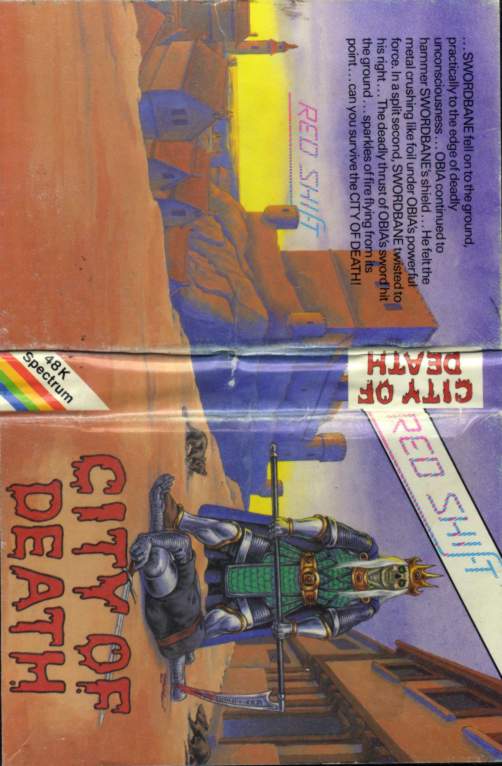
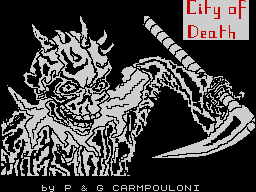
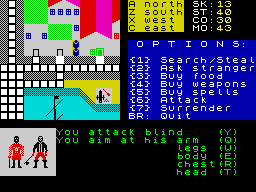
DEREK BREWSTER'S ADVENTURE TRAIL PUBLIC IMAGE You know, when I buy a piece of software, or have it dropped through my letterbox, I expect the packaging and instruction leaflet to inform me on why this game exists and why it should merit my attention. Gilsoft's The Curse has a sparse cover which give more prominence to copyright and warning notices than to the substance of the program. One can only assume there is nothing worth mentioning and so what impression does this give? It hardly augurs well. Indeed, the cover supplies the name of the artist who decorated the inlay but there is no mention of the author of the program itself. Don't get me wrong about artwork, certainly packaging should have good artwork but this must reflect the quality of the program within, and not exceed it. The artistic details of Tower of Despair shows how artwork can add appreciably to the atmosphere and enjoyment of an adventure. But surely the software business has much in common with the music industry; the public will remain loyal to good programmers and seek out quality from whichever quarter it emanates just as loyalties to artists and the unearthing of excellence goes on even in the music world. Packaging and leaflets provide the room for two important aspects, the storyline and instructions. A storyline mustn't be so small as to fit in the window at the back of a cassette casing but should be full and enlightening enough to ensure a substantive background to develop in the player's mind before play begins and to encourage a feel for how the game might be tackled. Alas, I have witnessed so many storylines tagged on to a finished program to round off the marketing exercise. It should, of course, be in existence before coding begins so that the plot and theme are integral parts from the off, ensuring a sense of consistency and credibility pervades the whole. Instructions find a natural home on the cassette cover where browsing in a computer store may tell something of the game and should not reside in the program as this would then represent an unforgivable waste of memory (some Quilled games are guilty here) and neither should they reside on the tape before the game proper as this is then a waste of the game player's time (Knight's Quest, for example). All this brings me round to great and ever-fluctuating debate in software retailing, namely, should the package be large and flamboyant or small and utilitarian. Cynically, a large package is justified by the greater price charged for it, representing a greater capture of the consumer's money for the software business merry-go-round - packaging, printing, publicity. This last is a significant point as a large package is its own advert. Who can forget Valkyrie 17 in all the shops before Christmas? Perhaps there is a deeper message here, playing on the psychology which has it that if a company has gone to all the trouble of producing a large, expensive package, then what is on the tape must be worth something. Alas, I can think of many examples where this reasoning is misleading. What a large presentation can afford is a suitably glossy booklet giving in-depth playing instructions and a greater insight into the complexities therein. Certainly, no one would complain of the extra expense entailed to this purpose in the Midnight Trilogy. But what of the many where the supporting literature is thin on the ground and the cassette wallows in a sea of moulded plastic? It would seem the packaging here is only a precept for charging more. Unfortunately, you can not tell whether a large package has much supporting literature until you buy it, as shops are reluctant to leave anything on the shelves which might tempt petty thieving. Well, here is the crux of the matter; I myself, on the whole, prefer cassette-sized packs because they are easier to carry back home and are more utilitarian in a futuristic way. It is similar to my regard for the Spectrum - there is some fascination in a computer with 48K RAM which takes up just a little more room than a pocket calculator and can be unplugged and carried around with the ease of a book. So with cassettes. A world of adventure packed in to a s mall plastic box with neat, precise artwork, and playing instructions unfolding like a concertina. But if large packages grabbed the attention, and the shelf space, over the festive season one development had them cast as dinosaurs. Not only could you allot the big packs a position with the cassette-sized packs neatly stacked in cassette racks and cases, but, when browsing in shops their absence amongst the chart displays was very noticeable - they just could not fit into displays like the Boots Top Twenty! THE CITY OF DEATH Producer: Redshift Memory Required: 48K Retail Price: £ Author: P. Carmpouloni & G. Carmpouloni City of Death is an adventure game which takes place in an old city inhabited by some very unusual people. Strangers are avoided by the populace, and hunted down, jailed or killed by mercenary guards of the city. Far more dangerous still are the soul-looters, who in their bright red garb roam the streets, terrorising the inhabitants. You start the game on the jetty of a harbour where your ship has docked. All you know about the city has been gleaned from whispered rumours. Your objective is to find the wizard Bellatrix. You will need whatever money you can get hold of, as information does not come cheap. Entering houses, you can steal, request news from the inhabitants, fight, surrender, or buy weapons, food and spells. Many of the guards that you meet will have superior combat skills to yourself and you will therefore need to continually improve your combat skills when ever possible. This can be achieved by purchasing superior weapons from the armoury or magical abilities at the wizard's villa. Stamina can be increased by the purchase of food at one of the taverns in the city. The purchase of magical abilities also buys an increase of stamina. Play entails using a strange combination of keys to move around; north is A, south is Z, west is X and east C. On your way around the paths that criss-cross the city your main preoccupations are the contents of the houses and taverns you pass. When confronted by a guard you will be asked if you wish to surrender. Should you be running short of stamina points, or if you feel that you are unlikely to win, it may be wise to surrender. When you enter into combat, attack options are displayed in order of difficulty of hitting that location (head, chest, body, legs, arms) and the damage inflicted by a successful hit. So a head blow is more tricky but scores greater damage if successful. However, you can choose to aim blind which gives you a better chance of a hit, but the computer randomly selects the location of inflicted damage. The severity of a wound inflicted on you is displayed in 'damage points'. When entering a house you are given the option of either searching the house with a view to stealing anything of value, or asking the inhabitants the direction of Bellatrix's house. However, in the city where greed plays an overwhelming part, you will find that you need to bribe them for an answer. False clues can be given, but a false clue will never be given twice, whilst genuine clues can appear again and again. Displayed in the top right-hand corner is your current status. This shows your current skill level, stamina, wealth, and how many moves you have made so far. Clearly, City of Death is a D&D style game where the idea is to build up your stamina and skills to enable you to defeat ever more powerful foes in order to complete the quest. The success of such a game relies on the accurate interpretations of actions so that their outcome can be realistically expressed in terms of numbers. So, when you glance up to the top right the increments and decrements in stamina and skills should fall in line with what you would expect from the action taking place. In this game there are one or two inconsistencies that are left unexplained. Buying four units of food for five coins gains forty units of stamina while on another occasion one unit for twenty coins gave only twenty-five increments in stamina. Further, I think it strange that continually eating results in an increase in stamina without a reasonable limit to its growth. Once you have visited a house, a return trip gives 'you have been here before' which although unhelpful in itself does allow you to get your bearings. It might have been a sneaky plus for the game had it allowed you to return to a location where you had paid for information but this time kill the occupant and regain your money. If you choose the option 'ask stranger' at a house, and there is no-one inside, you are not allowed to search and steal. Why not is not abundantly clear apart from the saving in program complexity. Combat, once again, continues to the death with no option for surrender or run while you have no idea of the strength of your opponent until combat begins. Another example of where the program leaves you in the cold is when paying money for arms, your skill factor increases, but you are not told of the type of arms you have succeeded in purchasing. In other words, it's all numbers and no realism. Asking for information from the natives you soon discover the limitations here since to choose information valued at five coins always gives 'a skeleton rules in the city'. In all fairness the game has got some charm in places. Three options are offered on loading, easy, moderate and difficult while during each game the guards move from a snail's pace posing very little threat to a remarkable agility towards the end. City of Death is a neat, well-presented D&D style game with colourful graphics and a curious choice of movement keys. The jerky graphics and slow response are perhaps an indication of the game's posturing toward strategy rather than arcade but as a strategy game it has many inconsistencies and omissions. The game is not such a bad attempt at bringing D&D to the computer screen, it just has too many occasions where you're left thinking 'if only it had....' COMMENTS Difficulty: easy at start but gets harder Graphics: reasonable Presentation: would be better if only listed options available at any one given time Response: sluggish when moving large distances
Advert1
- Games ComputingDec 1984 · p.27
News/Note1
- Micro Adventurer #13Nov 1984 · p.6
Related
- Versions
- MCoder II (Authored with)
- Compilations
- ZX-Spectrum Vega
- Same entry at
- Spectrum ComputingZXInfo
Reviews from people here
Sign in to write about this, or make an account. It takes a minute and lets you correct the catalogue too.
No description, tag recorded.
Sign in to correct or add to this.
Hold the rights to this and want it taken down?