
Colossus Bridge 4
Casual Game: Card · ZX-Spectrum 48K · 1 players · English
CDS Microsystems · 1986 · Pound sterling 11.95
Also known as Colossus 4 Bridge (English)
Discussion
Nobody has started a thread about this yet.
Remarks
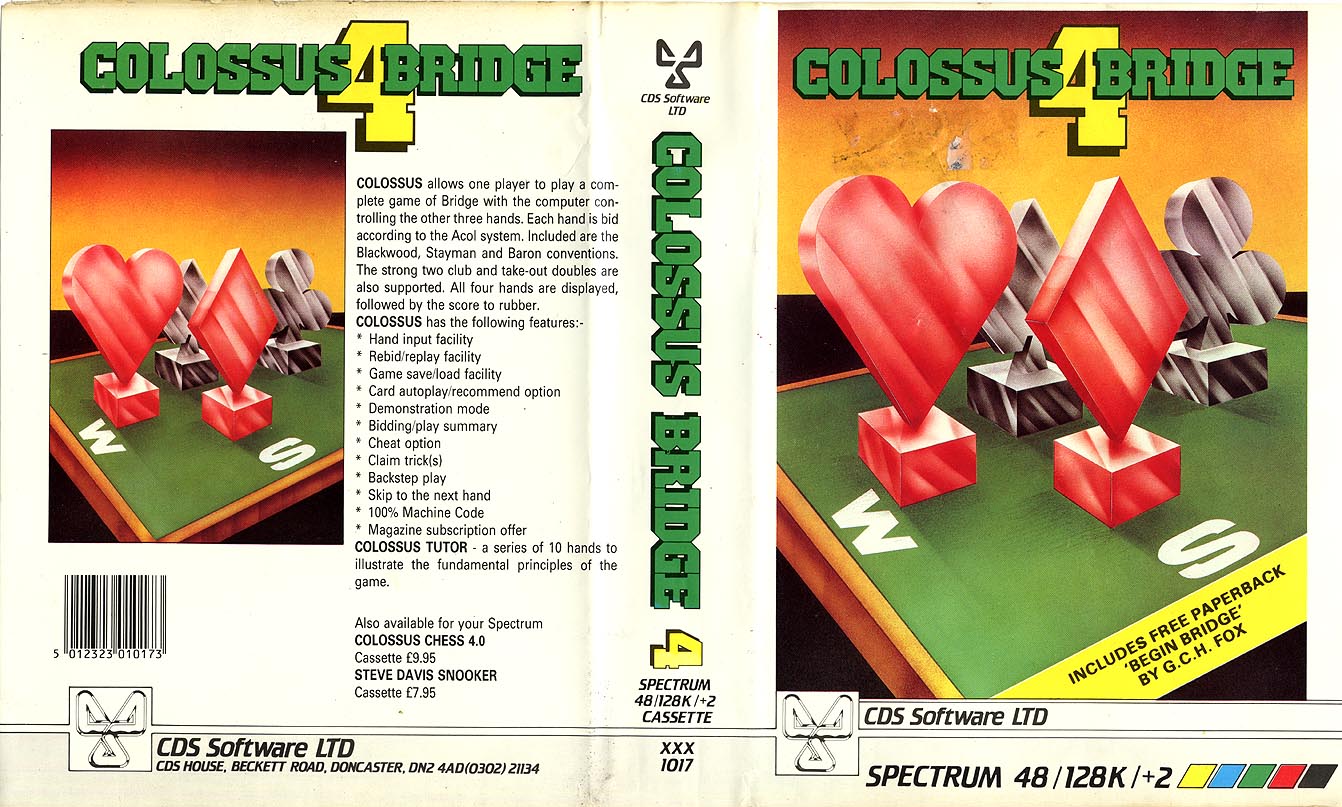
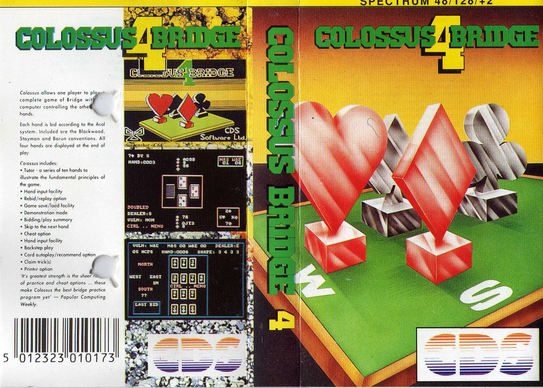
Came with a free copy of the paperback "Begin Bridge" by Geoffrey C.H. Fox.
Releases
- 1986CDS Microsystems Sold as Colossus 4 BridgePound sterling 11.95
- UnknownEDOS
Play
- ColossusBridge4.dsk.zipDisk image English36 KB
- ColossusBridge4.tzx.zipTape image English27 KB
- ColossusBridge4.tap.zipTape image English27 KB
Documents
- ColossusBridge4.txtInstructions English12 KB
- ColossusBridge4(EN).pdfInstructions English466 KB
Files and rights
No permission is on record either way. Screens and pictures are copied here on a take-down basis: if you hold the rights and want something removed, say so and it goes.
Credits
- Chris Birkenshawcredited
Sign in to credit somebody, or say what these people did.
Awards
Scores
In the magazines
- Your Sinclair #141987 · Overall8/10
- ZX Computing #331987 · OverallGood
- Crash #361987 · Overall70%
Elsewhere on the web
- WorldOfSpectrum 4 votes6.50
In the magazines 7
ACE (Advanced Computer Entertainment) #6Mar 1988 · p.67
ACE (Advanced Computer Entertainment)
Spectrum, £11.95cs Amstrad CPC, £11.95cs, £14.95dk C64, £11.95cs, £14.95dk Amstrad PCW, £15.95dk IBM PC, £15.95dk This programs's intended for beginners and learners, and is packaged with H. Fox's book Begin Bridge. It offers both random hands and hands with a certain point count for those who get tired of passing all the time. There are lots of options for rebidding, reviewing, and replaying hands, or peeking at your opponent's cards, and the computer will understand and initiate both Stayman and Blackwood conventions. Colossus bids strictly according to the conventional Acol point counts/distribution, with the occasional inexplicable call made by by the computer just to throw you off balance. Card play is similarly uniform. It will draw trumps, then lead out strong suits. It also finesses sometimes - although not only when it will be successful. With its replay options and tutor program. Colossus is a very good choice for those getting to grips with the game. The screen display is clear and easy to understand, though functional rather than pretty.
Your Sinclair #14Feb 1987 · p.757/107/108/109/108/108/10
Graphics 7/10
Playability 7/10
Value For Money 8/10
Addictiveness 9/10
Overall 8/10
Gwyn Hughes 8/10
CDS £11.95 Reviewer: Gwyn Hughes So, there's a storm whenever I review a chess program because I'm not a Grand Master. On those grounds I shouldn't even be allowed to load Colossus Bridge! You see, the problem is that (gasp)... I can't play Bridge at all! We're force fed the rudiments of the pawn game when we're young but not so Bridge. Don't let that put you offc Colossus is a good way to learn. Of course, you must like card games in general, and sophisticated card games in particular. Bridge calls for two pairs of players, who sit opposite each other and are referred to as North, South, East and West . A game breaks down into two Parts. Let's start at the end! in the second part, one player throws down a card. The others follow. trying to play a higher card, which has to be of the same suit whenever possible. The highest card wins the 'trick'. The only additional rule is that one suit may be nominated as trumps. If a player can't play the suit that's required, he may be able to play a powerful trump card. This is all nice and simple, but complexities arise in the scoring. You don't just play for the greatest number of tricks, but you have to fulfil the 'contract' that you've made, and if you fail to do that, your opponents score penalty points. The 'contract' is made in the first part of the game, when you nominate how many 'tricks' you think you and your partner will win, and what suit they'll be. Of course, this presents a slight problem as you can only see your own hand of thirteen cards. You might hold five strong diamonds, but you've no idea whether your partner can back you up if you contract to win three 'tricks' more than your opponents, with diamonds as trumps. Never fear, for a clever system of communication has arisen... and I don't mean kicking each other under the table. Instead your partner's reply should alert you to the wisdom of a bid, if you open with one diamond and receive a reply of three diamonds, you can be pretty sure you're both well placed. If that doesn't sound too daunting, then Colossus Bridge is a great way into the game. For starters, it comes with a paperback introduction. Then there's a tutor on the second side of the tape which presents you with ten hands that you have to bid correctty. As with Colossus Chess, there's a good selection of optiona, including the opportunity to hold the auction again it you think you bid incorrectly, or to have the computer suggest a card in the second part of the game. The program's instruction booklet is a bit on the thin side, but you should find what you want there. There's hardly a flood of Bridge programs on the Spectrum, and you could do far worse than this if you want to learn the game... though I suspect it'll give experienced players a good time too. For me, it built a bridge across a whirlpool of confusing rules and terms to a game I'm fast becoming hooked on.
North declined to follow up your bid, and East/West failed to make a counter-move, so the game starts. East began strongly and this enabled your opponents to win four tricks, but then you took the advantage and won two. With Clubs as trumps and some powerful Diamonds, it should be possible to make that one Club contract without too much trouble - though for a low score.
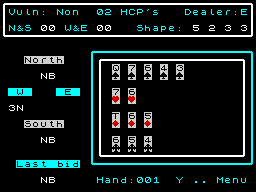
The Auction. You partner, North, and opponent, East, have chosen not to bid, but you hold a good hand. It's valued at 17 points, found by counting the high cards, which is shown in the top row. Its strength is centred on the Clubs, so South opens with a tentative bid of one Club.
ZX Computing #33Jan 1987 · p.38ZX Computing GlobertGood
ZX ComputingZX Computing Globert
Overall Good
CDS £11.95 The game of bridge has received considerably less analysis by computer than might be supposed. After all, there are many chess programs available which are capable of beating the majority of players, so why isn't the same true for bridge? There are a number of reasons but the main one is that as a game, it is incredibly difficult to analyse. Whereas a bishop can only move according to well defined rules, a bridge player has considerably fewer restrictions when it comes to making a bid or playing a card. Side stepping some of the complexities of the game itself Colossus Bridge 4 is aimed fairly and squarely at the beginner. Presentation wise the program works well. Entering a bid or playing a card is simplicity itself and there are facilities to replay or rebid a hand if you want to study alternative lines. Deals can be listed to printer if you want to save a hard copy and you can input your own hands it desired. My only niggles here are that it is not too easy to distinguish between clubs and spades and the claim option which allows you to claim some or all of the remaining tricks without having to play the rest of the hand through. The problem here is that the program does not check the validity of your claim allowing you to cheat if you were unscrupulous enough so to do. The standard of bidding is at best average. Allegedly following the Acol system - the one used by most British players, it copes well for the first round but then tends to get into murky waters. Wild leaps with inadequate trump support but a strong hand are commonplace but then it doesn't upgrade weaker hands with redeeming features such as good trumps and an unbalanced distribution. Once you get used to its style though, you should end up in the right contract on about 6-7 deals out of 10 where your side holds the balance of the high cards. The program's card play again isn't too hot, especially when defending and several of my contracts were allowed to be made when the computer simply failed to cash winners. That's all well and good you say, but you know more or less what you are doing. How does the program rate for a beginner? The answer is not too bad at all. The tape is packaged with a book entitled Begin Bridge by Geoff Fox, one of the foremost bridge teachers and the combination of the two will prove an admirable introduction for anyone new to the game. Read up on the basics of the game first and then get a feel for the mechanics of the game via the program. One last grumble though. Side two of the tape contains ten demonstration hands. Apart from the fact that the program is badly bugged so you cannot actually play the hands through, the choice of deals is also poor. Elimination and endplays together with advanced avoidance techniques have no place in a beginner's package. To conclude then, a reasonable introduction for the beginner who finds it impossible to learn from books alone but the more experienced player is likely to get extremely annoyed at lack of a real challenge.
Crash #36Jan 1987 · p.17475%48%73%65%72%62%70%
Use of Computer 75%
Graphics 48%
Playability 73%
Getting Started 65%
Addictive Qualities 72%
Value For Money 62%
Overall 70%
Unknown
Unknown
Unknown
Producer: CDS Retail Price: £11.95 Author: Chris Birkenshaw The arcane mysteries of playing Bridge is something few of us aspire to. But CDS, with this new offering, is trying to make the world of the green baize and eyeshade more accessible to us mere mortals. In addition, for those to whom bridge is not a closed book, this program attempts to provide a bit of relaxation when you can't tussle up the required three chums. On one side of the tape is a tutor program which takes the beginner through the rudiments. There are ten 'hands' of bridge, each of which demonstrates a different sort of problem commonly encountered. The player chooses a card from the hand, and unless the right one is chosen, the program bleeps and another card must be tried. At the end of the hand, there is an analysis of why the cards were played. On the other side of the tape is the heart of the program. Now you're on your own. A series of random hands are thrown out by the computer. First comes the bidding. Here the four players, playing as two pairs, must out-bid each other in an attempt to win the contract for that hand. The higher the bid, the more tricks they must win. Any legal bid can be entered, Including doubles and re-doubles. The computer will respond according to the ACOL system and will also respond to the Blackwood slam bidding convention. After the contract has been settled, the game moves on to the play of the hand. If you are declarer, you control your own and your partner's hand. If you simply want to throw away your lowest card, you just hit return. Otherwise, the suit and value must be entered. At any time a number of commands can be entered. The background colour can be changed, the hand abandoned, the bidding can be reviewed, the program can be restarted, or the state of play can be saved to tape or microdrive. During play of the hand there is a further set of options. The rest of the cards can be played by the computer, some or all of the remaining tricks can be 'claimed' if you think your cards are winners, although the computer doesn't check that they are, you can even peek at the opposing hands. There is also a hint available if you don't know which card to play. If you're completely stumped, or truly devoid of inspiration, you can even let the computer play a card for you. At the end of the hand, the computer will tot up the scores, and display the total score in the rubber thus far. At this stage there is yet another set of options. The speed of response of the opposition can be changed, the deal can be listed to a printer, a hand can be typed in (for problem solving), or the points value or distribution of your hand can be set. The computer can also run through the bidding and play of the previous hand so, you can spot any mistakes. For the uninitiated, for whom all the above explanation might just as well have been written in Chinese, there is a book in the package called 'Begin Bridge' which tries to shed some light on the subject for the total beginner. COMMENTS Control keys: menu driven Joystick: none Keyboard play: fast Use of colour: Graphics: primitive Sound: virtually nil Skill levels: variable response time Screens: two
No Cameron, three spades was not the right contract. Hmm, wonder if, I can get him to play for a penny a point.
The bidding screen. Looks like a pre-emptive three clubs to me, but Cameron seems to be a bit indecisive.
Feature1
- ACE (Advanced Computer Entertainment) #6Mar 1988 · p.65
Preview1
- Your Sinclair #13Jan 1987 · p.10
Review1
- Computer Gamer #22Jan 1987 · p.44
Licensed from
- BridgeCardunofficial
Related
- Compilations
- The Complete Home Entertainment Centre, The Complete Home Entertainment Centre - 10 Great Games
- Ports
- (Amstrad CPC), (BBC Micro), (Commodore 64), (Acorn)
- Same entry at
- Spectrum ComputingZXInfo
Reviews from people here
Sign in to write about this, or make an account. It takes a minute and lets you correct the catalogue too.
No tag recorded.
Sign in to correct or add to this.
Hold the rights to this and want it taken down?