
Colossus Chess 4
Game: Board · ZX-Spectrum 48K · 1 players · English
CDS Microsystems · 1986 · Pound sterling 9.95 · Pound sterling 14.99 disk
Also known as Colossus 4 Chess (English)
.jpg)
_Back.jpg)
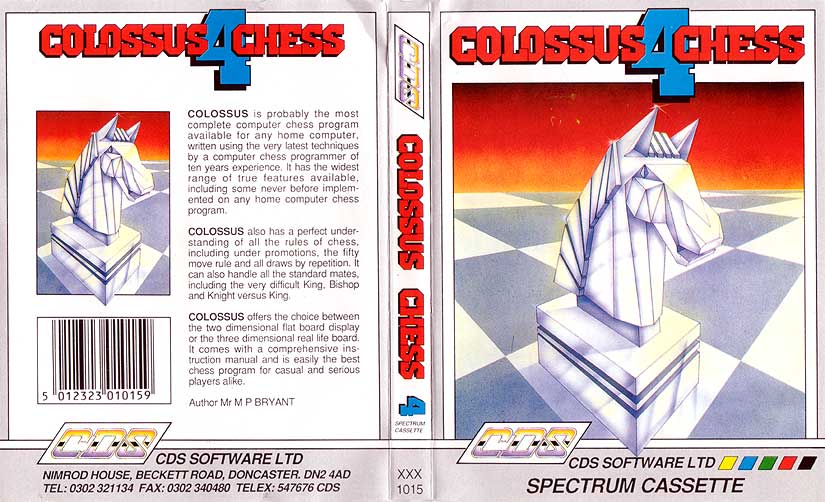
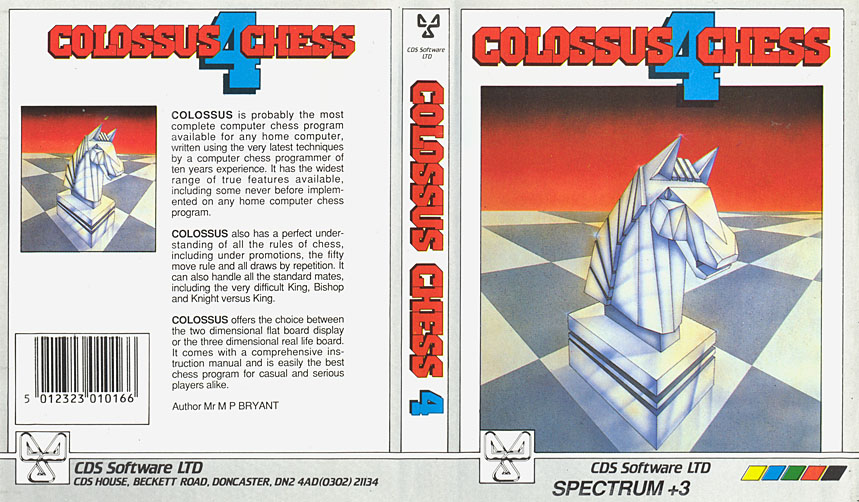
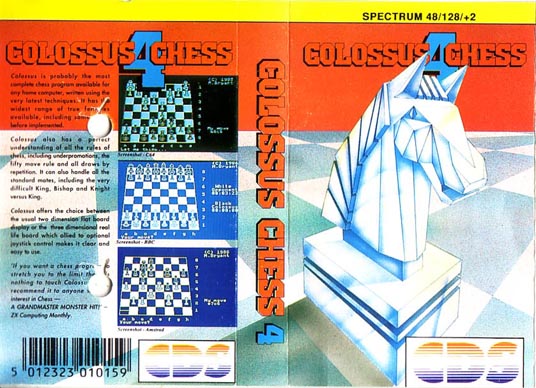
.jpg)
.jpg)
.jpg)
_2.jpg)
_Front.jpg)
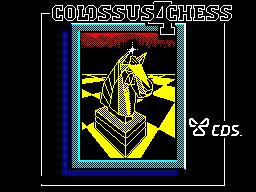
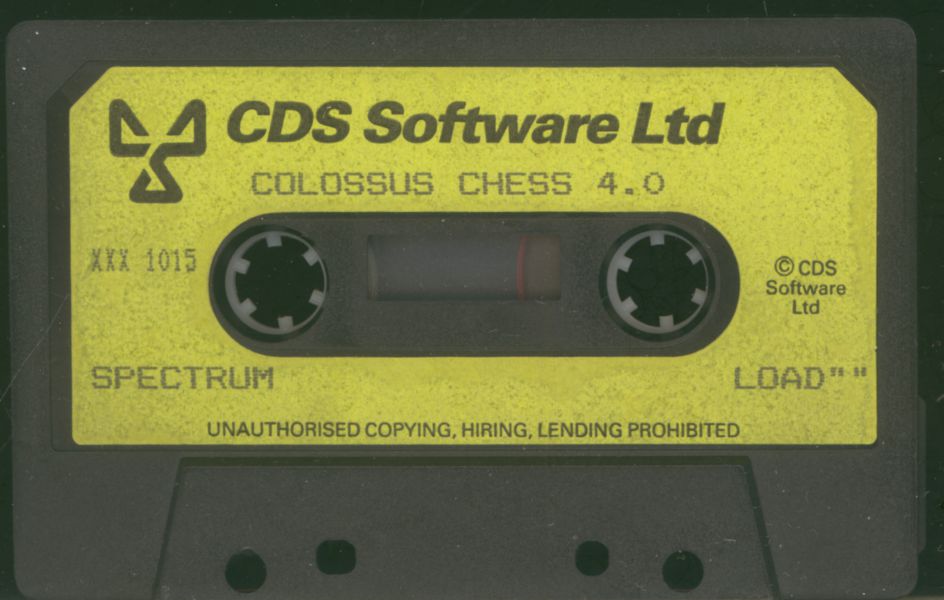
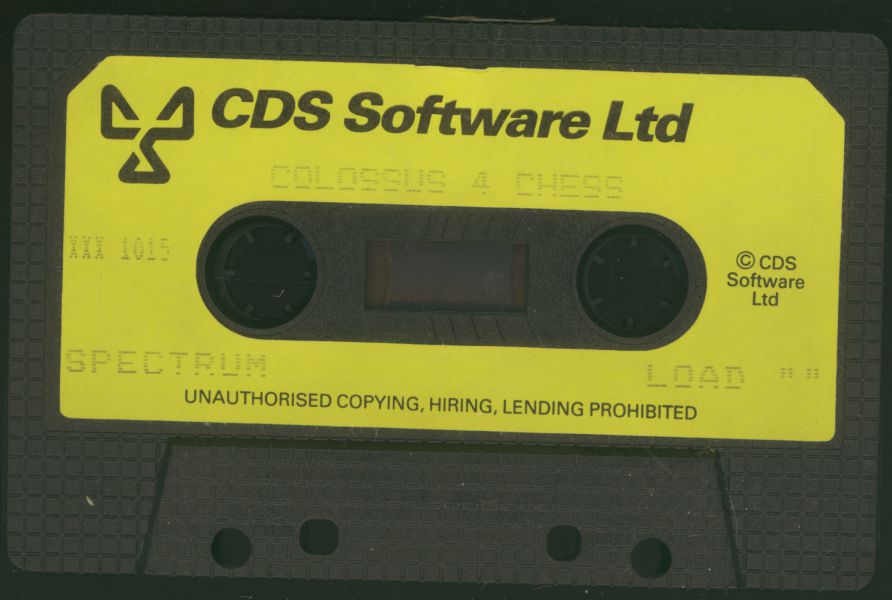
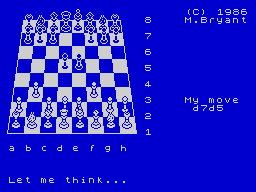
_Addendum.jpg)
Discussion
Nobody has started a thread about this yet.
Releases
- 1986CDS Microsystems Sold as Colossus 4 ChessPound sterling 9.95 · Pound sterling 14.99 disk
- UnknownEDOS
- UnknownProein Soft Line
- 1986Zafi Chip
- 1988Serma Software
- UnknownZ CobraSpanish peseta 1200.00
- UnknownProein S.A.
- 8 Apr 1992CDS MicrosystemsPound sterling 3.99
Play
- ColossusChess4.dsk.zipDisk image English42 KB
- ColossusChess4(ProeinSA).dsk.zipDisk image English41 KB
- colossus4chess.rzxRZX playback file
- ColossusChess4V4.0.tzx.zipTape image English25 KB
- ColossusChess4V4.2.tzx.zipTape image English25 KB
- ColossusChess4.tap.zipTape image English27 KB
- ColossusChess4(ZCobra).tzx.zipTape image English24 KB
- ColossusChess4(ZafiChip).tzx.zipTape image English25 KB
Documents
- ColossusChess4(ZafiChip).pdfInstructions Spanish612 KB
- ColossusChess4(EN).pdfInstructions English778 KB
- ColossusChess4.txtInstructions English31 KB
Files and rights
No permission is on record either way. Screens and pictures are copied here on a take-down basis: if you hold the rights and want something removed, say so and it goes.
Credits
- Martin Bryantcredited
- Carl Cropleycredited
Sign in to credit somebody, or say what these people did.
Awards
Scores
In the magazines
- Your Sinclair #101986 · Overall8/10
- Sinclair User #731988 · Overall7/10
Elsewhere on the web
- WorldOfSpectrum 20 votes8.22
In the magazines 58
Sinclair User #73Apr 1988 · p.437/107/10
Overall 7/10
Tony Dillon 7/10
Label: CDS Software Author: M. Bryant Price: £14.99 Memory: 128K (+3 only) Joystick: various Reviewer: Tony 'Grandmaster' Dillonoschoff Colossus 4 Chess brings a lot of promise with it. It heralds itself as being the greatest 8 bit chess program available, but I feel I have to disagree. The old PSION Sinclair Chess program was pretty fab but I feel that PSI Chess is the best 8 bit chess game around. Colossus Chess has all the features of most of the chess programs about. It boasts 16 levels, which is quite impressive, and to be honest it does provide a good challenge. The screen layout is clear and in 3D perspective (or 2D newspaper style if you want) though still lack the 'cleaness' and finish of some other programs. Altogether, a very good attempt, but I can't see sales booming, not at this price anyway.
ACE (Advanced Computer Entertainment) #6Mar 1988 · p.66
ACE (Advanced Computer Entertainment)
C64, £9.95cs, C14.95dk Amstrad CPC, £9.95cs, £13.95dk Amstrad PCW, £15.95dk Spectrum, £9.95cs Very strong player, but not too hot in its 3D display mode; the pieces are not well-defined and it can be easy to confuse them. Perfectly clear, though, in 2D mode. If strength of play is more important to you than smart graphics, then it has to be your choice.
ZX Computing #30Oct 1986 · p.43ZX Computing Monster Hit
ZX ComputingZX Computing Monster Hit
THE STRONGEST CHESS PROGRAM FOR THE HOME MICRO FINALLY REACHES THE SPECTRUM. CDS £9.95 NOT ONE BUT TWO EXCELLENT CHESS PROGRAMS HAVE JUST BEEN RELEASED FOR THE SPECTRUM AND BOTH ARE A GOOD ALTERNATIVE IF KASPAROV CHICKENS OUT OF YOUR CHALLENGE MATCH. This program is definitely for the chess connoisseur - and the chess masochist. With an "opening book" of approximately 3000 positions and a move evaluation system that examines on average 170 moves per second in the middlegame we are looking at a class program here and unless you are a class player you will be staring defeat in the face. Of course there are features such as takeback and next/best move where the computer can be compelled to choose a second or third best move to soften the program's superiority (if you are unscrupulous), but even then it will give you a hard game. The program is crammed with features and purchasers of the microdrive version get a bonus in the form of 34 games that can be loaded and analysed with the replay function. Controls are simple to master and most major functions can be accessed quickly using the shift key. For instance if you want to deprive your computer opponent of time a useful command is SHIFT G which forces the computer to move immediately. There is also the Supervisor mode (SHIFT S) that stops the computer playing and allows you to make moves for both sides. It is also possible to switch sides in mid-game - a boon if you are being trounced or like hollow victories. 3-D Graphically Colossus 4 is more than adequate, though not stunning. The 3-D display is not well enough defined to make it enjoyable to play with for any length of time. It can be confusing distinguishing which pieces are which and the display only takes up about half the screen. I found it more pleasing to play on the conventional two dimensional board where it's easier to keep track of the game. If you want to watch Colossus in action against an opponent of equal stature (ie Colossus) there is a Play-self option that displays a game of computer-against-computer chess. By pressing the delete key you can step back into the action on either side while there is a pause between moves. It is difficult to imagine a more complete chess program, and more features than can be outlined here are described in an easy to follow 24 page booklet that comes with the game., The booklet also contains Colossus' past fixture list against other home computer chess games. Few managed to get more than the odd game in 16 and many suffered a humiliating whitewash. So it comes as no surprise that mere human opponents are cannon fodder for Colossus. If you want a chess program to stretch you to the limit there is nothing to touch Colossus and I recommend it to anyone with an interest in Chess. A Grandmaster Monster Hit.
COLOSSUS CREATOR INTERVIEW Programmer Martin Bryant reflects on the grandmaster in the machine and its cheat-prone human opponent. "I started writing chess programs when I was at University back in 1977. Then in 1982 I wrote White Knight for the BBC. I knew there could be a different approach so I decided to take the knowledge I'd acquired and write a better program. Colossus 1 appeared first on the Apple in 1983 and since then there have been gradual improvements on newer versions. I usually take about six months improving the program and a year to write versions for other machines. ON IMPROVEMENTS "The catalyst to write a new version comes when someone brings out a new program to challenge it. There is no clear cut way of improving a chess program although there is always something that can be improved. The problem is making the program as strong as possible within the time you have. There is no magic algorithm but the move evaluation function can be made more efficient. The values assigned to different capturing moves by the programmer give the program its specific style it's important to make the computer ignore obviously stupid moves when deciding its next step. From any strategic position the program can generate all the possible moves in reply. This is 'game tree' theory and hopefully the best move comes from the branch you are looking at. ON FANCY GRAPHICS "Putting Colossus on the Spectrum caused a couple of problems with memory space but its playing strength is still the same as the Apple version. Economising is achieved by writing the code more efficiently and not getting carried away with the graphics. Obviously it would be nice to have fancy 3-D graphics as on the larger machines but playing strength is the program's prime resource and it would be silly to cut back on memory in that department. So in consequence the 3D pieces don't glide gracefully across the board. ON CHEATING "I don't play as well as I used to. Obviously I spend a lot of time playing against programs and it's very different because there's not the ego involved that comes out when playing a person. "You can cheat very easily when you play the computer - take back moves, swop sides, and so on, and this can get you into bad habits. After all it's no good when you are playing a human opponent to ask him to give you your piece back. "It depends on how you use it of course if you keep taking moves back you are just kidding yourself. But what a chess program does is to provide a ready opponent any time who doesn't get tired. "Chess programming is still of great interest to me and it never ceases to make me aware of the beauty of the game of chess. It's marvellous to be able to do a job of work that I really enjoy and I'll be playing any new programs that come out until a rival appears - then it's time to bring out Colossus 5 Chess."
DISPLAYS 2 Dimensional Board 3-D Board LEVELS Average mode - variable time limit providing hundreds of possible levels. Tournament mode - time controls on the number of moves made as in tournament play. All the Moves Mode - Blitz chess against the clock. Equity mode - the program keeps pace with your elapsed time clock. Infinite Mode - for puzzles or correspondence, the computer searches indefinitely for the best move. PROBLEM MODE Comprehensive mode for solving check mating problems. Can solve mates up to seven moves ahead also "Selfmates and helpmates". OTHER FEATURES Instant replay/takeback. Colour changes options on board, pieces and border. Invisible Mode - enables you to play "blindfold chess" by making either black or white pieces for both) invisible. CONTROL Joystick/Keyboard
Your Sinclair #10Oct 1986 · p.286/108/109/109/108/108/10
Graphics 6/10
Playability 8/10
Value For Money 9/10
Addictiveness 9/10
Overall 8/10
Gwyn Hughes 8/10
CDS £9.95 Reviewer: Gwyn Hughes Calling this Colossus was, I presume, a carefully calculated strategy to reduce us wordplaying reviewers to the punful state of calling it 'colossal'. Well, as far as options and games go, it obviously is fairly... err... mega-good (Phew!) but when it comes to the instructions and general presentation it loses the odd point. Colossus 4 comes from a long line of highly rated chess proggies, much favoured by addicts. I wouldn't claim to be a Grand Master - in fact Psion's 1K ZX81 program usually beat me hollow - but even to the sort of player who loses his queen after only five moves, the strengths of Colossus are obvious. If you want proof that a CPU is better qualified for quick thinking than the old grey matter, you can even watch it sorting through all the possible lines of play as it prepares to thrash you. The manual boasts that Colossus crushes Superchess 3.5 and Cyrus IS, which is pretty impressive, by any standards. For those into the game's more esoteric outposts, there's a good selection of time options, allowing for blitz games and the like, and you can set up the board for problem solving. Microdrivers have a bonus selection of classic games and problems to solve, while only the most daring players won't vanish at the merest suggestion of Invisible Chess, in which either or both sets of pieces are concealed, so that you have to memorise the positions. If this sounds like driving round Spaghetti Junction with a blindfold, you'll be glad to know that you can control the difficulty by cutting back on how well the micro thinks - the equivalent in real terms of playing Karpov... with Motorhead providing a slight background distraction. Unfortunately the 3D chess board graphics are small and rather indistinct. While moving the pieces is neatly controlled by a cursor, you could spend some time searching through the instructions if you want to know how to do something relatively simple, such as changing sides. Eventually I'm sure you'll get used to the multitude of control keys, but at first it can be an irritating diversion when you'd rather be playing. Colossus is impressive in its options and should please anybody who's looking for some hard core pawn action, but if you want a prettier, albeit less demanding game, you may do better elsewhere.
Feature26
- ACE (Advanced Computer Entertainment) #6Mar 1988 · p.65
- Popular Computing Weekly #31Aug 1987 · p.5
- Popular Computing Weekly #32Aug 1987 · p.5
- Popular Computing Weekly #27Jul 1987 · p.4
- Popular Computing Weekly #30Jul 1987 · p.5
- Popular Computing Weekly #25Jun 1987 · p.5
- Popular Computing Weekly #24Jun 1987 · p.5
- Popular Computing Weekly #22Jun 1987 · p.5
- Popular Computing Weekly #18May 1987 · p.5
- Popular Computing Weekly #17May 1987 · p.5
- Popular Computing Weekly #10Mar 1987 · p.9
- Popular Computing Weekly #8Feb 1987 · p.9
- Popular Computing Weekly #7Feb 1987 · p.11
- Popular Computing Weekly #6Feb 1987 · p.9
- Popular Computing Weekly #5Jan 1987 · p.11
- Popular Computing Weekly #50Dec 1986 · p.12
- Popular Computing Weekly #46Nov 1986 · p.15
- Popular Computing Weekly #48Nov 1986 · p.11
- ZX Computing #30Oct 1986 · p.43
- Popular Computing Weekly #40Oct 1986 · p.11
- Popular Computing Weekly #42Oct 1986 · p.13
- Popular Computing Weekly #44Oct 1986 · p.13
- Popular Computing Weekly #38Sep 1986 · p.10
- Popular Computing Weekly #36Sep 1986 · p.13
- Popular Computing Weekly #34Aug 1986 · p.9
News/Note17
- ACE (Advanced Computer Entertainment) #8May 1988 · p.103
- ACE (Advanced Computer Entertainment) #7Apr 1988 · p.111
- ACE (Advanced Computer Entertainment) #6Mar 1988 · p.102
- ACE (Advanced Computer Entertainment) #4Jan 1988 · p.138
- Popular Computing Weekly #31Aug 1987 · p.5
- Popular Computing Weekly #17May 1987 · p.5
- Popular Computing Weekly #6Feb 1987 · p.9
- Popular Computing Weekly #50Dec 1986 · p.12
- Popular Computing Weekly #46Nov 1986 · p.15
- Popular Computing Weekly #48Nov 1986 · p.11
- Popular Computing Weekly #44Oct 1986 · p.13
- Popular Computing Weekly #40Oct 1986 · p.11
- Popular Computing Weekly #42Oct 1986 · p.13
- Popular Computing Weekly #39Sep 1986 · p.4
- Popular Computing Weekly #38Sep 1986 · p.10
- Popular Computing Weekly #34Aug 1986 · p.9
- ZX Computing #28Aug 1986 · p.6
CompoResult4
- Your Computer #3Mar 1987 · p.13
- ZX Computing #34Feb 1987 · p.4
- Sinclair User #59Feb 1987 · p.22
- Popular Computing Weekly #17Apr 1986 · p.28
Review3
- ZX MagazínMar 2001 · p.10
- Computer Gamer #18Sep 1986 · p.54
- Popular Computing Weekly #35Aug 1986 · p.13
CompoEntry3
- Sinclair User #56Nov 1986 · p.109
- Your Computer #11Nov 1986 · p.12
- ZX Computing #30Oct 1986 · p.60
Letters1
- Popular Computing Weekly #47Nov 1986 · p.11
Licensed from
- ChessBoard/Tabletopunofficial
Related
- Compilations
- The Complete Home Entertainment Centre, The Complete Home Entertainment Centre - 10 Great Games, The Classic Collection, ZX-Spectrum Vega
- Ports
- (Amstrad CPC), (Atari 8-bit), (BBC Micro), Colossus Chess 4.0 (Commodore 64), (Commodore Plus/4), (MSX), (Acorn)
- Elsewhere
- Centre for Computing HistoryMobyGamesRZX ArchiveThe TipshopUVLSpectrum Computing RZX - YouTube
- Same entry at
- Spectrum ComputingZXInfo
Reviews from people here
Sign in to write about this, or make an account. It takes a minute and lets you correct the catalogue too.
No description, tag recorded.
Sign in to correct or add to this.
Hold the rights to this and want it taken down?