
Afterburner
Arcade Game: Shoot-em-up · ZX-Spectrum 48K/128K · 1 players · English
Activision Inc · 1988 · Pound sterling 9.99 · Pound sterling 12.99 disk
Also known as ARCADE COLLECTION 21: Afterburner (English), F-14 Afterburner (English)
Discussion
Nobody has started a thread about this yet.
Known Errors
Bugfix provided by Bandit: <UL><LI> The +3 version plays 2 distinct AY music sounds (during intro menu and in-game), but the 128K version always plays the same due to a bug. Fixed using POKE 25011,0</UL>
- Control Option
- Interface 2 (right), Kempston Joystick
Releases
- 1988Activision Inc Sold as F-14 AfterburnerPound sterling 9.99 · Pound sterling 12.99 disk
- 1988Proein Soft LineSpanish peseta 1200.00
- 1989MCM Software S.A.
- 1991The Hit Squad Sold as ARCADE COLLECTION 21: AfterburnerPound sterling 2.99
Play
- Afterburner.rzx.zipwithheld by rights holder
- Afterburner(TheHitSquad).tzx.zipwithheld by rights holder
- Afterburner(128K).tzx.zipwithheld by rights holder
- Afterburner(48K).tzx.zipwithheld by rights holder
Documents
- Afterburner_BookletCrash60-4.jpgBooklet 194 KB
- Afterburner_BookletCrash60-7.jpgBooklet 54 KB
- Afterburner_BookletCrash60-6.jpgBooklet 107 KB
- Afterburner_BookletCrash60-5.jpgBooklet 183 KB
- Afterburner_BookletCrash60-3.jpgBooklet 205 KB
- Afterburner_BookletCrash60-2.jpgBooklet 183 KB
- Afterburner_BookletCrash60-1.jpgBooklet 120 KB
- Afterburner_BookletCover.jpgBooklet 161 KB
- Afterburner.txtInstructions English14 KB
- Afterburner(MCMSoftwareS.A.).pdfInstructions Spanish79 KB
- Afterburner_HitSquad_Instructions.pdfInstructions 218 KB
- Afterburner(MULTI-LANG).pdfInstructions Multi-language: English, French, German1,427 KB


Music
- Afterburner.mp3.zipBonus soundtrack(s) in MP3 format 703 KB
- Afterburner.ay.zipRipped in-game/theme music in AY format 2 KB
- Afterburner.mp3.zipSampled in-game/theme music in MP3 format 2,814 KB
Other files
- Afterburner_CompetitionLeaflet-Front.jpg? 134 KB
- Afterburner_CompetitionLeaflet-Back.jpg? 159 KB
- Afterburner_Sticker.jpg? 39 KB
- Afterburner.jpgAdvertisement 324 KB
- Afterburner(ProeinSoftLine).jpgAdvertisement 288 KB
- Afterburner.pngGame map 92 KB
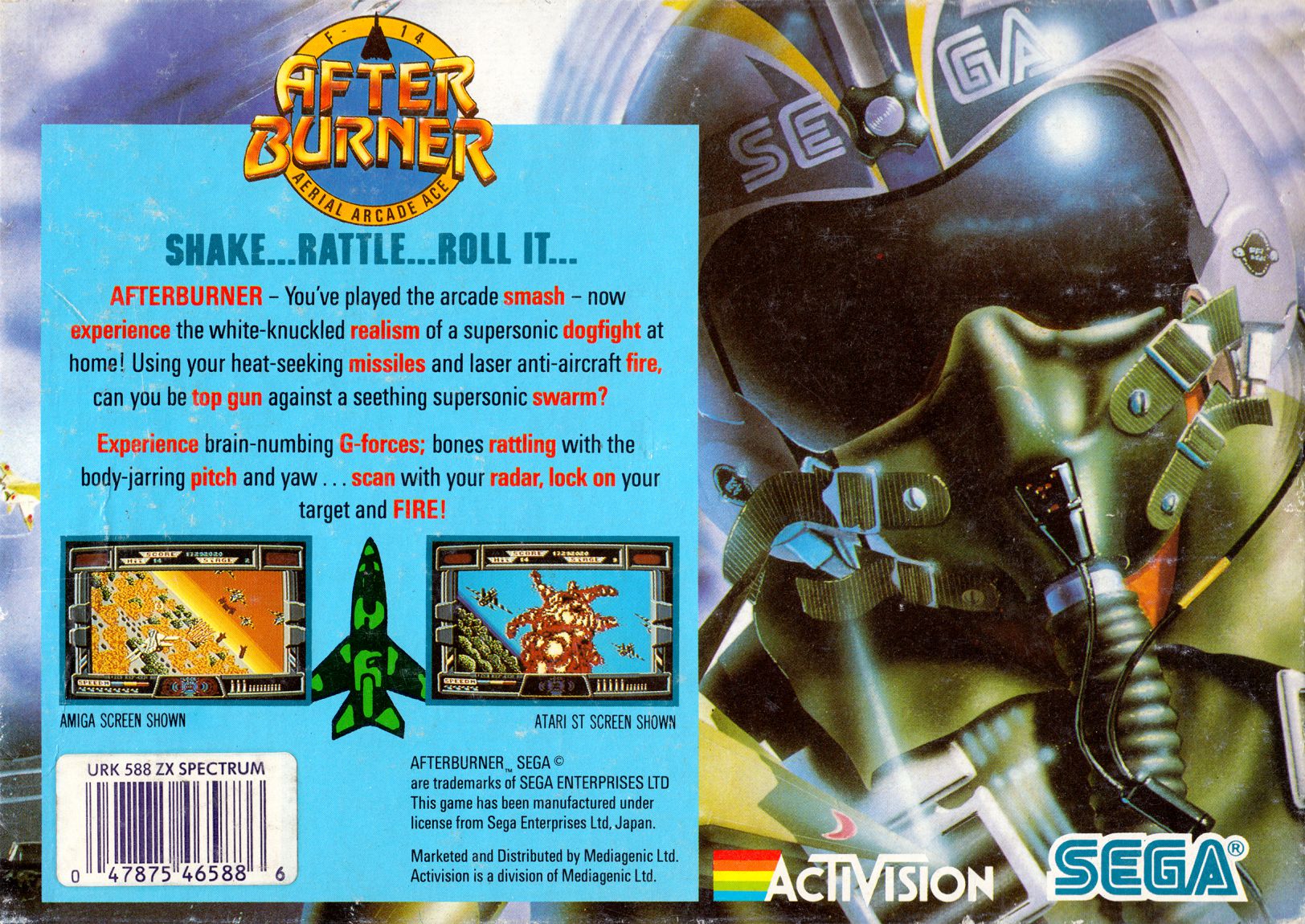
- Afterburner_Back.jpgInlay - Back 492 KB
- Afterburner(HitSquad)_Back.jpgInlay - Back 393 KB
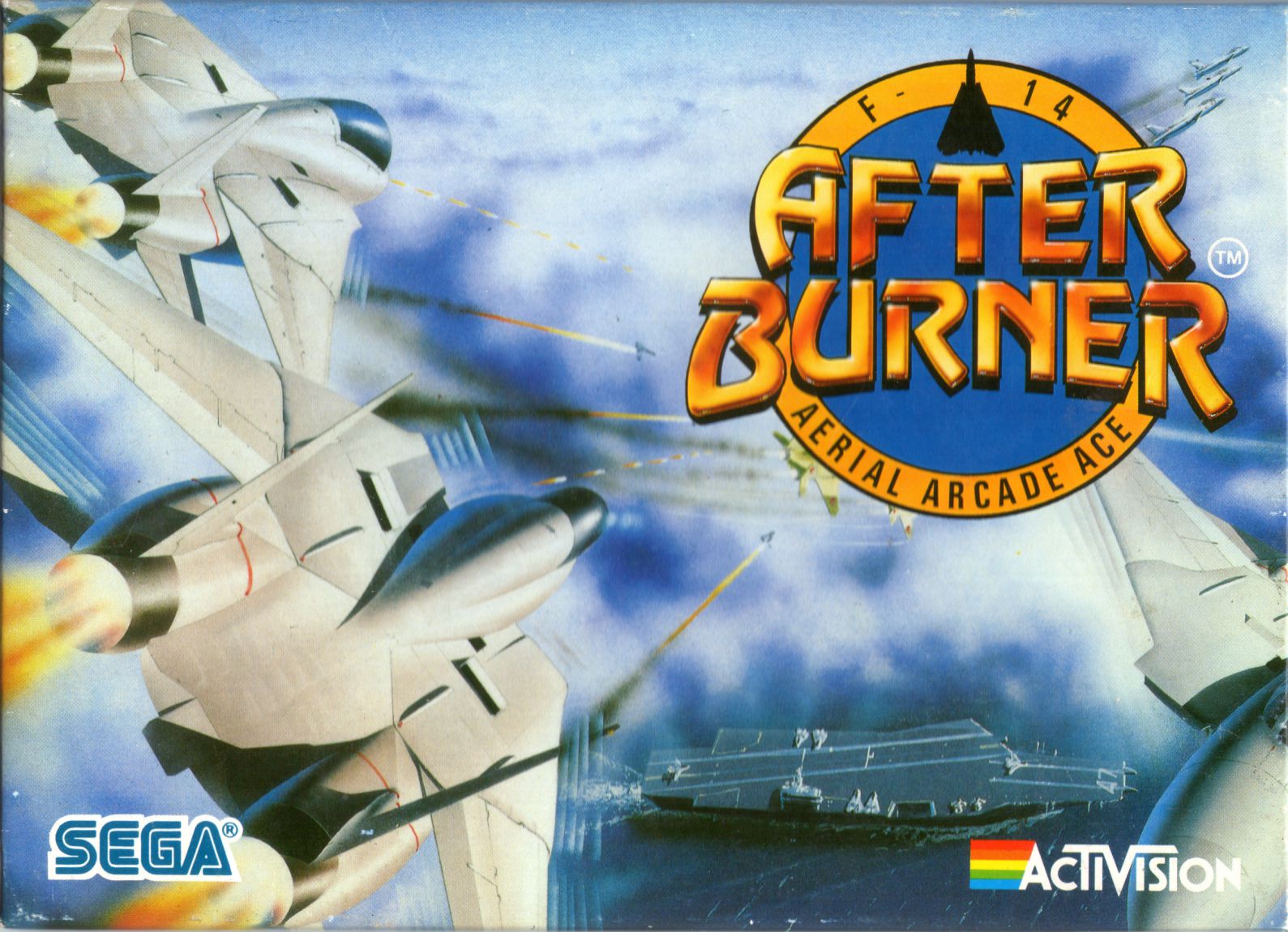
- Afterburner_Front.jpgInlay - Front 289 KB
- Afterburner(HitSquad).jpgInlay - Front 457 KB
- Afterburner(MCMSoftwareS.A.).jpgInlay - Front 31 KB
- Afterburner(MCMSoftwareS.A.)_2.jpgInlay - Front 212 KB
- Afterburner.scrLoading screen 7 KB
- Afterburner-LOAD-1.scrLoading screen 7 KB
- Afterburner_Media.jpgMedia scan 105 KB
- Afterburner(HitSquad)_Media.jpgMedia scan 110 KB
- Afterburner (1988)(Activision Inc).pokPOK pokes file 0 KB
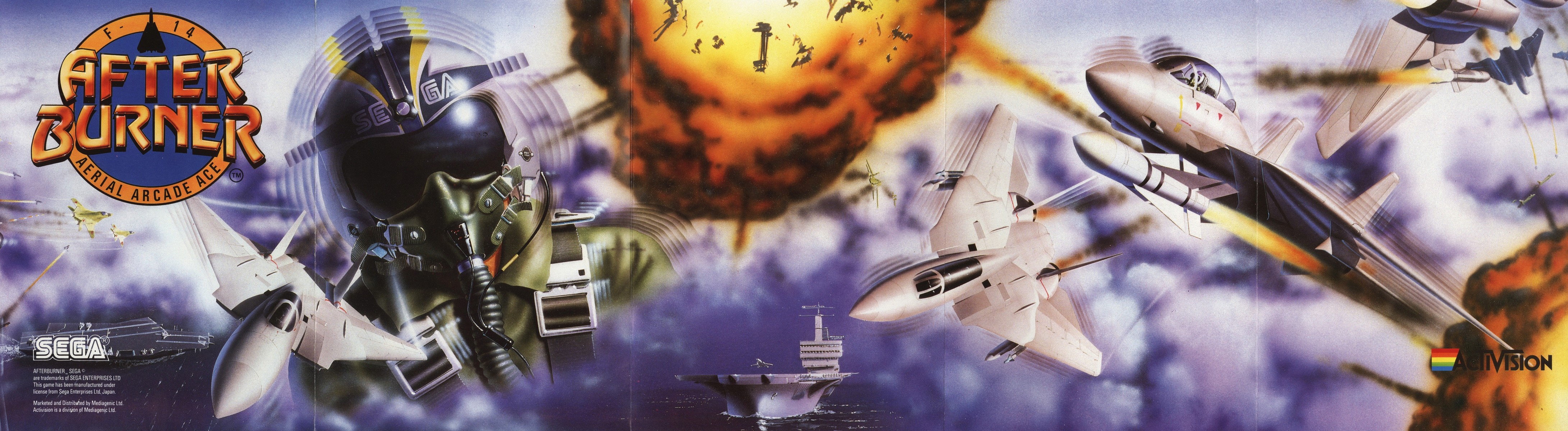
- Afterburner_Poster.jpgPoster 1,533 KB
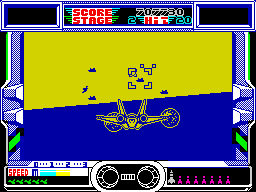
- Afterburner.gifRunning screen 5 KB


.jpg)

_Back.jpg)
.jpg)
.jpg)
_2.jpg)
_Media.jpg)
Files and rights
The rights holder has refused distribution. Files are listed because their existence is a catalogue fact, and none are served from here.
- DeniedActivision Inc → WorldOfSpectrum
Credits
- Keith BurkhillCode
- Jon Paul EldridgeMusic
- Focus Creative Enterprises LtdIn-game Graphics
- Mark A. JonesLoad Screen
Sign in to credit somebody, or say what these people did.
Awards
Scores
In the magazines
- Sinclair User #811988 · Overall90%
- Crash #591988 · Overall86%
- C&VG (Computer & Video Games) #861988 · Overall90%
- Your Sinclair #391989 · Overall7/10
- ACE (Advanced Computer Entertainment) #161989 · Ace Rating656/1000
- The Games Machine #151989 · Overall83%
- Your Sinclair #551990 · Overall67%
- Your Sinclair #491990 · Afterburner68%
- Your Sinclair #651991 · Overall78%
- C&VG (Computer & Video Games) #1131991 · Overall82%
- Crash #871991 · Overall85%
Elsewhere on the web
- WorldOfSpectrum 36 votes7.18
In the magazines 63
Your Sinclair #65May 1991 · p.6978%78%
Overall 78%
Rich Pelley 78%
BARGAIN BASEMENT It's damp and it's dark But it's always quite merry When you're locked down the cellar With PILLAR & PELLEY! AFTERBURNER Hit Squad £2.99 Reviewer: Rich Pelley Let's face it, the only reason you're reading this review is because you've got nothing better to read - not because you've never heard of Afterburner and want to know what it's about. I mean, everyone's heard of Afterburner! I even had an in depth discussion with my Gran about it once! But seeing as the more I write the more I get paid, let's have a quick recap. On first play, you'll probably think "wow' and go around annoying your family by telling them how good this new game you've just got is, and then wondering why from then on every time you enter a room everyone else suddenly leaves. The graphics, if a little lacking in any colour whatsoever, chugg along at a cracking rate, and your plane dips and dives, turns and rolls as you fly into the screen very effectively. Hoards of baddies zoom at you, you fire your machine gun at them, then lock on and despatch a missile or 2. There's then a convincing explosion and a 128K explosion-type-noise (or 48K beep). But this is just about all that you can do - for level after level. It's very easy too as there's nothing you can crash into (not even other planes - you can only be hit down by enemy missiles which are for the most part easy to avoid), and your machine guns and missiles fire and lock on automatically. You've got absolutely tonnes of lives too, so games tend to be pretty lengthy. Okay, so there are loads of levels (which load in a few at a time), including various (automatic) re-fuelling sequences, and a natty bit where you have to fly though a big canyon, but the gameplay does remain very samey throughout. It is however very addictive and cheap, so by all means scoop it up now if you didn't before.
1 There's a variety of enemy planes - these are the nastiest as they fire both missiles and bullets. 2. Ammo is limited, and shown here with a big missile representing 2 rows of little ones. (Your stock is of course replenished when you refuel.) 3. You.
C&VG (Computer & Video Games) #113Apr 1991 · p.7282%
Overall 82%
Hit Squad Spectrum £2.99 This conversion of the hit Sega coin-op puts you in the seat of an F-14, pitted against hordes of enemy aircraft. Its all really very good, considering the machine's limitations. Fans of the coin-op, grab three quid and check it out pronto!
Crash #87Apr 1991 · p.5085%85%
Overall 85%
Nick Roberts 85%
The Hit Squad £2.99 Just like the coin-op - wobble your fighter plane from left to right shooting incoming attackers as you fly (at high speed) over different terrains. Entertaining if you loved the coin-op, okay-ish as a stand-alone game.
Your Sinclair #55Jul 1990 · p.3352%63%49%75%67%67%
Alien-Death-Scum-From-Hell Factor 52%
Shopability 63%
Copycat Factor 49%
Visibility Factor 75%
Overall 67%
Matt Bielby 67%
THE COMPLETE YS GUIDE TO SHOOT-'EM-UPS PART 1 Where'd we all be without shoot-'em-ups, eh, Spec-chums? Well, we'd all have much smaller games collections, that's for sure! Join MATT BIELBY for an epic blast through nearly a decade of firepowered Spec-fun... Blimey! The complete guide to shoot-'em-ups, eh? A bit of a mammoth task you might be thinking (and you'd be blooming right! It's taken me absolutely ages!). It's so blinking gigantic in fact that we've had to split it in two to save the whole ish from being packed to the gills with ancient shooty-shooty games and very little else! So how's it all going to work? Well, this issue we spotlight those hundreds of games where you control a little spaceship, aeroplane or what have you, while next time round we'll be wibbling on for ages about those blasters where you command a man, creature or robot - things like Operation Wolf, Gryzor, Robocop (the list is endless, I'm sorry to say). Yes, I know it's a bit of an arbitrary way to divide the whole subject up in two, but it's the best I could come up. Anyway, if you 're all ready, let's arm the missiles, oil the cannons, buckle our seatbelts and go kick some alien ass! (Or something.) SO WHAT EXACTLY MAKES A SHOOT-'EM-UP A SHOOT-'EM-UP? Well, at the risk of stating the obvious, it's a game where simple reaction times count for (almost) everything, and the actual shooting of various baddies constitutes the major part of the gameplay. It's just about the oldest form of computer game going (Space Invaders was pure shoot-'em-up, for instance), short of mad Victorian chappies crouching down inside big wooden cabinets and pretending to be chess machines. It's one of the most enduring forms too - hardly an issue of YS goes by when we don't review at least a couple of newies, and it's the rare arcade-style game (sports sims and puzzlers excepted) that doesn't include at least a small shoot-'em-up element in there somewhere as part of the gameplay. But back to the case in hand. What we're talking about here are the pure shoot-'em-ups - games where the wiping out of waves of aliens or other baddies is everything (though let's be fair, the violence in most of these is very abstract and minimal). They easily divide into four major types, depending on how you view the action. And you can read all about them over the page. THE FIRST EVER SHOOT-'EM-UP Goodness knows - Space Invaders is the obvious answer, but most of the other early arcade games were shoot-'em-ups too - Defender, Asteroids, Galaxian and the rest. To find out what made it onto the Speccy first, well, we'll have to look back in the vaults and see what we come up with, shan't we? Right, here we are with the very first issue of Your Spectrum (later to evolve into Your Sinclair), cover date January 1984. Flick to the review section and we have two Space invaders-type games, both from long-forgotten Anirog Software - Galactic Abductor and Missile Defence. The second issue (Feb 84. believe it or not) brings us such delights as Xark (Contrast Software), a Defender-type game and Alien Swoop (a Galaxians rip-off), while in issue three had Bug Byte's Cavern Fighter (a tunnel-based jobbie, like an early version of R-Type). Hmm. Let's go back a bit further, shall we? All the early computer games mags were listings based (ie had lots of crap Basic games printed out line by line over oodles of pages, as if Program Pitstop had run rampant over the whole mag!) so we might find something in there. Believe it or not find something in there. Believe it or not, I have the very first issue of the very first computer games mag in the country sitting right here on my desk, cover-dated November 1981. There's only one Sinclair game in here (for a ZX80 or 81 - a Speccy forerunner - and taking up a whole 2K!). It's called City Bomb, and it's a sort of shoot-'em-up. Apparently you're in a plane at the top of the screen and have to bomb the city beneath you, flattening out a landing strip so you can put down safely. Thrilling stuff, eh? As for commercially available stuff, it's all lost a bit too far back in the mists of time to be sure. Still, shoot-'em-ups started emerging for the Speccy pretty soon after the machine came out, certainly by the end of '82. Throughout 83 people like Quicksilva and Bug Byte were churning out Space Invaders, Asteroids and Scramble clones advertised as 'being in 100% machine code and in colour' too, so perhaps it was one of those. Exciting stuff, eh? RATINGS In the great YS Guide To... tradition, for a one-off-only special occasion we've adapted our normal rating system to accommodate the shoot-'em-up theme. Here's how they work... Alien-Death-Scum-From-Hell Factor Are there oodles of inventive, nasty and extremely difficult-to-kill baddies all over the place (including the biggest, meanest muthas ever at the end of each level) or do you end up fighting a fleet of Trebor Mints? Shopability Are there oodles and oodles of well-thought-out and spectacular weapons available to pick up and use, or do you have to make do with the same crap little peashooter throughout the game? Copycat Factor Unusually, the lower the score the better here. Basically, is this exactly the same as every other shoot-'em-up ever (in which case it'll get a high score for being chronically unoriginal) or does it have something innovative and special about it to set it apart from the crowd? Visibility Factor Does everything make a degree of sense in Speccyvision, or is it all a jumbled mass of pixels, with bullets, missiles and even little spaceships winking in and out of view willy-nilly? Afterburner Activision A prime example of the sort of arcade conversion everyone said 'can't be done on the Speccy' and guess what? Yes, everyone was right! Still, that doesn't mean Activision didn't make a very brave try. Indeed, the speed with which they've got the various pretty large sprites (massive in the case of the F14 Tomcat you control) whanging around all over the screen is pretty impressive, to say the least. The only problem is - there isn't really much of a game hiding underneath the flash (and I know plenty of people will disagree with me, but I found pretty much the same thing to be the case with Space Harrier, Galaxy Force and all those other into the screen jobbies), a fault of Sega (the coin-op people) rather than the people who worked on the Speccy version. The scenario, as you all probably know, is your slightly oudated 'shoot down all those nasty Russian planes' jobbie. There are some neat touches (the inflight refueling sequences spring to mind) but with automatically firing guns, automatically locking missiles and so on it's really just a case of dodging enemy fire (try a constantly circling movement around the screen) and launching the odd missile. Sorry, but for me this 'unconvertible' game turned out to be exactly that.
Chocks awaaaaaay!
EVERY SHOOT-'EM-UP EVER Ha! You've got to be joking - I started working on it and got up to 150 names - and I was only half way through the poxy thing! Forget it!
GIANT ALIEN MUTHAS FROM HELL A few good end-of-level baddies can make a shoot-'em-up, a lack of them break one. Let's look at a few typical monsters, shall we? Dominator: Impressive pink mouth affair firmly in the R-Type mould, and nicely animated too - the eyes blink and teeth move. Unfortunately the rest of the game didn't live up to it. Mr Heli: A giant eye thing with lobster claws - not bad, the grey and yellow graphics don't help it to stand out as much as they might, do they? Silkworm: This is the other way to do it - not a giant fixed mass (like the other two) but a moving baddy in the vein of stuff you've already met on that level, but bigger. This super chopper is delightfully guppy-like.
HOW TO DESIGN A SPACESHIP We cant really express how important a good central sprite can be - after all, other sprites may come and go, but you're looking at this one the entire time! Halaga: Hmm. Your basic Space Invaders/Galaxians thing - not too impressive, is it? Sidearms: Anyone able to tell me what's meant to be going on here? It just looks like a bit of a mess to me! Answers on a postcard please. Dark Fusion: A-ha! Now this is more like it - simple, clean design, easy to see but not too distracting. It's the biz.
SHORTS Blimey! Space doesn't go very far when you've got a subject as big as this, eh? So, dotted across the next four pages, we've squeezed some mini (mini) reviews into snazzy white blobs (just like this) - not wham-bam classics, but all good representatives of a type…
SO, YOU WANNA WRITE A SHOOT-'EM-UP? Would you believe it's not as hard as it looks? (Actually, the way loads of people seem to write shoot-'em-ups it doesn't actually look all that hard anyway!) Here are a few of your central ingredients... The Main Spaceship A little square box thing with another square box on the front will do fine here - nice and simple and to the point. Alternatively you could go the whole hog and stick as many spikey bits as possible all over it so the sprite looks 'interesting' from all angles. Enemy Spaceships Nothing wrong with a whole squadron of polo mints zooming through space towards you - after all, it's the cunningness of the attack formations that counts! The Name Something gun-like sounds good and hard (say Side Arms or Armalyte) though anything vaguely aggressive-sounding will do (Eliminator, Dominator, Xecutor, H.A.T.E). If you're desperate you can always go the pseudo-scientific route (R-type, P47, Ultima Ratio), opt for an animal name (Salamander, Silkworm) or go for that old standard, the meaningless, vaguely futuristic-sounding word (Triaxos, Xeno, Zynaps, Xarax, Sanxion, Uridium, Xevious). Lots of 'Z's and 'X's are good. Background Nice and complicated is fine - let your imagination go wild. Don't worry about bullets (or even smaller enemy squadrons) getting lost amongst the mass of background detail - you can always pass it off as 'challenging gameplay'. Collision Detection Don't make it too easy for them! It's perfectly all right if any alien coming within inches of the player kills him dead, while he needs to blast baddies six times for any effect to be felt Again, it's all in the cause of challenging gameplay!
THE 'INTO-THE-SCREEN' JOBBIE Although occasionally attempted with reasonable success by budgeteers like CodeMasters, these often constitute a less than satisfying experience. All too often someone responsible for coin-op licence acquisition will pick out an arcade favourite with a giant hydraulic cabinet - say an Afterburner or Thunder blade - with little thought as to how it's going to translate to the home computer. (Not very well, usually.) Thus most 'into-the-screen' shoot-'em-ups are technically impressive and rather brave attempts to reproduce the thrills and spills of the original, but almost inevitably doomed to failure. Robbed of 3D, moving cabinets, and whizzo graphics, the limitations built into the game become abundantly clear - there's little real feeling of speed (difficult enough to create even with a rolling road as reference point, let alone without one), oodles of almost identical levels and very little to actually do. Boring. Videodrome, here we come - it's 'into the screen' time with F-16 Fighting Falcon.
THE FLIP-SCREEN Not all that common, but these can work very well indeed - check out Raf Cecco's Cybernoid duo, for instance. The thing seems to be that if you dispense with trying to write decent scrolling routines (since the background doesn't move at all - you simply progress across the screen until you get to the far end, when a new one flashes up with your little ship in its new starting position) you can spend a lot more time making everything else very pretty and colourful and inventive. Thus flip-screen games have some of the best, clearest, most colourful graphics ever seen on the Speccy. On the minus side however there's the disconcerting, disorientating bit where your ship flickers off the right hand side of the screen, only to reappear on the far left of the next one. But they can be incredibly addictive (it's always a temptation to try for 'just one more' screen to see what it looks like) and, in the case of the Cecco games at least, can strike a fine balance between mindless blasting and working out the best route past each new obstacle. They're still pure shoot-'em-ups, but slightly more cerebral ones. Flip screen a la NOMAD - no place to run to, no place to hide. (It's a bit like playing Murder In The Dark really.)
THE HORIZONTAL SCROLLER This is the other main option, and usually a much more sensible way to go about things. Not only is the screen the right shape, but you can have a very complicated and pretty bottom and/or top bit to it (the ground, or the edges of a tunnel, say), while leaving the bulk of the play area relatively free from obstructions. Most the great shoot-'em-ups (but by no means all) are built like this, including the Your Sinclair all-time fave raves like Uridium and R-Type. Game over, man! (Well, Game Over II to be precise.)
VERTICAL SCROLLERS One obvious option for a shoot-'em-up, and one that's used all over the place, is the vertical scroller. This is where the action is viewed from a God-like perspective above it all, looking down on everything from a distance. The action scrolls up (or on the very odd occasion down) the screen. This has some advantages - it's easy to lay out complicated attack formations and the little spaceships can he the simplest blobby shapes and still function quite well but it can suffer from some rather major flaws too. The first is that the shape of your average TV or monitor is all wrong. Think about it - you're trying to present portrait-shaped action (taller than it is long) on a landscape-shaped screen (wider than it is tall). In a coin-op, which is where 85% of vertical scrollers originate, there's no real problem with this because you can easily build a cabinet with a tall thin screen to contain the action, but in Speccyvision the programmers have to waste large portions of the side of the potential play area to reproduce it Subsequently, all the sprites have to be fairly small to fit in, and on most TVs become next to invisible. You've effectively castrated the game before you've even started. There's one other major problem too - the background. Since most scrolling Speccy games have to be largely monochrome, any sort of backdrop (say a forest which you're flying over) can cause real problems. You'll be safe (but probably rather bored) if the programmer opts for a simple black starfield over which all the sprites will show up well, but anything beyond that courts disaster. All too often overzealous background artists, small sprites, even smaller bullets and the sort of slightly crappy TVs most of us use with our Speccies conspire to render your brand new vertical scroller virtually unplayable. Don't think I've got a total downer on them though - despite all the limitations some of the real classics use this design. Xenon, anybody? Clear backdrops, that's what vertical scrollers need. (So Gemini Wing's a sorry loser.)
Your Sinclair #39Mar 1989 · p.839/108/106/105/107/107/10
Graphics 9/10
Playability 8/10
Value For Money 6/10
Addictiveness 5/10
Overall 7/10
Jonathan Davies 7/10
Activision £9.95 cass/£14.95 disk Reviewer: Jonathan Davies If US Gold was foolhardy enough to tackle OutRun, Activision must have been utterly crackers when it bought the licence to this one. With more hydraulics than a fleet of JCBs, and extraordinarily fast graphics, Afterburner is another one for the "Gosh! Wot, on the Speccy? Gerraway!" brigade. However as we all know, if it's got the right name on the box, just about any old dross can be made to sell like, well, like very fast. Not that Afterburners is any old dross, of course. Certainly not. But while it packs quite a punch graphically, there seems to be a gaping void where the gameplay should have been inserted. Just like the coin-op version, in fact. Hokay, for those of you who haven't seen it in the arcades and missed the Megapreview a couple of issues ago, the game goes like this. Launch your F-14 Tomcat from the flight deck of an aircraft carrier, zoom along at Mach 96 and shoot the marauding hordes of Russi... sorry, enemy aircraft who scoot around taking pot-shots at you, stopping for refuelling occasionally. Nothing frighteningly original there, I know, but where Afterburner excels is in the graphics. Even on the Speccy conversion, the speed at which sprites are wanged around the screen is phenomenal, especially considering that as your F-14 banks, the ground and all the clobber littered about on it bank too, so all the sprites have to be rotated around. The mathematics behind it doesn't bear thinking about. But then what maths does? As you can probably imagine, colour pretty well goes out of the window once again, making me wonder where the Spectrum got its name. Well fast it may be. So fast that you'll often be wiped out without knowing what's hit you. The trouble is, though, that there's very little to do. Your guns fire automatically, missiles lock on as soon as your sights pass over the target, so all you have to do really is dodge enemy fire and launch the odd missile now and then. This may be fine for some people, but after a few minutes I was pounding my fists on the keyboard, demanding to see the manager. While I can't help but quake at the sheer power of the graphics routines, hum along to the 128K tunes and snigger as yet another Comm er, baddy goes down in flames, the thing that amazes me most about Afterburner is that it's totally devoid of any addictive qualities whatsoever. Not many, anyway. I suppose that some of you might want to keep going to see all the various levels and refueling sequences, but it's not really worth playing just for the shooty bits. Buy it for the speed, graphics, free stickers and posters if you must, but be aware that they're covering up a serious lack of content. Damning perhaps, but that's the way the cookie crumbles.
Yer akchawi 'flying through a canyon' sequence. Very difficult, as it twists about causing you to pile into the sides on a regular basis.
The Games Machine #15Feb 1989 · p.5983%
Overall 83%
THE GAMES MACHINE TRASH Spectrum 48/128 Cassette: £9.99, Diskette: £12.99 Commodore 64/128 Cassette: £9.99, Diskette: £14.99 Atari ST £24.99 F F F FOURTEEN The Grumman F-14 Tomcat - capable of Mach 2.34 at height, armed with the longest range air-to-air missiles in the world and the US Navy's premier carrier-based fighter. Sega - Japan based maestro in producing top quality coin-ops. Activision - one of the most successful software houses in the UK. These three leaders in their field join forces to bring you home computer conversions of the 1988 top grossing coin-op - Afterburner. Afterburner stormed its way into arcades around the world and became Sega's biggest selling machine to date. Featuring three megabytes of superlative graphics, sound and heart-rending action, how could Activision be expected to convert it to home computers? For those who failed to notice the blanket promotion for the game, it is a flight-combat shoot-'em-up set over 23 levels. Your F- 14 is ready, waiting and armed with unlimited cannon shells for close combat and a lock-on fire-and-forget missile system. To destroy MiGs, lock-on target, squeeze the trigger and watch your missile heat-seek home. Through war torn skies you pilot the F-14, taking on, and hopefully defeating, a seemingly endless enemy force of fighter planes. Enemy craft and a salvo of heat seeking missiles rush toward your plane in an attempt to stop you - its a case of avoid or die! ONE MIG-HELL The basic theme is dodge enemy missiles, launch your own and survive to the next level. Added to this mayhem are canyons to negotiate - hit the sides and your mission comes to an explosive end. At certain stages you refuel in mid-air and also land at secret airbases to top up your firepower. Running out of missiles is not a good idea. Afterburner may not seem awesome from the plot - in fact the coin-ops success comes from the incredibly fast action and marvelous graphic quality. Actual gameplay is limited and can even become repetitive. Ironically, home computer conversions have had to make graphics a secondary priority. The most important requirement was to feature the simple gameplay of he coin-op.
Gosh, how can you destroy enemy planes when they're protected by huge square forcefields (C64 screen).
No, you don't have to destroy this big mother, it's here to refuel you.
"A case of avoid or die!"
ATARI ST Overall: 47% With Argonaut Software's programming pedigree, 16-bit versions looked set to be superb - they're not. There is no impression of high speed, confusing graphics make firing and dodging missiles tricky, and mystifyingly jerky plane moves kills all emotions of being there. Graphics feature primitive bushes and unreal runways but radar towers and trees are nicely detailed (unfortunately you do have time to admire them!). Urgent vocal messages are included but they add little to play.
COMMODORE 64/128 Overall: 29% If you can put up with the barely adequate graphics, confused play and at times horrific presentation, you may find a barely playable game. The worst feature is the presence of character blocks around missiles and aircraft when they pass over the ground such crudities haven't been seen for at least five years. If you've a perverse desire to waste your money, give this version of Afterburner a whirl.
OTHER FORMATS Afterburner is soon to be converted to the Amstrad (Cassette £9.99, Diskette £14.99), Amiga (£24.99) and MSX (Cassette £9.99).
ACE (Advanced Computer Entertainment) #16Jan 1989 · p.548/107/101/107/10656/1000656/1000
ACE (Advanced Computer Entertainment)
Graphics 8/10
Audio 7/10
IQ Factor 1/10
Fun Factor 7/10
Ace Rating 656/1000
Andy Smith 656/1000
Activision Lock On. Take a game, almost any game, put it in a large, colourful and very animated cabinet then plonk it in an amusement arcade and what have you got? Large queues waiting for their turn on the latest sure-fire arcade hit. After Burner was THE machine to play in the arcades earlier this year. It came in three versions: The upright cabinet, which is the standard arcade machine, the sit-in version, which shook and rattled as you played, and the Deluxe version, which shook and rattled enough to knock your false teeth into your lap. Now Activision bring us the home micro versions of the game - which come without a cabinet, so you'll have to do your own gyrating console impressions. The object of the game is very simple - fly your F-14 Thunder Cat through stage after stage of enemy territory and survive for as long as possible. Chances of survival are increased by shooting down as many of the enemy aircraft as you can before they shoot you. Your plane is armed with a continually front-firing machine gun and heat-seeking missiles. A small square sight just in front of your plane indicates where the machine gun is firing, and if an enemy plane wanders into the sight, it locks on to the enemy plane. You then let loose with a missile which will rocket towards the target - meanwhile, your small sight's still out in front so you can end up with half a dozen or more targeted enemy planes at once. Dealing with the enemy like that is not such a problem at the start of the game as long as your reactions are swift enough to bank left-right to avoid the incoming missiles. The problems start when enemy planes and enemy heat-seeking missiles start coming from in front and behind. The best way out of this kind of situation is to start using the throttle control to speed away from (or slow down and sneak in behind) the enemy. In later stages the skies are empty of enemy craft and it's a simple case of blasting away at ground targets such as oil tankers and look-out towers - occasionally you have to do this whilst flying through a narrow canyon. Although your machine gun has an inexhaustible magazine and keeps firing away happily, the number of missiles is limited and should you be so foolish to use up all your missiles early on, you'll have to survive without them until the refuelling stage, when either a large tanker plane comes flying over and drops a cable which your plane attaches itself to automatically, or a landing strip comes into view and the plane lands and gets refuelled. After Burner is pure sky-high mayhem, the ol' brain cells won't get a work-out but your joystick arm certainly will. It's playable stuff, but once the novelty has worn off you'll soon realise it is just a standard scrolling shoot-em-up with little in it to keep you interested and playing for any great length of time. Reviewer: Andy Smith RELEASE BOX Atari ST, £24.99dk, Out Now Amiga, £24.99dk, January Spec, £9.99cs, £12.99dk, Out Now Amstrad, £9.99cs, £14.99dk, Imminent C64/128, £9.99cs, £14.99dk, Imminent IBM PC, No plans. Predicted Interest Curve 1 min: 80/100 1 hour: 85/100 1 day: 60/100 1 week: 30/100 1 month: 20/100 1 year: 5/100
At the start of a new stage on the arcade machine.
Below - C64 version, notice how blocky the graphics are.
Blasting off at the start of the game on the Spectrum. Tilt your chair back as you power skywards (not too far!).
Re-fuelling and re-arming on the Spectrum. The player takes no part in this so it comes as a welcome break.
ST - Blam! A missile hits home. Watch out for that incoming missile at the top of the screen though or you'll go crashing to the ground.
ST - stage one and some enemy planes come screaming past you. Get 'em in your sights and fire off a missile.
Spectrum - in the thick of the action. You're locked onto four planes so let them missiles fly!
Spectrum - powering through the canyon in stage eight. There are no enemy planes to worry about as you blast everything on the ground. Mind the walls though! Far right - you're hit! You're going down! You've only got eight lives left! Oh no!
ARCADE ACCURACY It's fast, colourful and has all the features of the arcade game that you could reasonably expect. Coin-op Score: 8
ATARI ST VERSION The sound effects are good as are the graphics and gameplay. It's still not a stunning game though and you're liable to bored sooner rather than later. Graphics: 8/10 Audio: 7/10 IQ Factor: 1/10 Fun Factor: 6/10 Ace Rating: 687/1000
C64 VERSION The graphics are the worst of the bunch, They're colourful but very blocky - to the extent that it's often difficult to see what is going on and where the missiles are coming from. The sound too is poor - the effects especially. Graphics: 4/10 Audio: 5/10 IQ Factor: 1/10 Fun Factor: 4/10 Ace Rating: 519/1000 Predicted Interest Curve 1 min: 80/100 1 hour: 85/100 1 day: 75/100 1 week: 55/100 1 month: 25/100 1 year: 10/100
RIPE FOR CONVERSION? The programming team who converted After Burner have done a first rate job - very little, if anything, has been left out and the game plays very well. The only problem is, was After Burner really suitable for the home micro? Unlike R-Type, which is a challenging and enjoyable shoot-em-up, A.B. outside of the sit-in cabinet is dull. The cabinet made the game popular in the arcades and, without the frills, the home computer versions are poor cousins. Operation Wolf is another great arcade game, and although the coin-op featured a huge rattling machine gun mounted on the front of the cabinet that couldn't be emulated on the home micro versions, the game itself was good, and a competent conversion that compensates for the lack of machine gun should be (and is) a good computer game. Can the same be said for After Burner?
SPECTRUM VERSION Great graphics, great gameplay and OK sound effects and music. Unfortunately the game soon gets repetitive and you'll see your interest waning fast.
Crash #59Dec 1988 · p.983%84%85%86%83%86%83%91%85%
Presentation 83%
Graphics 84%
Sound 85%
Playability 86%
Addictive Qualities 83%
Overall 86%
Mark Caswell 83%
Nick Roberts 91%
Phil King 85%
Sega scorcher sears spectrum. Producer: Activision Money to Burn: £9.99 cass Author: Keith Burkhill One of the hottest coin-ops of all time has arrived. You begin your mission being catapulted off the deck of a beautifully-drawn aircraft carrier. Once airborne you come under attack from wave after wave of enemy jets, half armed with machine guns, the other half relying on missiles. To evade them the F-14 can bank left/right and even perform a 360° roll (with practice). It's also equipped with those essential afterburners for extra thrust - turn them on/off with space bar. To reply in kind the F-14 is armed with a unlimited cannon fire and a couple of dozen extremely useful heat-seeking missiles. Extra missiles are provided by the automatic refuelling stages - either landing on a runway or mid-air refuelling. Including these stages there are 23 levels (multi-loaded three at a time). Apparently everything in the arcade game has been replicated (apart from the hydraulic seat!). Despite the conversion's exhilarating speed Afterburner remains of dubious lasting value. The gameplay is just too repetitive, constantly dodging around the screen firing and trying to avoid occasionally indistinct missiles. But even so, to begin with Afterburner really does set your pulse racing. PHIL 85% THE ESSENTIALS Joysticks: Cursor, Kempston, Sinclair Graphics: stunningly fast 3-D, although ground features aren't very detailed Sound: catchy 128K title tune and ingame music which can be replaced by some hot sound effects Options: definable keys. Choose between ingame music or sound effects
Gruman F-14 about to be steam catapulted into high-speed arcade action.
Head-to-head combat with deadly MiGs
Not another BP advert! - vital fuel supplies for a hungry Afterburner.
TOO HOT TO HANDLE? Conserve your missiles for the really tough sections. Don't stay still - keep moving left and right to avoid enemy planes. Slow down to fly through the tricky canyon section. If a missile is on your tail, get out of its path and slow down to let it pass.
C&VG (Computer & Video Games) #86Dec 1988 · p.52C+VG Hit9/107/108/109/1090%90%
C&VG (Computer & Video Games)C+VG Hit
Graphics 9/10
Sound 7/10
Value 8/10
Playability 9/10
Overall 90%
Julian Rignall 90%
MACHINES: Spectrum/Amstrad/C64/Atari ST/Amiga/MS/PC SUPPLIER: Activision PRICE: Spec/C64/Ams/MSX £9.99 cass, C64/Ams £12.99 disk, ST £19.99, Amiga £24.99 VERSION TESTED: Spectrum Arguably the hottest arcade game of the year, Sega's Afterburner has finally arrived on home computer format courtesy of Activision. The unenviable task of converting this monster machine was given to Keith Burkhill, whose previous masterpieces include Ghosts 'n' Goblins, Space Harrier and Commando. Has he been able to work magic and reproduce Afterburner on the Spectrum? Well, the answer is a resounding yes - believe it or not. For the arcade virgins among us, Afterburner is an aerial combat game in which the player flies an F-14 against an entire enemy airforce. The action is viewed in 3D from behind the plan, rather like a traditional race game. Formations of enemy craft fly over the horizon and attack before peeling away. Sometimes planes emerge from the sides of the screen, swooping across the F-14's flightpath, and attack from behind, requiring some nifty manoeuvring to shake off the pursuer. The solo mission of death and destruction starts on an aircraft carrier. The F-14 takes off automatically and heads for the sky, and from then on you're on your own. The plane is armed with an unlimited supply of bullets, which fire constantly throughout the mission, and a limited amount of air-to-air missiles. When an enemy plane comes into firing range, a box appears around it and a missile can be launched by pressing the fire button to send it haring across the sky to home in on the target. Bullets are a good means of bringing down planes that fly front of the F-14, but otherwise they're pretty useless in combat. The first few formations of planes are merely cannon fodder, but the jets that follow launch missiles at the F14; one hit is fatal and the plane plunges to the ground and ploughs a great furrow as it comes to a standstill. As the player progresses the missiles become faster, more numerous and very accurate, and swift reflexes and good hand-to-eye co-ordination is needed to fly the plane safely through the seemingly unceasing assault. Occasionally a plane or homing missile approaches from behind with the sole intent of destroying the plane. This frantic situation prompts only one course of action; a spin. This particular manoeuvre is tricky to master, but essential if the player is to complete the mission. A short tug of the joystick in one direction, followed by a quick switch sends the plane - and the horizon - into a complete rotation, shaking off the aggressor in the process. At regular intervals a big tanker plane flies in and the F-14 automatically docks in mid-air for refuelling and rearming. There are 23 levels in all - like the arcade game - the majority of which involve aerial combat. There are two canyon runs, where the plane is guided down the middle of a steep-sided valley to strafe ground targets that litter the plain. The sides of the canyon have to be avoided, so its useful to slow the plane down as much as possible - that way there's more time to pick the juiciest targets and notch up as many points as possible. There are also two friendly airfields to land on, where the plane is quickly serviced before resuming combat; it provides a very welcome breather from the frenetic action. The programmer has included the little Hang-On bike and Outrun car which follow the plane up the runway as it takes off - it's good to see that sort of attention to detail. The original arcade game had lavish and very fast graphics. Unfortunately the colour is lost on the Spectrum - the playing screen is always a combination of two colours to avoid attribute problems - but the speed has been retained, and the game is as fast as its coin-op big brother. The main sprite is clearly drawn and the 3D update on the enemy planes is smooth. There are few ground features, the majority of them seem to be bushes, but you tend not to notice when you're flying - there are far more important things happening on-screen to spend time gawping at that scenery. The canyon section is well executed, and again the update is convincing. More importantly, the game is extremely playable. The plane handles beautifully, and targeting and firing missiles is easy. My one single gripe is that it's sometimes difficult to see incoming missiles due to the colour restrictions - but it doesn't ruin the game. Play is exciting, and the frenetic action keeps you on your toes constantly - the only time you can ever afford to relax is when the plane is on the runway! The difficulty level is set quite high, and even though the game is started with a generous number of lives, it doesn't take long to blow up all the planes. Nevertheless, this small fact didn't stop me playing it incessantly! Afterburner, is an excellent conversion, and while Keith Berkhill goes for a stroll on water, Spectrum owners at least can revel in one of the fastest and most impressive arcade games to appear in the six-year history of the machine! And now that Activision has proved the seemingly impossible, the ball is now in US Gold's court. Will Thunderblade shoot down Afterburner? Or will Afterburner leave Thunderblade in its jet wash? One thing's for sure: Thunderblade will have to be exceptional to beat this.
Banking steeply on the Speccy.
Near perfect title screen on the 64.
Speccy has the right opening sequence.
Swoop down to take out ground targets.
UPDATE... The 16-bit versions are being programmed by Argonaut Software, producers of Starglider I and II. Hopefully their usual high standards will be in evidence in their first arcade conversion. Afterburner on the C64 & Amstrad should be as fast as the Spectrum, and have more colours.
Sinclair User #81Dec 1988 · p.1275%76%79%87%90%90%
Graphics 75%
Sound 76%
Playability 79%
Lastability 87%
Overall 90%
Chris Jenkins 90%
Label: Activision Author: In-house Price: £9.99 Memory: 48K/128K Joystick: various Reviewer: Chris Jenkins Verrroom! Swooooshhhh! Kerblaaaaammmmm! Er... KERSPLOSHHHH! And any other sound effects you can think about. Afterburner is here, and it's just as spectacular as it promised to be. After months of previews, teasers and tickles, the official conversion of the best-selling coin-op from Sega has arrived. It was with trembling legs and dribbling chins that we loaded Afterburner and prepared to put it to the test. Would it be the most amazing convo ever? Or a complete load of old sausage-meat? Fortunately, it's better than we could have expected; just about as close to the coin-op as the Spectrum can manage. Not much has been left out of the gameplay. Let's face it, there wasn't much to leave out. Afterburner was never about complex gameplay; it's just about zooming through the skies, gawping at the incredibly fast, detailed, colourful graphics, and blowing to hell everything that moves. All these elements are still there, bar the colours. As your F-128 sooper-dooper transonic interdiction fighter lifts from the deck of the Sega Enterprise, you feel that you're in for something special. When you lift into the air, the horizon suddenly fills with enemy planes, and you know that you have a fight on your hands. The speed and smoothness with which your targets come out of the distance has to be seen to be believed. Your cannon fires continuously; you just have to line up your sights, dipping and veering to keep on target When the LOCK ON notice appears on the bottom of the screen, your guided missiles have selected a target. A cursor box appears around the doomed enemy plane, and by pressing the fire button you can launch a deadly missile. Your speed, and remaining stock of ammunition, are shown at the bottom of the screen. At the top is shown your current score, as well as the stage of the game you've achieved The first stage is relatively easy; the targets almost line up to be zapped. As you progress, though, you find yourself facing waves of missiles. The best way to avoid these is a quick barrel-roll; move the joystick over to the right or left, then give it a quick nudge. Your plane rolls alarmingly, the horizon spins around you, and with any luck you'll avoid the missiles. If you don't have any luck, your plane goes down, trailing what look like soap bubbles, which I'm sure are meant to be smoke rings. If you survive through stage one, you'll rendevouz with a tanker which will top up your fuel and ammunition. Then it's on into the unknown, with a different coloured background, new types of planes, and a faster, more furious fight. You must select music or sound effects during the game; the music's a jolly bouncy sort of affair, while the sound effects include some nice metallic bonglings and swooshings. The overall impression is of a game which is more than the sum of its separate parts; hence the rather strange marks in the faxbox. If you survive long enough, you'll get to see the Super Hang-On motorbike chasing you off a landing strip, an Outrun sports car and a Thunderblade helicopter. Nice to see that the programmers had enough memory space to get all the jokes in - of course, this means that the game has to be multi-load, or use continual disk access. OK, there's not much to Afterburner; it's just continuous, spectacular blasting. Don't let that stop you investing in what must be one of the big hits for Christmas.
100% Dynamite carries this game and has 20 references of its own.
Two-page ad13
- ACE (Advanced Computer Entertainment) #17Feb 1989 · p.62
- The Games Machine #15Feb 1989 · p.40
- Your Sinclair #38Feb 1989 · p.34
- Crash #61Feb 1989 · p.20
- C&VG (Computer & Video Games) #87Jan 1989 · p.90
- Sinclair User #82Jan 1989 · p.34
- Your Sinclair #37Jan 1989 · p.12
- Crash #60Jan 1989 · p.36
- The Games Machine #14Jan 1989 · p.26
- ACE (Advanced Computer Entertainment) #16Jan 1989 · p.100
- Crash #59Dec 1988 · p.78
- C&VG (Computer & Video Games) #86Dec 1988 · p.16
- ACE (Advanced Computer Entertainment) #15Dec 1988 · p.54
Tips7
- Sinclair User #109Mar 1991 · p.18
- Your Sinclair #42Jun 1989 · p.27
- Your Sinclair #40Apr 1989 · p.33
- The Games Machine #15Feb 1989 · p.79
- New Computer Express #10Jan 1989 · p.22
- The Games Machine #13Dec 1988 · p.102
- New Computer Express #7Dec 1988 · p.58
Preview7
- C&VG (Computer & Video Games) #86Dec 1988 · p.8
- The Games Machine #13Dec 1988 · p.17
- ACE (Advanced Computer Entertainment) #15Dec 1988 · p.18
- Your Sinclair #36Dec 1988 · p.38
- Sinclair User #80Nov 1988 · p.94
- Your Sinclair #35Nov 1988 · p.9
- ACE (Advanced Computer Entertainment) #6Mar 1988 · p.14
News/Note6
- The Games Machine #13Dec 1988 · p.10
- ACE (Advanced Computer Entertainment) #14Nov 1988 · p.8
- ACE (Advanced Computer Entertainment) #9Jun 1988 · p.8
- Your Sinclair #29May 1988 · p.7
- Sinclair User #73Apr 1988 · p.46
- Your Sinclair #28Apr 1988 · p.7
Review5
- ZX MagazínJan 1996 · p.18
- Your Sinclair #49Jan 1990 · p.97
- MicroHobby #185Feb 1989 · p.28
- New Computer Express #3Nov 1988 · p.31
- New Computer Express #2Nov 1988 · p.28
Feature5
- Your Sinclair #55Jul 1990 · p.36
- MicroHobby #186Mar 1989 · p.45
- Crash #60Jan 1989
- New Computer Express #1Nov 1988 · p.46
- The Games Machine #6May 1988 · p.15
Full-page ad5
- Your Sinclair #36Dec 1988 · p.94
- Your Sinclair #35Nov 1988 · p.52
- C&VG (Computer & Video Games) #85Nov 1988 · p.84
- ACE (Advanced Computer Entertainment) #14Nov 1988 · p.36
- Sinclair User #80Nov 1988 · p.57
CompoEntry4
- Crash #60Jan 1989 · p.88
- Sinclair User #82Jan 1989 · p.32
- Sinclair User #81Dec 1988 · p.20
- Your Sinclair #35Nov 1988 · p.6
Poster1
- Sinclair User #82Jan 1989 · p.58
Licensed from
- After Burner IIArcade coin-opSega Enterprises Ltd
Related
- Compilations
- 100% Dynamite, A Toda Maquina, Your Sinclair issue 36: Smash Tape 11
- Ports
- (Amstrad CPC), After Burner (Commodore 64), (MSX), (NES), (Sega Master System), (Amiga), (Atari ST)
- Elsewhere
- Speccy Screenshot MapsLost in TranslationHardcore Gaming 101WikipediaStrategyWikiCentre for Computing HistoryCentre for Computing HistoryMobyGamesRZX ArchiveThe TipshopUVLModern ZX-Retro GamingSpectrum Computing RZX - YouTubeRZX Archive - YouTube
- Same entry at
- Spectrum ComputingZXInfo
Reviews from people here
Sign in to write about this, or make an account. It takes a minute and lets you correct the catalogue too.
Everything ZXDB can hold about this is here.
Sign in to correct or add to this.
Hold the rights to this and want it taken down?