
Conflict
Game: Board · ZX-Spectrum 48K · 2 players · English
Martech Games Ltd · 1982 · Pound sterling 11.95
Conflict, 1 of 2
Discussion
Nobody has started a thread about this yet.
Remarks
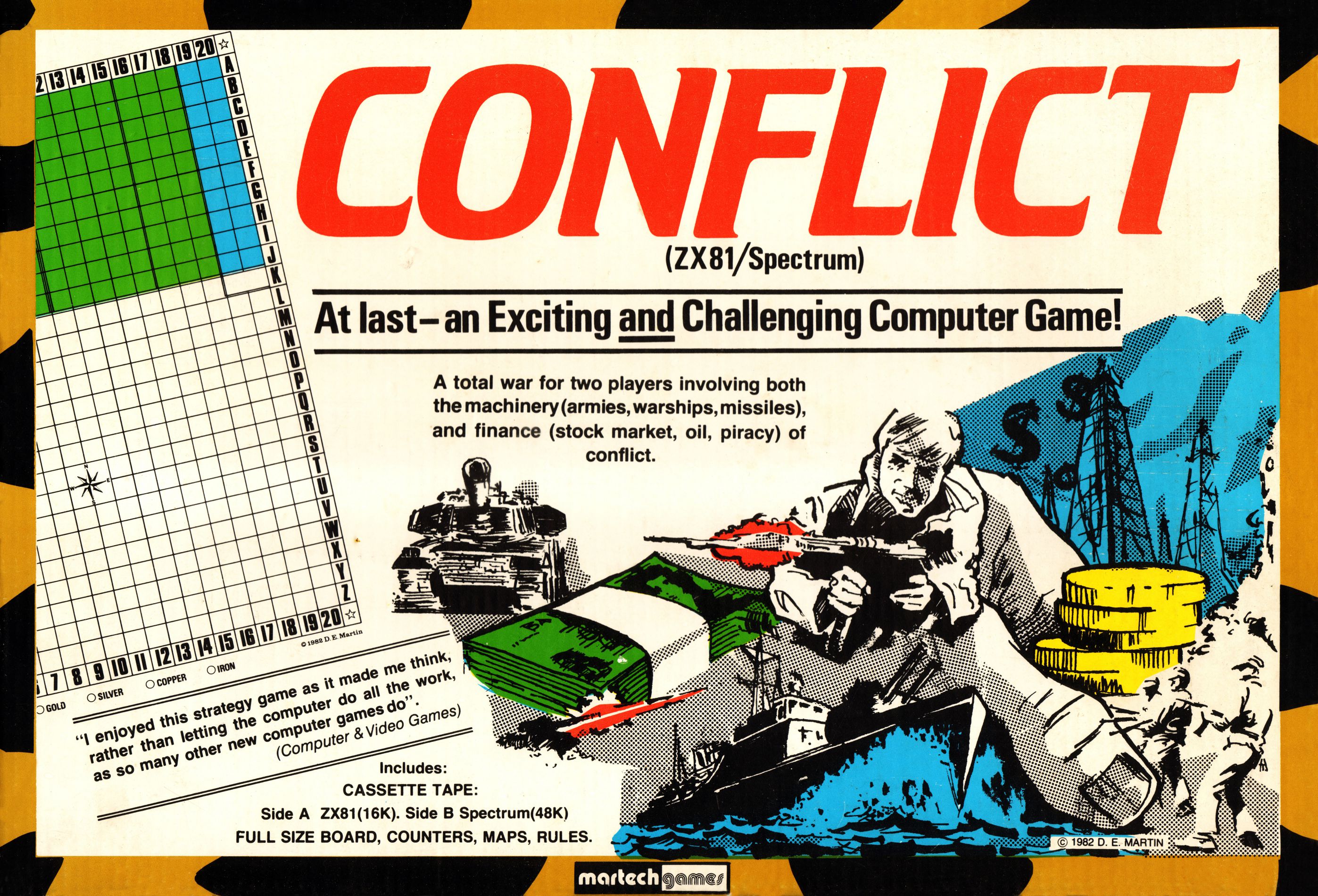
computer moderated board war game
Play
- Conflict.tap.zipTape image English7 KB
Documents
- Conflict.pdfInstructions English475 KB
- Conflict(EN).pdfInstructions English537 KB
Files and rights
No permission is on record either way. Screens and pictures are copied here on a take-down basis: if you hold the rights and want something removed, say so and it goes.
Credits
- D.E. Martincredited
Sign in to credit somebody, or say what these people did.
Scores
Elsewhere on the web
- WorldOfSpectrum 2 votes4.00
In the magazines 38
Crash #10Nov 1984 · p.135
Angus Ryall
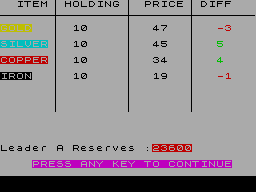
FRONTLINES From our correspondent at the front Angus Ryall. Allo mes petits sossions! I was much disappointed by the lack of libel suits, threats against life and limb, etc, resulting from the last FRONTLINE, so this issue I'm going to be tightening up and telling the real truth about some more strategy turkeys. Actually, I must tell you that CRASH has been told that its review of a certain game, should have been upgraded and we have risked losing the advertising from the company that produces it (money we get from advertising pays a large proportion of running costs, so it keeps the cover price down). I'd just like to point out to these cowboys that this kind of petty blackmail produces, if anything, an even more negative approach from writers. It's about time some of these people realised that a reviewer is paid to write what he or she feels about a game, and not what the game producer feels about it. For the record, as I didn't write the review, I've reviewed this particular game again and found myself in agreement with the previous reviewers. You'll have to guess which one it is, but I expect that even those of you with really short memories will get it. And while I'm having a gripe, I spent a knackering couple of days at the PCW show recently, and were there any decent strategy games there? In a word, no. Good old Lothlorien were there, of course, and there was one other excellent strategy game which I can't tell you anything about (ahh, conflict of interest...) but I was very rapidly reduced to discussing the moribund state of the industry with a nubile you cocktailperson in leopardskin shorts. Actually, I can't stand exhibitions you know, but when duty calls... CONFLICT Producer: Martech Games Author: D.E. Martin I'm not entirety sure if there's a lot of point in reviewing this, since it's over two years old now and almost certainty unobtainable. However, it's worth mentioning because, despite its age, its one of the only reasonable efforts that's been made to produce an integrated board/computer game. In Conflict you have to raise cash by trading in various commodities; with the money, you purchase and maintain armies which you use to further your megalomaniac ambitions. Basically, the trading is done on the screen and the battling on the board; having the board makes battle strategy probably more sophisticated than it otherwise would be, but it's very difficult to judge, as the game's age means that the programming looks as though it was done by an aardvark. There's another game by Martech, of similar vintage, called Galaxy Conflict, which looks to be slightly better; but again, the age of the game really precludes comparison with current software. I think, though, that if I were Mr. Martin, I would spend some time on updating these two games, because they both contain the germs of good ideas - but I don't think anyone will even look at them in their present, dated state.
Micro Adventurer #1Nov 1983 · p.18
Simon Langston
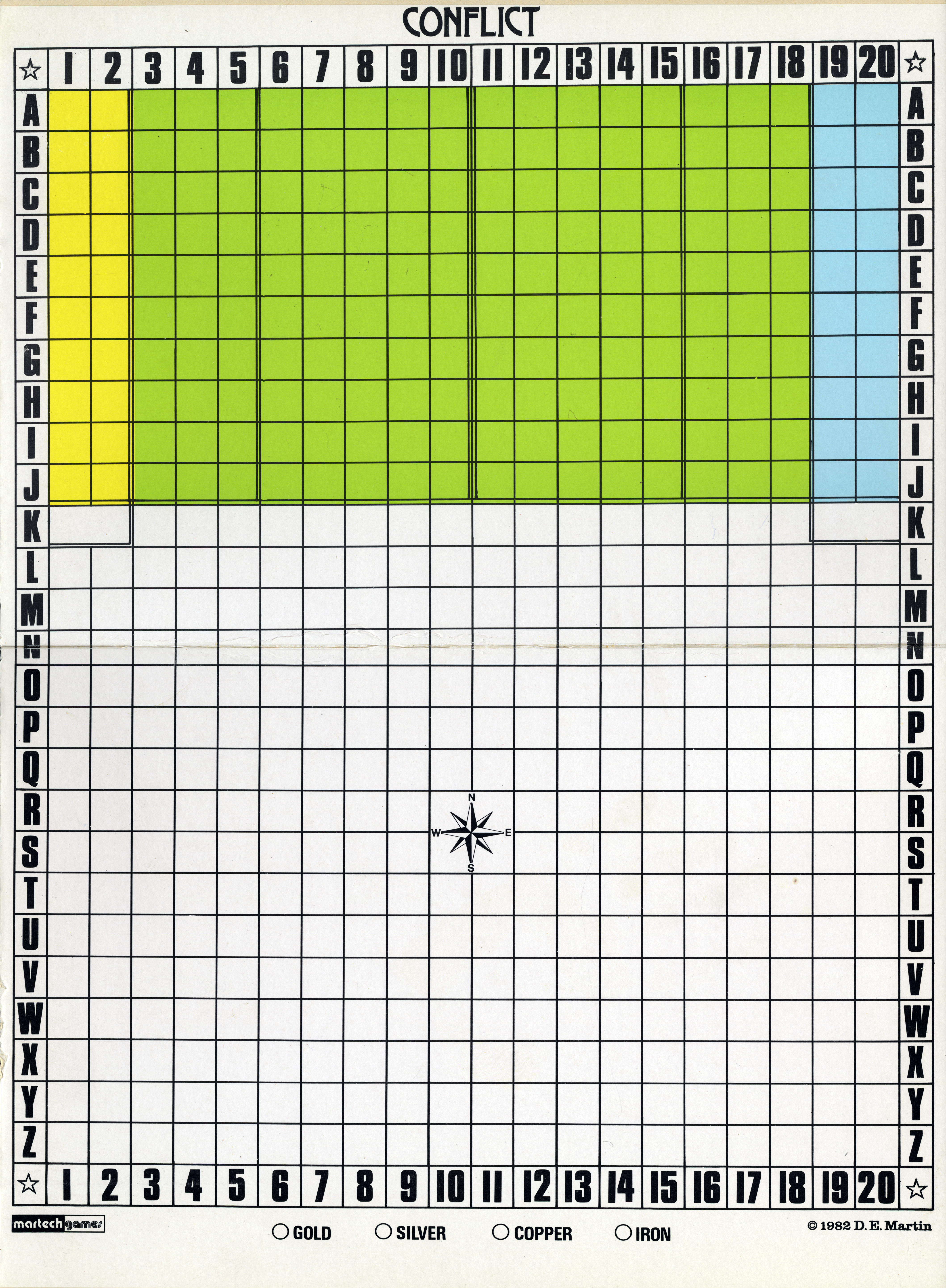
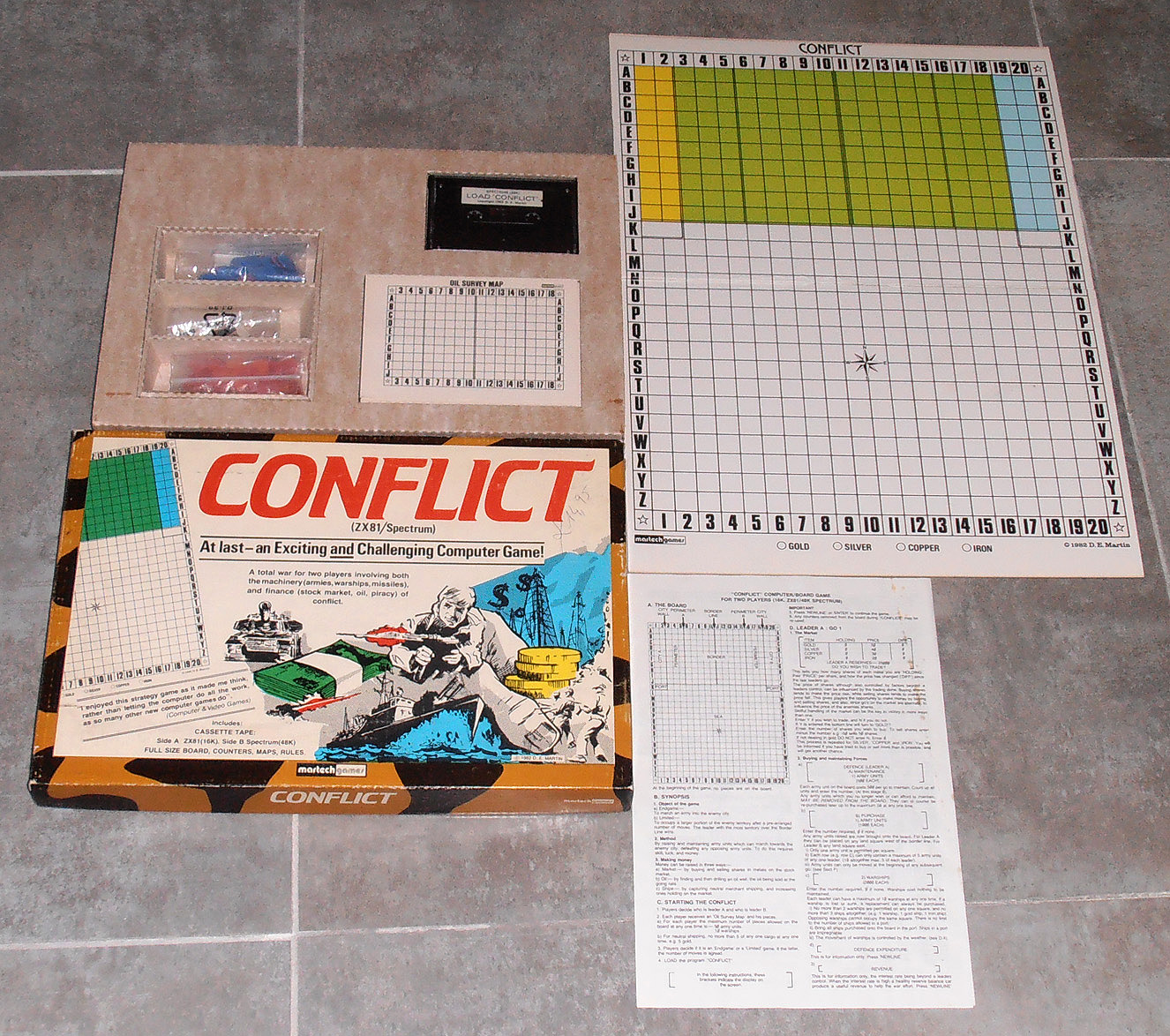
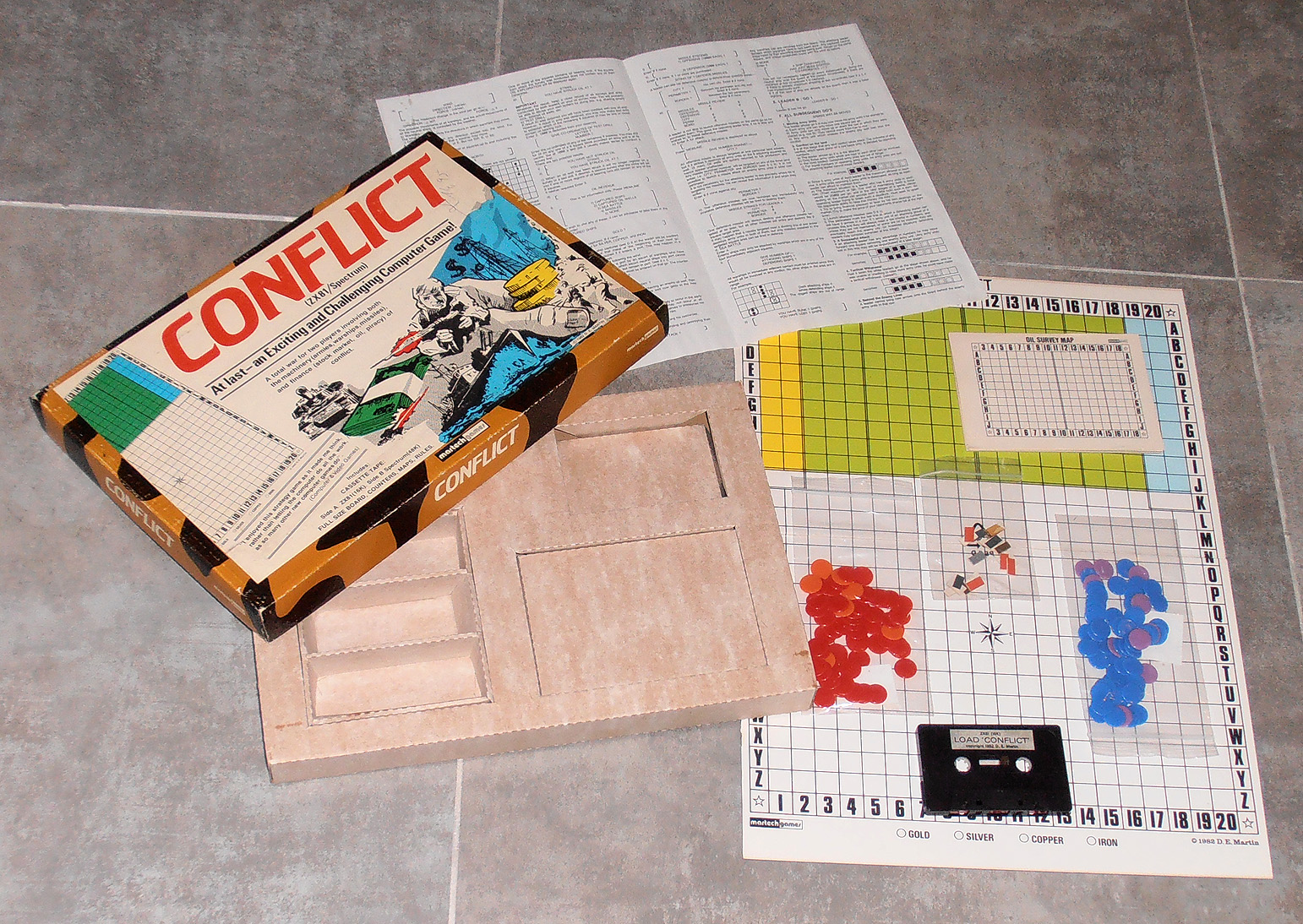
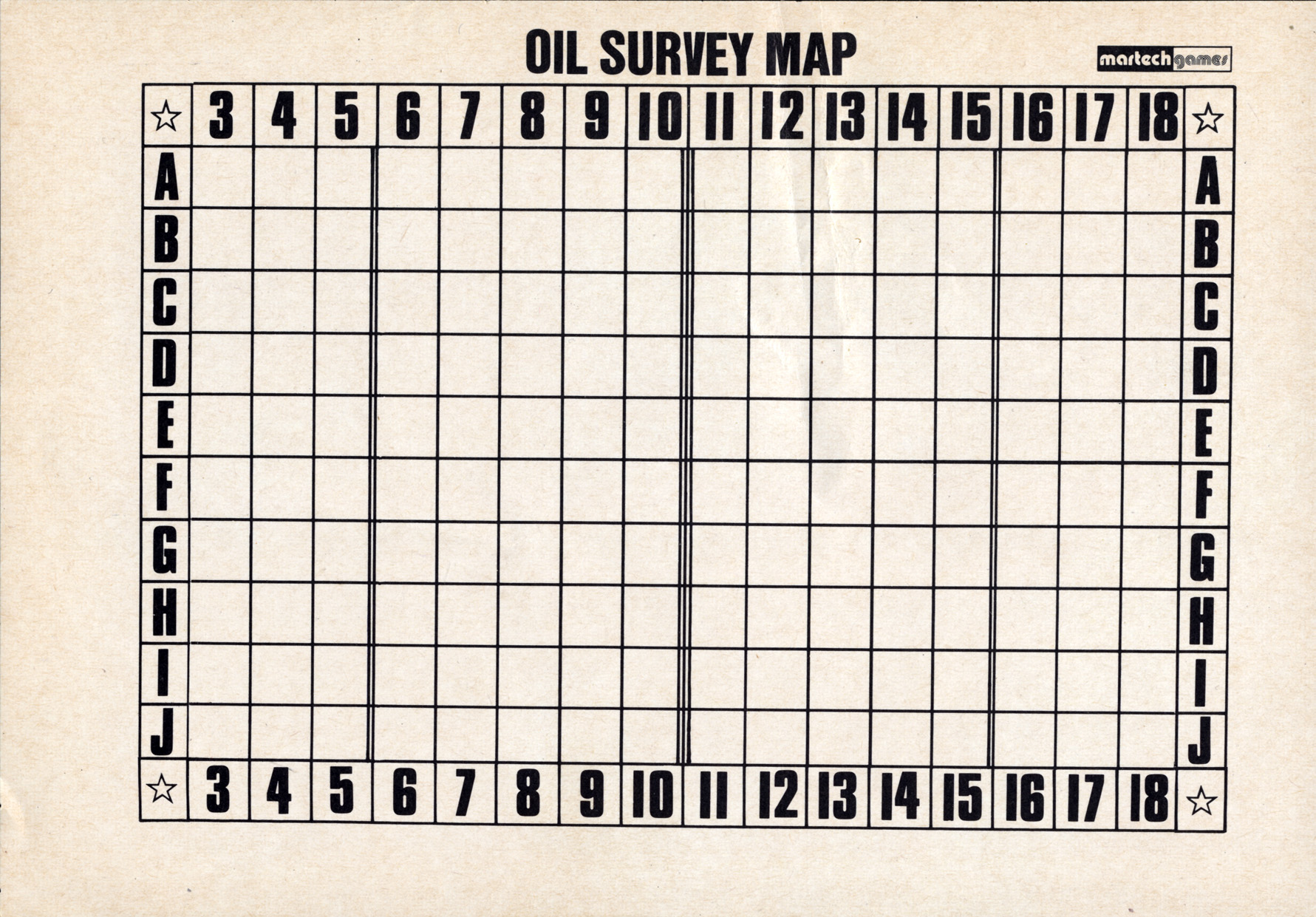
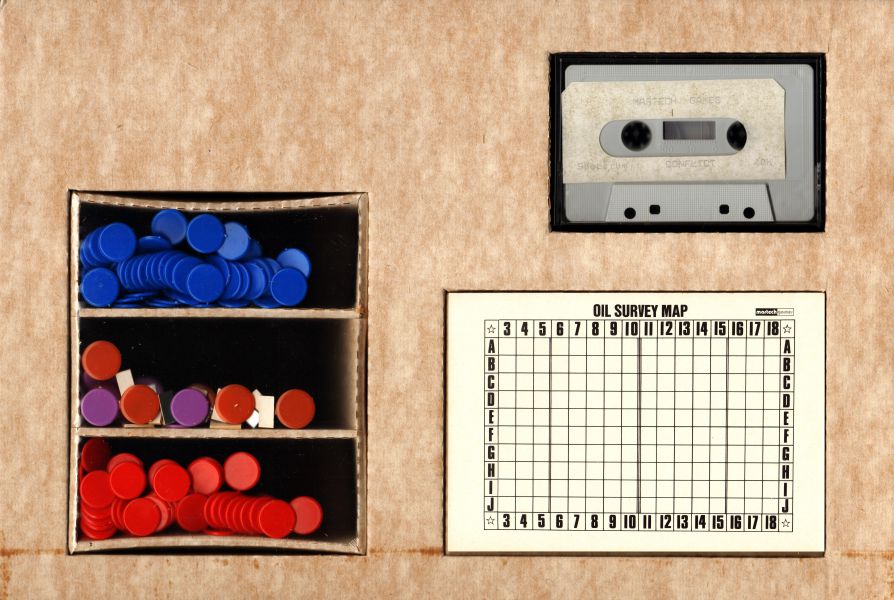
ALL ABOARD FOR WAR GAMES MICRO: ZX81, Spectrum 16K, CBM 64, Atari 800, BBC B, Dragon 32 PRICE: £11.95 on the Sinclair machines, £14.75 on the rest FORMAT: Cassette plus board and counters SUPPLIER: Martech Games, [redacted] Both of these games are different from most adventures as a separate playing board is included with each, and consequently most of the action takes place off the computer screen itself. The games come in fairly large boxes by computer game standards, and look like ordinary board games at the first glance. Indeed, once the box is opened the similarity continues, until you notice that among the board, counters and other paraphernalia there is a cassette tape. On one side of the tape is recorded a program for the ZX81, and on the other a program for the ZX Spectrum. The appropriate program for the players' computer has to be loaded before the game can start. Both games are two-player only, so you will have to grab a sibling, spouse or gullible friend as well. Conflict, the first game, is set in the present or near future, and is a war between two countries. Each player is in control of the resources of one country, and the winner is the first to march an army into his opponent's city. As an alternative, if time is limited, both players can agree on a number of moves after which the game will end. Most of the game is spent trying to earn the money necessary to purchase and maintain army units (mercenaries?). This can be done by dealing on the stock market, surveying and drilling for oil, and pirating neutral ships carrying precious metals. At each turn the players have to decide how much of their available revenue to spend on buying shares, armies, warships, oil prospecting, etc. In this sense the game is about resources management, not unlike the many other such games available on most microcomputers (eg Dictator, King, Hammurabi and Stock Market). However, the game also has the feel of a more traditional board game, since armies, warships and the like are represented by counters which are moved around the board. Galaxy Conflict, the second game, has a much more futuristic setting. This time each player is the leader of a fleet of battle eoncruisers, and the object is to defeat the enemy and become ruler of the galaxy. The game is very similar to Conflict, except that this time the limited resource is energy, and at each turn the players must decide how much of the available energy is to be used to build new eoncruisers, refit damaged eoncruisers, attack enemy planet stations, and the rest. However, the game is not as simple as it sounds, as there are also crew to think about, who will starve unless their supplies are replenished at fairly regular intervals, and of course there is the element of the game which involves moving counters round the board, as in Conflict. Also, there is the problem of defending each planet station's mineral moons, which provide the only source of regular energy input. The programs vary little between the Spectrum and the ZX81 versions, since only very limited use of colour and sound is made on the Spectrum versions. However, although they are not very impressive from a programming point of view, they do the job that they have to do. However, I do have a criticism of the programs - they do not keep track of where everything on the board is. Instead this information has to be entered every time the computer requires it. The boards themselves are very clear and well laid out. Both are divided into grids, with Conflict also being divided into regions which are identified by colour. The boards certainly have a much professional feel to them than the programs. However, the instructions do not receive such high praise. There seemed to be essential details missing from both sets, such as how to move the neutral ships in Conflict, and when the game actually ends in Galaxy Conflict. Still, as long as both players can agree on a convention, this needn't actually spoil the fun. In general, I found both these games enjoyable, and sometimes even quite intellectually taxing to play. However, rather than saying that they are computer games which also use a board, I think that it would be more accurate to say that they are board games in which a computer program replaces the dice and paper money.
Advert32
- Personal Computer Games #4Mar 1984 · p.19
- C&VG (Computer & Video Games) #28Feb 1984 · p.6
- Your Computer #2Feb 1984 · p.141
- Popular Computing Weekly #1Jan 1984 · p.4
- C&VG (Computer & Video Games) #27Jan 1984 · p.49
- Your Computer #1Jan 1984 · p.35
- Your Computer #12Dec 1983 · p.152
- Popular Computing Weekly #50Dec 1983 · p.4
- Sinclair User #18Sep 1983 · p.45
- Popular Computing Weekly #36Sep 1983 · p.44
- Sinclair User #17Aug 1983 · p.34
- Your Computer #8Aug 1983 · p.131
- Your Computer #7Jul 1983 · p.35
- Sinclair User #16Jul 1983 · p.47
- Your Computer #6Jun 1983 · p.158
- Sinclair User #15Jun 1983 · p.106
- Popular Computing Weekly #22Jun 1983 · p.19
- Sinclair Programs #7May 1983 · p.18
- Popular Computing Weekly #18May 1983 · p.32
- Sinclair User #14May 1983 · p.91
- Popular Computing Weekly #14Apr 1983 · p.10
- C&VG (Computer & Video Games) #18Apr 1983 · p.114
- Sinclair User #13Apr 1983 · p.34
- Popular Computing Weekly #9Mar 1983 · p.16
- Popular Computing Weekly #10Mar 1983 · p.14
Two-page ad2
- Sinclair Projects #5Aug 1983 · p.48
- Sinclair Programs #10Aug 1983 · p.44
Classified2
- Sinclair User1983 · p.114
- Sinclair User #8Nov 1982 · p.61
Related
- Ports
- (Atari 8-bit), (Commodore 64)
- Elsewhere
- MobyGamesThe TipshopUVL
- Same entry at
- Spectrum ComputingZXInfo
Reviews from people here
Sign in to write about this, or make an account. It takes a minute and lets you correct the catalogue too.
Everything ZXDB can hold about this is here.
Sign in to correct or add to this.
Hold the rights to this and want it taken down?