
Confrontation
Strategy Game: War · ZX-Spectrum 48K · 2 players · English
MC Lothlorien Ltd · 1983 · Pound sterling 7.95
Discussion
Nobody has started a thread about this yet.
Remarks
For 2 players only.
- Native Programming Language
- Sinclair BASIC
Play
- Confrontation.tzx.zipTape image English13 KB
- Confrontation.tap.zipTape image English13 KB
Documents
- Confrontation.pdfInstructions English102 KB
- Confrontation(EN).pdfInstructions English213 KB
Files and rights
No permission is on record either way. Screens and pictures are copied here on a take-down basis: if you hold the rights and want something removed, say so and it goes.
Credits
- Robert T. Smithcredited
Sign in to credit somebody, or say what these people did.
Awards
Scores
In the magazines
- Crash #31984 · Overall45%
- Crash #41984 · Overall45%
- Sinclair User #341985 · Gilbert Factor7/10
- ZX Computing #281986 · OverallGroan
- Sinclair User1986 · Overall4/5
Elsewhere on the web
- WorldOfSpectrum 5 votes5.20
In the magazines 35
ZX Computing #28Aug 1986 · p.42ZX Computing Glob SeniorGroan
ZX ComputingZX Computing Glob Senior
Overall Groan
Lothlorien £9.95 Spectrum 128 By pure coincidence, two wargames specifically for the Spectrum 128 arrived on my desk on the same day. As both are by the same company and one is very good and the other very bad, it is useful to look at them side by side. The company is Lothlorien and the two games are Confrontation and Austerlitz. Confrontation is a game for two players and attempts to cover scenarios from all over the twentieth century. Seven different scenarios are included in the package and there is also the facility to create your own mini games by first of all drawing up a map from various terrain types and then populating it with tanks, paratroops, flak guns and infantry etc. The seven scenarios included are Poland, Greece, Desert War, Crete, Afghanistan, Sinai and Angola. The main problem with the game is that it was originally written back in 1983, in Basic, and is now showing its age in that it is extremely user unfriendly compared to similar products released today. Drawing your map is done by moving a cursor round the screen and positioning towns and hills etc. Unfortunately, the cursor keys (remember that they are separate keys on the 128) don't work as the instructions claim. Only keys 5-8 (the cursor keys on the original Spectrum) worked. Another problem was that when I loaded a scenario the instructions left me unsure as to what I was supposed to be doing and my first attempt caused an "Integer out of range" error message whilst my next key press reset the machine. The only differences between the 48K and 128K versions appears to be that the scenarios sit in RAM in the larger model instead of having to be loaded in separately. If you already have the 48K version, don't bother with the update and if you don't have the earlier version, don't bother anyway.
Sinclair User1986 · p.554/54/10
Overall 4/5
Chris Bourne 4/10
CHRIS BOURNE TAKES A NOSTALGIC TRIP THROUGH THE BATTLE-STREWN FIELDS OF LAST YEAR'S STRATEGY GAMES Before programmers discovered sprites, 3D graphics and continuous fire buttons, strategy games were regarded as a sort of ideal computer entertainment. That was partly based on the idea that computers were essentially souped-up calculators and partly because mainframe computers were very good at games like chess. If you were into computers when the Spectrum was launched, you'll remember titles like Football Manager, and Flight Simulation being held up as examples of the finest programs around. These days it's more likely to be Alien 8, Shadowfire or Dun Darach, and their reputation depends in great part on graphics programming. One of the reasons for that is financial. In their wisdom, retailers and distributors tend to see strategy games as having a narrow appeal. They are the classic sleepers which sell steadily but slowly. The trade wants the money now and lots of it. That means quick-selling arcade games, preferably with some spin-off celebrity theme attached, which hits number one in the charts in a couple of weeks and stiffs out a month later. Many of the fine strategy/simulation games, produced in 1985, saw little exposure in the shops - certainly not in the big high street chains. That does not mean they were no good. In fact, there has been something of an upsurge in the quality of strategy games recently, and most spectacularly in the field of wargames. Wargames have as long a tradition as any sort of computer entertainment. If you've ever read the hefty instruction books for classic wargames of the past - Avalon Hill's Afrika Korps you'll understand why. Those rules tended to read like a computer program with complicated look-up tables for cross-referencing dice throws, gridded maps and strict sequences of actions within a given turn of play. They also took hours to play. The computer is supposed to take all the argument of table-top gaming out of wargames. It quickly does all the adding up, it doesn't cheat, and it can handle secret moves easily. Unfortunately, most wargames never turn out like that. Graphics tend to be based on unrealistic grids, the rules appear over-simple, and the computer generally takes a vast amount of time to think about the moves. One such game, which in other respects might have deserved success, was ATRAM. The name stands for Advanced Tactical Reconnaissance and Attack Mission, which turns out to be a NATO exercise in which the RAF and USAF battle it out using Harrier jump jets. The idea neatly sidesteps the obvious problems involved in trying to flog a game based on bombing the daylights out of Port Stanley. The game is a computer-moderated boardgame with a glossy magnetic board and stylized pieces that you slide about as if you were a real NATO general. Unfortunately, the computer part is less fun. The only excuse for the program is to handle the boring bits like keeping track of how much fuel each jet has consumed. The author is clearly fixated on jargon, which makes the rules almost unreadable, and all moves are keyed-in in a jumble of letters and numbers. It is so easy to make a mistake that you'll never be entirely sure whether you're playing the game properly. Headbangers and retired Harrier pilots only. A much better two-player wargame is Confrontation from Lothlorien. Confrontation is a wargame system which allows you to design your own maps and, within reason, choose the composition of your armies. That allows you to play at a tactical or strategic level. The flavour is essentially modern, with armour and mechanised infantry supported by footsloggers, artillery and air units. To go with the system, Lothlorien has also released a set of four scenarios ranging from a fictional WWII invasion of Kent to guerilla warfare in Afghanistan and Angola. We found the Egypt-Israel scenario most interesting in that the open terrain left units extremely vulnerable without air support. The organisation of such support requires capturing and defending a chain of airstrips in order to reach Tel Aviv or Suez depending on which way you're going. Nevertheless, Confrontation is still slow. The same cannot be said of Overlords, another two-player game from Lothlorien. Loosely based on an old boardgame favourite, Campaign, it is played across a large area of fairly basic terrain. The concept is abstract, involving footsoldiers, generals, and the Overlord. The objective is to capture strongpoints - ownership of which generates one piece per turn. The fighting is equally abstract, based on the number and strength of the pieces in contact with the enemy. Both players play simultaneously, and the game is so fast that you'll almost certainly need joysticks - preferably one each. The pieces whizz about the screen and that leads to a magnificent confusion as both players simultaneously attempt to outflank their opponent. By and large, it is the epic battles of WWII which command the keenest attention from programmers. Battle for Midway is a strange hybrid from PSS, and incorporates arcade sequences. The Battle of Midway was a crucial turning point in the war against Japan, when the US sent a force to smash the invasion fleet. The PSS game falls into two parts. First, locate the course of the three arms of the Japanese forces. Having done that you must send out strike forces from your aircraft carriers to bomb them. When battle is joined you get the chance to zap the Japs using a joystick, which rather spoils the point of a supposedly realistic wargame. The author claims it simulates the fog of war, or some such nonsense. We found the game easy to beat - it's good to see the computer taking an active part in a solo game for once, but the graphics are primitive and not very clear. A year ago we might have had more praise, but there are better games around. Much better, in fact, and the star of the bunch is undoubtedly Arnhem from CCS. CCS, like Lothlorien, specialises in strategy games. For years CCS games were worthy rather than exciting, and almost always written in super-slow Basic. With Arnhem the company has finally struck gold. The game follows the thrust of the Allied armies across the Rhine against fierce German opposition. The main idea was simple enough. The British were supposed to hurtle down country roads to Arnhem while American paratroopers were dropped on the bridges ahead to hold them for the main advance. Of course it wasn't as simple as that, and neither is the game. There are a number of levels at which you can play, until you get to the full battle. A time limit is set, and if you don't capture the bridges quickly enough you lose. The German task is therefore to hold up the advance. The graphics are pleasant, and information about each unit's strength can be obtained by positioning the cursor. One of the best features is the movement system. You can choose to move in open or close order - open order means you are far less vulnerable to attack but cannot take proper advantage of the roads. The game can be played by up to three players - with three, one player gets the Germans and the other two play British and American forces. The feel of the game is tremendously realistic, with the onus placed on keeping the British moving down the roads. Arnhem is absolutely recommended and will hopefully encourage other software houses to pull their socks up and match the standard. Less attractive, but equally fast, is Lothlorien's The Bulge - the German counter-attack on Antwerp and Hitler's last great offensive in Western Europe. It was always doomed to failure, what with narrow country lanes and terrain choked in snow. The computer plays so quickly and viciously that you'll be hard put to survive. Although The Bulge scores over Arnhem for speed, the graphics are less clear and the strategy less easy to fathom. Lothlorien has opted for simultaneous movement, and one is frequently reduced to hurling forces willy-nilly into the fray without much regard for tactics. A pleasing feature of both Arnhem and The Bulge is that you can issue general orders to units which they will continue to obey until you change them. That is a sensible and much more realistic alternative and saves having to move fifty pieces every turn, slowing the whole flow of play. Moving away from wargames, another category of great antiquity in computer circles is what is known as the land-management game. An early example of the genre was Hamurabi which puts you in charge of an ancient kingdom. You are head of a population, and there is corn in the treasury. The idea is to manage the economy - based entirely on corn - so that everybody gets enough to eat. There is enough corn to sow for next year with some in reserve in case of natural disaster. Of course, the way the game is set up at the beginning, there is never enough, so you get to make decisions about how many people to starve to death for the greater good of the rest, and so on. Such games are very easy to construct on computers, and if you want to write your own strategy game we suggest you try something along those lines. The secret is to construct a set of formulae governing the relationship between various factors - for example, how much food do people need? How many people are needed to sow an acre of land? How much corn? There are very few business-type activities that cannot be simulated in that sort of way. Two famous games of this type are Football Manager from Addictive Games and Mugsy from Melbourne House, in which you play a gangster trying to run rackets with the aid of a none too loyal gang. Sadly, Kevin Toms - Mr Football Manager himself - has not managed to follow that enormous success. Addictive has brought out a number of games along similar lines in 1985, but none of them match the old classic. Software Superstar casts you as a producer of games. You have to allocate time and money each month to releasing games, programming, advertising and the like. Nice touches include the decision to hype games or be honest about them, but the overall impression is dull, and we found it easy to get a hit program and reach the targets set. Grand Prix Manager from the same outfit was equally tedious, with poor graphics to boot. Luckily CRL brought out the infinitely more entertaining Formula One - a Sinclair User classic - which we found totally compulsive. Formula One is a full simulation of a grand prix season. Start off by hiring drivers and building cars - you have a million quid or so but it goes very fast. When the race starts choose your tyres and then watch the cars whizz past in convincing graphics. Messages inform you of the state of the track and incidents involving other cars, while a leader board keeps you in touch with the race positions. Best of all, you can call pit stops for tyre changes, and the correct choice of timing may win or lose a race. The pit stop sequence is arcade based, and you have to manoeuvre a mechanic around the four wheels to complete it. Purists may have their doubts, but the speed of movement is linked to the amount of money you invested in the crew, and does not therefore make a mockery of the strategic element. Formula One is a good game against the computer, but becomes really exciting when played with friends. Almost as enthralling, although less well presented and rather more anarchic in play is The Biz, a simulation of the record industry from Virgin Games. You begin by choosing your social class - from stinking rich to unemployed - and then form a band. Hire a manager, go on the pub or college circuit and send endless demo tapes to bored record companies. If you have the money, you can cut your own discs, but beware - without the clout of the big boys behind you it may all go to nothing. The ultimate goal is, of course, to get a number one, but the road is full of pitfalls. The game is full of subtle humour - you may reckon a dry ice machine is just right for your tacky rock band, but watch your credibility plummet. You may even get a chance to sample drugs during the game. Try it and see where it gets you. On then to simulation proper, by which is meant those worthy and sometimes addictive attempts to portray accurately a real-life experience. The original impetus comes from the flight simulators used by airlines to train pilots, and for some time software houses only seemed to be interested in mimicking those. They all look more or less the same, with an array of instruments on the lower half of the screen and a view of the horizon with occasional crude landmarks. Some are better than others for speed and ease of use, and the best are still Psion's antique classic, Flight Simulation and Digital integration's Fighter Pilot, which is rather more difficult but does allow for aerial dogfights. DACC specialises in those features, and recently brought out 747 Flight Simulator. We've taken a bit of stick at Sinclair User for giving it the thumbs down, but I still maintain it's an unexciting production, mainly because the Jumbo jet isn't a patch on a light aircraft for aerobatics. Real enthusiasts will probably enjoy it, it is certainly a worthy and apparently highly accurate program. If you're looking for entertainment, though, try elsewhere. You might try looking at Southern Belle from Hewson. The program simulates the old Pullman service from London to Brighton, and you have to handle the great steam engine all the way. Initial levels involve handling only one or two controls while the computer does the rest, but you work up to a full schedule with stops, signals, hazards on the track, brakes and handling gradients, to name a few. It is a surprisingly fulfilling program, and the wire-frame graphics of recognisable landmarks along the track are well executed. You are marked at the end according to your accuracy on the schedule and how economically you conserved fuel. Another unusual simulation is Juggernaut from CRL, in which you have to drive a container truck around town picking up cargoes. The screen shows an overhead view of the lorry and road, with traffic lights, status, steering and gears. The movement is slow and there are no other vehicles around - presumably you're driving in the middle of the night, council bye-laws notwithstanding. The irrepressible John Gilbert reckons the lorry looks like a Gillette GII razor. He's quite right, and although Juggernaut isn't a bad idea, the end result is rather dull. Finally, a look at a few odds and ends which don't really fit any categories. One such Minder, a much-hyped trading game based on the famous television series. You play Arthur Daley, the dodgy entrepreneur, and the idea is to buy and sell an incredible range of weird goods such as gold acupuncture needles while steering clear of the law in the form of mean inspector Chisholm. You do that by seeking out dealers and wide boys, either at their warehouses or in the Winchester Club. Terry, as ever, gets to do the fetching and carrying, and can also be hired to mind you - an important function when dealers discover goods are stolen. In essence the game is simply trading, with a large text interpreter enabling you to bargain with characters in authentic Daley cockney - it understands words like bent, or pony. Once you get into it there's rather more strategy involved. You have to organise Terry's time so goods get collected and delivered on schedule, while you need sufficient cash to pay for the next lot. Minder is a pleasant romp and deserved to do better in the charts than it did, but would have benefited from a greater variety of incidents. Memory taken up with slang during the bargaining is fun at first but since it is really only window dressing it leaves you with the feeling that the game lacks depth. Alien on the other hand, from Argus, has plenty of depth but is difficult to get into. It follows the tense cult movie in which a devastating alien invades a spaceship and proceeds to exterminate the crew. The game uses menus to pick characters, objects and locations in the spaceship Nostromo, while plans of the decks indicate your position. The idea is to destroy the alien either in a straight fight - fat chance - or by escaping from the ship and blowing it up by remote control. You only see the alien when you are in control of a character in the same room. The rest of the time you can hear it as doors and ventilation grilles slide open, or your scanner picks up the presence of a living creature nearby. That makes for tremendous tension in the play, and the one drawback is the simplicity of the graphics which works against the otherwise strong illusion of involvement. Fans of the film will enjoy it. Others may find it tough going. We have made no mention of some of the plethora of spin-off titles in the sports arena which might come under the umbrella of simulations. Those are generally disappointing, especially in comparison with the arcade based sports games. Two, which play quite well, are Steve Davis' Snooker and American Football from Argus - which has the added virtue of not involving a famous personality. Nick Faldo's Open is a lovingly programmed simulation of the course at Sandwhich which suffers from one horrible flaw. The closer your ball is to the flag on the green, the more difficult it is to judge the angle at which you should strike it. In fact, the reverse should happen. It is heartening to see arcade games taking on more elements of strategy in their play. Arcade-adventures such as Knight Lore or Gyron - if you can categorise those masterpieces at all - have as much to do with logical thought and planning as they do with swift reactions. That argues a growing maturity, both among games publishers and also in public taste, as computer owners look for more than a quick joystick fix from their hobby.
747 Flight Simulator.
Alien.
Formula One.
Juggernaut.
Minder.
Southern Belle.
Sinclair User #34Jan 1985 · p.427/107/10
Gilbert Factor 7/10
Chris Bourne 7/10
CONQUER KENT, CRUSH KABUL CONFRONTATION MASTER PROGRAM Memory: 48K Price: £7.95 CONFRONTATION SCENARIOS VOLUME 1 Memory: 48K Price: £5.95 Although there have been many attempts to produce wargames on the Spectrum of comparable quality to the boardgames of the mid-seventies, few have managed to match their ancestors. Lothlorien has attempted to rectify that with Confrontation, a system which allows players to define their own maps and forces for play. The system suffers from being a two-player game, relegating the computer to the role of the umpire. Battles are modern in style, with armoured and foot infantry, aircraft and artillery. The mechanics are of the move-fire type, with mobile units moving first and each player moving in turn. The graphics are attractive and easy to follow. There are no confusing figures to interpret. The Confrontation package includes a simple scenario to start you off. Lothlorien has also released a cassette of scenarios based on 'real' events, which cannot be used without the original program. The scenarios are bold in conception; Egypt vs Israel across the Sinai desert is an exercise in chess-like precision of communication lines. An Angolan scenario in which Unita defends coastal strongpoints against Cuban-trained forces introduces the possibility of South African reinforcements. Operation Sea Lion enters the world of alternative history with the German invasion of Kent, while the fourth scenario has a Soviet column attempting to force a passage through the mountain passes of Afghanistan. All of the scenarios, as well as the main program, are well-constructed and represent challenging problems for keen wargamers. They will welcome the series with en- thusiasm. But those who cannot claim to be avid armchair generals are less likely to find a sometimes frustrating business enthralling enough to justify the investment.
Crash #9Oct 1984 · p.77
Angus Ryall
FRONTLINES From our correspondent at the front Angus Ryall. We have been conscious for some time that CRASH has had two weaknesses and these have been in the areas of adventure games and war/strategy games. The former problem was solved when Derek Brewster kindly agreed to write an adventure column and review the games. We are now able to overcome the second weakness - and this issue sees the start of our wargamers column put together for us by ANGUS RYALL. Angus is the Software Marketing Manager for Games Workshop Ltd. As such he brings with him his experience not only of software but also the over view of strategy games in general. OVERVIEW OF STRATEGY GAMES Everyone knows that wargamers thrive on 'complexity', and this is what has kept the hobby so elitist for so long. Traditional wargames/strategy games have been virtually impossible for mere mortals such as you or I to crack, and the small number of people playing them has also kept their prices ridiculously high. The arrival of home computers should have changed all that, by getting rid of the number-crunching and all those fiddly little card counters that always end up down the back of the settee. There should by now be as many decent strategy games available as adventures - but there aren't. Having just gone through a pile of strategy games I think I'm beginning to understand why. The people writing them for the Spectrum are giving the sector a bad name - it's the same old idea, of making the players bust a gut to play the game, that has kept traditional wargaming such a minority pastime. Most of these games have abominable graphics, laughable points systems, and unintelligible instructions. They tend to be long winded and very slow, and one or two are just plain idiotic. Only a couple here were actually enjoyable to play. DODOS These were the real pits - don't even waste your tape on copying them. BISMARK (ASP) You are in the South Atlantic in WWII. You have 12 battleship groups of varying strengths. You have to find and destroy the Bismark in a grid about 1 units square. It took me three minutes. Lucky maybe, but I'm not going back for another go - I've got too much sleeping to do. This comes, incidentally, from Argus Press, who publish all sorts of really naff computer magazines; but even they should know better than this. INVASION (ASP) Another one from Argus. This one raised my hackles before it even started - You are the commander of the Western Alliance' it says, the Reds are attacking'. Then it says Reds are stupid' - I think this kind of thing is insulting the intelligence of the audience, like those badges which say Nuke 'em till they glow' - it's not really funny, just childish. Anyway, the game is played on the same sort of grid as BISMARK, and the evil Reds come creeping down towards you. Each turn you are given so many resource points, depending on how many cities you control, which you then use to buy units and attack points. The Reds are given overwhelming force by the program, which tends to make the game more an exercise in headbanging than a game of strategy and skill. Argus run away with this month's mouldy cheeseburger; and I run like hell in the opposite direction. DIEHARDS Slightly better but still terrible. CONFRONTATION (MC LOTHLORIEN) A couple of months ago we ran a feature on Lothlorien, who produce this turkey; in the piece they complained bitterly about the fact that they always had bad reviews. Frankly, looking at this, I'm not surprised. Confrontation is supposedly their classic wargame, and is the master program for a whole series of wargame scenarios. The game is above the Argus level at any rate: but it suffers from a problem which typifies virtually all strategy games - the presentation of the map and units is diabolical. In the Lothlorien interview, one of the directors, Roger Lees, said "you have to make sure that the graphics don't get in the way of playing the game". Or lack of them, Roger? The only way to gain any kind of overall view of what's happening is to make a note of where everything is each turn, because an enemy unit only appears as itself once you've moved right up next to it - which can be a little bit late, Otherwise it's all guesswork, which doesn't sound much like strategy to me. Despite a fair variety of unit types, a reasonable terrain system, and a generous scenario-builder program, the game still fails because of this 'guesswork or paperwork' problem. REICHSWALD (MW GAMESWORLD) The map supplied with CONFRONTATION, Twin River, is in fact amazingly similar to that in REICHSWALD - only the Reichswald one is even more primitive. The only feature on this map which bears any resemblance to what it's supposed to be is the river. Merry & Wallis Gamesworld is only a small firm, so I can almost forgive them for that; but Big John Merry is a wargamer who goes back years and years (and outwards yards and yards, my spies tell me) and it certainly shows. They've managed to turn what could have been a nice, compact little exercise into a sprawling numeric animal that keeps tripping over its fifteen legs. Each unit has three strength values, for tank, anti-tank and infantry, which are determined by the computer and awarded randomly at the beginning of the game. There don't seem to be any set movement values (I may be wrong about this but this was one aspect of the game which proved impenetrable). There are terrain differences and victory points, but again, you can't see the enemy (computer controlled this time, by the way) and the combat just sort of happens when you move too close to the invisible huns. Definitely another pencil and paper job, and very ssssslllllooooowwwww so only really recommended for those about to embark on a term of life imprisonment. Generally about as action-packed as a bowl of semolina. DIAMONDS Well, having trashed everyone so far, I feel honour-bound to give a bit of praise to someone, and the only people I can think of that really deserve it are Red Shift whose two games Apocalypse and Rebelstar Raiders are still far and away the best strategy games for the Spectrum, even though Apocalypse is now over a year old. Unfortunately, a series of problems at Red Shift earlier this year led to the departure of most of the programmers to form the SLUG co-op; this means that there is an improved version of Apocalypse which will probably never see the light of day. But even the old Apocalypse is great if you can get hold of it. Before I say anything about it, I'd better make it clear that it is an anti-war game (in view of what I said earlier!) but its subtle in its methods - it really works by forcing the players to think about the consequences of aggression. The game comes with four maps, and the distribution of cities can be done either manually or automatically. In addition to the main map to the chosen area, say Europe, there is a close-up of the cursor position giving unit strengths in each square. As the game plays through, the players (up to four) make decisions as to whether they are going to use aggression, whether to use conventional forces to expand their empires, or whether to use the ultimate sanction of nuclear weapons. There's a lot more to this game than simply blasting away at your opponents, yet you don't have to sit up all night with a calculator in order to know what's going on. REBELSTAR RAIDERS (RED SHIFT) Even better than Apocalypse is REBELSTAR RAIDERS, where one player commands a team of space pirates in an attempt to destroy the control centres of three different installations (each loaded separately). The other player, naturally, has to defend the installations. The graphics are quite superb, and the installations, which appear as plans or cross sections are designed for maximum game flexibility. Cursor movement is fast and smooth, although the keyboard layout takes a bit of getting used to. The wide variety of weapons available and the manual deployment of the characters create a great mix of strategic thinking and general blasting power. The only things I really dislike about RAIDERS are the irritating sound effects (which seem to be something of a Red Shift trademark) and the packaging - which is so amateurish it could have come from Merry and Wallis. REBELSTAR RAIDERS and APOCALYPSE prove that it is possible to write good strategy games for the Spectrum: but they also highlight the great gulf that there is between strategy games, and arcade and adventure games. Whey you consider that state-of-the-art in arcade and adventure changes almost month by month (look at the GREAT SPACE RACE) it is incredible that one of the two best strategy games is over a year old. This is one of the few areas where American software, for Ataris and Commodores, wipes the floor with us. Perhaps it's about time that some of the software houses renowned for their arcade and adventure work took a long hard look at the strategy games desert - the demand is there, when the right game arrives.
C&VG (Computer & Video Games) #36Oct 1984 · p.55
Mike Singleton
MIKE SINGLETON'S 5TH COLUMN A players guide to strategy and war games ALL TIME IS GAME TIME Have you ever fancied yourself as the new, improved Genghis Khan, Julius Caesar minus the noble hindrance of Brutus or, perhaps, not being an ambitious type, Emperor of the Galaxy? No? Well, there's a first time for everything I'm told - this may be yours! I suspect you are thinking, gentle reader, that you have somehow blundered into the section of the magazine devoted to apprentice dictators and that this column might be more aptly titled Megalomaniacs Corner. Sorry to disappoint you. The Fifth Column is here to bring you inside information on games of strategy and it is just a fact of life that the struggles of men for power offer the richest themes for computer simulation - struggles that mean war on the battlefield, in the boardroom or at the ballot box. So, I will make no apologies that the Fifth Column will be discussing war-games, anymore than an historian would apologise for having to mention the Battle of Hastings. Suffice it to say that, in any case, venting a lust for power or destruction at the keyboard (if that really is what makes people play war-games) is a darned sight healthier than venting it in real life. As far as the Fifth Column is concerned, all time is game time and any connection with reality is purely coincidental. REMOTE CONTROL Games that need more than one player are always beset by one crucial problem - finding enough sane, rational human beings who are crazy or gullible enough to fritter away their valuable time actually playing them with you. A lot of games solve the problem by assigning the computer the role of opponent but, let's face it, there is something psychologically more challenging in playing against other people. Imperial Software's unique solution is Empires, a game of galactic warfare involving both military and economic decisions. The game is beautifully packaged and comes complete with four cassette tapes, four rule-books, four galactic maps and a pack of blank record cards. My only major criticism of Empires is the patience and dedication it needs to see a game through to its conclusion. On the other hand, if you do get to play Empires, you will find the sheer time-scale creates all the tensions and nail-biting of a titanic struggle. If you want a game that will keep you engrossed for months, this could be it. SALT-CELLAR SOFTWARE The ladies have retired to the drawing-room, the subtle aroma of brandy and cigar smoke wafts through the air and Carruthers is energetically manouevring the salt-cellar, which he strangely refers to as the 21st Panzer Division, across the desert of the tablecloth. Now is the perfect time introduce our imaginative guest to Lothlorien's Confrontation. It's a clever concept. It's not just a war-game but a whole system for recreating any modern warfare scenario you choose. The Master Tape allows you to design your own map, select your own units and set your own objectives. Your selection is made from a comprehensive range of terrain features and unit types, including air squadrons and paras as well as conventional ground units, so that virtually any land battle of the 20th century can be simulated. Three of the tapes of player tapes. The fourth is the umpires tape, and this is the key to the game. Imperial Software has created a play-by-mail system which uses cassette tapes as the medium for passing information and orders back and forth. Your personal player tape enables you to load and scrutinize the latest turn's data which the umpire has sent you on a cassette. At your leisure, you check the status of your battle fleets, the profitability of your mining companies and ponder the significance of newly explored solar systems. It may take you hours to decide on your next moves - it may take you days! Eventually, you give a fresh set instructions to your computer which then records the data back onto the cassette the umpire sent you. Now you must return the tape to the umpire for processing. Having received a fresh batch of tapes from all the players, it's the umpire's turn for some fun. Using his special umpire's tape, he first collates and processes the data that's been sent to him. Ships make landfall on new planets, battles rage in the starry blackness, great fortunes accrue in the interstellar treasuries but each event is handled impartially and automatically by the umpire's Spectrum which finally records the new turn's data to be dispatched to the players. So where's the fun? Well, the umpire has access to a lot of information that the players don't. Whereas an individual player knows only the location of his own ships and mining operations plus the odd enemy force he has chanced upon, the umpire knows all. Imperial suggests that the umpire uses this knowledge creatively to leak facts selectively to individual players. The umpire's task, if he so chooses, is to add the spice of his imagination to the game. The game itself is well presented on screen, all information about your race's galactic dispositions being routed through a convincing representation of a computer console and attention detail is good. Imperial has even designed a different character set for each interstellar race. A pity, then, that this outstanding concept is not quite so outstanding in actual play. It is interesting and can be engaging but somehow it doesn't stimulate quite as well as it simulates. The battle system which gave no clues as to damage inflicted, save a burp from the loudspeaker or the actual disappearance of a unit from the screen, was needlessly uninformative. In particular, the on-screen map, which was very attractive to look at casually, was not quite as nice to look at when you were trying to decide if your unit was armoured, mechanized infantry, artillery or whatever. This is what comes of trying to cram a large map onto a small screen. If only Lothiorien had gone for a scrolling screen and units occupying four cells instead of one! Still, ours is not to reason why. It's an ideal simulation if you've got eyes like a hawk and an eidetic memory . Sometimes, I suspect all of my opponents have! Full marks, Lothlorien, for originality but please spare a few thoughts for the poor old player next time. We aren't all perfect.
Personal Computer Games #9Aug 1984 · p.100
Stuart N Cooke
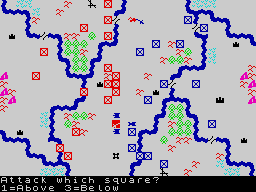
MICRO WARS Fancy yourself as a latter-day Napoleon, staging intergalactic time-travelling battles or controlling the Roman Empire? Stuart Cooke surveys the latest in war games. If you have bit blasted too many aliens for one day, or have got lost in that dratted maze in the new adventure you've bought and are about to see just how well your computer will fly through the window, why not give these 'normal' computer games a rest. Load in a strategy game and find Out just how well you would have run the Roman Empire. Take control of a group of soldiers or travel through lime and fight out battles in outer space or on planets you have never heard off. War games with scenarios similar to the above as well as many others can be found for nearly every micro. Some games will allow you to play against the computer. In others you have to play against a partner: why not have a go at killing your beloved brother, wife etc? In fact buying war games could lead to the end of family arguments as we know them. Whole families could be crowded around the television waiting to see who will win the War of the Roses and settle the latest family feud. Until very recently most of the computer-moderated war games were shipped over from the US. All of these, although of very good quality, tended to be of a very high price. A number of British manufacturers have now produced many excellent packages, all marketed at a price far lower than their American counterparts. This feature will concentrate on products from these companies. One British company who have really made an impact on the war gaming market are Lothlorien. Titles from this company are available fur nearly every machine: Commodores, BBCs, Dragons etc. Most of them seem to make a first appearance on the Spectrum and are converted onto the other machines at a later date. CONVENTIONAL WARRFARE Confrontation is possibly one of the most popular games from this Stockport-based company. This is a two player game of conventional 20th century warfare. One player controls the Blue forces and the other player the Red. One nice feature of this game is the option to play on a black and white TV set. If you wish to play in black and white, the pieces of the player on the left hand side of the screen are shown in inverse to make them distinguishable from those of his opponent. Each player takes control of a number of forces. The forces consist of mobile units made up of tanks, mechanised infantry and engineers. Each type of unit has its own particular use, for example it would be of very little use trying to destroy a plane with a paratrooper, but the flak guns can easily inflict damage on enemy aircraft. The playing area is very clear with rivers, mountains, cities, bridges and other useful landmarks displayed. Pieces on the board belonging to each player are only displayed when they are actually being moved, which means that if the players agree not to look at the TV while the enemy is moving you will not know which piece is what type of unit before it is adjacent. All pieces are represented by a little picture when they are being controlled. The number of squares they can be moved and their type are displayed at the bottom of the screen. One of the nicest and fairly original features this game offers is the option to design your own scenario. Once the program has loaded there is no map held in memory and you can load the one supplied by Lothlorien or design one of your own. Map design is very easy: the cursor keys are used to move a cursor around the playing area and the designer can place cities, rivers, mountains etc by pressing the appropriate key. Because the map can be designed by the user there are no set victory conditions. You can play until all forces have been destroyed for a set number of moves, until a particular point is captured; in fact the list of possibilities is almost endless. Since the finishing conditions are left to the players a game could last five minutes, five hours, or until you wish to end. Confrontation is an excellent game, available on a number of popular micros. Because the scenario is left up to the player it is an ideal program for both beginner and expert war gamer. ZAP THE YANKEES Johnny Reb is another popular game produced by Lothlorien. This game can be played against another player or the computer. On the Commodore 64 version you can even get the computer to take both sides. The game is set in the American Civil War and is a fairly small skirmish at a river crossing between the Union and Confederate forces. To win at this game you must capture the enemy's flag. though it is possible to set a limit upon the number of possible moves, the winner being the person (computer) who has scored the most hits against the enemy. Unfortunately, this game lacks some of the polish you find in Confrontation. Numbers surround the playing area making it easy to judge distances when moving but making the display very messy. The only symbols found on the map other than the various pieces controlled by each player are the river, marshland, forest and a bridge. None of these graphics is used very well and the video display seems to lack a great amount of interest. Each player is supplied with a number of playing pieces. These have differing movement and fighting capabilities, depending on what they represent. Artillery pieces are the only ones that can fire at the enemy from a distance. Unfortunately you can only shoot in eight directions and therefore have to be fairly close to, or in line with, the enemy or the shot disappears off the screen before you can hit him. It would have been nice to be able to select your target by moving a cursor around to point at the destination square. First impressions led me to believe that this was a very simple and boring game. After a few sessions at the keyboard, however, I found there was a lot more to it than you would expect. To start with, a lot of forward planning is required so you can line yourself up with the enemy to shoot at him face to face. Secondly, you must make sure that whenever you do move one of your pieces you are not placing your man in the firing line of the enemy's guns. Even though the graphics of this game are simple. and it is simple to understand, a lot of skill is required. It will take quite a while before you can totally master the game, if ever. This program is also a little slow - you get the impression that when the computer is playing one of the sides and you are waiting for it to use some of its artillery fire against your men you could have overrun the whole of its army and returned home to your farmstead. LEGIONS ON THE MARCH ASP Software is another firm which has begun to put a lot of strategy games on the market. Their latest release is The Fall of Rome, another game available for most popular micros. The outside cover for this game states that you are supplied with a Free Colour Map, so you open up the box expecting to find some painstakingly drawn map of the Roman Empire only to find that the printed instructions are larger than the map. Don't go fixing the free map to your bedroom wall, you'll only lose it and it comes in very handy when playing the game. The Fall of Rome bears a slight resemblance to the well worn Dictator type of game. Each game turn you have to enter the number of legions you wish to buy and maintain in each area of the Empire. Income varies from region to region and the presence of unfriendly tribes will reduce it. This games goes a step further than the normal buy or sell that you normally have to do in a Dictator game in that you are allowed to move your men around. During the movement phase you can move your forces into any neighbouring province. Once you have moved the computer will move the enemy tribes. By moving to an area controlled by the enemy you can fight against him. Even though the graphics are good and the responses to input faster than on some other games The Fall of Rome does not give you the feeling that you are actually in control. If you had a little more control of how each legion fought then you would have a better game. Instead you get the impression that you are having an exercise in entering numbers. HEAVY METAL Kriegspiel from Beyond Software runs on the Dragon 32 and is one of the few games around that exploits graphic facilities to the full. The scenario puts you in control of a heavy tank division. You have the option of your opponent either being another player or the computer. Whoever plays, the object of the game is to capture the other player's city HQ. All the action takes place on a high resolution map that scrolls around the screen, which means that the battlefield is actually much bigger than the small area you can see. Three different maps are supplied with the game, and it is very simple to choose the one you wish to use. Each player is put in control of 15 pieces. These consist of four heavy tanks, five light tanks and six infantry. It is possible to increase the number of playing pieces up to 25, after every round the player in control of the most friendly towns will gain extra men. It is possible to enter all of your moves by either the keyboard or by using a joystick. Use of a joystick makes all entries to the computer very quick and speeds up play considerably. Probably one of the most original aspects of this game is the way in which the weather affects play. It's realistic - and very annoying. You just think that you are about to make a surprise attack on an enemy when it begins to rain and you find all your powers of movement halved. If it snows, for example, your movement is halved and you have no transport. The instructions supplied with the game are very clear, therefore a beginner to war games should soon be playing. So that you can tell which area is which on the map a key is given on the instructions; remember it's a lot harder to move through a forest than through a desert. This is a very well-presented game and its clear, colourful graphics should appeal to everyone. If you are a Dragon owner then you should buy this game just so that you can see what your machine is really capable of. For those of us who don't own a Dragon, would Beyond please bring out versions for other machines. Probably one of the most popular war games that you can buy is Apocalypse from Games Workshop. Red Shift are producing the computer game version of Apocalypse under licence. WORLD WAR III If you are one of those unfortunate people who have never played Apocalypse then the subtitle given to the game should give you the whole story: The Game Of Nuclear Devastation. You are told, however, that use of nuclear weapons could cause a catastrophic chain reaction. Apocalypse allows between one and four players to take part, however, if only one player is involved he will have to take two sides, the computer will not play against you. Each player is given a certain amount of power points, the number he gets depending on how many centres he occupies and the type of land that his centre is on. There are three different maps provided with the game for your warfare to take place upon. These maps cover areas such as Britain, Europe and London. Red Shift have realised the potential of this game and are producing expansion cassettes containing more maps. Expansion maps cover areas such as US, Galactic, Napoleon's Campaigns and War in the Pacific. The BBC version does not yet have all the expansion packs available. The maps used in Apocalypse cover most of the screen and are very clear. The map shows all the occupied areas and under which player's control they are. When making moves it is possible to move a cursor around the screen and an exploded view of the cursor position is given, showing which forces are situated there. This is very easy to use but tends to be a little slow and it is easy to forget which forces you have where, it's a law playing area to try to find out every time. The only 'major' flaw in this game was found in the BBC version. The symbol of each of the players is positioned on any area he owns. Quite regularly the background colour was the same as the character's piece making it difficult to see exactly who was in control of the square. Apocalypse is a very involved game and it will take quite a time for a beginner to master play. The instructions are good and clear and give examples wherever possible. The fact that you can purchase extra maps should add to the length of time before this game is put on the shelf and forgotten about. 25TH CENTURY RAIDERS Rebelstar Raiders comes from the same stable as Apocalypse. This game takes place in the 25th century. You are given three different scenarios: Moonbase, Starligdale and the Final Assault. Two players are needed to play, each having control of between 20 to 30 characters. Every character in this game has his/its own name and weapon and characteristics. All inputs to the computer are very easy. To get information on a particular character all you need to do is place the cursor over the player in question and press the I key. If you wish to find out about the character's weapon you press the P key. Because each of the maps is different, the victory conditions differ although a specific object has to be destroyed or protected in each of them. This is a game that you need at least an hour to play, but it is worth it when you guide one of your men around a corner and blast three of your opponent's men into little pieces. Rebelstar Raiders is a challenging and very enjoyable game.
Crash #4May 1984 · p.6845%
Overall 45%
Producer: Lothlorien, 48K £7.95 (3) This is a wargame for two players versus each other, you can't play against the computer. There is a master program to which various scenarios may be added, one is includded with the game, but the others will become available later. Each player is given 12 various units which he may move across the map and which include many modern equivalents that may be omitted if playing a game set in an earlier period. Like most other Lothlorien war games, each player must move all his units in turn and by one square. This makes it a long and involved game unlikely to appeal to anyone except wargame addicts. The screen is very crowded and the symbols are hard to read without practice, the graphics are slow because of the BASIC in which the program is written. Overall CRASH rating 45%
Crash #3Apr 1984 · p.8250%45%37%43%50%42%45%
Use of Computer 50%
Graphics 45%
Playability 37%
Getting Started 43%
Addictive Qualities 50%
Value For Money 42%
Overall 45%
Unknown
Unknown
Unknown
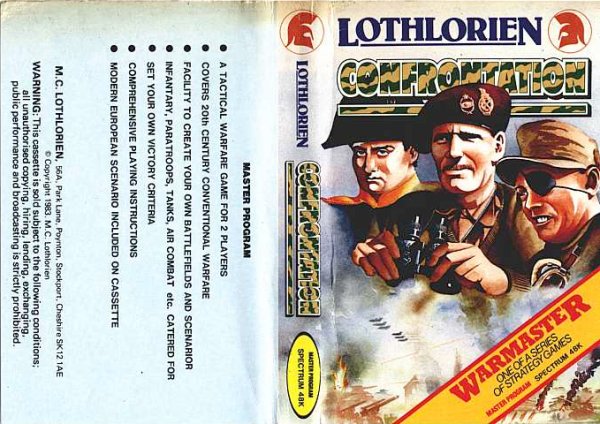
Producer: MC Lothlorien Memory Required: 48K Retail Price: £7.95 Language: Basic Author: R. T. Smith This game comes excellently pacakaged in a plastic snap shut case, but the cover picture is a little misleading, or rather odd anyway, a montage of Napolean, Montgomery and Rommel, yet the game is a modern scenario - Napoleon never saw tanks, Monty and Rommel weren't all to familiar with jet fighter aircraft either! 14 pages of instructions accompany the tape and are essential reading before play. In most respects, this game follows the usual pattern of Lothlorien war games where two players (in this case, rather than one against the computer) are each given 12 various units to move about the battlefield until they encounter an enemy unit. This scenario is made more complex by the addition of various air forces, however units may only move one square per turn, so having aircraft doesn't mean zipping about the place any faster. Units include; tanks, mechanised infantry, flak, anti-tank guns, scouts, infantry, artillery, paratroopers, fighter planes, ground attack planes and transport planes onto which paratroopers may be embarked, and from which they may jump. Other elements are; airfields, bridges, cities, forts, hills, mountains, marshes, towns and woods. There is a master program on the tape which offers you the opportunity of then loading an already saved scenario. You may also redesign the terrain and alter the content of the units. After the master programme comes a preprogrammed scenario called 'Twin River'. COMMENTS Control keys: many keys Keyboard play: Input commands taken rapidly, but general processing of commands takes time Colour: quite well used Graphics: generally poor Sound: very rare
Micro Adventurer #4Feb 1984 · p.23
SC
VARIETY IN WAR GAME SCENARIOS MICRO: Spectrum 48K PRICE: £7.95 FORMAT: Cassette SUPPLIER: MC Lothlorien, [redacted] Having already sampled Lothlorien's wares in the form of Johnny Reb I jumped at the chance of trying out one of their latest offerings, Confrontation. This is basically a design-your-own-battle package and will do for wargaming what The Quill has done for text adventures. After loading, the screen displays the seven options available, which include all the necessary routines to enable you to set up and play almost any 20th century battle you can think of. The final option allows you to load a pre-designed scenario from tape and they have, thoughtfully, included one. Entitled Two Rivers it is a land and air battle revolving around the sovereignty of six cities three of which, initially, are controlled by each side. Most movement commands can be entered by the cursor keys, which is a welcome simplification. This is not the type of game where you play against the computer. It is specifically designed for two humans (remember them? They used to live here before we got computers) to sit down and settle their differences on a battlefield. The two armies are depicted as red and blue forces, along very similar lines to those used by the British Army on manoeuvres. Unit types are only shown when typing in orders or when actually engaged in combat. Your opponent might know the position of your forces but cannot know what they are until he meets them in battle. This tends to resemble the secrecy one might find in real warfare, which lends itself to some highly tactical play. For setting up your scenario the package caters for all types of terrain, dwelling and arms, except nuclear, which is understandable. The cassette is value for money and comes in a sturdy case with clear instructions. My review copy had a couple of small bugs but I expect these will have been ironed out in the finished version.
Advert17
- Big K #8Nov 1984 · p.80
- C&VG (Computer & Video Games) #35Sep 1984 · p.20
- Big K #5Aug 1984 · p.17
- Crash #5Jun 1984 · p.10
- Sinclair User #26May 1984 · p.91
- C&VG (Computer & Video Games) #31May 1984 · p.115
- Computer Answers #15Apr 1984 · p.26
- C&VG (Computer & Video Games) #30Apr 1984 · p.90
- Big K #1Apr 1984 · p.104
- Games ComputingApr 1984 · p.25
- Micro Adventurer #6Apr 1984 · p.32
- Sinclair User #25Apr 1984 · p.57
- Sinclair User #24Mar 1984 · p.133
- C&VG (Computer & Video Games) #29Mar 1984 · p.90
- Your Computer #3Mar 1984 · p.127
- Sinclair User #23Feb 1984 · p.89
- Sinclair User #21Dec 1983 · p.39
News/Note4
- ZX Computing #27Jul 1986 · p.7
- Micro Adventurer #10Aug 1984 · p.7
- Micro Adventurer #9Jul 1984 · p.6
- Micro Adventurer #3Jan 1984 · p.6
Feature3
- Crash #9Oct 1984 · p.76
- Micro Adventurer #9Jul 1984 · p.24
- Computer Answers #15Apr 1984 · p.23
Letters1
- Crash #10Nov 1984 · p.32
Review1
- TV GamerAug 1984 · p.55
Related
- Ports
- (BBC Micro)
- Same entry at
- Spectrum ComputingZXInfo
Reviews from people here
Sign in to write about this, or make an account. It takes a minute and lets you correct the catalogue too.
Everything ZXDB can hold about this is here.
Sign in to correct or add to this.
Hold the rights to this and want it taken down?